
Outdoor Leadership Nature Bound Workshop Series 12 Elements

Outdoor Leadership Nature Bound Workshop Series
12 Elements of an Outdoor Leader • • • Technical Skills Safety Skills Environmental Ethics Organizational Skills Instructional Skills Facilitation Skills Professional Ethics Leadership Style Experienced-based judgment Problem-Solving Decision-Making Skills Communication Skills
12 Elements of an Outdoor Leader • Technical Skills – Being competent in the actual adventure (i. e. being able to climb to a certain level or being able to paddle at a particular grade or class) • Safety Skills – Being able to enjoy the activity in a safe and prudent manner. But also having the necessary skills to recognize and handle emergencies that may arise

12 Elements of an Outdoor Leader • Environmental Skills & Organizational Skills – Having the ability to plan, prepare and execute activities for the specific needs of your group as well as knowledge and competencies to be able to prevent environmental damage. • Instructional & Facilitation Skills – Having the ability to teach or introduce “moments of learning” as well as work with a group to debrief and event. Understanding group dynamics and enabling others to overcome challenges.
12 Elements of an Outdoor Leader • Professional Skills – Adhering to the moral standards and value systems that are demanded of outdoor/adventure programming. • Communication Skills –Understanding the process of communication and being able to facilitate communication among your participants. • Leadership Styles – Be able to recognize the different types of leadership styles and use the most appropriate style for the situation
12 Elements of an Outdoor Leader • Problem Solving & Decision Making Skills – Having the ability to recognize problems and work effectively to solve them. Be able to determine the appropriate course of action among multiple options given the conditions. • Experienced-based Judgment – Be able to rely on past experiences, use sound judgment to determine the best course of action.
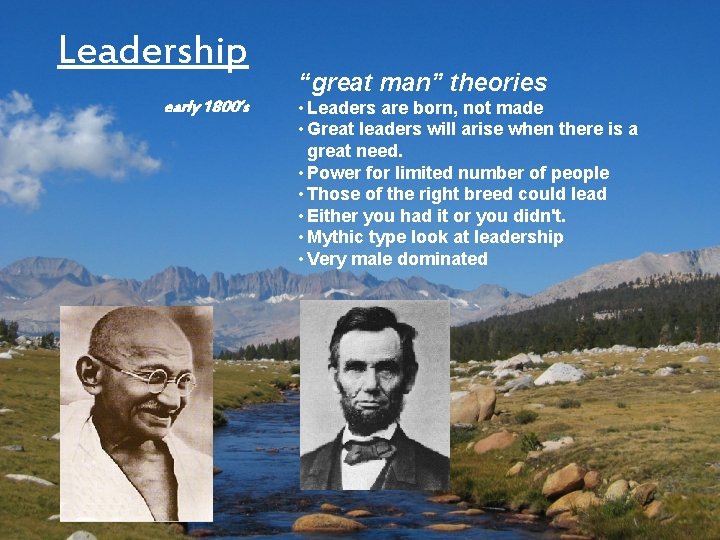
Leadership early 1800’s “great man” theories • Leaders are born, not made • Great leaders will arise when there is a great need. • Power for limited number of people • Those of the right breed could lead • Either you had it or you didn't. • Mythic type look at leadership • Very male dominated
Leadership mid 1900’s Trait theory • People are born with inherited traits. • Some traits are particularly suited to leadership • People who make good leaders have the right (or sufficient) combination of traits. • Universal traits common to all leaders Intelligent Behavior theory • Leaders can be made, rather than are born. • Successful leadership is based in definable, learnable behavior. • Look at what leaders “do” • Implication: Can be taught Charismatic feet smell like roses
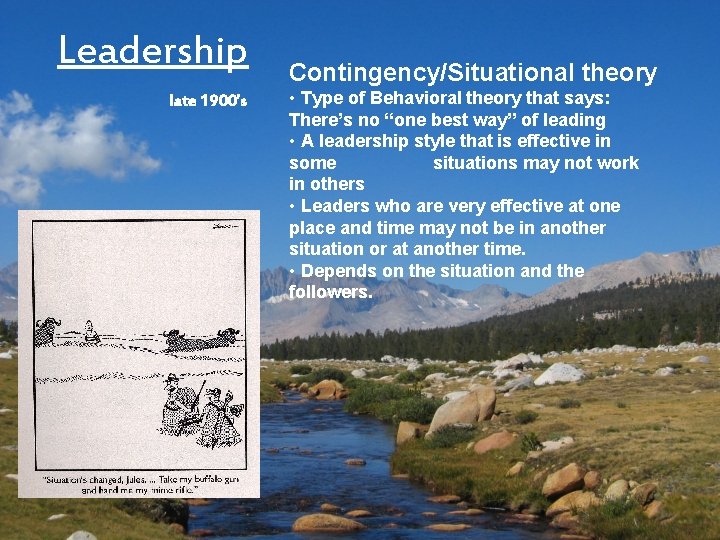
Leadership late 1900’s Contingency/Situational theory • Type of Behavioral theory that says: There’s no “one best way” of leading • A leadership style that is effective in some situations may not work in others • Leaders who are very effective at one place and time may not be in another situation or at another time. • Depends on the situation and the followers.
Leadership present day Transactional leadership • People are motivated by reward and punishment. • Social systems work best with a clear chain of command. • All authority goes to the manager. • The prime purpose of a subordinate is to do what their manager tells them to do. • “Telling” vs. “Selling” Transformational leadership • People will follow a person who inspires them. • A person with vision and passion can achieve great things. • The way to get things done is by injecting enthusiasm and energy. • Vision Selling the Vision Determining the Path Leading the Way • Enroll others in their vision
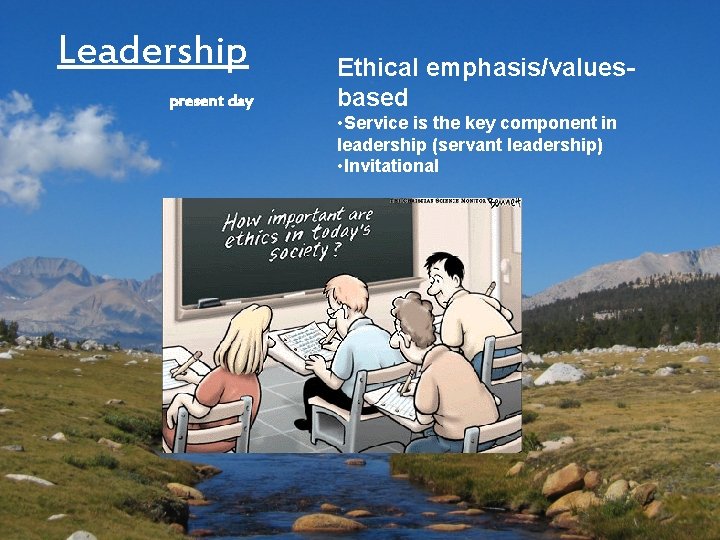
Leadership present day Ethical emphasis/valuesbased • Service is the key component in leadership (servant leadership) • Invitational
- Slides: 12