
OUTDOOR Air Pollution Also known as Ambient Air
OUTDOOR Air Pollution Also known as “Ambient Air Pollution”
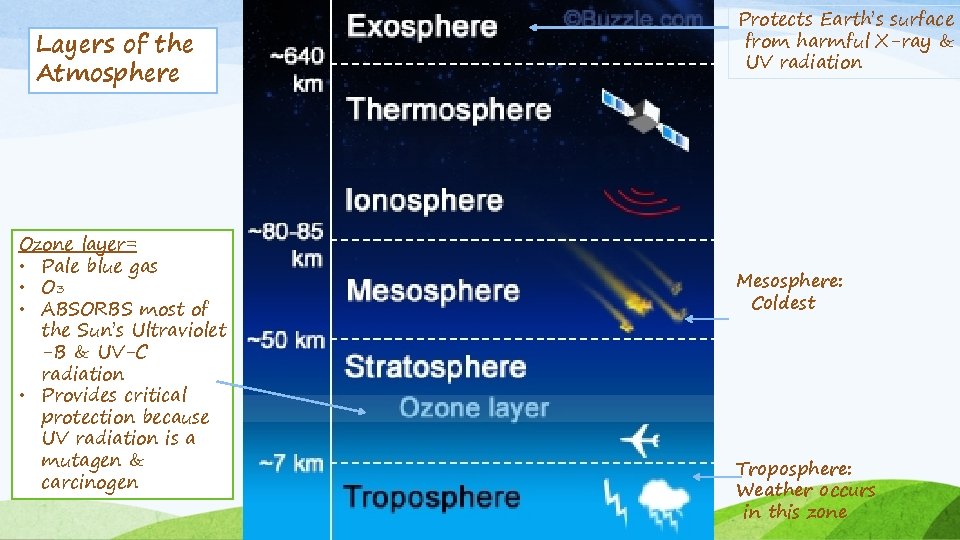
Layers of the Atmosphere Ozone layer= • Pale blue gas • O 3 • ABSORBS most of the Sun’s Ultraviolet -B & UV-C radiation • Provides critical protection because UV radiation is a mutagen & carcinogen Protects Earth’s surface from harmful X-ray & UV radiation Mesosphere: Coldest Troposphere: Weather occurs in this zone
• Air pollution= refers to pollution in the troposphere, the first 16 km (10 miles) of the atmosphere • Sometimes called ground-level pollution • Natural sources of air pollution • Volcanoes & fires • Anthropogenic sources • Automobiles & factories • Air pollution is a global system • LV smog some of it blows in from California • Acidic rainfall on West Coast air pollution in Asia
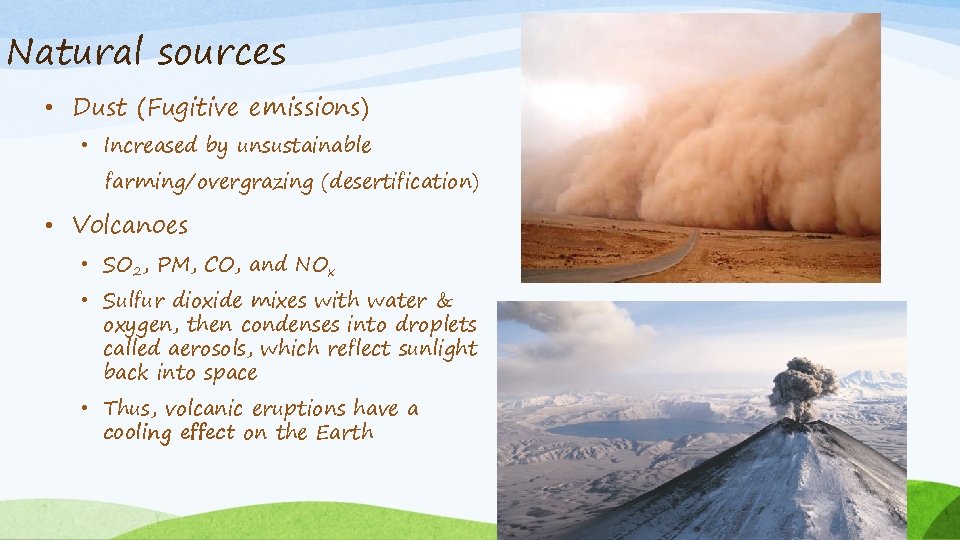
Natural sources • Dust (Fugitive emissions) • Increased by unsustainable farming/overgrazing (desertification) • Volcanoes • SO 2, PM, CO, and NOx • Sulfur dioxide mixes with water & oxygen, then condenses into droplets called aerosols, which reflect sunlight back into space • Thus, volcanic eruptions have a cooling effect on the Earth
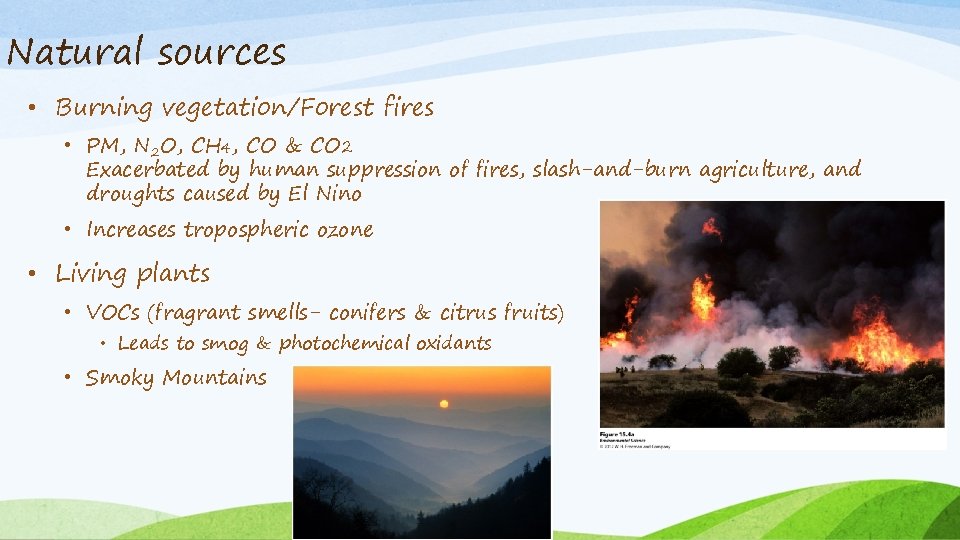
Natural sources • Burning vegetation/Forest fires • PM, N 2 O, CH 4, CO & CO 2 Exacerbated by human suppression of fires, slash-and-burn agriculture, and droughts caused by El Nino • Increases tropospheric ozone • Living plants • VOCs (fragrant smells- conifers & citrus fruits) • Leads to smog & photochemical oxidants • Smoky Mountains

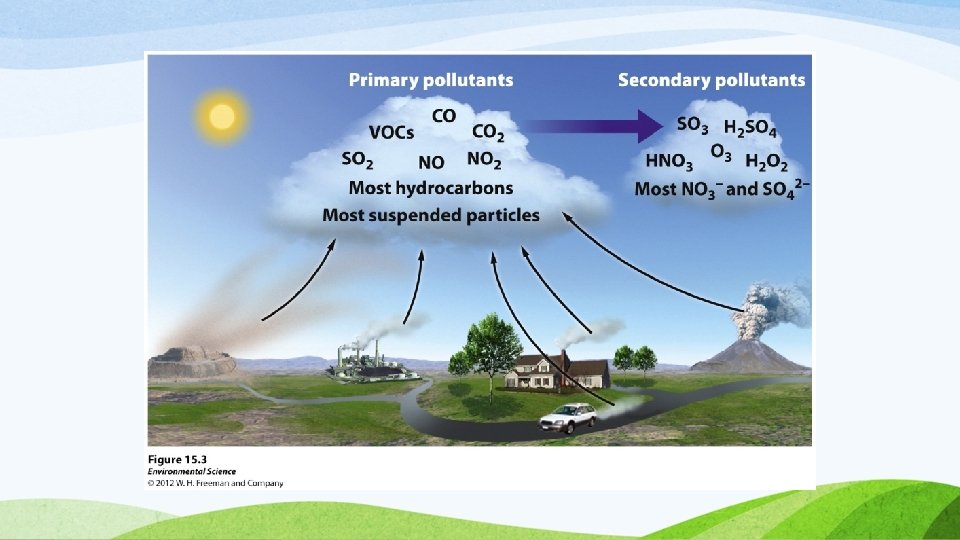
Types of air pollutants • Primary pollutants • Pollutants emitted into troposphere in a form that can be directly harmful or that can react to form harmful substances. • Examples: particulate matter (soot), CO 2, SO 2, NOx • Secondary pollutants • Harmful substances produced when primary pollutants interact or react with constituents of the atmosphere • Occur more rapidly during day due to sunlight • Examples: tropospheric ozone and nitric/sulfuric acid (acid deposition)
Air is a Global Commons • U. S. Clean Air Act of 1970 • Set strict standards for air quality • Imposed limits on emissions from stationary and mobile sources (factories, automobiles) • Provided funds for pollution-control research • Enabled citizens to sue parties violating air standards • Amended in 1977
Air is a Global Commons • U. S. Clean Air Act of 1990 • Strengthened regulations on • Air quality standards, auto emissions, toxic air pollution, acidic deposition, and stratospheric ozone depletion • Businesses & utilities were allowed to buy, sell, or trade their permits for emitting pollutants • Each year the overall amount of allowable pollution was decreased • Helped reduce sulfur dioxide emissions
Air is a Global Commons • As a result of Clean Air Act, The EPA sets nationwide standards for emissions of pollutants • EPA must specify allowable concentrations of each pollutant • It is up to the State to monitor air quality & develop, implement & enforce regulations (states submit plan to EPA for approval) • EPA identified 6 pollutants that significantly threaten human well-being, ecosystems and/or structures • Known as CRITERIA POLLUTANTS: • SO 2, NO 2, CO, PM, Tropospheric Ozone, Lead • CO 2 added to list in 2007 by US Supreme Court hearing
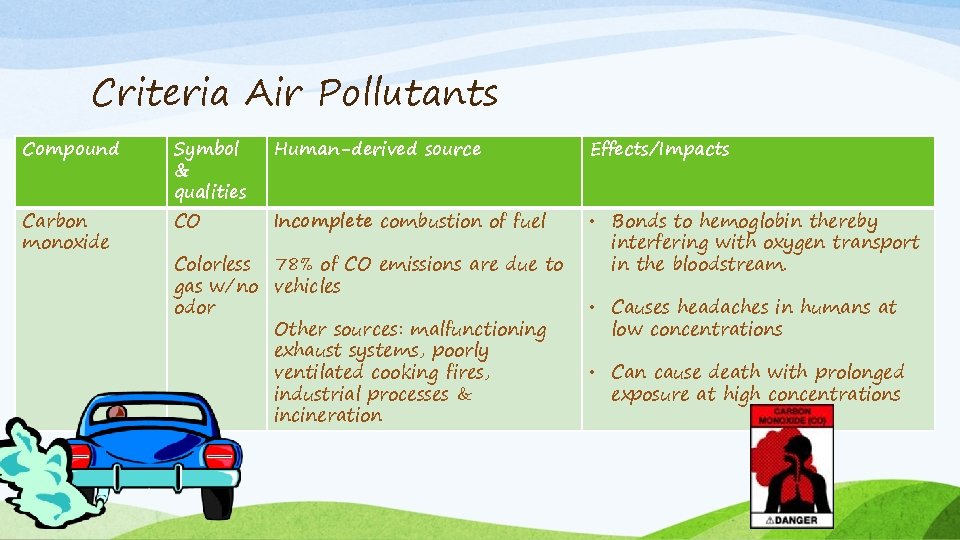
Criteria Air Pollutants Compound Carbon monoxide Symbol & qualities CO Human-derived source Effects/Impacts Incomplete combustion of fuel • Bonds to hemoglobin thereby interfering with oxygen transport in the bloodstream. Colorless 78% of CO emissions are due to gas w/no vehicles odor Other sources: malfunctioning exhaust systems, poorly ventilated cooking fires, industrial processes & incineration • Causes headaches in humans at low concentrations • Can cause death with prolonged exposure at high concentrations
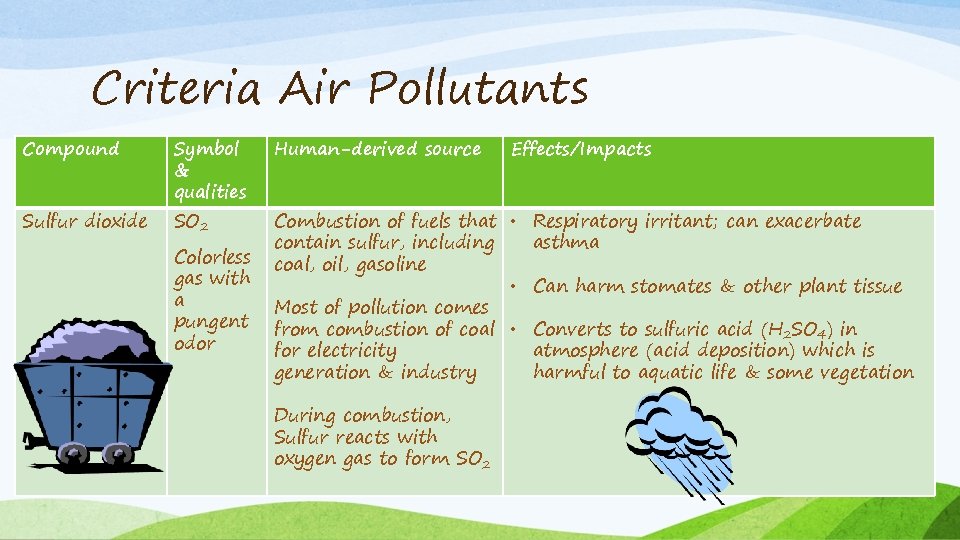
Criteria Air Pollutants Compound Sulfur dioxide Symbol & qualities SO 2 Colorless gas with a pungent odor Human-derived source Effects/Impacts Combustion of fuels that • Respiratory irritant; can exacerbate contain sulfur, including asthma coal, oil, gasoline • Can harm stomates & other plant tissue Most of pollution comes from combustion of coal • Converts to sulfuric acid (H 2 SO 4) in for electricity atmosphere (acid deposition) which is generation & industry harmful to aquatic life & some vegetation During combustion, Sulfur reacts with oxygen gas to form SO 2
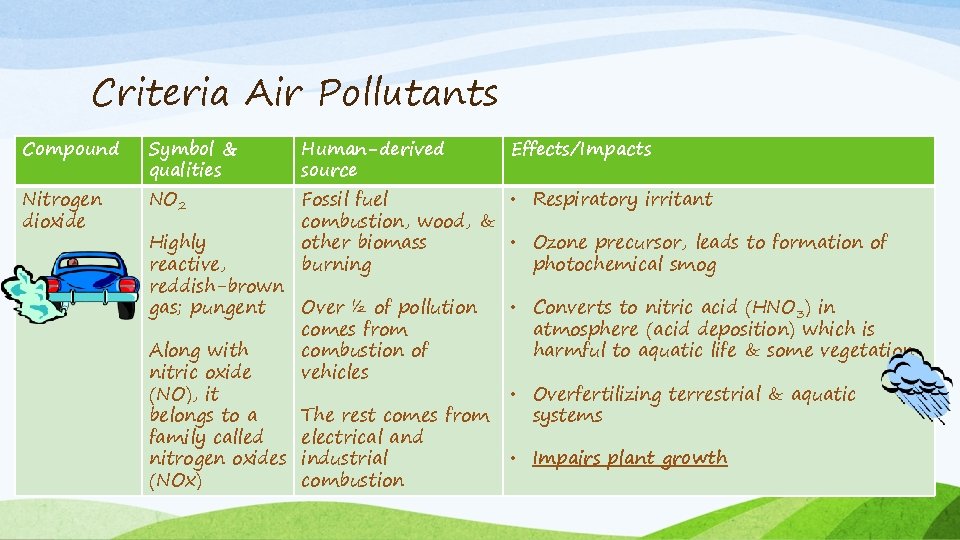
Criteria Air Pollutants Compound Nitrogen dioxide Symbol & qualities NO 2 Human-derived source Effects/Impacts Fossil fuel • Respiratory irritant combustion, wood, & other biomass • Ozone precursor, leads to formation of burning photochemical smog Highly reactive, reddish-brown gas; pungent Over ½ of pollution comes from Along with combustion of nitric oxide vehicles (NO), it belongs to a The rest comes from family called electrical and nitrogen oxides industrial (NOx) combustion • Converts to nitric acid (HNO 3) in atmosphere (acid deposition) which is harmful to aquatic life & some vegetation • Overfertilizing terrestrial & aquatic systems • Impairs plant growth
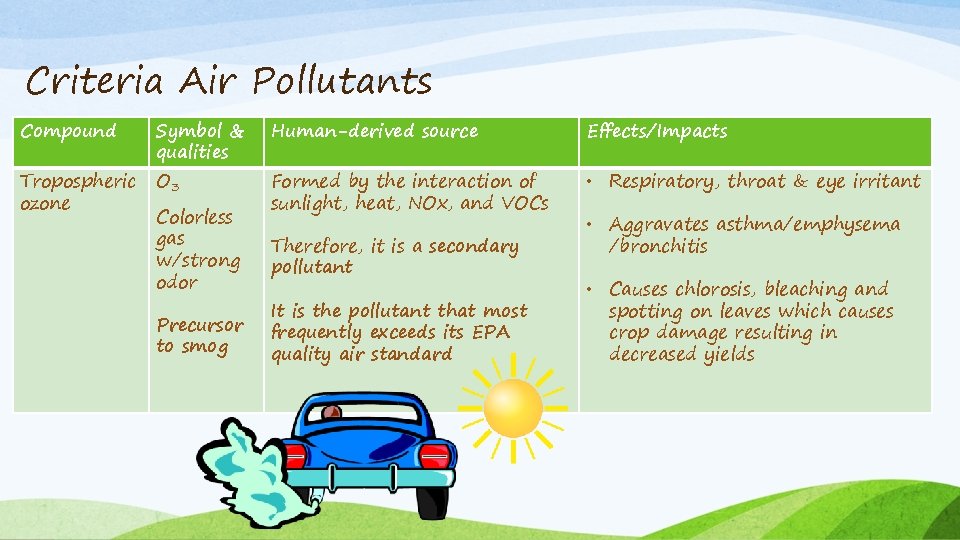
Criteria Air Pollutants Compound Tropospheric ozone Symbol & qualities O 3 Colorless gas w/strong odor Precursor to smog Human-derived source Effects/Impacts Formed by the interaction of sunlight, heat, NOx, and VOCs • Respiratory, throat & eye irritant Therefore, it is a secondary pollutant It is the pollutant that most frequently exceeds its EPA quality air standard • Aggravates asthma/emphysema /bronchitis • Causes chlorosis, bleaching and spotting on leaves which causes crop damage resulting in decreased yields
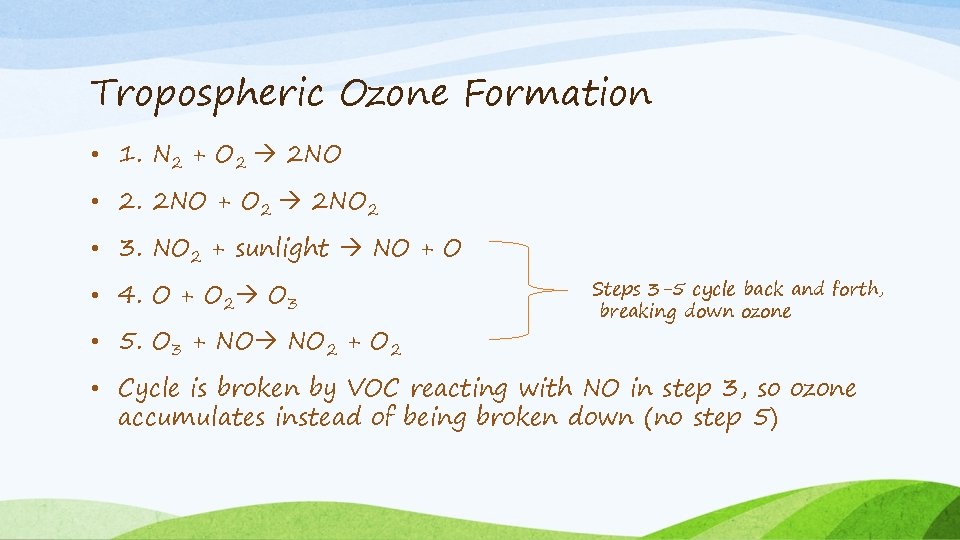
Tropospheric Ozone Formation • 1. N 2 + O 2 2 NO • 2. 2 NO + O 2 2 NO 2 • 3. NO 2 + sunlight NO + O • 4. O + O 2 O 3 • 5. O 3 + NO NO 2 + O 2 Steps 3 -5 cycle back and forth, breaking down ozone • Cycle is broken by VOC reacting with NO in step 3, so ozone accumulates instead of being broken down (no step 5)

Formation of ozone & smog PANs
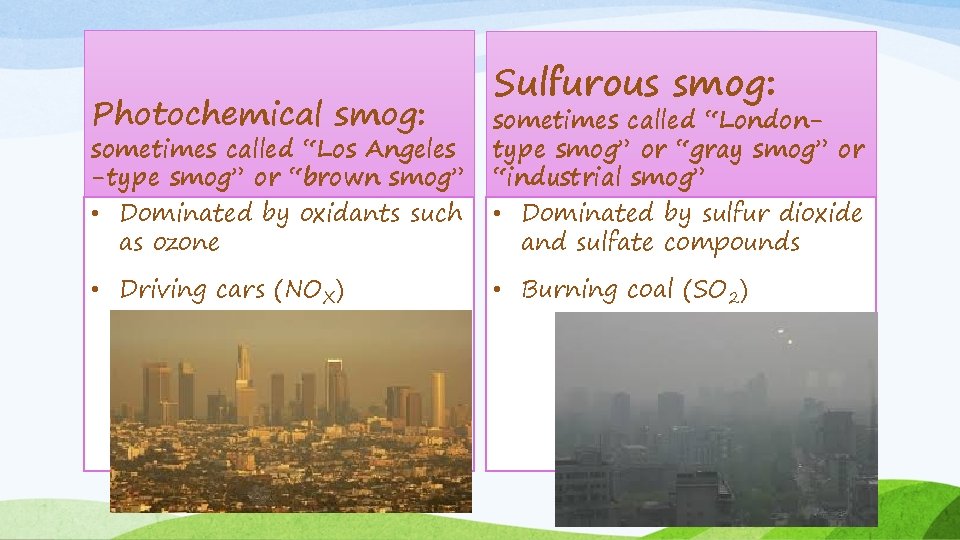
Photochemical smog: Sulfurous smog: sometimes called “Los Angeles -type smog” or “brown smog” sometimes called “Londontype smog” or “gray smog” or “industrial smog” • Driving cars (NOX) • Burning coal (SO 2) • Dominated by oxidants such as ozone • Dominated by sulfur dioxide and sulfate compounds
Photochemical Smog • Occurs more often on hot, sunny, windless days in urban areas • Exhaust from traffic release large amounts of NO and VOCs • Sunlight then promotes the production of ozone • Levels of photochemical pollutants typically peak in midafternoon & can irritate people’s eyes, noses & throat
Smog Check • A smog check is a test done on the exhaust system of a motor vehicle to determine how many pollutants, and of which type, the vehicle is emitting. • It also includes an assessment of other parts of the vehicle to make sure that they are in working order, especially those parts which pertain to emissions control.
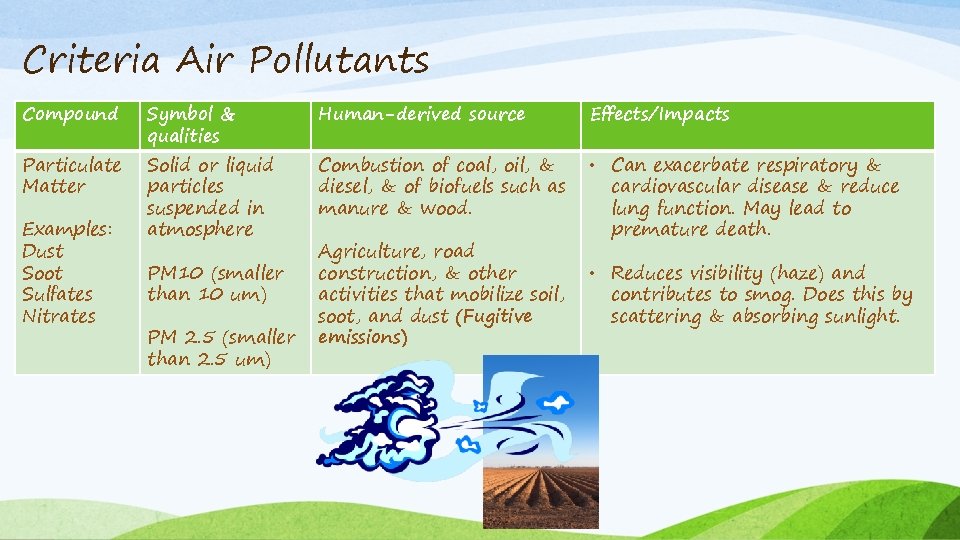
Criteria Air Pollutants Compound Particulate Matter Examples: Dust Soot Sulfates Nitrates Symbol & qualities Solid or liquid particles suspended in atmosphere PM 10 (smaller than 10 um) PM 2. 5 (smaller than 2. 5 um) Human-derived source Effects/Impacts Combustion of coal, oil, & diesel, & of biofuels such as manure & wood. • Can exacerbate respiratory & cardiovascular disease & reduce lung function. May lead to premature death. Agriculture, road construction, & other activities that mobilize soil, soot, and dust (Fugitive emissions) • Reduces visibility (haze) and contributes to smog. Does this by scattering & absorbing sunlight.
O 3 Criteria Air Pollutants Compound Lead Symbol & qualities Pb Human-derived source Effects/Impacts Gasoline additive (improved engine performance), oil and gasoline, coal, old paint • Enters food chain (bioaccumulation & biomagnification) Phased out in 1970 s Today greatest source is in developing countries in industrial smelting. They also still add lead to their gasoline • Impairs nervous system (neurotoxin) • At low concentrations, can have measurable effects on learning & ability to concentrate
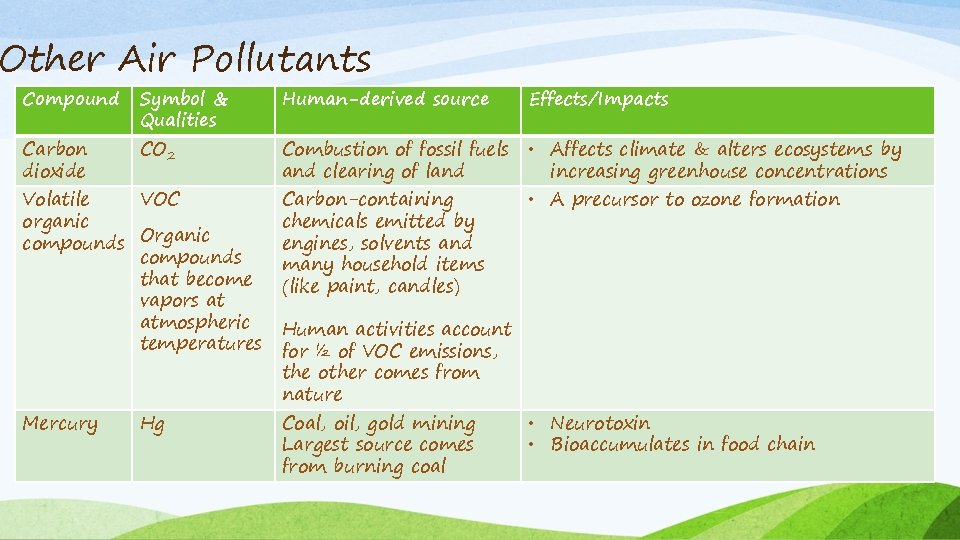
Other Air Pollutants Compound Carbon dioxide Symbol & Qualities CO 2 Volatile VOC organic compounds Organic compounds that become vapors at atmospheric temperatures Mercury Hg Human-derived source Effects/Impacts Combustion of fossil fuels and clearing of land • Affects climate & alters ecosystems by increasing greenhouse concentrations Carbon-containing chemicals emitted by engines, solvents and many household items (like paint, candles) Human activities account for ½ of VOC emissions, the other comes from nature Coal, oil, gold mining Largest source comes from burning coal • A precursor to ozone formation • Neurotoxin • Bioaccumulates in food chain
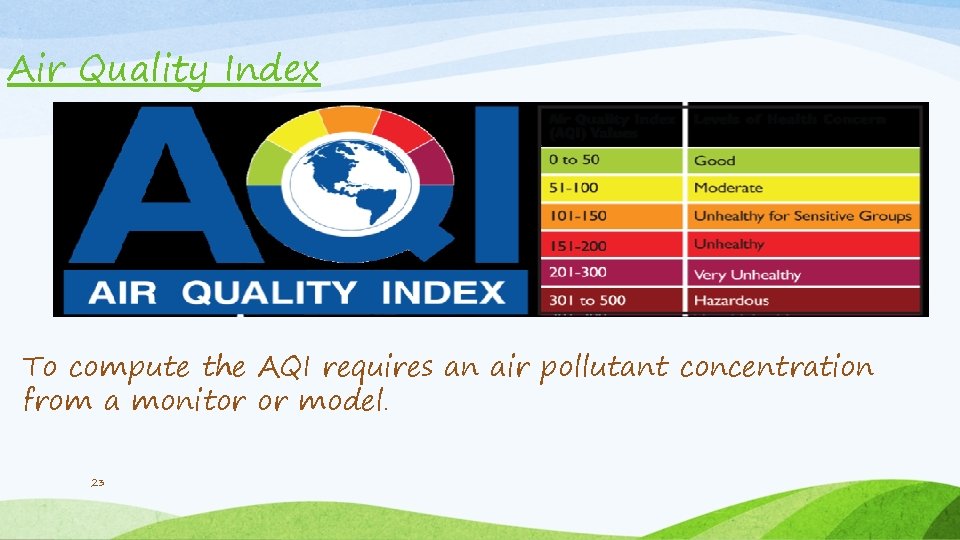
Air Quality Index To compute the AQI requires an air pollutant concentration from a monitor or model. 23
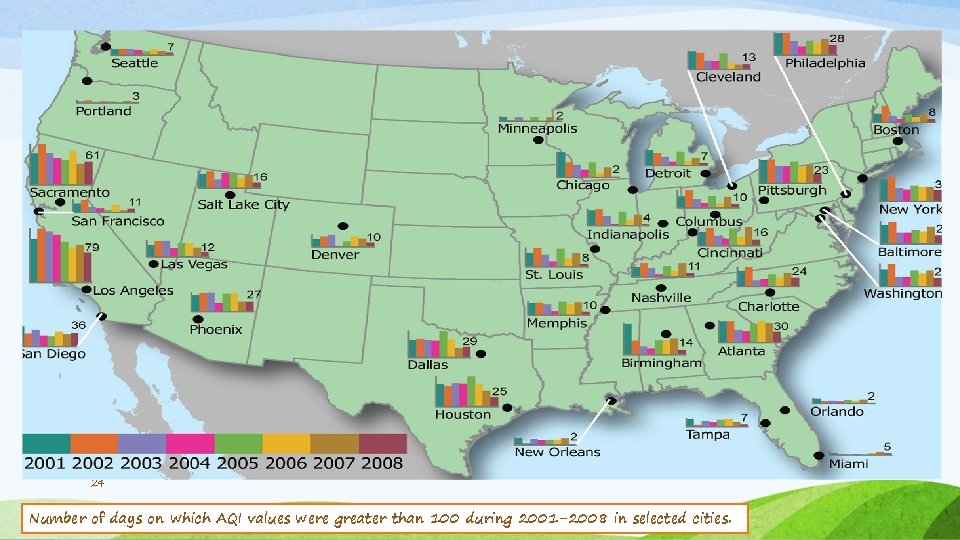
24 Number of days on which AQI values were greater than 100 during 2001 -2008 in selected cities.
Areas with worst Air Pollution • Industrializing (Developing) countries • China • 4 out of 5 cities suffered SO 2 or NO 2 emissions above threshold set by the WHO • Together, China & India suffer 58% of the 1. 8 million premature deaths that occur each year globally due to outdoor air pollution • “Asian Brown Cloud” • A persistent 2 -mile-thick layer of pollution that hangs over the continent due to pollution from southern Asia
Controlling Pollution SMOG REDUCTION: Focus on reducing the sources: SO 2 and NOx
Controlling SOx and NOx Sulfur Dioxide permit-trading program Fluidized bed combustion • • Removes SO 2 from coal exhaust Coal is burned in close proximity to Ca. CO 3 (limestone), which absorbs SO 2 and produces calcium sulfate which can be used in production of sheetrock for houses. Scrubbers Removes SO 2 from coal Uses lime, Ca. O. Ca mixes w/S and it falls to bottom as gypsum Catalytic converter • Installed on automobiles since 1975 • Reduces the amount of NOx and CO emissions • Platinum or palladium used to oxidize N & C • CO CO 2 • NOx N 2
Controlling PM Gravitational settling • Gravity to remove some particles as exhaust travels through smokestack • Ash must be disposed of in landfill Baghouse filters • Allows gases to pass through them but removes PM Electrostatic precipitator • Uses an electrical charge to attract PM Scrubbers • Uses water & air to separate and remove particles from air

Bag filter
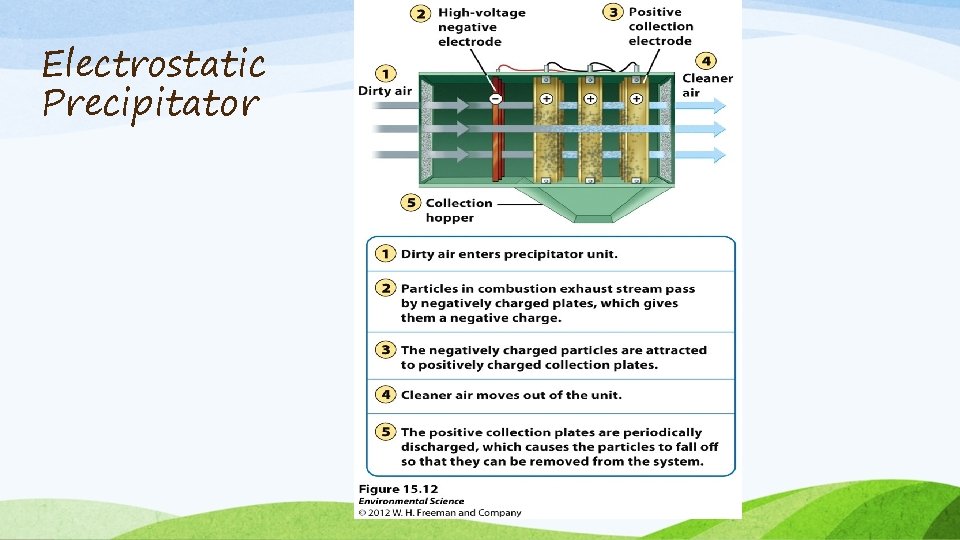
Electrostatic Precipitator
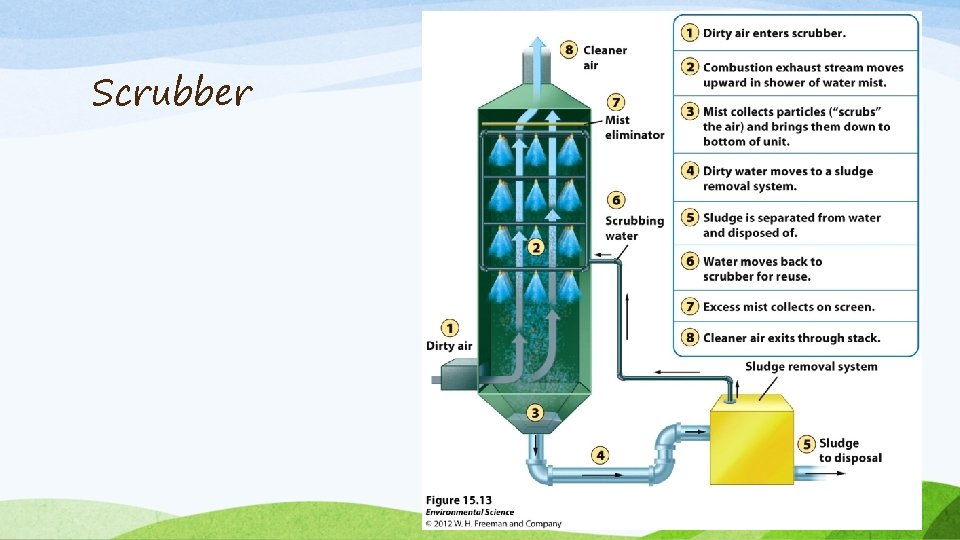
Scrubber
Innovative Pollution Control • Some municipalities have tried to restrict automobile use • Mexico City- only drive every other day • China- 2008 Beijing Olympics, govt. expanded public transportation networks, imposed motor vehicle restrictions & temporarily shut down a number of industries • Carpool lanes, better public transportation, toll roads • Cars responsible for large emissions of NOx and VOCs
- Slides: 32