
Outcomes of patients with cutaneous Tcell lymphoma CTCL
- Slides: 1
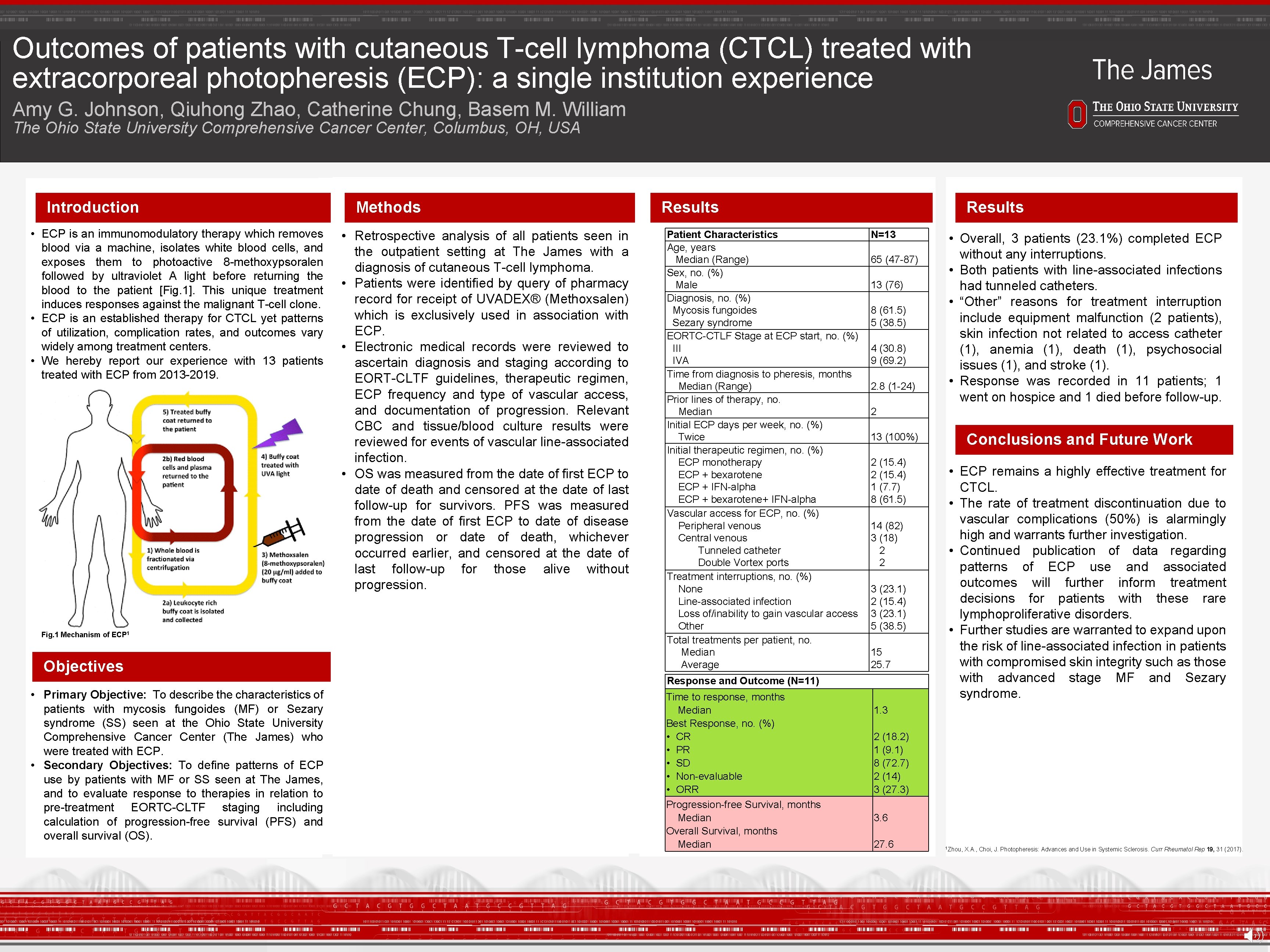
Outcomes of patients with cutaneous T-cell lymphoma (CTCL) treated with extracorporeal photopheresis (ECP): a single institution experience Amy G. Johnson, Qiuhong Zhao, Catherine Chung, Basem M. William The Ohio State University Comprehensive Cancer Center, Columbus, OH, USA Introduction • ECP is an immunomodulatory therapy which removes blood via a machine, isolates white blood cells, and exposes them to photoactive 8 -methoxypsoralen followed by ultraviolet A light before returning the blood to the patient [Fig. 1]. This unique treatment induces responses against the malignant T-cell clone. • ECP is an established therapy for CTCL yet patterns of utilization, complication rates, and outcomes vary widely among treatment centers. • We hereby report our experience with 13 patients treated with ECP from 2013 -2019. Fig. 1 Mechanism of ECP 1 Objectives • Primary Objective: To describe the characteristics of patients with mycosis fungoides (MF) or Sezary syndrome (SS) seen at the Ohio State University Comprehensive Cancer Center (The James) who were treated with ECP. • Secondary Objectives: To define patterns of ECP use by patients with MF or SS seen at The James, and to evaluate response to therapies in relation to pre-treatment EORTC-CLTF staging including calculation of progression-free survival (PFS) and overall survival (OS). Methods • Retrospective analysis of all patients seen in the outpatient setting at The James with a diagnosis of cutaneous T-cell lymphoma. • Patients were identified by query of pharmacy record for receipt of UVADEX® (Methoxsalen) which is exclusively used in association with ECP. • Electronic medical records were reviewed to ascertain diagnosis and staging according to EORT-CLTF guidelines, therapeutic regimen, ECP frequency and type of vascular access, and documentation of progression. Relevant CBC and tissue/blood culture results were reviewed for events of vascular line-associated infection. • OS was measured from the date of first ECP to date of death and censored at the date of last follow-up for survivors. PFS was measured from the date of first ECP to date of disease progression or date of death, whichever occurred earlier, and censored at the date of last follow-up for those alive without progression. Results Patient Characteristics Age, years Median (Range) Sex, no. (%) Male Diagnosis, no. (%) Mycosis fungoides Sezary syndrome EORTC-CTLF Stage at ECP start, no. (%) III IVA Time from diagnosis to pheresis, months Median (Range) Prior lines of therapy, no. Median Initial ECP days per week, no. (%) Twice Initial therapeutic regimen, no. (%) ECP monotherapy ECP + bexarotene ECP + IFN-alpha ECP + bexarotene+ IFN-alpha Vascular access for ECP, no. (%) Peripheral venous Central venous Tunneled catheter Double Vortex ports Treatment interruptions, no. (%) None Line-associated infection Loss of/inability to gain vascular access Other Total treatments per patient, no. Median Average Results N=13 65 (47 -87) 13 (76) 8 (61. 5) 5 (38. 5) 4 (30. 8) 9 (69. 2) 2. 8 (1 -24) 2 Conclusions and Future Work 13 (100%) 2 (15. 4) 1 (7. 7) 8 (61. 5) 14 (82) 3 (18) 2 2 3 (23. 1) 2 (15. 4) 3 (23. 1) 5 (38. 5) 15 25. 7 Response and Outcome (N=11) Time to response, months Median Best Response, no. (%) • CR • PR • SD • Non-evaluable • ORR Progression-free Survival, months Median Overall Survival, months Median • Overall, 3 patients (23. 1%) completed ECP without any interruptions. • Both patients with line-associated infections had tunneled catheters. • “Other” reasons for treatment interruption include equipment malfunction (2 patients), skin infection not related to access catheter (1), anemia (1), death (1), psychosocial issues (1), and stroke (1). • Response was recorded in 11 patients; 1 went on hospice and 1 died before follow-up. • ECP remains a highly effective treatment for CTCL. • The rate of treatment discontinuation due to vascular complications (50%) is alarmingly high and warrants further investigation. • Continued publication of data regarding patterns of ECP use and associated outcomes will further inform treatment decisions for patients with these rare lymphoproliferative disorders. • Further studies are warranted to expand upon the risk of line-associated infection in patients with compromised skin integrity such as those with advanced stage MF and Sezary syndrome. 1. 3 2 (18. 2) 1 (9. 1) 8 (72. 7) 2 (14) 3 (27. 3) 3. 6 27. 6 1 Zhou, X. A. , Choi, J. Photopheresis: Advances and Use in Systemic Sclerosis. Curr Rheumatol Rep 19, 31 (2017).