
Outcomes for patients undergoing TIPS insertion at KUMC
- Slides: 29
Outcomes for patients undergoing TIPS insertion at KUMC since 01 -JAN-2010 Samantha King, Jill Jones MD, Russ Waitman Ph. D PRVM 868 Biomedical Informatics Driven Clinical Research Final Presentation Thursday, December 1 st, 2016
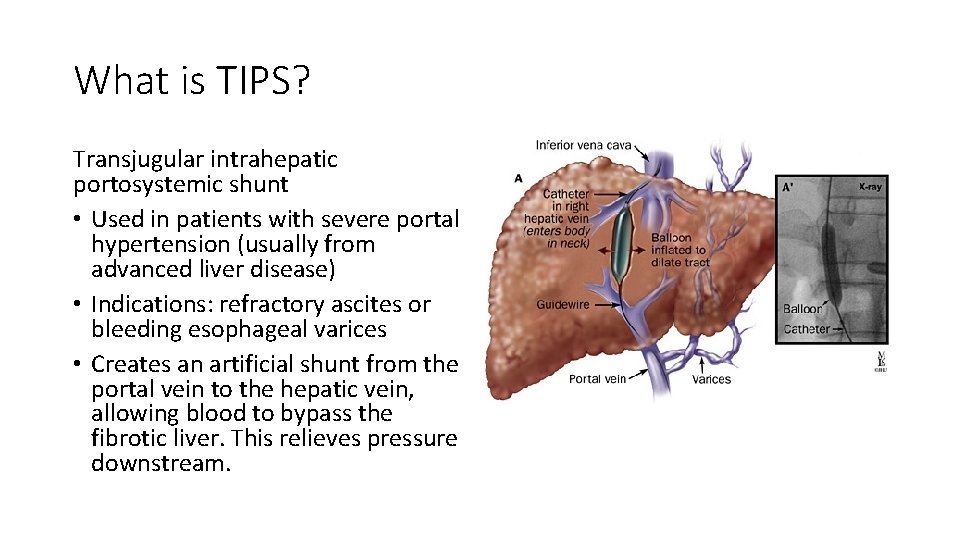
What is TIPS? Transjugular intrahepatic portosystemic shunt • Used in patients with severe portal hypertension (usually from advanced liver disease) • Indications: refractory ascites or bleeding esophageal varices • Creates an artificial shunt from the portal vein to the hepatic vein, allowing blood to bypass the fibrotic liver. This relieves pressure downstream.
Research Interest • Masters thesis project: ultrasound elastography measurement of splenic stiffness before and after TIPS insertion • Hypothesis: there will be a significant decrease in splenic stiffness after TIPS • Long-term goal: validate splenic elastography as an accurate tool to monitor shunt function in TIPS patients • In doing background research for this project, • I found a wide array of dysfunction rates in literature • I found data on in-hospital mortality, but could not find data on overall mortality • I could not find much data on TIPS in transplant patients
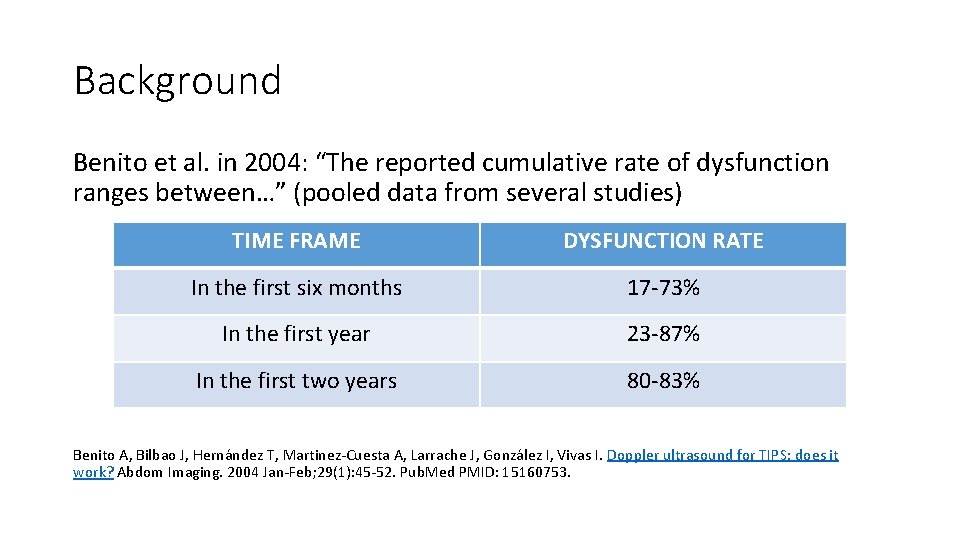
Background Benito et al. in 2004: “The reported cumulative rate of dysfunction ranges between…” (pooled data from several studies) TIME FRAME DYSFUNCTION RATE In the first six months 17 -73% In the first year 23 -87% In the first two years 80 -83% Benito A, Bilbao J, Hernández T, Martinez-Cuesta A, Larrache J, González I, Vivas I. Doppler ultrasound for TIPS: does it work? Abdom Imaging. 2004 Jan-Feb; 29(1): 45 -52. Pub. Med PMID: 15160753.
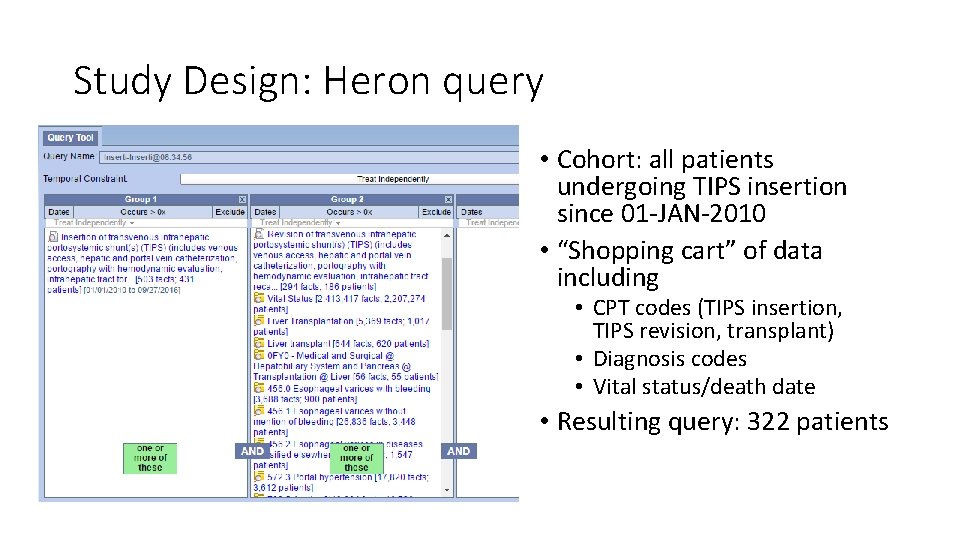
Study Design: Heron query • Cohort: all patients undergoing TIPS insertion since 01 -JAN-2010 • “Shopping cart” of data including • CPT codes (TIPS insertion, TIPS revision, transplant) • Diagnosis codes • Vital status/death date • Resulting query: 322 patients
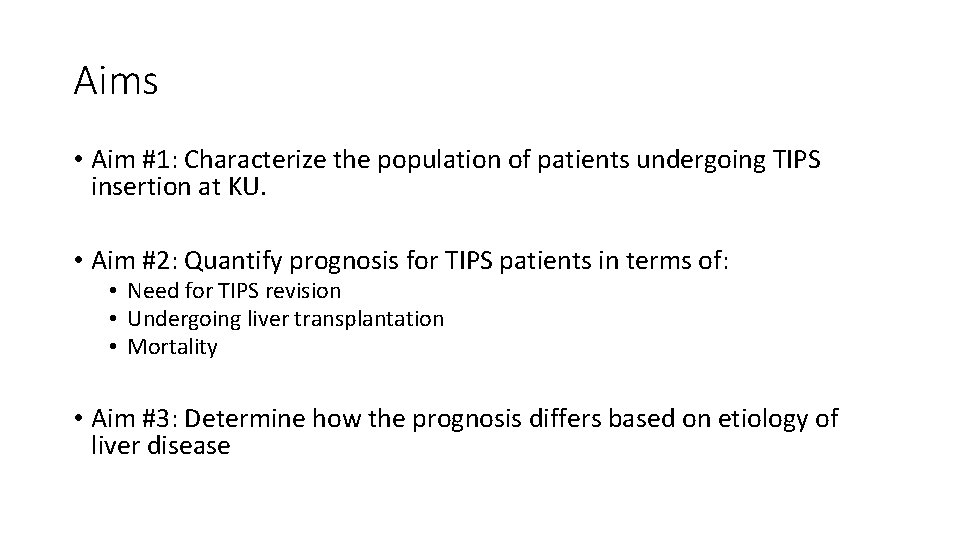
Aims • Aim #1: Characterize the population of patients undergoing TIPS insertion at KU. • Aim #2: Quantify prognosis for TIPS patients in terms of: • Need for TIPS revision • Undergoing liver transplantation • Mortality • Aim #3: Determine how the prognosis differs based on etiology of liver disease
Aim #1 Characterize the population of patients undergoing TIPS insertion at KU.
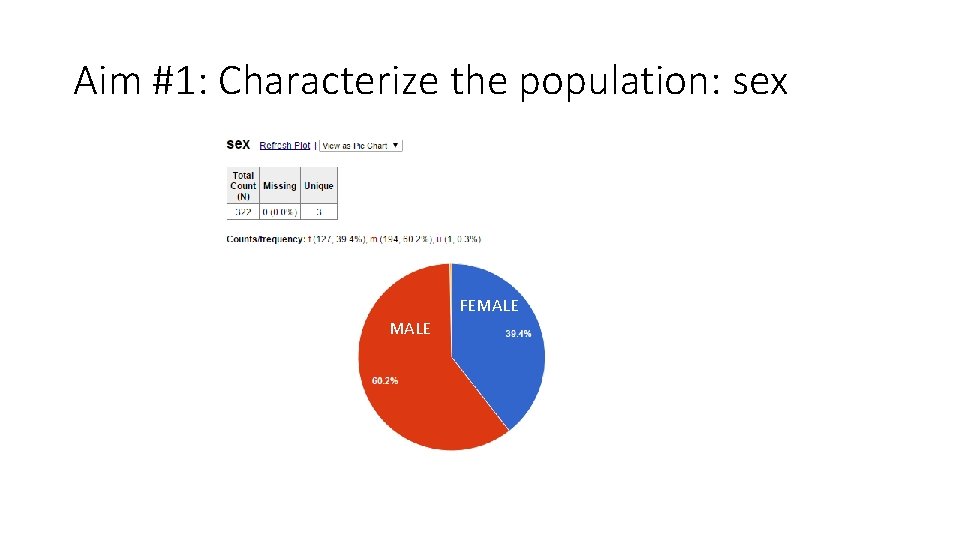
Aim #1: Characterize the population: sex FEMALE
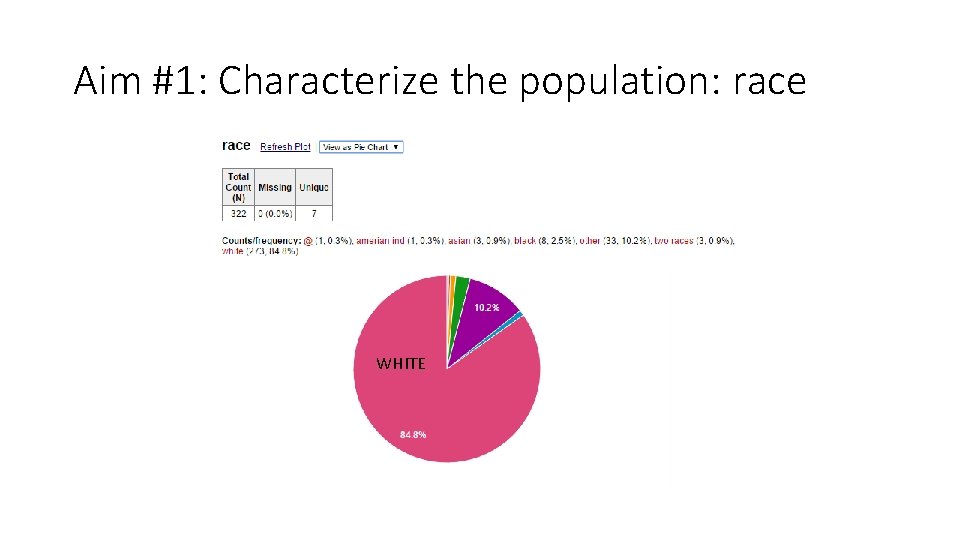
Aim #1: Characterize the population: race WHITE
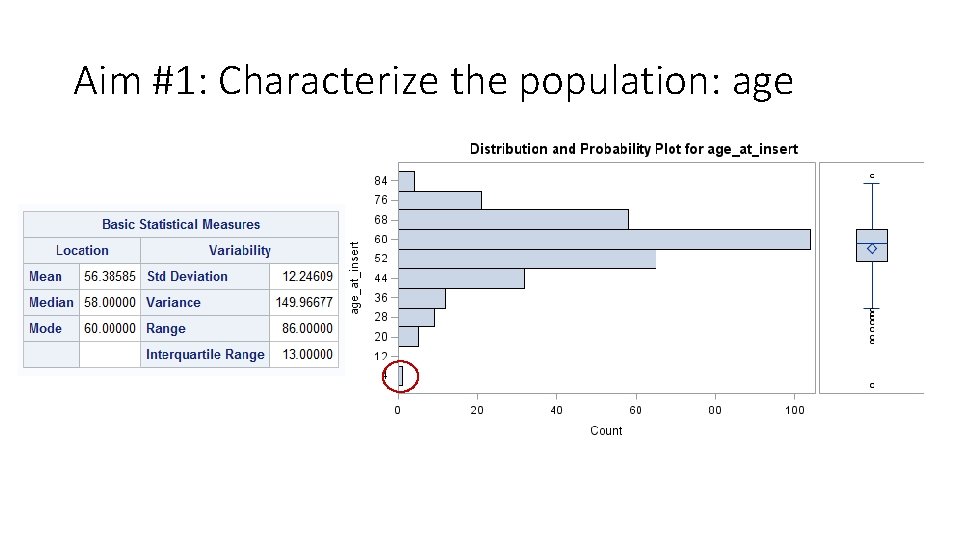
Aim #1: Characterize the population: age
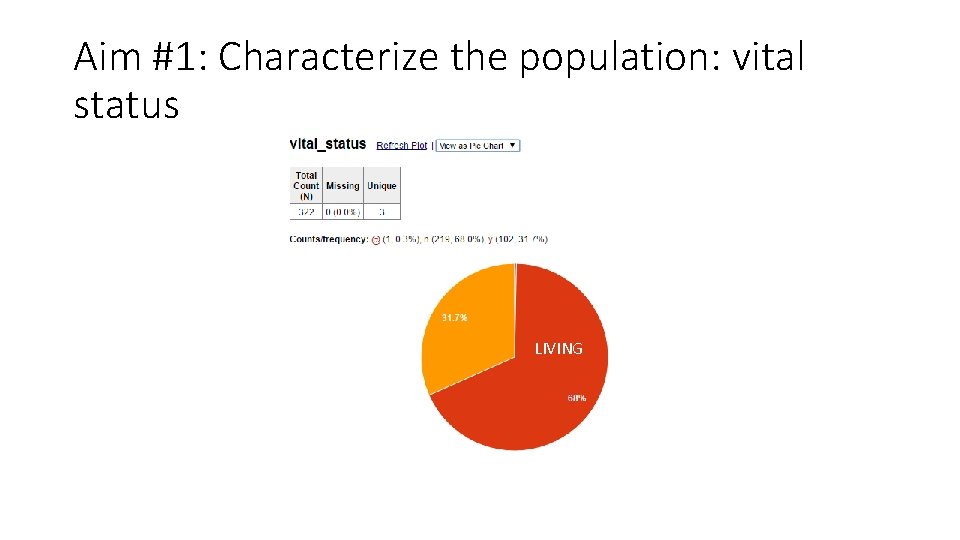
Aim #1: Characterize the population: vital status LIVING
Aim #2 Quantify prognosis for TIPS patients in terms of: Need for TIPS revision Undergoing liver transplantation Mortality
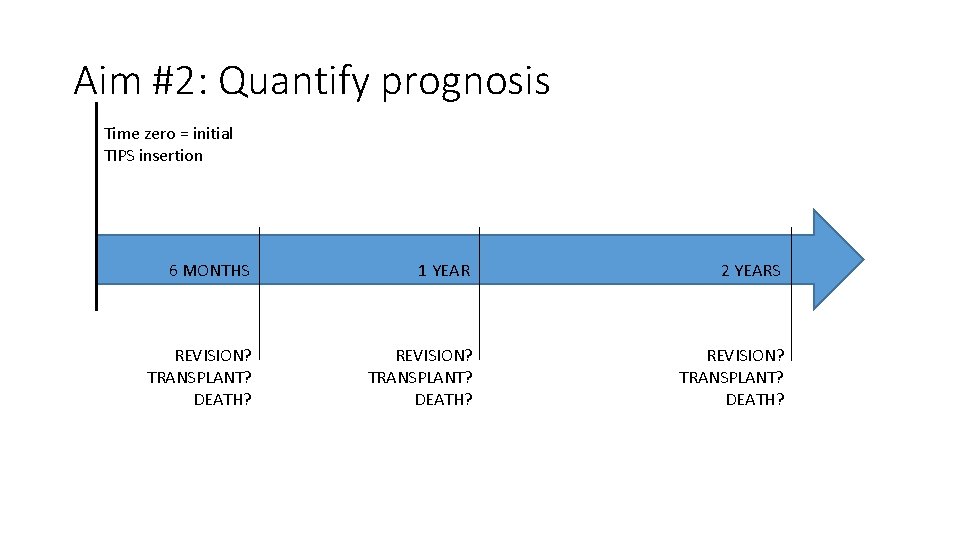
Aim #2: Quantify prognosis Time zero = initial TIPS insertion 6 MONTHS 1 YEAR 2 YEARS REVISION? TRANSPLANT? DEATH?
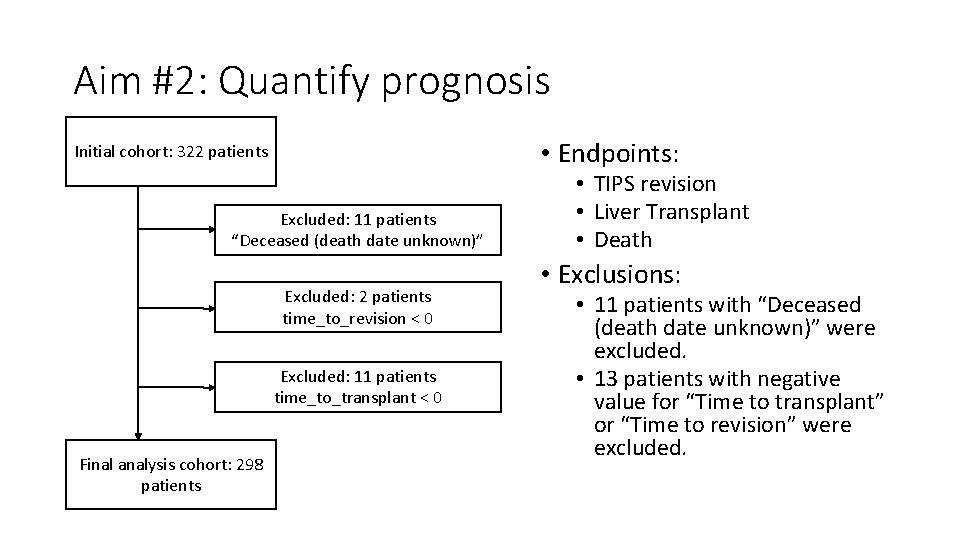
Aim #2: Quantify prognosis • Endpoints: Initial cohort: 322 patients Excluded: 11 patients “Deceased (death date unknown)” Excluded: 2 patients time_to_revision < 0 Excluded: 11 patients time_to_transplant < 0 Final analysis cohort: 298 patients • TIPS revision • Liver Transplant • Death • Exclusions: • 11 patients with “Deceased (death date unknown)” were excluded. • 13 patients with negative value for “Time to transplant” or “Time to revision” were excluded.
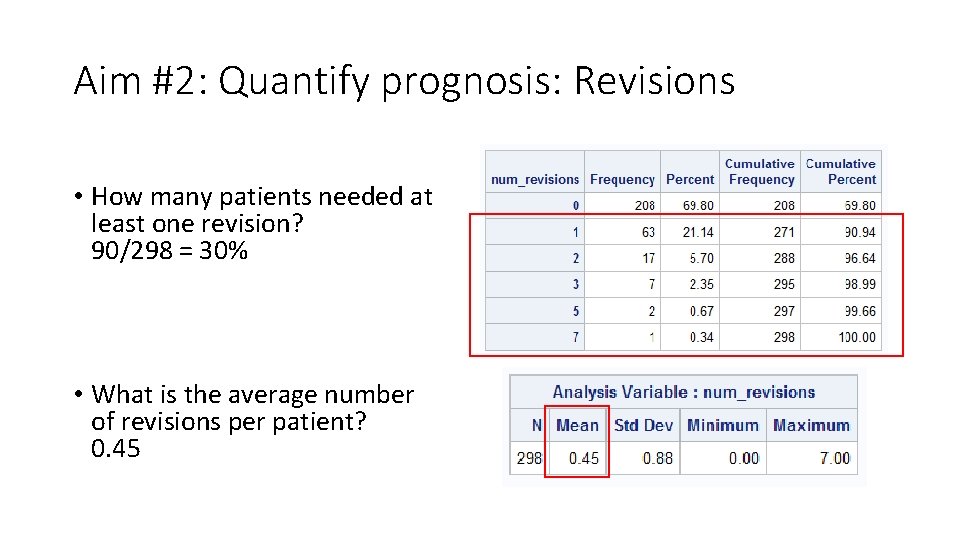
Aim #2: Quantify prognosis: Revisions • How many patients needed at least one revision? 90/298 = 30% • What is the average number of revisions per patient? 0. 45
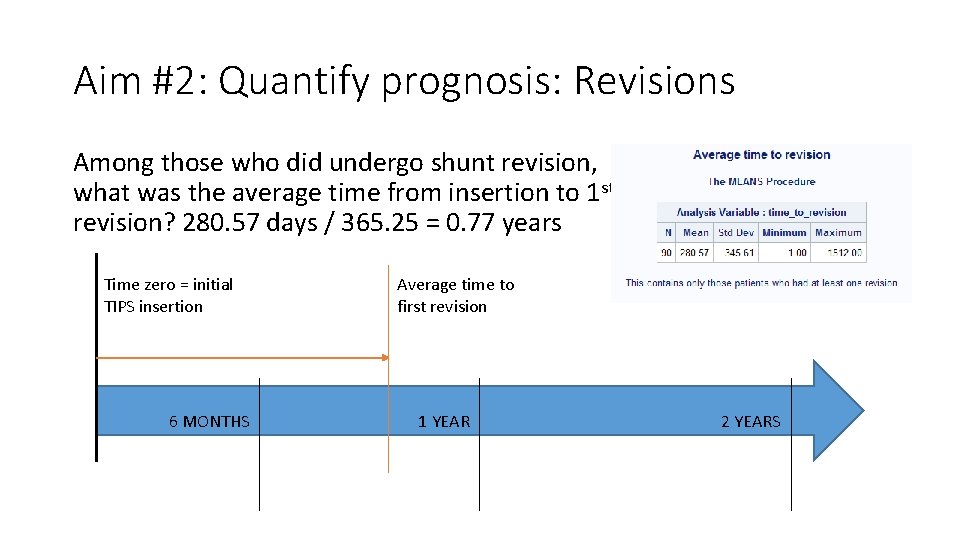
Aim #2: Quantify prognosis: Revisions Among those who did undergo shunt revision, what was the average time from insertion to 1 st revision? 280. 57 days / 365. 25 = 0. 77 years Time zero = initial TIPS insertion 6 MONTHS Average time to first revision 1 YEAR 2 YEARS
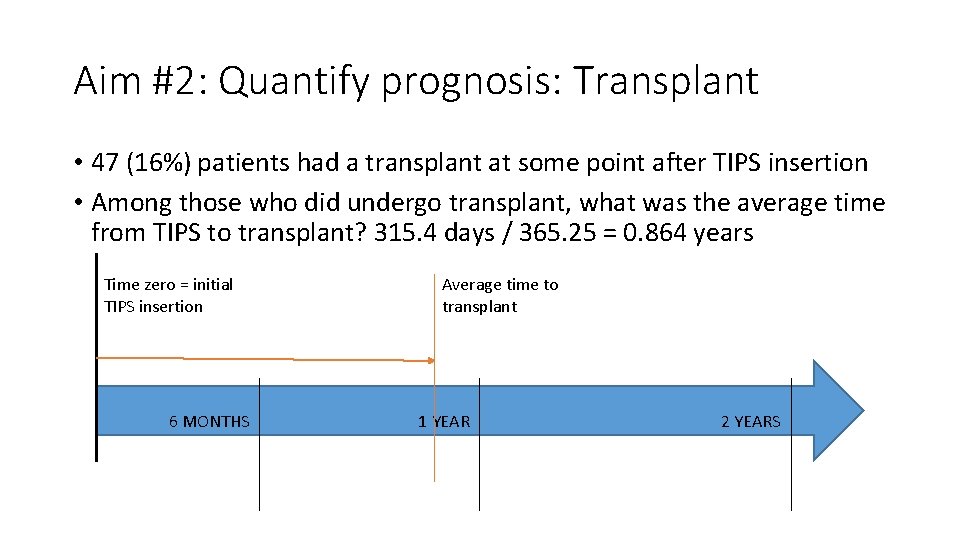
Aim #2: Quantify prognosis: Transplant • 47 (16%) patients had a transplant at some point after TIPS insertion • Among those who did undergo transplant, what was the average time from TIPS to transplant? 315. 4 days / 365. 25 = 0. 864 years Time zero = initial TIPS insertion 6 MONTHS Average time to transplant 1 YEAR 2 YEARS
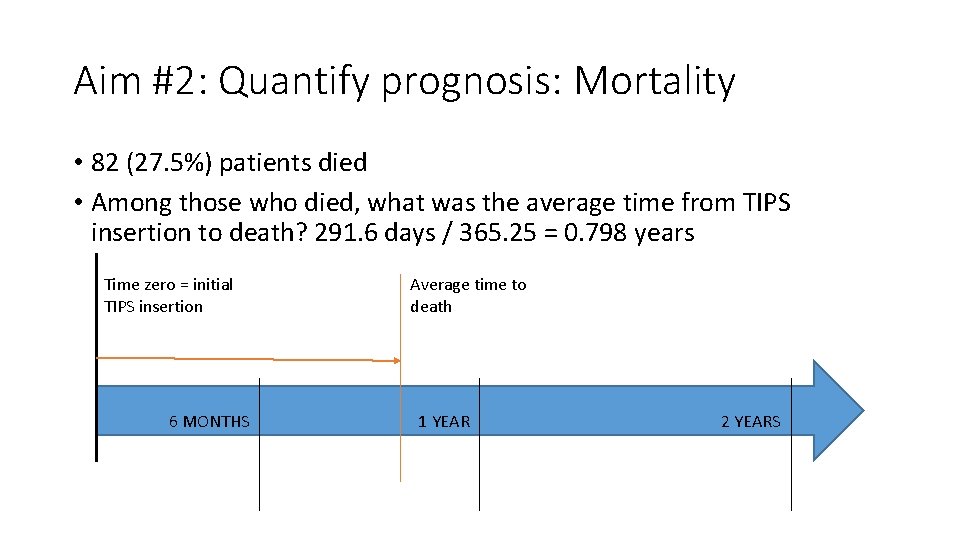
Aim #2: Quantify prognosis: Mortality • 82 (27. 5%) patients died • Among those who died, what was the average time from TIPS insertion to death? 291. 6 days / 365. 25 = 0. 798 years Time zero = initial TIPS insertion 6 MONTHS Average time to death 1 YEAR 2 YEARS
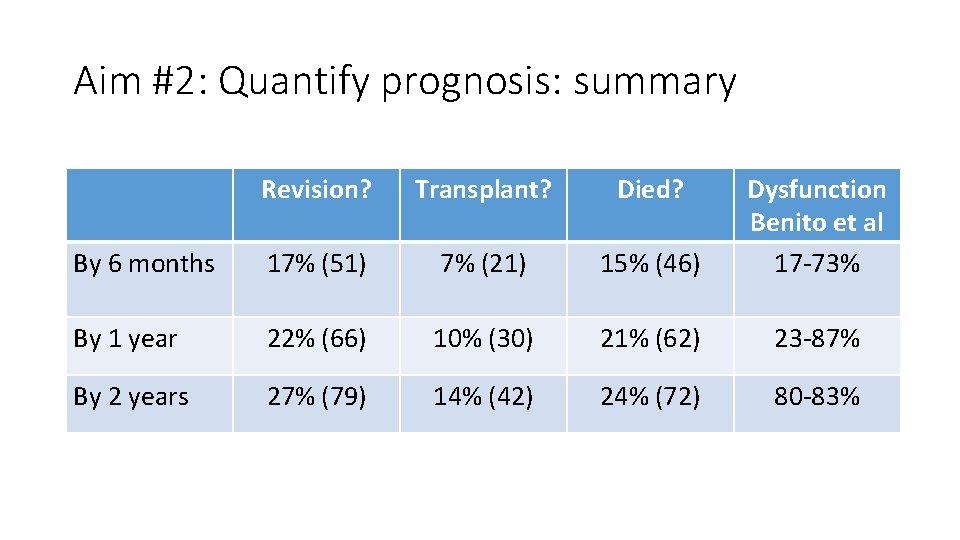
Aim #2: Quantify prognosis: summary Revision? Transplant? Died? By 6 months 17% (51) 7% (21) 15% (46) Dysfunction Benito et al 17 -73% By 1 year 22% (66) 10% (30) 21% (62) 23 -87% By 2 years 27% (79) 14% (42) 24% (72) 80 -83%
Aim #3 Determine how the prognosis differs based on etiology of liver disease.
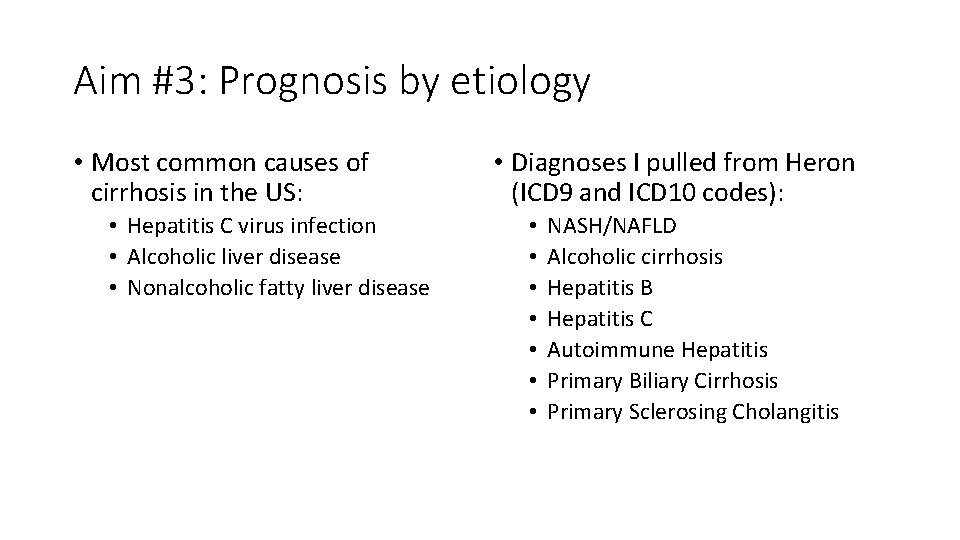
Aim #3: Prognosis by etiology • Most common causes of cirrhosis in the US: • Hepatitis C virus infection • Alcoholic liver disease • Nonalcoholic fatty liver disease • Diagnoses I pulled from Heron (ICD 9 and ICD 10 codes): • • NASH/NAFLD Alcoholic cirrhosis Hepatitis B Hepatitis C Autoimmune Hepatitis Primary Biliary Cirrhosis Primary Sclerosing Cholangitis
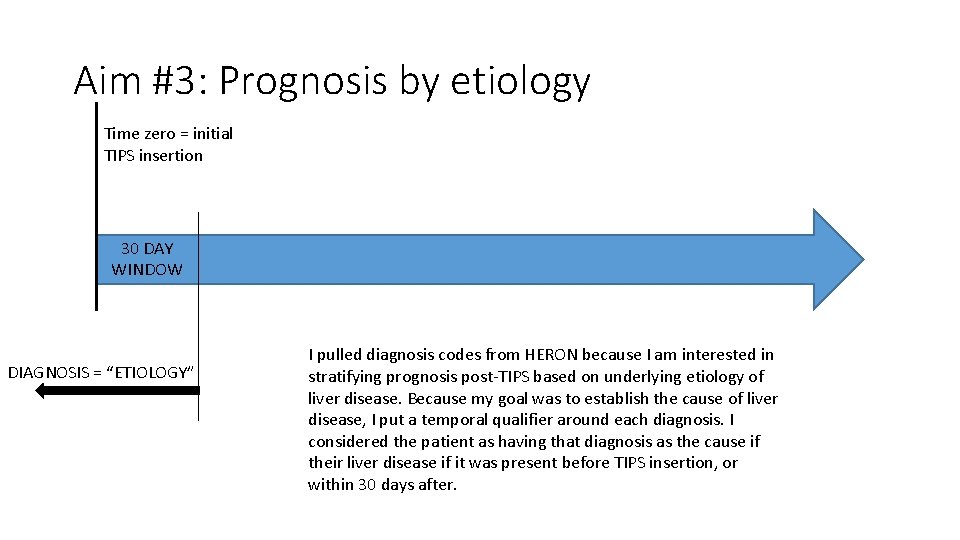
Aim #3: Prognosis by etiology Time zero = initial TIPS insertion 30 DAY WINDOW DIAGNOSIS = “ETIOLOGY” I pulled diagnosis codes from HERON because I am interested in stratifying prognosis post-TIPS based on underlying etiology of liver disease. Because my goal was to establish the cause of liver disease, I put a temporal qualifier around each diagnosis. I considered the patient as having that diagnosis as the cause if their liver disease if it was present before TIPS insertion, or within 30 days after.
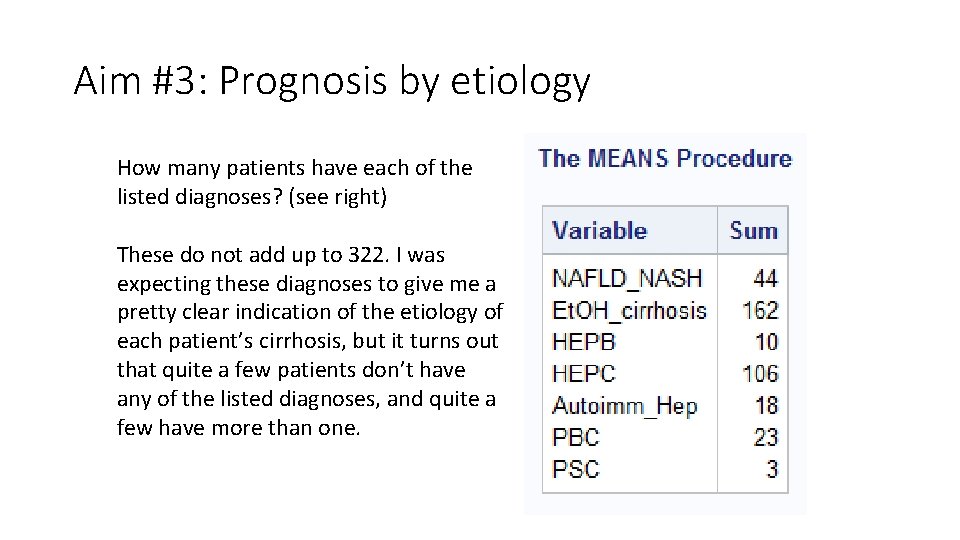
Aim #3: Prognosis by etiology How many patients have each of the listed diagnoses? (see right) These do not add up to 322. I was expecting these diagnoses to give me a pretty clear indication of the etiology of each patient’s cirrhosis, but it turns out that quite a few patients don’t have any of the listed diagnoses, and quite a few have more than one.
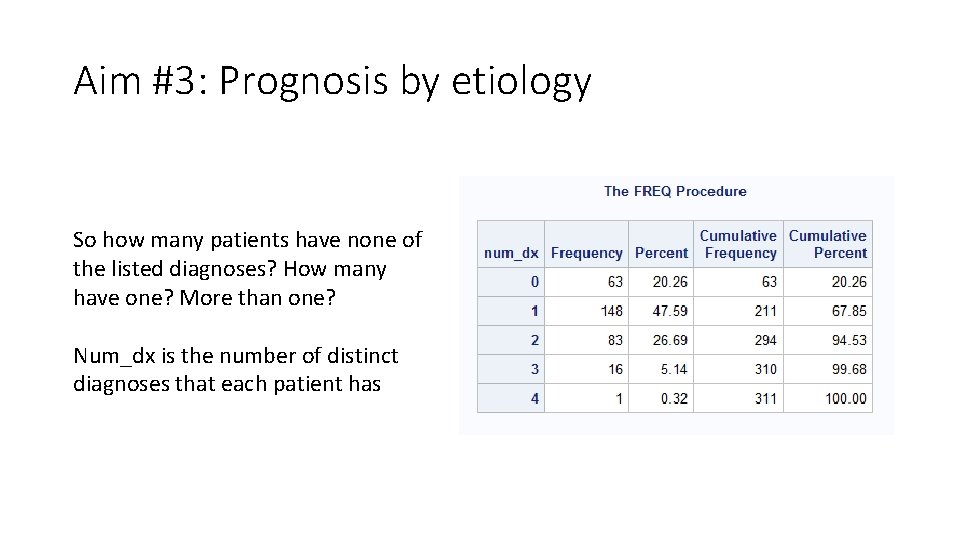
Aim #3: Prognosis by etiology So how many patients have none of the listed diagnoses? How many have one? More than one? Num_dx is the number of distinct diagnoses that each patient has
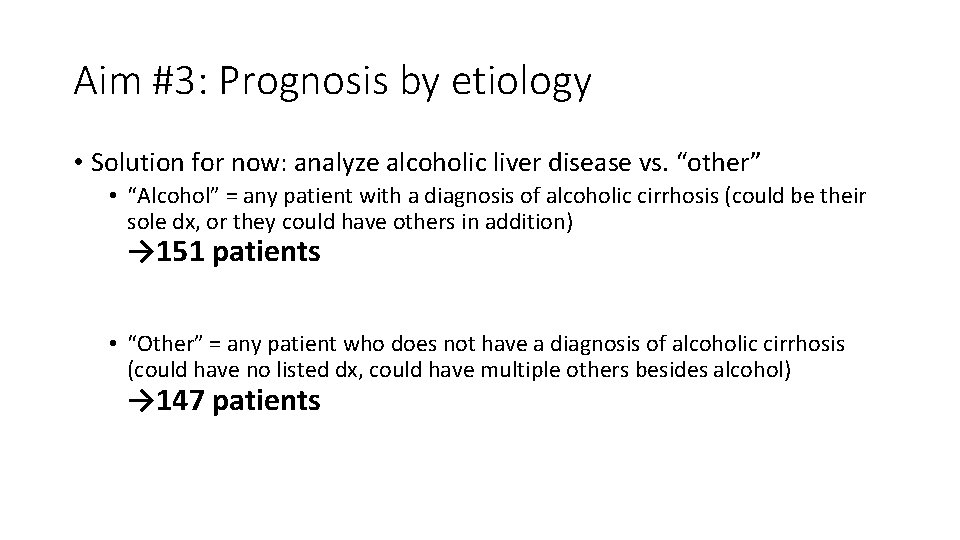
Aim #3: Prognosis by etiology • Solution for now: analyze alcoholic liver disease vs. “other” • “Alcohol” = any patient with a diagnosis of alcoholic cirrhosis (could be their sole dx, or they could have others in addition) → 151 patients • “Other” = any patient who does not have a diagnosis of alcoholic cirrhosis (could have no listed dx, could have multiple others besides alcohol) → 147 patients
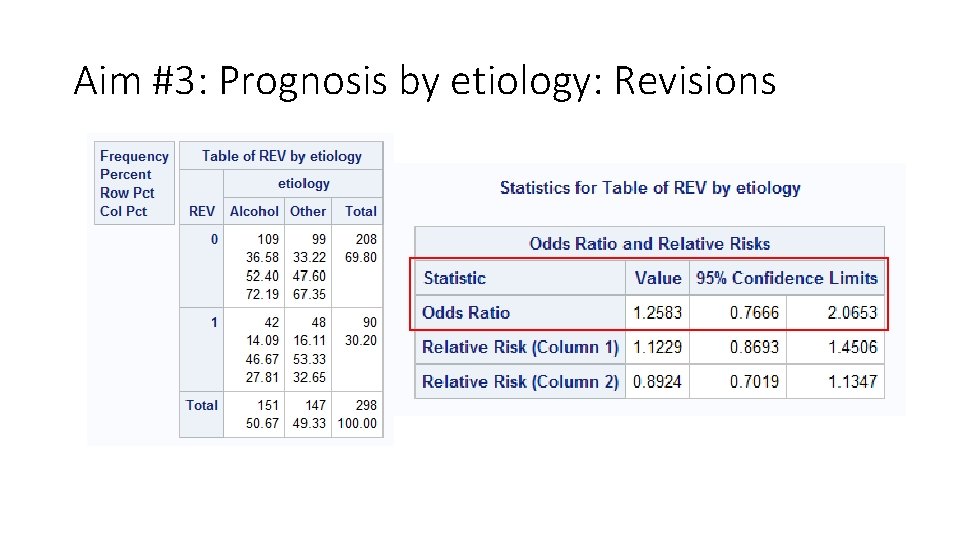
Aim #3: Prognosis by etiology: Revisions
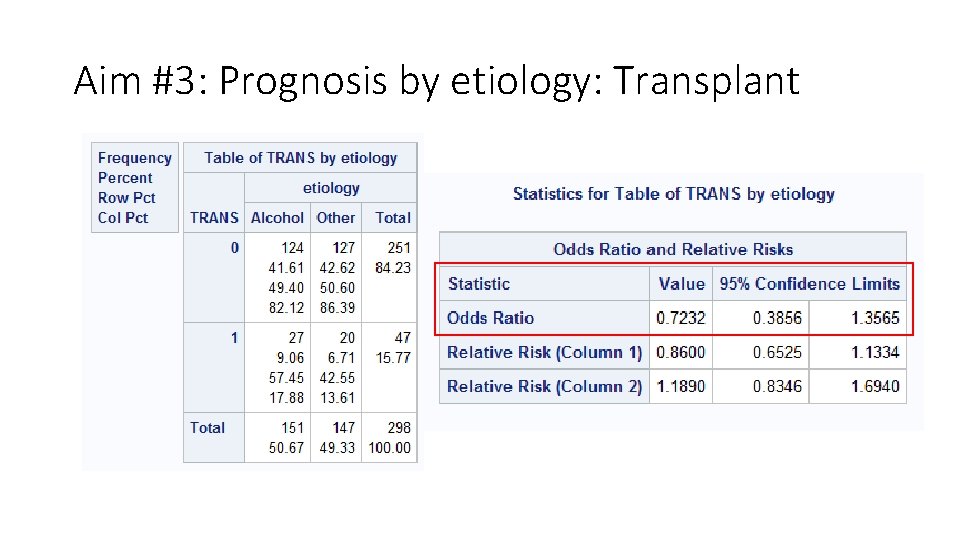
Aim #3: Prognosis by etiology: Transplant
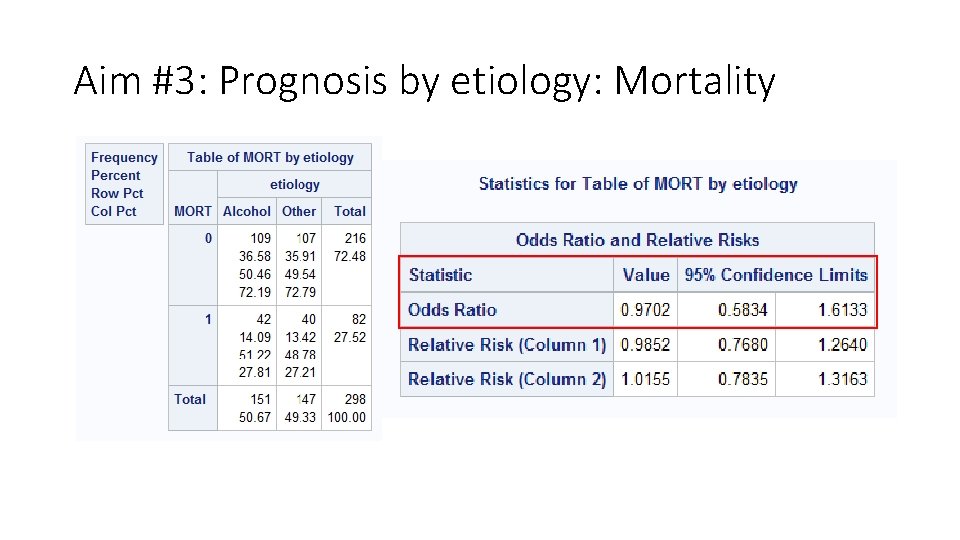
Aim #3: Prognosis by etiology: Mortality
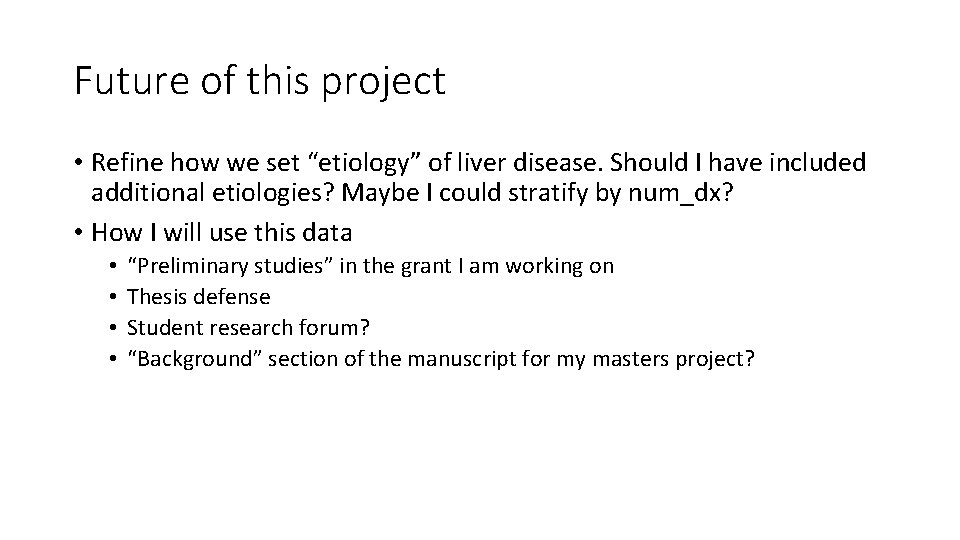
Future of this project • Refine how we set “etiology” of liver disease. Should I have included additional etiologies? Maybe I could stratify by num_dx? • How I will use this data • • “Preliminary studies” in the grant I am working on Thesis defense Student research forum? “Background” section of the manuscript for my masters project?