
OUTBREEDING Outbreeding The mating of unrelated individuals is
OUTBREEDING

Outbreeding Ø The mating of unrelated individuals is called as outbreeding or genetic disassortative mating. outbreeding OUTCROSSING CROSSBREEDING GRADING UP SPECIES HYBRIDIZATIO N

OUTCROSSING Ø This the mating system in which mating occurs among the unrelated individuals of the same breed. Ø The progeny which is produced by outcrossing is called as outcross. Ø HOW OUTCROSSING PRODUCE CHANGES? ? by using genetic variability which exist within breed. Ø The outcrossing within a herd by use of selected sires is called as selective breeding. Ø The point or level at which there is failure to response or genetic gain is called as plateau or plateaued population.
Cont. . Topcrossing - It is the mating of females to the last male in top side of the pedigree. It is also used to refer the mating of purebred males with unrelated females.
What is Crossbreeding? ? • Crossbreeding is the mating of animals from different established breeds. (Falconer and Mackay, 1996) • The progeny produced is called crossbred. • This system has major role in livestock improvement by developing new breeds of livestock.
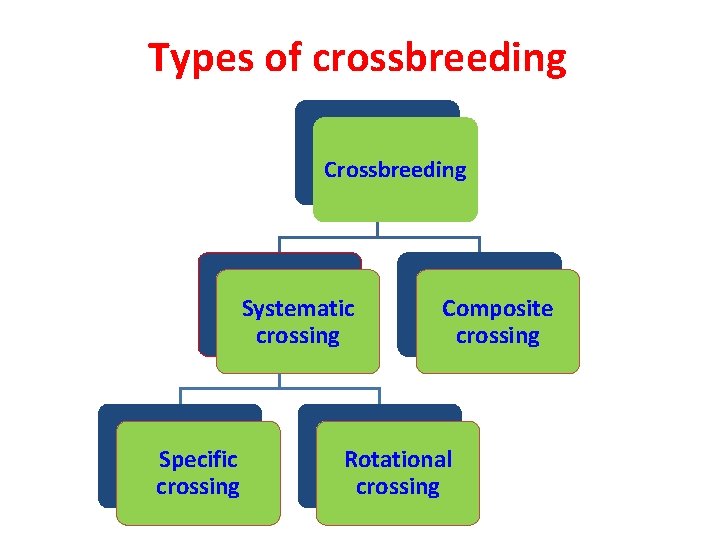
Types of crossbreeding Crossbreeding Systematic crossing Specific crossing Composite crossing Rotational crossing
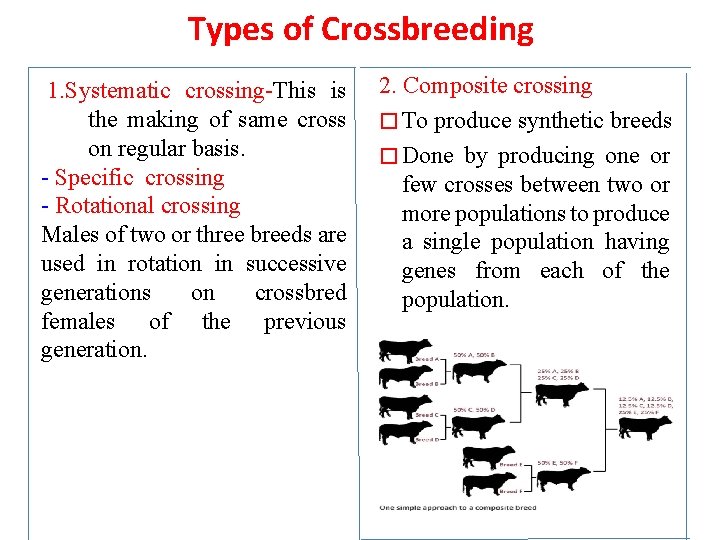
Types of Crossbreeding 1. Systematic crossing-This is the making of same cross on regular basis. - Specific crossing - Rotational crossing Males of two or three breeds are used in rotation in successive generations on crossbred females of the previous generation. 2. Composite crossing � To produce synthetic breeds � Done by producing one or few crosses between two or more populations to produce a single population having genes from each of the population.
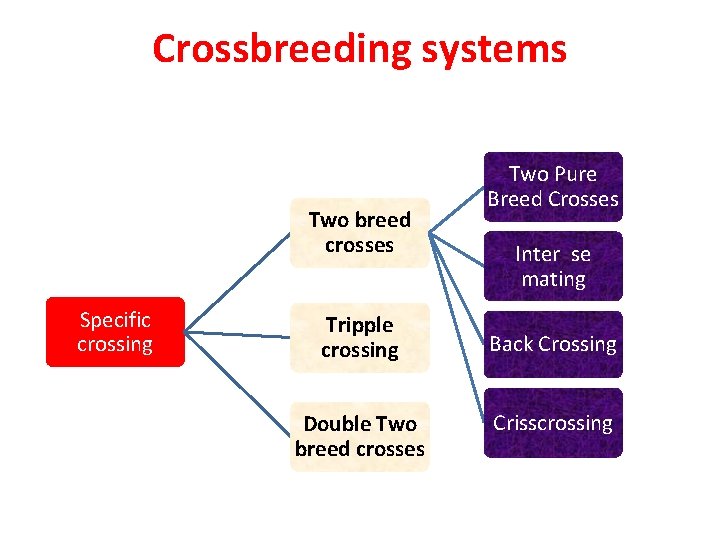
Crossbreeding systems Two breed crosses Specific crossing Tripple crossing Double Two breed crosses Two Pure Breed Crosses Inter se mating Back Crossing Crisscrossing
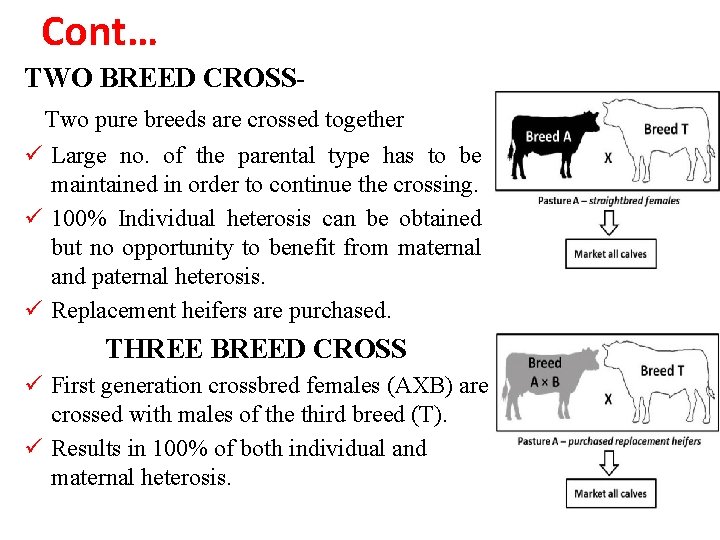
Cont… TWO BREED CROSSTwo pure breeds are crossed together ü Large no. of the parental type has to be maintained in order to continue the crossing. ü 100% Individual heterosis can be obtained but no opportunity to benefit from maternal and paternal heterosis. ü Replacement heifers are purchased. THREE BREED CROSS ü First generation crossbred females (AXB) are crossed with males of the third breed (T). ü Results in 100% of both individual and maternal heterosis.
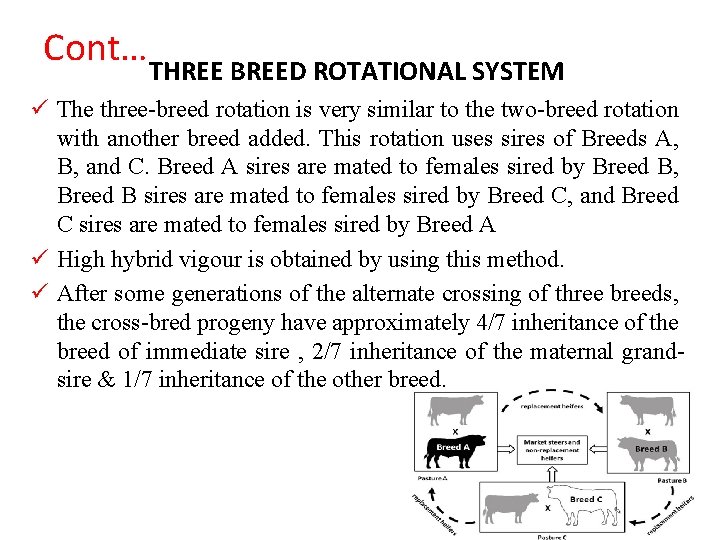
Cont… THREE BREED ROTATIONAL SYSTEM ü The three-breed rotation is very similar to the two-breed rotation with another breed added. This rotation uses sires of Breeds A, B, and C. Breed A sires are mated to females sired by Breed B, Breed B sires are mated to females sired by Breed C, and Breed C sires are mated to females sired by Breed A ü High hybrid vigour is obtained by using this method. ü After some generations of the alternate crossing of three breeds, the cross-bred progeny have approximately 4/7 inheritance of the breed of immediate sire , 2/7 inheritance of the maternal grandsire & 1/7 inheritance of the other breed.
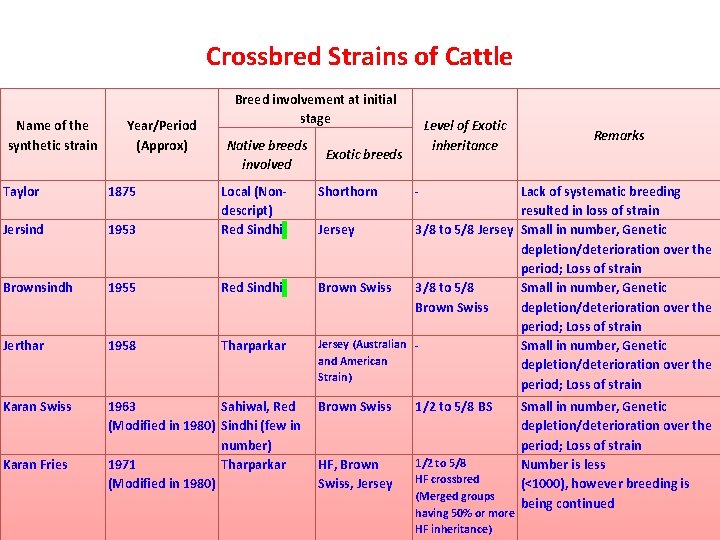
Crossbred Strains of Cattle Name of the synthetic strain Year/Period (Approx) Breed involvement at initial stage Native breeds involved Taylor 1875 Jersind 1953 Local (Nondescript) Red Sindhi Brownsindh 1955 Red Sindhi Jerthar 1958 Tharparkar Karan Swiss 1963 Sahiwal, Red (Modified in 1980) Sindhi (few in number) 1971 Tharparkar (Modified in 1980) Karan Fries Level of Exotic inheritance Exotic breeds Shorthorn - Brown Swiss 1/2 to 5/8 BS HF, Brown Swiss, Jersey 1/2 to 5/8 HF crossbred (Merged groups having 50% or more HF inheritance) Remarks Lack of systematic breeding resulted in loss of strain Jersey 3/8 to 5/8 Jersey Small in number, Genetic depletion/deterioration over the period; Loss of strain Brown Swiss 3/8 to 5/8 Small in number, Genetic Brown Swiss depletion/deterioration over the period; Loss of strain Jersey (Australian Small in number, Genetic and American depletion/deterioration over the Strain) period; Loss of strain Small in number, Genetic depletion/deterioration over the period; Loss of strain Number is less (<1000), however breeding is being continued
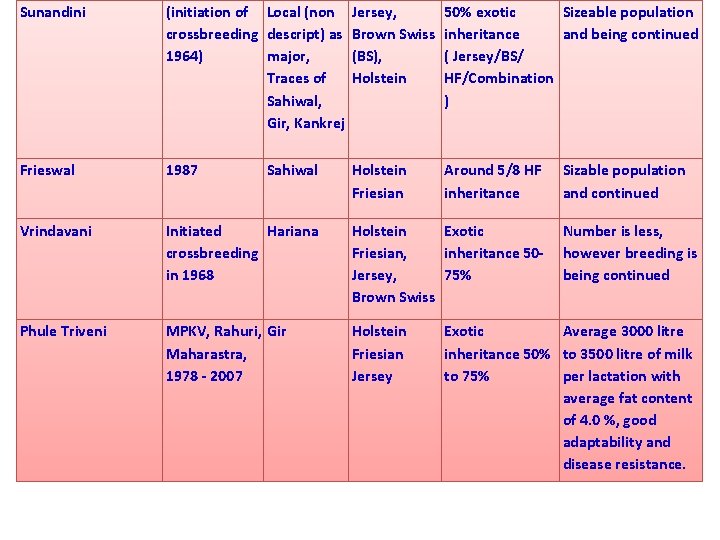
Sunandini (initiation of Local (non crossbreeding descript) as 1964) major, Traces of Sahiwal, Gir, Kankrej Jersey, Brown Swiss (BS), Holstein 50% exotic Sizeable population inheritance and being continued ( Jersey/BS/ HF/Combination ) Frieswal 1987 Holstein Friesian Around 5/8 HF inheritance Vrindavani Initiated Hariana crossbreeding in 1968 Holstein Exotic Friesian, inheritance 50 Jersey, 75% Brown Swiss Phule Triveni MPKV, Rahuri, Gir Maharastra, 1978 - 2007 Holstein Friesian Jersey Cont… Sahiwal Sizable population and continued Number is less, however breeding is being continued Exotic Average 3000 litre inheritance 50% to 3500 litre of milk to 75% per lactation with average fat content of 4. 0 %, good adaptability and disease resistance.
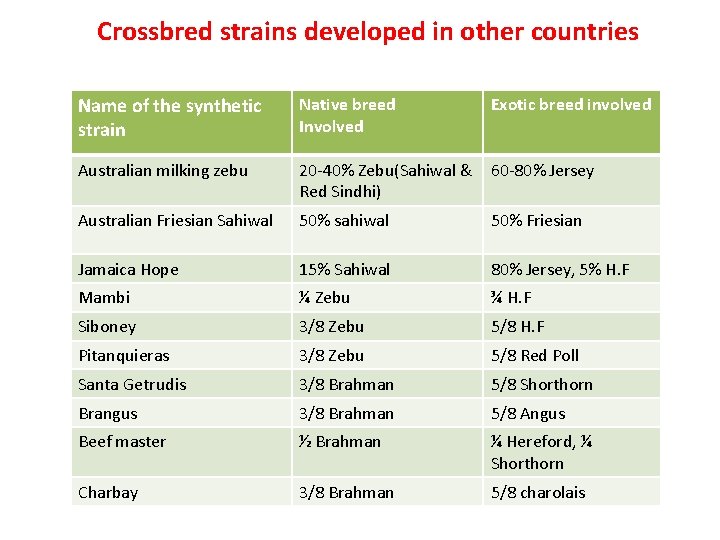
Crossbred strains developed in other countries Name of the synthetic strain Native breed Involved Exotic breed involved Australian milking zebu 20 -40% Zebu(Sahiwal & Red Sindhi) 60 -80% Jersey Australian Friesian Sahiwal 50% sahiwal 50% Friesian Jamaica Hope 15% Sahiwal 80% Jersey, 5% H. F Mambi ¼ Zebu ¾ H. F Siboney 3/8 Zebu 5/8 H. F Pitanquieras 3/8 Zebu 5/8 Red Poll Santa Getrudis 3/8 Brahman 5/8 Shorthorn Brangus 3/8 Brahman 5/8 Angus Beef master ½ Brahman ¼ Hereford, ¼ Shorthorn Charbay 3/8 Brahman 5/8 charolais
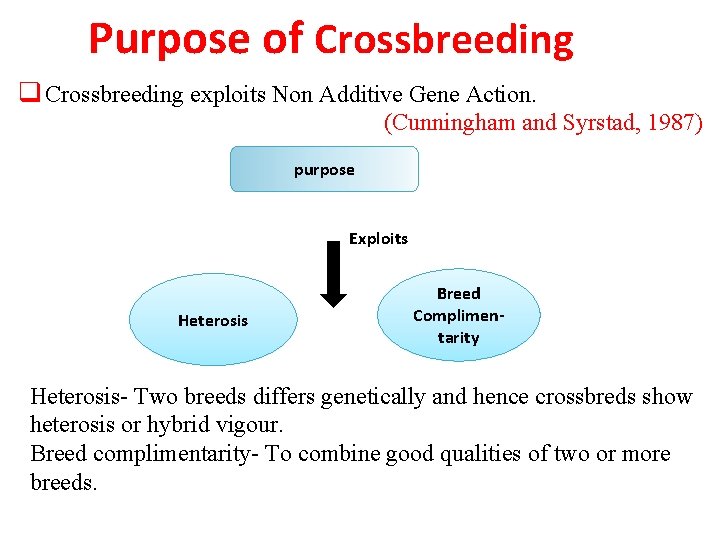
Purpose of Crossbreeding q Crossbreeding exploits Non Additive Gene Action. (Cunningham and Syrstad, 1987) purpose Exploits Heterosis Breed Complimentarity Heterosis- Two breeds differs genetically and hence crossbreds show heterosis or hybrid vigour. Breed complimentarity- To combine good qualities of two or more breeds.
Hetrosis • The superiority of outbreds /crossbreds over the average of their parents is called as heterosis/hybrid vigour. • The heterosis is opposite to the phenomenon of inbreeding depression. • Estimation of heterosis Heterosis = Mean of F 1 progeny – Mean of parents
Genetic explanation of heterosis • Dominance theory: Effect of favourable dominant genes in offspring will mask/hide the effect of unfavourable recessives genes. (Davenport, 1908) A 1 A 2=A 1 A 1>A 2 A 2 • Overdominance: Overdominance is the interactions between genes and it results in the heterozygous individuals being superior to the best homozygous parent. Shull and East (1908). A 1 A 2>A 1 A 1>A 2 A 2 • Epistasis: The different genes coming together in the hybrid interact with each other and produce greater effect than when they are in different parents. (Tomar S. S. , 2004)
Potentials of crossbreeding ü Paternal, maternal and individual heterosis are exploited. ü Helps to introduce desirable characters into a population in which they have not existed formerly. ü Helps to evolve a new breed. ü Crossbred animals usually exhibit an accelerated growth, vigor and fertility. ü Used to produce commercial stock to meet market demand. ü Effective for the improvement of traits which are highly influenced by non-additive gene action.
Grading Up Ø The sire of purebred are mated to the female of nondescript or deshi. This type of mating system is called grading up. Ø The crossbred female are backcross to purebred sire to produce the progeny with 75% genes from purebred. So, after six generation of crossing the graded females with the purebred sires to produce the progeny which have 98. 4% genes of purebred. Ø Grading up is useful to produce purebreds after a few generation.
Cont. . Ø It is less expensive Ø This system help to prove the genetic potentialities of the sire.

THANK YOU
- Slides: 20