
Outagamie County Treatment Courts Brian Bezier Psy D

Outagamie County Treatment Courts Brian Bezier, Psy. D. Clinical Director/Manager: MH/AODA Taylor Geske, MA Drug and Alcohol Treatment Court Coordinator Robyn Van Bogart, MA Mental Health Court Coordinator
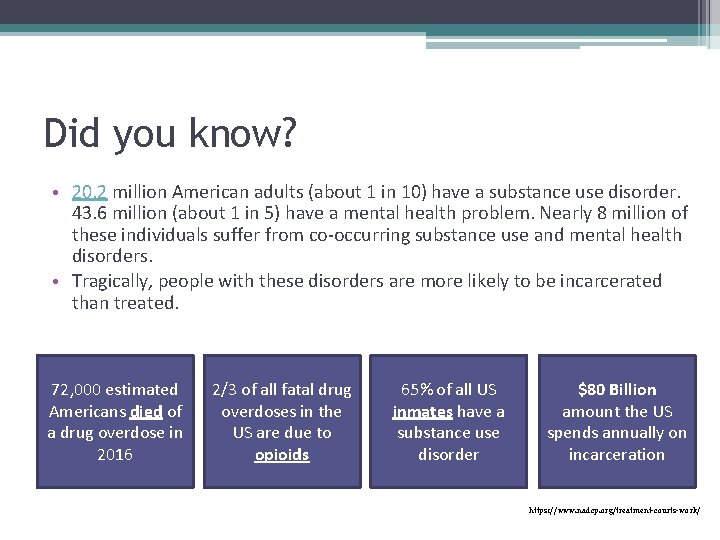
Did you know? • 20. 2 million American adults (about 1 in 10) have a substance use disorder. 43. 6 million (about 1 in 5) have a mental health problem. Nearly 8 million of these individuals suffer from co-occurring substance use and mental health disorders. • Tragically, people with these disorders are more likely to be incarcerated than treated. 72, 000 estimated Americans died of a drug overdose in 2016 2/3 of all fatal drug overdoses in the US are due to opioids 65% of all US inmates have a substance use disorder $80 Billion amount the US spends annually on incarceration https: //www. nadcp. org/treatment-courts-work/
What is a Treatment Court? • Specialized program focused on collaboration • Managed by a non-adversarial and multi-disciplinary team • The average national completion rate for treatment courts is nearly 60%, approximately two-thirds higher than probation and more than twice the rate of probationers with substance use disorders • Comprehensive model: ▫ ▫ ▫ Screening of Risk, Needs, and Responsivity Judicial interaction Monitoring and supervision Graduated sanctions and incentives Treatment and habilitation services
Treatment Court Model • Treatment courts vary in target population, program design, and service resources • Based on a comprehensive model involving: ▫ ▫ ▫ Offender screening and assessment of risks, needs, and responsivity Judicial interaction Monitoring (e. g. , drug testing) and supervision Graduated sanctions and incentives Treatment and rehabilitation services • Managed by a non-adversarial and multidisciplinary team
History of Treatment Courts • First Drug court held in Miami-Dade County in 1989 • Broward County Florida Mental Health Court in 1997 • Currently over 3, 000 Drug Courts and over 300 Mental Health Courts in the United States
Implementation • Drug and Alcohol Treatment Court (DATC) began in February of 2009, based on collaborative efforts of the Department of Corrections and Circuit Courts and moved to Health and Human Services in 2012 • Mental Health Court (MHC) began in July of 2012 within Health and Human Services
Treatment Court Teams • • • Circuit Courts Department of Corrections (DOC) District Attorney Public Defenders Office Health and Human Services (DHHS) Criminal Justice Treatment Services (CJTS) OC Sheriffs Department Appleton Police Department Treatment Providers Community Resources
Structure of the Courts • Drug and Alcohol Treatment Court and Mental Health Court are post conviction and voluntary • Potential participants are screened and, once under probation, can voluntarily agree to participate • Length of time in the court is approximately 18 -24 months • Successful completion can result in avoided incarceration and may also allow for some charges to be reduced or dismissed • Case management is provided by DHHS and Department of Corrections Agents
What makes us different? • • • Treatment plan development Case management services Adherence versus Compliance Meaningful Activity and Pro-social Wellness Points Individual Placement and Support (IPS) Moral Reconation Therapy (MRT)
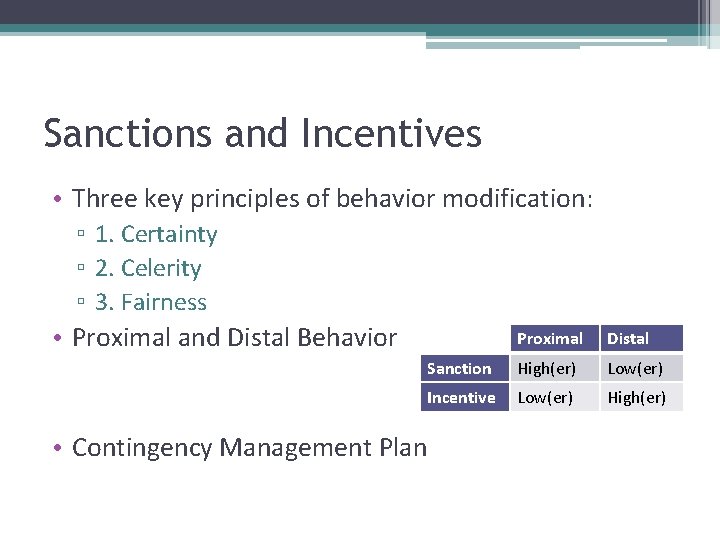
Sanctions and Incentives • Three key principles of behavior modification: ▫ 1. Certainty ▫ 2. Celerity ▫ 3. Fairness • Proximal and Distal Behavior Proximal Distal Sanction High(er) Low(er) Incentive Low(er) High(er) • Contingency Management Plan
Participation in Treatment Courts Treatment Court team staffing Attendance at regular court sessions Participation in AODA and/or mental health treatment Required involvement in weekly productive activity Participation and successful completion of Moral Reconation Therapy • Participants are required to pay a fee to participate • • • ▫ 2020 Fees �DATC: $65 per month �MHC: $20 per month
Moral Reconation Therapy • Systematic treatment strategy to decrease recidivism among adult criminal offenders by increasing moral reasoning. • MRT has seen the following outcomes: ▫ ▫ ▫ ▫ ▫ Reduction in Recidivism Reduced Criminal Justice Involvement Reduced Substance Abuse Increased Housing Stability and Job Retention Increased Medication Acceptance Increased Treatment Adherence Improved Psychiatric Symptoms and Functioning Decreased Hospitalization Enhanced Life Purpose Raised Motivation • All DATC and MHC participants are required to complete the 12 -16 week program
The mission of the Outagamie County Drug and Alcohol Treatment Court is to increase community safety by reducing substance abuse and criminal behavior to improve the lives of participants, families, and the community by intensive focus on treatment, increased court supervision, and reduction in recidivism rates while holding all participants accountable.
Eligibility Requirements • At least 18 years of age or adjudicated as an adult • An established resident of Outagamie County according to the Wisconsin Department of Health and Family Services Residency Manual • Minimum 24 months of supervision remaining; if less than 24 remain, probation must be extended • Current AODA Assessment, within the past 6 months, that shows an active primary diagnosis of substance dependence • Current Correctional Officer Management Profiling for Alternative Sanctions (COMPAS) assessment, within the past 12 months, that shows a score of medium to high risk, as well as a score of probable to highly probable in the Substance Abuse subcategory • Participant agrees to sign all releases of information, as requested, and comply with the Drug and Alcohol Treatment Court Treatment Conditions/Terms of Participation. • Violent offenders are not eligible to participate in DATC. A violent offender is defined as a person to whom one of the following applies: ▫ The person has been charged with or convicted of an offense in a pending case and, during the course of the offense, the person carried, possessed, or used a dangerous weapon, the person used force against another person, or a person died or suffered serious bodily harm. ▫ The person has one or more prior convictions for a felony involving the use or attempted use of force against another person with the intent to cause death or serious bodily harm. • Participants that have a medical or psychiatric condition causing a degree of impairment or instability such that it would interfere with program participation, treatment and/or functioning will not be eligible for programming
Program Requirements • AODA Treatment ▫ Based on individualized plan and COMPAS assessment ▫ Can include individual and group AODA therapy, mental health therapy, medication management, SCRAM or electronic monitoring, etc. • Court Appearances ▫ Weekly court appearances in Phase One and Two, bi-weekly in Phase Three, monthly in Phase Four, and every other month in Phase Five. • Drug Testing ▫ Each participant receives random urinary analysis testing, with each day receiving a 3 in 7 chance of testing • Employment and Education ▫ All participants are expected to maintain stable employment and have a high school diploma, HSED, or GED, upon successful completion of Drug and Alcohol Treatment Court • Community Support Meetings ▫ Participants are required to attend at least 3 weekly support group meetings , and obtain a sponsor if it is appropriate based on their treatment progress • Constructive Activity ▫ All participants are required to engage in 40 hours a week of constructive activity. This can include, work/school or a combination of both, Urinary Analysis Testing, AODA/Mental Health Treatment, Community Service, meetings with their sponsor, and community support meetings.
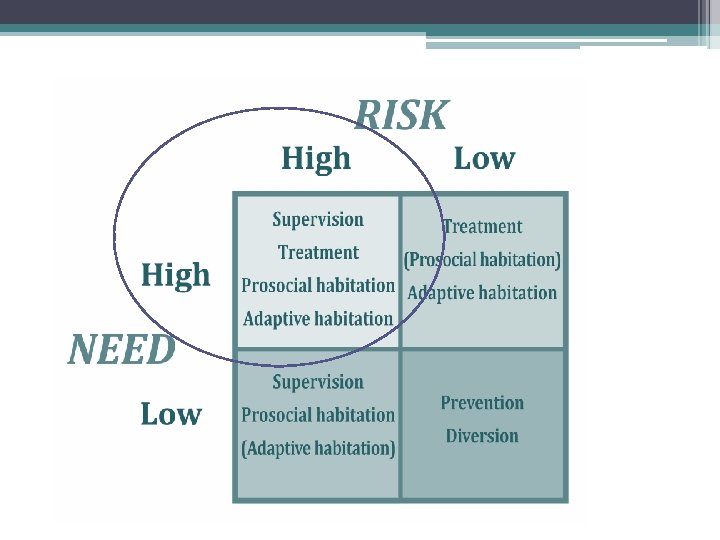
Stage Progression • DATC is designed in five Stages • As an individual moves forward in the court, they will have more flexibility in their treatment, but there will also be higher expectations • The stages are reflective of the distal and proximal goals of the high risk/high need participants served in the Drug and Alcohol Treatment Court
Stage 1: Acute Stabilization • Weekly attendance, and meeting with Agent/Coordinator weekly • Minimum of 30 days in length with 14 days of sobriety to advance • Focus is on immediate needs: crisis stabilization, introduction to treatment providers, AODA, housing, medical/dental
Stage 2: Clinical Stabilization • Weekly attendance, and meeting with Agent/Coordinator weekly • Minimum of 90 days in length with 30 days of sobriety to advance • Participants should be actively engaged in treatment, attend a minimum of 3 community support meetings per week, locate and begin working with a treatment sponsor, begin to build recovery skills, etc.
Stage 3: Pro-Social Habilitation • Bi-weekly attendance, meeting with Agent/Coordinator bi-weekly • Minimum of 120 days in length with 45 days of sobriety to advance • Participants should be actively engaged in treatment, engaged in MRT, attending 3 support meetings each week, meeting with sponsor weekly, maintaining recovery network, etc.
Stage 4: Adaptive Habilitation • Monthly attendance, meeting with Agent/Coordinator monthly • Minimum of 120 days in length with 60 days of sobriety to advance • Participants should continue to engage in treatment, create a success plan, maintain recovery network, etc.
Stage 5: Continuing Care • Attend court every other month, meeting with Agent/Coordinator monthly • Minimum of 180 days with 90 days of sobriety to graduate • Participants should maintain recovery network, obtain a service/leadership position giving back to the community, continue with treatment as necessary, finalize success plan, etc.
Graduation/Commencement • Once a participant has completed all necessary requirements within the five phases they are eligible to apply for graduation • Participants are required to complete a Continuing Care Success Plan and present it at their Graduation Ceremony • DATC graduates are welcomed and encouraged to return to court at any time, and join the Peer Mentorship Program as a mentor for incoming participants
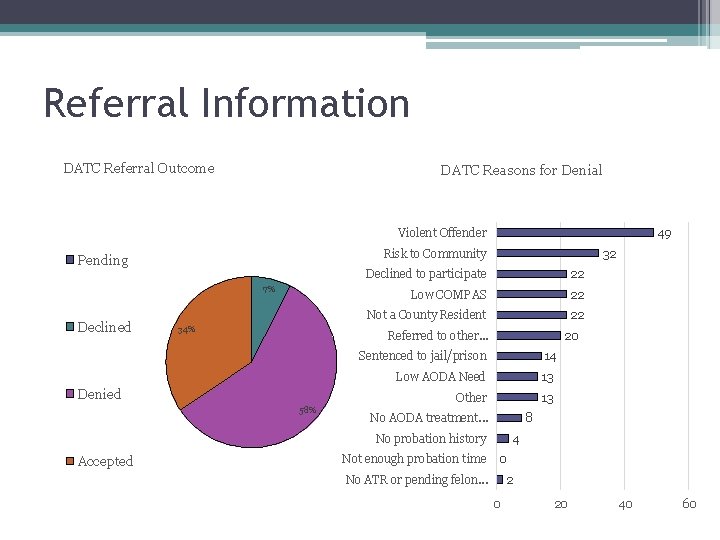
Referral Information DATC Referral Outcome DATC Reasons for Denial Violent Offender Risk to Community Pending 7% Declined 49 34% 32 Declined to participate 22 Low COMPAS 22 Not a County Resident 22 Referred to other. . . Denied 58% 20 Sentenced to jail/prison 14 Low AODA Need 13 Other 13 No AODA treatment. . . 8 No probation history Accepted Not enough probation time 4 0 No ATR or pending felon. . . 2 0 20 40 60
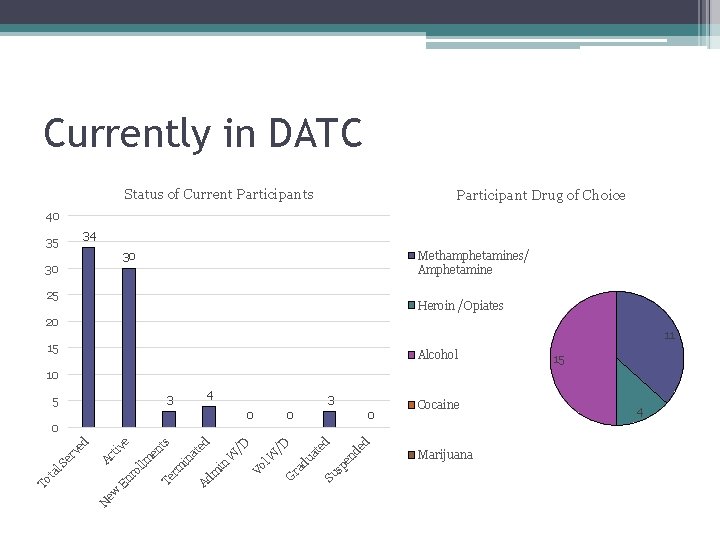
Currently in DATC Status of Current Participants Participant Drug of Choice 40 34 35 Methamphetamines/ Amphetamine 30 30 25 Heroin /Opiates 20 11 15 Alcohol 15 10 4 3 en Su sp at ra de d ed 0 du l. W W in Vo /D d m Ad rm in a en Te llm ro En N ew To te ts e tiv Ac ta l. S er ve d 0 0 /D 0 G 3 5 Cocaine Marijuana 4
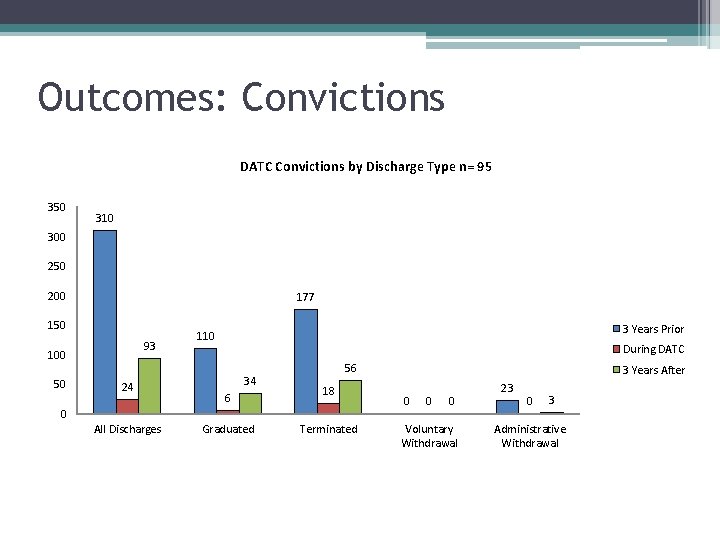
Outcomes: Convictions DATC Convictions by Discharge Type n= 95 350 310 300 250 200 177 150 93 100 50 24 3 Years Prior 110 During DATC 34 6 56 18 0 All Discharges Graduated Terminated 3 Years After 0 0 0 Voluntary Withdrawal 23 0 3 Administrative Withdrawal
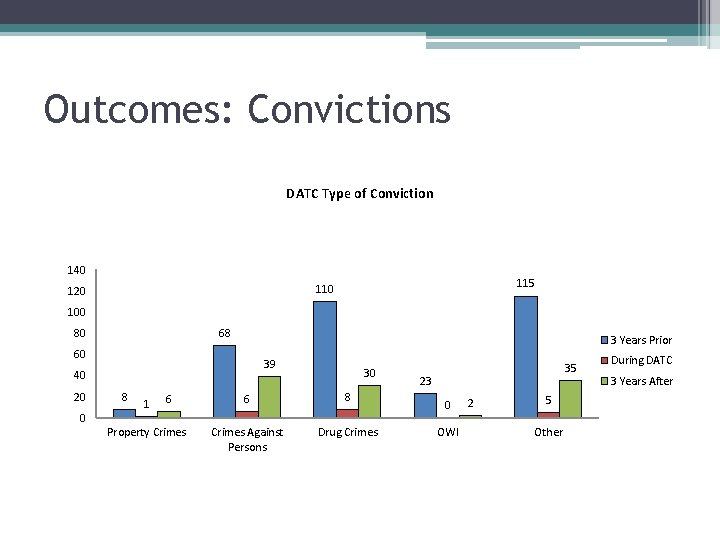
Outcomes: Convictions DATC Type of Conviction 140 115 110 120 100 68 80 3 Years Prior 60 39 40 20 0 8 1 6 Property Crimes 30 6 8 Crimes Against Persons Drug Crimes 35 23 0 OWI 2 5 Other During DATC 3 Years After
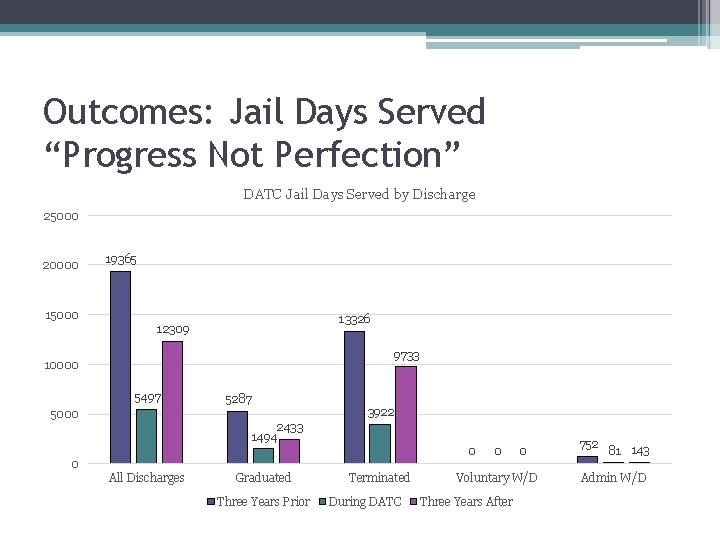
Outcomes: Jail Days Served “Progress Not Perfection” DATC Jail Days Served by Discharge 25000 20000 19365 15000 13326 12309 9733 10000 5497 5000 5287 3922 2433 1494 0 0 All Discharges Graduated Three Years Prior Terminated During DATC 0 0 Voluntary W/D Three Years After 752 81 143 Admin W/D
The mission of the Outagamie County Mental Health Court is to increase public safety and restore productive and law abiding citizens to the community by breaking the cycle of criminal behavior through effective evidence-based mental health treatment and intensive court supervision.
Who do we serve? • Outagamie County residents involved in the criminal justice system • Adults with severe and persistent mental illness • Participants with at least 24 months of probation/extended supervision upon enrollment • Individuals who pose a Medium or High risk to reoffend based on a COMPAS assessment
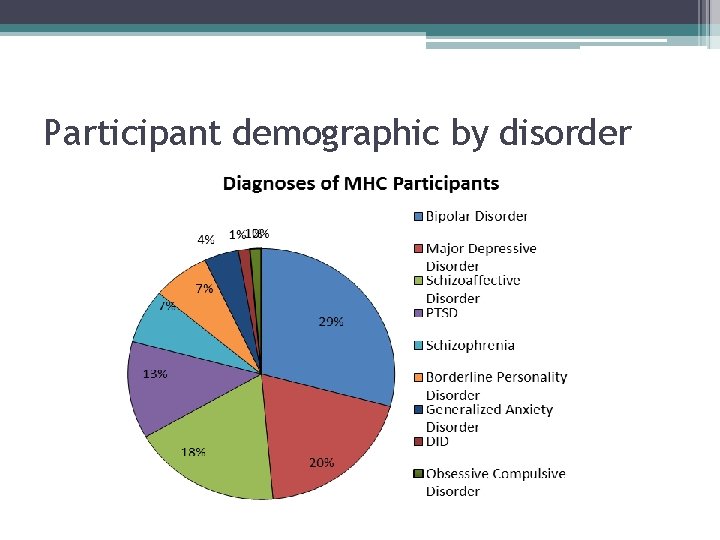
Participant demographic by disorder
What do we provide? • Linkage to the following services and supports: ▫ ▫ ▫ Individual Placement and Support for employment Mental health therapy Psychiatric monitoring Alcohol and drug treatment (outpatient and in-patient) Case management Residential options
Funding providers include: • TAD Grant (when eligible) • Medicaid billing through therapy and participation in Comprehensive Community Services • Department of Corrections • Outagamie County
Stage Progression • MHC consists of four stages • As an individual moves forward in the court, they will have more flexibility in their treatment, but there will also be higher expectations • The stages are reflective of the distal and proximal goals of the high risk/high need participants served in the MHC
Stage 1: Acute Stabilization • Weekly attendance, and meeting with Agent/Coordinator weekly • Minimum of 60 days in length, with 14 days sobriety to advance • Focus is on immediate needs: crisis stabilization, introduction to treatment providers, AODA, housing, medical/dental, etc.
Stage 2: Clinical Stabilization • Court attendance is still weekly, meeting with Agent and/or Coordinator weekly • Minimum of 90 days in length, with 30 days sobriety to advance • Focus is on developing and maintaining treatment plan, introducing pro-social activities and behaviors
Stage 3: Pro-Social Habilitation • Attend Court and meet with Agent bi-weekly, Coordinator as needed • Minimum of 90 days and 60 days sobriety to advance • Enrolled in Moral Reconation Therapy • Participants should be active in treatment
Stage 4: Adaptive Habilitation • Attend Court and meet with Agent bi-weekly, Coordinator as needed • Minimum of 120 days and 90 days sobriety to advance • Complete Moral Reconation Therapy • Participants should have a well-established Pro. Social Network
Graduation/Commencement • Once a participant has completed all necessary requirements they are eligible to apply for graduation • Participants are required to complete a Continuing Care plan and present a Recovery Project at their Graduation Ceremony • MHC graduates are welcomed and encouraged to return to court at any time
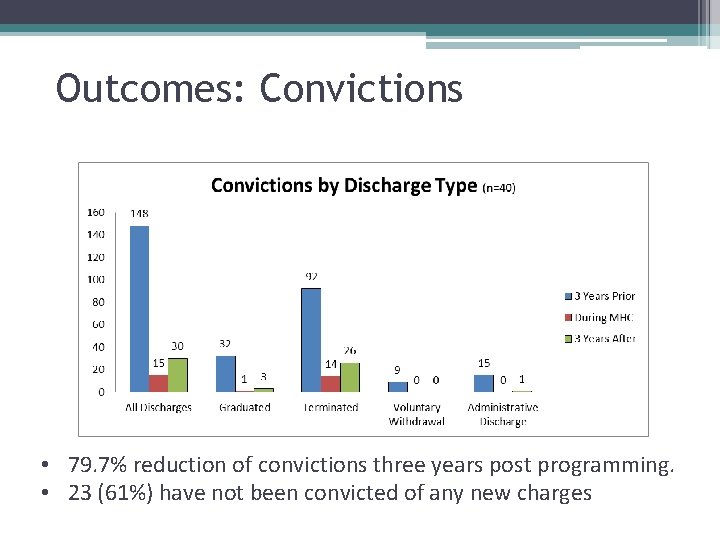
Outcomes: Convictions • 79. 7% reduction of convictions three years post programming. • 23 (61%) have not been convicted of any new charges
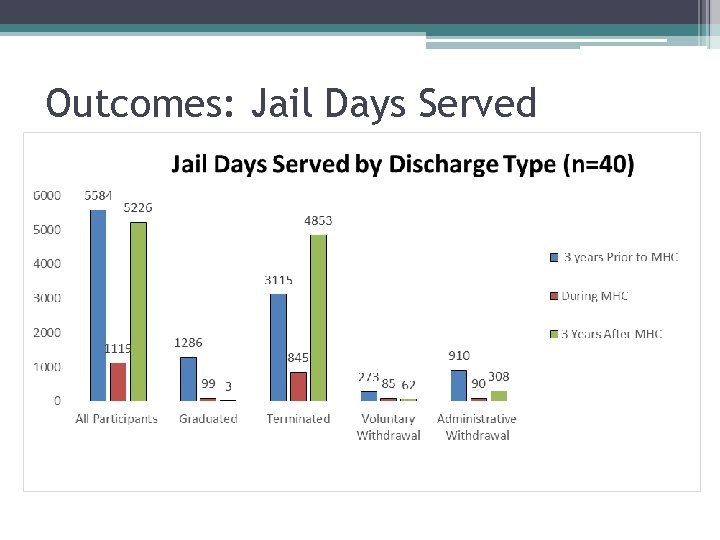
Outcomes: Jail Days Served
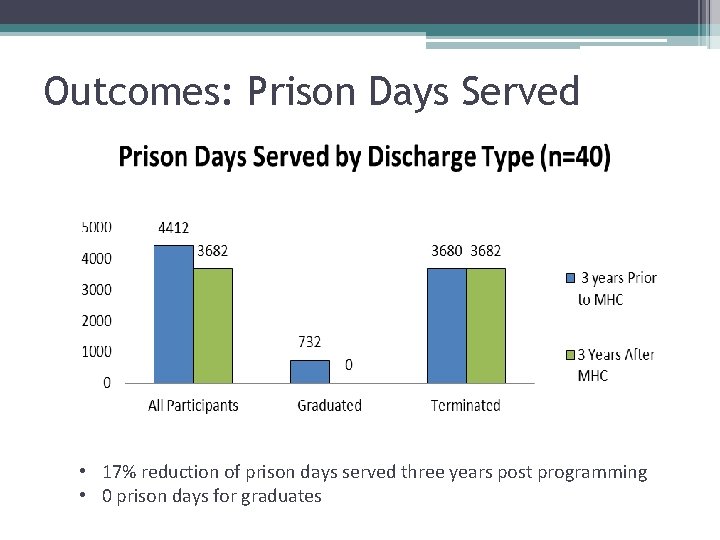
Outcomes: Prison Days Served • 17% reduction of prison days served three years post programming • 0 prison days for graduates
Challenges in the Treatment Courts • Reduction of services available during COVID-19 • Drug and alcohol testing protocol change ▫ Reduced testing during high need days ▫ Increased distance between clients and tester • • • Increase in mental health issues Transportation Decrease in face-to-face contact Decrease of peer groups (AA, NA, etc. ) Jobs lost due to COVID
How we have adapted • • • Changes to court processes Seeing client via Zoom for weekly meetings Increase in client meetings Increase in therapy sessions for clients Drug and alcohol groups have moved to video format Increase in positive praise and rewards
Future Plans and Challenges • Implementation of Peer Mentorship Program for Drug and Alcohol Treatment Court ▫ DATC graduates paired with incoming DATC participants to offer: �Same sex peer support �Encourage engagement in recovery community through AA/NA meetings and events �Provide accountability �Answer questions/assist with challenges ▫ Peer Mentorship Programs help to reduce recidivism rates and program outcomes
Future Plans and Challenges • Add an additional stage in Mental Health Court ▫ Additional freedom and less accountability to the court ▫ Participants will meet one time per month, continue with pro-social activities and one random drug test ▫ Keeping connected to the court with less interaction to help participants phase out of the program and reduce recidivism.
Resources • National Association of Drug Court Professionals: ▫ https: //www. nadcp. org/ • The Council of State Governments Justice Center: ▫ https: //csgjusticecenter. org/courts/ • Outagamie County Treatment Courts: ▫ https: //www. outagamie. org/government/departments-ae/clerk-of-circuit-courts/treatment-courts
Contact Information Taylor Geske Taylor. Geske@outagamie. org 920 -832 -5270 Fax: 920 -832 -5488 Robyn Van Bogart Robyn. Vanbogart@outagamie. org 920 -832 -5270 Fax: 920 -832 -5488
- Slides: 49