
Out of Place Examining UserCenteredness and Roving Reference

- Slides: 14
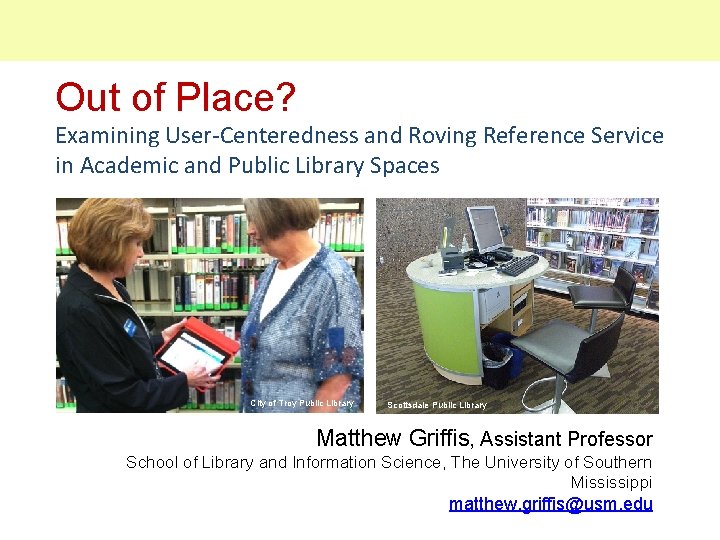
Out of Place? Examining User-Centeredness and Roving Reference Service in Academic and Public Library Spaces City of Troy Public Library Scottsdale Public Library Matthew Griffis, Assistant Professor School of Library and Information Science, The University of Southern Mississippi matthew. griffis@usm. edu
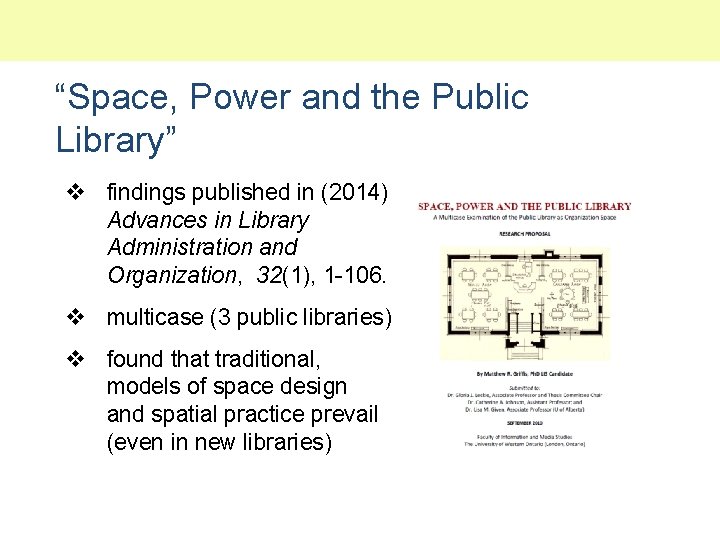
“Space, Power and the Public Library” v findings published in (2014) Advances in Library Administration and Organization, 32(1), 1 -106. v multicase (3 public libraries) v found that traditional, models of space design and spatial practice prevail (even in new libraries)
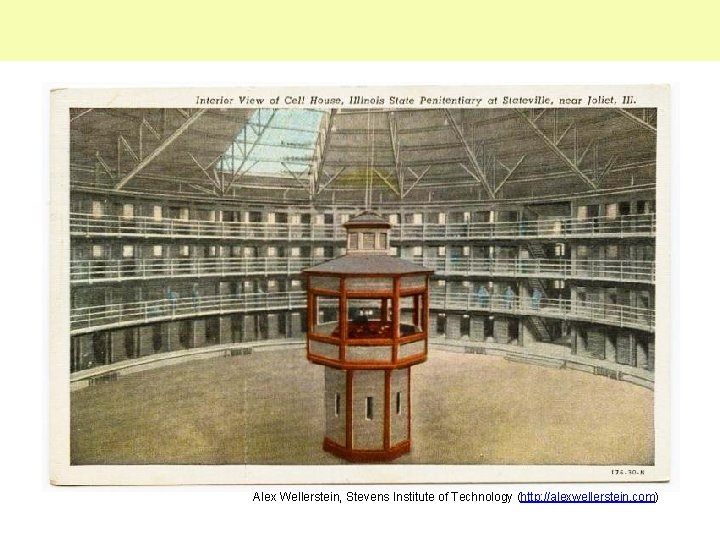
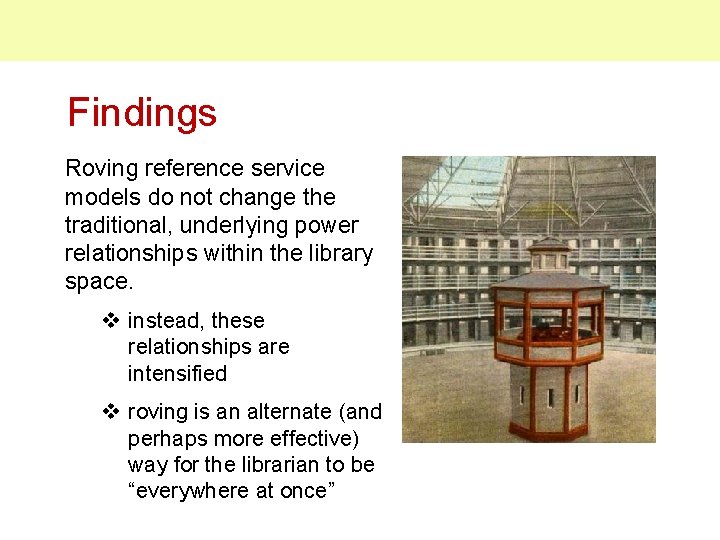
Conceptual Framework v social space: Lefebvre (1991), Lawson (2001) v space is socially produced and determines and influences relationships between people v organization space: Gutman (1972) Dale & Burrell (2008) v modern organizations use space design to enforce processes and outcomes favorable to their objectives v panopticism : Foucault (1973, 1977), Black, Pepper and Bagshaw (2009), Andrejewski (2008) v modern institutional building types have been based on “maximum efficiency” (“prison”) design
Alex Wellerstein, Stevens Institute of Technology (http: //alexwellerstein. com)
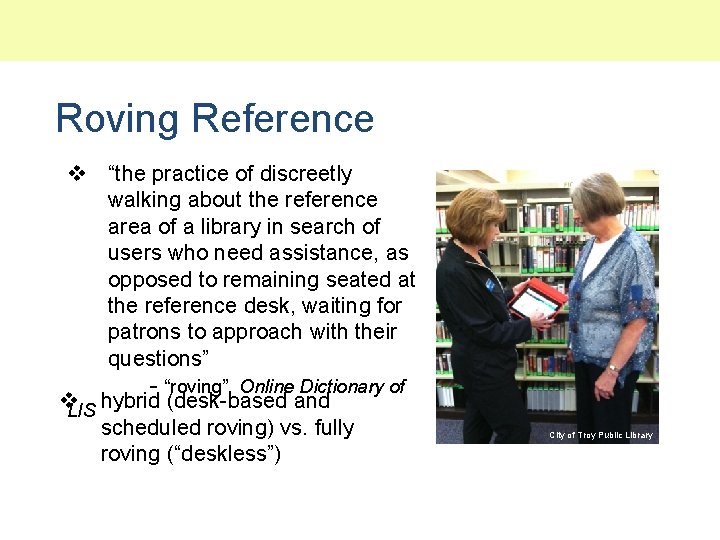
Roving Reference v “the practice of discreetly walking about the reference area of a library in search of users who need assistance, as opposed to remaining seated at the reference desk, waiting for patrons to approach with their questions” - “roving”, Online Dictionary of v LIS hybrid (desk-based and scheduled roving) vs. fully roving (“deskless”) City of Troy Public Library
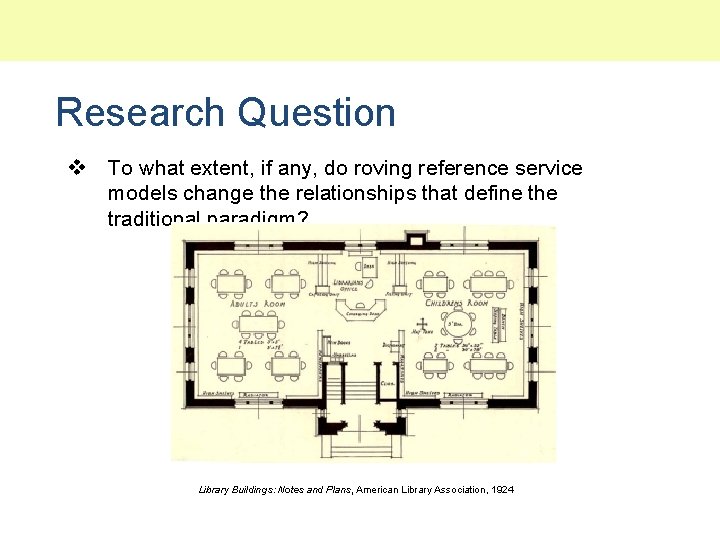
Research Question v To what extent, if any, do roving reference service models change the relationships that define the traditional paradigm? Library Buildings: Notes and Plans, American Library Association, 1924
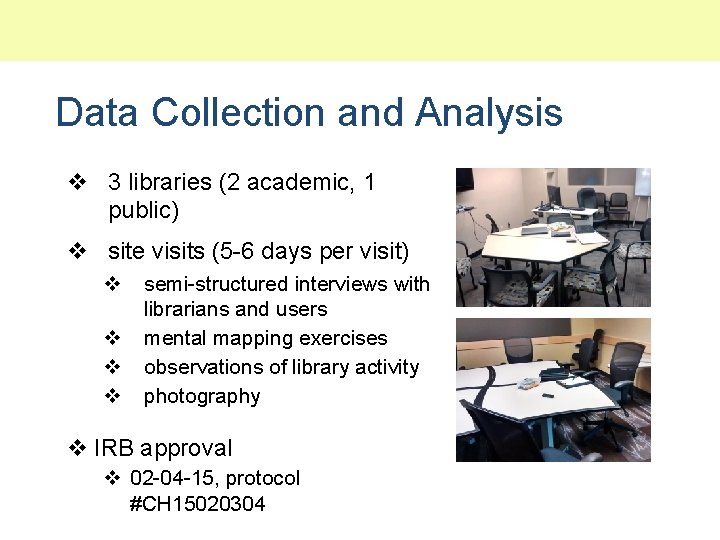
Data Collection and Analysis v 3 libraries (2 academic, 1 public) v site visits (5 -6 days per visit) v v semi-structured interviews with librarians and users mental mapping exercises observations of library activity photography v IRB approval v 02 -04 -15, protocol #CH 15020304
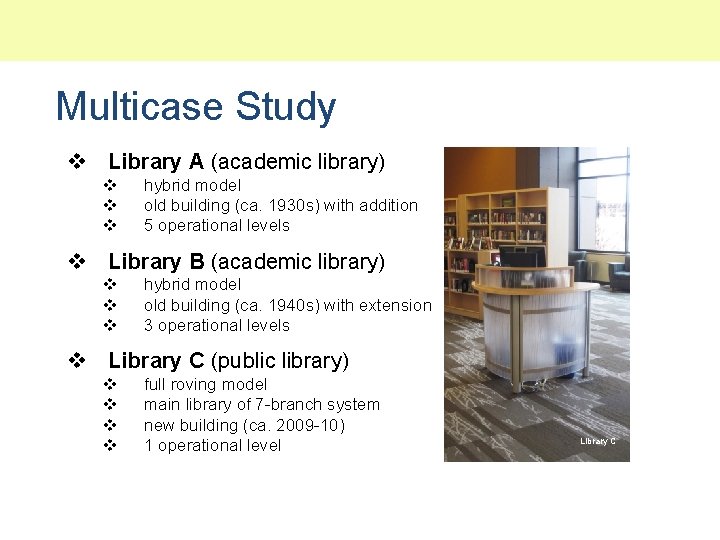
Multicase Study v Library A (academic library) v v v hybrid model old building (ca. 1930 s) with addition 5 operational levels v Library B (academic library) v v v hybrid model old building (ca. 1940 s) with extension 3 operational levels v Library C (public library) v v full roving model main library of 7 -branch system new building (ca. 2009 -10) 1 operational level Library C
Data Collection and Analysis DATA SOURCES LIBRARY A LIBRARY B LIBRARY C Interviews 8 L, 3 U 4 L, 5 U 6 L, 10 U Photographs 355 234 457 1046 photographs Observations 11 p 9 p 13 p 33 pages TOTALS 36 interviews (18 L, 18 U)
Findings Roving reference service models do not change the traditional, underlying power relationships within the library space. v instead, these relationships are intensified v roving is an alternate (and perhaps more effective) way for the librarian to be “everywhere at once”
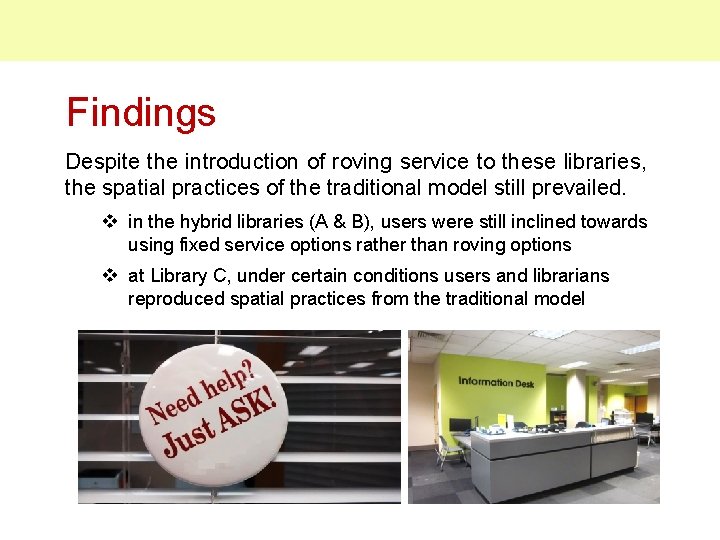
Findings Despite the introduction of roving service to these libraries, the spatial practices of the traditional model still prevailed. v in the hybrid libraries (A & B), users were still inclined towards using fixed service options rather than roving options v at Library C, under certain conditions users and librarians reproduced spatial practices from the traditional model
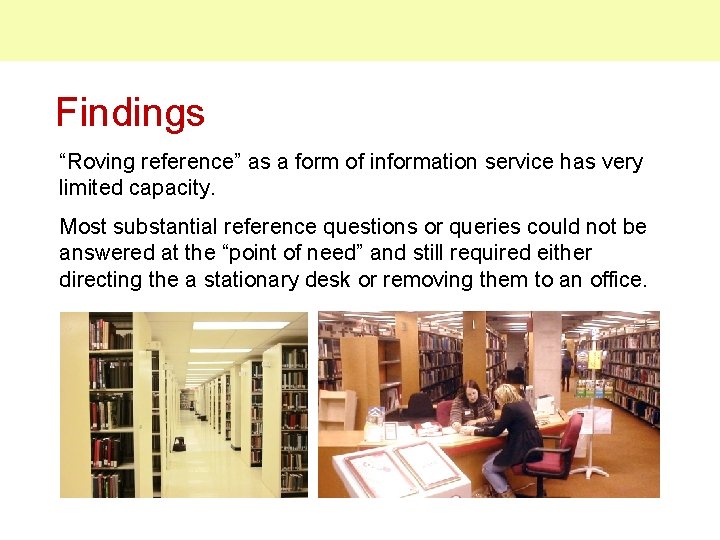
Findings “Roving reference” as a form of information service has very limited capacity. Most substantial reference questions or queries could not be answered at the “point of need” and still required either directing the a stationary desk or removing them to an office.
Conclusions To what extent, if any, does the roving reference model change the traditional, desk-based spatial model? It does not. It reinforces the underlying power relationships of the traditional model. v the user experience is not substantially different v multiple modes of service working in partnership is ideal v roving reference better as an extension of (i. e. , but not a replacement for) traditional, deskbased service?
Acknowledgements This research was funded with a 2015 OCLC/ALISE Research grant. The researcher further acknowledges the interest and cooperation of the anonymous case libraries and the anonymous interview participants. References Andrejewski, A. V. (2008). Building power: Architecture and surveillance in Victorian America. Knoxville: University of Tennessee Press. Black, A. , Pepper, S. , and Bagshaw, K. (2009). Books, buildings and social engineering. London: Ashgate. Dale, K. & Burrell, G. (2008). The spaces of organization and the organization of space: Power, identity and materiality at work. New York: Palgrave. Foucault, M. (1973). The birth of the clinic: An archaeology of medical perception. New York: Vintage. Foucault, M. (1977). Discipline and punish: The birth of the prison. New York: Random House. Gutman, R. (1972). People and buildings. New York: Basic. Lawson, B. (2001). The language of space. Boston: Architectural Press. Lefebvre, H. (1991). The production of space. D. Nicholson-Smith, trans. Oxford: Blackwell.