
Out of Hours GP Trainee Induction 2019 Oscar

- Slides: 60
Out of Hours GP Trainee Induction- 2019 Oscar Onyebuchi, Clinical Lead Kate Mc. Lean, CAS Manager Luisa Gaiteri, Clinical Recruiter
What does OOH mean to me? • Training requirement; I don’t see myself working in the OOH Service. • Might enjoy it and could possibly form a portion of my income. • I enjoy it and its flexibility. Makes my routine in-hour GP work easier. Would form a proportion of my income.
Aims of Session • • • GP OOH training requirements and competencies Progression of training Trainee responsibilities History of HUC NHS 111/OOH overview OOH roles Booking shifts Overview of clinical system – Systm. One The patient journey through OOH
GP OOH Training q Minimum of 72 hours over the 3 years training to attain competencies necessary for unscheduled care (48 hours in traditional OOH in ST 3) "Time served" should not be seen as the model against which to define the attainment of urgent & unscheduled care capabilities. ” “Knowledge and skills relevant to attaining urgent care capabilities can be attained through learning undertaken in both hospital placements and GP placements but alone will be insufficient to address the full range of urgent & unscheduled / out of hours' capabilities” (RCGP/ COGPED, 2019)
GP OOH Training. . contd Areas that may contribute to urgent & unscheduled care capabilities include: • "In Hours" Urgent and Unscheduled Services in GP practices including undertaking "Duty Doctor" sessions • GP Extended Hours where the service being provided includes provision of urgent appointments and is not limited to only encompass "routine" follow up of long term conditions • Urgent Care / Treatment Centres • Primary Care services delivered within a secondary / community care provider
Types of training sessions • • “Observational – Typically ST 1. Trainee observes health professional consulting in urgent and unscheduled care but has no input into patient management. Includes relevant courses. The time comes out of protected learning time during the normal working week. Direct – Typically ST 1/2. Trainees consult patients with an approved supervisor present. This could include a joint surgery on call in the practice as part of the self-directed study time. For sessions undertaken in settings outside of the normal training practice and working hours, time off in lieu should be granted. Near – Typically ST 3 but could be ST 1/2 if competent. Approved clinical supervisor is readily available in the same building. Time off in lieu must be given for sessions undertaken outside of normal working hours. Remote – ST 3 trainees only. Approved clinical supervisor available by phone. Time off in lieu must be given for sessions undertaken outside of normal working hours. ” (HEE EOE)
GP OOH Training. . contd q Aim to do your sessions with a few supervisors/ same supervisor in your ST 3 to establish rapport, monitor progress and improve learning q. Complete e-portfolio entry for each session and attach “Urgent and Unscheduled Care Observational Session Record” to demonstrate evidence q. Plan and book shifts early. Make sure they are evenly spread. Bear in mind new junior doctors contract requirements.
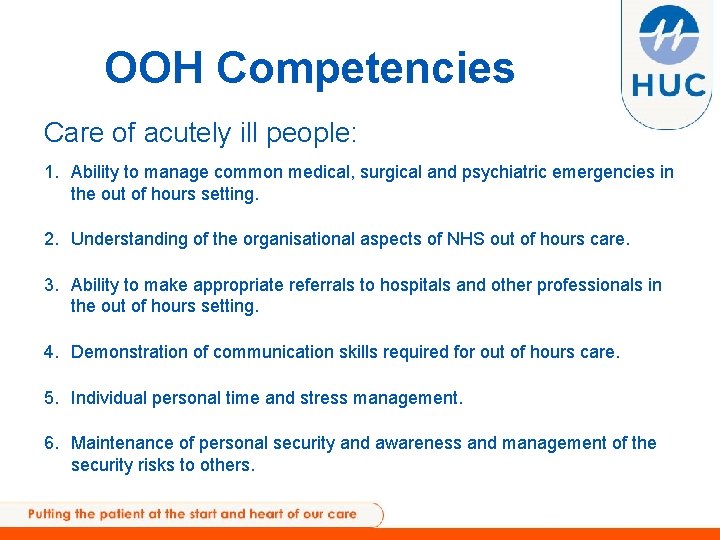
OOH Competencies Care of acutely ill people: 1. Ability to manage common medical, surgical and psychiatric emergencies in the out of hours setting. 2. Understanding of the organisational aspects of NHS out of hours care. 3. Ability to make appropriate referrals to hospitals and other professionals in the out of hours setting. 4. Demonstration of communication skills required for out of hours care. 5. Individual personal time and stress management. 6. Maintenance of personal security and awareness and management of the security risks to others.
Useful Resources for OOH Requirements • https: //www. rcgp. org. uk/training-exams/training/mrcgp-workplacebased-assessment-wpba/out-of-hours. aspx • https: //heeoe. hee. nhs. uk/general_practice/gp-trainees/urgent-andunscheduled-care
Integrated Urgent care service • https: //youtu. be/FIZZu 4 R 6 y. EU
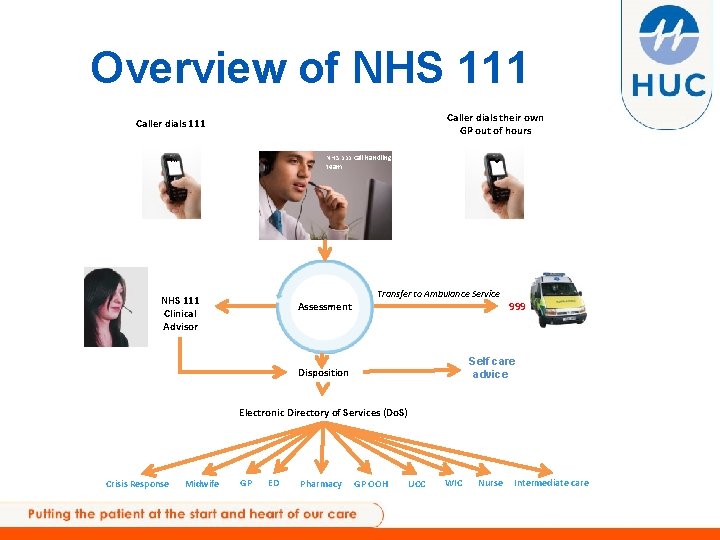
Overview of NHS 111 Caller dials their own GP out of hours Caller dials 111 NHS 111 call handling team 111 NHS 111 Clinical Advisor Assessment GP Transfer to Ambulance Service 999 Self care advice Disposition Electronic Directory of Services (Do. S) Crisis Response Midwife GP ED Pharmacy GP OOH UCC WIC Nurse Intermediate care
Who are HUC? • Social Enterprise (not-for-profit organisation). • NHS 111 and Out of Hours service provider for Hertfordshire and west Essex, Luton & Bedfordshire, Cambridgeshire & Peterborough. • NHS 111 contact centre in Bedford, Welwyn Garden City, Peterborough with call handlers and clinicians. • Clinical Assessment Service (CAS): GP in contact centre to revalidate ED dispositions and re-triage of green ambulances. • Numerous primary care centres and visiting cars. • Other services provided include: – – – Urgent Treatment Centres Extended Access service (West Essex) Acute in-hours Visiting Service (East & North Herts) GP Practices District Nurse call-handling
Trainee Responsibilities • Booking and organising own OOH Shifts • To attend and work full shift. Non-attendance is a probity issue • Minimum 2 weeks notice to cancel a shift. • Up to date BLS and safeguarding competence • Have nhs. net e-mail account • Bring smartcards and own equipment to shifts
Equipment to bring • • • Stethoscopes, Otoscopes, Ophthalmoscopes, Tendon hammers, Sphygmomanometer, Thermometer
Shift Roles • Telephone Triage/GP 111/CAS • Base • Visiting • Redeye GP (overnight shifts)
Which shifts can be booked? • ST 1 Trainees can book base, visiting or HQ telephone triage shifts on Monday – Friday evenings. • Saturdays and Sundays - Visiting shifts only (excluding HQ). NO WEEKEND OR BANK HOLIDAY BASE SHIFTS, CAS, OR HQ SHIFTS.
Which Shifts can be booked? • ST 2 Trainees can book base, visiting or HQ telephone triage shifts Monday-Friday evenings, Saturday & Sunday visiting shifts (excluding HQ) and afternoon and evening base shifts. • NO WEEKEND MORNING BASE SHIFTS, MCAS, HQ SHIFTS OR BANK HOLIDAY MORNINGS.
Which Shifts can be booked? • ST 3 Trainees can book shifts anytime. • SENIOR CAS AND 111 TRIAGE SHIFTS ST 3 ONLY
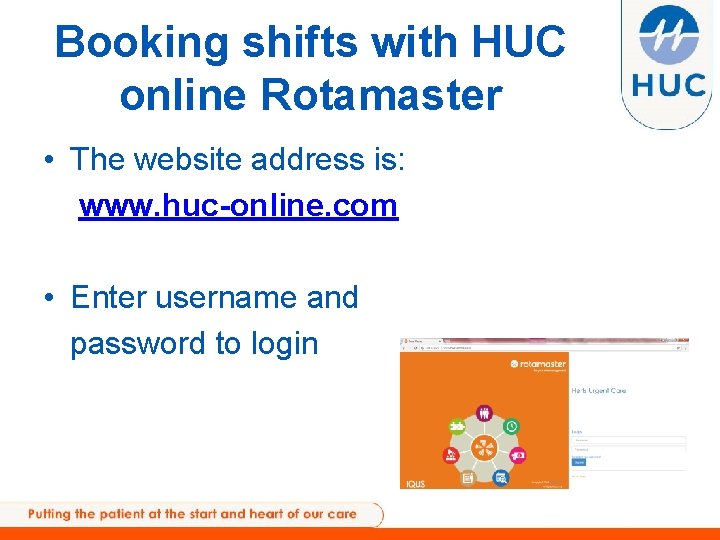
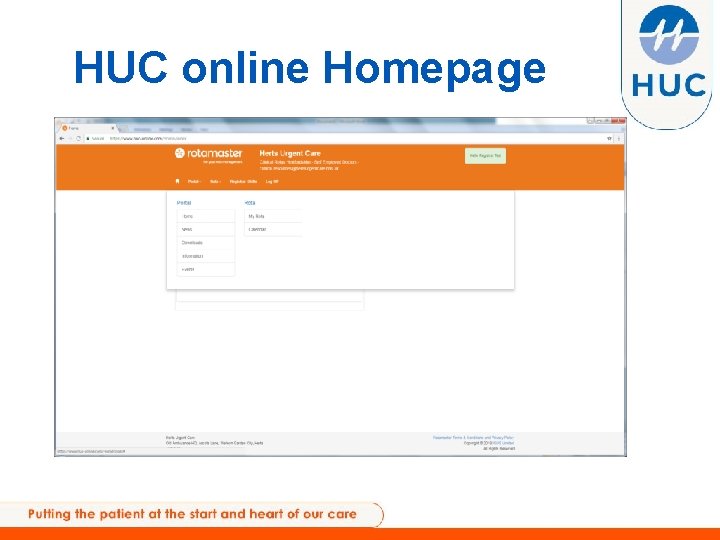
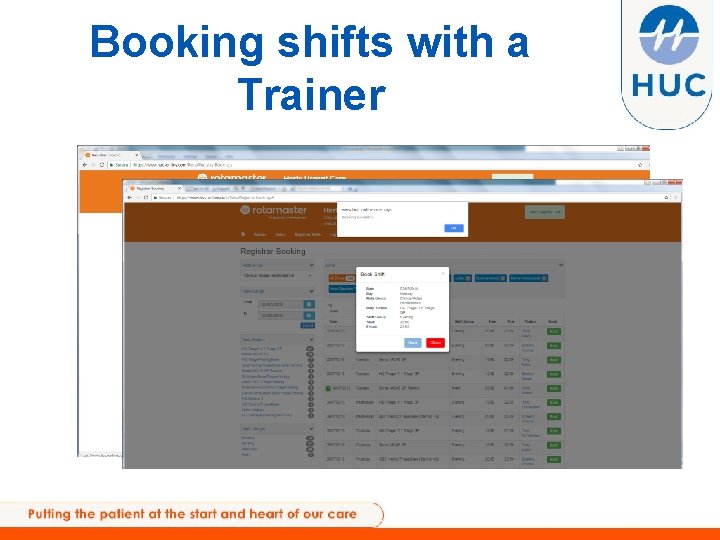
Booking shifts with HUC online Rotamaster • The website address is: www. huc-online. com • Enter username and password to login
HUC online Homepage
Booking shifts with a Trainer
Clinical Resources Team • Hertfordshire 01707 385933 • Luton & Bedfordshire 01707 384983 • Cambridge & Peterborough 385932 • clinical. resources@hertsurgentcare. nhs. uk • bedfordshire. rotas@hertsurgentcare. nhs. uk • peterborough. rotas@hertsurgentcare. nhs. uk 01707
Things you will need for shifts • NHS Smartcard • Own equipment - Stethoscopes, otoscopes, ophthalmoscopes, tendon hammers, sphygmomanometers, thermometers. • Login details for Systm. One
Overview of Systm. One OOH consultation skills and practical advice THE PATIENT OOH JOURNEY
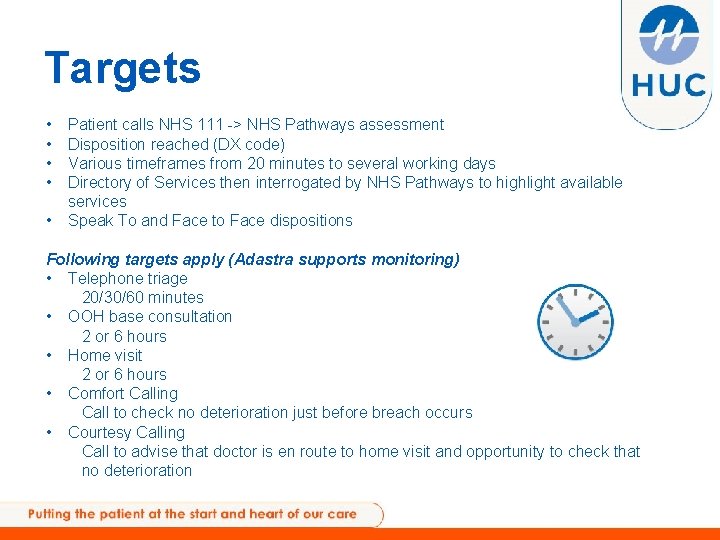
Targets • • • Patient calls NHS 111 -> NHS Pathways assessment Disposition reached (DX code) Various timeframes from 20 minutes to several working days Directory of Services then interrogated by NHS Pathways to highlight available services Speak To and Face to Face dispositions Following targets apply (Adastra supports monitoring) • Telephone triage 20/30/60 minutes • OOH base consultation 2 or 6 hours • Home visit 2 or 6 hours • Comfort Calling Call to check no deterioration just before breach occurs • Courtesy Calling Call to advise that doctor is en route to home visit and opportunity to check that no deterioration
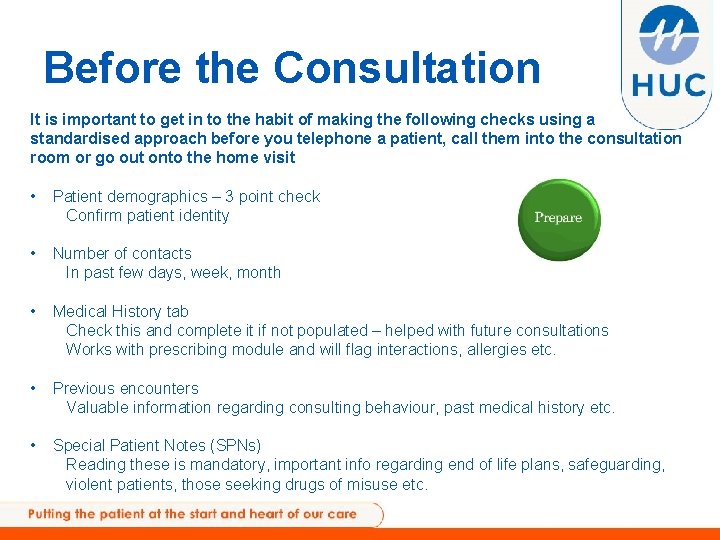
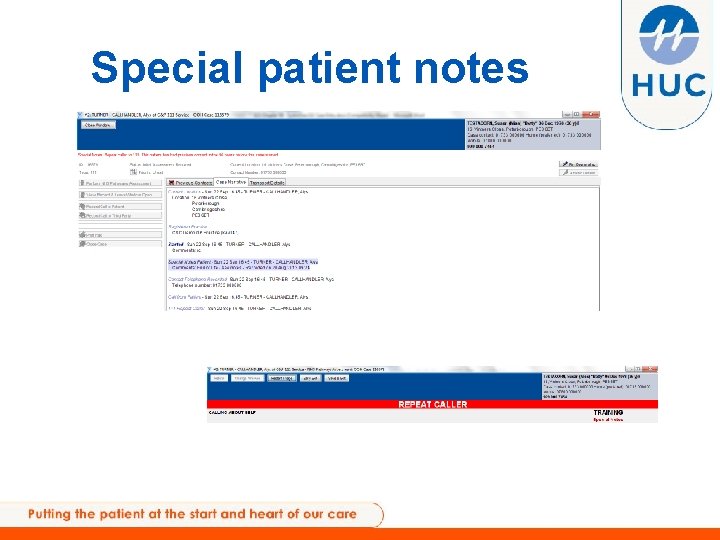
Before the Consultation It is important to get in to the habit of making the following checks using a standardised approach before you telephone a patient, call them into the consultation room or go out onto the home visit • Patient demographics – 3 point check Confirm patient identity • Number of contacts In past few days, week, month • Medical History tab Check this and complete it if not populated – helped with future consultations Works with prescribing module and will flag interactions, allergies etc. • Previous encounters Valuable information regarding consulting behaviour, past medical history etc. • Special Patient Notes (SPNs) Reading these is mandatory, important info regarding end of life plans, safeguarding, violent patients, those seeking drugs of misuse etc.
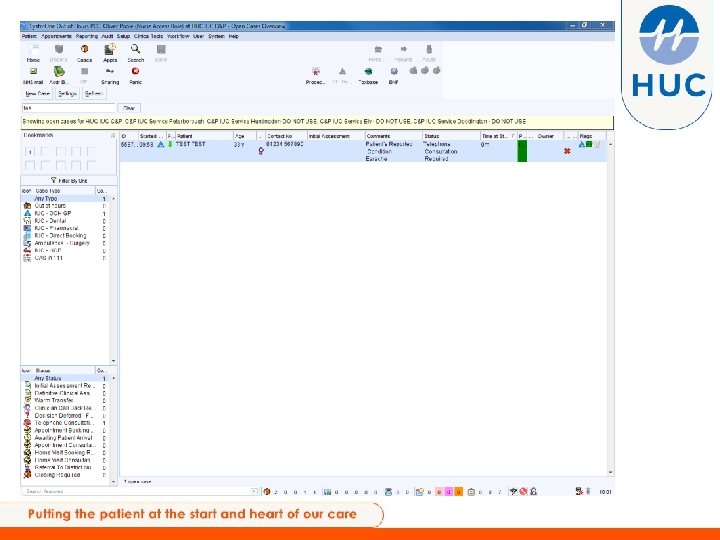
Special patient notes
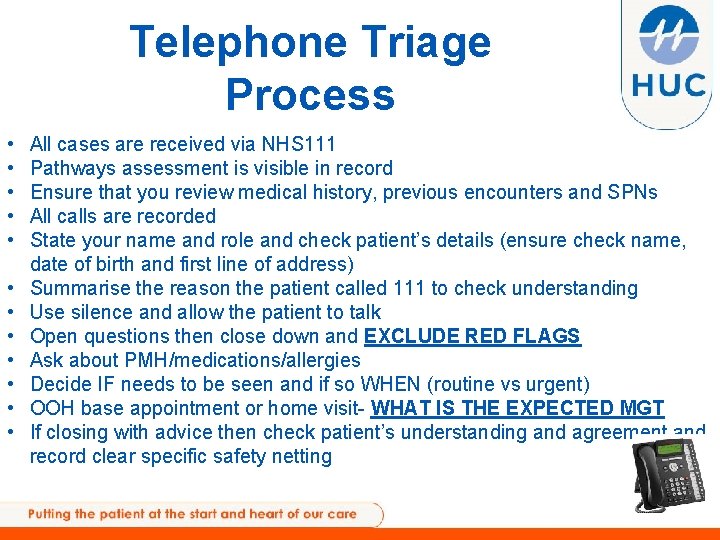
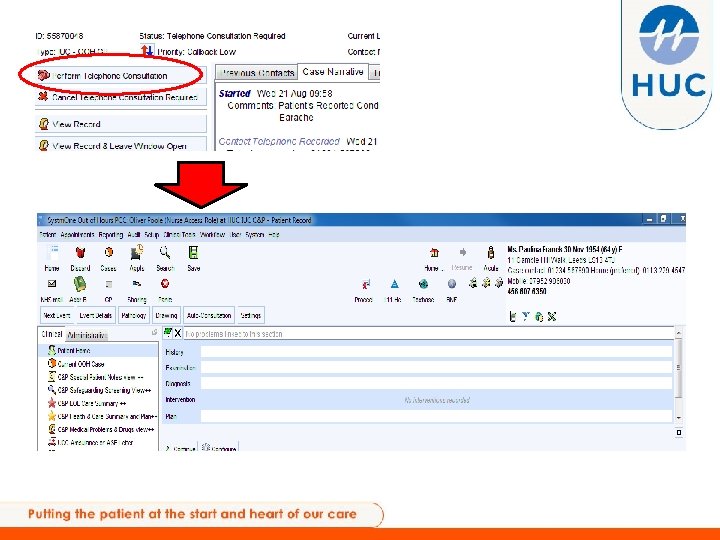
Telephone Triage Process • • • All cases are received via NHS 111 Pathways assessment is visible in record Ensure that you review medical history, previous encounters and SPNs All calls are recorded State your name and role and check patient’s details (ensure check name, date of birth and first line of address) Summarise the reason the patient called 111 to check understanding Use silence and allow the patient to talk Open questions then close down and EXCLUDE RED FLAGS Ask about PMH/medications/allergies Decide IF needs to be seen and if so WHEN (routine vs urgent) OOH base appointment or home visit- WHAT IS THE EXPECTED MGT If closing with advice then check patient’s understanding and agreement and record clear specific safety netting
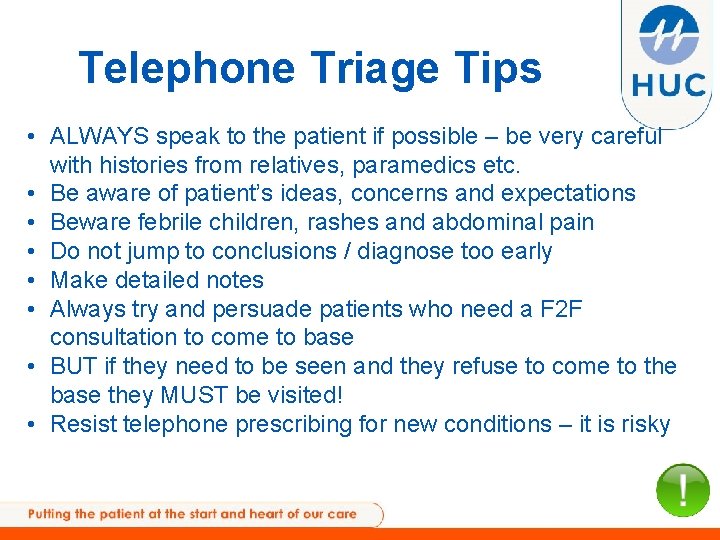
Telephone Triage Tips • ALWAYS speak to the patient if possible – be very careful with histories from relatives, paramedics etc. • Be aware of patient’s ideas, concerns and expectations • Beware febrile children, rashes and abdominal pain • Do not jump to conclusions / diagnose too early • Make detailed notes • Always try and persuade patients who need a F 2 F consultation to come to base • BUT if they need to be seen and they refuse to come to the base they MUST be visited! • Resist telephone prescribing for new conditions – it is risky
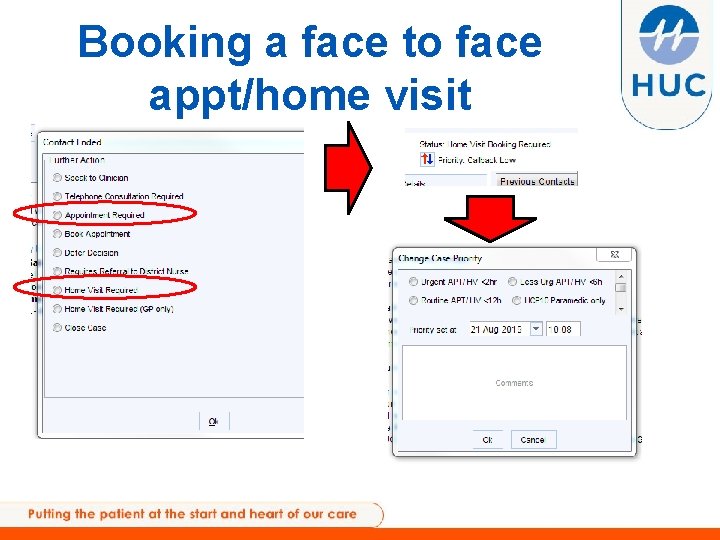
Booking a face to face appt/home visit
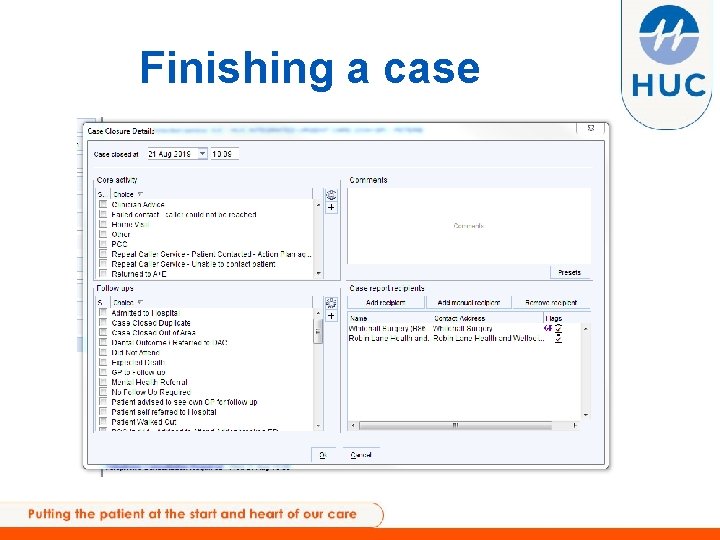
Finishing a case
Face to Face appointments at urgent care centres • Traditional face to face consultations at base • Booked appointments • Don’t be too relaxed in approach – there are still risks: No access to medical records at times No knowledge of the patient Reliant upon the history obtained from the patient A need to take the patient at face value • Keep detailed records Significant negatives Red flags PMH/medications/allergies Differential diagnoses Management plan Safety netting – timely and specific
Home visits • Reserved for patients who require a face to face assessment and who are: • Too unwell to come to the OOH (e. g. nursing home patient with SOB) • Immobile or bedbound (e. g. MS patient with UTI, housebound elderly patient with vomiting) • Palliative care • Unable to attend the OOH due to circumstances e. g. single mother with younger children etc. • High risk mental health patient • • Routine 6 hours Urgent 2 hours • • You will regularly be faced with patients who insist on a home visit Negotiation and a rational discussion will be required including other methods of transport (public transport, friends and relatives etc. ) BUT……. . ultimately the clinical needs of a patient who requires a face to face consultation during the OOH period must come before any disagreement about their ability to come to base. The OOH Visiting Service Car and driver Remote Medications Equipment
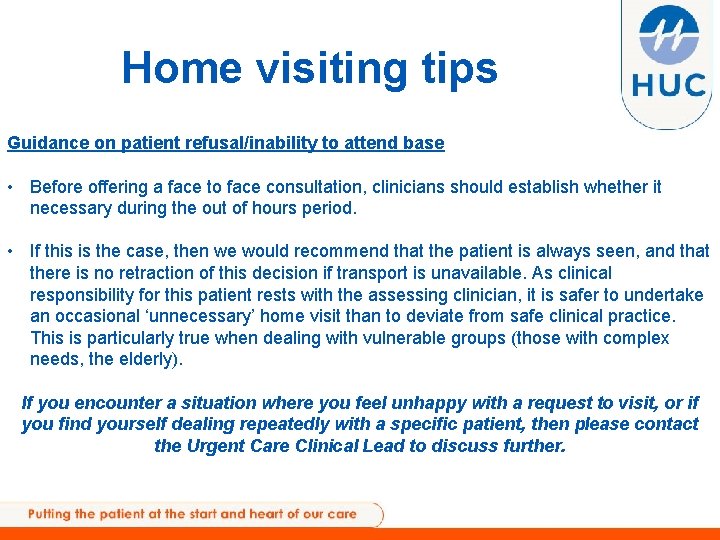
Home visiting tips Guidance on patient refusal/inability to attend base • Before offering a face to face consultation, clinicians should establish whether it necessary during the out of hours period. • If this is the case, then we would recommend that the patient is always seen, and that there is no retraction of this decision if transport is unavailable. As clinical responsibility for this patient rests with the assessing clinician, it is safer to undertake an occasional ‘unnecessary’ home visit than to deviate from safe clinical practice. This is particularly true when dealing with vulnerable groups (those with complex needs, the elderly). If you encounter a situation where you feel unhappy with a request to visit, or if you find yourself dealing repeatedly with a specific patient, then please contact the Urgent Care Clinical Lead to discuss further.
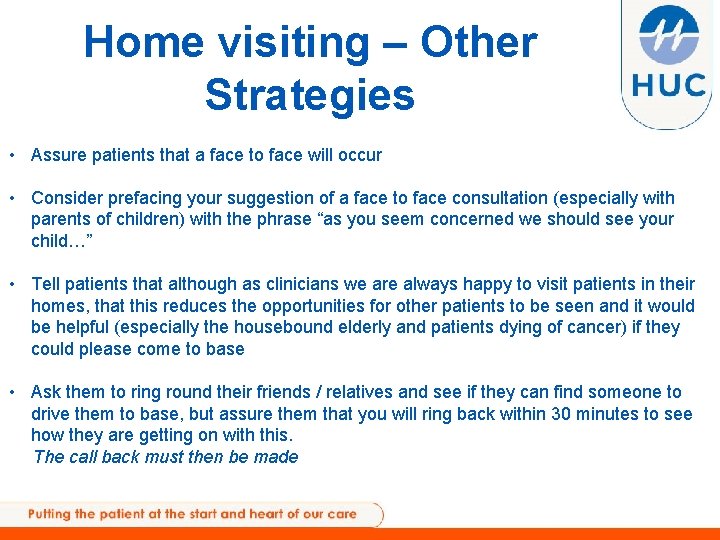
Home visiting – Other Strategies • Assure patients that a face to face will occur • Consider prefacing your suggestion of a face to face consultation (especially with parents of children) with the phrase “as you seem concerned we should see your child…” • Tell patients that although as clinicians we are always happy to visit patients in their homes, that this reduces the opportunities for other patients to be seen and it would be helpful (especially the housebound elderly and patients dying of cancer) if they could please come to base • Ask them to ring round their friends / relatives and see if they can find someone to drive them to base, but assure them that you will ring back within 30 minutes to see how they are getting on with this. The call back must then be made
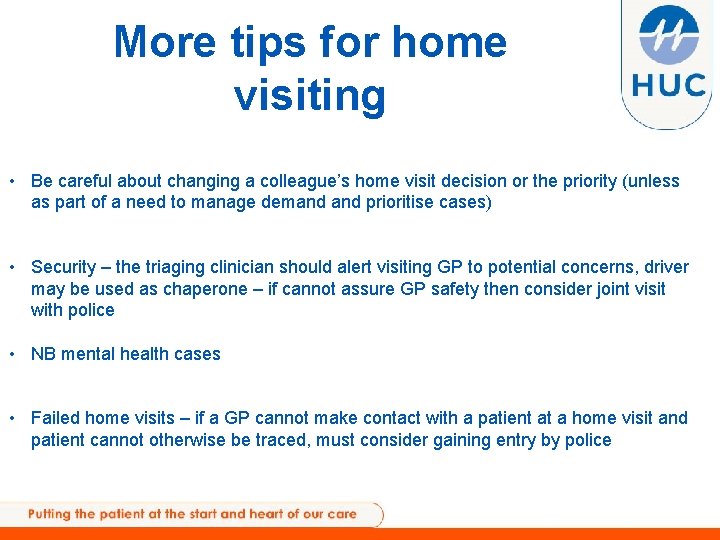
More tips for home visiting • Be careful about changing a colleague’s home visit decision or the priority (unless as part of a need to manage demand prioritise cases) • Security – the triaging clinician should alert visiting GP to potential concerns, driver may be used as chaperone – if cannot assure GP safety then consider joint visit with police • NB mental health cases • Failed home visits – if a GP cannot make contact with a patient at a home visit and patient cannot otherwise be traced, must consider gaining entry by police
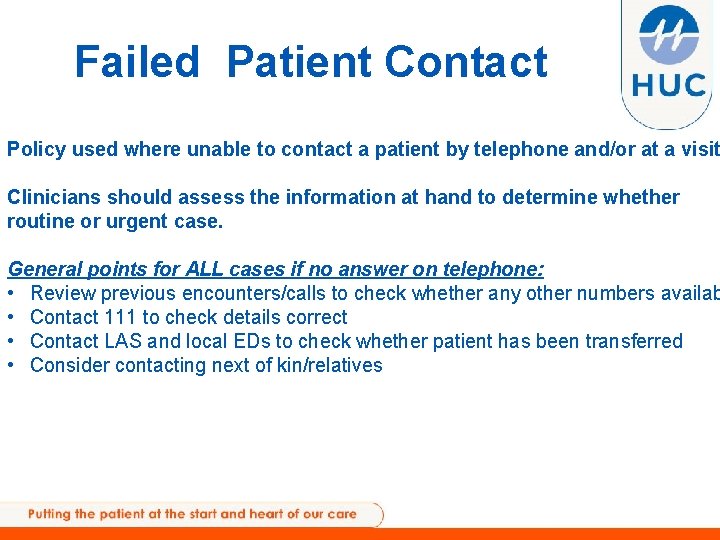
Failed Patient Contact Policy used where unable to contact a patient by telephone and/or at a visit Clinicians should assess the information at hand to determine whether routine or urgent case. General points for ALL cases if no answer on telephone: • Review previous encounters/calls to check whether any other numbers availab • Contact 111 to check details correct • Contact LAS and local EDs to check whether patient has been transferred • Consider contacting next of kin/relatives
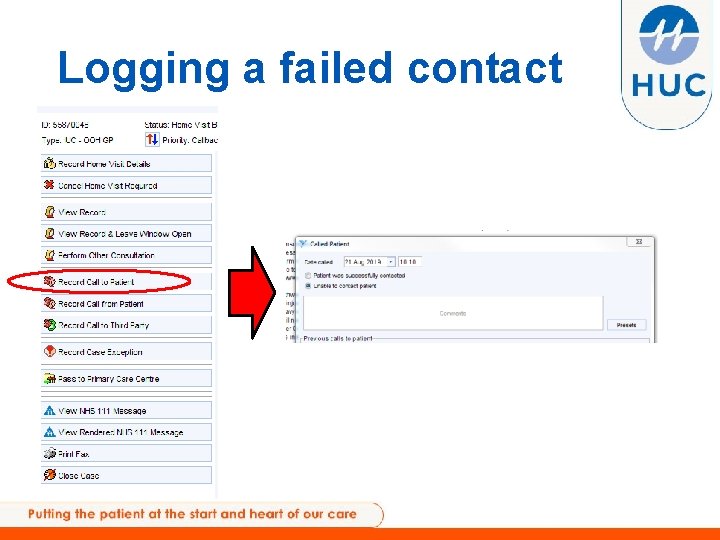
Logging a failed contact
Failed contact – Routine/Low risk cases • Make 2 attempts 20 minutes apart over one hour • Log each call on Systm. One – “Record Call to Patient” • If no contact risk assess case and either close case (e. g. leaving answerphone message with call back advice and document information to be passed to own GP) or pass for OOH visit
Failed contact – high risk cases • Make 3 attempts every 10 minutes for 30 minutes • Check telephone number by looking up previous calls, asking 111 to check number – note that you have done this • Check whether patient has contacted LAS and contact local hospitals • If still unable to contact patient pass for urgent visit • If not able to contact patient at the address contact police to gain entry in light of urgent priority • GP to remain at address until police arrive
Did not attend • Where patients are > 60 minutes late for their booked appointment the case will return to the GP callback list to be contacted to check on well-being • GP telephones patients and assesses • If patient declines appointment (e. g. states that they are better) GP to document this and close case • Otherwise if patient wishes appt or GP advises that it is clinically necessary appropriate appt is booked
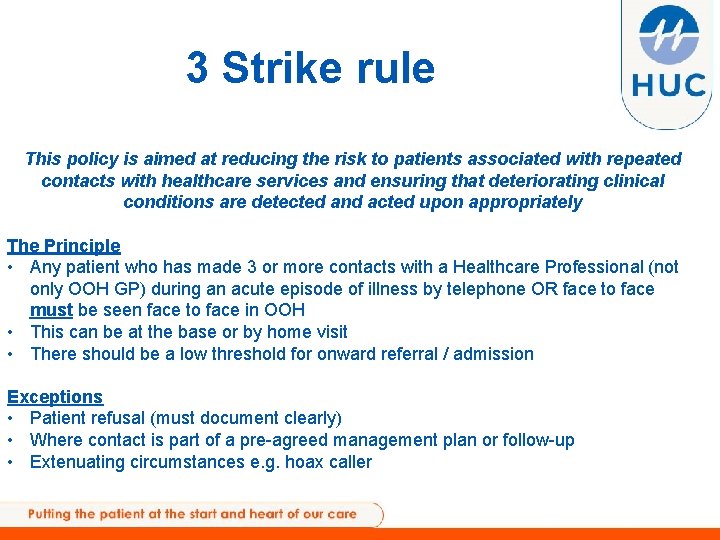
3 Strike rule This policy is aimed at reducing the risk to patients associated with repeated contacts with healthcare services and ensuring that deteriorating clinical conditions are detected and acted upon appropriately The Principle • Any patient who has made 3 or more contacts with a Healthcare Professional (not only OOH GP) during an acute episode of illness by telephone OR face to face must be seen face to face in OOH • This can be at the base or by home visit • There should be a low threshold for onward referral / admission Exceptions • Patient refusal (must document clearly) • Where contact is part of a pre-agreed management plan or follow-up • Extenuating circumstances e. g. hoax caller
Out of Hours SPECIAL SCENARIOS
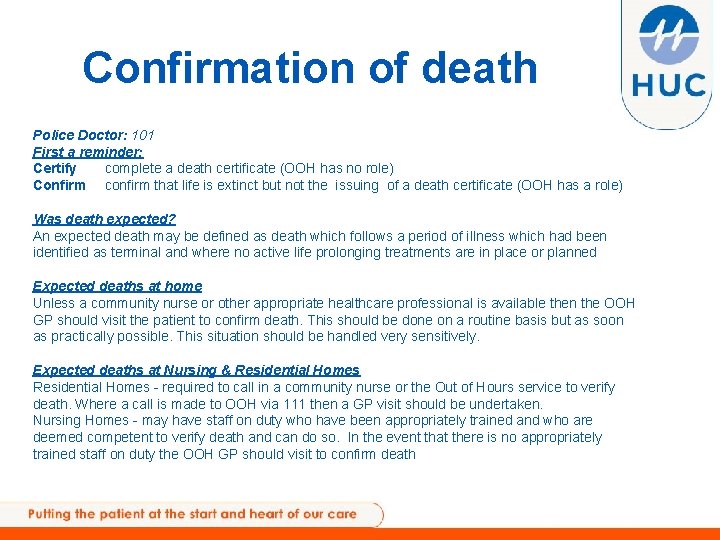
Confirmation of death Police Doctor: 101 First a reminder: Certify complete a death certificate (OOH has no role) Confirm confirm that life is extinct but not the issuing of a death certificate (OOH has a role) Was death expected? An expected death may be defined as death which follows a period of illness which had been identified as terminal and where no active life prolonging treatments are in place or planned Expected deaths at home Unless a community nurse or other appropriate healthcare professional is available then the OOH GP should visit the patient to confirm death. This should be done on a routine basis but as soon as practically possible. This situation should be handled very sensitively. Expected deaths at Nursing & Residential Homes - required to call in a community nurse or the Out of Hours service to verify death. Where a call is made to OOH via 111 then a GP visit should be undertaken. Nursing Homes - may have staff on duty who have been appropriately trained and who are deemed competent to verify death and can do so. In the event that there is no appropriately trained staff on duty the OOH GP should visit to confirm death
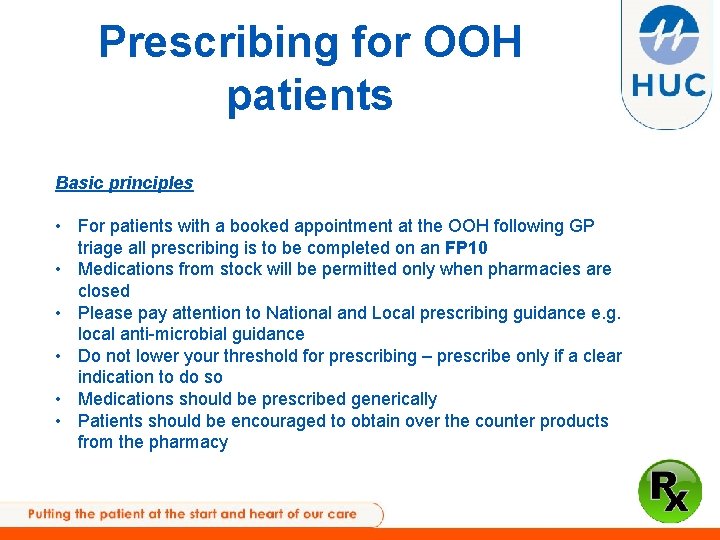
Prescribing for OOH patients Basic principles • For patients with a booked appointment at the OOH following GP triage all prescribing is to be completed on an FP 10 • Medications from stock will be permitted only when pharmacies are closed • Please pay attention to National and Local prescribing guidance e. g. local anti-microbial guidance • Do not lower your threshold for prescribing – prescribe only if a clear indication to do so • Medications should be prescribed generically • Patients should be encouraged to obtain over the counter products from the pharmacy
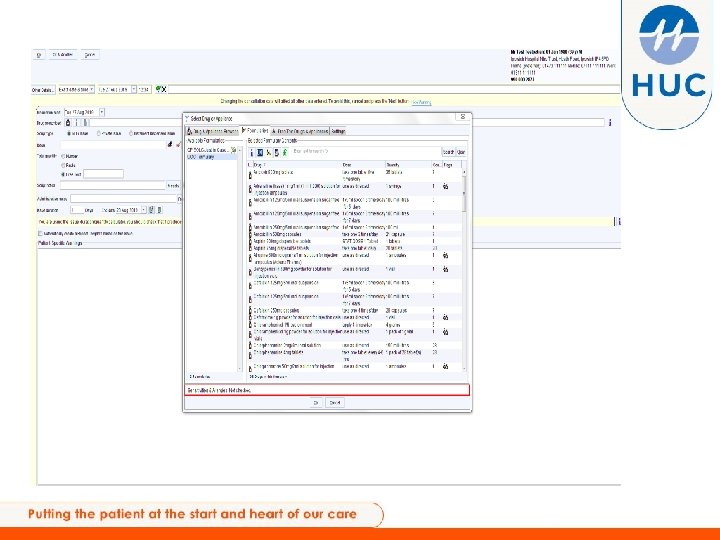
Record keeping of Prescriptions • Past medical history, medications and allergies must be recorded • Prescriptions must contain correct dosage instructions and quantity • Handwritten prescriptions to be used only when IT fails • Good practice to prescribe medication in the patient record after FP 10 issued during a home visit- helps with checking drug interaction, etc
Acute prescriptions • Complete courses to be prescribed • Analgesia – pay attention to analgesic ladder and be wary of opioids in opioid naïve patients • Maximum 7 day supply unless otherwise indicated (e. g. penicillin in scarlet fever) • No methadone or Subutex to be prescribed under any circumstances • Maximum 3 days supply low dose diazepam e. g. 2 mg qds for 3 days
Personally administered drugs • Patients may occasionally need PA drugs • The drug name, dose, batch number, expiry date, route of admin, site of admin and time and date of admin must all be recorded • FP 10 REC must be completed
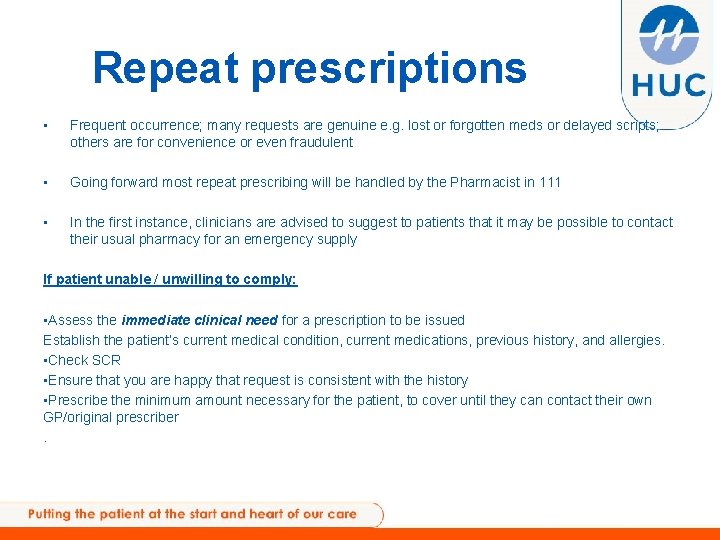
Repeat prescriptions • Frequent occurrence; many requests are genuine e. g. lost or forgotten meds or delayed scripts; others are for convenience or even fraudulent • Going forward most repeat prescribing will be handled by the Pharmacist in 111 • In the first instance, clinicians are advised to suggest to patients that it may be possible to contact their usual pharmacy for an emergency supply If patient unable / unwilling to comply: • Assess the immediate clinical need for a prescription to be issued Establish the patient’s current medical condition, current medications, previous history, and allergies. • Check SCR • Ensure that you are happy that request is consistent with the history • Prescribe the minimum amount necessary for the patient, to cover until they can contact their own GP/original prescriber.
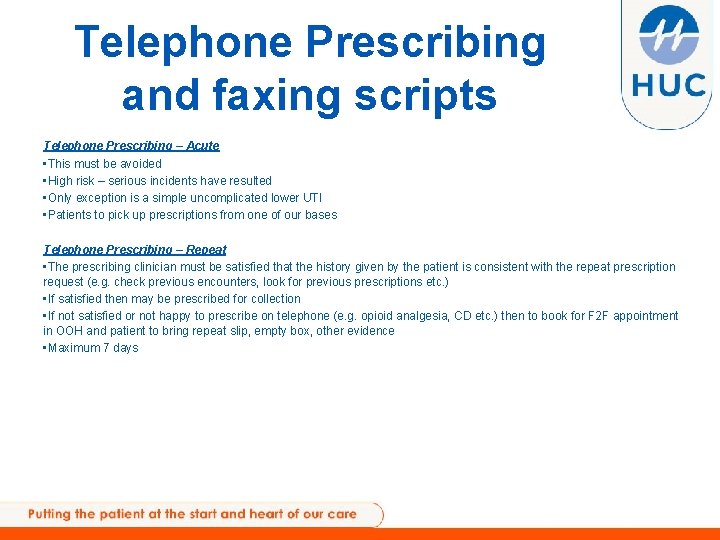
Telephone Prescribing and faxing scripts Telephone Prescribing – Acute • This must be avoided • High risk – serious incidents have resulted • Only exception is a simple uncomplicated lower UTI • Patients to pick up prescriptions from one of our bases Telephone Prescribing – Repeat • The prescribing clinician must be satisfied that the history given by the patient is consistent with the repeat prescription request (e. g. check previous encounters, look for previous prescriptions etc. ) • If satisfied then may be prescribed for collection • If not satisfied or not happy to prescribe on telephone (e. g. opioid analgesia, CD etc. ) then to book for F 2 F appointment in OOH and patient to bring repeat slip, empty box, other evidence • Maximum 7 days
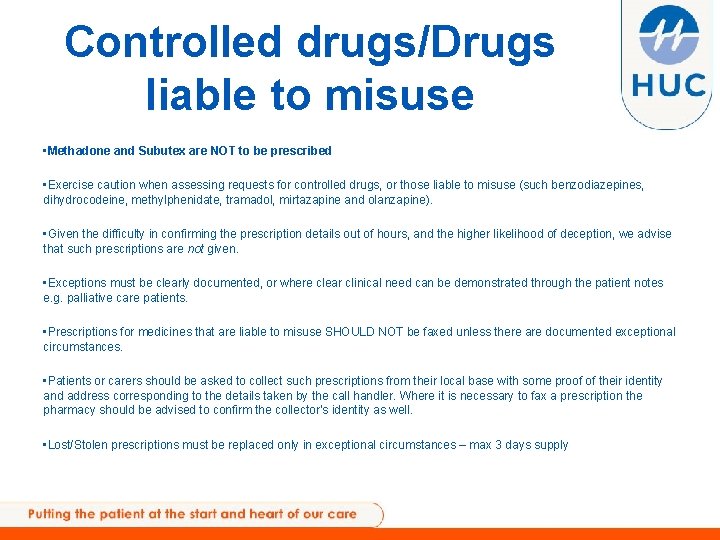
Controlled drugs/Drugs liable to misuse • Methadone and Subutex are NOT to be prescribed • Exercise caution when assessing requests for controlled drugs, or those liable to misuse (such benzodiazepines, dihydrocodeine, methylphenidate, tramadol, mirtazapine and olanzapine). • Given the difficulty in confirming the prescription details out of hours, and the higher likelihood of deception, we advise that such prescriptions are not given. • Exceptions must be clearly documented, or where clear clinical need can be demonstrated through the patient notes e. g. palliative care patients. • Prescriptions for medicines that are liable to misuse SHOULD NOT be faxed unless there are documented exceptional circumstances. • Patients or carers should be asked to collect such prescriptions from their local base with some proof of their identity and address corresponding to the details taken by the call handler. Where it is necessary to fax a prescription the pharmacy should be advised to confirm the collector’s identity as well. • Lost/Stolen prescriptions must be replaced only in exceptional circumstances – max 3 days supply
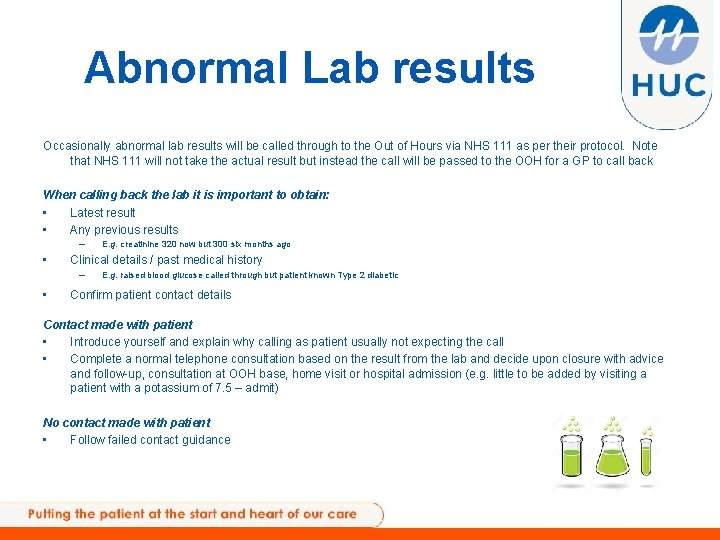
Abnormal Lab results Occasionally abnormal lab results will be called through to the Out of Hours via NHS 111 as per their protocol. Note that NHS 111 will not take the actual result but instead the call will be passed to the OOH for a GP to call back When calling back the lab it is important to obtain: • Latest result • Any previous results – • Clinical details / past medical history – • E. g. creatinine 320 now but 300 six months ago E. g. raised blood glucose called through but patient known Type 2 diabetic Confirm patient contact details Contact made with patient • Introduce yourself and explain why calling as patient usually not expecting the call • Complete a normal telephone consultation based on the result from the lab and decide upon closure with advice and follow-up, consultation at OOH base, home visit or hospital admission (e. g. little to be added by visiting a patient with a potassium of 7. 5 – admit) No contact made with patient • Follow failed contact guidance
OOH Competencies – Useful links • OOH GP Training: Guidance for GP Trainees https: //heeoe. hee. nhs. uk/sites/default/files/heeoe_ooh_training_guidance_for_t rainees. pdf • Mapping of Out of Hours competencies to the GP curriculum and WPBA RCGP - Out of Hours, Urgent, Unscheduled and Emergency Care • Bradford VTS resources
Clinical Team Clinical Leads for GP Trainees Dr Oscar Onyebuchi – Oscar. onyebuchi@hertsurgentcare. nhs. uk Dr Rafid Aziz - rafid. aziz@hertsurgentcare. nhs. uk For Clinical Queries: Clinical. management. T@hertsurgentcare. nhs. uk
Any Questions? Thank you for listening