
Our Solar System The Milky Way Galaxy Since

- Slides: 37
Our Solar System
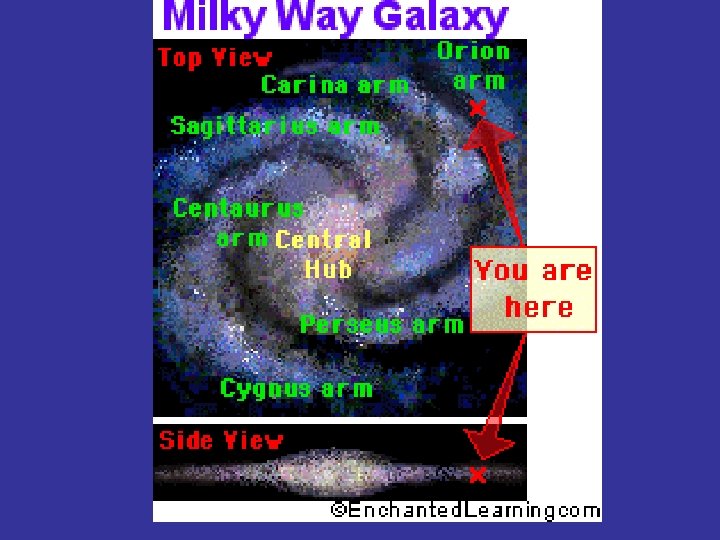
The Milky Way Galaxy • Since we're inside the Milky Way Galaxy and we've never sent a spacecraft outside our Galaxy, we have no photographs of the Milky Way Galaxy. Radio telescope data does, however, let us know a lot about it.
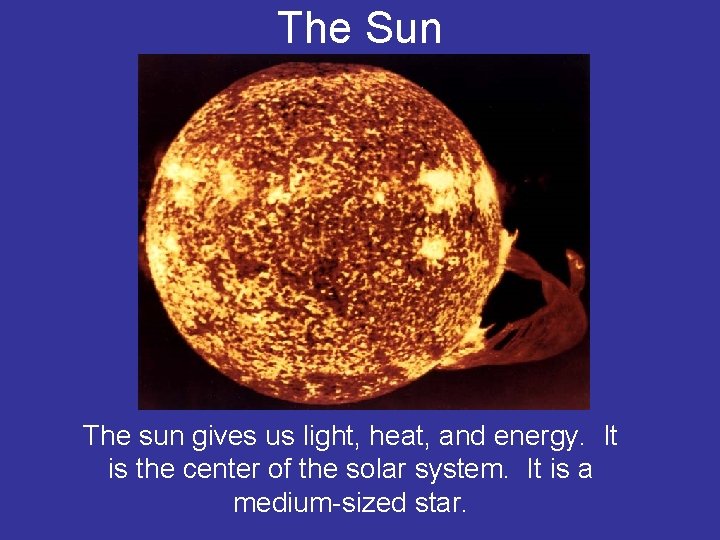
The Sun The sun gives us light, heat, and energy. It is the center of the solar system. It is a medium-sized star.
The Sun from the side
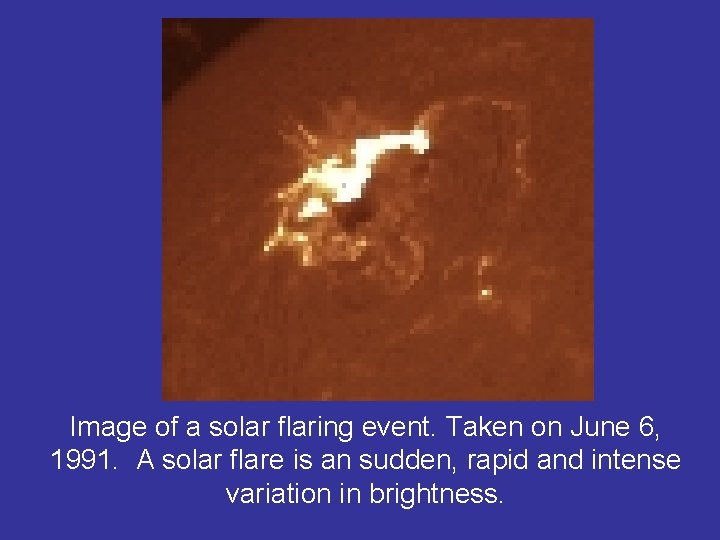
Image of a solar flaring event. Taken on June 6, 1991. A solar flare is an sudden, rapid and intense variation in brightness.
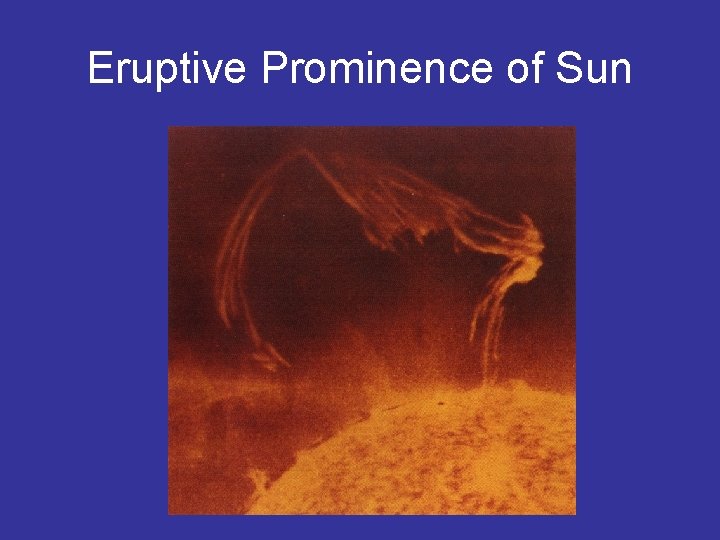
Eruptive Prominence of Sun
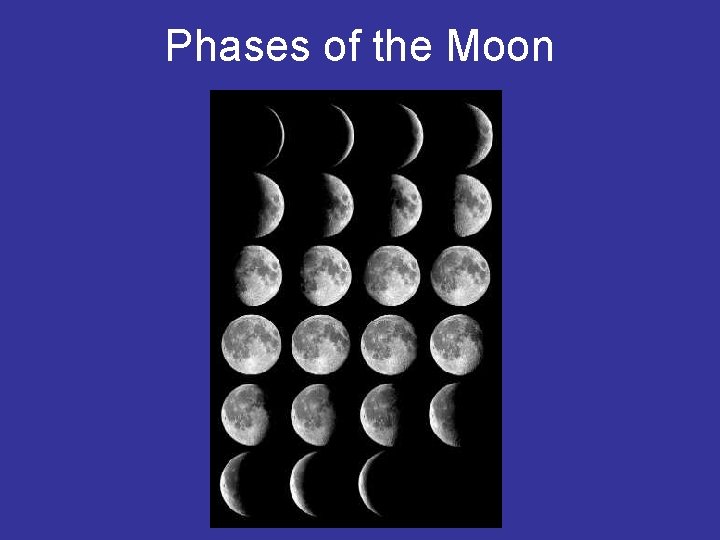
Phases of the Moon
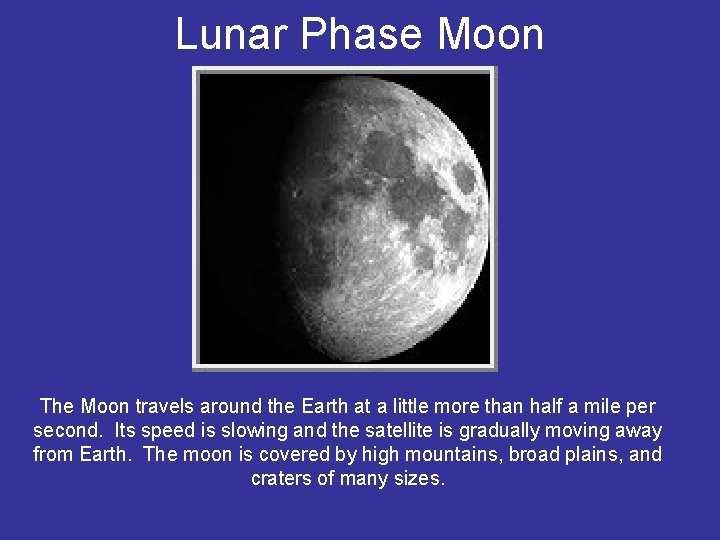
Lunar Phase Moon The Moon travels around the Earth at a little more than half a mile per second. Its speed is slowing and the satellite is gradually moving away from Earth. The moon is covered by high mountains, broad plains, and craters of many sizes.
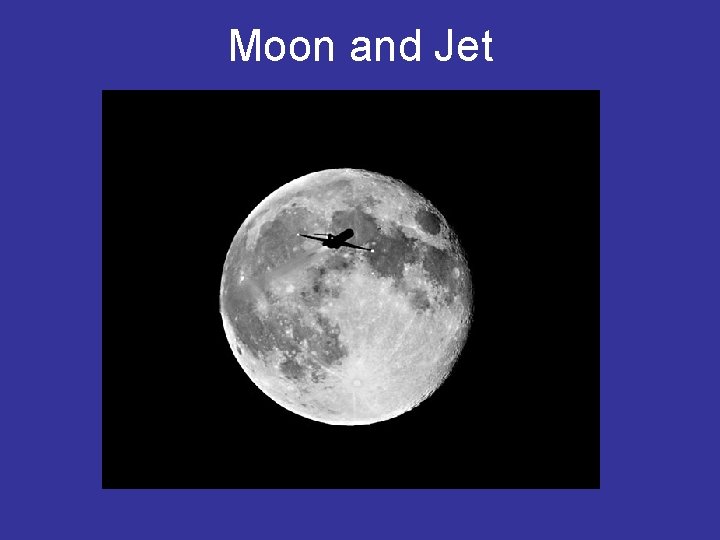
Moon and Jet
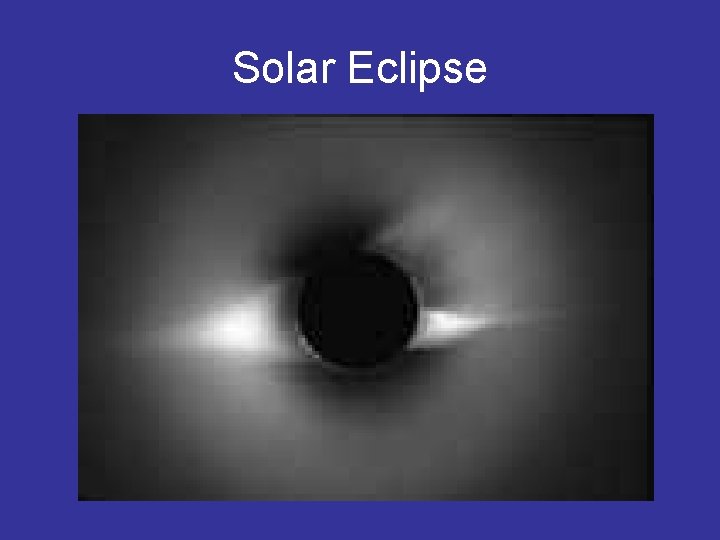
Solar Eclipse
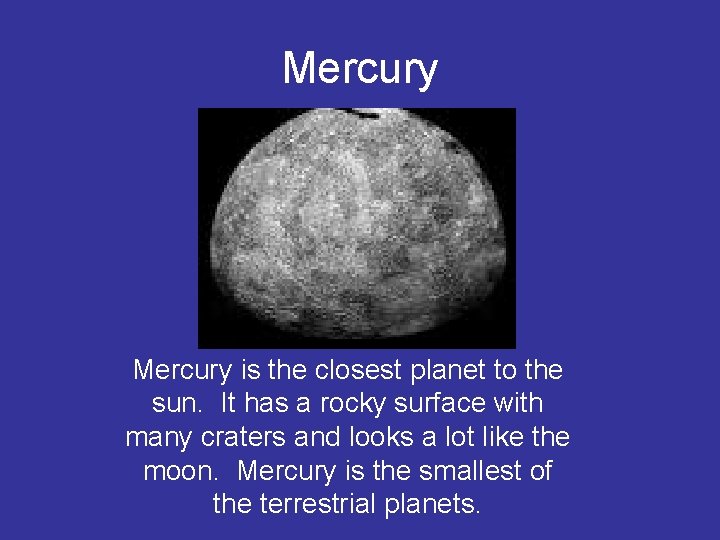
Mercury is the closest planet to the sun. It has a rocky surface with many craters and looks a lot like the moon. Mercury is the smallest of the terrestrial planets.
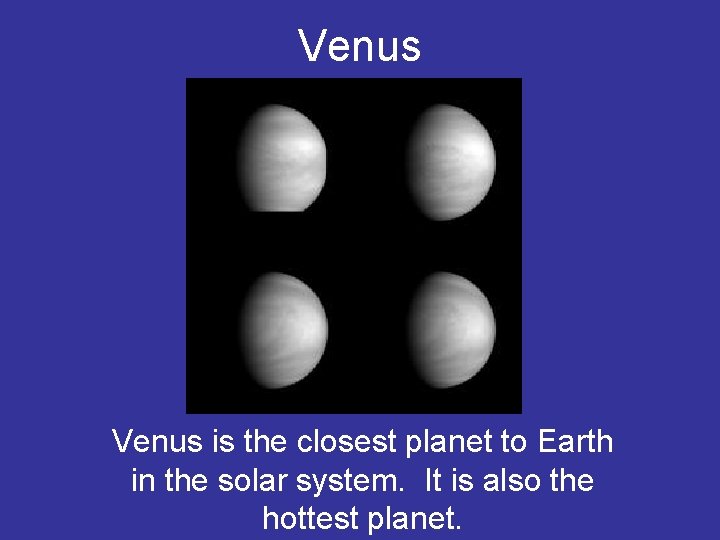
Venus is the closest planet to Earth in the solar system. It is also the hottest planet.
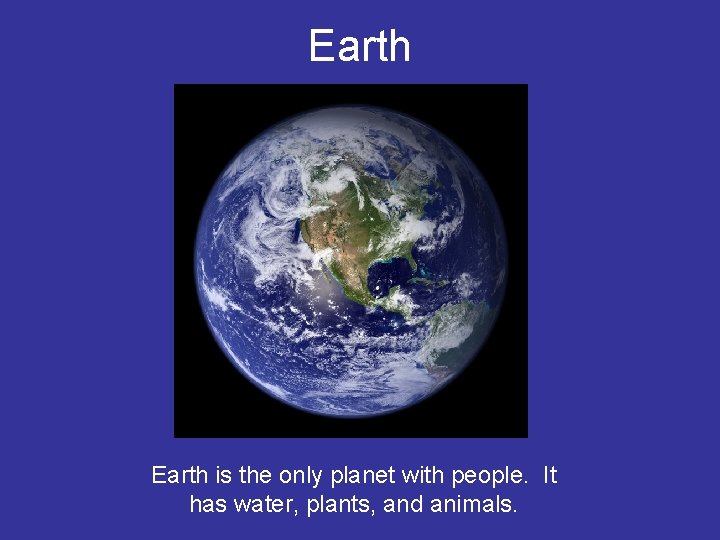
Earth is the only planet with people. It has water, plants, and animals.
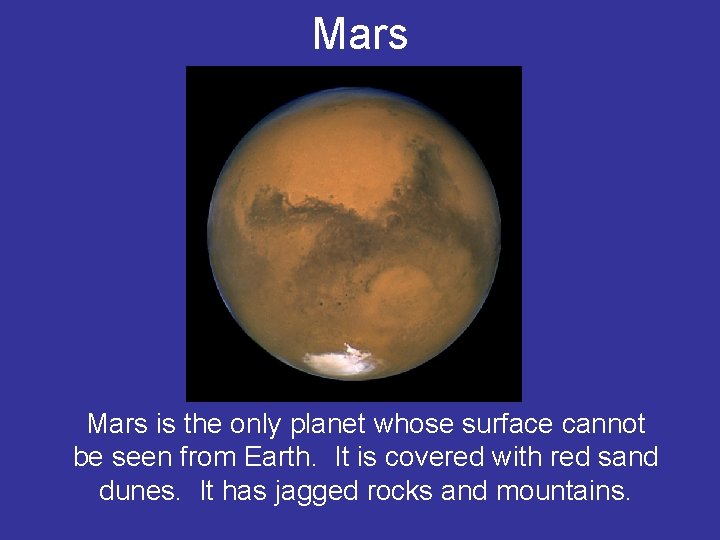
Mars is the only planet whose surface cannot be seen from Earth. It is covered with red sand dunes. It has jagged rocks and mountains.
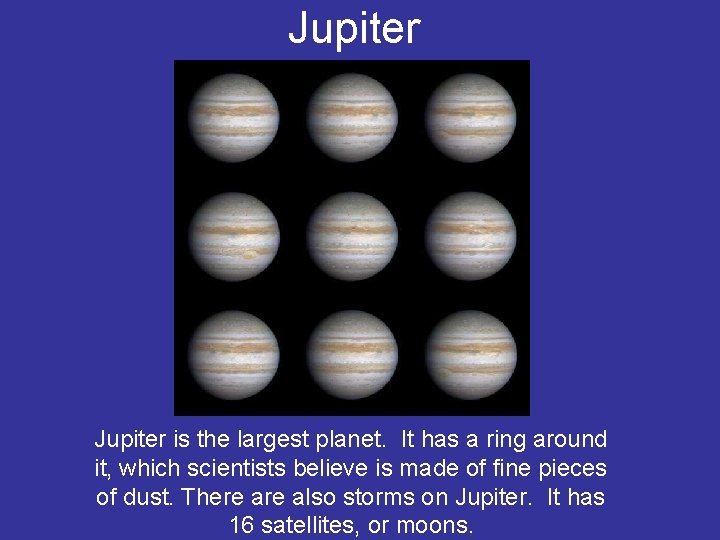
Jupiter is the largest planet. It has a ring around it, which scientists believe is made of fine pieces of dust. There also storms on Jupiter. It has 16 satellites, or moons.
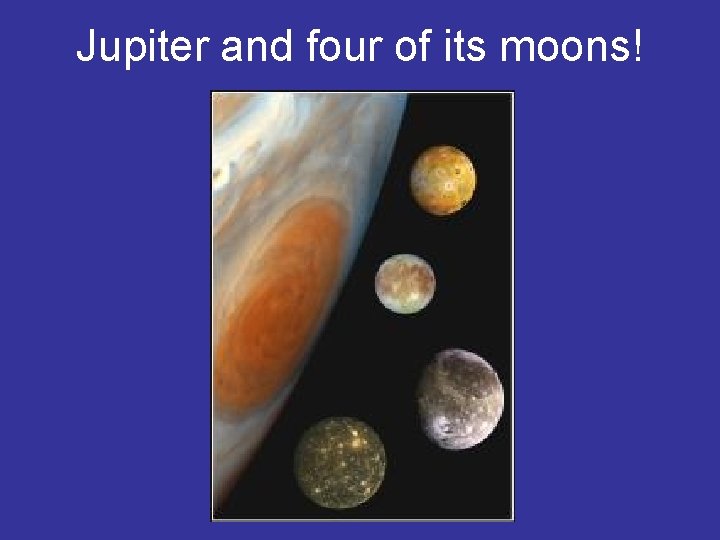
Jupiter and four of its moons!
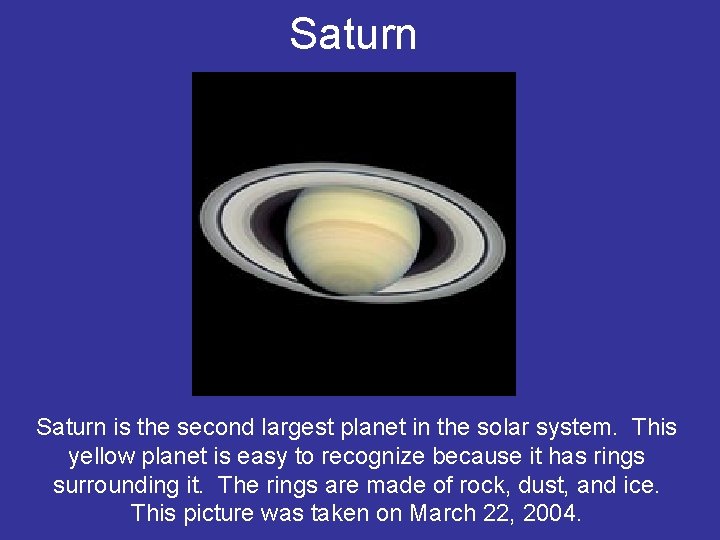
Saturn is the second largest planet in the solar system. This yellow planet is easy to recognize because it has rings surrounding it. The rings are made of rock, dust, and ice. This picture was taken on March 22, 2004.
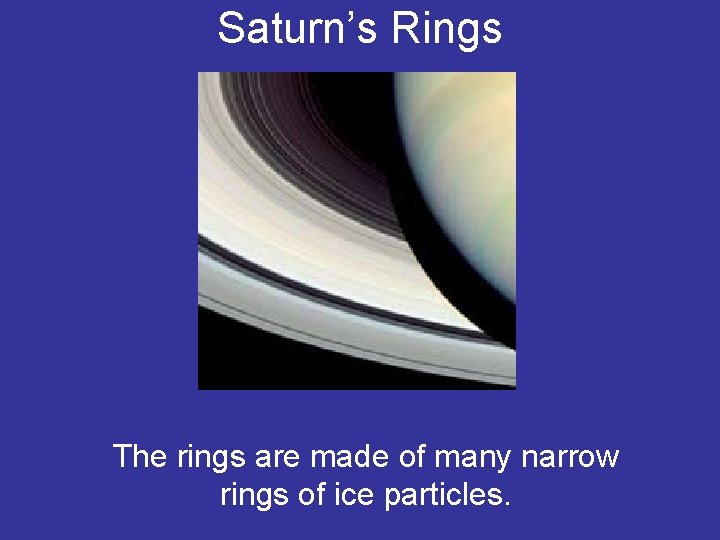
Saturn’s Rings The rings are made of many narrow rings of ice particles.
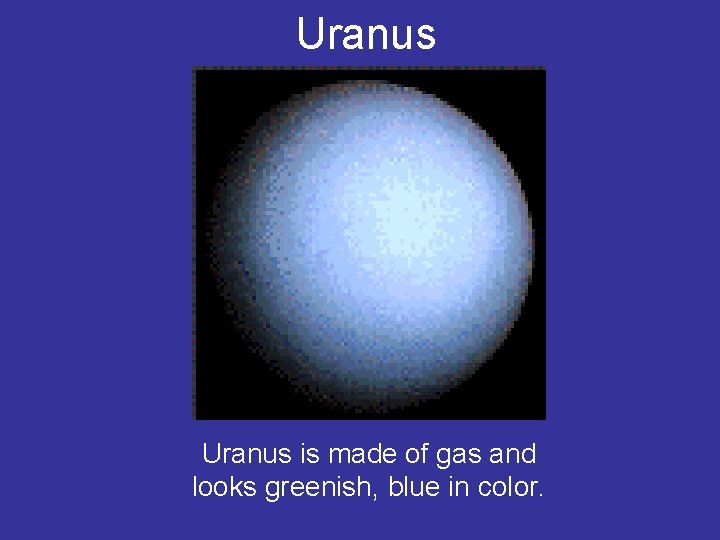
Uranus is made of gas and looks greenish, blue in color.
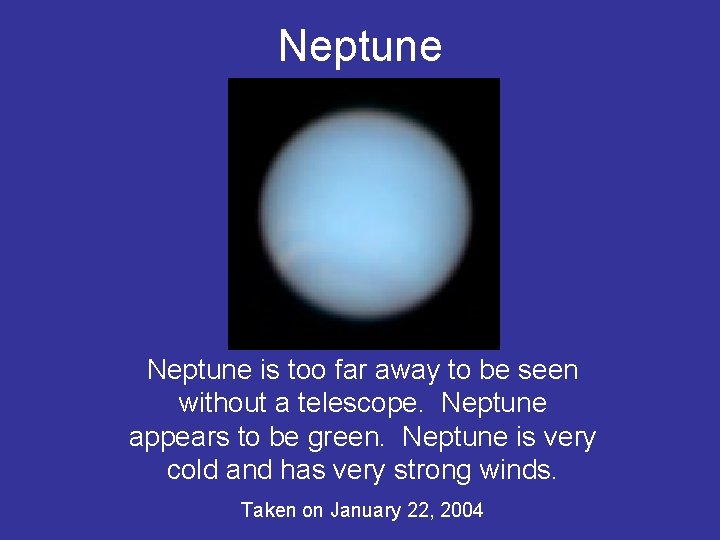
Neptune is too far away to be seen without a telescope. Neptune appears to be green. Neptune is very cold and has very strong winds. Taken on January 22, 2004
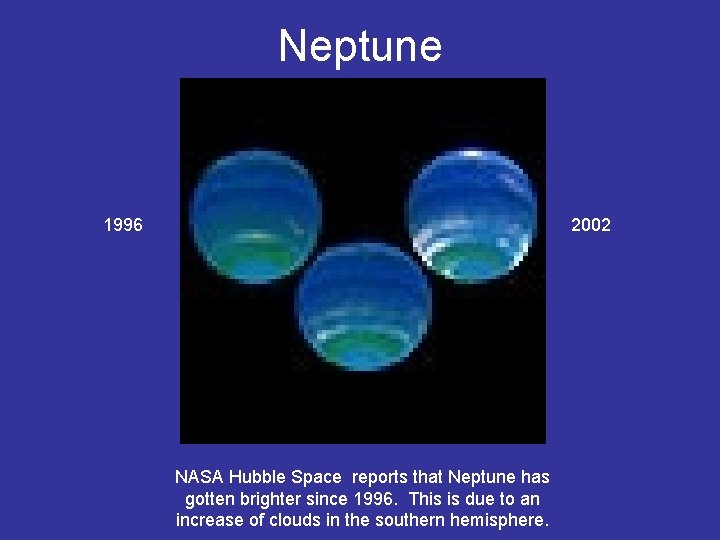
Neptune 1996 2002 NASA Hubble Space reports that Neptune has gotten brighter since 1996. This is due to an increase of clouds in the southern hemisphere.
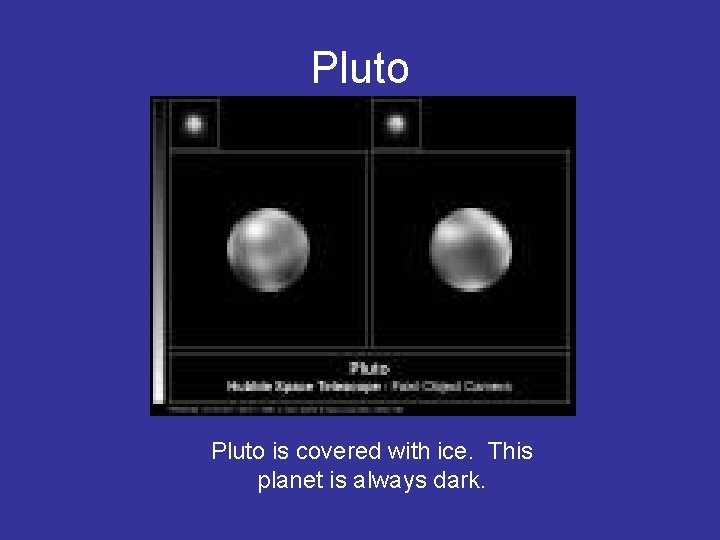
Pluto is covered with ice. This planet is always dark.
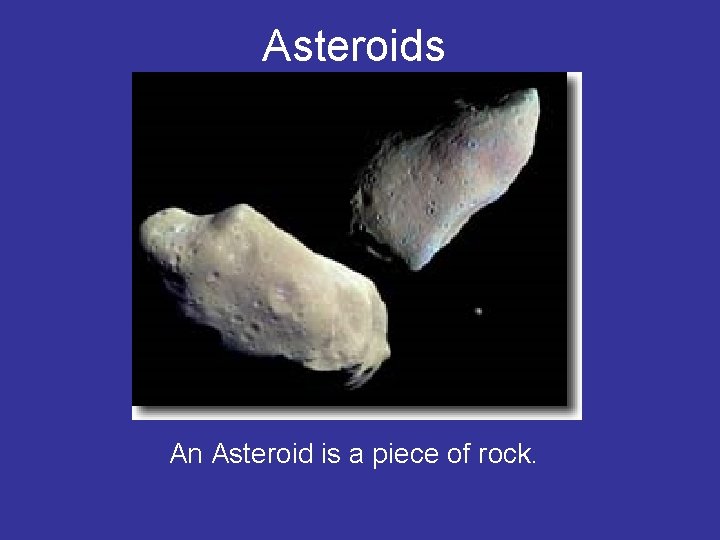
Asteroids An Asteroid is a piece of rock.
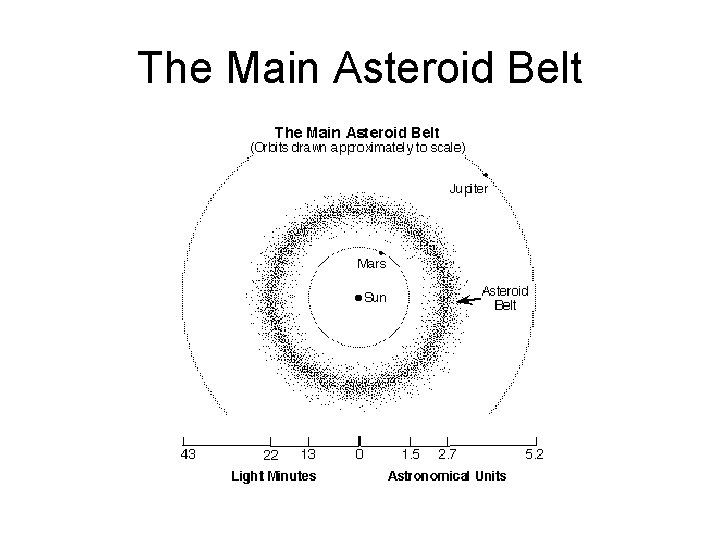
The Main Asteroid Belt
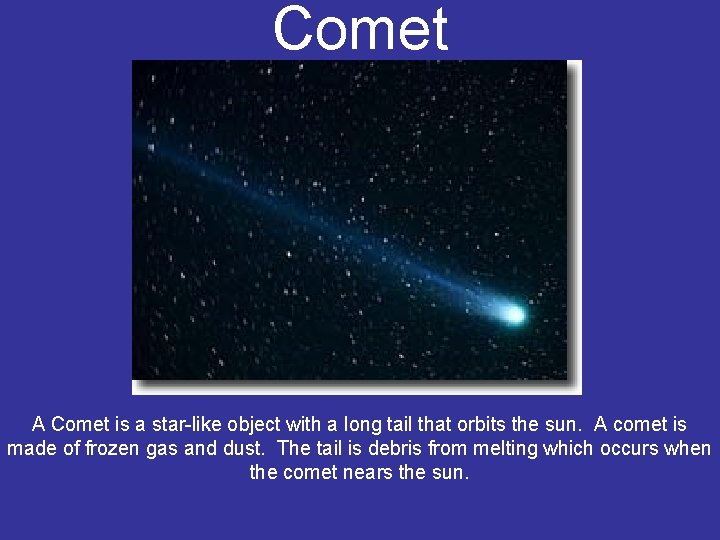
Comet A Comet is a star-like object with a long tail that orbits the sun. A comet is made of frozen gas and dust. The tail is debris from melting which occurs when the comet nears the sun.
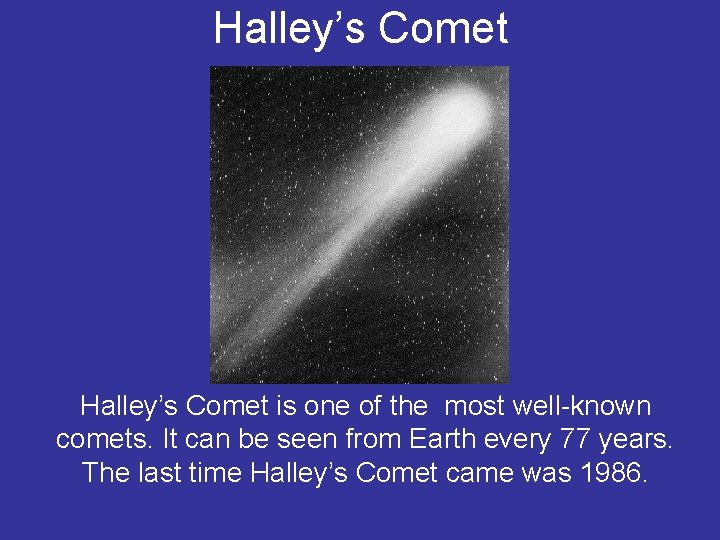
Halley’s Comet is one of the most well-known comets. It can be seen from Earth every 77 years. The last time Halley’s Comet came was 1986.
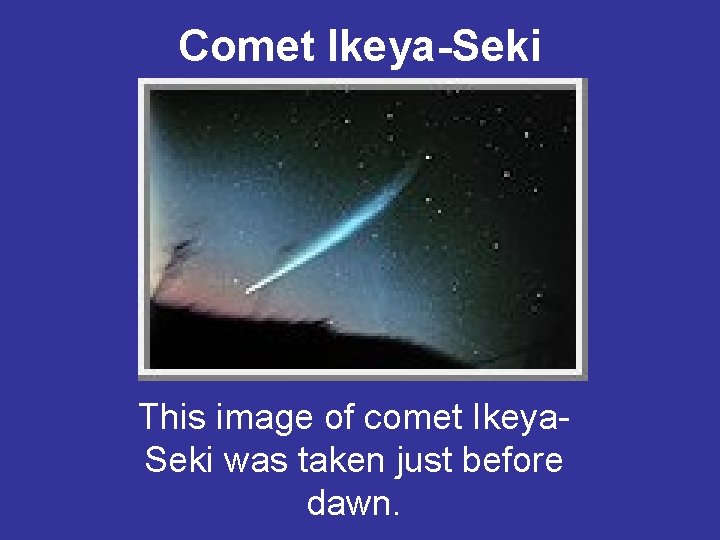
Comet Ikeya-Seki This image of comet Ikeya. Seki was taken just before dawn.
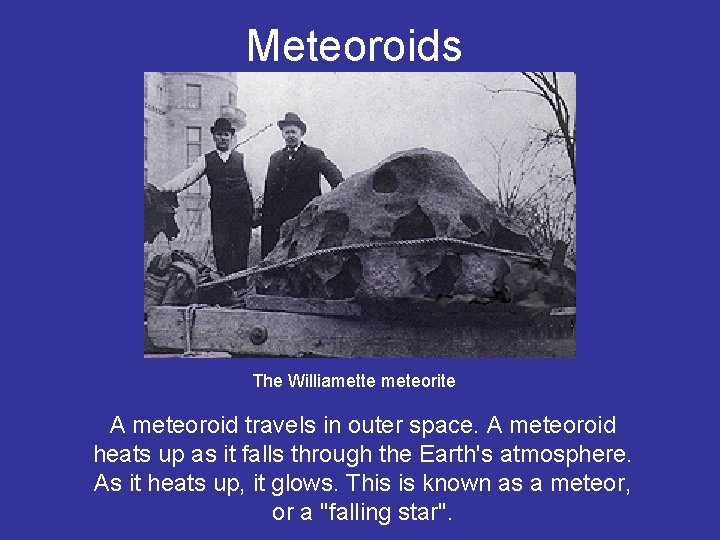
Meteoroids The Williamette meteorite A meteoroid travels in outer space. A meteoroid heats up as it falls through the Earth's atmosphere. As it heats up, it glows. This is known as a meteor, or a "falling star".
• A meteoroid is a piece of stony or metallic material which travels in space. A meteor is a piece of stony or metallic material which enters the Earth's atmosphere and burns up. A meteorite is a meteor which doesn't burn up before impacting with the Earth's surface.
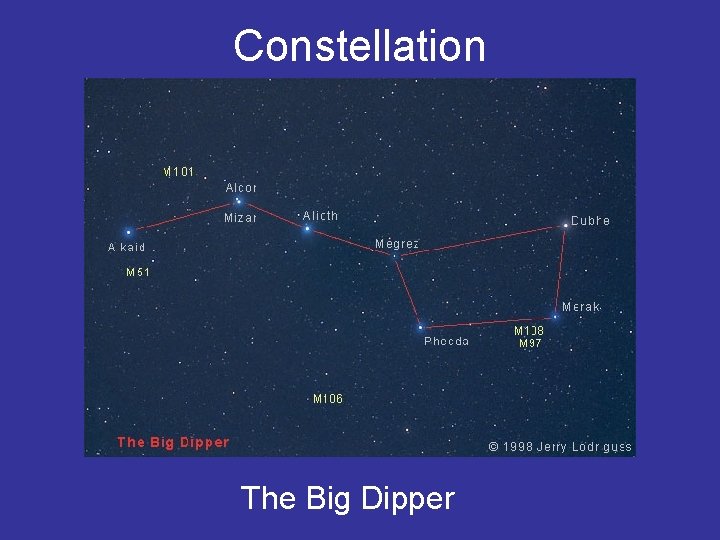
Constellation The Big Dipper
How to remember the order of the planets. . . In order from the sun. . . My Very Excited Mother Just Served Us Nine Pizzas. My =Mercury Very = Venus Excited = Earth Mother = Mars Just = Jupiter Served = Saturn Us = Uranus Nine = Neptune Pizzas = Pluto
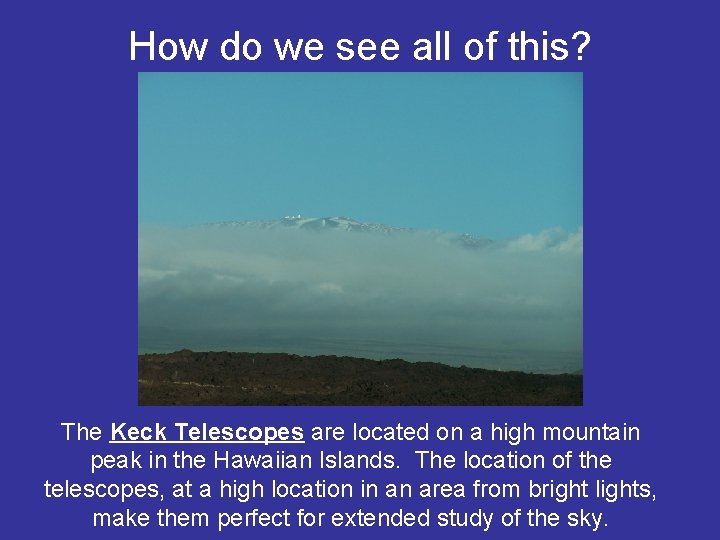
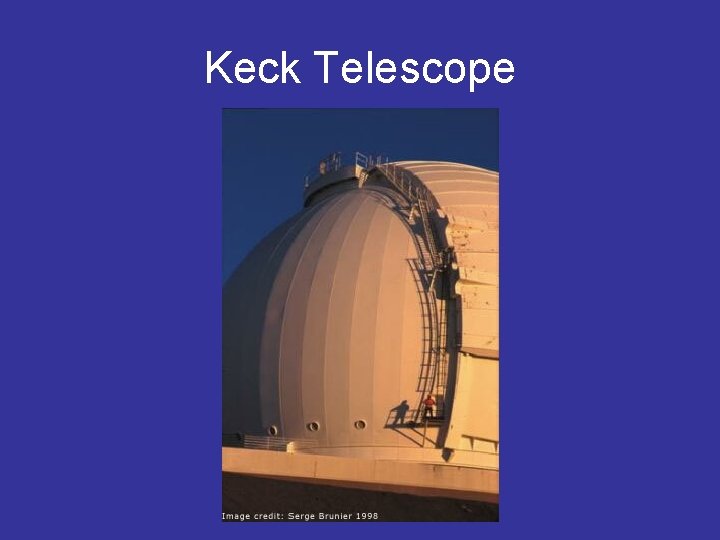
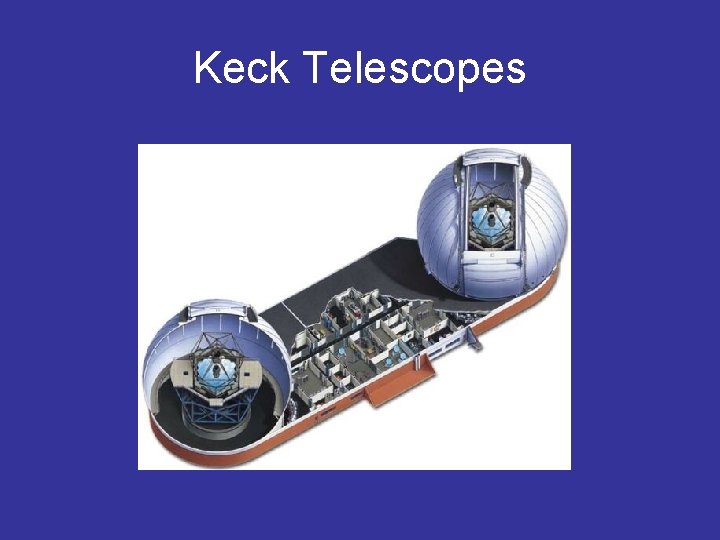
How do we see all of this? The Keck Telescopes are located on a high mountain peak in the Hawaiian Islands. The location of the telescopes, at a high location in an area from bright lights, make them perfect for extended study of the sky.
Keck Telescope
Keck Telescopes
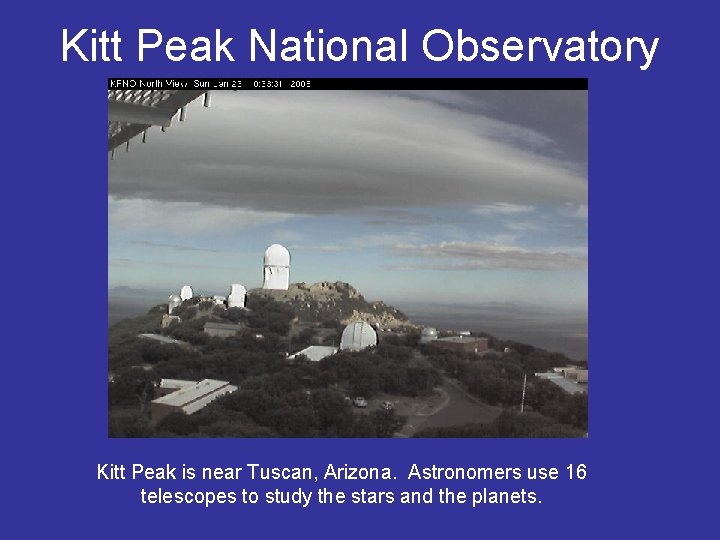
Kitt Peak National Observatory Kitt Peak is near Tuscan, Arizona. Astronomers use 16 telescopes to study the stars and the planets.
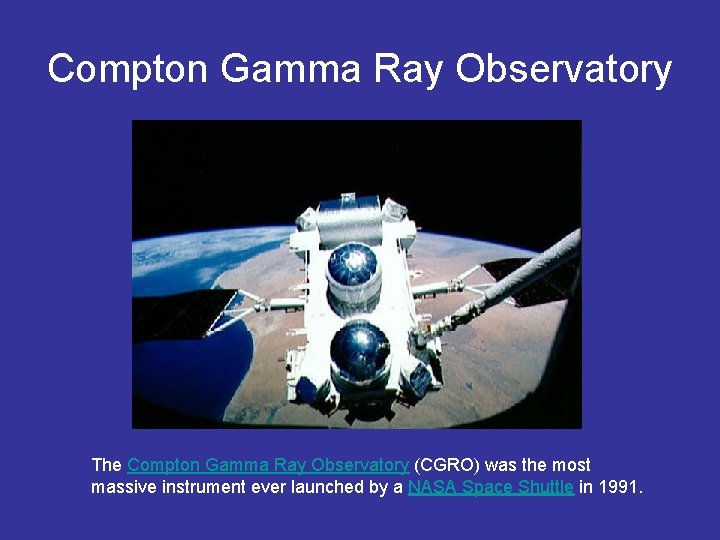
Compton Gamma Ray Observatory The Compton Gamma Ray Observatory (CGRO) was the most massive instrument ever launched by a NASA Space Shuttle in 1991.