
Our Solar System Neptune This picture of Neptune
- Slides: 9
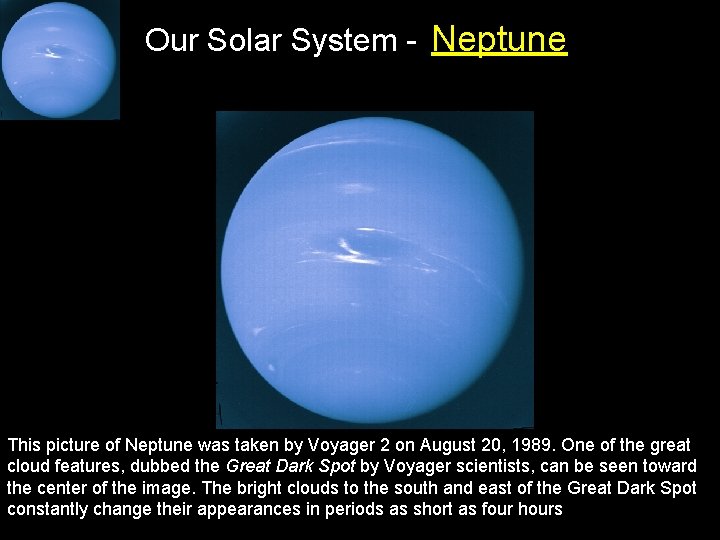
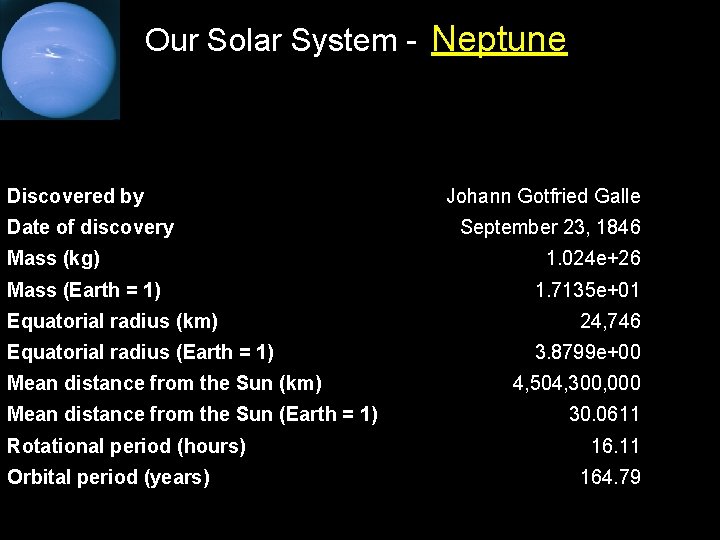
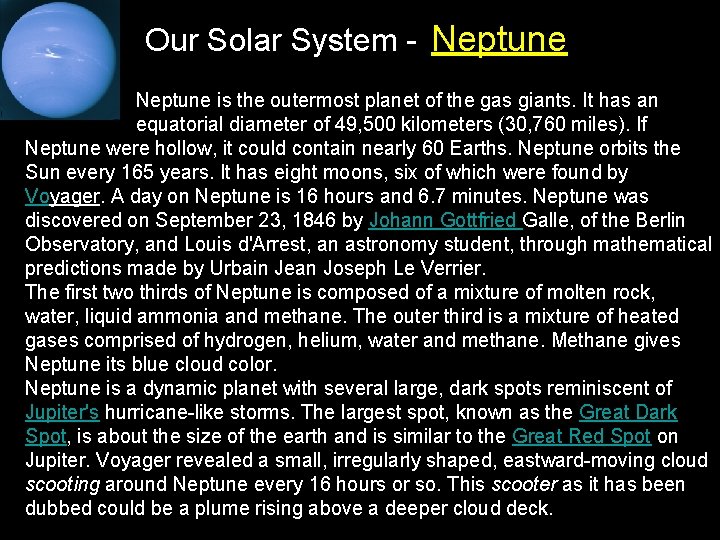
Our Solar System - Neptune This picture of Neptune was taken by Voyager 2 on August 20, 1989. One of the great cloud features, dubbed the Great Dark Spot by Voyager scientists, can be seen toward the center of the image. The bright clouds to the south and east of the Great Dark Spot constantly change their appearances in periods as short as four hours.
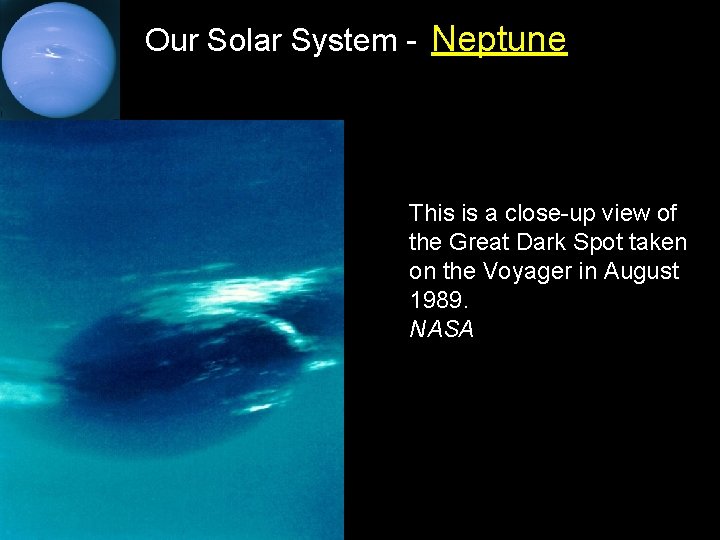
Our Solar System - Neptune This is a close-up view of the Great Dark Spot taken on the Voyager in August 1989. NASA
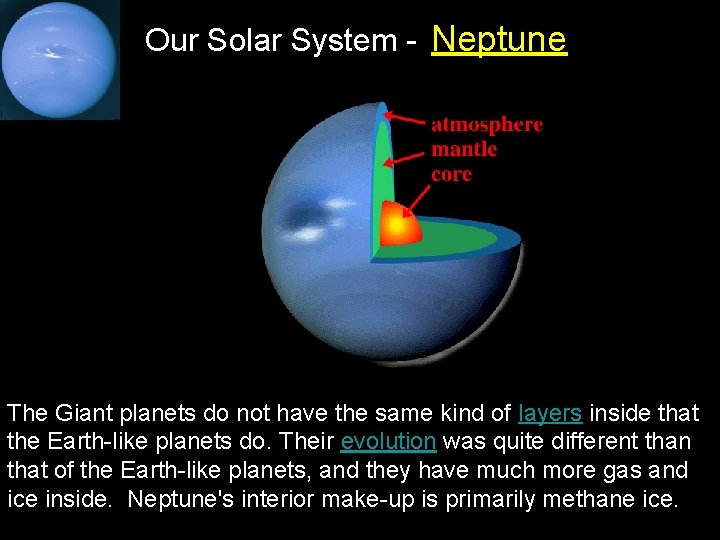
Our Solar System - Neptune The Giant planets do not have the same kind of layers inside that the Earth-like planets do. Their evolution was quite different than that of the Earth-like planets, and they have much more gas and ice inside. Neptune's interior make-up is primarily methane ice.
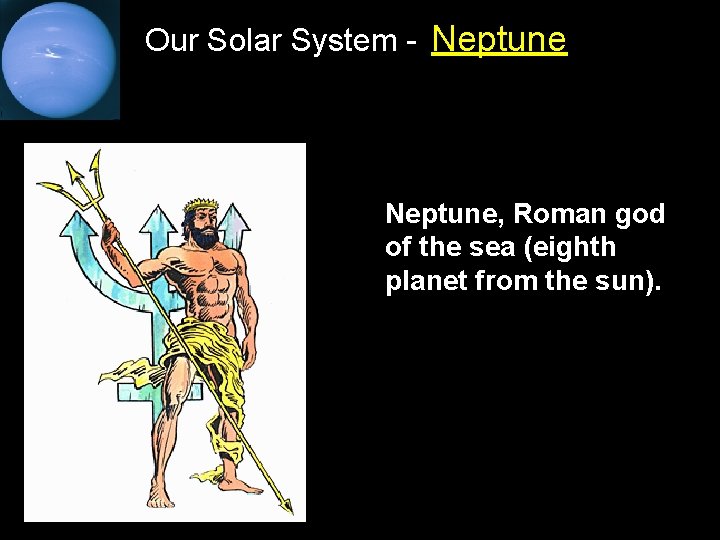
Our Solar System - Neptune, Roman god of the sea (eighth planet from the sun).
Our Solar System - Neptune Discovered by Date of discovery Mass (kg) Mass (Earth = 1) Equatorial radius (km) Equatorial radius (Earth = 1) Mean distance from the Sun (km) Mean distance from the Sun (Earth = 1) Rotational period (hours) Orbital period (years) Johann Gotfried Galle September 23, 1846 1. 024 e+26 1. 7135 e+01 24, 746 3. 8799 e+00 4, 504, 300, 000 30. 0611 164. 79
Our Solar System - Neptune is the outermost planet of the gas giants. It has an equatorial diameter of 49, 500 kilometers (30, 760 miles). If Neptune were hollow, it could contain nearly 60 Earths. Neptune orbits the Sun every 165 years. It has eight moons, six of which were found by Voyager. A day on Neptune is 16 hours and 6. 7 minutes. Neptune was discovered on September 23, 1846 by Johann Gottfried Galle, of the Berlin Observatory, and Louis d'Arrest, an astronomy student, through mathematical predictions made by Urbain Jean Joseph Le Verrier. The first two thirds of Neptune is composed of a mixture of molten rock, water, liquid ammonia and methane. The outer third is a mixture of heated gases comprised of hydrogen, helium, water and methane. Methane gives Neptune its blue cloud color. Neptune is a dynamic planet with several large, dark spots reminiscent of Jupiter's hurricane-like storms. The largest spot, known as the Great Dark Spot, is about the size of the earth and is similar to the Great Red Spot on Jupiter. Voyager revealed a small, irregularly shaped, eastward-moving cloud scooting around Neptune every 16 hours or so. This scooter as it has been dubbed could be a plume rising above a deeper cloud deck.
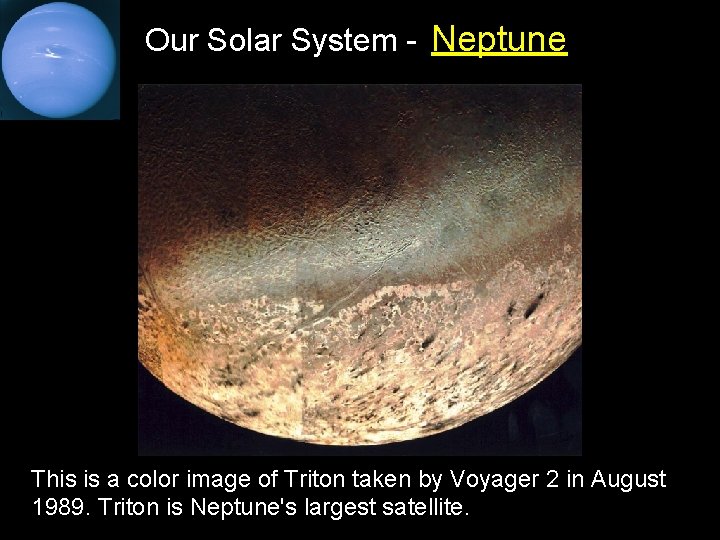
Our Solar System - Neptune This is a color image of Triton taken by Voyager 2 in August 1989. Triton is Neptune's largest satellite.
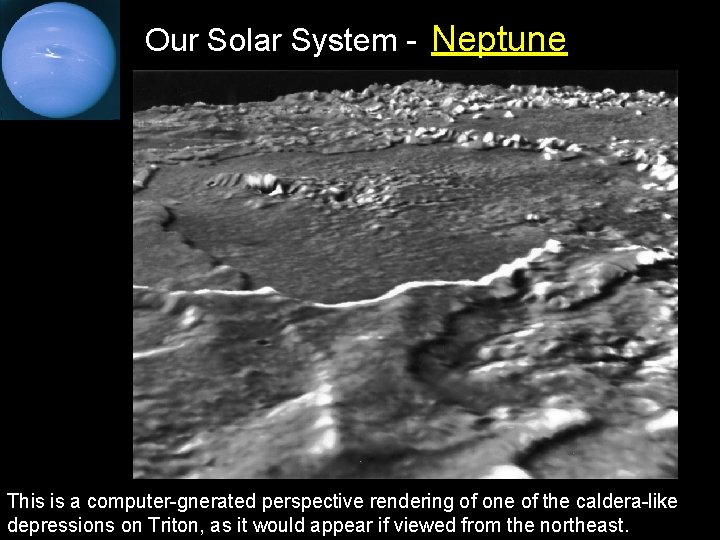
Our Solar System - Neptune This is a computer-gnerated perspective rendering of one of the caldera-like depressions on Triton, as it would appear if viewed from the northeast.
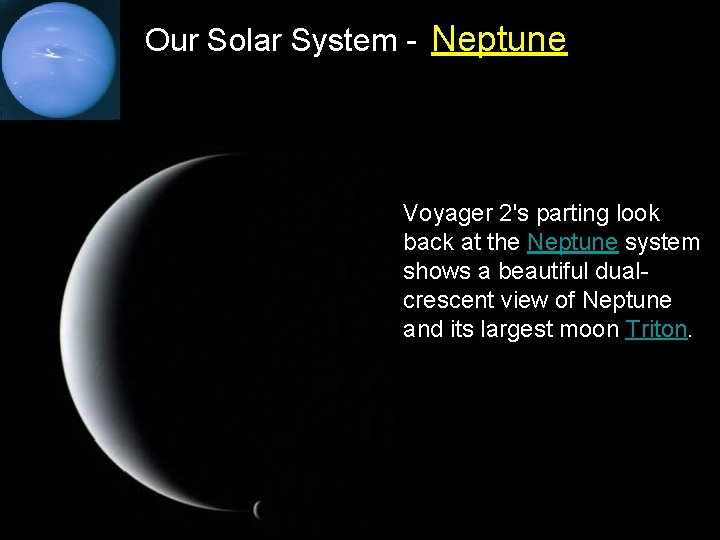
Our Solar System - Neptune Voyager 2's parting look back at the Neptune system shows a beautiful dualcrescent view of Neptune and its largest moon Triton.