
Our Solar System First Sighting of Planets Ancient
- Slides: 11
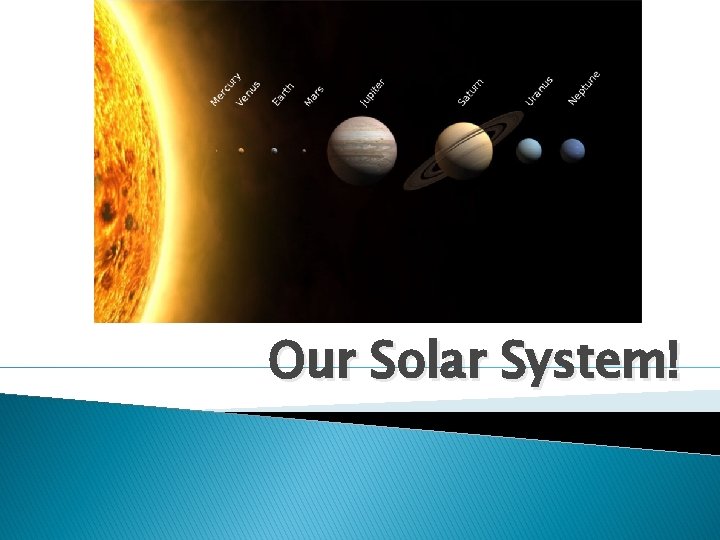
Our Solar System!
First Sighting of Planets � Ancient Greeks noticed that ______ objects appeared to wander through the _______. � These were the 5 planets you can see without binoculars or telescopes: ◦ Mercury, Venus, Mars, Jupiter, and Saturn � The ancient Greeks thought that these objects were special because they were not ______ against the background sky, like the stars appear to be. � Planet: from the Greek word for wanderer.
Criteria to be a Planet An object is a ______ if it: 1) 2) 3) 4) orbits around one or more ______ is not a _____ itself is _______ does not share its _______ with another object
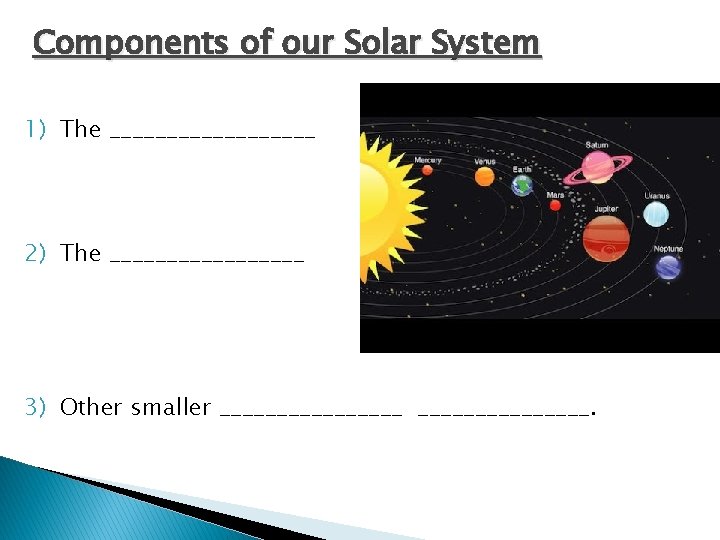
Components of our Solar System 1) The _________ 2) The _________ 3) Other smaller ________.
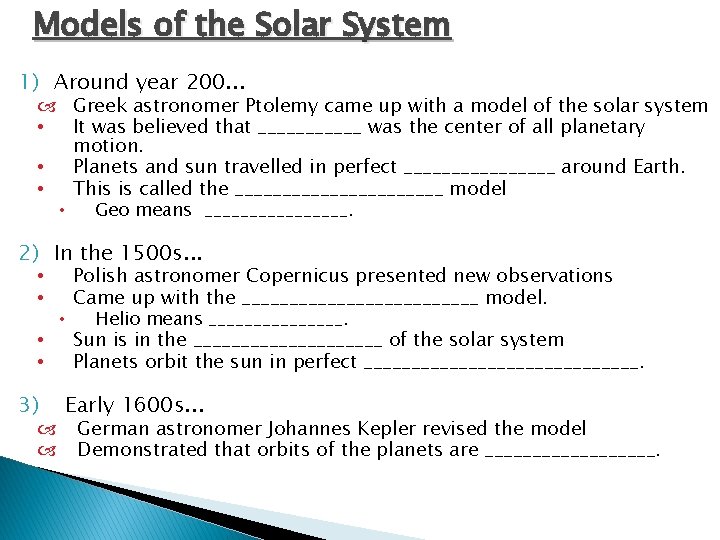
Models of the Solar System 1) Around year 200. . . Greek astronomer Ptolemy came up with a model of the solar system • It was believed that ______ was the center of all planetary motion. • Planets and sun travelled in perfect ________ around Earth. • This is called the ___________ model • Geo means ________. 2) In the 1500 s. . . • • 3) • Polish astronomer Copernicus presented new observations Came up with the _____________ model. Helio means ________. Sun is in the __________ of the solar system Planets orbit the sun in perfect _______________. Early 1600 s. . . German astronomer Johannes Kepler revised the model Demonstrated that orbits of the planets are _________.
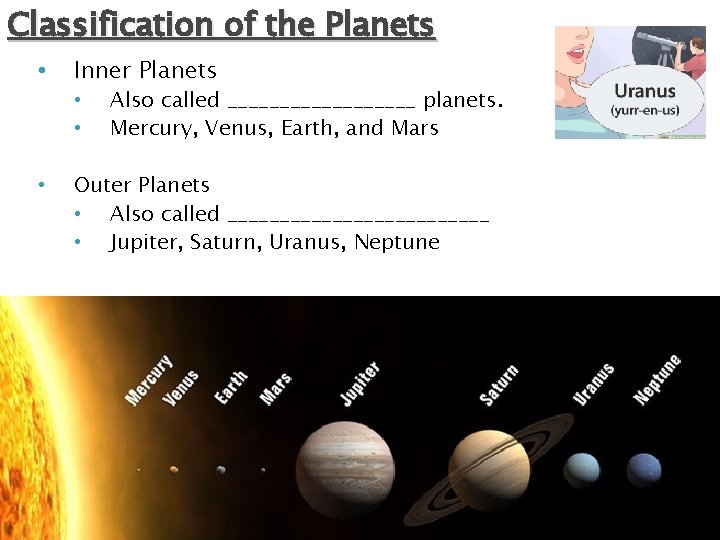
Classification of the Planets • Inner Planets • • • Also called _________ planets. Mercury, Venus, Earth, and Mars Outer Planets • Also called _____________ • Jupiter, Saturn, Uranus, Neptune
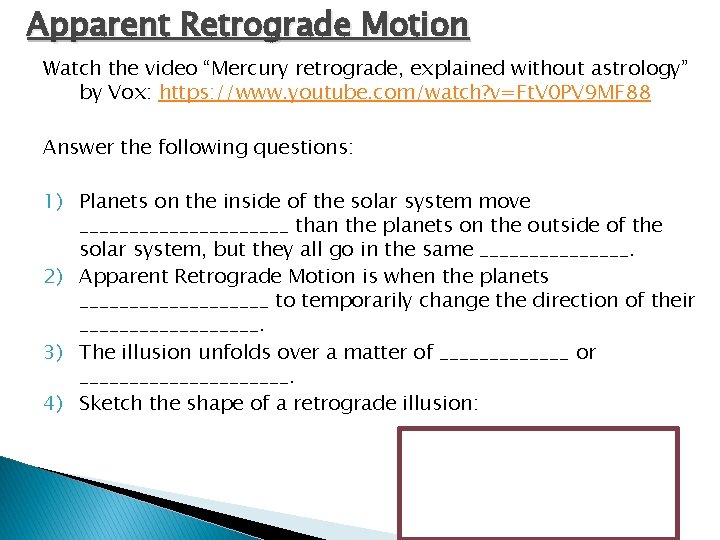
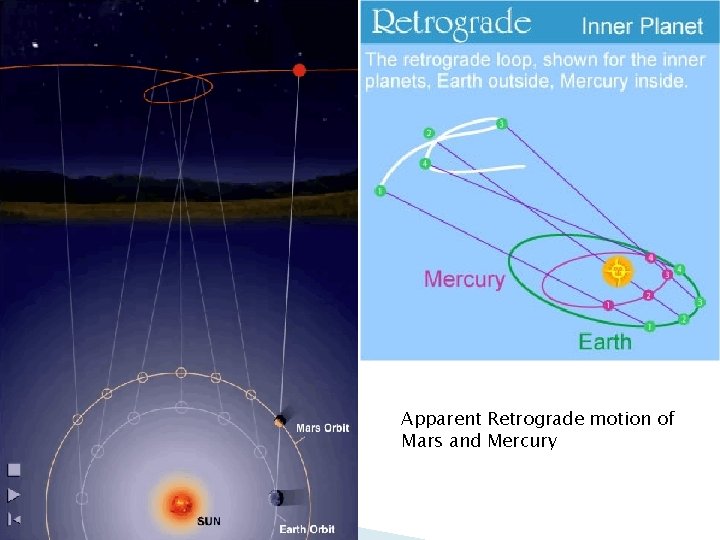
Apparent Retrograde Motion Watch the video “Mercury retrograde, explained without astrology” by Vox: https: //www. youtube. com/watch? v=Ft. V 0 PV 9 MF 88 Answer the following questions: 1) Planets on the inside of the solar system move ___________ than the planets on the outside of the solar system, but they all go in the same ________. 2) Apparent Retrograde Motion is when the planets __________ to temporarily change the direction of their _________. 3) The illusion unfolds over a matter of _______ or ___________. 4) Sketch the shape of a retrograde illusion:
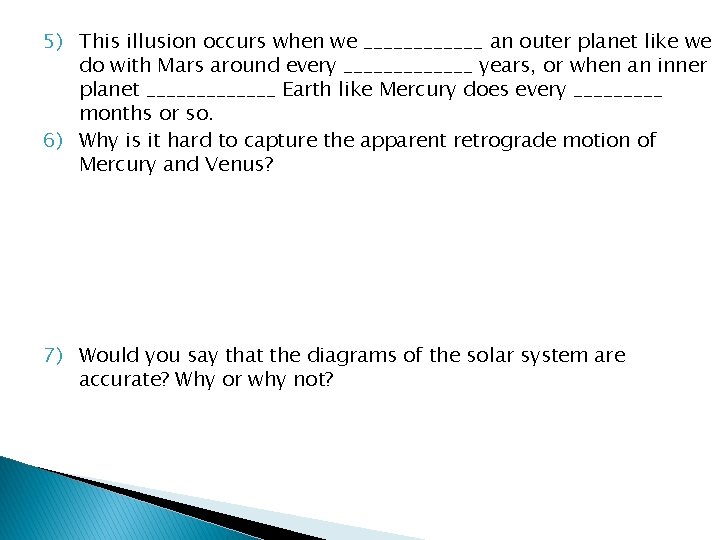
5) This illusion occurs when we ______ an outer planet like we do with Mars around every _______ years, or when an inner planet _______ Earth like Mercury does every _____ months or so. 6) Why is it hard to capture the apparent retrograde motion of Mercury and Venus? 7) Would you say that the diagrams of the solar system are accurate? Why or why not?
Apparent Retrograde motion of Mars and Mercury
Distances between Planets • The distance between planets is so huge that astronomers created a unit for measuring distances in the solar system • The Astronomical Unit (AU) • Equal to the average distance between the ______ and the ________. • Equals about _________ million kilometres. • By definition, Earth is _______ from the Sun. • The average distance between the Sun and an object orbiting the Sun is called the ______________.
Homework Use pg. 294 -295 to complete the table THE PLANETS OF OUR SOLOR SYSTEM. Page 292, #1, 2 Page 296, #1, 2, 4, 5 (use the table you already made), 7, 8.