
OUR SOLAR SYSTEM BY PETER CROSSETT A solar
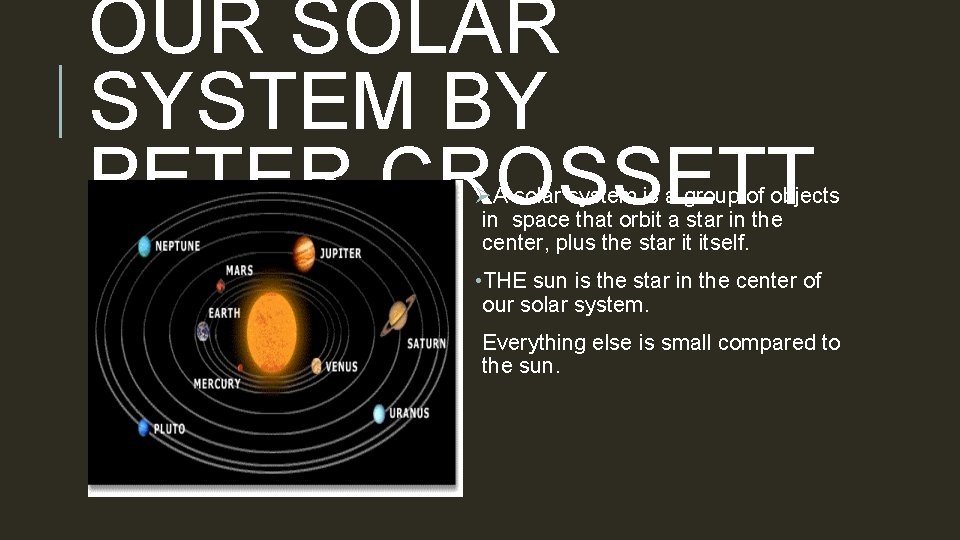
OUR SOLAR SYSTEM BY PETER CROSSETT ØA solar system is a group of objects in space that orbit a star in the center, plus the star it itself. • THE sun is the star in the center of our solar system. Everything else is small compared to the sun.
THE SUN THE sun is the largest object in our solar system. THE next largest objects are the nine plants that orbit the sun. Often, scientists group them as the inner planets, which are closer to the sun, and the outer planets, which are farther from the sun.
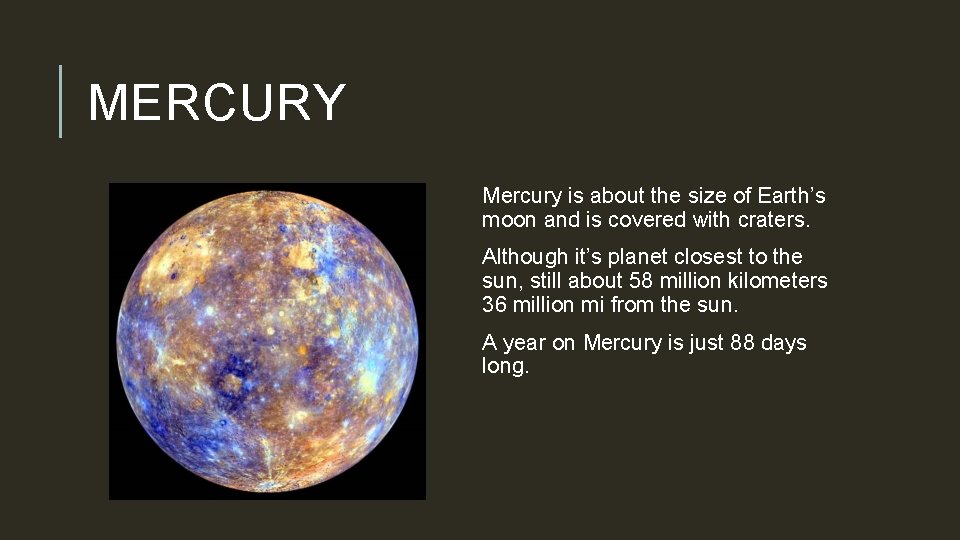
MERCURY Mercury is about the size of Earth’s moon and is covered with craters. Although it’s planet closest to the sun, still about 58 million kilometers 36 million mi from the sun. A year on Mercury is just 88 days long.
VENUS Venus is about the same size as Earth. Venus is the brightest object in Earth’s sky only the sun and moon appear brighter. Clouds of sulfuric acid make the planet difficult to study from Earth.
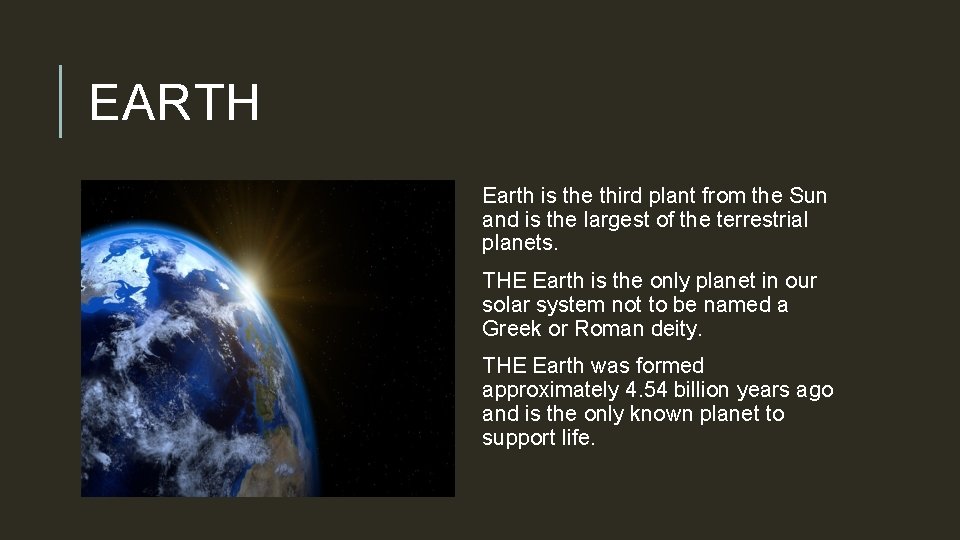
EARTH Earth is the third plant from the Sun and is the largest of the terrestrial planets. THE Earth is the only planet in our solar system not to be named a Greek or Roman deity. THE Earth was formed approximately 4. 54 billion years ago and is the only known planet to support life.
MARS Mars is the fourth planet from the Sun and is the second smallest planet in our solar system. Named after the Roman god of war, Mars is also often described as the red planet’ due to its reddish appearance. MARS is a terrestrial planet with a thin atmosphere composed primarily of carbon dioxide.

ASTEROID BELT • THE asteroid belt was first discovered in 1801. • THE asteroid belt is a disc shape, located between the orbits of Mars and Jupiter. THE asteroids are made of rock and metal and are all irregularly shaped.
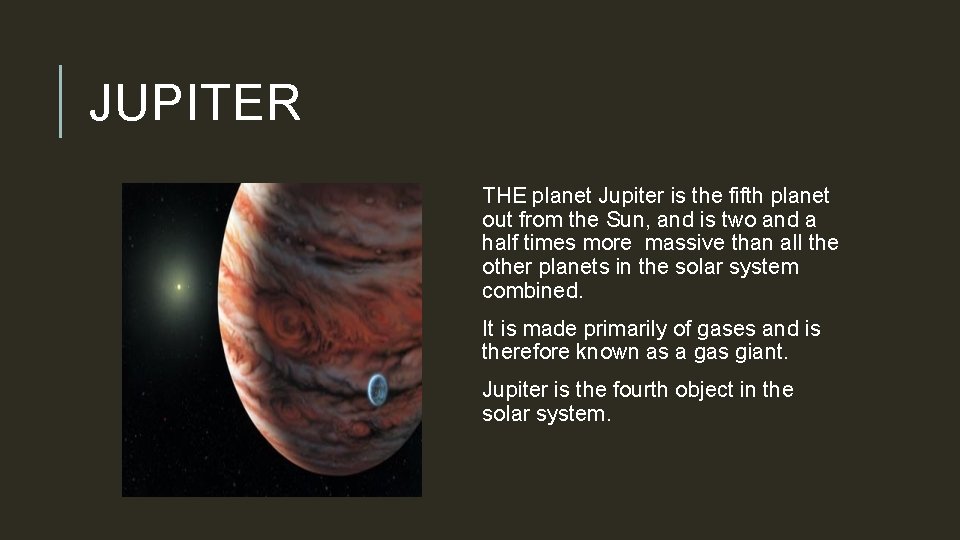
JUPITER THE planet Jupiter is the fifth planet out from the Sun, and is two and a half times more massive than all the other planets in the solar system combined. It is made primarily of gases and is therefore known as a gas giant. Jupiter is the fourth object in the solar system.
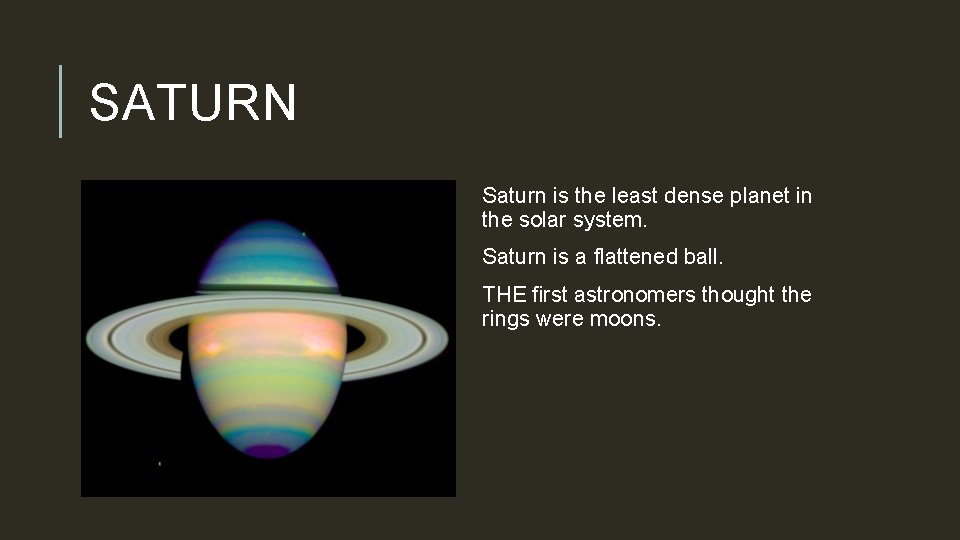
SATURN Saturn is the least dense planet in the solar system. Saturn is a flattened ball. THE first astronomers thought the rings were moons.
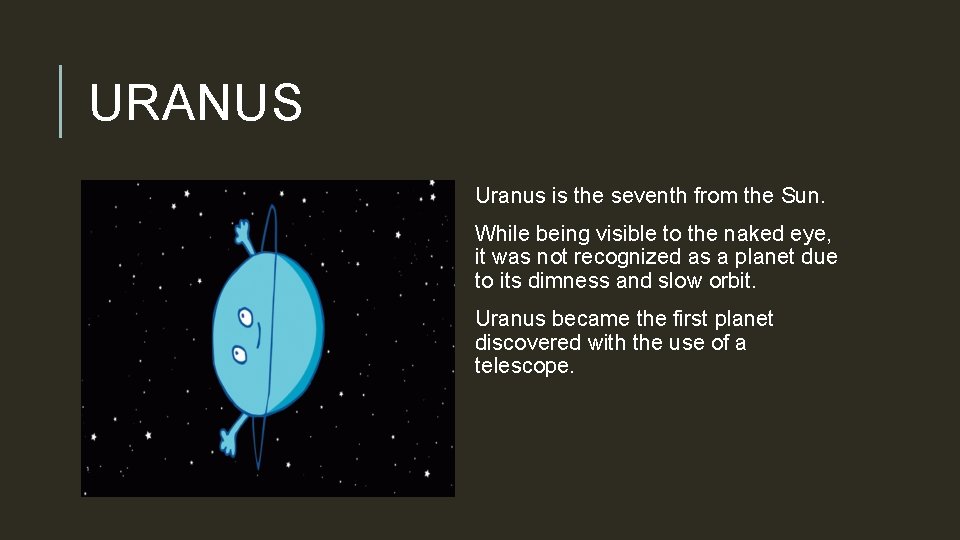
URANUS Uranus is the seventh from the Sun. While being visible to the naked eye, it was not recognized as a planet due to its dimness and slow orbit. Uranus became the first planet discovered with the use of a telescope.
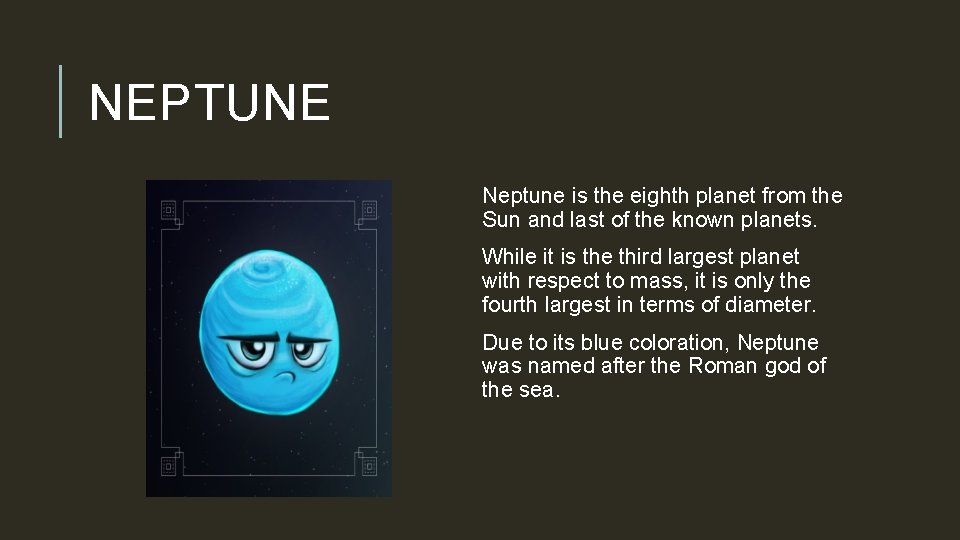
NEPTUNE Neptune is the eighth planet from the Sun and last of the known planets. While it is the third largest planet with respect to mass, it is only the fourth largest in terms of diameter. Due to its blue coloration, Neptune was named after the Roman god of the sea.
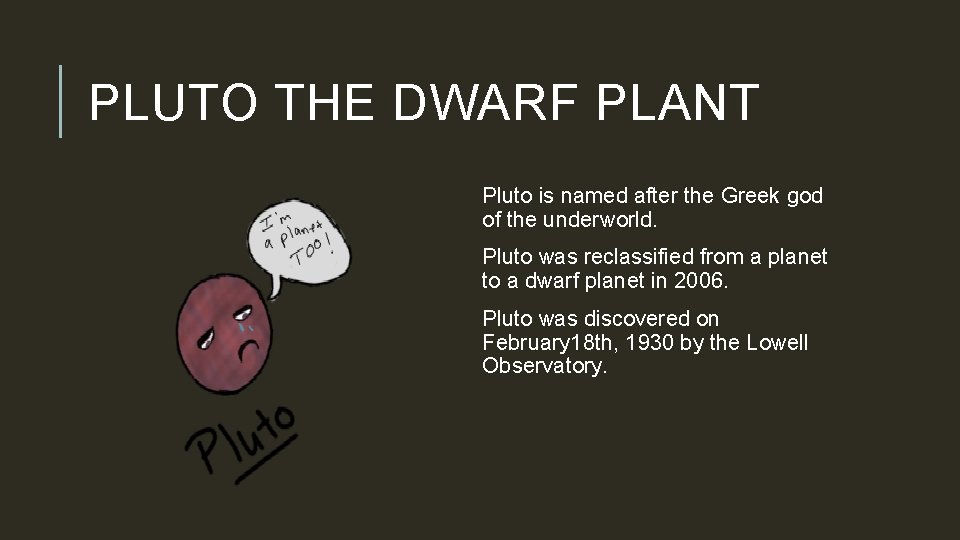
PLUTO THE DWARF PLANT Pluto is named after the Greek god of the underworld. Pluto was reclassified from a planet to a dwarf planet in 2006. Pluto was discovered on February 18 th, 1930 by the Lowell Observatory.
RESOURCES Google. com/images Harcourt Science Book
- Slides: 13