
Our Recent Experience with Online Language Courses Ray
- Slides: 12
Our Recent Experience with Online Language Courses Ray Clifford Associate Dean, College of Humanities Brigham Young University 27 May 2020 1
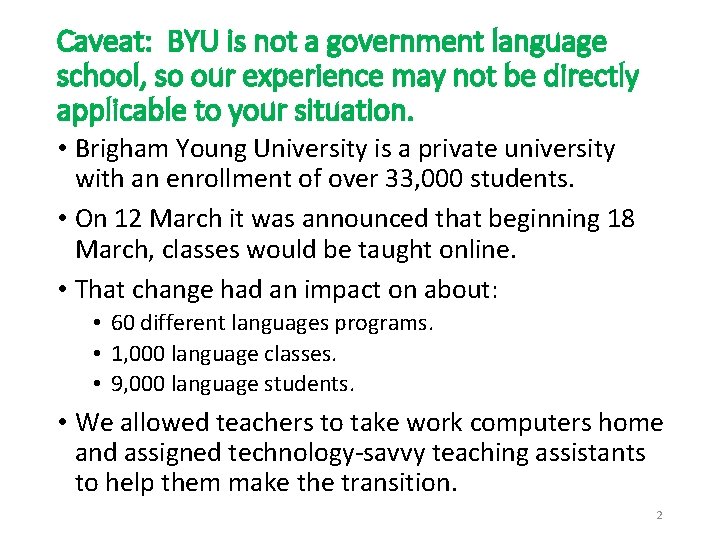
Caveat: BYU is not a government language school, so our experience may not be directly applicable to your situation. • Brigham Young University is a private university with an enrollment of over 33, 000 students. • On 12 March it was announced that beginning 18 March, classes would be taught online. • That change had an impact on about: • 60 different languages programs. • 1, 000 language classes. • 9, 000 language students. • We allowed teachers to take work computers home and assigned technology-savvy teaching assistants to help them make the transition. 2
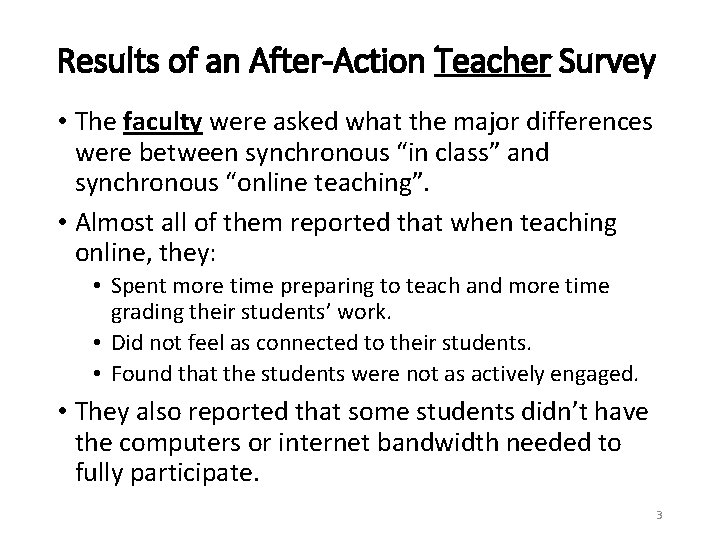
Results of an After-Action Teacher Survey • The faculty were asked what the major differences were between synchronous “in class” and synchronous “online teaching”. • Almost all of them reported that when teaching online, they: • Spent more time preparing to teach and more time grading their students’ work. • Did not feel as connected to their students. • Found that the students were not as actively engaged. • They also reported that some students didn’t have the computers or internet bandwidth needed to fully participate. 3
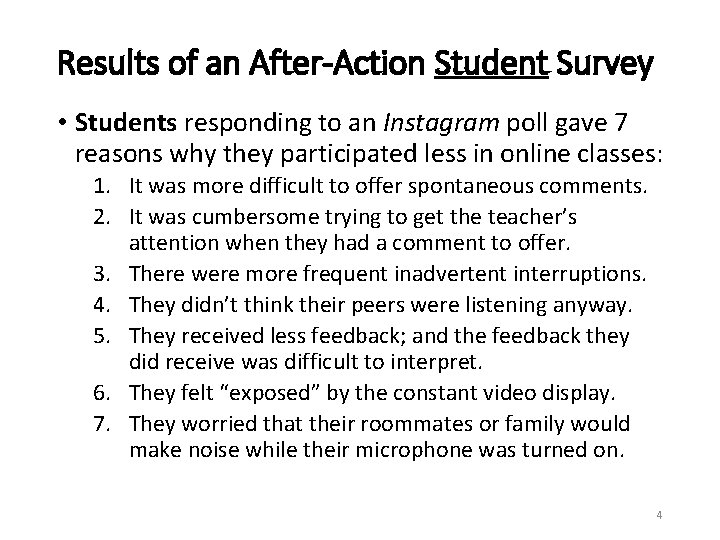
Results of an After-Action Student Survey • Students responding to an Instagram poll gave 7 reasons why they participated less in online classes: 1. It was more difficult to offer spontaneous comments. 2. It was cumbersome trying to get the teacher’s attention when they had a comment to offer. 3. There were more frequent inadvertent interruptions. 4. They didn’t think their peers were listening anyway. 5. They received less feedback; and the feedback they did receive was difficult to interpret. 6. They felt “exposed” by the constant video display. 7. They worried that their roommates or family would make noise while their microphone was turned on. 4
Did the online students learn as much? • We don’t know yet. • We only administer standardized proficiency tests at major milestones – not after each language class. • We will be watching to see if the proficiency results change for students striving for a language major, a language minor, or a Language Certificate. • We have some evidence that language majors didn’t think they did as well. When the university offered students the option of withdrawing from the online class or switching to a Pass/Fail grade: • 8. 2% of the language majors withdrew from the class. • 40. 6% of the language majors chose to switch to the Pass/Fail grading option. 5
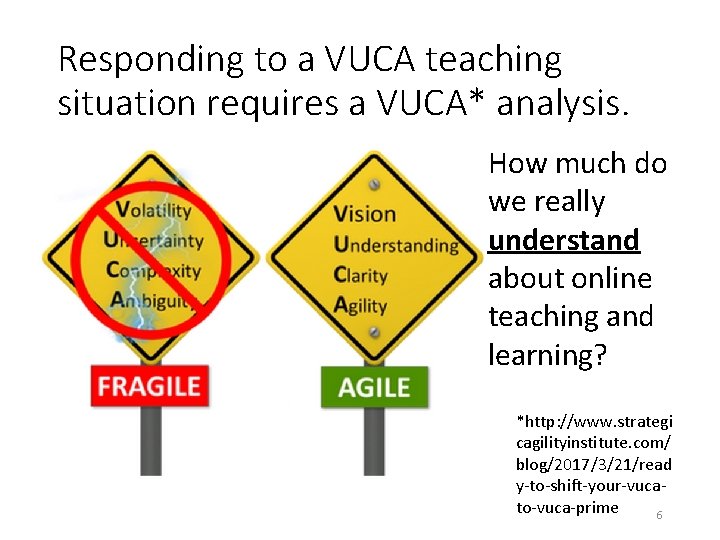
Responding to a VUCA teaching situation requires a VUCA* analysis. How much do we really understand about online teaching and learning? *http: //www. strategi cagilityinstitute. com/ blog/2017/3/21/read y-to-shift-your-vucato-vuca-prime 6
We understand that: • Language is the most complex of human behaviors. • Learning is one of the least understood of human endeavors. • Language Learning is complexity 2. • Distance learning adds another complexity factor. • Language Learning Online can be viewed as complexity 3. 7
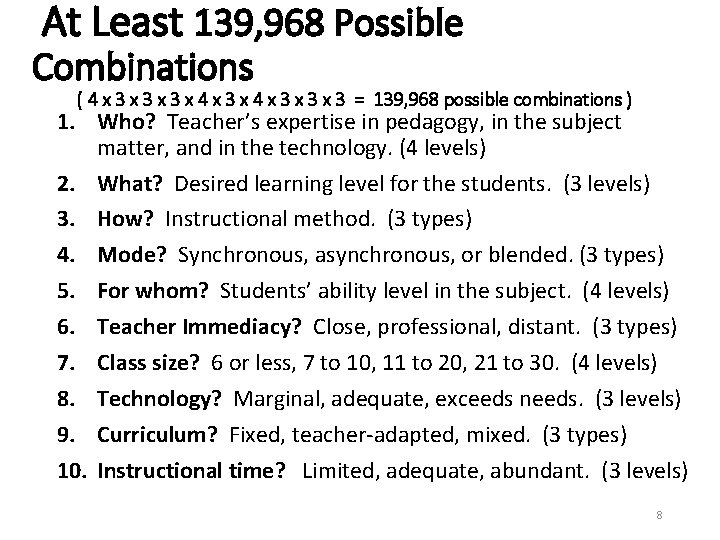
At Least 139, 968 Possible Combinations ( 4 x 3 x 3 x 4 x 3 x 3 = 139, 968 possible combinations ) 1. Who? Teacher’s expertise in pedagogy, in the subject matter, and in the technology. (4 levels) 2. What? Desired learning level for the students. (3 levels) 3. How? Instructional method. (3 types) 4. Mode? Synchronous, asynchronous, or blended. (3 types) 5. For whom? Students’ ability level in the subject. (4 levels) 6. Teacher Immediacy? Close, professional, distant. (3 types) 7. Class size? 6 or less, 7 to 10, 11 to 20, 21 to 30. (4 levels) 8. Technology? Marginal, adequate, exceeds needs. (3 levels) 9. Curriculum? Fixed, teacher-adapted, mixed. (3 types) 10. Instructional time? Limited, adequate, abundant. (3 levels) 8
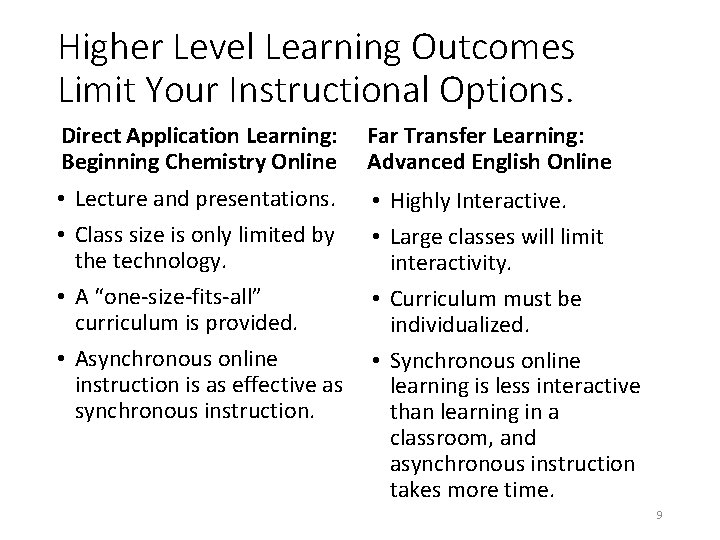
Higher Level Learning Outcomes Limit Your Instructional Options. Direct Application Learning: Beginning Chemistry Online Far Transfer Learning: Advanced English Online • Lecture and presentations. • Class size is only limited by the technology. • A “one-size-fits-all” curriculum is provided. • Asynchronous online instruction is as effective as synchronous instruction. • Highly Interactive. • Large classes will limit interactivity. • Curriculum must be individualized. • Synchronous online learning is less interactive than learning in a classroom, and asynchronous instruction takes more time. 9
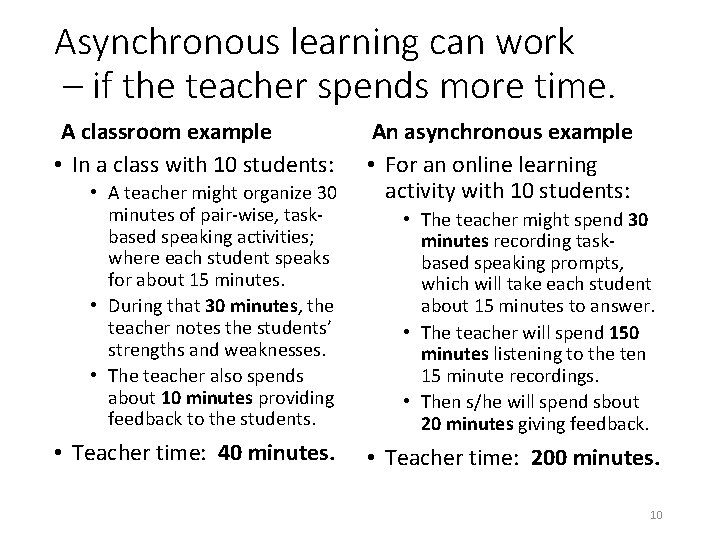
Asynchronous learning can work – if the teacher spends more time. A classroom example • In a class with 10 students: • A teacher might organize 30 minutes of pair-wise, taskbased speaking activities; where each student speaks for about 15 minutes. • During that 30 minutes, the teacher notes the students’ strengths and weaknesses. • The teacher also spends about 10 minutes providing feedback to the students. • Teacher time: 40 minutes. An asynchronous example • For an online learning activity with 10 students: • The teacher might spend 30 minutes recording taskbased speaking prompts, which will take each student about 15 minutes to answer. • The teacher will spend 150 minutes listening to the ten 15 minute recordings. • Then s/he will spend sbout 20 minutes giving feedback. • Teacher time: 200 minutes. 10
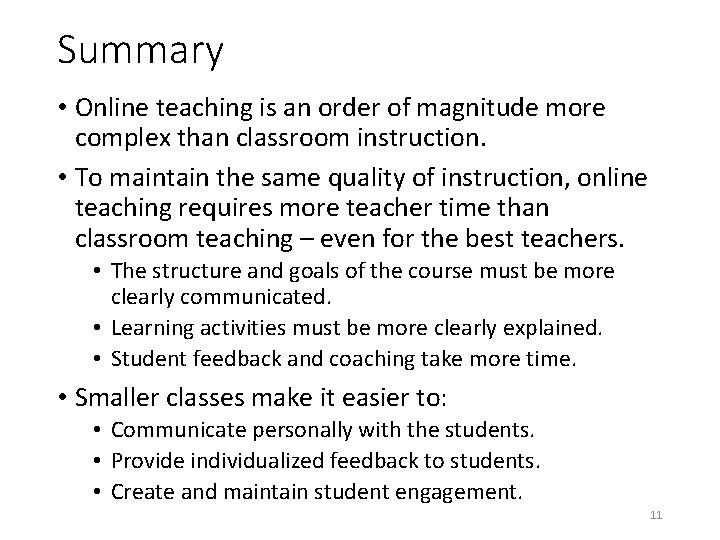
Summary • Online teaching is an order of magnitude more complex than classroom instruction. • To maintain the same quality of instruction, online teaching requires more teacher time than classroom teaching – even for the best teachers. • The structure and goals of the course must be more clearly communicated. • Learning activities must be more clearly explained. • Student feedback and coaching take more time. • Smaller classes make it easier to: • Communicate personally with the students. • Provide individualized feedback to students. • Create and maintain student engagement. 11
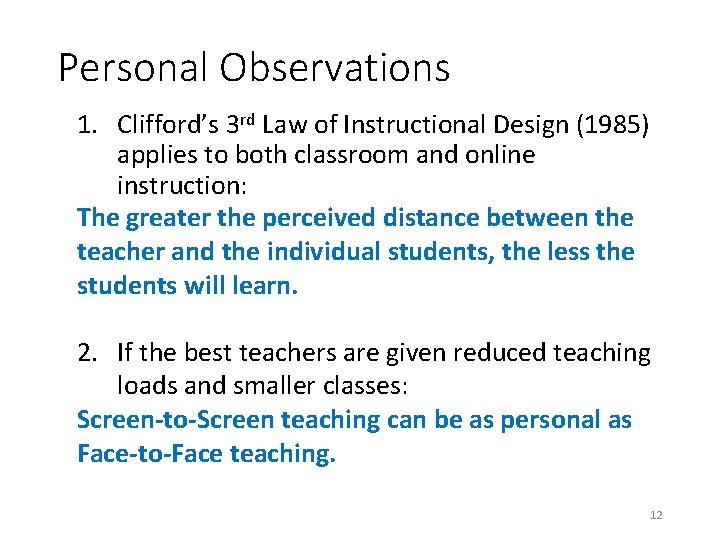
Personal Observations 1. Clifford’s 3 rd Law of Instructional Design (1985) applies to both classroom and online instruction: The greater the perceived distance between the teacher and the individual students, the less the students will learn. 2. If the best teachers are given reduced teaching loads and smaller classes: Screen-to-Screen teaching can be as personal as Face-to-Face teaching. 12