
Our cells go through cell division mitosis for
- Slides: 71
§Our cells go through cell division (mitosis) for growth and repair § This process is highly regulated: § The DNA must make a copy and it is “proofread” § The cell must receive proper signals for growth or repair to start division process § If the process becomes unregulated, this can lead to uncontrolled growth - cancer © 2013 Pearson Education, Inc.
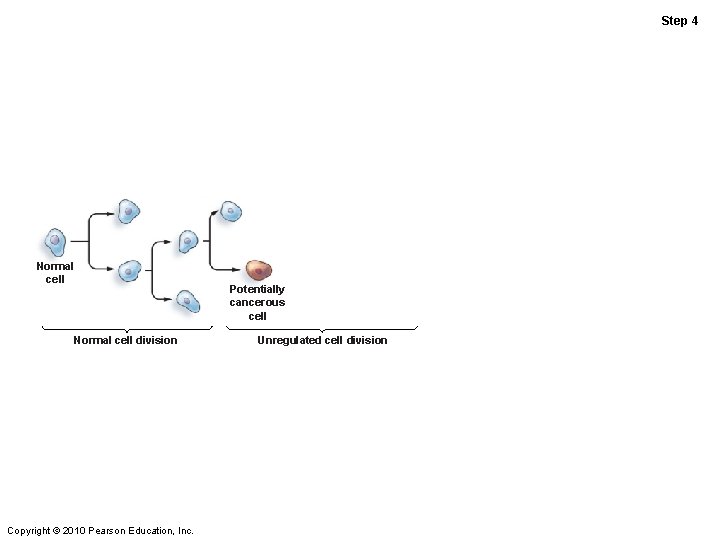
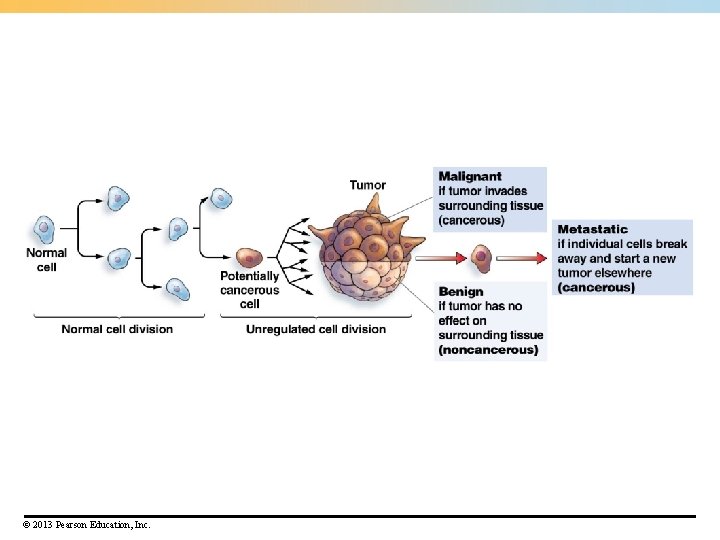
What Is Cancer? § Tumor: Unregulated cell division that form a mass of cells with no function § Benign tumor: doesn’t affect surrounding tissues § Malignant tumor: invades surrounding tissues; cancerous § Metastasis: cells break away from a malignant tumor and start a new cancer at another location © 2013 Pearson Education, Inc.
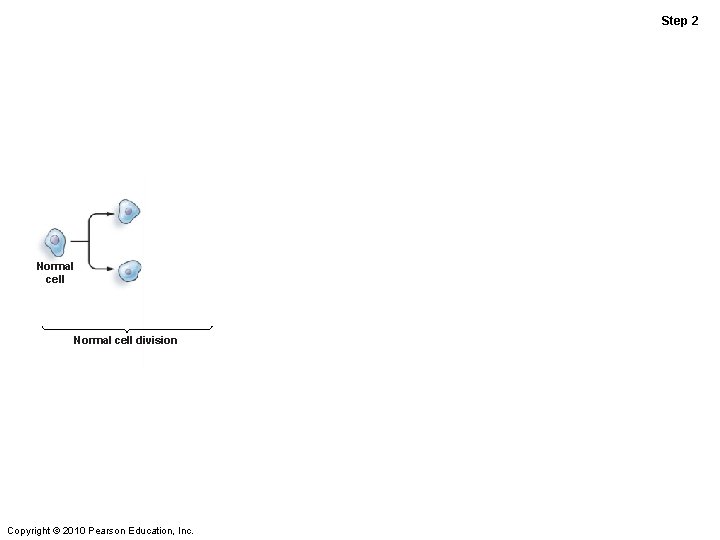
Step 2 Normal cell division Copyright © 2010 Pearson Education, Inc.
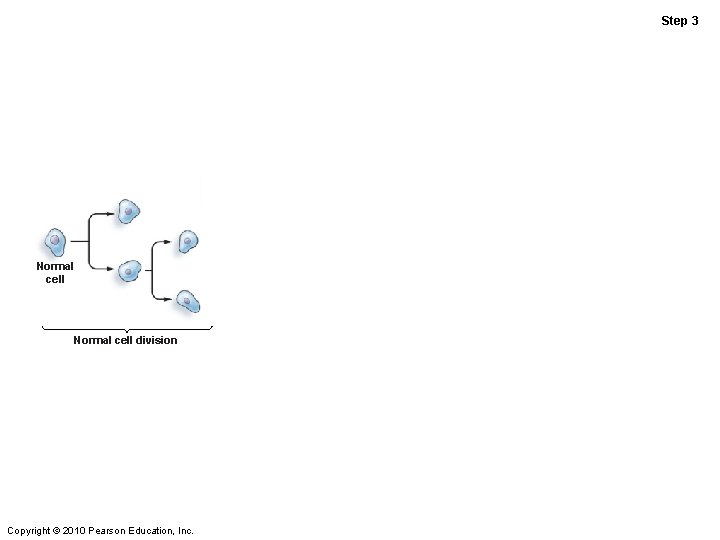
Step 3 Normal cell division Copyright © 2010 Pearson Education, Inc.
Step 4 Normal cell division Copyright © 2010 Pearson Education, Inc. Potentially cancerous cell Unregulated cell division
© 2013 Pearson Education, Inc.
§Metastatic cells can travel throughout the body via the circulatory system or the lymphatic system. § Lymphatic system collects fluid that leaks from capillaries. § Lymph nodes filter the lymph. § Cancer cells found in lymph nodes indicate metastasis has taken place. © 2013 Pearson Education, Inc.
§Cancer cells differ from normal cells: § Divide when they shouldn’t § Invade surrounding tissues § Move to other locations in the body © 2013 Pearson Education, Inc.
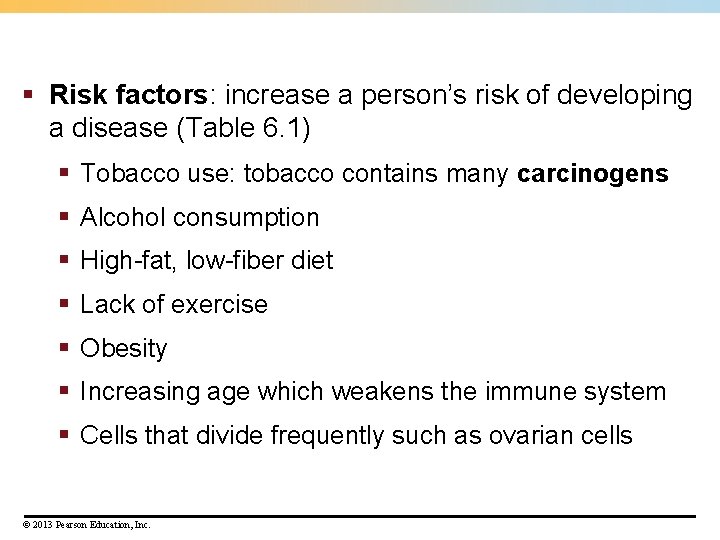
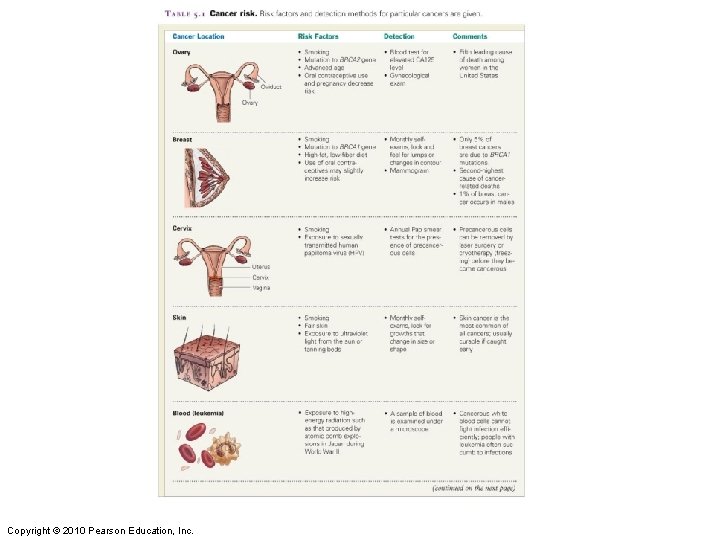
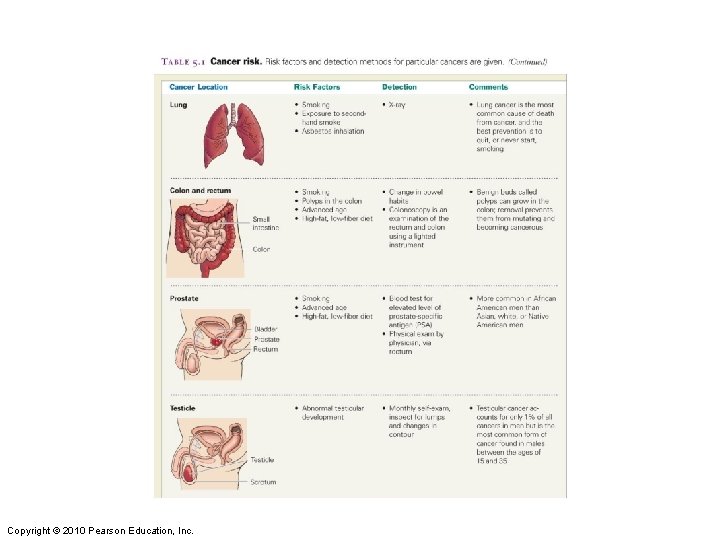
§ Risk factors: increase a person’s risk of developing a disease (Table 6. 1) § Tobacco use: tobacco contains many carcinogens § Alcohol consumption § High-fat, low-fiber diet § Lack of exercise § Obesity § Increasing age which weakens the immune system § Cells that divide frequently such as ovarian cells © 2013 Pearson Education, Inc.
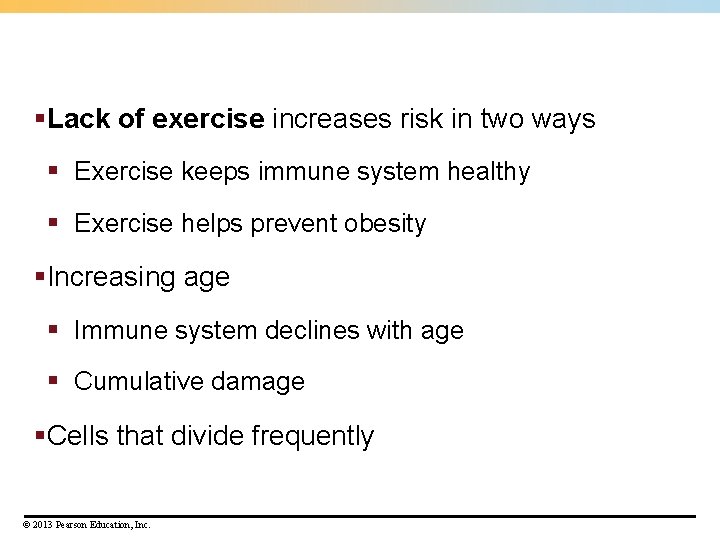
§Lack of exercise increases risk in two ways § Exercise keeps immune system healthy § Exercise helps prevent obesity §Increasing age § Immune system declines with age § Cumulative damage §Cells that divide frequently © 2013 Pearson Education, Inc.
Copyright © 2010 Pearson Education, Inc.
Copyright © 2010 Pearson Education, Inc.
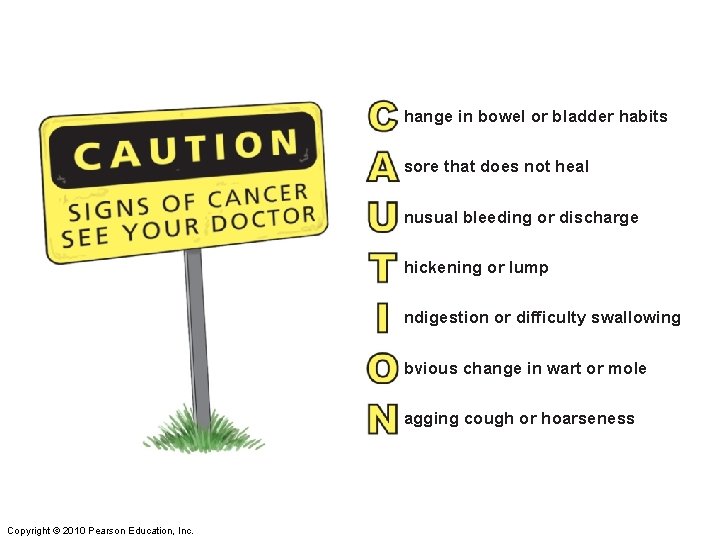
hange in bowel or bladder habits sore that does not heal nusual bleeding or discharge hickening or lump ndigestion or difficulty swallowing bvious change in wart or mole agging cough or hoarseness Copyright © 2010 Pearson Education, Inc.
§Remember that our cells go through mitosis to make new cells when growth or repair is required § Result is 2 cells with diploid number of chromosomes § In humans that is 46 chromosomes §Another division process (Meiosis) happens in cells that will make gametes (egg and sperm cells) § Result is egg and sperm cells that have half the number of chromosomes § In humans that is 23 chromosomes © 2013 Pearson Education, Inc.
§ Asexual reproduction: § Only one parent § Offspring are genetically identical to parent § Sexual reproduction § Gametes (egg and sperm cells) are combined from two parents § Offspring are genetically different from one another and from the parents © 2013 Pearson Education, Inc.
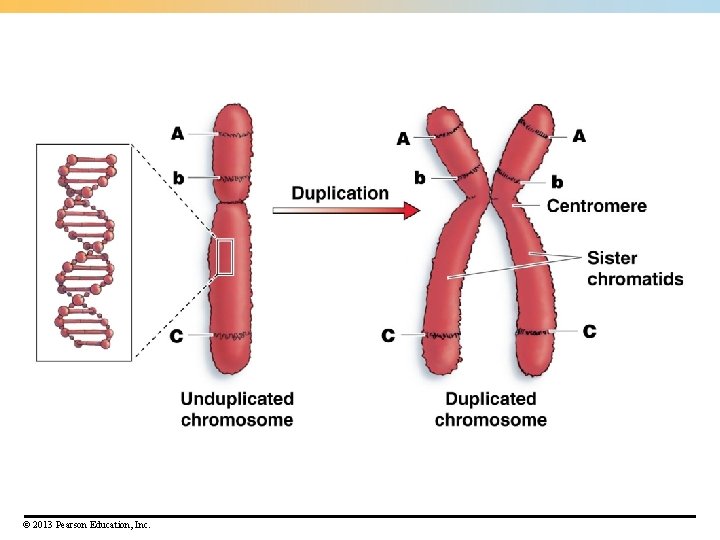
§ Before dividing (in mitosis or meiosis), cells must copy their DNA § Gene: section of DNA that has the instructions for making all proteins § One molecule of DNA is wrapped around proteins to form a chromosome containing hundreds of genes. § Different species have different numbers of chromosomes (we have 46). © 2013 Pearson Education, Inc.
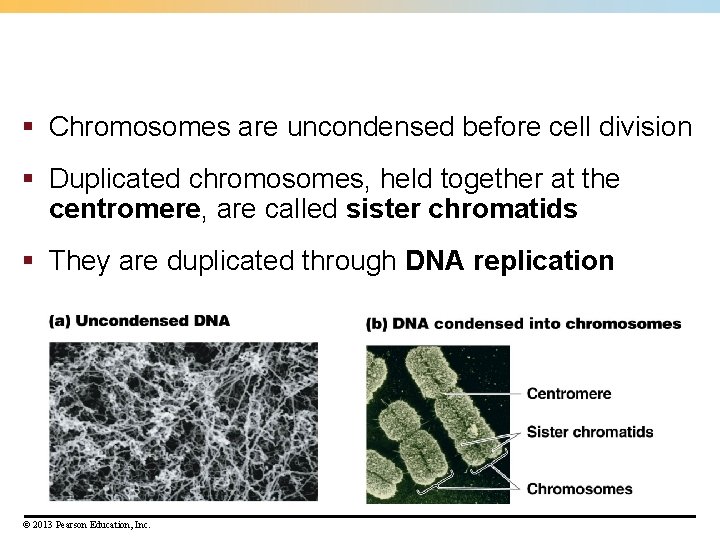
§ Chromosomes are uncondensed before cell division § Duplicated chromosomes, held together at the centromere, are called sister chromatids § They are duplicated through DNA replication © 2013 Pearson Education, Inc.
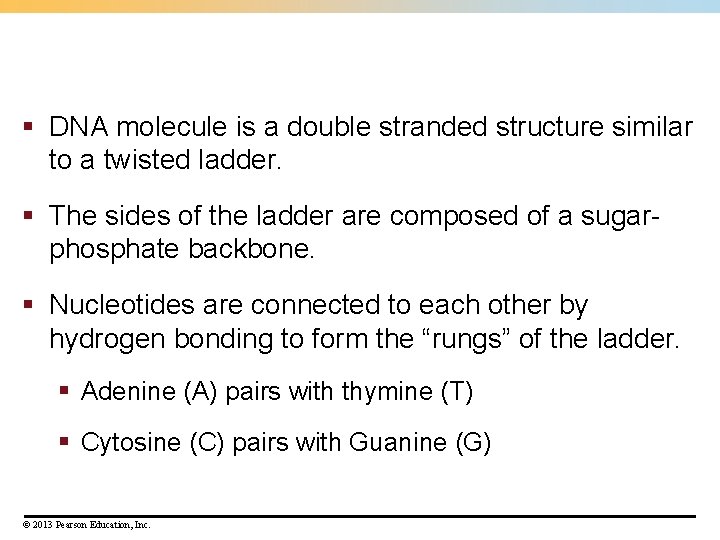
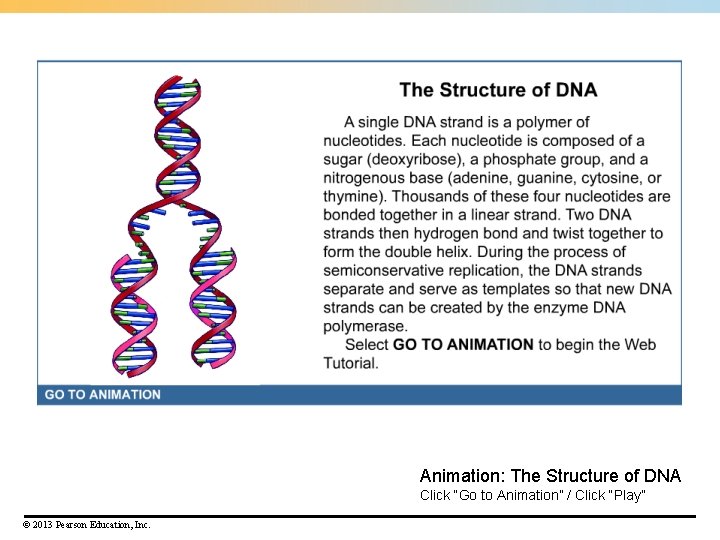
§ DNA molecule is a double stranded structure similar to a twisted ladder. § The sides of the ladder are composed of a sugarphosphate backbone. § Nucleotides are connected to each other by hydrogen bonding to form the “rungs” of the ladder. § Adenine (A) pairs with thymine (T) § Cytosine (C) pairs with Guanine (G) © 2013 Pearson Education, Inc.
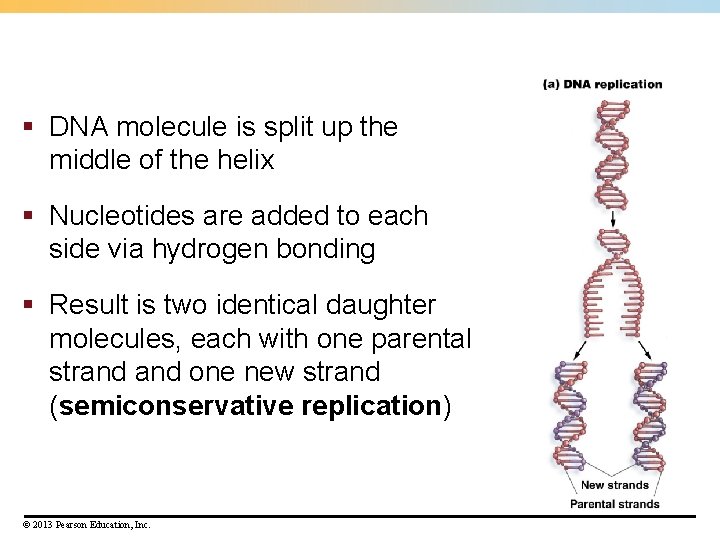
§ DNA molecule is split up the middle of the helix § Nucleotides are added to each side via hydrogen bonding § Result is two identical daughter molecules, each with one parental strand one new strand (semiconservative replication) © 2013 Pearson Education, Inc.
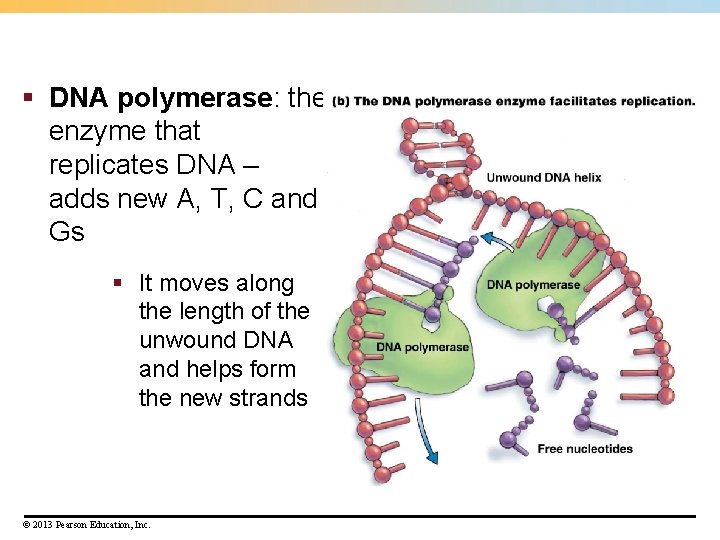
§ DNA polymerase: the enzyme that replicates DNA – adds new A, T, C and Gs § It moves along the length of the unwound DNA and helps form the new strands © 2013 Pearson Education, Inc.
© 2013 Pearson Education, Inc.
Animation: The Structure of DNA Click “Go to Animation” / Click “Play” © 2013 Pearson Education, Inc.
Bio. Flix: DNA Replication © 2013 Pearson Education, Inc.
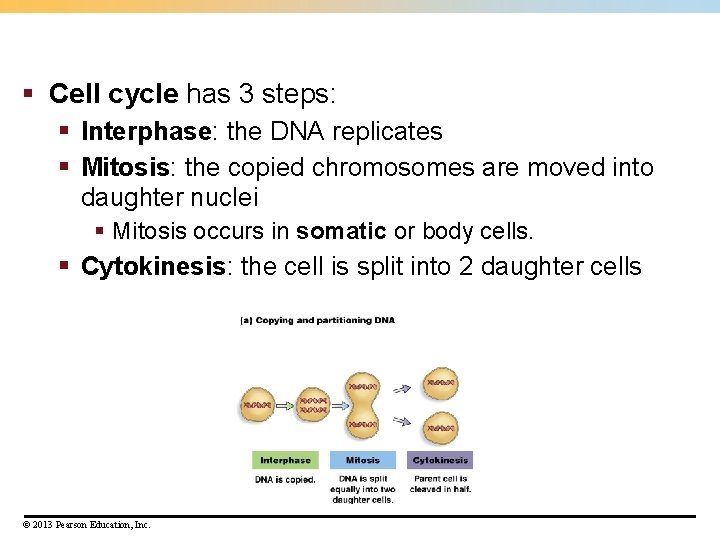
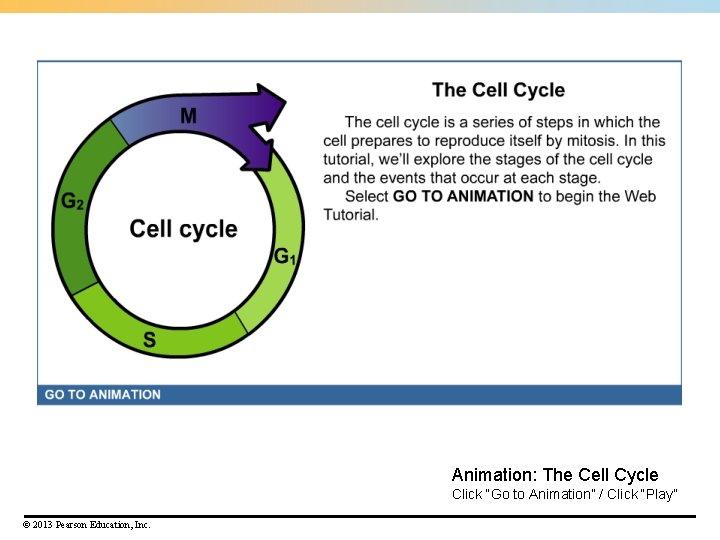
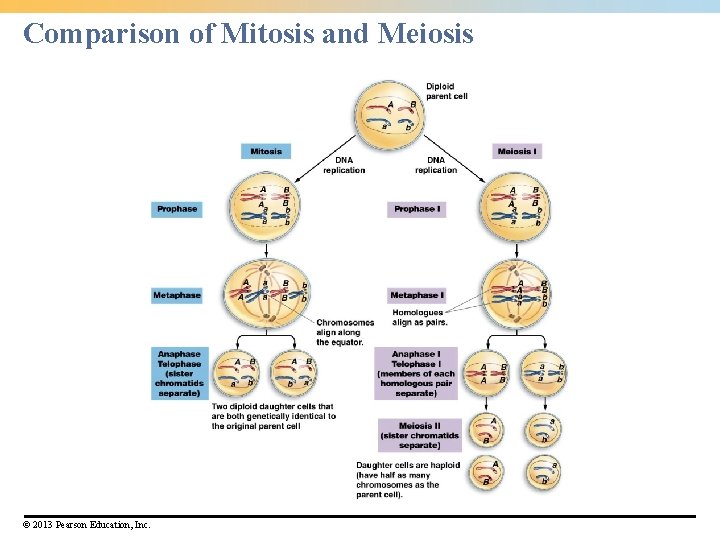
§ Cell cycle has 3 steps: § Interphase: the DNA replicates § Mitosis: the copied chromosomes are moved into daughter nuclei § Mitosis occurs in somatic or body cells. § Cytokinesis: the cell is split into 2 daughter cells © 2013 Pearson Education, Inc.
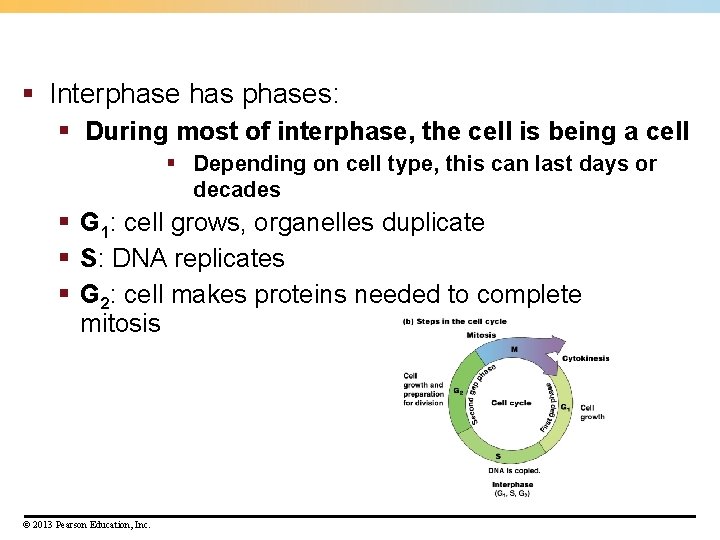
§ Interphase has phases: § During most of interphase, the cell is being a cell § Depending on cell type, this can last days or decades § G 1: cell grows, organelles duplicate § S: DNA replicates § G 2: cell makes proteins needed to complete mitosis © 2013 Pearson Education, Inc.
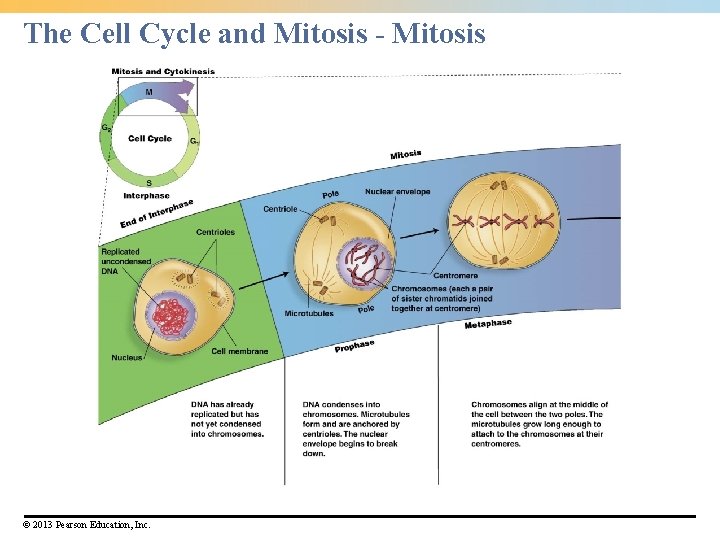
§ Mitosis produces genetically-identical daughter nuclei § Mitosis is followed by cytokinesis which splits the two nuclei into two daughter cells § Four stages: § Prophase § Metaphase § Anaphase § Telophase © 2013 Pearson Education, Inc.
§ Prophase: § Chromosomes condense § Nuclear envelope disappears § Microtubules pull the chromosomes around during cell division § Animal cells: microtubules attached to centrioles at the poles of the cell © 2013 Pearson Education, Inc.
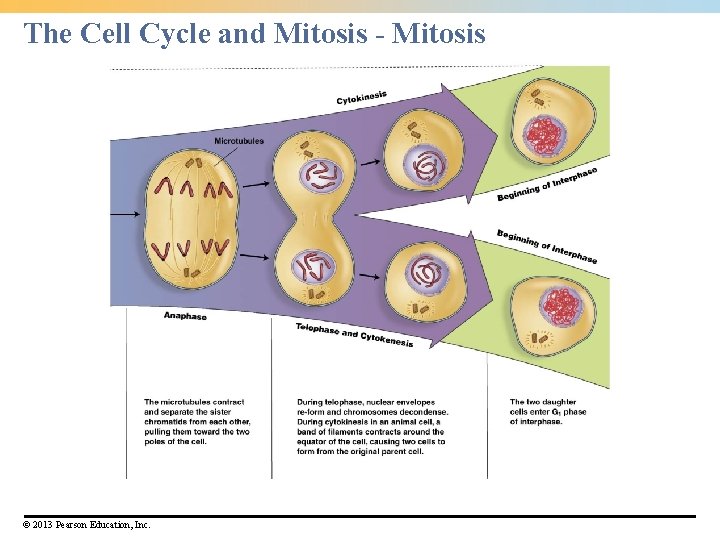
§ Metaphase: § Chromosomes are aligned across the middle of the cell by microtubules § Anaphase: § centromeres split, § sister chromatids are pulled apart toward opposite poles § Telophase: § Nuclear envelopes reform around chromosomes § Chromosomes revert to uncondensed form © 2013 Pearson Education, Inc.
The Cell Cycle and Mitosis - Mitosis © 2013 Pearson Education, Inc.
The Cell Cycle and Mitosis - Mitosis © 2013 Pearson Education, Inc.
The Cell Cycle and Mitosis Suggested Media Enhancement: Mitosis To access this animation go to folder C_Animations_and_Video_Files and open the Bio. Flix folder. PLAY © 2013 Pearson Education, Inc.
Bio. Flix: Mitosis © 2013 Pearson Education, Inc.
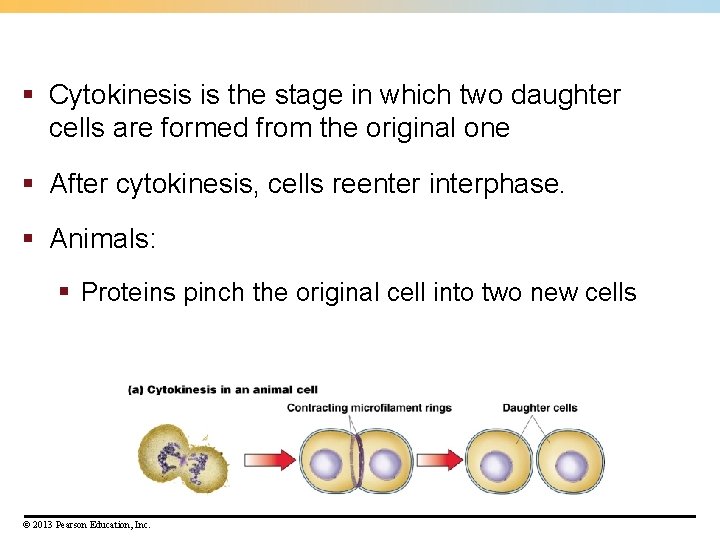
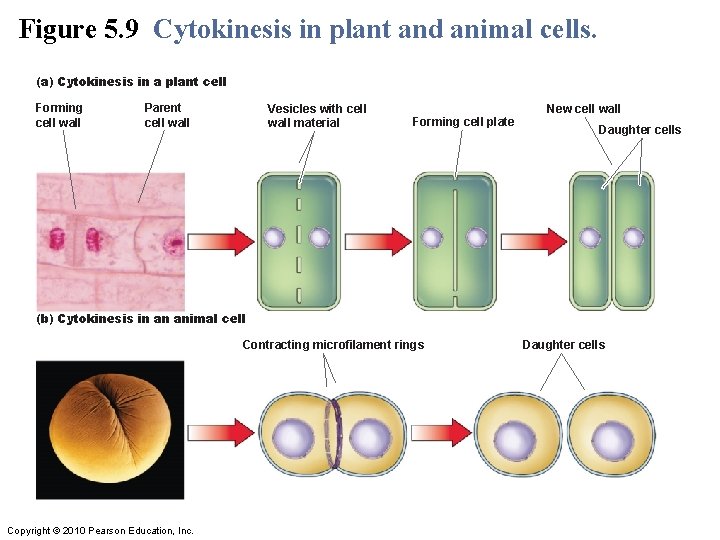
§ Cytokinesis is the stage in which two daughter cells are formed from the original one § After cytokinesis, cells reenter interphase. § Animals: § Proteins pinch the original cell into two new cells © 2013 Pearson Education, Inc.
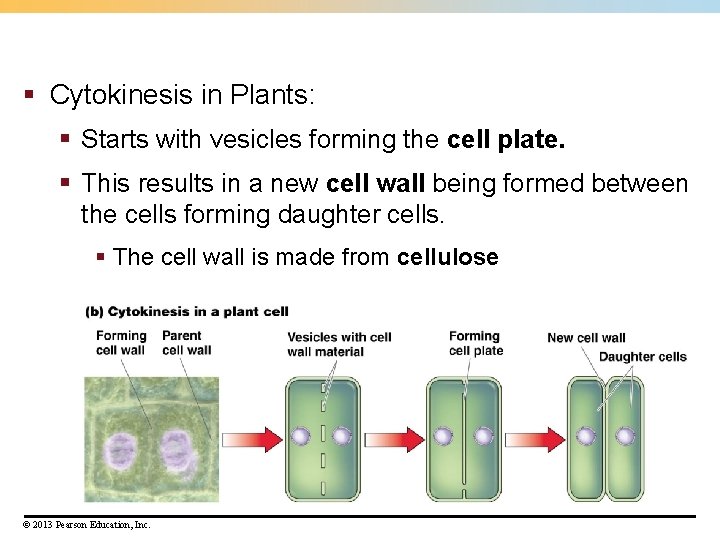
§ Cytokinesis in Plants: § Starts with vesicles forming the cell plate. § This results in a new cell wall being formed between the cells forming daughter cells. § The cell wall is made from cellulose © 2013 Pearson Education, Inc.
Figure 5. 9 Cytokinesis in plant and animal cells. (a) Cytokinesis in a plant cell Forming cell wall Parent cell wall Vesicles with cell wall material Forming cell plate New cell wall Daughter cells (b) Cytokinesis in an animal cell Contracting microfilament rings Copyright © 2010 Pearson Education, Inc. Daughter cells
Animation: Mitosis Click “Go to Animation” / Click “Play” © 2013 Pearson Education, Inc.
Animation: The Cell Cycle Click “Go to Animation” / Click “Play” © 2013 Pearson Education, Inc.
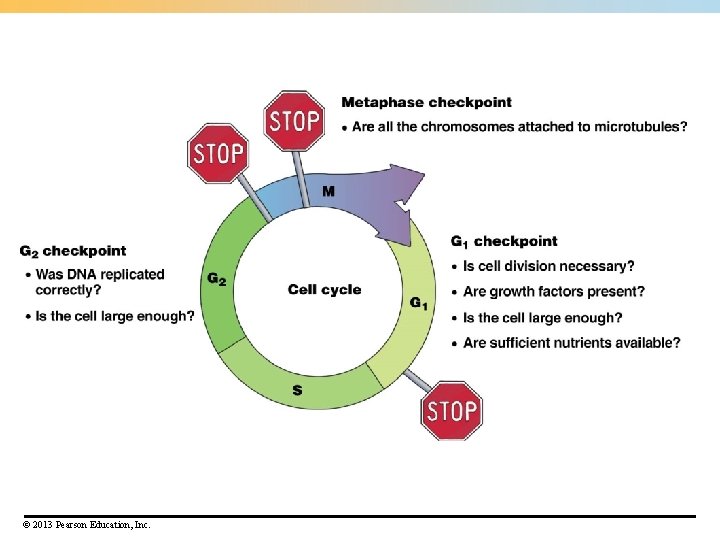
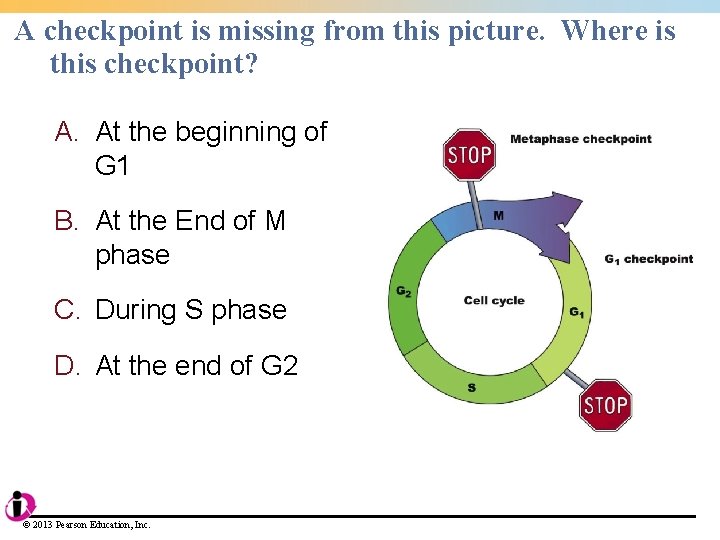
§ Cell division is a tightly controlled process § Normal cells halt at checkpoints § Proteins survey the condition of the cell § Cell must pass the survey to proceed with cell division § 3 checkpoints: G 1, G 2, and metaphase © 2013 Pearson Education, Inc.
© 2013 Pearson Education, Inc.
§ Growth factors stimulate cells to divide § Growth factors bind to receptors to trigger a response from a cell § Mutation: a change in the sequence of DNA § Changes to DNA can change the structure and function of the protein coded by the DNA § Mutations may be inherited or caused by carcinogens © 2013 Pearson Education, Inc.
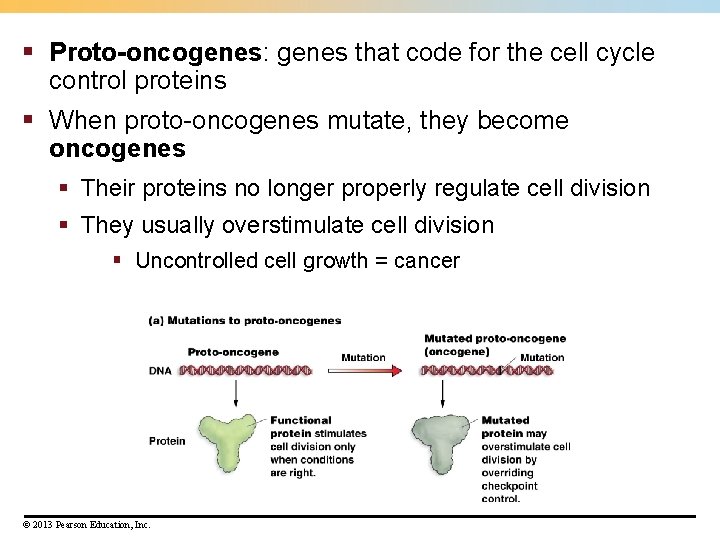
§ Proto-oncogenes: genes that code for the cell cycle control proteins § When proto-oncogenes mutate, they become oncogenes § Their proteins no longer properly regulate cell division § They usually overstimulate cell division § Uncontrolled cell growth = cancer © 2013 Pearson Education, Inc.
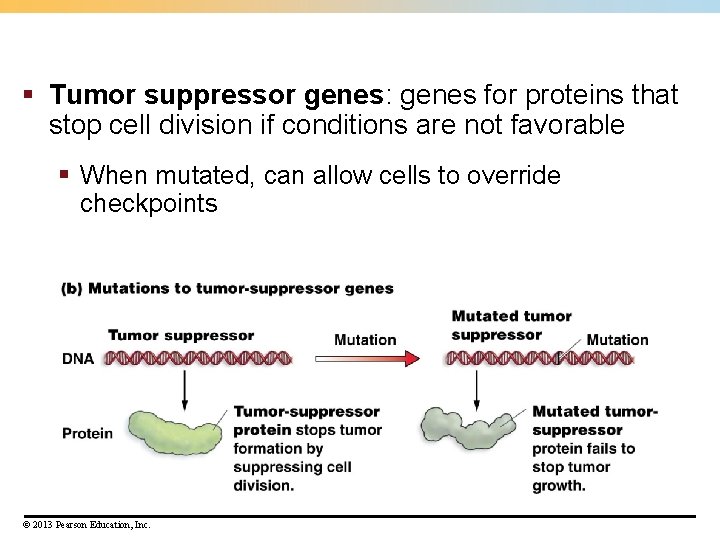
§ Tumor suppressor genes: genes for proteins that stop cell division if conditions are not favorable § When mutated, can allow cells to override checkpoints © 2013 Pearson Education, Inc.
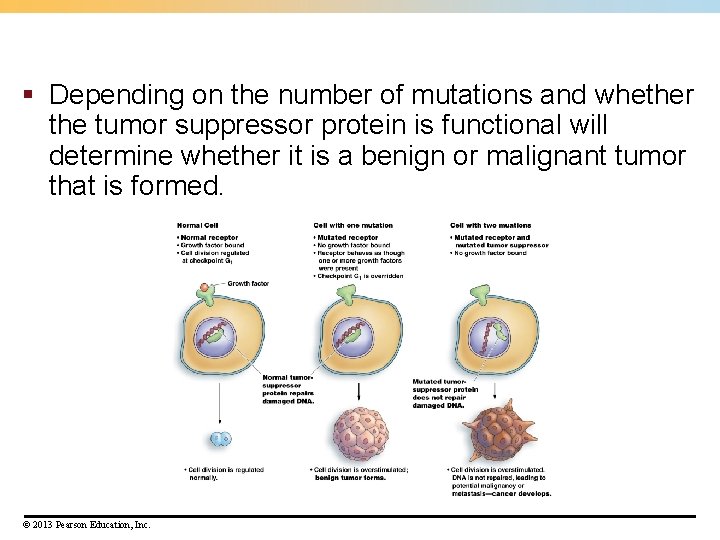
§ Depending on the number of mutations and whether the tumor suppressor protein is functional will determine whether it is a benign or malignant tumor that is formed. © 2013 Pearson Education, Inc.
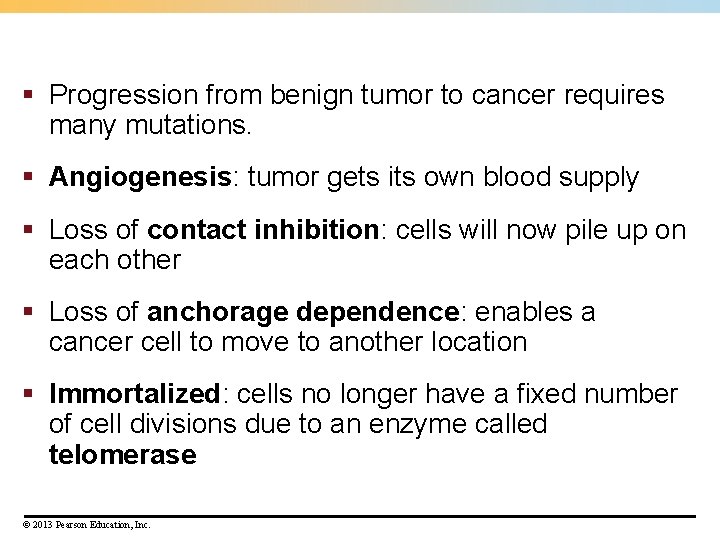
§ Progression from benign tumor to cancer requires many mutations. § Angiogenesis: tumor gets its own blood supply § Loss of contact inhibition: cells will now pile up on each other § Loss of anchorage dependence: enables a cancer cell to move to another location § Immortalized: cells no longer have a fixed number of cell divisions due to an enzyme called telomerase © 2013 Pearson Education, Inc.
§ Multiple hit model: process of cancer development requires multiple mutations § Some mutations may be inherited (familial risk) § Most are probably acquired during a person’s lifetime © 2013 Pearson Education, Inc.
§ Early detection increases odds of survival § There are different detection methods for different cancers § Some cancers produce increased amount of a characteristic protein § Biopsy: surgical removal of cells or fluid for analysis § Needle biopsy: removal is made using a needle § Laparascope: surgical instrument with a light, camera, and small scalpel © 2013 Pearson Education, Inc.
§ Chemotherapy: drugs that selectively kill dividing cells § Combination of different drugs used (“cocktail”) § Interrupt cell division in different ways § Helps prevent resistance to the drugs from arising § Normal dividing cells are also killed (hair follicles, bone marrow, stomach lining) © 2013 Pearson Education, Inc.
§ Radiation therapy: use of high-energy particles to destroy cancer cells § Damages their DNA so they can’t continue to divide or grow § Usually used on cancers close to the surface § Typically performed after surgical removal of tumor § If a person remains cancer free after treatment for 5 years they are in remission and after 10 years they are cured. © 2013 Pearson Education, Inc.
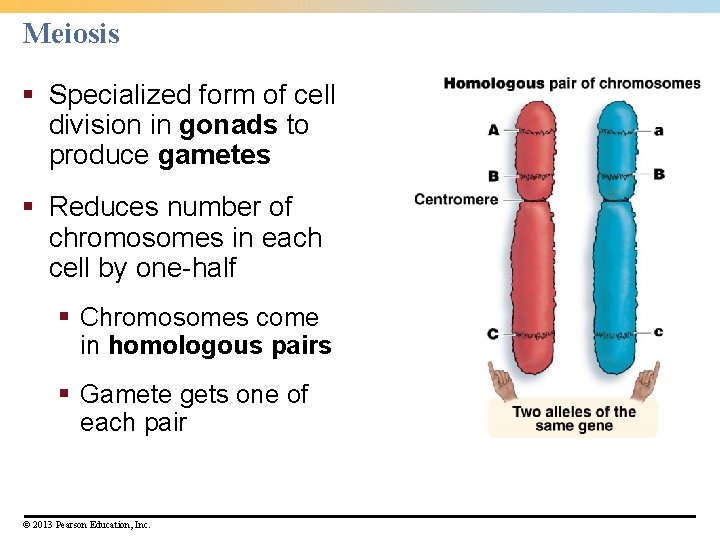
Meiosis § Specialized form of cell division in gonads to produce gametes § Reduces number of chromosomes in each cell by one-half § Chromosomes come in homologous pairs § Gamete gets one of each pair © 2013 Pearson Education, Inc.
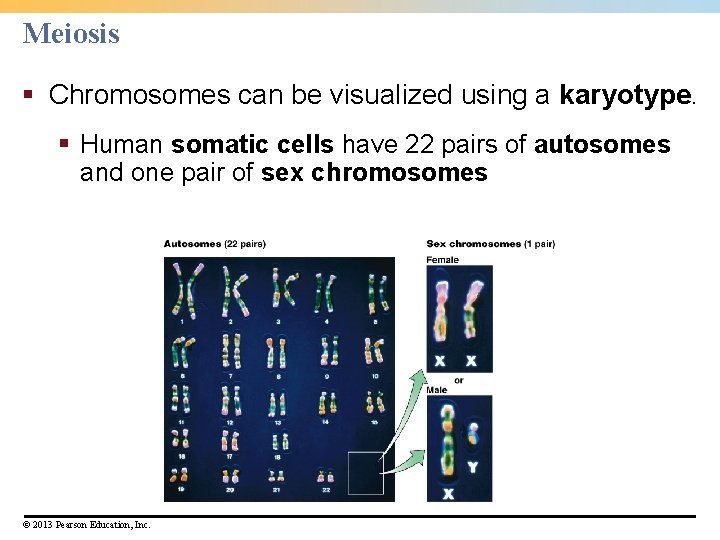
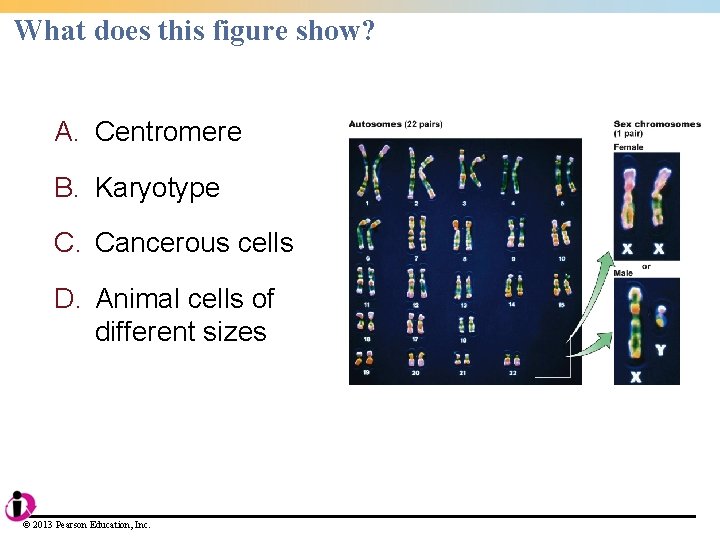
Meiosis § Chromosomes can be visualized using a karyotype. § Human somatic cells have 22 pairs of autosomes and one pair of sex chromosomes © 2013 Pearson Education, Inc.
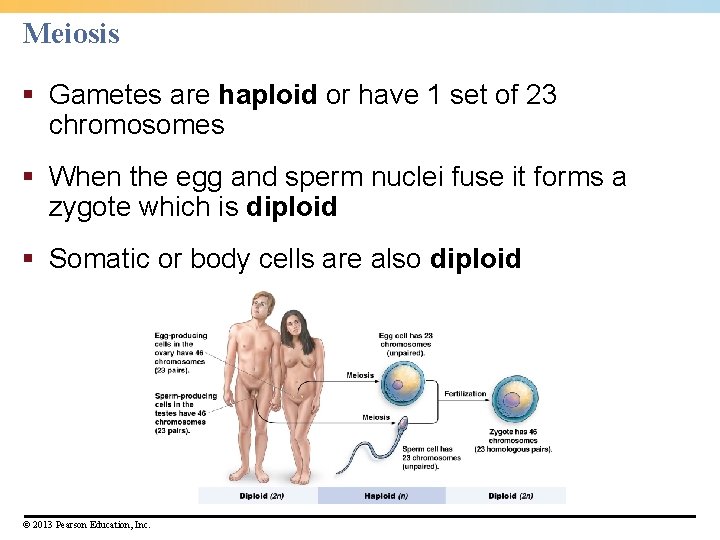
Meiosis § Gametes are haploid or have 1 set of 23 chromosomes § When the egg and sperm nuclei fuse it forms a zygote which is diploid § Somatic or body cells are also diploid © 2013 Pearson Education, Inc.
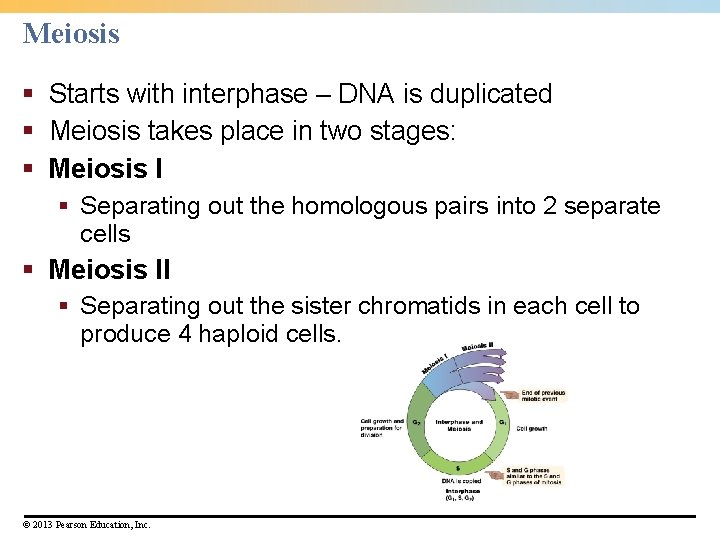
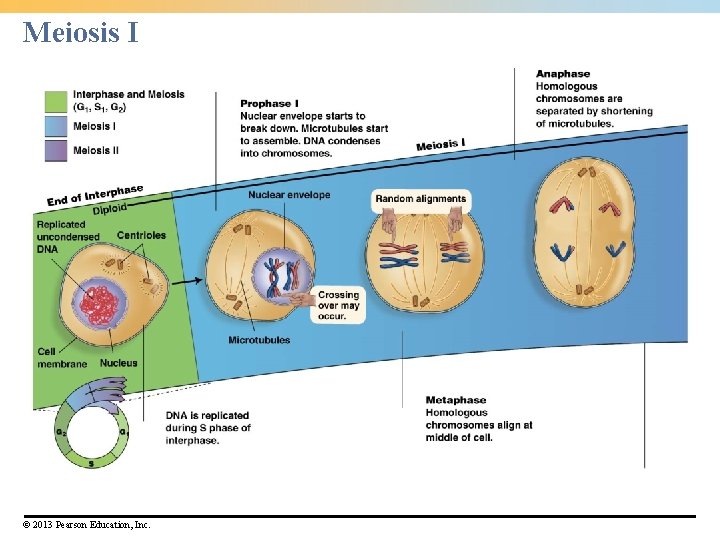
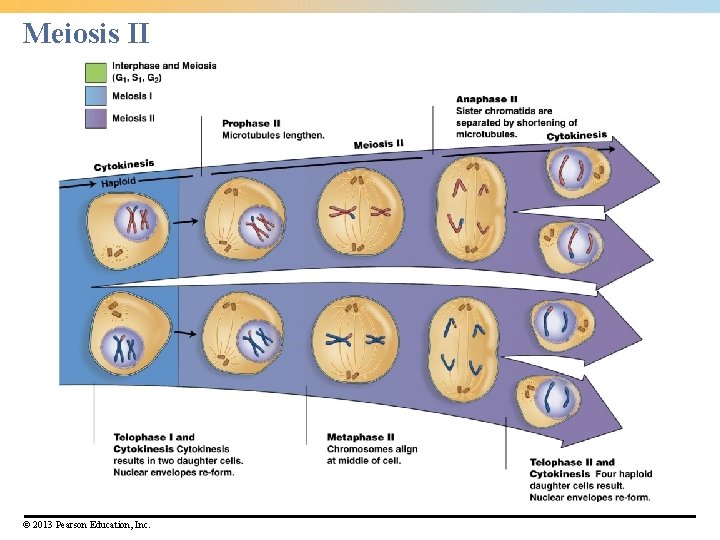
Meiosis § Starts with interphase – DNA is duplicated § Meiosis takes place in two stages: § Meiosis I § Separating out the homologous pairs into 2 separate cells § Meiosis II § Separating out the sister chromatids in each cell to produce 4 haploid cells. © 2013 Pearson Education, Inc.
Meiosis I © 2013 Pearson Education, Inc.
Meiosis II © 2013 Pearson Education, Inc.
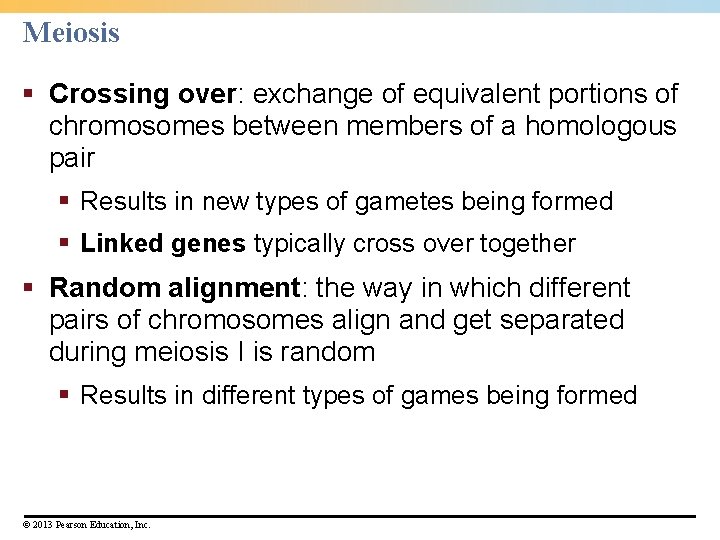
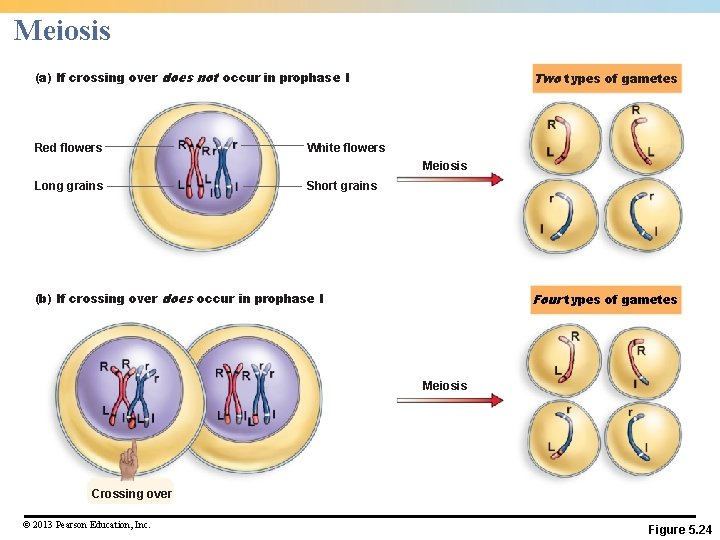
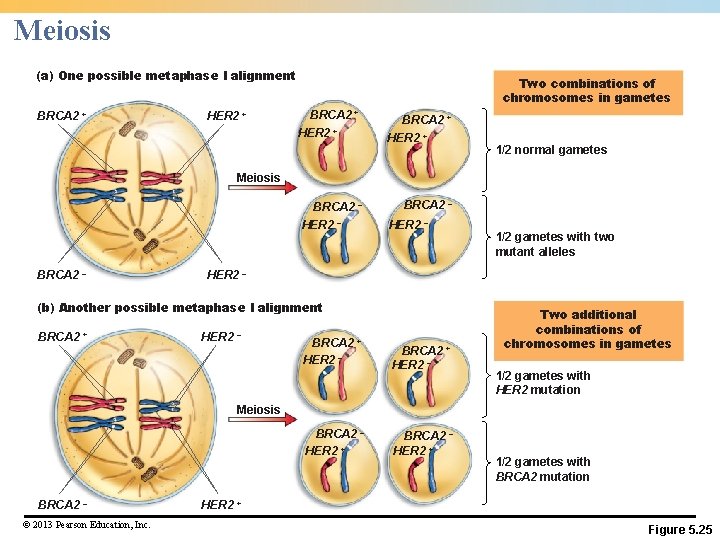
Meiosis § Crossing over: exchange of equivalent portions of chromosomes between members of a homologous pair § Results in new types of gametes being formed § Linked genes typically cross over together § Random alignment: the way in which different pairs of chromosomes align and get separated during meiosis I is random § Results in different types of games being formed © 2013 Pearson Education, Inc.
Meiosis (a) If crossing over does not occur in prophase I Red flowers Two types of gametes White flowers Meiosis Long grains Short grains (b) If crossing over does occur in prophase I Four types of gametes Meiosis Crossing over © 2013 Pearson Education, Inc. Figure 5. 24
Meiosis (a) One possible metaphase I alignment BRCA 2 + HER 2 + Two combinations of chromosomes in gametes BRCA 2 + HER 2 + 1/2 normal gametes Meiosis BRCA 2 – HER 2 – (b) Another possible metaphase I alignment BRCA 2 + 1/2 gametes with two mutant alleles HER 2 – BRCA 2 + HER 2 – Two additional combinations of chromosomes in gametes 1/2 gametes with HER 2 mutation Meiosis BRCA 2 – HER 2 + BRCA 2 – © 2013 Pearson Education, Inc. BRCA 2 – HER 2 + 1/2 gametes with BRCA 2 mutation HER 2 + Figure 5. 25
Bio. Flix: Meiosis © 2013 Pearson Education, Inc.
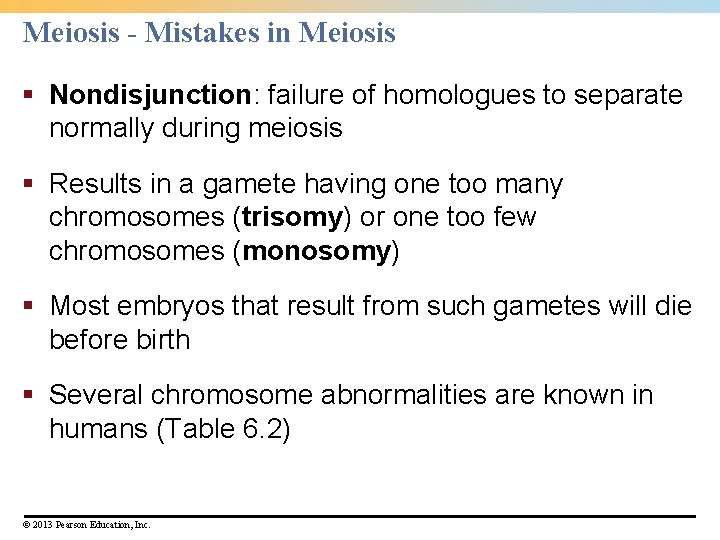
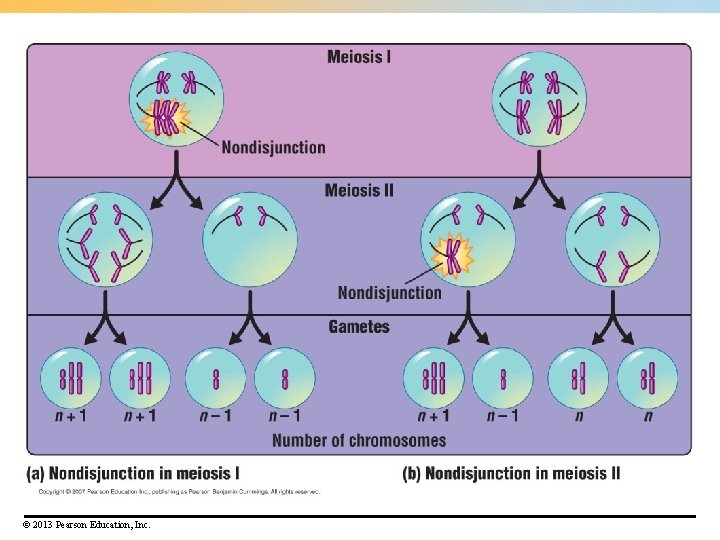
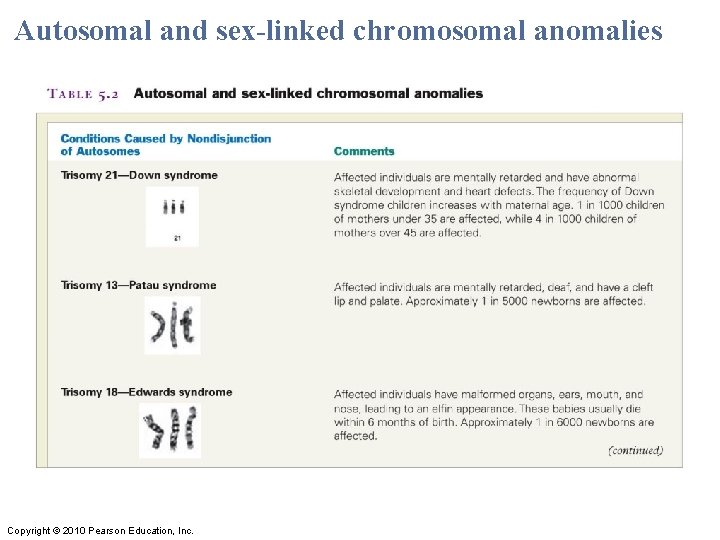
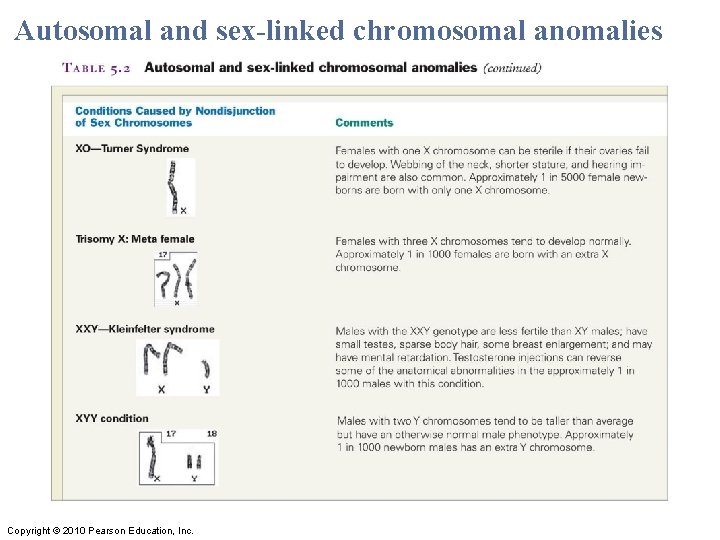
Meiosis - Mistakes in Meiosis § Nondisjunction: failure of homologues to separate normally during meiosis § Results in a gamete having one too many chromosomes (trisomy) or one too few chromosomes (monosomy) § Most embryos that result from such gametes will die before birth § Several chromosome abnormalities are known in humans (Table 6. 2) © 2013 Pearson Education, Inc.
© 2013 Pearson Education, Inc.
Comparison of Mitosis and Meiosis © 2013 Pearson Education, Inc.
Autosomal and sex-linked chromosomal anomalies Copyright © 2010 Pearson Education, Inc.
Autosomal and sex-linked chromosomal anomalies Copyright © 2010 Pearson Education, Inc.
Meiosis §For cancer mutations to be passed on to offspring, they must take place in cells that give rise to gametes. §Mutations in somatic cells (e. g. , skin cancer) are not heritable. © 2013 Pearson Education, Inc.
How many chromosomes does a human body cell contain? A. 12 B. 23 C. 34 D. 46 © 2013 Pearson Education, Inc.
During which phase of mitosis does the centromere split, allowing motor proteins to pull each sister chromatid to opposite poles of the cell? A. Prophase B. Metaphase C. Telophase D. Anaphase © 2013 Pearson Education, Inc.
The genes that encode the proteins regulating the cell cycle are called ____. A. Oncogenes B. Proto-oncogenes C. Carcinogens D. Malignant © 2013 Pearson Education, Inc.
True or False: Chemotherapy causes hair loss because hair follicles divide rapidly, like cancer cells. §True §False © 2013 Pearson Education, Inc.
At what stage of Meiosis does crossing over occur? A. Metaphase I B. Metaphase II C. Prophase I D. Prophase II © 2013 Pearson Education, Inc.
A checkpoint is missing from this picture. Where is this checkpoint? A. At the beginning of G 1 B. At the End of M phase C. During S phase D. At the end of G 2 © 2013 Pearson Education, Inc.
What does this figure show? A. Centromere B. Karyotype C. Cancerous cells D. Animal cells of different sizes © 2013 Pearson Education, Inc.