
Ottoman Empire The Modern Era 1750 1914 The
- Slides: 16
Ottoman Empire The Modern Era (1750 -1914)
The acorn says… o o o Compare reaction to foreign interference in the Ottoman Empire (and China, India, SE Asia, & Japan) Muhammad Ali Suez Canal
Remember the Ottomans? o o o Conquered Constantinople in 1453: Istanbul “Golden Age” under Suleyman Magnificent in mid 16 th c. Janissaries Blend Byzantine, Arab, & Persian styles Dominate overland trade routes
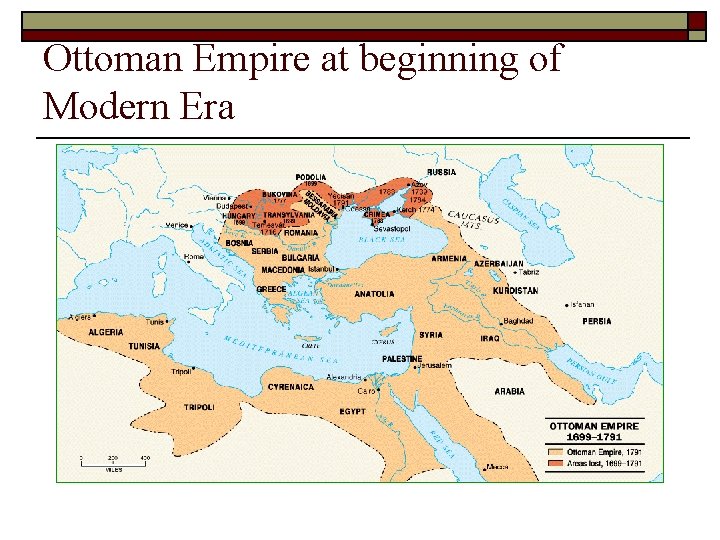
Ottoman Empire at beginning of Modern Era
Ottoman Decline (18 th & 19 th c. ): the Sick Man of Europe o o o Government corruption, ineptitude, series of assassinations Competition from European products & usurpation of trade routes by Europeans led to economic decline Intellectual stagnation
Challenges to the Ottoman Empire o o The West: Napoleon invaded Muslim heartland of Egypt in 1798 & quickly conquered weak Ottoman Egyptian forces. He was only expelled because of British aid/alliance. Decentralization: As the empire decayed, regional forces from within the Empire began to emerge. n n Inspired by Enlightenment ideas & nationalistic fervor, Christian regions of the Balkans rebelled with European encouragement & achieved independence. Muhammad Ali strengthens & separates Egypt
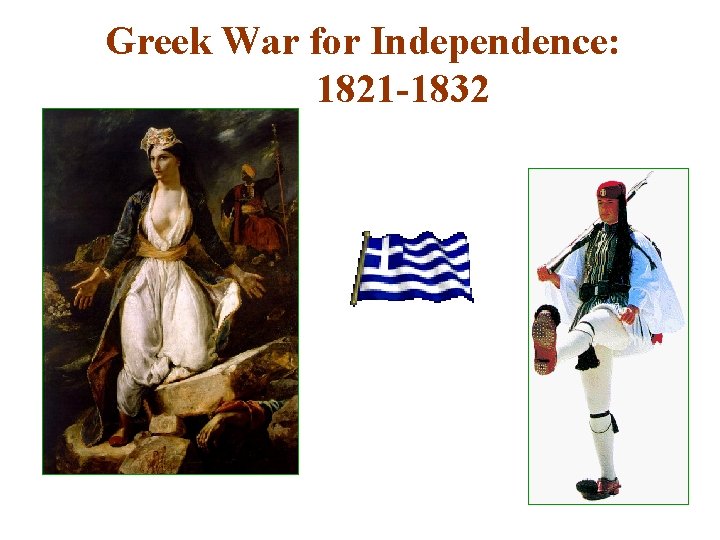
Greek War for Independence: 1821 -1832
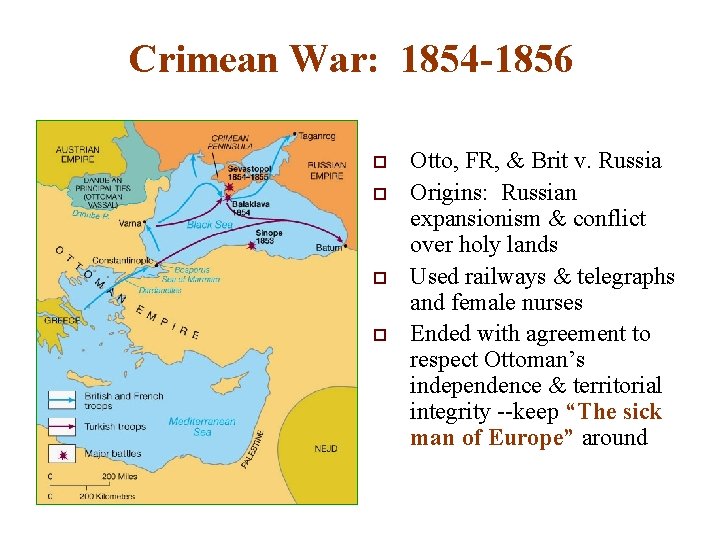
Crimean War: 1854 -1856 o o Otto, FR, & Brit v. Russia Origins: Russian expansionism & conflict over holy lands Used railways & telegraphs and female nurses Ended with agreement to respect Ottoman’s independence & territorial integrity --keep “The sick man of Europe” around
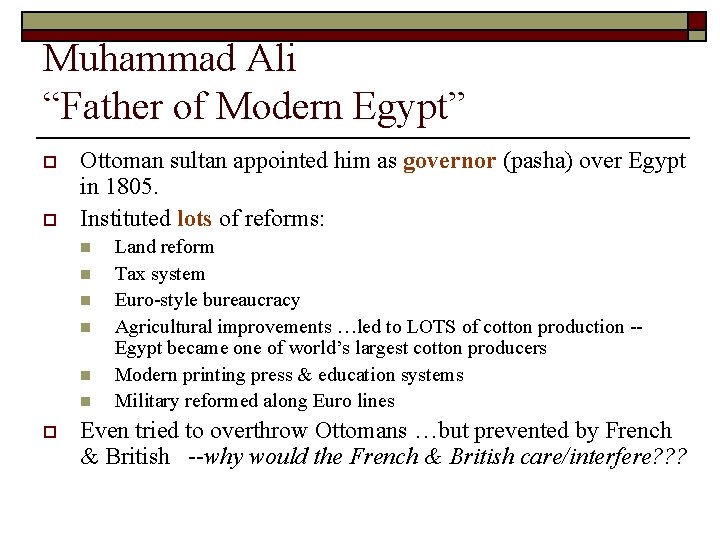
Muhammad Ali “Father of Modern Egypt” o o Ottoman sultan appointed him as governor (pasha) over Egypt in 1805. Instituted lots of reforms: n n n o Land reform Tax system Euro-style bureaucracy Agricultural improvements …led to LOTS of cotton production -Egypt became one of world’s largest cotton producers Modern printing press & education systems Military reformed along Euro lines Even tried to overthrow Ottomans …but prevented by French & British --why would the French & British care/interfere? ? ?
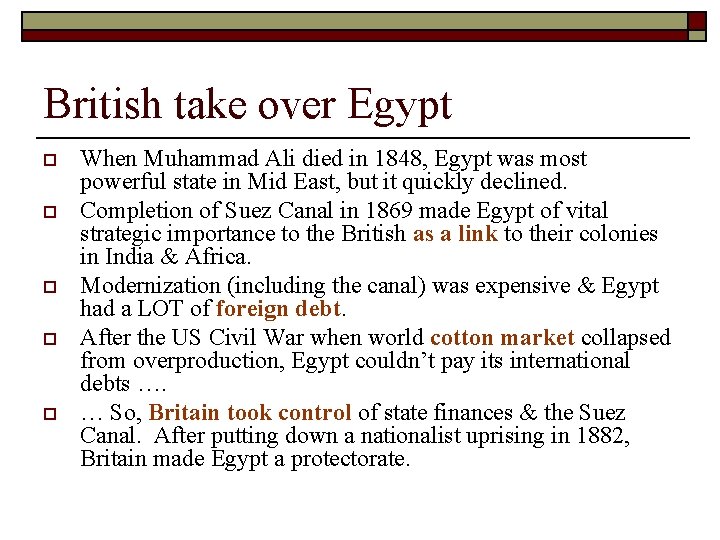
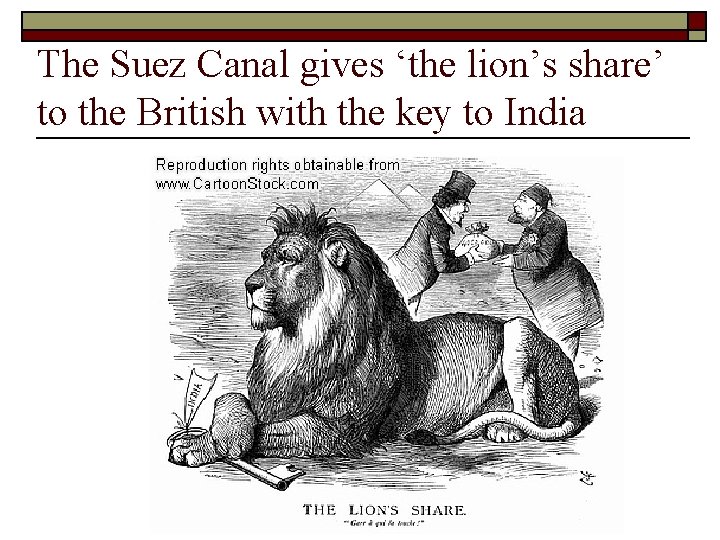
British take over Egypt o o o When Muhammad Ali died in 1848, Egypt was most powerful state in Mid East, but it quickly declined. Completion of Suez Canal in 1869 made Egypt of vital strategic importance to the British as a link to their colonies in India & Africa. Modernization (including the canal) was expensive & Egypt had a LOT of foreign debt. After the US Civil War when world cotton market collapsed from overproduction, Egypt couldn’t pay its international debts …. … So, Britain took control of state finances & the Suez Canal. After putting down a nationalist uprising in 1882, Britain made Egypt a protectorate.
The Suez Canal gives ‘the lion’s share’ to the British with the key to India
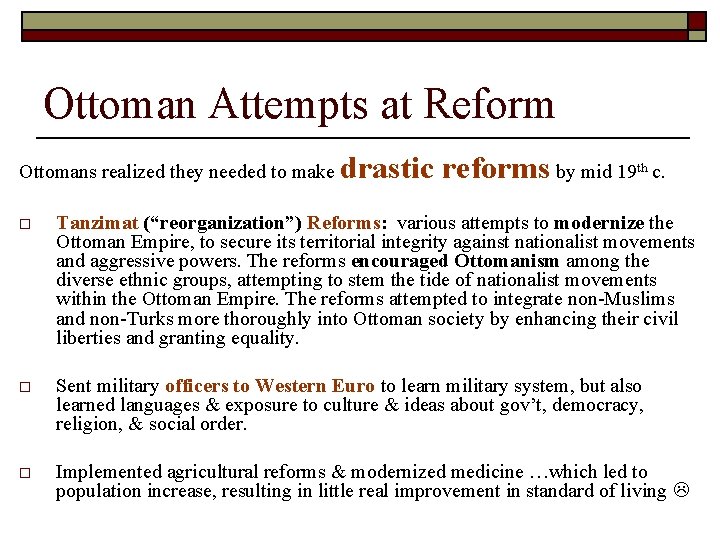
Ottoman Attempts at Reform Ottomans realized they needed to make drastic reforms by mid 19 th c. o Tanzimat (“reorganization”) Reforms: various attempts to modernize the Ottoman Empire, to secure its territorial integrity against nationalist movements and aggressive powers. The reforms encouraged Ottomanism among the diverse ethnic groups, attempting to stem the tide of nationalist movements within the Ottoman Empire. The reforms attempted to integrate non-Muslims and non-Turks more thoroughly into Ottoman society by enhancing their civil liberties and granting equality. o Sent military officers to Western Euro to learn military system, but also learned languages & exposure to culture & ideas about gov’t, democracy, religion, & social order. o Implemented agricultural reforms & modernized medicine …which led to population increase, resulting in little real improvement in standard of living
Varied Reaction to European Domination o o Westernization: copy the social, political, economic, & military structure of West. Usually these reforms affected only educated elites & political change was superficial. Nationalism: which kind do you think? ? Resistance: some hated Euro political & economic domination that often accompanied reform; lots of anti-Western riots & wars with European countries Islamic Fundamentalism: especially in Sudan as led by Mahdi in 1881.
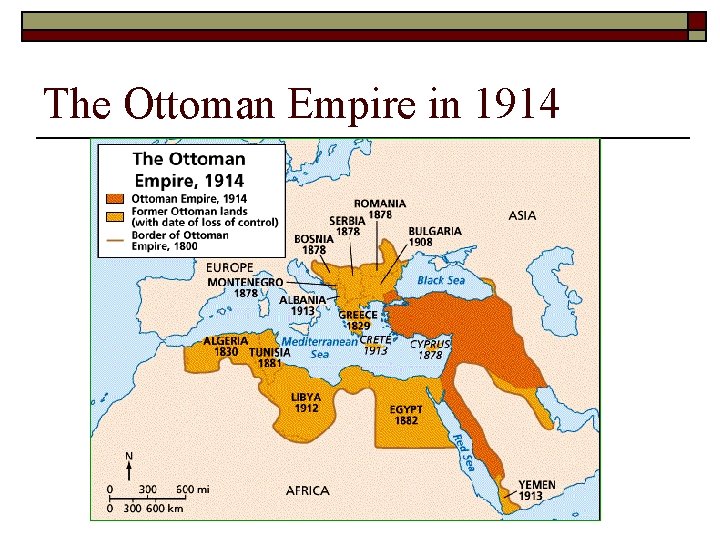
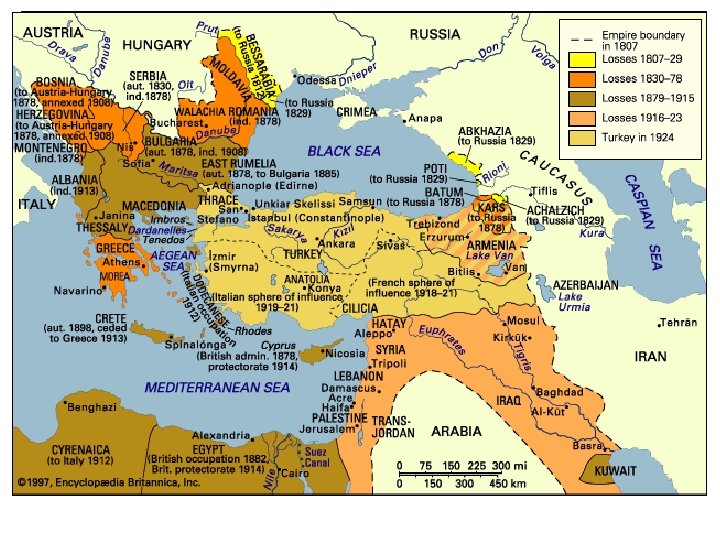
Demise of the Ottoman Empire o o By the end of the 19 th c, only the Ottomans remained as an important independent Muslim state …but it was really weak. Reforms were too little, too late In early 20 th c, group of liberals known as Young Turks deposed autocratic ruler & instituted more reforms. But they ended up supporting Germany & Austria-Hungary in WWI, & after the war the empire was broken up & occupied by foreign powers From its ruins, a new Islamic state, the Republic of Turkey rose.
The Ottoman Empire in 1914