
Otto 4 Stroke Cycle SI Nicolaus August Otto



- Slides: 18
Otto 4 Stroke Cycle SI
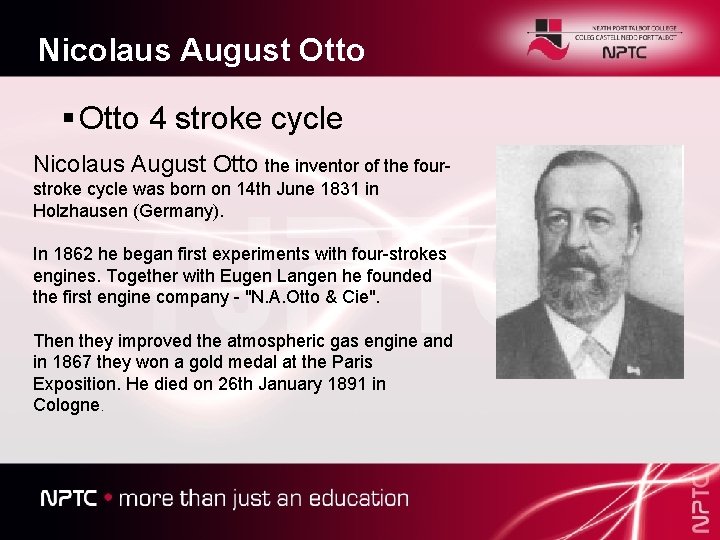
Nicolaus August Otto § Otto 4 stroke cycle Nicolaus August Otto the inventor of the fourstroke cycle was born on 14 th June 1831 in Holzhausen (Germany). In 1862 he began first experiments with four-strokes engines. Together with Eugen Langen he founded the first engine company - "N. A. Otto & Cie". Then they improved the atmospheric gas engine and in 1867 they won a gold medal at the Paris Exposition. He died on 26 th January 1891 in Cologne.
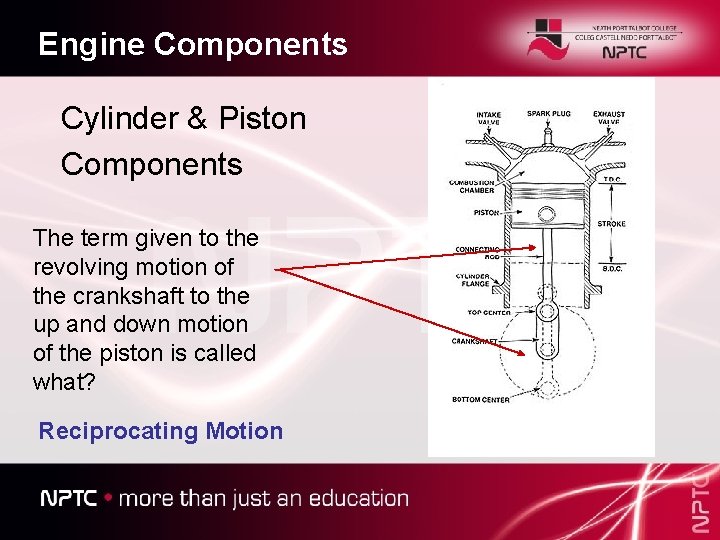
Engine Components Cylinder & Piston Components The term given to the revolving motion of the crankshaft to the up and down motion of the piston is called what? Reciprocating Motion
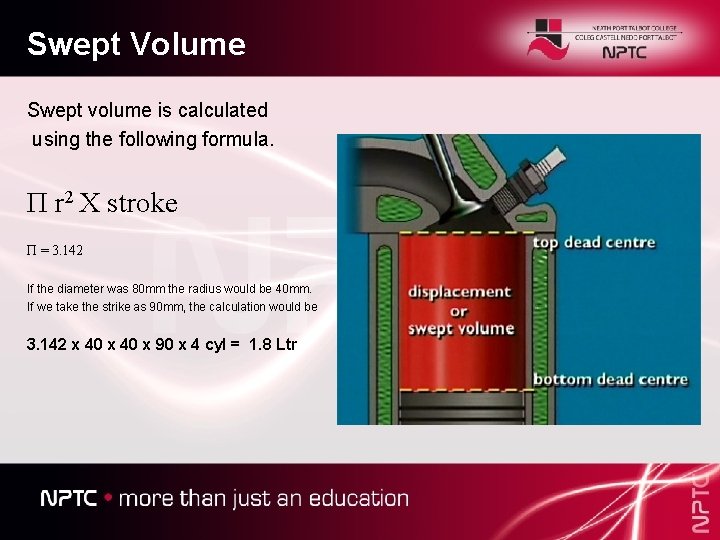
Swept Volume Swept volume is calculated using the following formula. Π r 2 X stroke Π = 3. 142 If the diameter was 80 mm the radius would be 40 mm. If we take the strike as 90 mm, the calculation would be 3. 142 x 40 x 90 x 4 cyl = 1. 8 Ltr
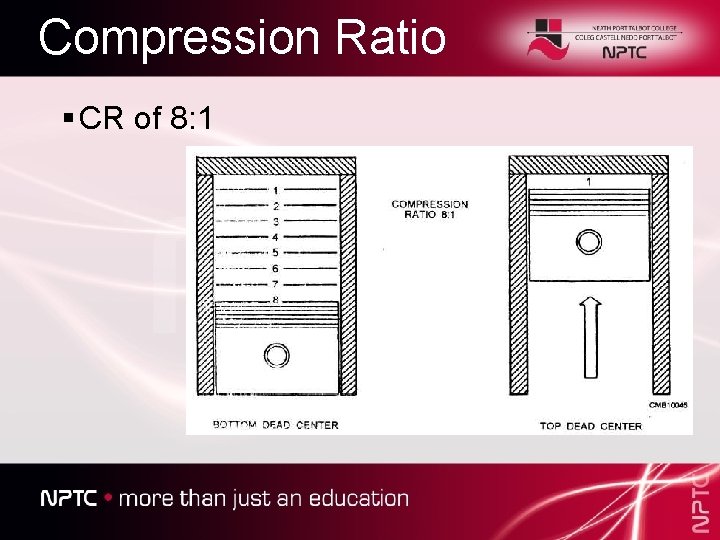
Compression Ratio § CR of 8: 1
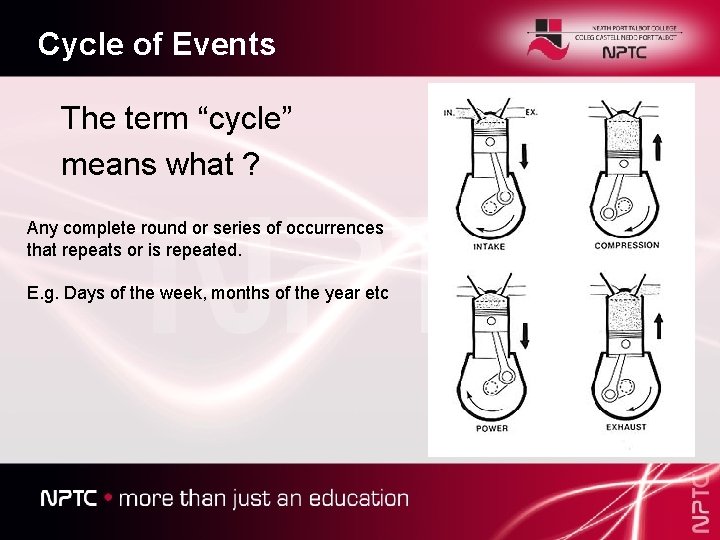
Cycle of Events The term “cycle” means what ? Any complete round or series of occurrences that repeats or is repeated. E. g. Days of the week, months of the year etc
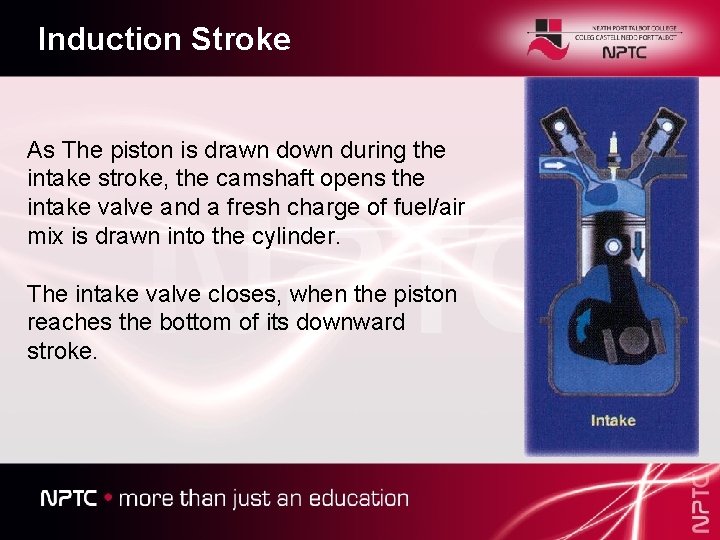
Induction Stroke As The piston is drawn down during the intake stroke, the camshaft opens the intake valve and a fresh charge of fuel/air mix is drawn into the cylinder. The intake valve closes, when the piston reaches the bottom of its downward stroke.
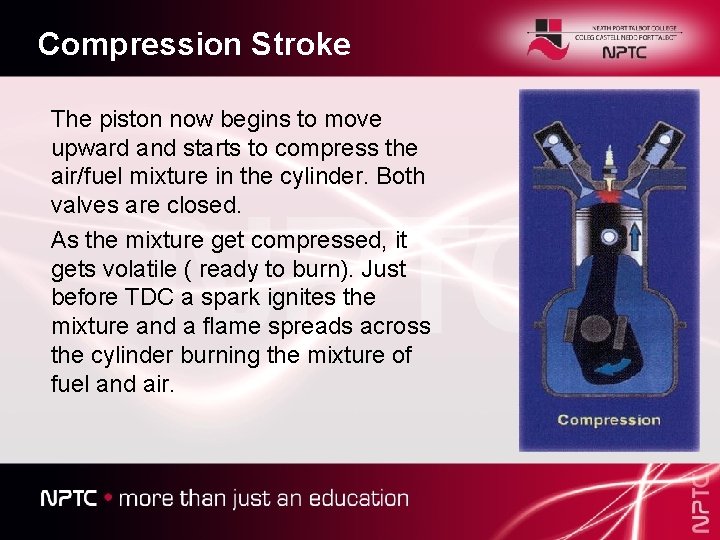
Compression Stroke The piston now begins to move upward and starts to compress the air/fuel mixture in the cylinder. Both valves are closed. As the mixture get compressed, it gets volatile ( ready to burn). Just before TDC a spark ignites the mixture and a flame spreads across the cylinder burning the mixture of fuel and air.
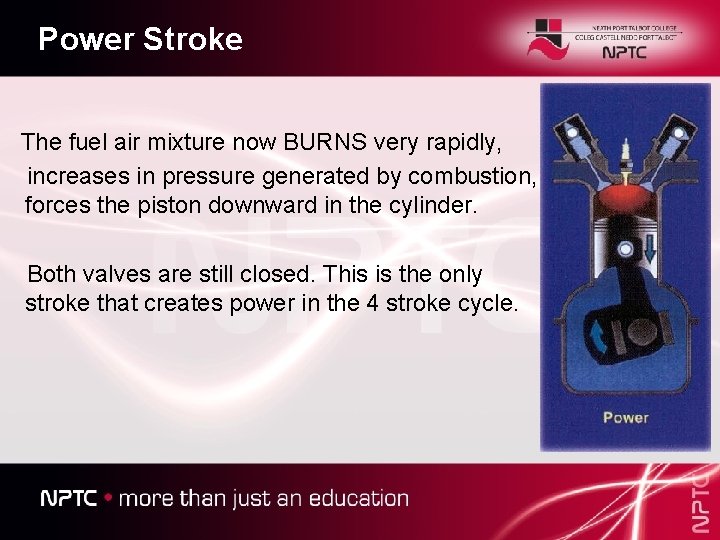
Power Stroke The fuel air mixture now BURNS very rapidly, increases in pressure generated by combustion, forces the piston downward in the cylinder. Both valves are still closed. This is the only stroke that creates power in the 4 stroke cycle.
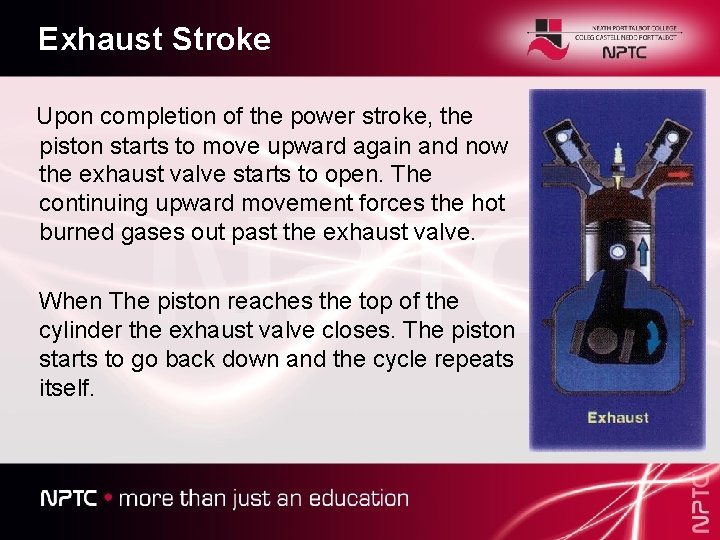
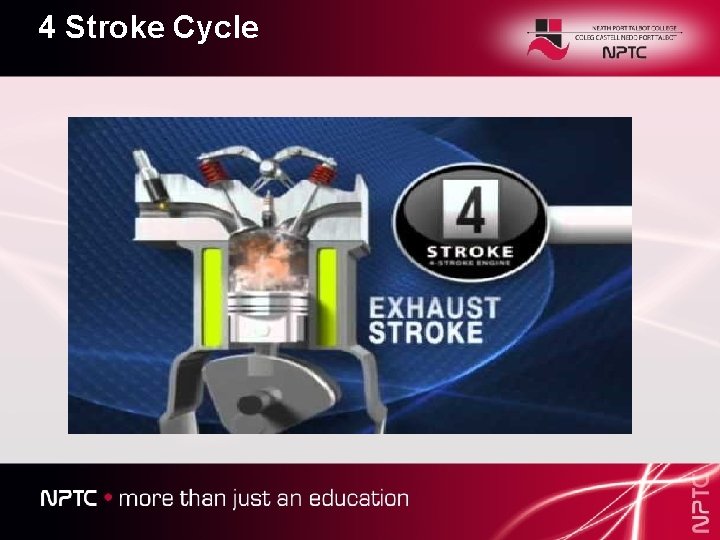
Exhaust Stroke Upon completion of the power stroke, the piston starts to move upward again and now the exhaust valve starts to open. The continuing upward movement forces the hot burned gases out past the exhaust valve. When The piston reaches the top of the cylinder the exhaust valve closes. The piston starts to go back down and the cycle repeats itself.
4 Stroke Cycle What is a stroke
4 Stroke Cycle
4 Stroke Cycle
4 Stroke Cycle https: //youtu. be/Pu 7 g 3 u. IG 6 Zo
4 Stroke Cycle
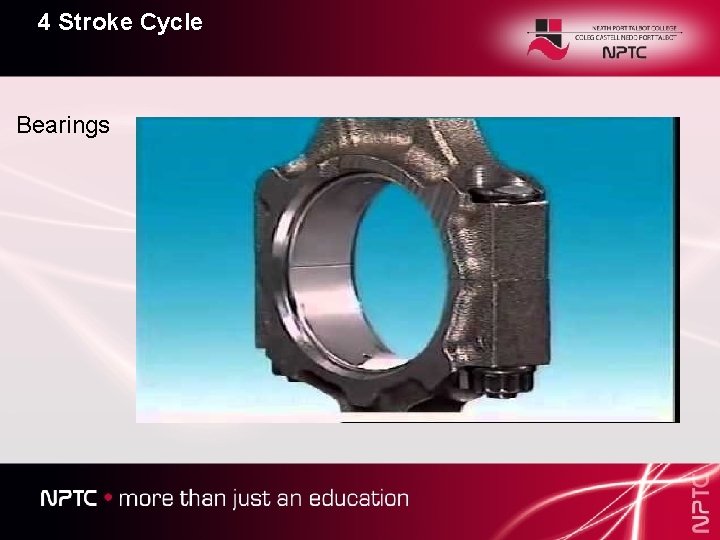
4 Stroke Cycle Bearings
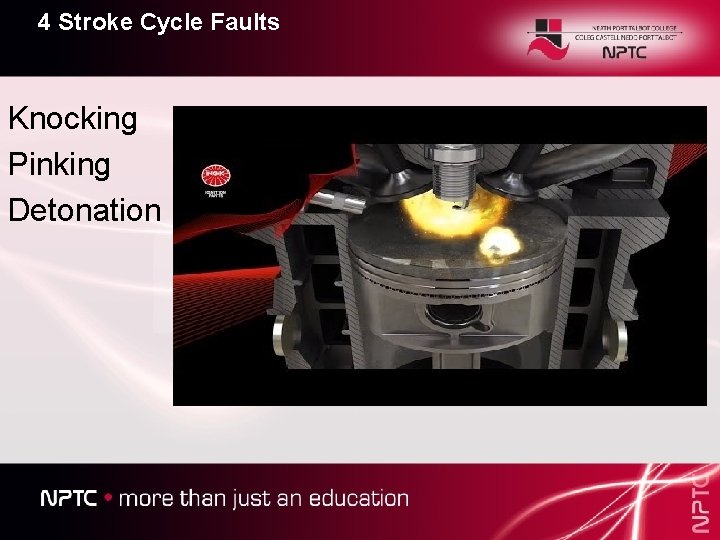
4 Stroke Cycle Faults Knocking Pinking Detonation
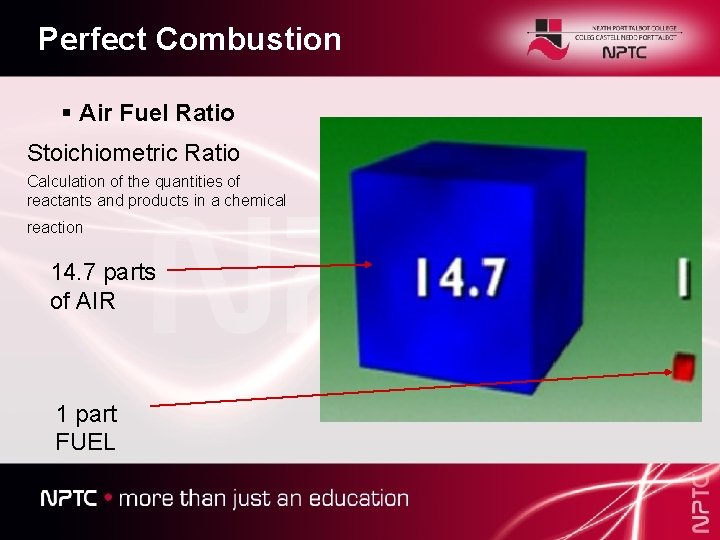
Perfect Combustion § Air Fuel Ratio Stoichiometric Ratio Calculation of the quantities of reactants and products in a chemical reaction 14. 7 parts of AIR 1 part FUEL