
OTRAS TRANSFORMADAS ESPECTRALES DISCRETAS Transformada Discreta de Fourier




- Slides: 36
OTRAS TRANSFORMADAS ESPECTRALES DISCRETAS
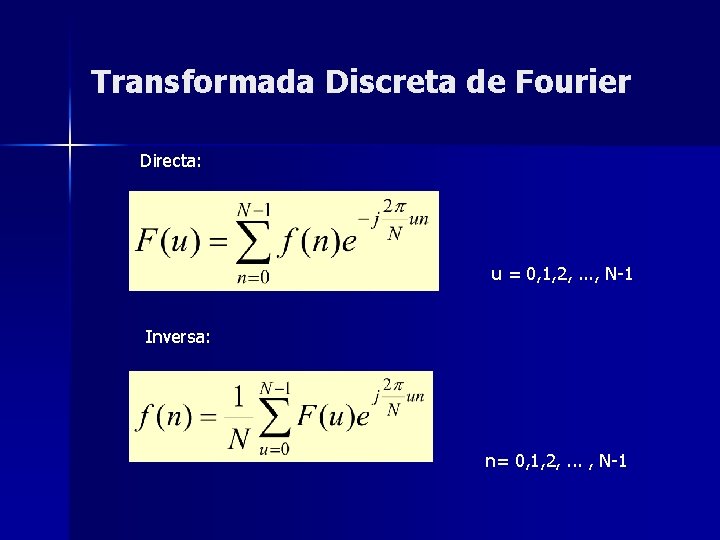
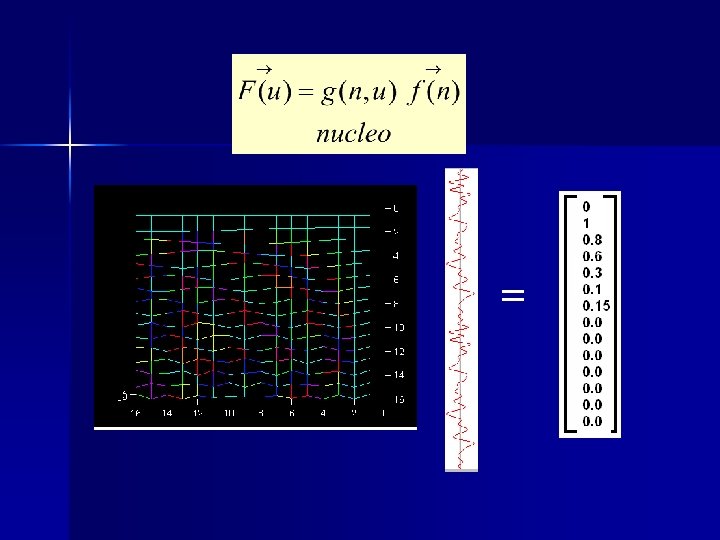
Transformada Discreta de Fourier Directa: u = 0, 1, 2, . . . , N-1 Inversa: n= 0, 1, 2, . . . , N-1
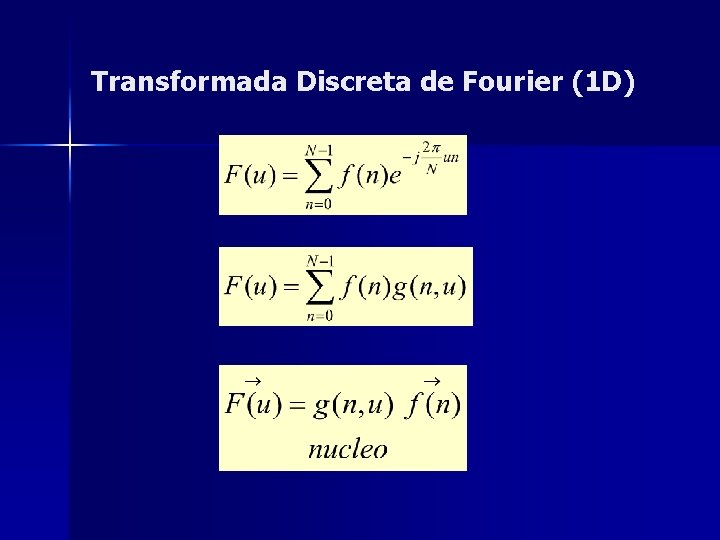
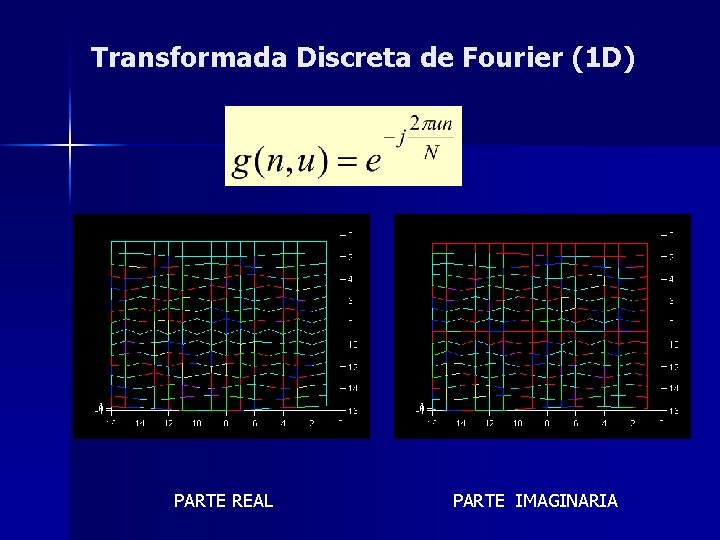
Transformada Discreta de Fourier (1 D)
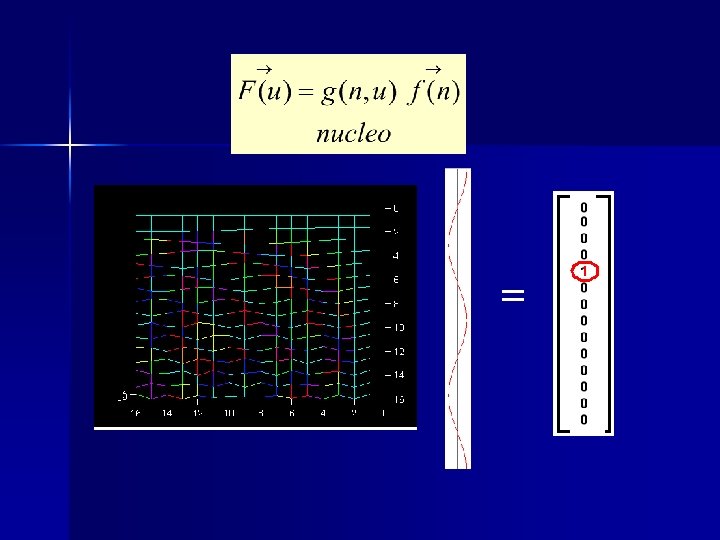
Transformada Discreta de Fourier (1 D) PARTE REAL PARTE IMAGINARIA
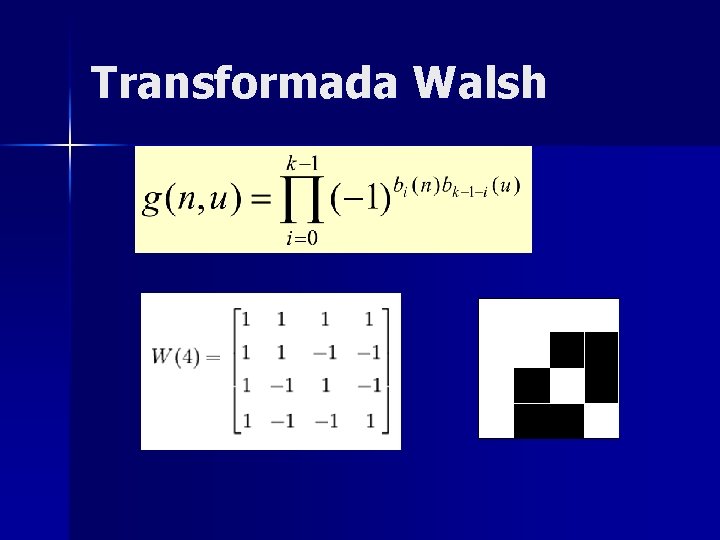
Transformada Walsh
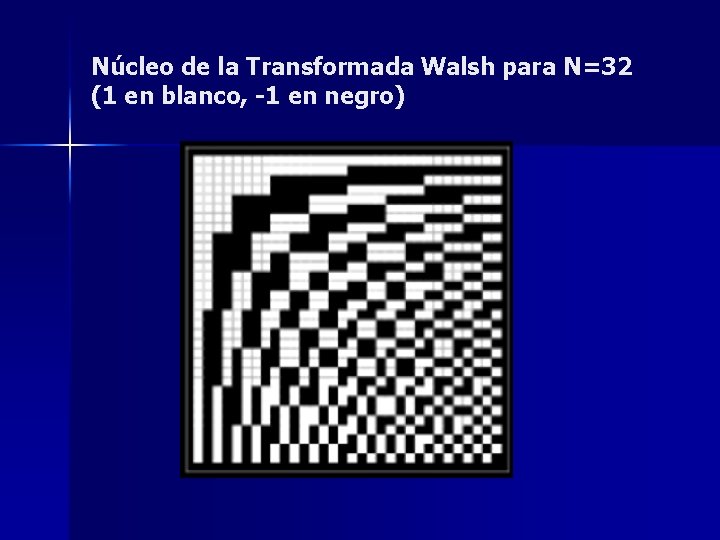
Núcleo de la Transformada Walsh para N=32 (1 en blanco, -1 en negro)
Transformada Walsh n http: //www. cs. tut. fi/~dabov/fwt/
Transformada Hadamard
Transformada Hadamard (otra forma de definición) Y en general :
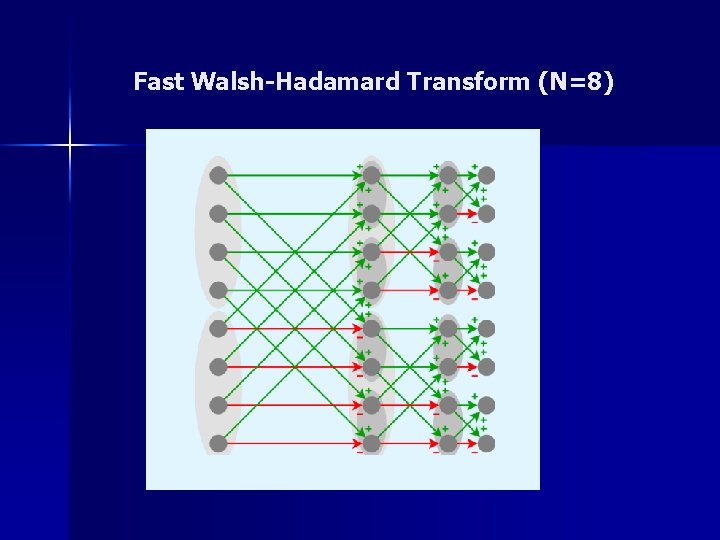
Fast Walsh-Hadamard Transform (N=8)
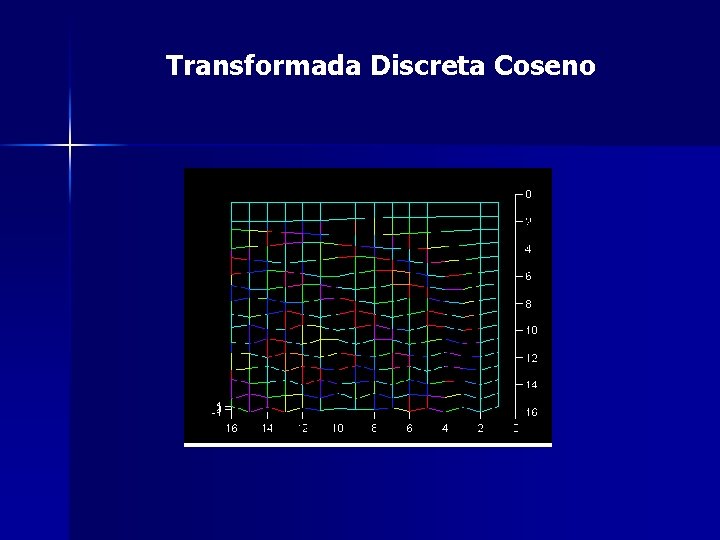
Transformada Discreta Coseno
Transformada Discreta Coseno
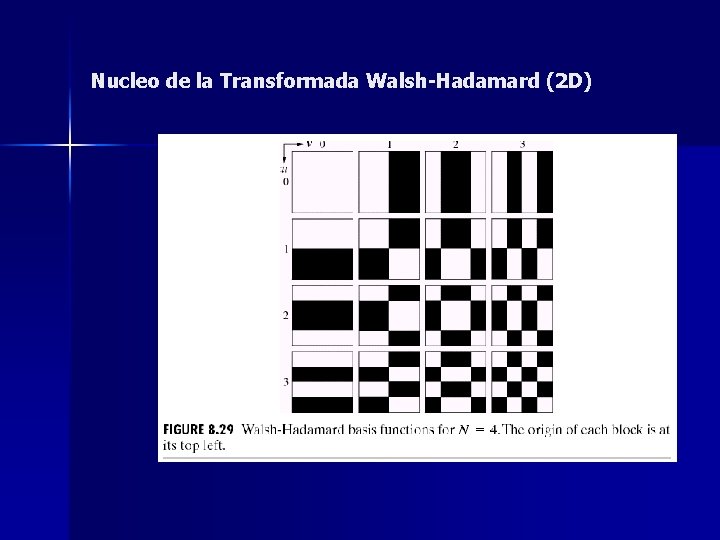
Nucleo de la Transformada Walsh-Hadamard (2 D)
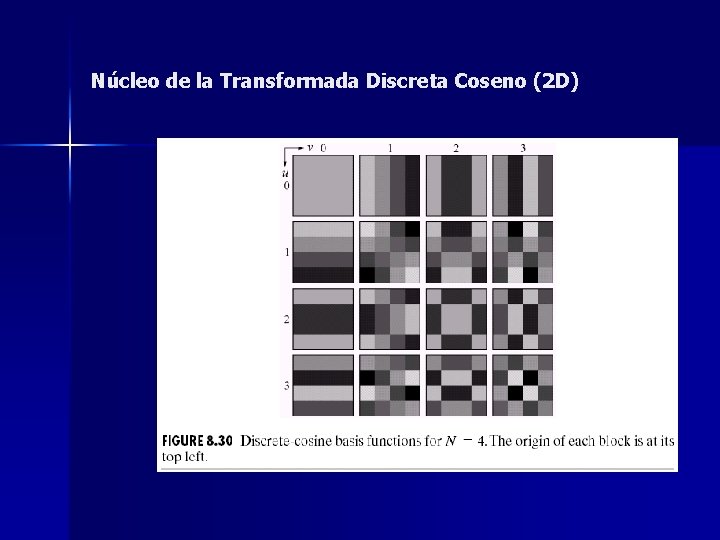
Núcleo de la Transformada Discreta Coseno (2 D)
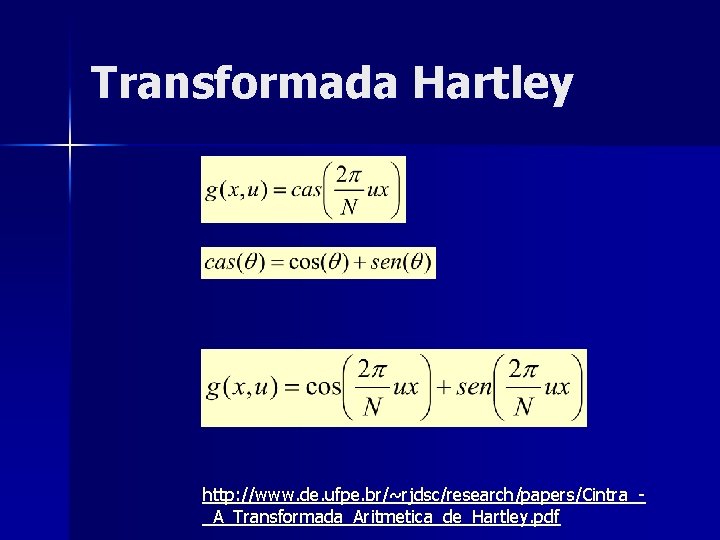
Transformada Hartley http: //www. de. ufpe. br/~rjdsc/research/papers/Cintra__A_Transformada_Aritmetica_de_Hartley. pdf
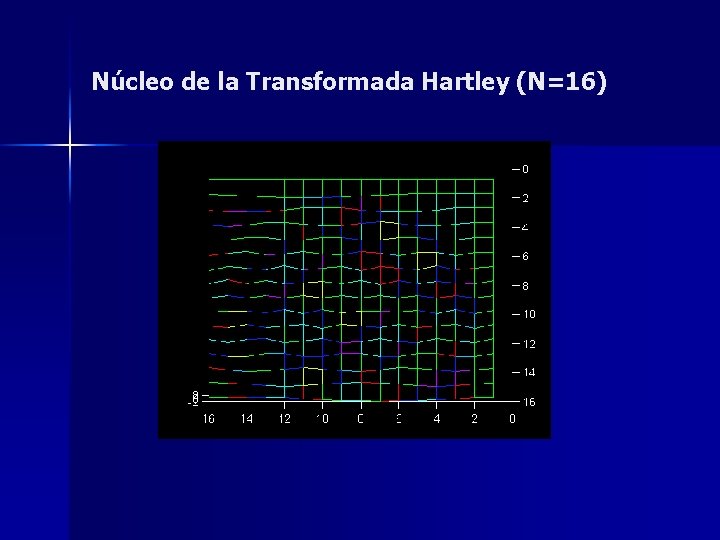
Núcleo de la Transformada Hartley (N=16)
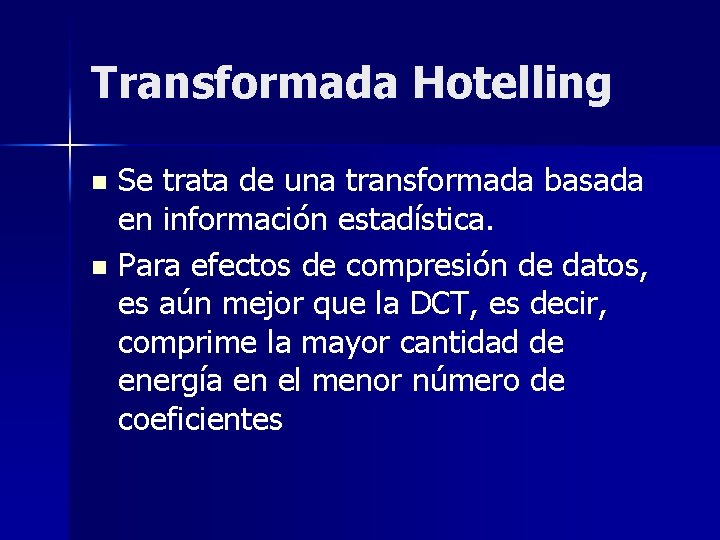
Transformada Hotelling Se trata de una transformada basada en información estadística. n Para efectos de compresión de datos, es aún mejor que la DCT, es decir, comprime la mayor cantidad de energía en el menor número de coeficientes n
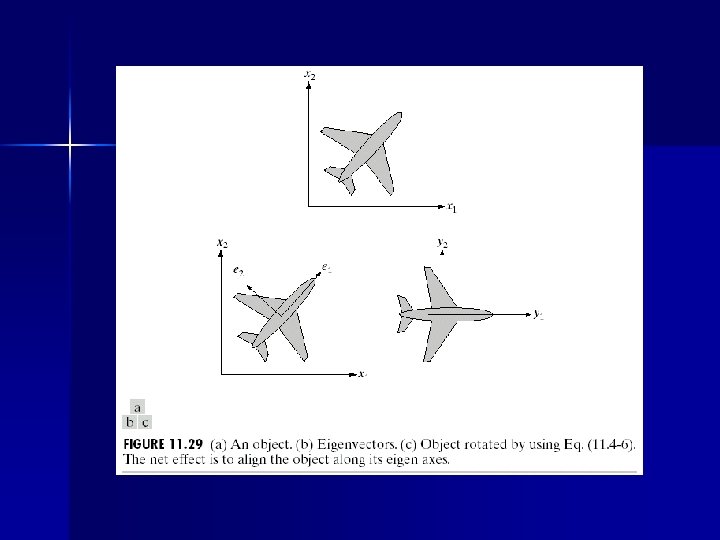
Los vectores que forman la nueva base son los EIGENVECTORES de la población. n Los eigenvectores definen las direcciones de máxima distribución de los datos, en consecuencia son los vectores óptimos de representación. n
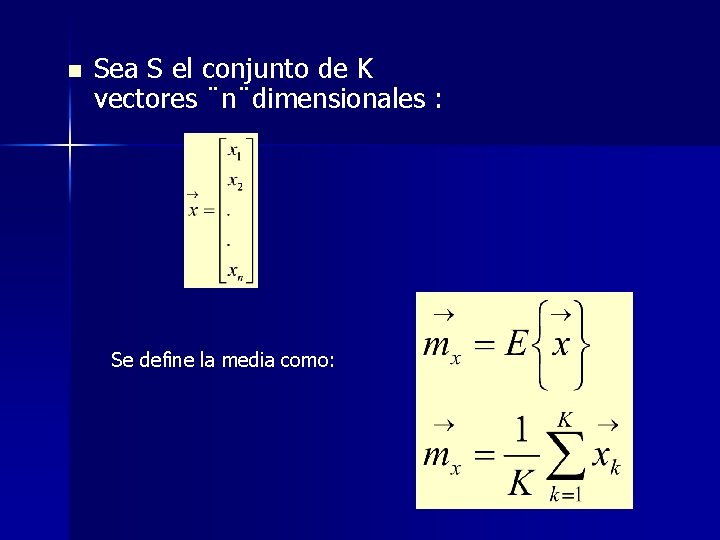
n Sea S el conjunto de K vectores ¨n¨dimensionales : Se define la media como:
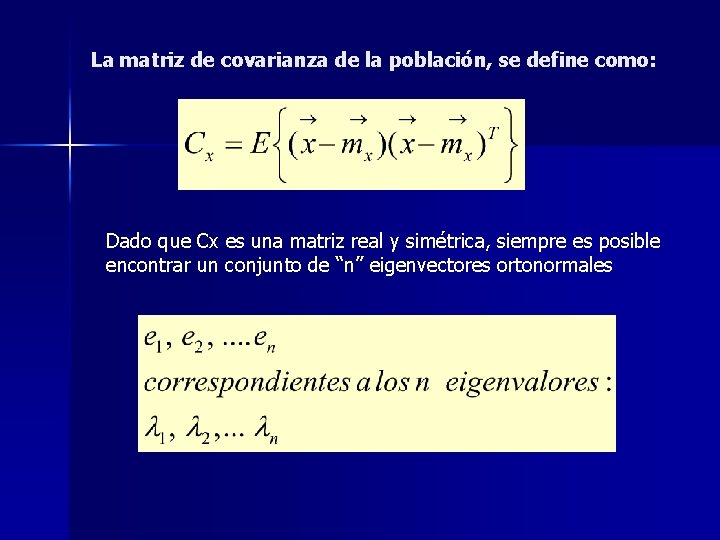
La matriz de covarianza de la población, se define como: Dado que Cx es una matriz real y simétrica, siempre es posible encontrar un conjunto de “n” eigenvectores ortonormales
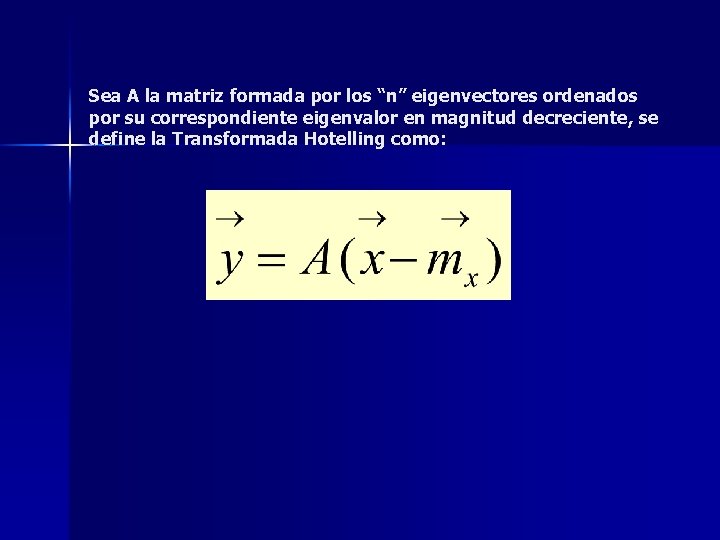
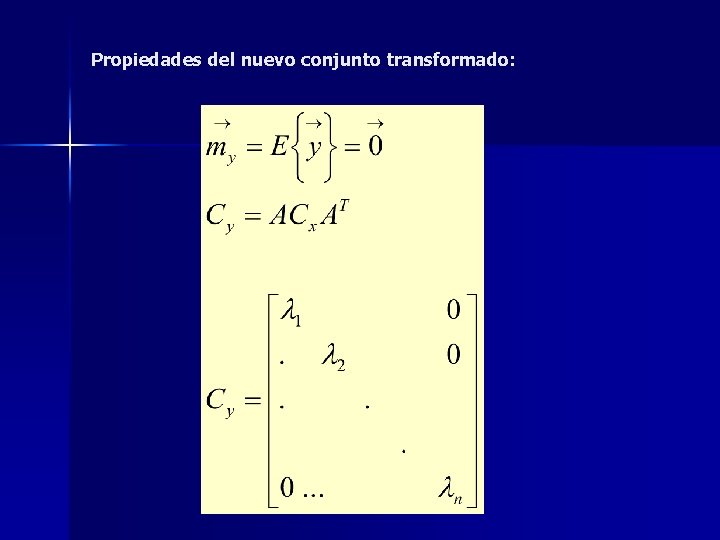
Sea A la matriz formada por los “n” eigenvectores ordenados por su correspondiente eigenvalor en magnitud decreciente, se define la Transformada Hotelling como:
Propiedades del nuevo conjunto transformado:
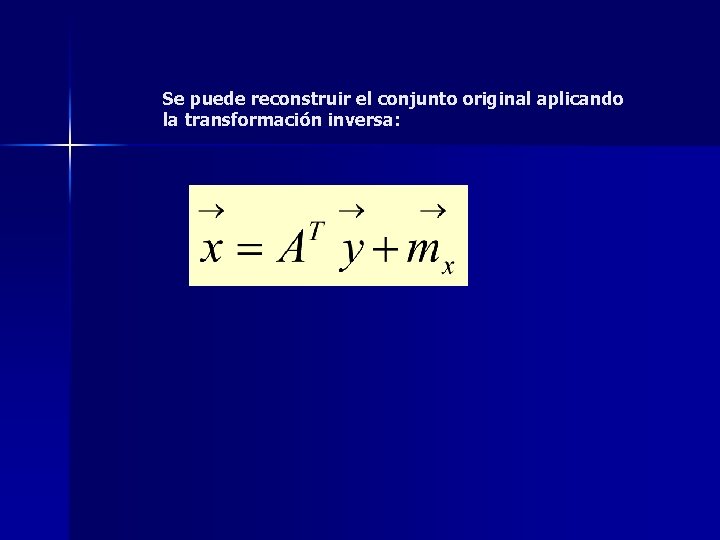
Se puede reconstruir el conjunto original aplicando la transformación inversa:
Aplicación de Transformadas Espectrales en Compresión de Datos
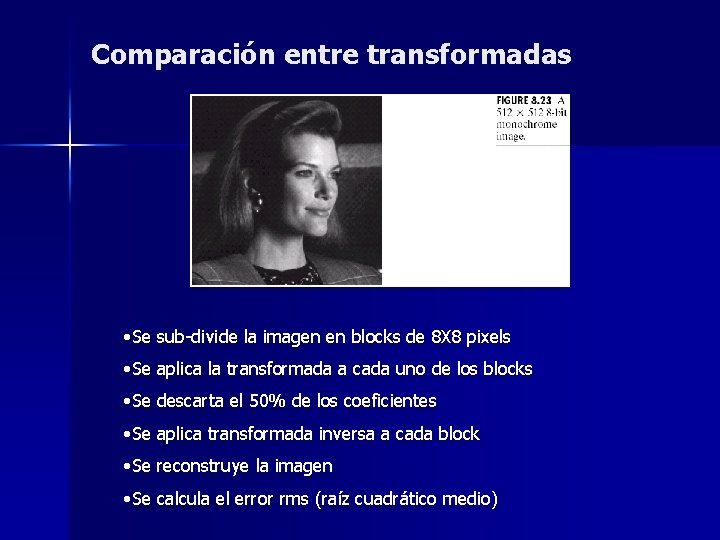
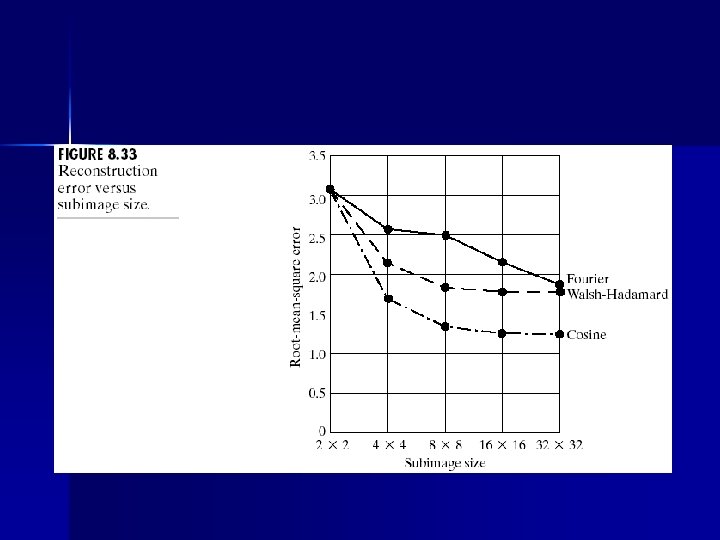
Comparación entre transformadas • Se sub-divide la imagen en blocks de 8 X 8 pixels • Se aplica la transformada a cada uno de los blocks • Se descarta el 50% de los coeficientes • Se aplica transformada inversa a cada block • Se reconstruye la imagen • Se calcula el error rms (raíz cuadrático medio)
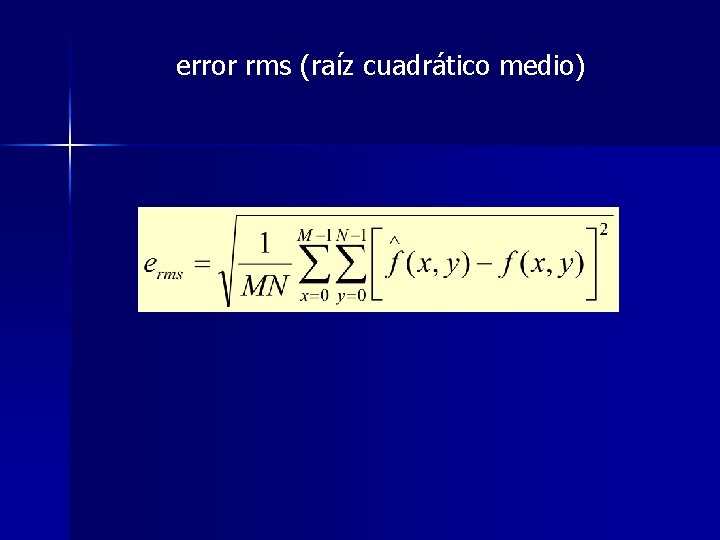
error rms (raíz cuadrático medio)
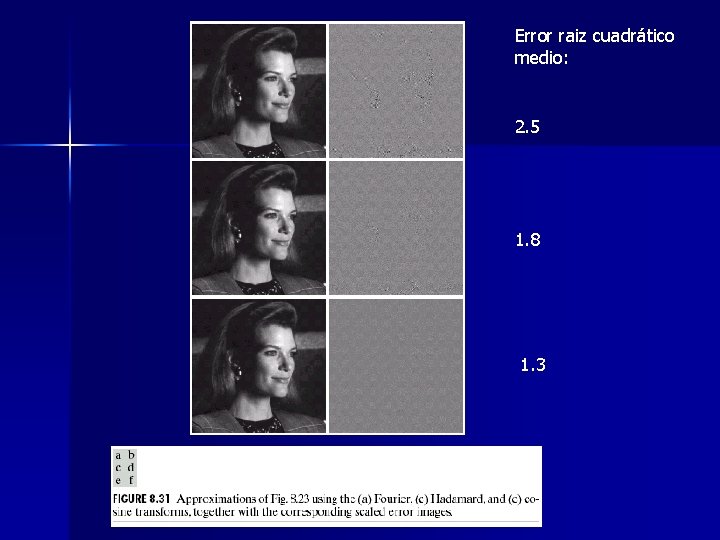
Error raiz cuadrático medio: 2. 5 1. 8 1. 3
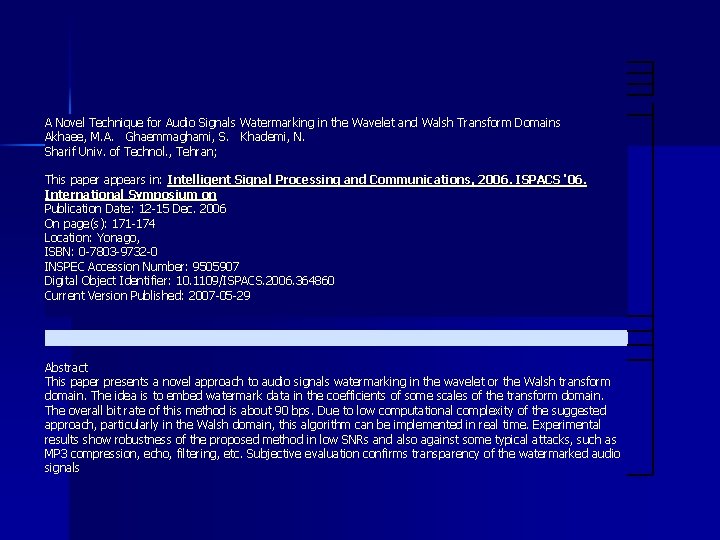
A Novel Technique for Audio Signals Watermarking in the Wavelet and Walsh Transform Domains Akhaee, M. A. Ghaemmaghami, S. Khademi, N. Sharif Univ. of Technol. , Tehran; This paper appears in: Intelligent Signal Processing and Communications, 2006. ISPACS '06. International Symposium on Publication Date: 12 -15 Dec. 2006 On page(s): 171 -174 Location: Yonago, ISBN: 0 -7803 -9732 -0 INSPEC Accession Number: 9505907 Digital Object Identifier: 10. 1109/ISPACS. 2006. 364860 Current Version Published: 2007 -05 -29 Abstract This paper presents a novel approach to audio signals watermarking in the wavelet or the Walsh transform domain. The idea is to embed watermark data in the coefficients of some scales of the transform domain. The overall bit rate of this method is about 90 bps. Due to low computational complexity of the suggested approach, particularly in the Walsh domain, this algorithm can be implemented in real time. Experimental results show robustness of the proposed method in low SNRs and also against some typical attacks, such as MP 3 compression, echo, filtering, etc. Subjective evaluation confirms transparency of the watermarked audio signals
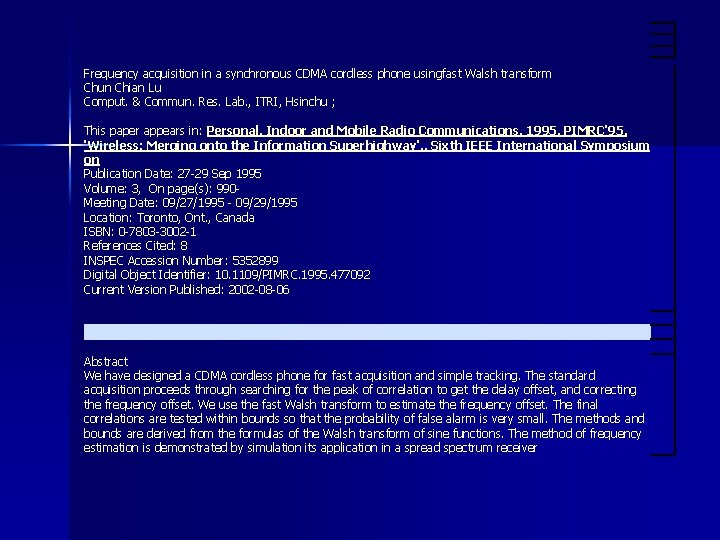
Frequency acquisition in a synchronous CDMA cordless phone usingfast Walsh transform Chun Chian Lu Comput. & Commun. Res. Lab. , ITRI, Hsinchu ; This paper appears in: Personal, Indoor and Mobile Radio Communications, 1995. PIMRC'95. 'Wireless: Merging onto the Information Superhighway'. , Sixth IEEE International Symposium on Publication Date: 27 -29 Sep 1995 Volume: 3, On page(s): 990 Meeting Date: 09/27/1995 - 09/29/1995 Location: Toronto, Ont. , Canada ISBN: 0 -7803 -3002 -1 References Cited: 8 INSPEC Accession Number: 5352899 Digital Object Identifier: 10. 1109/PIMRC. 1995. 477092 Current Version Published: 2002 -08 -06 Abstract We have designed a CDMA cordless phone for fast acquisition and simple tracking. The standard acquisition proceeds through searching for the peak of correlation to get the delay offset, and correcting the frequency offset. We use the fast Walsh transform to estimate the frequency offset. The final correlations are tested within bounds so that the probability of false alarm is very small. The methods and bounds are derived from the formulas of the Walsh transform of sine functions. The method of frequency estimation is demonstrated by simulation its application in a spread spectrum receiver
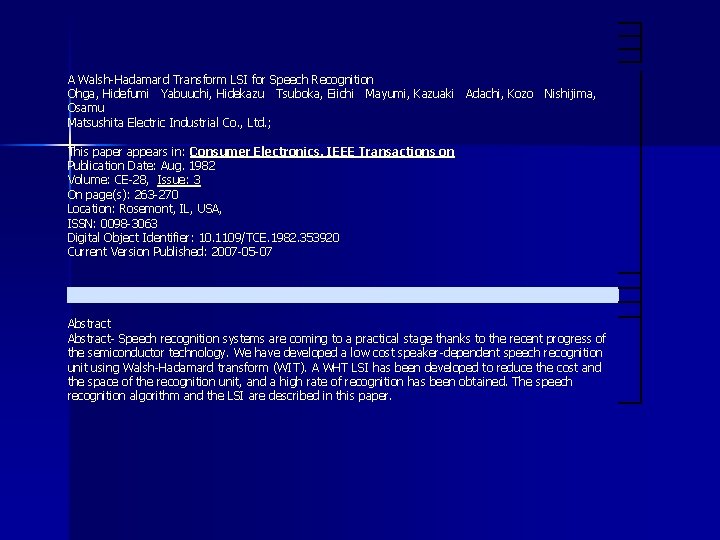
A Walsh-Hadamard Transform LSI for Speech Recognition Ohga, Hidefumi Yabuuchi, Hidekazu Tsuboka, Eiichi Mayumi, Kazuaki Adachi, Kozo Nishijima, Osamu Matsushita Electric Industrial Co. , Ltd. ; This paper appears in: Consumer Electronics, IEEE Transactions on Publication Date: Aug. 1982 Volume: CE-28, Issue: 3 On page(s): 263 -270 Location: Rosemont, IL, USA, ISSN: 0098 -3063 Digital Object Identifier: 10. 1109/TCE. 1982. 353920 Current Version Published: 2007 -05 -07 Abstract- Speech recognition systems are coming to a practical stage thanks to the recent progress of the semiconductor technology. We have developed a low cost speaker-dependent speech recognition unit using Walsh-Hadamard transform (WIT). A WHT LSI has been developed to reduce the cost and the space of the recognition unit, and a high rate of recognition has been obtained. The speech recognition algorithm and the LSI are described in this paper.
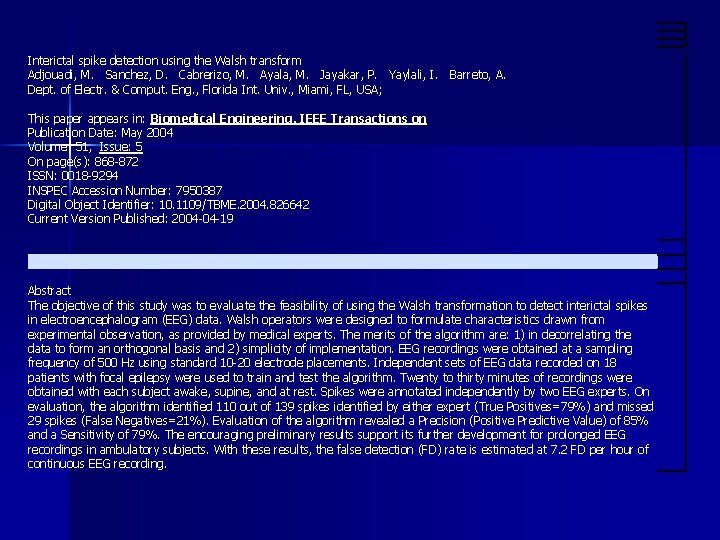
Interictal spike detection using the Walsh transform Adjouadi, M. Sanchez, D. Cabrerizo, M. Ayala, M. Jayakar, P. Yaylali, I. Barreto, A. Dept. of Electr. & Comput. Eng. , Florida Int. Univ. , Miami, FL, USA; This paper appears in: Biomedical Engineering, IEEE Transactions on Publication Date: May 2004 Volume: 51, Issue: 5 On page(s): 868 -872 ISSN: 0018 -9294 INSPEC Accession Number: 7950387 Digital Object Identifier: 10. 1109/TBME. 2004. 826642 Current Version Published: 2004 -04 -19 Abstract The objective of this study was to evaluate the feasibility of using the Walsh transformation to detect interictal spikes in electroencephalogram (EEG) data. Walsh operators were designed to formulate characteristics drawn from experimental observation, as provided by medical experts. The merits of the algorithm are: 1) in decorrelating the data to form an orthogonal basis and 2) simplicity of implementation. EEG recordings were obtained at a sampling frequency of 500 Hz using standard 10 -20 electrode placements. Independent sets of EEG data recorded on 18 patients with focal epilepsy were used to train and test the algorithm. Twenty to thirty minutes of recordings were obtained with each subject awake, supine, and at rest. Spikes were annotated independently by two EEG experts. On evaluation, the algorithm identified 110 out of 139 spikes identified by either expert (True Positives=79%) and missed 29 spikes (False Negatives=21%). Evaluation of the algorithm revealed a Precision (Positive Predictive Value) of 85% and a Sensitivity of 79%. The encouraging preliminary results support its further development for prolonged EEG recordings in ambulatory subjects. With these results, the false detection (FD) rate is estimated at 7. 2 FD per hour of continuous EEG recording.