
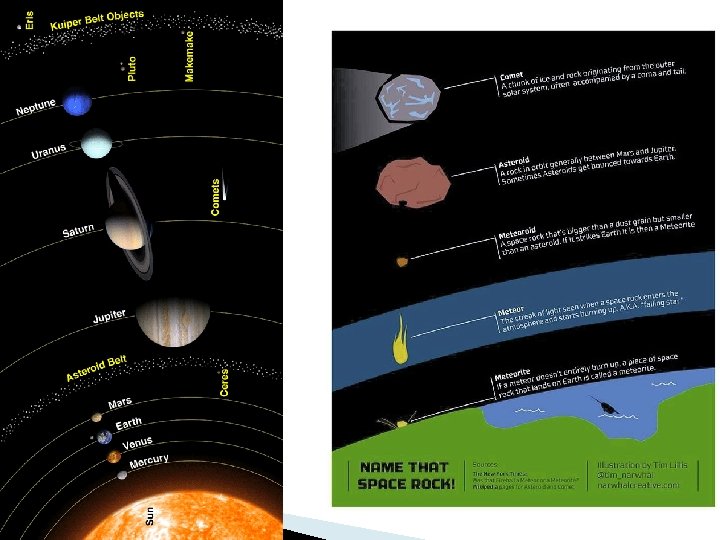
Other Objects in our Solar System So far
Other Objects in our Solar System
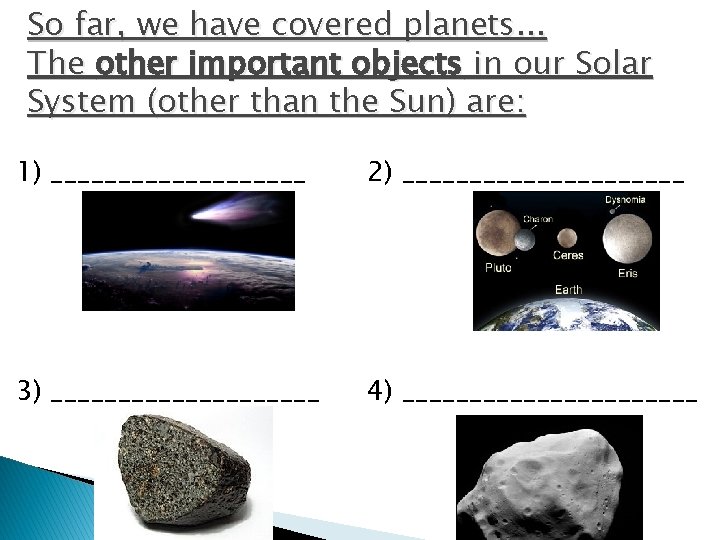
So far, we have covered planets. . . The other important objects in our Solar System (other than the Sun) are: 1) __________ 2) ___________ 3) __________ 4) ___________

Shoemaker-Levy 9 Comet ◦ Comet discovered by Carolyn and Eugene Shoemaker, an American husband-wife __________ team. ◦ Canadian astronomer David Levy co-discovered it. ◦ In 1994, chunks of the comet hit Jupiter, each impact leaving a mark the size of _________ in Jupiter’s atmosphere. ◦ https: //www. youtube. com/watch? v=Ci. LNx. Zbp. P 20
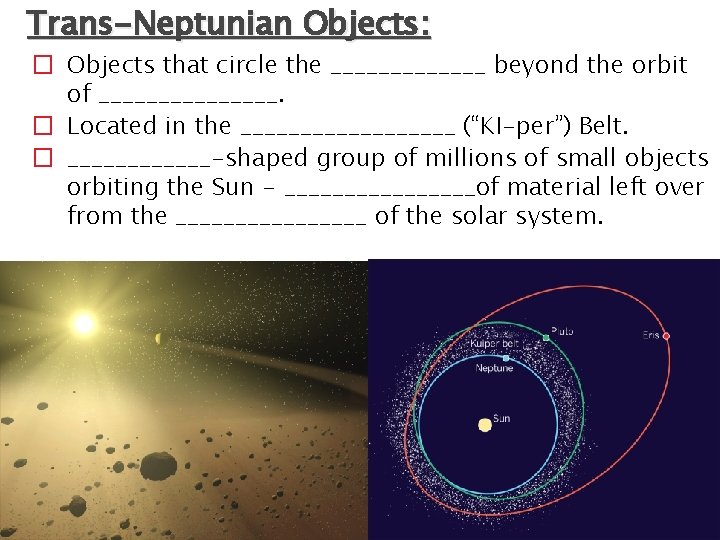
Trans-Neptunian Objects: � Objects that circle the _______ beyond the orbit of ________. � Located in the _________ (“KI-per”) Belt. � ______-shaped group of millions of small objects orbiting the Sun - ________of material left over from the ________ of the solar system.
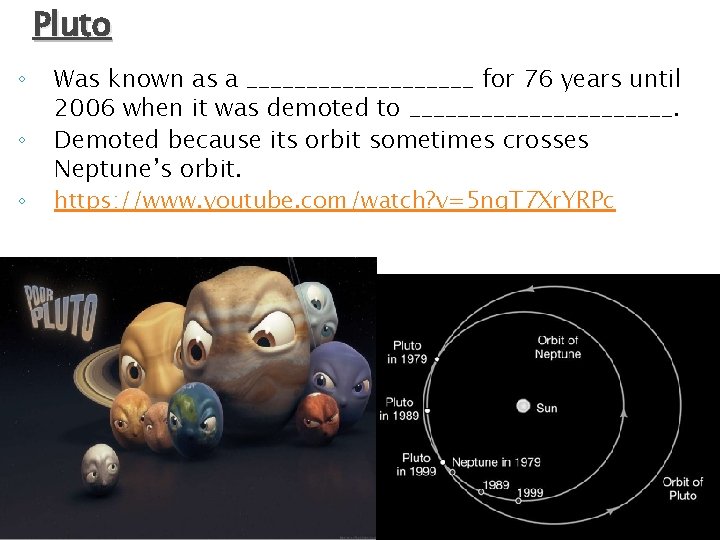
Pluto ◦ ◦ ◦ Was known as a __________ for 76 years until 2006 when it was demoted to ___________. Demoted because its orbit sometimes crosses Neptune’s orbit. https: //www. youtube. com/watch? v=5 nq. T 7 Xr. YRPc
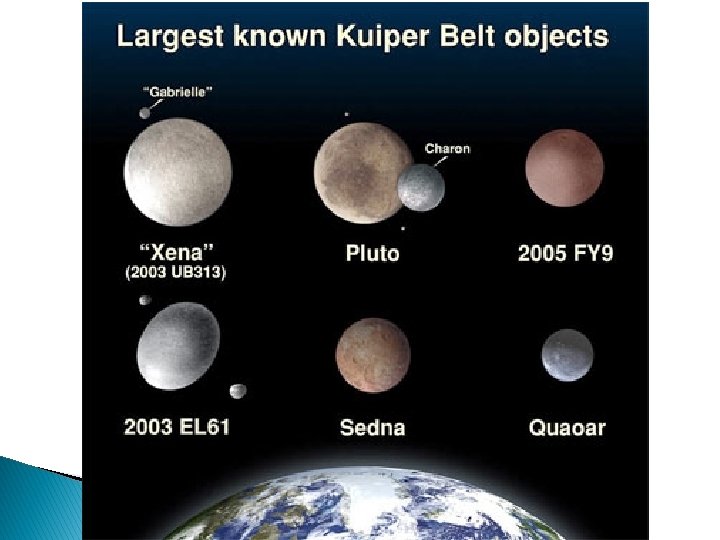
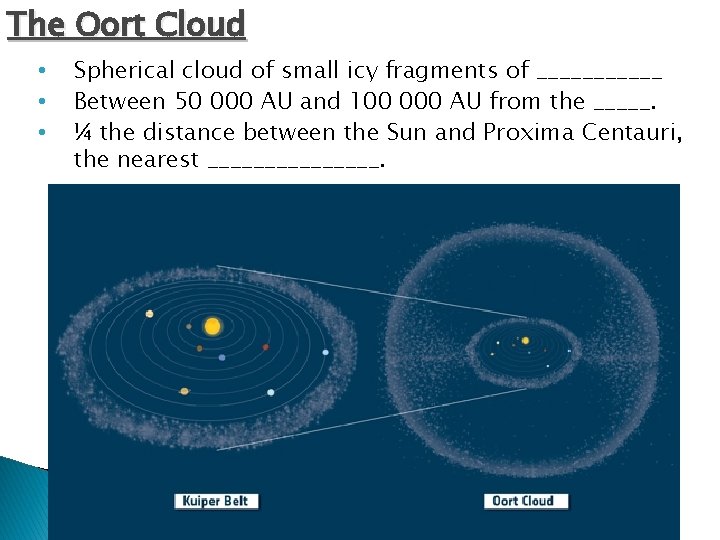
The Oort Cloud • • • Spherical cloud of small icy fragments of ______ Between 50 000 AU and 100 000 AU from the _____. ¼ the distance between the Sun and Proxima Centauri, the nearest ________.
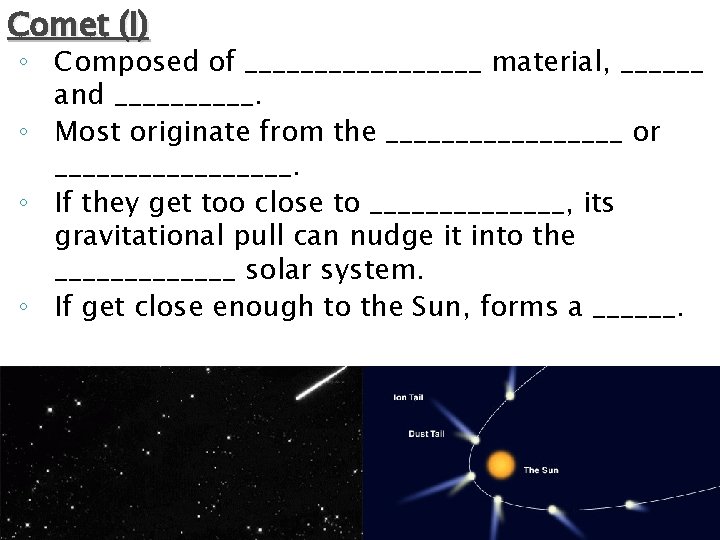
Comet (I) ◦ Composed of _________ material, ______ and _____. ◦ Most originate from the _________ or _________. ◦ If they get too close to _______, its gravitational pull can nudge it into the _______ solar system. ◦ If get close enough to the Sun, forms a ______.
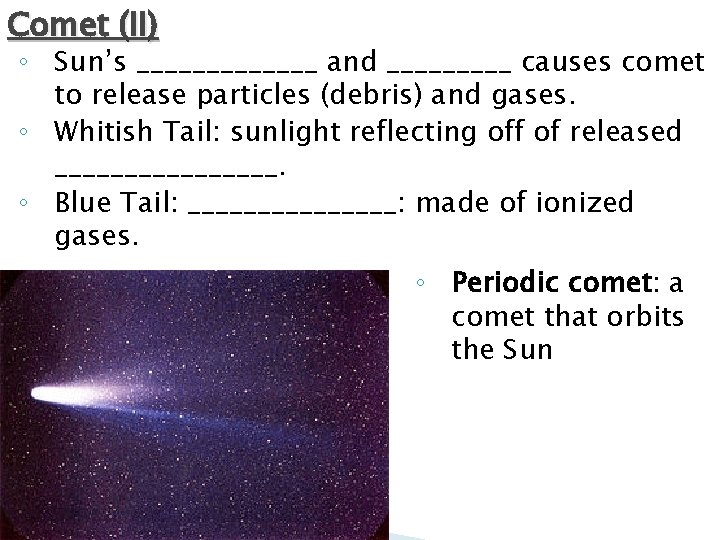
Comet (II) ◦ Sun’s _______ and _____ causes comet to release particles (debris) and gases. ◦ Whitish Tail: sunlight reflecting off of released ________. ◦ Blue Tail: ________: made of ionized gases. ◦ Periodic comet: a comet that orbits the Sun
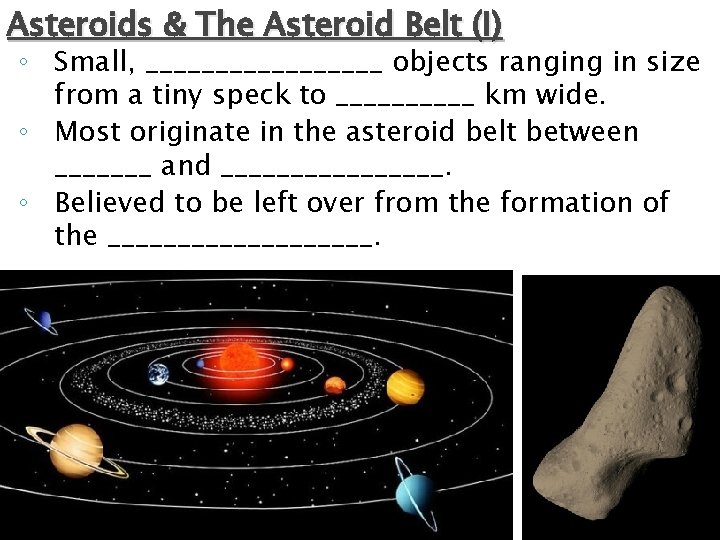
Asteroids & The Asteroid Belt (I) ◦ Small, _________ objects ranging in size from a tiny speck to _____ km wide. ◦ Most originate in the asteroid belt between _______ and ________. ◦ Believed to be left over from the formation of the __________.
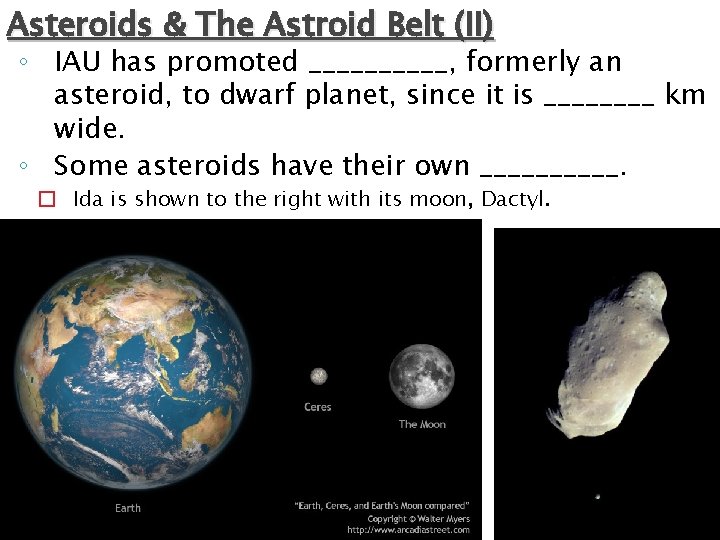
Asteroids & The Astroid Belt (II) ◦ IAU has promoted _____, formerly an asteroid, to dwarf planet, since it is ____ km wide. ◦ Some asteroids have their own _____. � Ida is shown to the right with its moon, Dactyl.
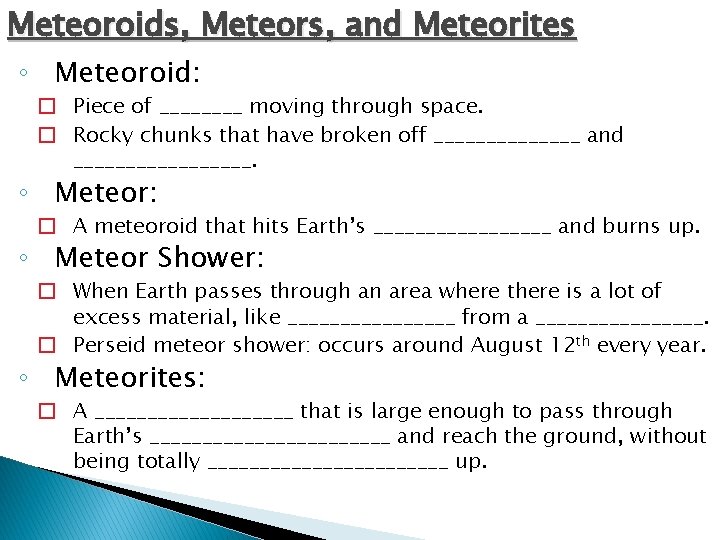
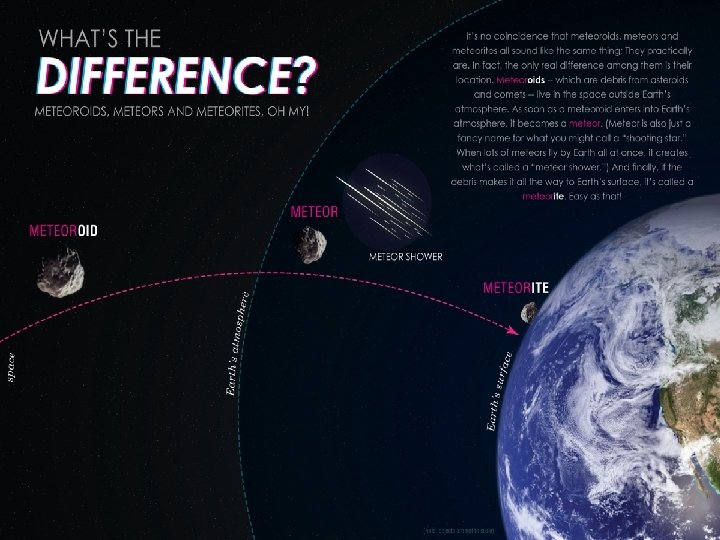
Meteoroids, Meteors, and Meteorites ◦ Meteoroid: � Piece of ____ moving through space. � Rocky chunks that have broken off _______ and _________. ◦ Meteor: � A meteoroid that hits Earth’s _________ and burns up. ◦ Meteor Shower: � When Earth passes through an area where there is a lot of excess material, like ________ from a ________. � Perseid meteor shower: occurs around August 12 th every year. ◦ Meteorites: � A __________ that is large enough to pass through Earth’s ____________ and reach the ground, without being totally ____________ up.
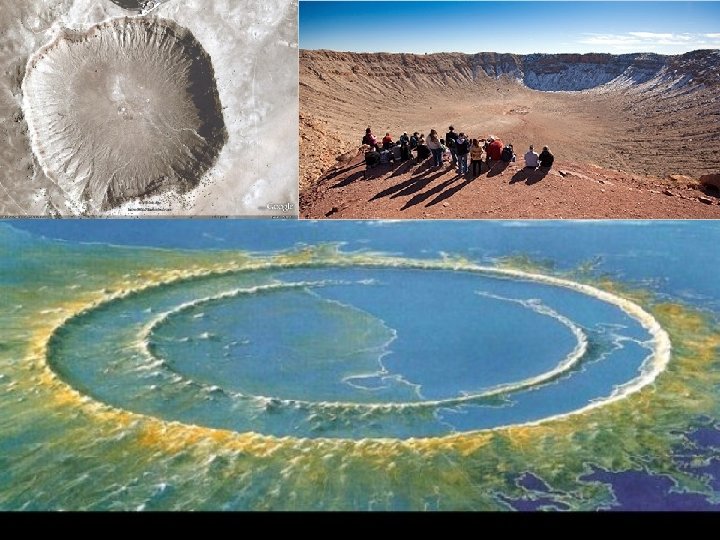
Asteroid and Meteorite Impacts ◦ 65 million years ago � � � Chicxulub crater, Mexico Asteroid the size of a _______ struck Earth Collision sent debris from Earth up into the atmosphere Earth was ________for years Global mass __________ (including dinosaurs). ◦ 39 million years ago � Haughton Crater, Nunavut ◦ About 45, 000 years ago � Barringer Meteorite Crater, Arizona � Produced an explosion with energy equivalent to _______ atomic bombs. � Hurricane-force winds � Falling rock would have _______ everything within a 10 km radius.
NOTICE Notice: there will be a Quest on Wednesday, May 24 th. It will be on the following: ◦ ◦ ◦ ◦ The Big Bang Video Worksheet Evidence of the Big Bang Worksheet Textbook work from 7. 1. Gizmos: Seasons, Phase of the Moon, 2 D Eclipse, Tides Constellations lesson Solar System lesson Planets of our Solar System Table Today’s Lesson & Homework YOU WILL BE ABLE TO USE 1 OR 2 ITEMS FROM YOUR BINDER – THESE WILL NOT BE REVEALED UNTIL RIGHT BEFORE THE TEST. (Therefore, make sure all of your homework is done!)
Homework Page 301, #1 -3 Page 306, #1 -5, 7, 8. Review for Test: Page 312, #1 -21, 22, 27 -29, 30.
- Slides: 18