
Other N log N Sorts v Binary Tree
Other N log N Sorts v Binary Tree Sort q q q Basic Recipe o Insert into binary search tree (BST) o Do Inorder Traversal Complexity o Create: O(N log N) o Traversal O(N) Not usually used for sorting unless you need BST for other reasons Comp. Sci 100 E 28. 1
Other N log N Sorts v Heap Sort q q Basic recipe: o Create Heap (priority queue) o Get items one at a time (Sorted order!) Complexity o Create heap: N * O(1) = O(N) o Remove N items: N * O(log N) = O(N log N) To make into sort: o Use Max-Heap on array o Put removed items into space vacated as heap shrinks o Thus sort “in place”: no extra array needed Not widely used sort; not stable Comp. Sci 100 E 28. 2
Shellsort v Uses Insertion Sorts with gaps (or skips) q q q q v “Diminishing Gap Sort” (Donald Shell, 1959) [ 17 | 13 | 29 | 21 | 20 | 24 | 11 | 15 | 14 | 18 | 23 | 27 | 12 ] Gap = 5 (5 insertion sorts with every 5 th element) [ 17 | 11 | 12 | 14 | 18 | 23 | 15 | 21 | 20 | 24 | 27 | 29 ] Gap = 3 (3 insertion sorts with every 3 rd element) [ 13 | 11 | 12 | 14 | 15 | 21 | 17 | 18 | 23 | 20 | 24 | 27 | 29 ] Gap = 1 (standard insertions sort) [ 11 | 12 | 13 | 14 | 15 | 17 | 18 | 20 | 21 | 23 | 24 | 27 | 29 ] Complexity q q q Very hard to analyze: depends on gaps used O(N 3/2 ) fairly easy to achieve; can do better Easy to program Comp. Sci 100 E 28. 3
Non-comparison-based sorts v v v Lower bound: W(n log n) for comparison-based sorts (like searching lower bound) Bucket sort/radix sort are not comparison based, faster asymptotically and in practice Sort a vector of ints, all ints in the range 1. . 100, how? q v q q One-pass per digit Sort based on digit What order should passes be in? Comp. Sci 100 E 16 73 44 26 34 42 23 25 56 10 0 1 2 3 4 5 6 7 8 9 10 42 23 73 34 44 25 56 26 16 (use extra storage) Radix: examine each digit of numbers being sorted q 23 34 56 25 44 73 42 26 10 16 26 44 16 25 10 23 34 42 56 0 1 2 3 4 5 73 6 7 8 9 10 16 23 25 26 34 42 44 56 73 28. 4
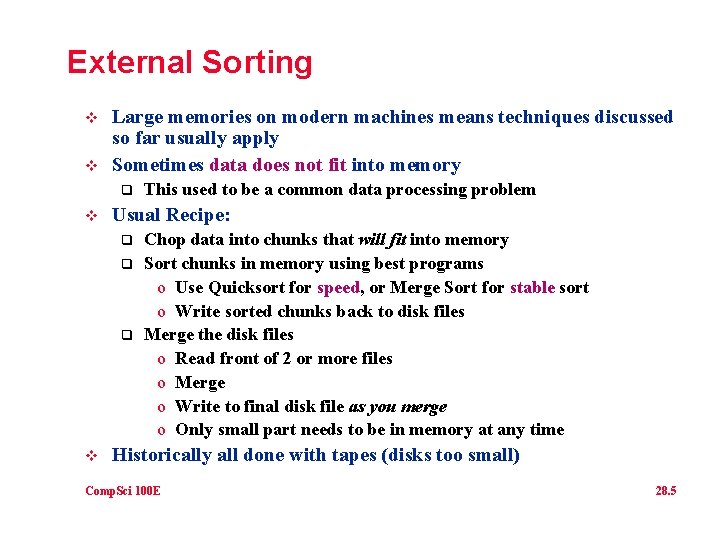
External Sorting v v Large memories on modern machines means techniques discussed so far usually apply Sometimes data does not fit into memory q v Usual Recipe: q q q v This used to be a common data processing problem Chop data into chunks that will fit into memory Sort chunks in memory using best programs o Use Quicksort for speed, or Merge Sort for stable sort o Write sorted chunks back to disk files Merge the disk files o Read front of 2 or more files o Merge o Write to final disk file as you merge o Only small part needs to be in memory at any time Historically all done with tapes (disks too small) Comp. Sci 100 E 28. 5
- Slides: 5