
Other Diseases Disabilities Hereditary Diseases caused by abnormal
Other Diseases & Disabilities

Hereditary Diseases caused by abnormal chromosomes or by defective genes inherited from one or both parents.
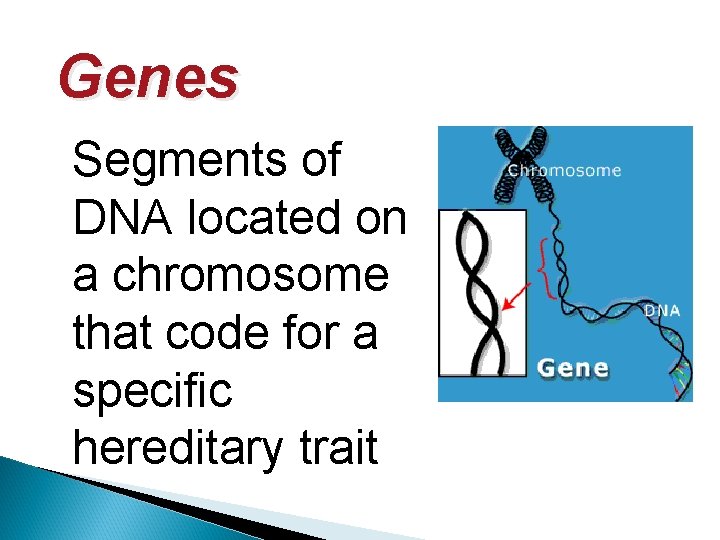
Genes Segments of DNA located on a chromosome that code for a specific hereditary trait

Single-Gene Diseases Occur when 1 gene out of 30, 000 to 40, 000 genes in the body has a harmful mutation.
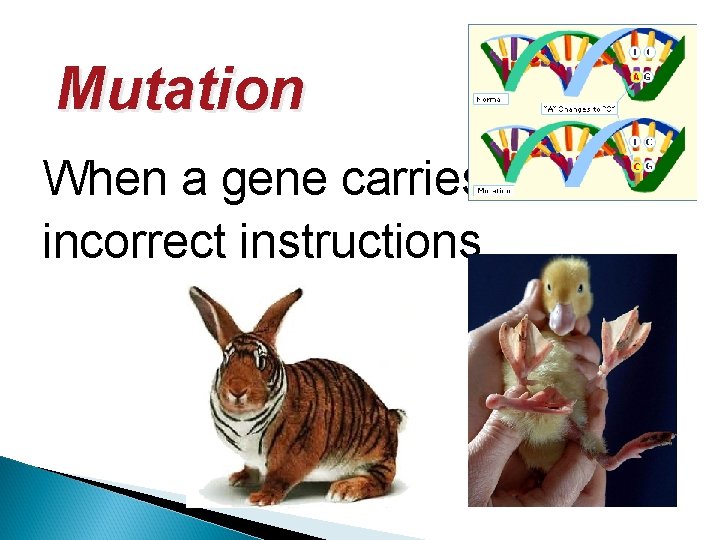
Mutation When a gene carries incorrect instructions
Parkinson’s Disease Nerve cells use a brain chemical called dopamine to help control muscle movement. Parkinson's disease occurs when the nerve cells in the brain that make dopamine are slowly destroyed. Without dopamine, the nerve cells in that part of the brain cannot properly send messages. This leads to the loss of muscle function.
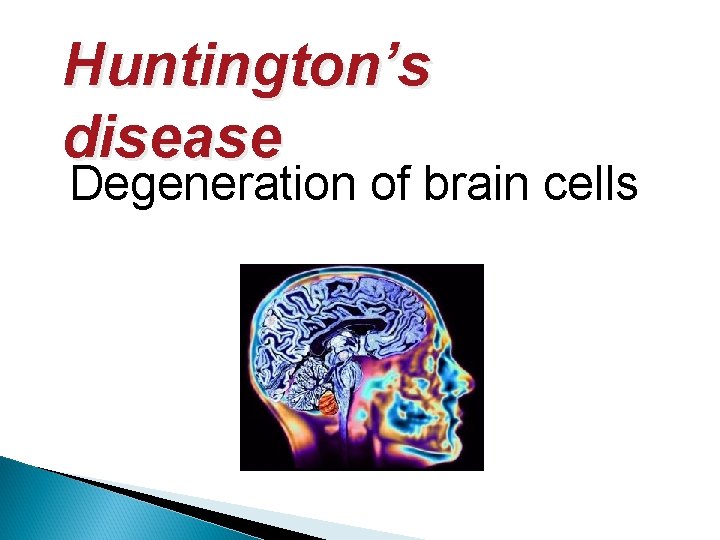
Huntington’s disease Degeneration of brain cells

Sickle Cell Anemia Blood disease in which the body produces defective hemoglobin.
Hemophilia Blood disease in which the body produces little or none of the blood proteins necessary for
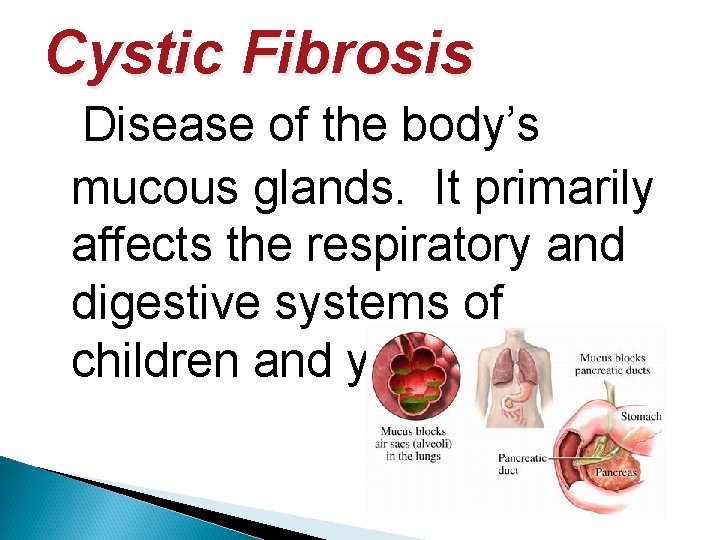
Cystic Fibrosis Disease of the body’s mucous glands. It primarily affects the respiratory and digestive systems of children and young adults.
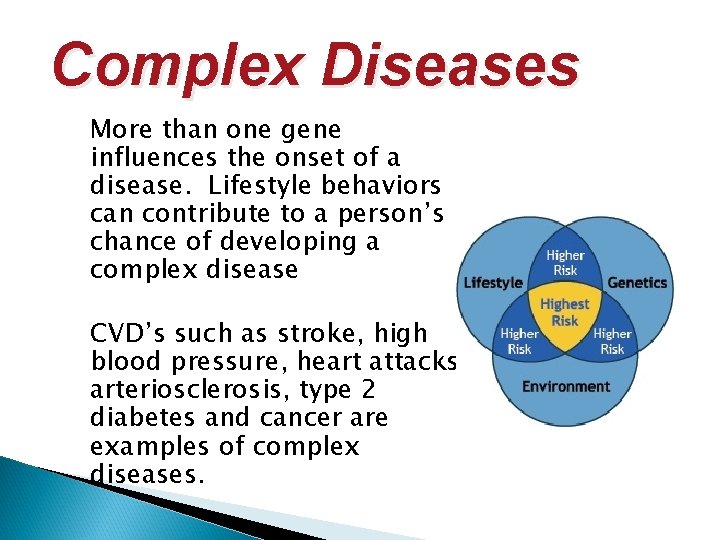
Complex Diseases More than one gene influences the onset of a disease. Lifestyle behaviors can contribute to a person’s chance of developing a complex disease CVD’s such as stroke, high blood pressure, heart attacks, arteriosclerosis, type 2 diabetes and cancer are examples of complex diseases.
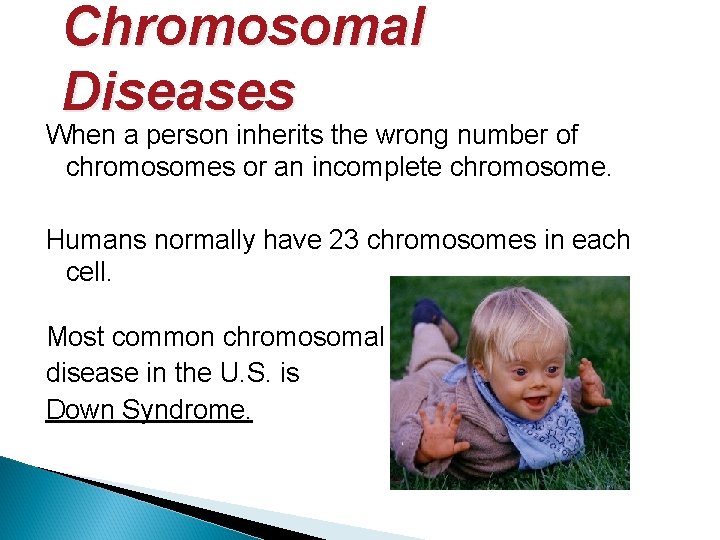
Chromosomal Diseases When a person inherits the wrong number of chromosomes or an incomplete chromosome. Humans normally have 23 chromosomes in each cell. Most common chromosomal disease in the U. S. is Down Syndrome.
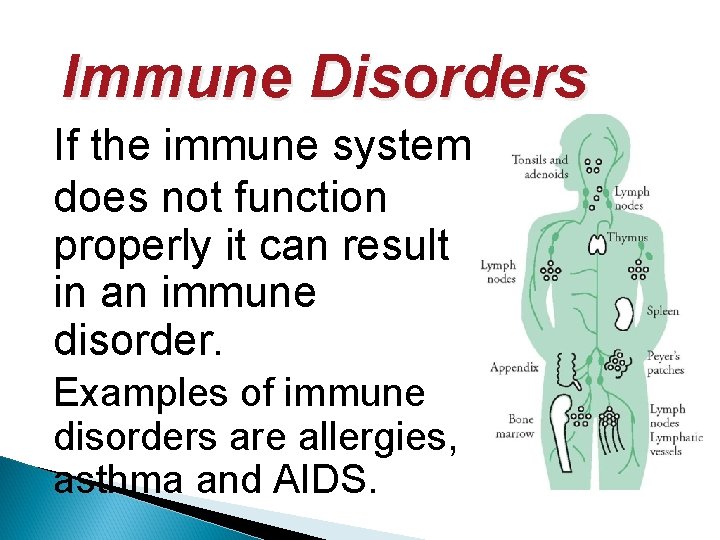
Immune Disorders If the immune system does not function properly it can result in an immune disorder. Examples of immune disorders are allergies, asthma and AIDS.
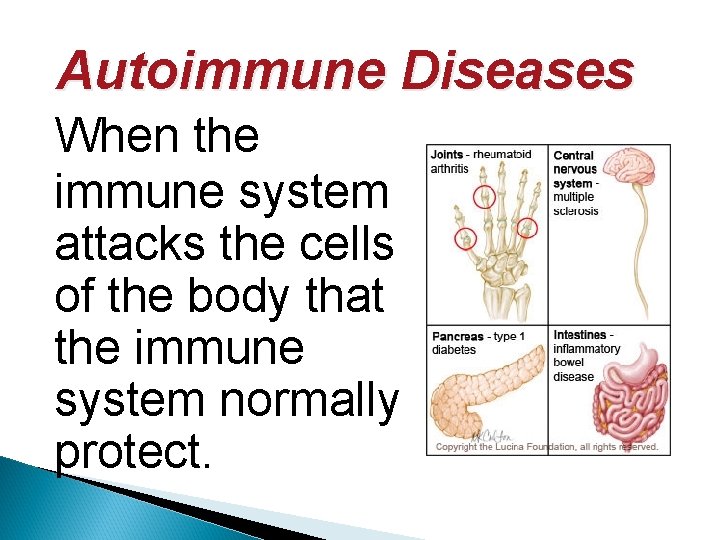
Autoimmune Diseases When the immune system attacks the cells of the body that the immune system normally protect.
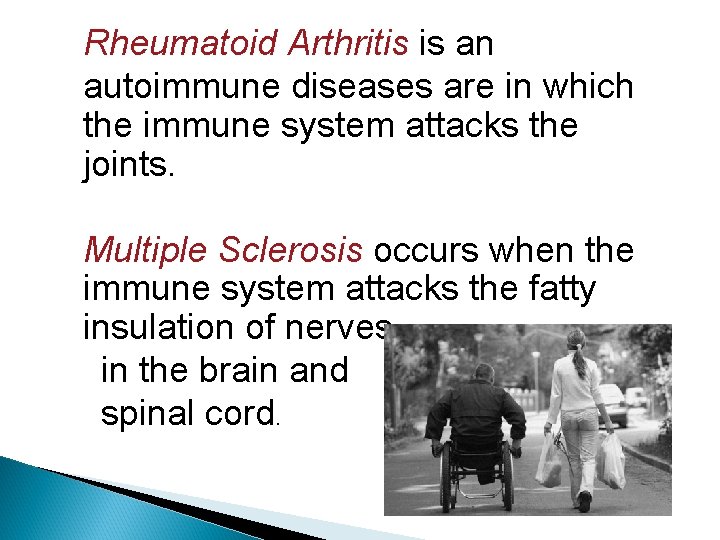
Rheumatoid Arthritis is an autoimmune diseases are in which the immune system attacks the joints. Multiple Sclerosis occurs when the immune system attacks the fatty insulation of nerves in the brain and spinal cord.
Learning Disabilities Definition: A disorder in one or more of the basic psychological processes involved in understanding or in using language Manifests itself as an imperfect ability to listen, think, speak, write, spell, or do mathematical calculations. Usually have normal IQ but can’t perform academically within the normal IQ range.
Learning Disabilities Common characteristics hyperactive behavior, short attention spans, impulsiveness, poor self concepts, delay in play development Effects on motor proficiency hard time with visual-motor coordination, fine motor coordination, bilateral coordination, balance, and difficulties in perception (sight, sound, touch, muscle feeling, smell, and taste)
Mental Disabilities Definition: Significantly sub-average general intellectual functioning; a wide continuum exists Characteristics: short attention span, being slow to understand follow directions, being lovable and wanting to please, exhibiting a delay in physical and motor skills Motor skills: similar to learning disabilities; Poor body image, poor spatial relations, (with themselves, others, and equipment), clumsy and lack balance
Mental Disabilities Students with mental disabilities benefit from a highly structured and consistent environment, as well as immediate praise Suggestions: Structured, consistent environment, teach by demonstrations and verbalization, be brief with directions, affirm/praise valid attempts (instantly)
Emotional and Behavioral Disturbances Definition: A condition exhibiting characteristics which over a long period of time (adversely affects the child’s education): Ex. Tourette’s syndrome, Bipolar, PDD (autism, asperger’s), Oppositional Defiant disorder
Emotional and Behavioral Disturbances Characteristics: inability to learn that cannot be explained by intellectual, sensory, or health factors inability to build or maintain satisfactory interpersonal relationship with peer or teachers inappropriate behaviors or feelings under normal circumstances general mood of unhappiness or depression tendency to develop physical symptoms or fears associated with personal/school problems
Sensory Impairments: Visual Definition: Includes partial sight and blindness. Visual impairment, including blindness, means an impairment in vision that, even with correction, adversely affects a child’s educational performance Characteristics: self stimulation mannerisms (rocking, clicking fingers), stand too close because don’t know distances, Motor skills: slow to walk and develop gross motor skills created by limited movement and exploration, higher body mass index (low levels of fitness)
Sensory Impairments: Auditory Definition: May be a permanent or fluctuating impairment or deafness. Impairment in hearing, whether permanent or fluctuating, that adversely affects a child’s education performance; Deafness is a hearing impairment that is so severe that the child is impaired in processing linguistic information through hearing, with or without amplification
Sensory Impairments: Auditory Characteristics: social domain is hardest, frustration when multiple conversations are going on, withdrawal from game experiences if not given special assistance Motor skills: Poor balance, learn at normal rate but most have lower fitness scores
Orthopedic and Physical Impairments Definition: May result from congenital causes, disease, injury. A severe orthopedic impairment that adversely affects a child’s educational performance includes impairments caused by congenital anomaly (missing a limb), disease (arthritis), and other causes (cerebral palsy, amputations, etc)
Orthopedic and Physical Impairments Characteristics: Some are average to above IQ while others have mild to severe learning disabilities Cerebral Palsy is the orthopedic impairment found most often in public schools. Can have “mild” (generalized clumsiness or slight limp) to “severe” (dominated by reflexes, unable to ambulate, unable to speak, almost no control of motor function); Most common form is call spasticity which is hypertension of the tendons and muscles (look and feel stiff); the degree of severity depends on the different body parts involved
- Slides: 26