
OTHER CLAUSE ELEMENTS ADVERBIALS ADVERBIALS A Optional elements
OTHER CLAUSE ELEMENTS ADVERBIALS

ADVERBIALS, A Optional elements Can be omitted without affecting the grammaticality of the clause Tell us stgh. extra about the action or state described by the rest of the sentence We can have several adverbials present in a single sentence

ADVERBS VS. ADVERBIALS Adverbs Adverbials Morphology Syntax one of word class one of sentence elements Form and changes within (grading – inflections) position in a sentence Meaning implication (manner, place, frequency, degree, viewpoint adverbs, focus adverbs, connectives) we are concerned with the meaning it brings to a sentence (manner, place, time, frequency, degree, cause, reason, purpose, disjcunts, conjuncts)

EXAMPLES Adverbs Adverbials Suddenly In a hurry Here, left On the top shelf Tomorrow, early At eight, in 1987 Twice, often Very seldom Clearly, evidently, frankly Surely, you don´t mean it. However, meanwhile, furthermore I promised to meet him, however, I had to call and cancel the appointment.
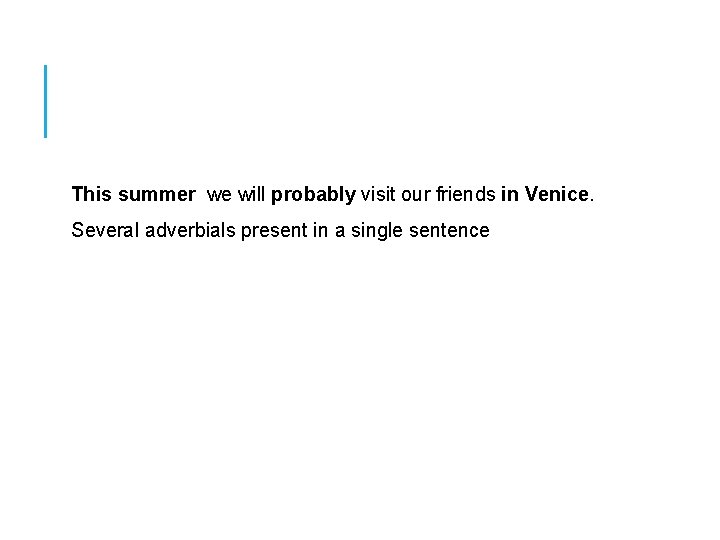
This summer we will probably visit our friends in Venice. Several adverbials present in a single sentence
SYNTACTIC FEATURES Can be added more or less independently of the type of verb (compare complement) Generally optional in the clause structure Realized by adverb phrase, prepositional phrases or clauses More mobile than other clause elements, occupying a variety of positions in the clause More than one adverbial can occur in the same clause, unlike other elements
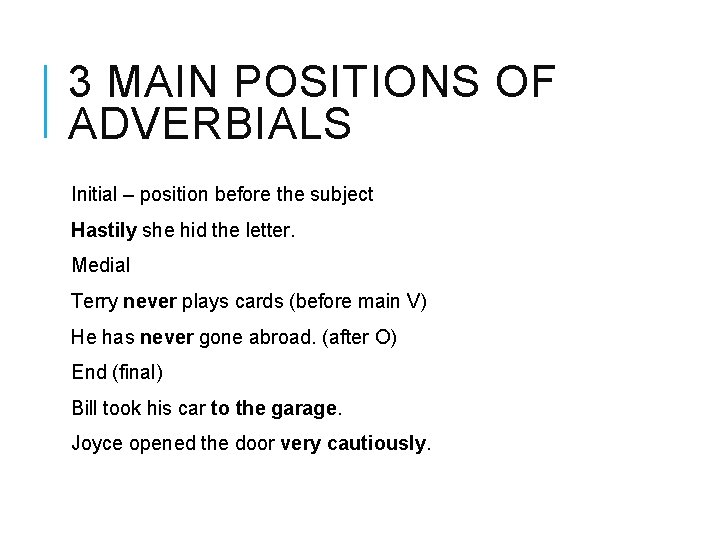
3 MAIN POSITIONS OF ADVERBIALS Initial – position before the subject Hastily she hid the letter. Medial Terry never plays cards (before main V) He has never gone abroad. (after O) End (final) Bill took his car to the garage. Joyce opened the door very cautiously.
SEMANTIC ROLES ADVERBIALS USUALLY REFER TO: Space (position, direction, goal, source, distance) Time (duration, frequency, relations between times) Process (manner, means, instrument) Degree (amplification, diminution)

3 MAIN TYPES OF ADVERBIALS Adjuncts Disjuncts Conjuncts

ADJUNCTS (CIRCUMSTANCE ADVERBIALS) Describing circumstances or conditions of an action or state Where? When? How? Why? To what extent? A wide range of semantic roles: Place (distance, direction, position) He had travelled a long way before he reached the camp. The children were playing in the garden.
Time (duration, frequency) Her birthday is in May. They usually visit us once a week. Process (manner, means, instrument) He explained that very clearly. He chopped the meat with a sharp knife.
Contingency (súvislosť) (reason/cause, purpose, concession, condition, result) His aunt died of cancer. Mrs. Black is happy because she found her purse. They phoned to invite us. Although he is on diet, he cannot resist the delicious cakes that his Granny baked.
If he explains me how to do it, I will be able to put it together by myself. (condition) He stayed up late, so he is very sleepy now. (result) Extent or degree: amplifier, diminisher She looked very much like her mother. He pulled the string a little bit.
Addition/restriction I enjoyed this movie, too. This present is especially for you. I just want to ask you something. Recipient (expressed by for-phrases) The sweets are so good that I am going to save some for the kids.
Many adverbials can have secondary roles E. g. slowly and quickly (do not describe only manner of an action but also duration) Adjuncts – realized by: Prepositional phrases Adverb phrases Clauses
ADJUNCTS REALIZED BY: PP They acted in a strange way. (manner) Let´s meet at 5. (time) He grew up in Sweden. (place) Adv. P He is always late. (frequency) She looked at him coldly. (manner)
Finite clauses If you call me, I will come. (condition) Just because you´ve lost it, you do not have to cry. (reason) He acts as if he were a child. (manner) Non-finite and verbless clauses We stopped to have a rest. (purpose) When in Rome, do not forget to visit your aunt. (time)
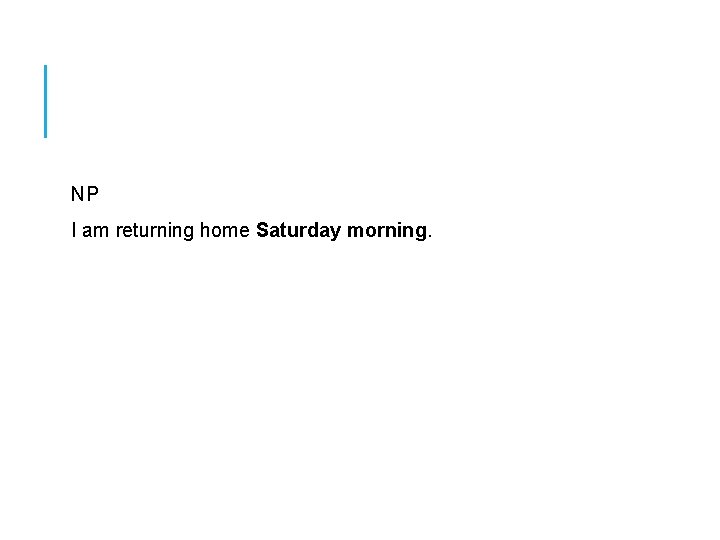
NP I am returning home Saturday morning.
ADJUNCTS Can be used both with transitive and intransitive verbs There is no limit to their number in a clause Typically they are Adv. P, Prep. , but realized also by other clauses

DISJUNCTS (STANCE ADVERBIALS) Optional additions Express the attitude of the speaker/writer towards the content of the message Unlike adjuncts they are more loosely attached to the clause More mobile Not part of predicate
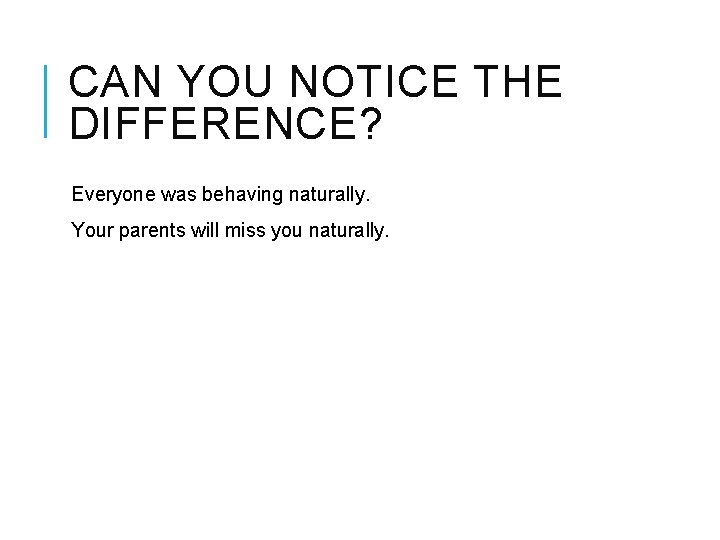
CAN YOU NOTICE THE DIFFERENCE? Everyone was behaving naturally. Your parents will miss you naturally.
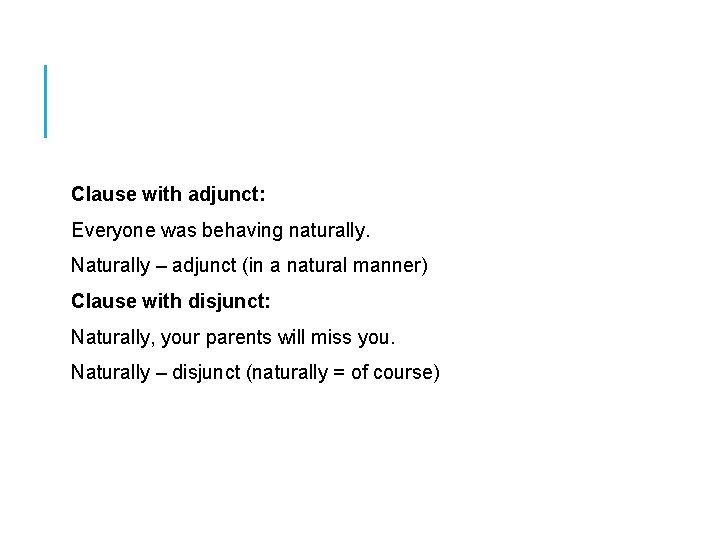
Clause with adjunct: Everyone was behaving naturally. Naturally – adjunct (in a natural manner) Clause with disjunct: Naturally, your parents will miss you. Naturally – disjunct (naturally = of course)

DISJUNCTS Superior role to sentence elements Not part of the predicate Separate from the clause Their message refers to the whole clause or sentence Usually placed before or after the sentence, while adjuncts are placed after the verb

THINK OF THIS SENTENCE: PERHAPS JOHN WORKS HERE Disjunct (Sentence modifier) - Perhaps Sentence Nucleus – John works here.
Of course, he is late again. He is late again, of course. Disjuncts can be also found parenthetically or between commas He is, of course, late again.

EXAMPLES OF DISJUNCTS frankly, honestly, truthfully generally, literally, personally, strictly Showing certainty: undoubtedly, perhaps Evaluation: correctly, hopefully, predictably, quite rightly, strangely, stupidly, sensibly, wisely. . .
USE OF PREPOSITIONAL AND RELATIVE CLAUSES (TO SHOW STANCE) To my regret, she did not need my help. To be honest, she has not even tried to do it. Tom has been, which is surprising, nominated for the prize.
CONJUNCTS (LINKING ADVERBIALS) Connectors of structure Are mobile like disjuncts Often separated by the rest of the clause
CONJUNCTS CAN BE PLACED: Between two parallel structures She is young, clever, and above all pretty. Between clauses His parents are not wealthy, nevertheless, Tom has an expensive car. Between sentences Ann did not study hard. Consequently, she failed the final exam.
Between paragraphs: Firstly. . . Further. . . In conclusion. . . Conjuncts express textual relationship
SEMANTIC ROLE OF CONJUNCTS: Additive – and, furhtermore, in other words, moreover Adversative – but, instead, nevertheless (napriek tomu, avšak), on the other hand Causal – for, because, therefore, then, in that case Temporal – next, then, after that, finally
CONJUNCTS CAN BE REALIZED BY: Adverbs – nevertheless, moreover, first, namely, consequently, incidentally PP – by the way, in other words, on the contrary, on top of that Adj. P. – last of all, better still Adv. P. – more accurately Finite cl. – what is more, that is why Non-finite cl. – to conclude, to sum up
OTHER EXAMPLES OF CONJUNCTS (LINKING ADVERBIALS): For example For instance Such as
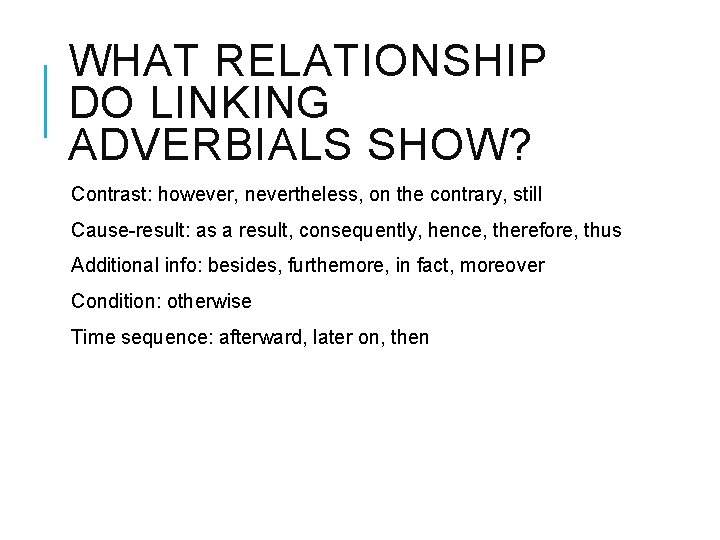
WHAT RELATIONSHIP DO LINKING ADVERBIALS SHOW? Contrast: however, nevertheless, on the contrary, still Cause-result: as a result, consequently, hence, therefore, thus Additional info: besides, furthemore, in fact, moreover Condition: otherwise Time sequence: afterward, later on, then

ADJUNCTS, DISJUNCTS, CONJUNCTS – TO CONCLUDE Optional elements Can be added or omitted without producing an ungrammatical clause Adjuncts – circumstantial infos Disjuncts – additional comment by the speaker Conjuncts – not elements of the clause (issue of semantic understanding of the text assuring coherence and cohesion of the text)
Cohesion – can be achieved by linguistic devices – Therefore, additionally. . (how the text is linked together by specific devices) Coherence (text is coherent if we as readers can make sense of the entire text)
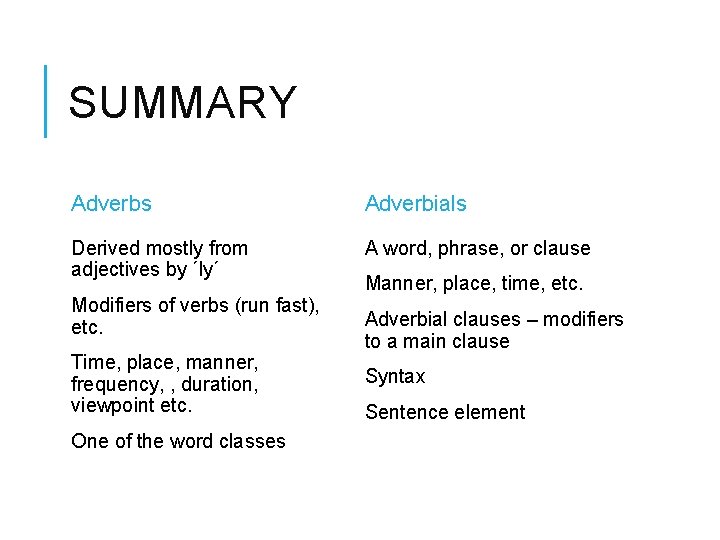
SUMMARY Adverbs Adverbials Derived mostly from adjectives by ´ly´ A word, phrase, or clause Modifiers of verbs (run fast), etc. Time, place, manner, frequency, , duration, viewpoint etc. One of the word classes Manner, place, time, etc. Adverbial clauses – modifiers to a main clause Syntax Sentence element
HOMEWORK Make a paragraph using at least 10 of the conjuncts (conjunctive adverbs) !!! Bring your text for the next week seminar !!! Use the following adverbials in a paragraph: of course, frankly, to sum up, however, at first, to conclude, furthermore. .
- Slides: 38