
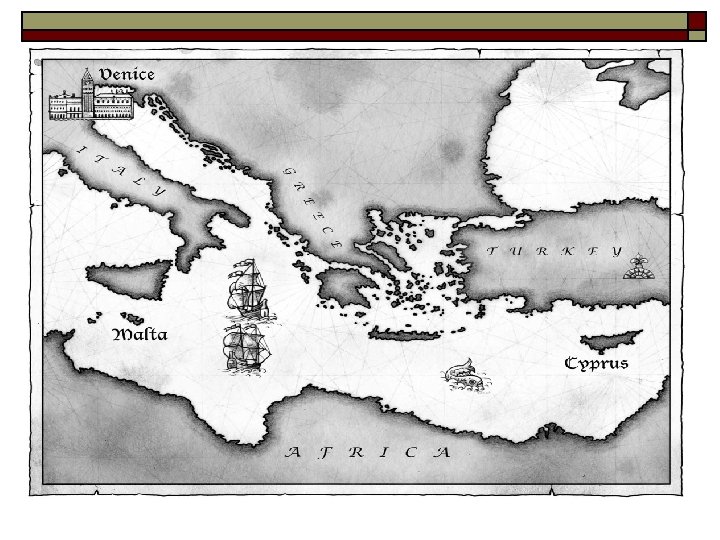
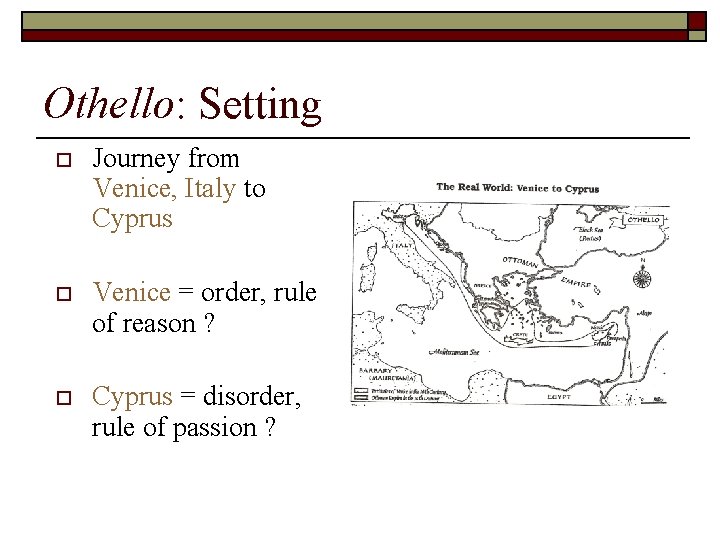
Othello Setting o Journey from Venice Italy to
- Slides: 13
Othello: Setting o Journey from Venice, Italy to Cyprus o Venice = order, rule of reason ? o Cyprus = disorder, rule of passion ?
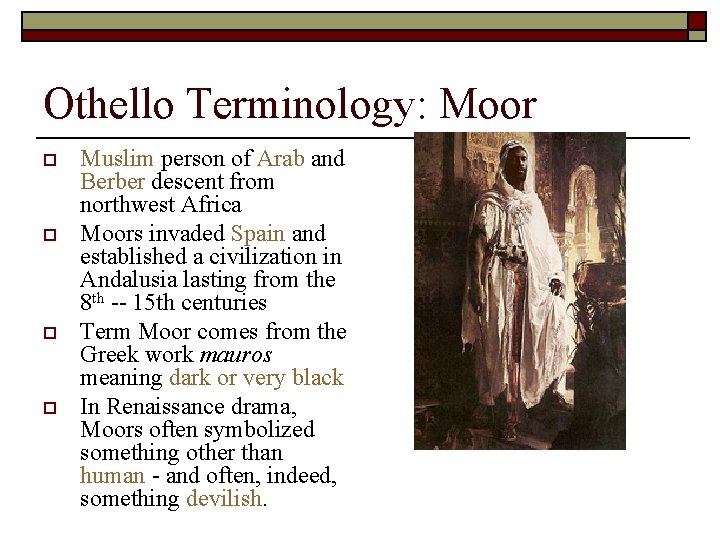
Othello Terminology: Moor o o Muslim person of Arab and Berber descent from northwest Africa Moors invaded Spain and established a civilization in Andalusia lasting from the 8 th -- 15 th centuries Term Moor comes from the Greek work mauros meaning dark or very black In Renaissance drama, Moors often symbolized something other than human - and often, indeed, something devilish.
Othello Terminology: Cuckold o o a man whose wife is unfaithful to him Represented with horns growing out of his forehead “That cuckold lives in bliss Who, certain of his fate, loves not his wronger; But O, what damned minutes tells he o’er Who dotes, yet doubts; suspects, yet strongly loves!” (3. 3. 197 -200) “I have a pain upon my forehead, here” (326).
Tragedy o o A serious play representing the disastrous downfall of the hero Achieves a catharsis by arousing pity and terror in the audience Hero is led into fatal calamity by hamartia (tragic flaw or error) which often takes the form of hubris (excessive pride leading to divine retribution Tragic effect depends upon audience’s awareness of the admirable qualities of the hero which are wasted in the disaster
Classical Tragic Hero o o The tragic hero is a good man, important to society The hero suffers a fall brought about by something in his nature The fall provokes the emotions of pity and fear in the reader The tragic character comes to some kind of understanding or new recognition of what has happened
Tragic Flaw Defect of character that leads to the hero’s disastrous downfall
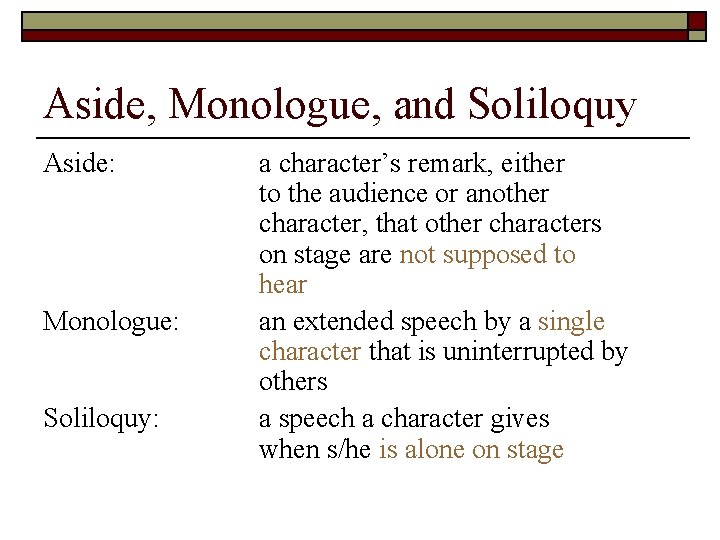
Aside, Monologue, and Soliloquy Aside: Monologue: Soliloquy: a character’s remark, either to the audience or another character, that other characters on stage are not supposed to hear an extended speech by a single character that is uninterrupted by others a speech a character gives when s/he is alone on stage
Verse vs. Prose o In Othello, pay careful attention to the situations in which Iago switches between speaking in verse and speaking in prose. o What importance does his choice of verse or prose seem to have?
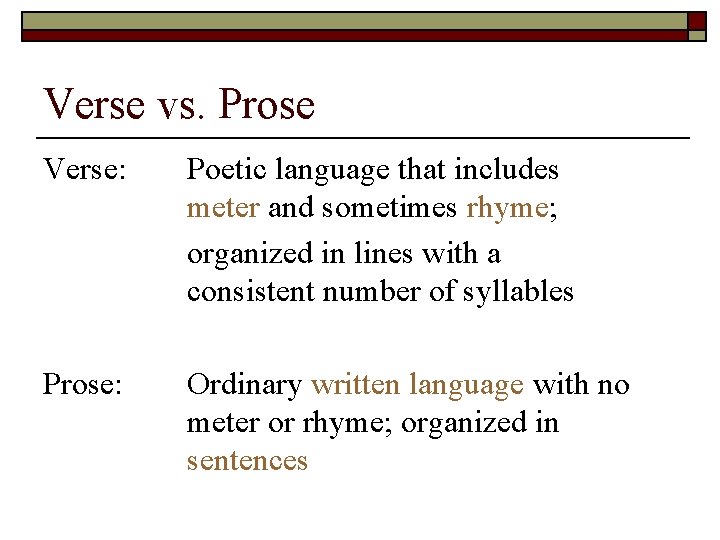
Verse vs. Prose Verse: Poetic language that includes meter and sometimes rhyme; organized in lines with a consistent number of syllables Prose: Ordinary written language with no meter or rhyme; organized in sentences
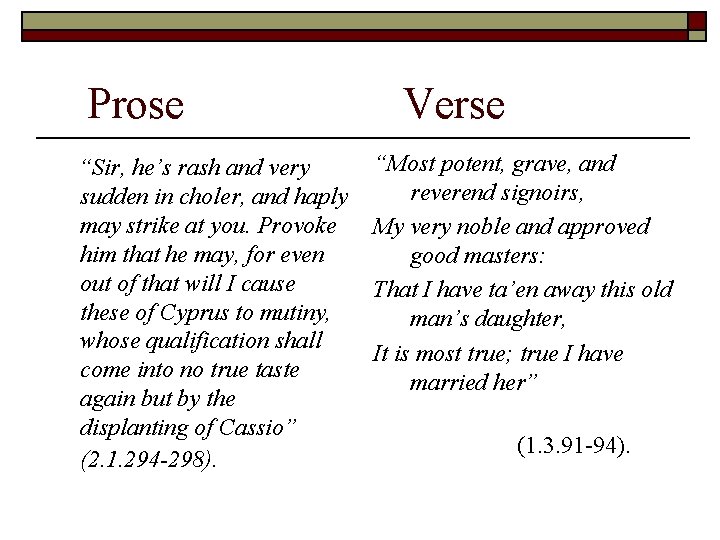
Prose “Sir, he’s rash and very sudden in choler, and haply may strike at you. Provoke him that he may, for even out of that will I cause these of Cyprus to mutiny, whose qualification shall come into no true taste again but by the displanting of Cassio” (2. 1. 294 -298). Verse “Most potent, grave, and reverend signoirs, My very noble and approved good masters: That I have ta’en away this old man’s daughter, It is most true; true I have married her” (1. 3. 91 -94).
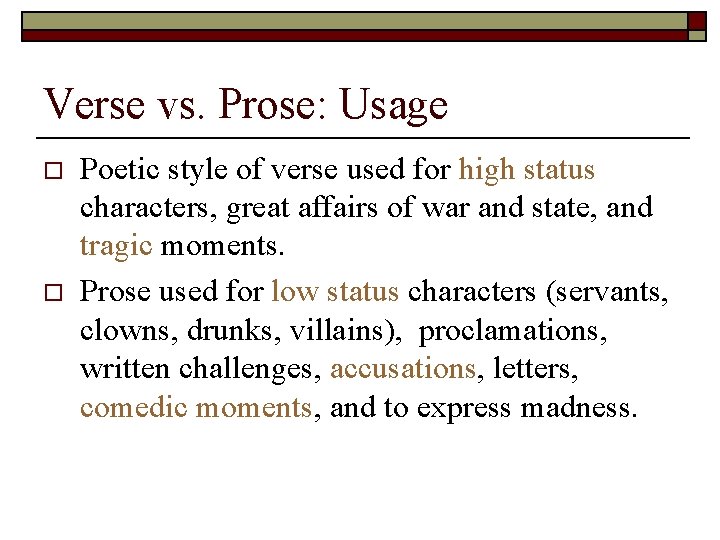
Verse vs. Prose: Usage o o Poetic style of verse used for high status characters, great affairs of war and state, and tragic moments. Prose used for low status characters (servants, clowns, drunks, villains), proclamations, written challenges, accusations, letters, comedic moments, and to express madness.