
OTES 2 0 Curriculum Council September 16 2019

OTES 2. 0 Curriculum Council September 16, 2019
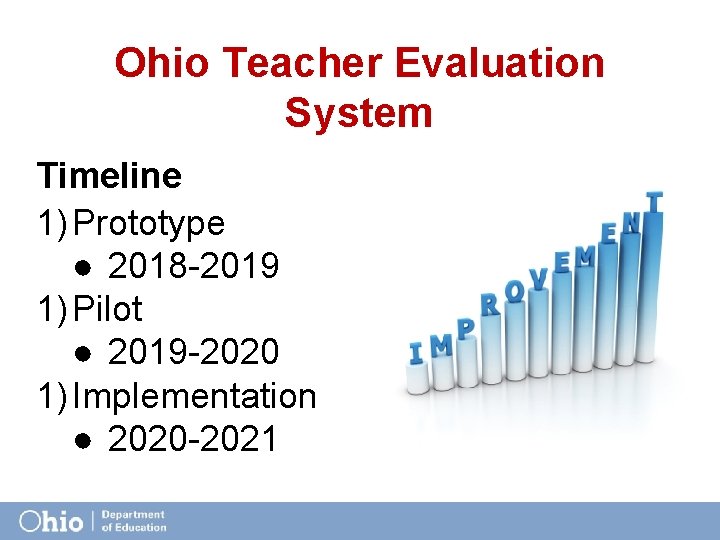
Ohio Teacher Evaluation System Timeline 1) Prototype ● 2018 -2019 1) Pilot ● 2019 -2020 1) Implementation ● 2020 -2021
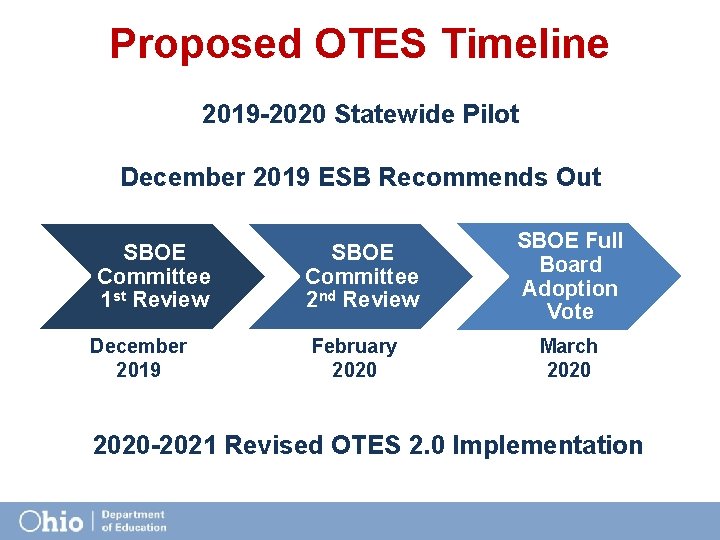
Proposed OTES Timeline 2019 -2020 Statewide Pilot December 2019 ESB Recommends Out SBOE Committee 1 st Review December 2019 SBOE Committee 2 nd Review February 2020 SBOE Full Board Adoption Vote March 2020 -2021 Revised OTES 2. 0 Implementation

OTES 1. 0 and OTES 2. 0 Some things remain the same. . .
What remains the same in OTES 2?
Who should be evaluated? • Any person employed under a teaching license and • Who spends at least 50 percent of the time employed providing student instruction
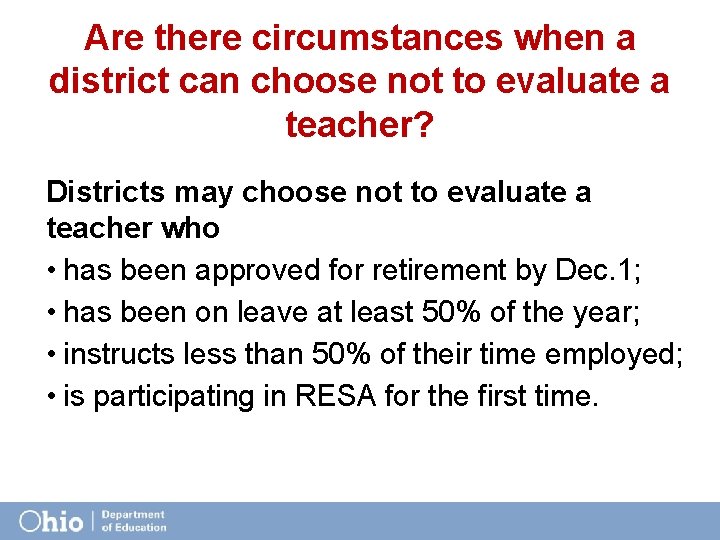
Are there circumstances when a district can choose not to evaluate a teacher? Districts may choose not to evaluate a teacher who • has been approved for retirement by Dec. 1; • has been on leave at least 50% of the year; • instructs less than 50% of their time employed; • is participating in RESA for the first time.
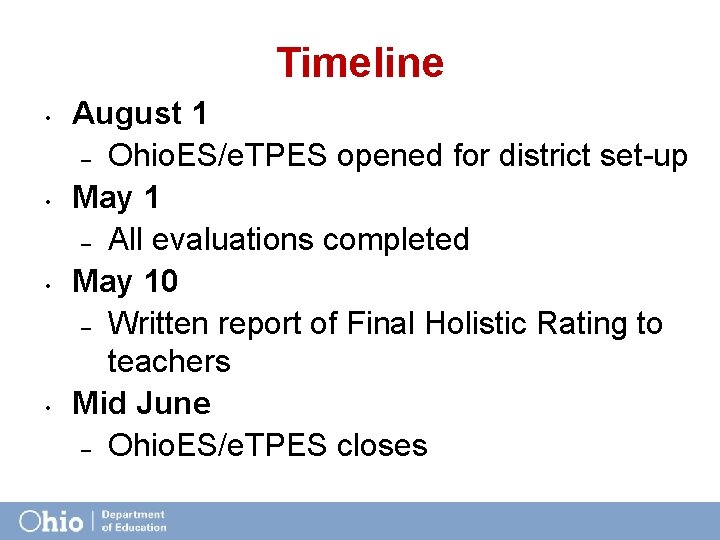
Timeline • • August 1 – Ohio. ES/e. TPES opened for district set-up May 1 – All evaluations completed May 10 – Written report of Final Holistic Rating to teachers Mid June – Ohio. ES/e. TPES closes

What changes with OTES 2?
Rationale for Changes ● ● Educator Standards Board Law
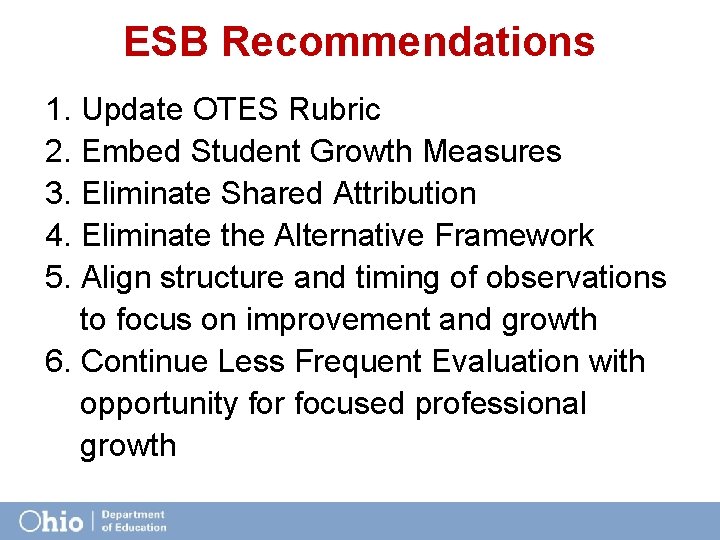
ESB Recommendations 1. Update OTES Rubric 2. Embed Student Growth Measures 3. Eliminate Shared Attribution 4. Eliminate the Alternative Framework 5. Align structure and timing of observations to focus on improvement and growth 6. Continue Less Frequent Evaluation with opportunity for focused professional growth
What Changes did Law Bring to OTES? 1 Ohio Revised Code 3319. 111 2 Ohio Revised Code 3319. 112
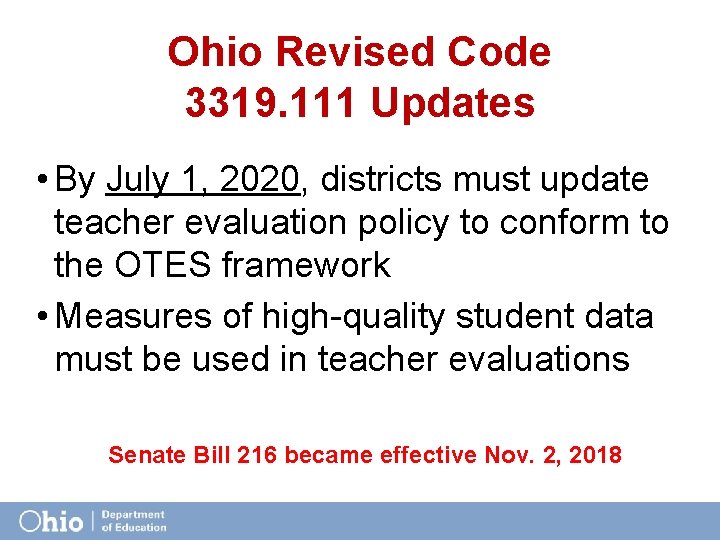
Ohio Revised Code 3319. 111 Updates • By July 1, 2020, districts must update teacher evaluation policy to conform to the OTES framework • Measures of high-quality student data must be used in teacher evaluations Senate Bill 216 became effective Nov. 2, 2018
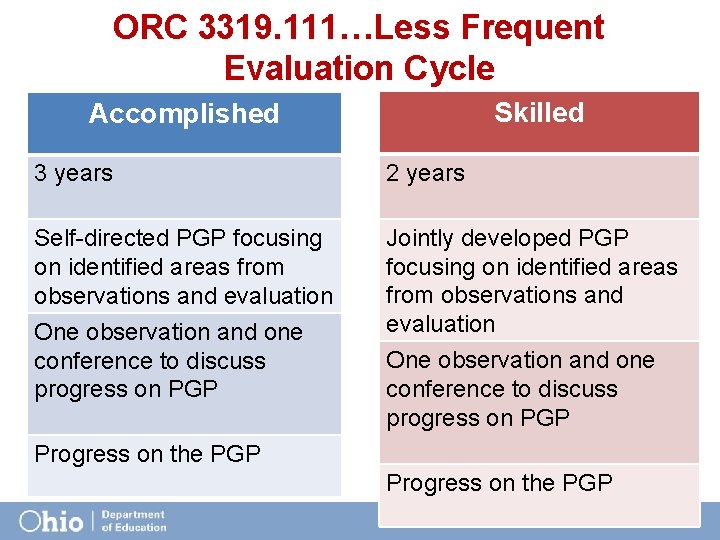
ORC 3319. 111…Less Frequent Evaluation Cycle Skilled Accomplished 3 years 2 years Self-directed PGP focusing on identified areas from observations and evaluation Jointly developed PGP focusing on identified areas from observations and evaluation One observation and one conference to discuss progress on PGP Progress on the PGP
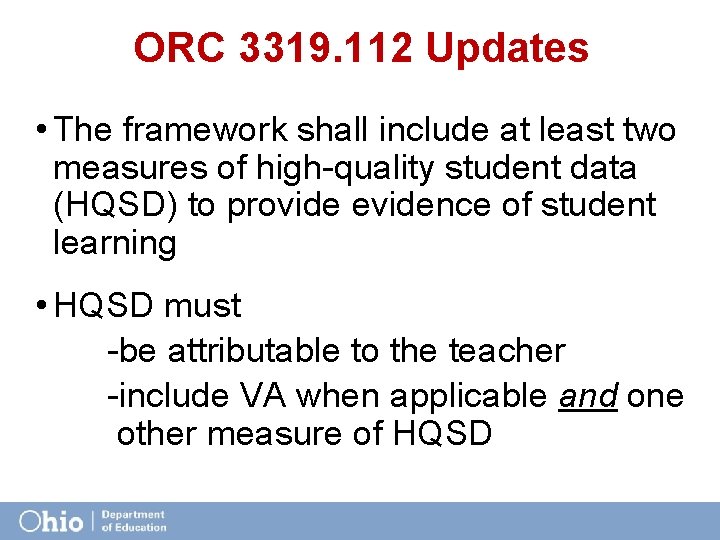
ORC 3319. 112 Updates • The framework shall include at least two measures of high-quality student data (HQSD) to provide evidence of student learning • HQSD must -be attributable to the teacher -include VA when applicable and one other measure of HQSD
ORC 3319. 112 Updates • Prohibits shared attribution • Prohibits the use of Student Learning Objectives (SLOs) • PGP or IP based on results of evaluation and aligned to any building and/or district improvement plan
Must vs. May Musts: Ohio Revised Code OTES Draft Framework • Includes components and procedures that must be followed Mays: OTES Draft Model • Includes guidance, document templates, and recommended best practices that may be followed
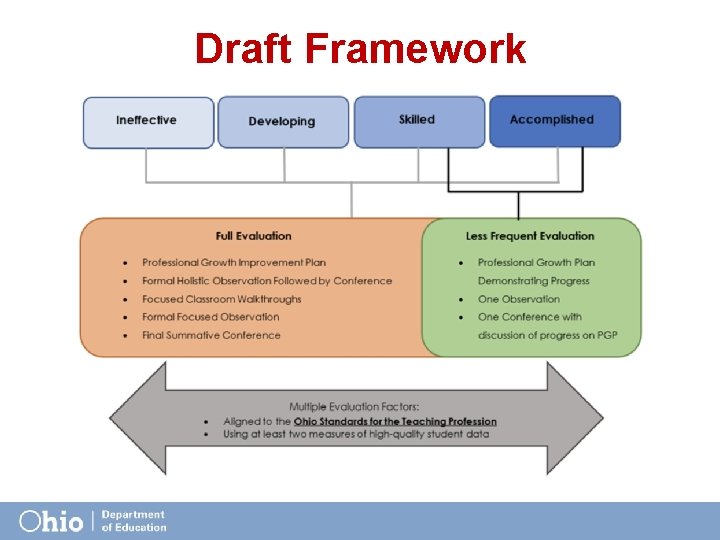
Draft Framework
Final Holistic Rating • Teacher’s Final Holistic Rating based on –Combination of observations –Use of district-determined HQSD that adheres to State guidelines
Observations Required components of full evaluation still include • two formal observations of at least thirty minutes each • at least two classroom walkthroughs of less than thirty minutes
Shifting the Focus Required components of full evaluation include • One formal holistic observation - followed by a conference • Walkthroughs – focused on specific area(s) identified for support • One formal focused observation – focused on specific area(s) identified for support • One summative conference
Professional Growth Plan Goals • Make the PGP a living document • Support teacher growth to enhance practice • Offer opportunity for teacher self-reflection • Provide professional development and supports that are individualized to the needs of the teacher and his or her students
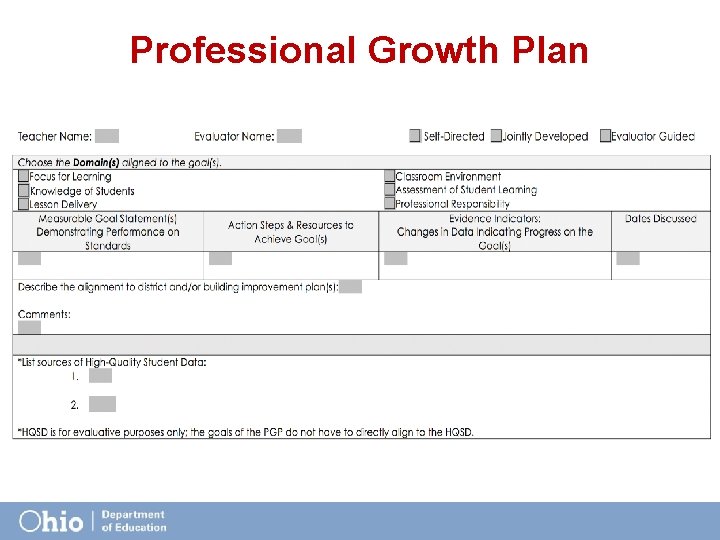
Professional Growth Plan
Level of Support • Teachers with an earned rating of Accomplished will complete a selfdirected PGP • Teachers with an earned rating of Skilled will work with their evaluator to jointly complete the PGP • Teachers with an earned rating of Developing will complete a PGP that is guided by their evaluator
Goal Setting • Data based • SMART goals • Aligned to any district and/or building improvement plan(s) • Goals may or may not align with focus area(s) identified for support • Number of goals is locally determined • Involve regular communication
Evidence Indicators of Progress • Progress on the PGP must be made to remain on the less frequent evaluation cycle • The evidence indicators should include changes in data that will indicate progress • Evaluator determines whether progress has been made on the goals
School or Building Improvement Plan Alignment • ORC 3319. 112 states the PGP must be based on the results of the evaluation and aligned to any school district and/or building improvement plan(s) • Consider the goals, vision, and mission of the school improvement plan

OTES Rubric Current OTES 1. 0 Rubric Revised Draft OTES 2. 0 Rubric Aligned to the OSTP Uses 4 teacher performance levels 10 Standard Areas SGM calculated separately 50% of calculated rating Aligned to the OSTP Maintains the same 4 performance levels 6 Domains Use of HQSD embedded No calculation

Rubric Domain Aligned to Goals Current OTES 1. 0 Standard Areas Revised Draft OTES 2. 0 Domains Focus for Learning Assessment Data Knowledge of Students Prior Content Knowledge. . . Lesson Delivery Knowledge of Students Classroom Environment Lesson Delivery Assessment of Student Learning Differentiation Professional Responsibilities Resources Classroom Environment Assessment of Student Learning Professional Responsibilities
Performance Levels • Accomplished • Skilled • Developing • Ineffective What distinguishes an Accomplished teacher from a Skilled teacher?
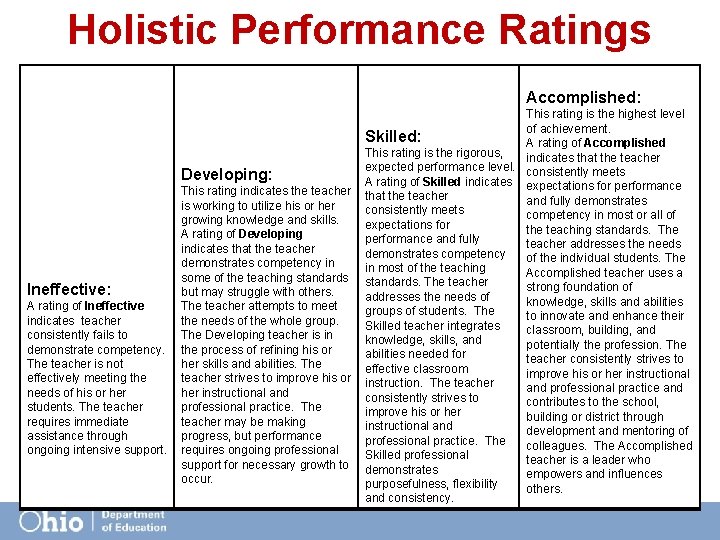
Holistic Performance Ratings Accomplished: This rating is the highest level of achievement. Skilled: A rating of Accomplished This rating is the rigorous, indicates that the teacher expected performance level. consistently meets Developing: A rating of Skilled indicates expectations for performance This rating indicates the teacher that the teacher and fully demonstrates is working to utilize his or her consistently meets competency in most or all of growing knowledge and skills. expectations for the teaching standards. The A rating of Developing performance and fully teacher addresses the needs indicates that the teacher demonstrates competency of the individual students. The demonstrates competency in in most of the teaching Accomplished teacher uses a some of the teaching standards. The teacher strong foundation of Ineffective: but may struggle with others. addresses the needs of knowledge, skills and abilities A rating of Ineffective The teacher attempts to meet groups of students. The to innovate and enhance their indicates teacher the needs of the whole group. Skilled teacher integrates classroom, building, and consistently fails to The Developing teacher is in knowledge, skills, and potentially the profession. The demonstrate competency. the process of refining his or abilities needed for teacher consistently strives to The teacher is not her skills and abilities. The effective classroom improve his or her instructional effectively meeting the teacher strives to improve his or instruction. The teacher and professional practice and needs of his or her instructional and consistently strives to contributes to the school, students. The teacher professional practice. The improve his or her building or district through requires immediate teacher may be making instructional and development and mentoring of assistance through progress, but performance professional practice. The colleagues. The Accomplished ongoing intensive support. requires ongoing professional Skilled professional teacher is a leader who support for necessary growth to demonstrates empowers and influences occur. purposefulness, flexibility others. and consistency.
High-Quality Student Data • Sources of High-Quality Student Data
ORC 3319. 111 • Measures of high-quality student data (HQSD) must be used in teacher evaluations
ORC 3319. 112 • HQSD can be used as evidence in any component of the evaluation • The framework shall include at least two measures of HQSD to provide evidence of student learning • HQSD must – Be attributable to the teacher – Include VA when applicable and one other measure of HQSD
Defining High-Quality Student Data: Data Tool The high-quality student data instrument used must have been rigorously reviewed by experts in the field of education to meet the following criteria: • Align to learning standards • Measure what is intended to be measured • Not offend or be driven by bias • Be attributable to the specific teacher for course(s) and grade level(s) taught • Demonstrate evidence of student learning (achievement and/or academic growth) • Follow protocols for administration and scoring • Provide trustworthy results
What instruments can be used? • • • Teacher level VA if available must be used as one of these Department will continue to approve and post Vendor Assessments District-determined instruments • Portfolios • Performance-based assessments • Current district approved assessments
Defining High-Quality Student Data: Data Tool The teacher must use the data generated from the highquality student data instrument by: • Accurately reflecting upon and analyzing available data, using the information as part of an ongoing cycle of support for student learning • Considering student learning needs and styles, identifying the strengths and weaknesses of an entire class as well as individual students • Informing instruction, adapting instruction to meet student need based upon the information gained from the data analysis • Measuring student learning (achievement and/or growth) and progress towards achieving state/local standards
HQSD Best Practices • • • Develop a committee to assist with decision making Calibrate evaluators on decisions around HQSD Train teachers and evaluators on sound assessment design and data literacy
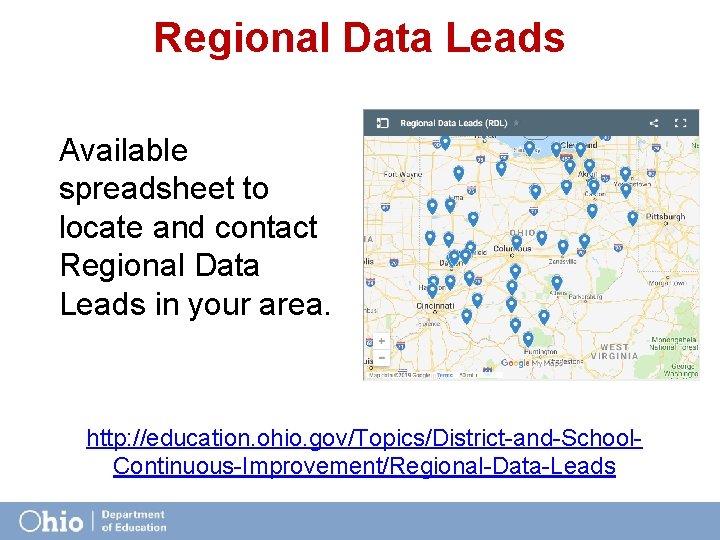
Regional Data Leads Available spreadsheet to locate and contact Regional Data Leads in your area. http: //education. ohio. gov/Topics/District-and-School. Continuous-Improvement/Regional-Data-Leads
- Slides: 40