
OTC Mobile Source Committee OTC Committee Meeting September
OTC Mobile Source Committee OTC Committee Meeting September 2009 Buffalo, New York 1
Overview • • National Measures Under Development Measures Under Consideration Next Steps 2
National Measures • Establishment of Emission Control Area Along the East Coast for Ocean Going Vessels – Support U. S. Efforts • Renewable Fuel Standard (RFS) – Part II – Backsliding Concern • Upgrade Aftermarket Catalyst Standards 3
Oceangoing Vessels • USEPA & IMO Emission Control Areas (ECA) – International Maritime Organization (IMO) Action (March 2010) • NOx and SO 2 requirements on ship near shore – 2015 – 1000 ppm Maximum Sulfur Fuel – 2016 – New Engine Standards – Tier 3 (80% reduction) – Existing Engines – (starting 2010) 15 – 20% NOx reductions • OTC action – Letter of support for the USEPA and IMO Action - March 13, 2009 4
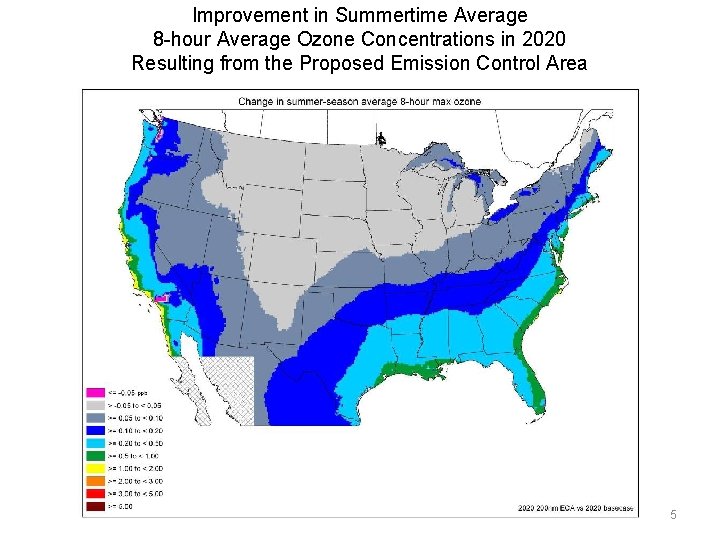
Improvement in Summertime Average 8 -hour Average Ozone Concentrations in 2020 Resulting from the Proposed Emission Control Area 5
Renewable Fuel Standard Part II • Energy Independence and Security Act (December 2007) Required Changes – Increase volume of renewable fuel – Separate Requirements for: • • Cellulosic Biofuel – 16 billion gallons by 2022 Biomass-Based Diesel – 1 billion gallons by 2012 Advanced Biofuel – 21 billion gallons by 2022 Total Renewable Fuel – 36 billion gallons by 2022 – Minimum Lifecycle GHG reductions 6
Renewable Fuel Standards • EPA RFS 2 – Proposed May 5 th – Renewable fuel requirements starting in 2010 • OTC is concerned about increased emissions – Projected NOx increased by 2022 • 241, 00 tons from upstream production • 71, 000 tons from downstream use – Projected hydrocarbon (VOC) increase by 2022 • 77, 000 tons from upstream production • 35, 000 tons from downstream use • Need to address possible backsliding 7

8
National: Aftermarket Catalysts • Current Federal EPA Standard (1986) – 25, 000 mile durability requirement – 30% NOx reduction • California requirements – 50, 000 mile durability requirement – Vehicle certification emission standards (60% - 85% NOx reduction) with additional hydrocarbon requirements – Estimated cost increase above today’s pre-OBD converter of $200 per converter – Benefits: at least 282 TPD NOx reduction nationally 9
Aftermarket Catalyst Replacement • OTC Statement - calling on the USEPA to update its policy regarding use, installation, and purchase of aftermarket catalytic converters. – OTC Annual Meeting, June 10 th 2009 • Form Workgroup to Develop Program Implementation Materials to Submit to the USEPA 10
Measures Under Development • Off-Shore Lightering of Ships • Non-Road Vehicle and Equipment Idle Reduction • Seaports 11
Off-Shore Lightering of Ships • Transfer of bulk liquid cargo from a tank vessel to a service vessel (46 CFR 38. 10 -3) • Occurs in Coast Guard Approved zones or anchorages in state waters and in offshore • Model: Delaware Regulation 1124 • Status: – Identifying Locations & State Inventories – Developing Emission Estimates 12
Non-Road Vehicle and Equipment Idle Reduction • Limits on idling time, e. g. , 3 minutes • Exemptions • Status: – Examining Emission Factors – Developing Emission Estimates 13
Seaports • Potential Categories – Ocean-Going Vessels – Cargo Handling Equipment – Locomotives (Rail) – Trucks and Vehicles – Harbor Vessels • Status: – Compiling Emission Estimates – Strategy / Measure Definition 14
Measures Under Consideration • Regional Fuel • Diesel Inspection and Maintenance • Vehicle Miles Traveled (VMT) Reductions 15
Regional Fuels • Historic interest in single fuel in the northeast and mid-Atlantic states • Low Carbon Fuel Standard (LCFS) effort underway 16
Diesel Vehicle Inspection / Maintenance • Enhancing Opacity testing • On-Board Diagnostic (OBD) system testing 17
Vehicle Miles Traveled (VMT) Reduction Strategies • Tie with the Greenhouse Gas Strategies 18
Next Steps • Continue to work on developing the strategies • Continue to seek stakeholder input in strategy development • Identify stakeholders for further discussions 19
- Slides: 19