
OST STEM Systems Building Core Group Planning Meeting
OST STEM Systems Building Core Group Planning Meeting April 16, 2012
Meeting Agenda Welcome & Introductions Item 1 Item 2 Item 3 Item 4 Item 5 Meeting Objectives & Warm Up OST System Building Overview & Role of Team Scan of Existing Programs Basecamp, Meetings & Next Steps
Objectives 1. 2. 3. Develop a common understanding of the MOST STEM Systems Core Planning Team and Responsibilities Agree on scope and definitions underpinning the STEM After-school Scan Set April to August meeting plan and action steps/deliverables

Warm Up Name the most effective out-of-school STEM program you know of. Describe it. Why is it the best?

STEM SYSTEMS BUILDING PLANNING PROCESS
MOST • • • 1 of 40 Statewide Afterschool Networks supported by C. S. Mott Foundation Broad Coalition Mission: Increase the quantity and quality of afterschool and summer opportunities for youth K-12 in Maryland
OST/Informal STEM • • • Hands On & Inquiry Based May or may not include experts Beyond school day, year, or school walls Underpinned by Youth Development framework Focus on Equity Example: PASA Principles
What do we mean by system? • • • Collaborative efforts to support scale and quality Often requires multiple partners in various roles Research based common elements
System Elements • • • Vision & Priority Setting Data Collection Collaboration & Partnership Development Sustainability Quality & Best Practices
Vision & Priority Setting • • • Providing a framework Setting goals Prioritizing
Data Collection • • Landscape Outcomes Measurement • • Assessment/Feedback Loop • • “Engaged & Excited” Youth Survey Dimensions Of Success/YPQA Stem Monitoring & Accountability
Collaboration/Partnership Development • • • Convening Brokering Networks
Sustainability • • Leveraging Advocating Communicating Fundraising
System Examples • • Oklahoma Nebraska
Roles of the Planning Committee 1. Represent the perspectives and resources of your organization and industry/sector 2. Evaluate baseline data gathered from the scan 3. Develop a plan for building a state-wide system of OST STEM programs
Role Reflection Given the elements of systems building, how can you and your organization best support this effort? • • • Vision & Priority Setting Data Collection Collaboration & Partnership Development Sustainability Quality & Best Practices
Our Process: Deliverables • • OST STEM Landscape (Baseline) Strategic Plan to include • • • Financing Assessment & Evaluation Implementation (The What!)
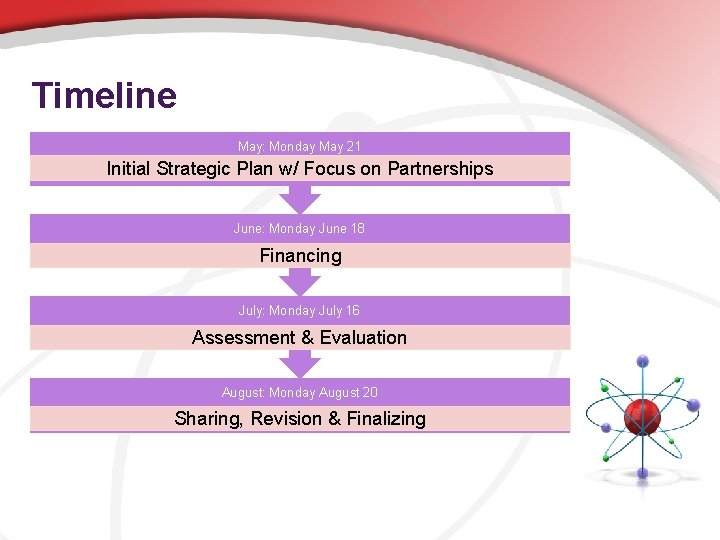
Timeline May: Monday May 21 Initial Strategic Plan w/ Focus on Partnerships June: Monday June 18 Financing July: Monday July 16 Assessment & Evaluation August: Monday August 20 Sharing, Revision & Finalizing
Building Blocks & Resources • • Rich Local Partnerships Curriculum & Content • • 4 H NPASS NASA’s BEST National Network • • Project Liftoff PEAR
Food for Thought • • Focus on Equity (Access) Pipelines (Elem – Post High School) Levels of Interaction Challenges, Fairs, Expos & Incentives
Scan Definitions & Process Our task is to identify all out-of-school STEM activities in each of the 24 Maryland jurisdictions • • • Who Where When Why What How
STEM OST Scan: What 1. 2. What is a STEM OST program? What do we want to know about these programs?
Your Feedback Please! What is a STEM OST program? An after-school or summer program offered to students in grades Pre-K to 12 that provides content in science, technology, engineering, or mathematics topics.
Your Feedback Please! What do we want to know about these programs? • • • What demographics are important to our initiative? What do we need to know in order to evaluate program quality? Are there content or pedagogical data points we need to collect? How do we collect enough data to be valuable but not so much that the quantity of data points drives down response rate?
STEM OST Scan: How 1. 2. 3. How will we gather this data? How will we organize/consolidate the data? How will we share the data?
How will we gather this data? Three-tiered approach: 1. Survey the sources of OST programs • • Non-profit. . . Boys and Girls Clubs, FIRST Robotics Military… Army Research Lab Commercial sector… Raytheon Higher Education… UMd, HCC Survey granting agencies 2. • MSDE, Gates, Noyce Survey Maryland K-12 public schools 3. • IDs the “one-offs” and fills in gaps
How will we gather this data? Three-step approach: 1. 2. Web research and existing databases Phone contact: • • 3. Electronic survey, or Phone interview 3 rd-party, or ‘endorsed’ data call Feedback Please! What’s in it for respondents?
How will we organize/consolidate the data? Maximum ability to export and easily configure for other uses • Excel spreadsheet, county-by-county with master sheet searchable by any field • Will consider upgrading tool/technology as requirements change • Feedback Please! Is there a better COTS solution? • Web-based • ~Free • Searchable
How will we share the data? • • • With county LEA STEM coordinators? STEMNet? MOST Web site? Feedback Please! What are potential next steps/uses for this data?
Meeting Dates • • • Third Mondays 9 a. m. through August Need hosts! Larger Convening • • August 2 nd? UMBC?
Basecamp • • Project management tool Basic Features • • Shared Files Calendar Discussion To Do Lists DEMONSTRATION
Next Steps • • • Finalize and implement Scan Send Save the Dates for Larger Convening Engage additional partners
- Slides: 32