
OSSA MEMBRI THORACICI Forelimb o The girdle Cingulum
OSSA MEMBRI THORACICI Forelimb o The girdle * Cingulum membri thoracici (Pectoral girdle) o The column * Stylopodium Brachium (the upperarm) (humerus) * Zeugopodium Antebrachium (the forearm)(radius-ulna) o The extremity * Autopodium Skeleton manus - Basipodium Ossa carpi - Metapodium Ossa metacarpi - Acropodium Ossa digitorum manus Coto
Pectoral (Shoulder) girdle o Pectoral girdle is the set of bones which connect the limb to the axial skeleton. It comprise three main bones; o All three bones are fully developed in reptiles and flying birds. o Coracoid o Clavicula o Scapula Coto
Pectoral (Shoulder) girdle o Coracoid is totally regressed and represented only a bony process on the scapula in man and domestic mammals o Clavicula o Scapula Coto
Pectoral (Shoulder) girdle o Coracoid o Clavicula (collar bone) is a fully developed rodshaped bone in man but it becomes reduced in domestic mammals. The rudimentary clavicle is embedded in the muscle as a small ossicle (fe), a cartilage (ca) or a tendinous band (Un) o Scapula Coto
Pectoral (Shoulder) girdle o Pectoral girdle is the set of bones which connect the limb to the axial skeleton o Coracoid o Clavicula o Scapula is the main structure of shoulder girdle in domestic mammals. It is well-developed and carries the foreleg. It is connected to body by extrinsic scapular muscles Coto
SCAPULA – Shoulder blade o The scapula is the most familiar wide flat, triangular bone. The shape of the bone likes a trowel or small shovel, so the name originates from in Greek word «skaptein-to dig» o It placed on a cranio-lateral aspect of the thoracic cage with almost 60° to ground Coto
SCAPULA – Shoulder blade The scapula has 3 edges, 3 angles and 2 sides o Margo dorsalis cartilago scapulae (wd in Ru, Su and eq) o Margo cranialis inc. scapulae o Margo caudalis o Angulus cranialis o Angulus caudalis o Angulus ventralis o Facies costalis o Facies lateralis Coto
Scapula o Facies costalis Facies serrata : the serrate muscles attach Fossa subscapularis : excavated area providing attachment for the muscles Coto
Scapula o Facies lateralis Spina scapulae : Palpated long projection dividing the scapula’s lateral surface Tuber spinae scapulae (su, eq) Acromion (Ru, Car) : The expanded distal end of the spine Proc. Hamatus (Car) : Well-developed acromion Proc. Suprahamatus (metacromion) (fe) : The caudal extension of the acromion Fossa supraspinata : The area cranial to the spine Fossa infraspinata. The area caudal to the spine Coto

Scapula o Collum scapulae Tuberculum supraglenoidale : The process on the cranial aspect of glenoid cavity for the insertion of the biceps brachii muscle Processus coracoideus : the remnant of coracoid placed near the median side of supraglanoid tubercle o Cavitas glenoidalis : Deep hollow for the head of humerus Inc. glenoidalis Coto
BRACHIUM (Humerus) o Humerus is a long bone and the largest one of the arm consisting of 3 main parts ; o Extremitas proximalis o Corpus humeri o Extremitas distalis Coto
Humerus Extremitas proximalis o Caput humeri : rounded head articulating with scapula’s glenoid cavity and forms the shoulder joint o Collum humeri : the narrow neck under the head of bone o Tuberculum majus : Greater lateral process to attach many of muscles. It is also divided into cranial and caudal parts o Tuberculum minus : Lesser process on the medial side of the head o Sulcus intertubercularis : The groove between the tubercles through which the tendon of the biceps brachii muscle runs. o Tuberculum intermedium (eq) : A prominence in the equine’s intertubercular groove Coto
BRACHIUM (Humerus) Corpus humeri o Tuberositas deltoidea : The large tuberosity on the lateral side of the bone shaft. The deltoid muscle projects from the spine of scapula to the deltoid tuberosity. Coto
BRACHIUM (Humerus) Extremitas distalis o Condylus humeri forms the distal part of the bone o Trochlea and capitulum humeri (in Man and Car. ) o Fossa olecrani is a deeply excavated part for ulna o Fossa radialis is a shallow surface just above the trochlea o For. supratrochleare (ca, su) - For. supracondylare (fe) Coto
ANTEBRACHIUM-Forearm o RADIUS o ULNA o spatium interosseum antebrachii o Pronation-supination Coto
RADIUS Caput radii o fovea capitis radii Collum radii o tuberositas radii Corpus radii o crista transversa Trochlea radii o facies articularis carpea o proc. styloideus medialis et lateralis o inc. ulnaris Coto
ULNA o o Olecranon tuber olecrani -one (eq, su, ov, cap) -two (bo) -three (Car) o proc. anconeus o proc. coronoideus medialis o proc. coronoideus lateralis o inc. trochlearis o inc. radialis o o Corpus ulnae proc. styloideus Coto
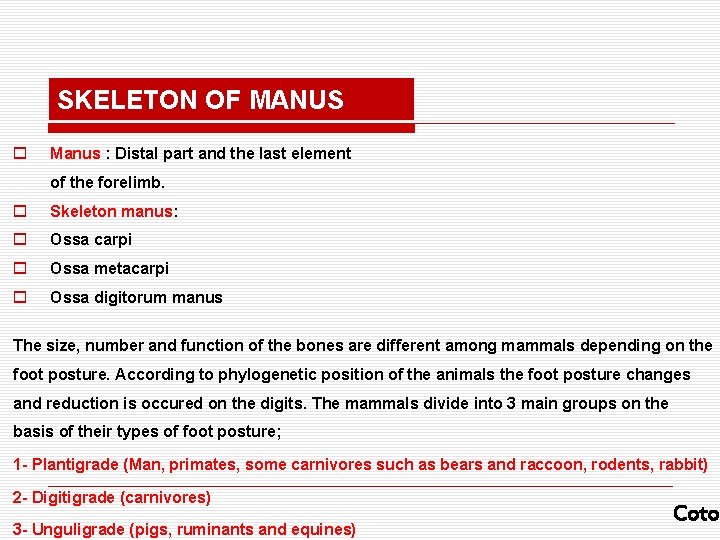
SKELETON OF MANUS o Manus : Distal part and the last element of the forelimb. o Skeleton manus: o Ossa carpi o Ossa metacarpi o Ossa digitorum manus The size, number and function of the bones are different among mammals depending on the foot posture. According to phylogenetic position of the animals the foot posture changes and reduction is occured on the digits. The mammals divide into 3 main groups on the basis of their types of foot posture; 1 - Plantigrade (Man, primates, some carnivores such as bears and raccoon, rodents, rabbit) 2 - Digitigrade (carnivores) 3 - Unguligrade (pigs, ruminants and equines) Coto
SKELETON OF MANUS o Ossa carpi (wrist bones) o Ossa metacarpi (instep) o Ossa digitorum manus (phalanges) Coto

CARPUS-CARPAL BONES-OSSA CARPI o o Skeleton of te carpus is formed by the two rows of small rounded bones. Proximal row : Os carpi radiale – intermedium – ulnare – accessorium (scaphoid) (lunate) (triquetrum) (pisiform) o Distal row : Os carpale primum – (trapezium) secundum (trapezoid) – tertium – (capitate) quartum (hamate) Coto
The Wrist bone – Ossa carpi o The number of carpal bones varies between species due to the fusion between bones or absence of one or more bones Coto
The Wrist bone – Ossa carpi o The number of carpal bones varies between species due to the fusion between bones or absence of one or more bones o The pig has the generalized pattern of eight bones Coto
The Wrist bone – Ossa carpi o The number of carpal bones varies between species due to the fusion between bones or absence of one or more bones o The Carnivores have 7 carpal bones due to fusion of the radil and intermediate carpal bones at the proximal row. (os carpi intermedioradiale) Coto
The Wrist bone – Ossa carpi o The number of carpal bones varies between species due to the fusion between bones or absence of one or more bones o The equine has also 7 carpal bones. The missing bone is the first carpal bones of distal row. Coto
The Wrist bone – Ossa carpi o The number of carpal bones varies between species due to the fusion between bones or absence of one or more bones o The ruminants have 6 carpal bones because of the 1 st carpal bone is absent and 2 nd and 3 rd bones are fused at the distal row. Coto
The Wrist bones-Ossa carpi o The shape and position ; Coto
OSSA METACARPI o Metacarpus consists of five bones between carpus and digits, numbered 1 -5 from medial to lateral o Os metacarpalia I – III – IV – V Coto
OSSA METACARPI o The carnivors have the generalized pattern of five bones. The 1 st bone is reduced and bears no weight (The 1 st digit doesn’t touch the ground) Coto
OSSA METACARPI o The pig has four bones in metacarpus. The 1 st bone is missing, 2 nd and 5 tf are greatly reduced and dont bear the weight. Coto
OSSA METACARPI o The ruminants have two metacarpal bones. The 1 st and 2 nd bones are missing. The 3 rd and 4 th are fused (the large metacarpal bone – cannon bone). The 5 th is reduced and unfunctional (the small metacarpal bone). Anatomy; o Basis -Tuberositas ossis metacarpalia III o Body -Sulcus longitudinalis dorsalis (Ru) -Sulcus longitudinalis palmaris (Ru) -Canalis metacarpi proximalis (Ru) -Canalis metacarpi distalis (Ru) o Caput -Verticillus -inc. intercapitalis Coto
OSSA METACARPI o The horses have 3 metacarpal bones totally. The 1 st and 5 th bones are absent. The 2 nd and 4 th bones (splint bones) are greatly reduced. The large 3 rd bone (the cannon bone) is the only metacarpal to articulate with the digit and bears the all weight Coto

DIGITS and DIGITAL BONES o Digits: The term of the digit correspond to finger and toes of man. There are 5 digits in the generalized digital pattern numbered 1 -5 from medial to lateral. It generally consists of 3 phalanges. o The shape, size and numbers of the digits and phalanges different among mammals. o Phalanx proximalis o Phalanx media o Phalanx distalis Coto
Digits in Carnivore o They have four main weight bearing digits and a dew claw (1 st digit) o Phalanx proximalis o Phalanx media o Phalanx distalis - Extensor process - Flexor process - Ungual process: is a tapered, cone shaped process covered by horny claw - Horny claw: corresponds to finger nail and covers the ungula process Coto
Digits in Pig o They have four digits. The 1 st is missing. The 3 rd and 4 th are fully developed bearing weight digits. The 2 nd and 5 th are reduced and don’t bear weight. o Phalanx proximalis o Phalanx media o Phalanx distalis Coto
Digits in Ruminant o They have four digits. The 3 rd and 4 th are fully developed bearing weight digits. The 2 nd and 5 th are not palpable. There are vestiges and locate behind the fetlock o Phalanx proximalis o Phalanx media o Phalanx distalis Coto
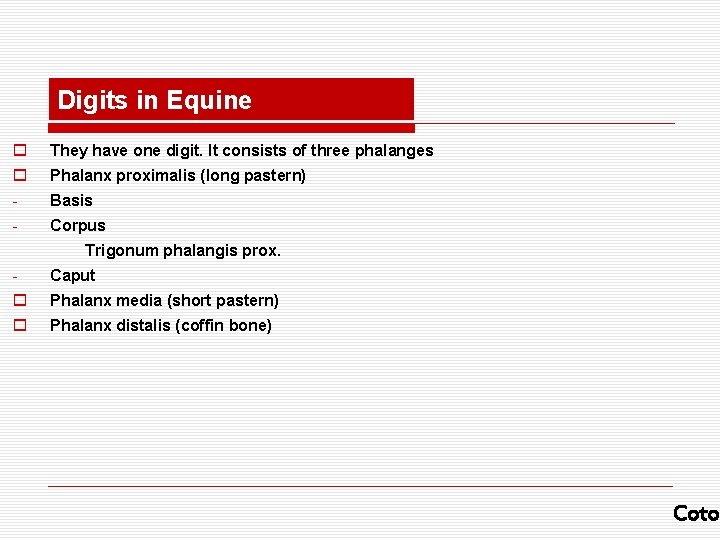
Digits in Equine o They have one digit. It consists of three phalanges o Phalanx proximalis (long pastern) - Basis - Corpus Trigonum phalangis prox. - Caput o Phalanx media (short pastern) o Phalanx distalis (coffin bone) Coto
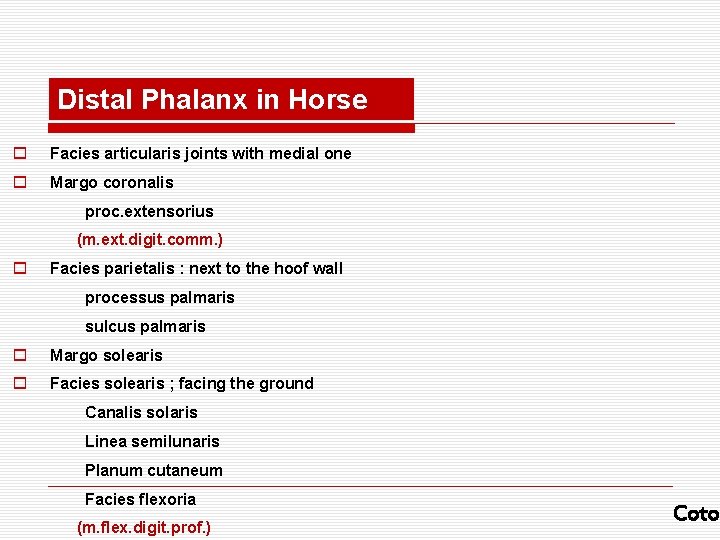
Distal Phalanx in Horse o Facies articularis joints with medial one o Margo coronalis proc. extensorius (m. ext. digit. comm. ) o Facies parietalis : next to the hoof wall processus palmaris sulcus palmaris o Margo solearis o Facies solearis ; facing the ground Canalis solaris Linea semilunaris Planum cutaneum Facies flexoria (m. flex. digit. prof. ) Coto
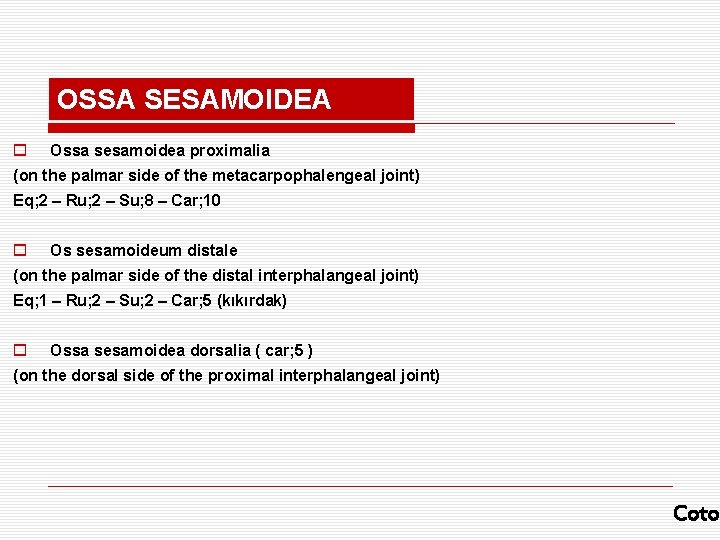
OSSA SESAMOIDEA o Ossa sesamoidea proximalia (on the palmar side of the metacarpophalengeal joint) Eq; 2 – Ru; 2 – Su; 8 – Car; 10 o Os sesamoideum distale (on the palmar side of the distal interphalangeal joint) Eq; 1 – Ru; 2 – Su; 2 – Car; 5 (kıkırdak) o Ossa sesamoidea dorsalia ( car; 5 ) (on the dorsal side of the proximal interphalangeal joint) Coto
OSSA SESAMOIDEA o Ossa sesamoidea proximalia (on the palmar side of the metacarpophalengeal joint) Eq; 2 – Ru; 2 – Su; 8 – Car; 10 o Os sesamoideum distale (on the palmar side of the distal interphalangeal joint) Eq; 1 – Ru; 2 – Su; 2 – Car; 5 (kıkırdak) o Ossa sesamoidea dorsalia ( car; 5 ) (on the dorsal side of the proximal interphalangeal joint) Coto
- Slides: 39