
Osmosis and Terminology Ion and Osmotic Balance Across
Osmosis and Terminology Ion and Osmotic Balance Across Aquatic Habitats and Animal Groups 2/19 and 2/25/08
Osmosis Defined o. Movement of some solvent across a selectively permeable membrane n usually refers to the movement of water o cause most solutes can’t pass through the membrane n across a cell membrane n down a concentration gradient (for solvent) 2
Terminology o Isosmotic n Equal osmolarity n But may still result in a change in cell volume n Due to differences in the electrochemical gradient n Or membrane permeability to particular solutes o Isotonic n Reference is cell response n Solution that does not cause shrinking or swelling 3
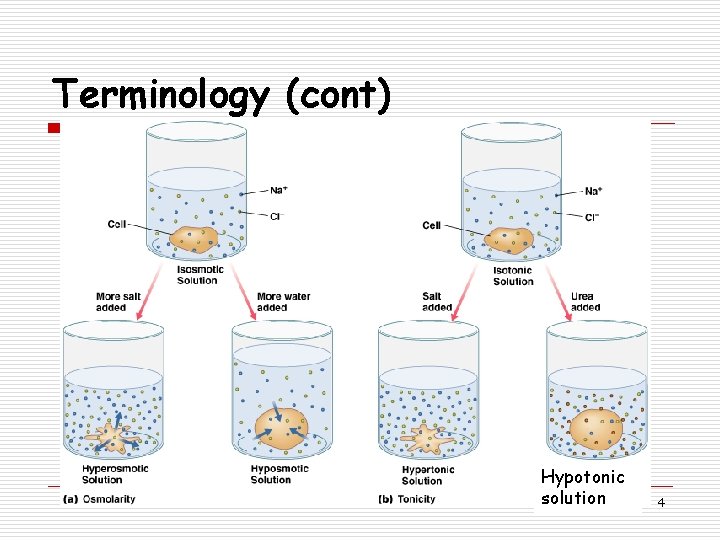
Terminology (cont) Hypotonic solution 4
Overview o Osmoregulation: solute and H 20 balance o Animals use different combinations of tissues to control ion and water balance o Representatives of most animal phyla live in direct association with water n Greater pressure for water/salt exchange than terrestrial habitats o Point: Animals cope with the ionic concentration of the external environment using different mechanisms 5
Obligatory Exchanges o Is there a gradient between the extracellular compartment and the external environment? n Greater the gradient, greater tendency for NET DIFFUSION o Surface-to-volume ratio, higher for smaller animals n Larger surface area = greater exchange n Evaporative water loss, ion exchange, etc. 6
Obligatory Exchanges (2) o Permeability of the integument or portions of the integument, esp. respiratory surfaces n Covering external surfaces with hydrophobic molecules, e. g. mucous, keratin, chitin n More aquaporin proteins increase water permeability 7
Obligatory Exchanges (3) o Feeding n Gain water and solutes from food n In marine enviro. salt gain is a problem n Will have special means for excreting excess salt o Metabolic factors n End products of metabolism that cannot be used must be eliminated (nitrogenous waste) and this requires WATER! 8
Ionic and Osmotic Regulation o Strategies n Ionoconformer o exert little control over the solute profile within the extracellular space; exclusively marine n Ionoregulator o control the ion profile of the extracellular space n Osmoconformer o internal and external osmolarity are similar; marine invertebrates n Osmoregulator o osmolarity is constant regardless of the external environment 9
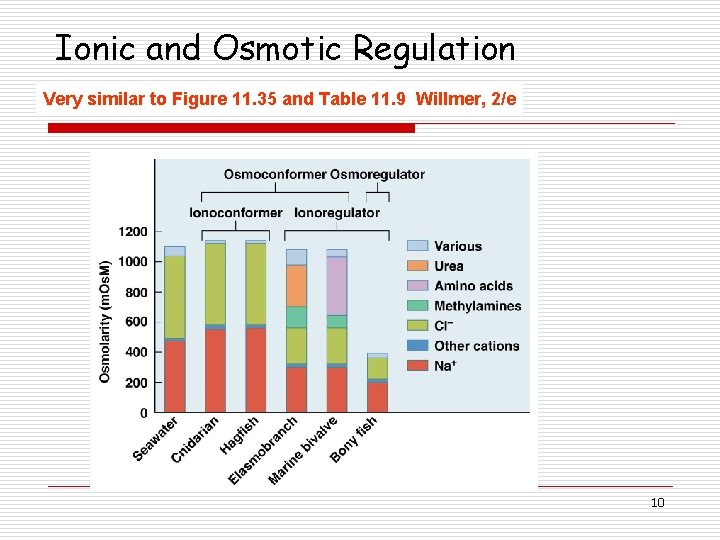
Ionic and Osmotic Regulation Very similar to Figure 11. 35 and Table 11. 9 Willmer, 2/e 10
Ionic and Osmotic Regulation (Cont. ) o Ability to cope with changes in external osmolarity n Stenohaline – tolerate a narrow range o Generally conformers n Euryhaline – tolerate a wide range o Generally regulators 11
Marine Invertebrates o Marine inverts: internal osmotic concentration similar to seawater n Tend to be osmoconformers n Exception is arthropods! o May regulate solute COMPOSITION to differ from their enviro, requires extensive regulation (= energy) n Echinoderms – no significant regulation n Jellyfish – regulate select ions o Lg size, active cells on outer surface n Crustaceans – variable, but regulate ions o See Tables 11. 3 and 11. 4 in Willmer, 2/e 12
Marine Invertebrates o Osmoregulation accomplished via: n impermeable body surface n thin surface membrane of the gills (rapid exchange) o Salt gained via: n INCOMPLETELY impermeable body surface n thin surface membrane of the gills n food and seawater (both containing some solutes) 13
Invasion of Other Habitats o Marine inverts, both conformers and regulators, can inhabit brackish water n Oysters – tolerate dilution, even before closing shell n Various crabs (again) – fairly successful regulators, although extremes may be too much o No FW Echinoderms or Cephalopods 14
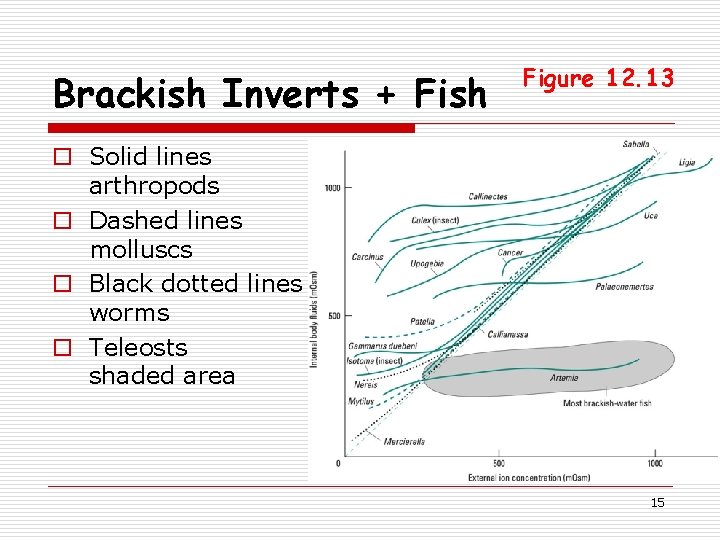
Brackish Inverts + Fish Figure 12. 13 o Solid lines arthropods o Dashed lines molluscs o Black dotted lines worms o Teleosts shaded area 15
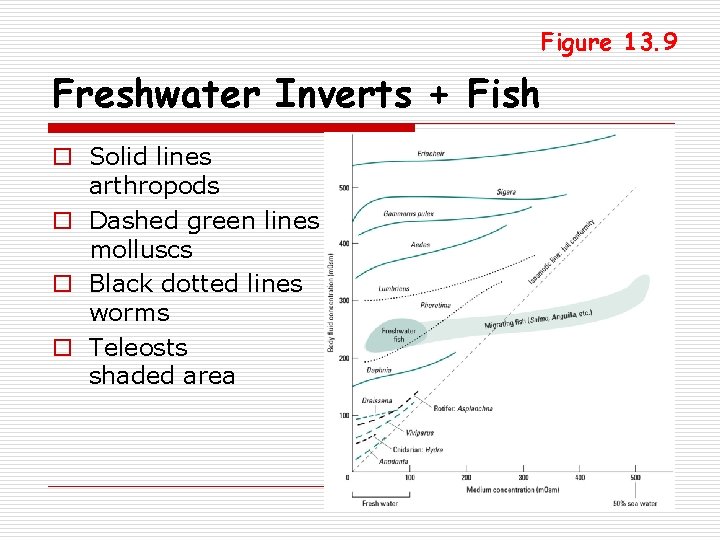
Figure 13. 9 Freshwater Inverts + Fish o Solid lines arthropods o Dashed green lines molluscs o Black dotted lines worms o Teleosts shaded area 16
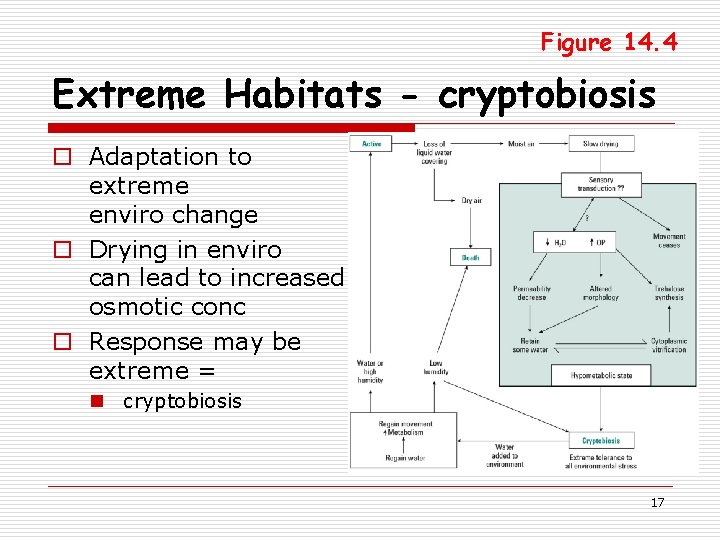
Figure 14. 4 Extreme Habitats - cryptobiosis o Adaptation to extreme enviro change o Drying in enviro can lead to increased osmotic conc o Response may be extreme = n cryptobiosis 17
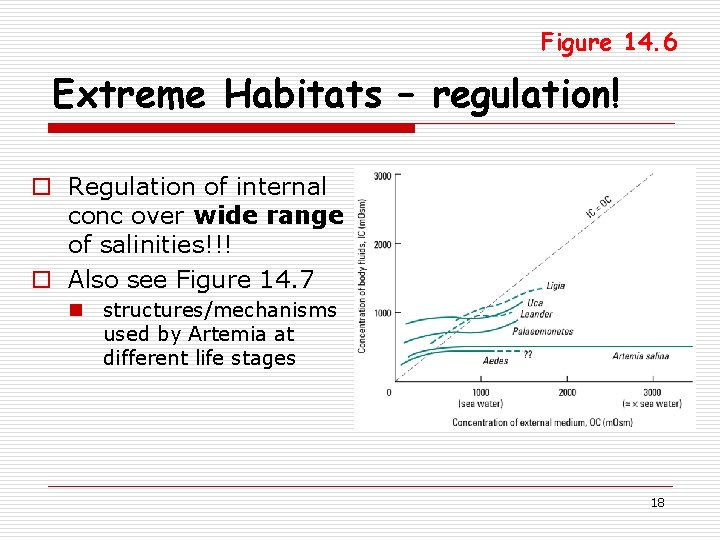
Figure 14. 6 Extreme Habitats – regulation! o Regulation of internal conc over wide range of salinities!!! o Also see Figure 14. 7 n structures/mechanisms used by Artemia at different life stages 18
Marine bony fishes o Marine bony fishes n Few same or slightly above the conc. of the external medium (hagfish), most about 1/3 the conc. of seawater o General Osmotic Tendencies n Osmotic efflux of water n Influx of ions 19
Marine bony fishes (2) o Active secretion of monovalent ions at the gills o Produce small amount of urine isosmotic to the blood n but high in Mg++ and SO 4= o Drink water o Compare/contrast w/ freshwater bony fish, see summary handout of vertebrates (slide 15) n Osmotic issues are loss of ions/salts and water gain! 20
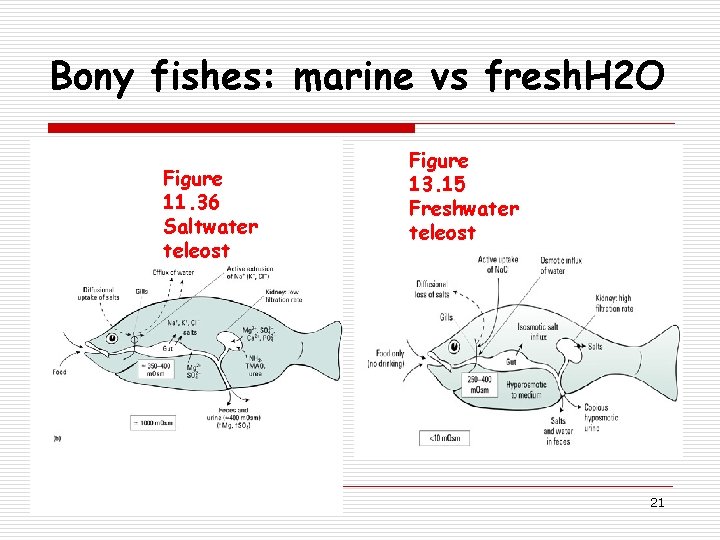
Bony fishes: marine vs fresh. H 2 O Figure 11. 36 Saltwater teleost Figure 13. 15 Freshwater teleost 21
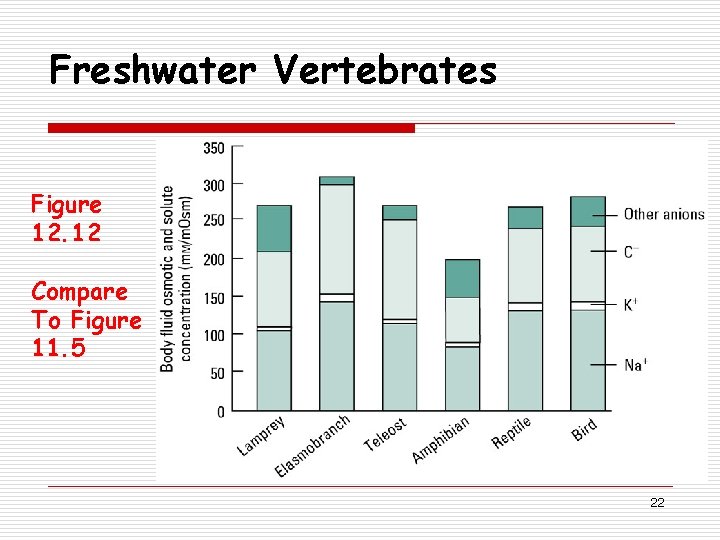
Freshwater Vertebrates Figure 12. 12 Compare To Figure 11. 5 22
Marine Vertebrates -elasmobranchs/chondrichthyes o Sharks and rays almost exclusively marine o Solve problem of water efflux by being slightly hyperosmotic (to the environment) o However, salt conc. about 1/3 that of SW o High osmolarity from organic compounds in a ratio of 2 urea: 1 TMAO n Urea is an end-product of protein metabolism and is known to destabilize many proteins (= ENZYMES)!! n TMAO has an inhibitory effect on the action of the urea 23
Marine Vertebrates -elasmobranchs/chondrichthyes v(2) o Hyperosmotic internal environment solves problem of water efflux n actually slight influx via gills! n No need to drink SW (w/ additional salt load) o But salt conc. about 1/3 that of SW means that there is still an ion regulation issue o Solutions includen Excretion of salts in urine n Excretion of Na+ and Cl- (hyperosmotic to SW) via the rectal gland 24
Marine Vertebrates -birds and reptiles o Salt glands o May eliminate excess salt load by using an extrarenal salt gland o Salt gland produces a highly concentrated solution of salt n Seawater = 470 mmol Na+ /L n Seabird salt gland excretion = 600 -1100 mmol Na+ /L o Also produce uric acid n Combines with ions n Precipitates from solution (H 2 O) conservation 25
Marine Vertebrates -mammals o Marine mammals have a HIGHLY EFFICIENT KIDNEY that can produce urine more conc. than SW o Some pinnipeds can live without drinking water on a diet of fish n Remember that marine fish are NOT as conc. as SW or MARINE INVERTS!! 26
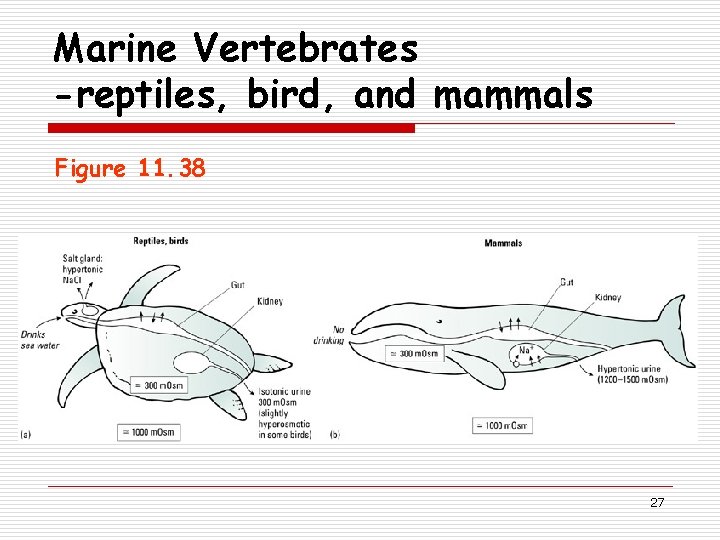
Marine Vertebrates -reptiles, bird, and mammals Figure 11. 38 27
Moist Skinned Animals o Back to regulatory issues, these animals will have less control over water loss than others n Worms, various phyla n Gastropod molluscs, esp. slugs n Amphibians (only vertebrates here) o Evaporation rates are 1 -2 orders of magnitude higher than other animals (Table 8. 8 and Fig 8. 12 in Schmidt-Nielsen, 5 th Ed) 28
Moist Skinned Animals (2) o Solutions to minimize water loss include n n Live near water Humid habitats, soil or mud Active at night (lower evaporation rate) Active during or immediate following precipitation 29
Less Permeable Terrestrial Animals o These animals will have more control over water loss than moist skinned animals n Arthropods o exoskeleton and cuticle n Most higher vertebrates, except amphibians o epidermis, hair, scales, feathers 30
Additional Information from Text o Willmer (2/e) n Table 5. 1, extracellular fluid concentration of various animals n Figure 5. 2, responses to changing environmental concentrations n Table 5. 2, tolerance to water loss n Table 5. 3, permeability across various surfaces n Figure 5. 6, chloride cells of fish 31
- Slides: 31