
OSHA Regulations in the Laboratory 29 CFR 1910
OSHA Regulations in the Laboratory (29 CFR 1910. 1450) WHAT YOU NEED TO KNOW
OSHA Laboratory Standard summary Overview of this Session Key points to be aware of from the Chemical Hygiene Plan & Right to Know Laws (Science Department / Administrator / School District Official) Best practices in the laboratory Common concerns ( labelling / storage / disposal / safety training ) & OSHA Checklist
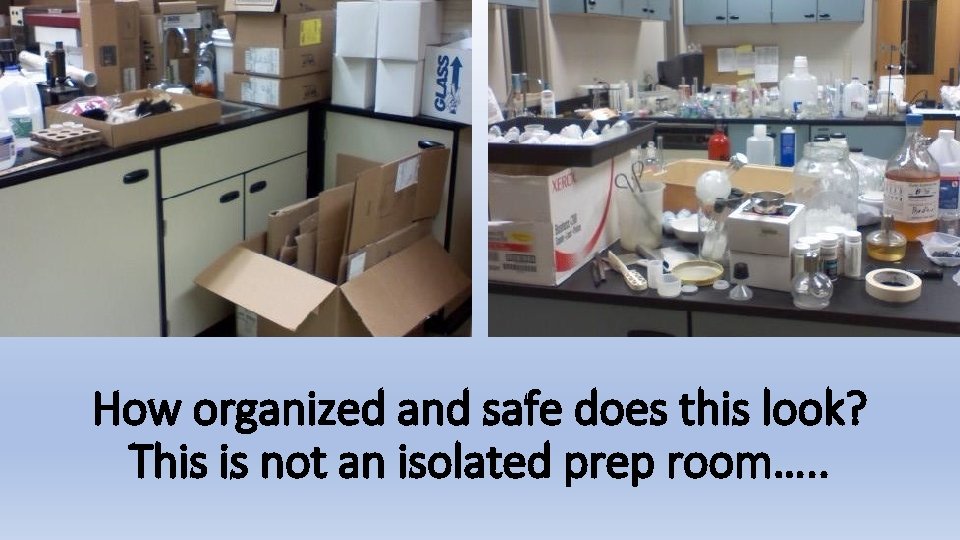
How organized and safe does this look? This is not an isolated prep room…. .
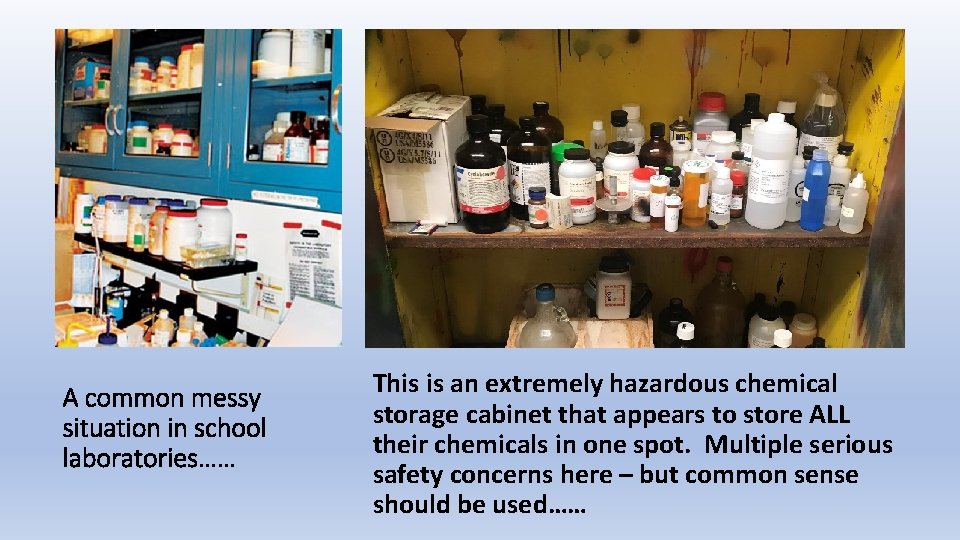
A common messy situation in school laboratories…… This is an extremely hazardous chemical storage cabinet that appears to store ALL their chemicals in one spot. Multiple serious safety concerns here – but common sense should be used……
OSHA Laboratory Standard (29 CFR 1910. 1450) Laboratory Safety: OSHA Laboratory Standard OSHA’s Occupational Exposure to Hazardous Chemicals in Laboratories standard (29 CFR 1910. 1450), referred to as the Laboratory standard, covers laboratories where chemical manipulation generally involves small amounts of a limited variety of chemicals. This standard applies to all hazardous chemicals meeting the definition of “laboratory use” and having the potential for worker exposure. This means school laboratories and prep rooms.

OSHA Lab Standard Fact Sheet https: //www. osha. gov/Publications/laboratory/OSHAfactsheet-laboratory-safety-osha-lab-standard. pdf
Key Pieces of the Laboratory Standard to know: You must have a CHP (Chemical Hygiene Plan) in place for your school that covers all aspects of the Laboratory Standard. This is a legal document that outlines the procedures in the laboratory area with emphasis on the following: • General laboratory rules and procedures • Personal protective equipment requirements • Accidental Spill and accident prevention procedures • Chemical storage rules and procedures • Safety equipment requirements and inspection procedures • Employee safety training • Exposure and medical evaluations • Emergency evacuation plan • Access to Information on SDS’s Labelling Requirements for chemicals under HAZCOM & OSHA RTK Laws All of these aspects of the CHP occur with the understanding that we are to minimize risk by using the proper PPE, following established safety protocols, utilizing functional safety equipment (fume hoods, eye wash stations etc. ) and choosing to use the safest/ lowest concentration chemicals). For this to be effective it also requires more than just procedures…. .

Key Pieces of the Laboratory Standard to know (2) You must have functional PPE, engineering controls, preventative measures and fire safety equipment, in place for your school. 1. PPE (Goggles/Gloves/Face Shield/Hearing Protection/Respirator) 2. Engineering Controls (Fume Hood/Eyewash/Drench Shower/Chemical Safety Cabinets/Chemical Spill Kit/ 3. Fire Safety (Extinguisher/Fire Blanket/Detector/Fire Alarm/Evacuation Procedure Signage) 4. Employee Training – Are your teachers trained in safety procedures?
Chemical Hygiene Plan In May of 1990, the federal government passed an extension of the Hazard Communication Act written specifically for the research and academic laboratory. Most states also passed a version of the Laboratory Standard. Enforcement of the new Laboratory Standard began in January of 1991. The Laboratory Standard is very similar in many ways to the original law. The major difference is the requirement to have a Chemical Hygiene Plan and a Chemical Hygiene Officer. A Chemical Hygiene Plan (CHP) is a written report summarizing all your safety regulations, proper laboratory procedures for handling hazardous chemicals, and training procedures. It is a dynamic document that is reviewed at least annually and revisions made as necessary.
Chemical Hygiene Plan Includes: • General laboratory rules and procedures • Personal protective equipment requirements • Accidental Spill and accident prevention procedures • Chemical storage rules and procedures • Safety equipment requirements and inspection procedures • Employee safety training • Exposure and medical evaluations • Emergency evacuation plan • Designation of a Chemical Hygiene Officer
This Photo by Unknown Author is licensed under CC BY Chemical Hygiene Plan Summary The CHP is a manual that describes your laboratory regulations, proper lab procedures, and how to respond to emergency situations. The listing of rules and procedures are your Standard Operating Procedures. These rules and procedures must be well thought out with the principal goal of always minimizing the exposure of employees and students to hazardous chemicals.
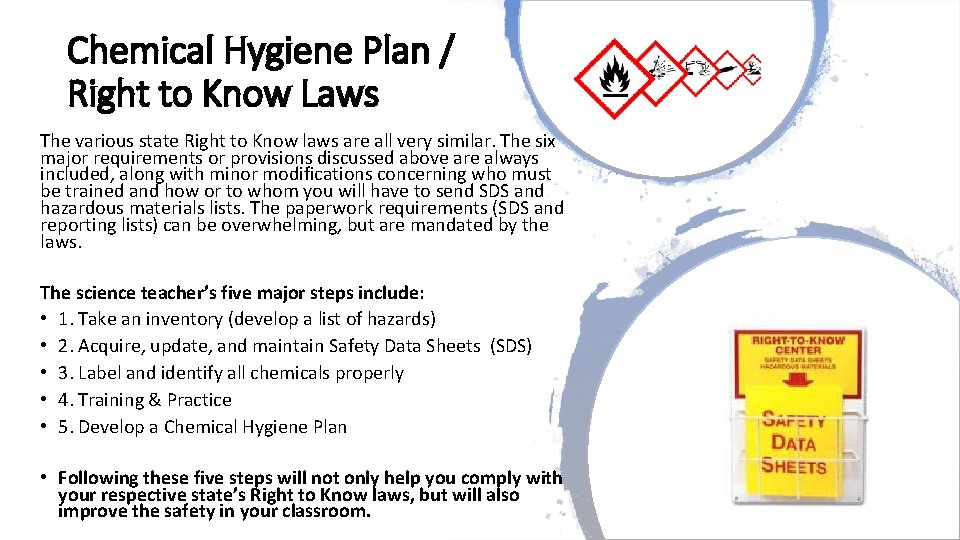
Chemical Hygiene Plan / Right to Know Laws The various state Right to Know laws are all very similar. The six major requirements or provisions discussed above are always included, along with minor modifications concerning who must be trained and how or to whom you will have to send SDS and hazardous materials lists. The paperwork requirements (SDS and reporting lists) can be overwhelming, but are mandated by the laws. The science teacher’s five major steps include: • 1. Take an inventory (develop a list of hazards) • 2. Acquire, update, and maintain Safety Data Sheets (SDS) • 3. Label and identify all chemicals properly • 4. Training & Practice • 5. Develop a Chemical Hygiene Plan • Following these five steps will not only help you comply with your respective state’s Right to Know laws, but will also improve the safety in your classroom.
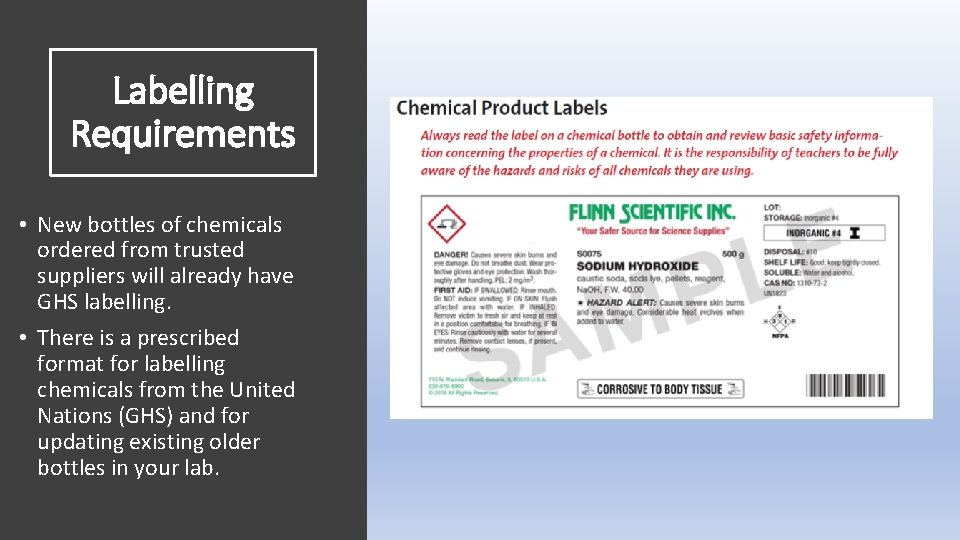
Labelling Requirements • New bottles of chemicals ordered from trusted suppliers will already have GHS labelling. • There is a prescribed format for labelling chemicals from the United Nations (GHS) and for updating existing older bottles in your lab.
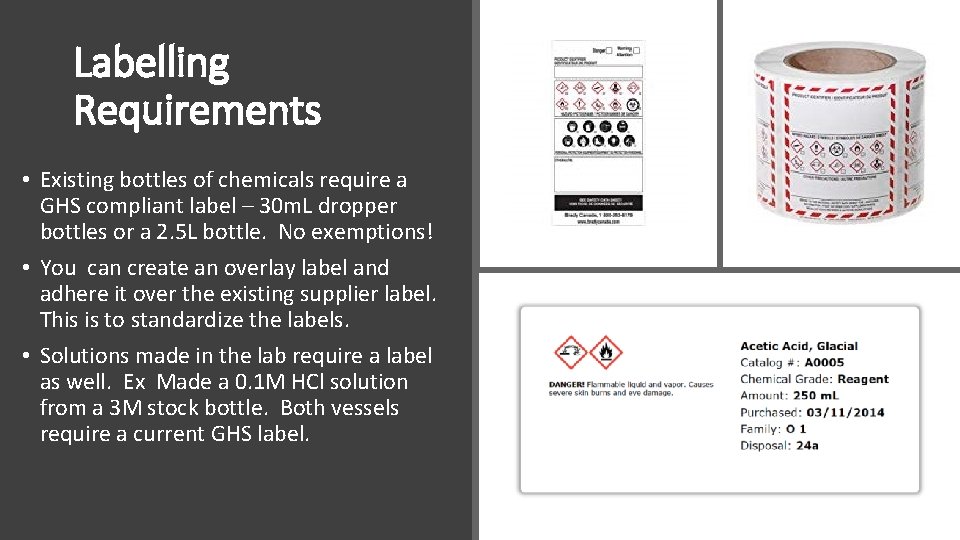
Labelling Requirements • Existing bottles of chemicals require a GHS compliant label – 30 m. L dropper bottles or a 2. 5 L bottle. No exemptions! • You can create an overlay label and adhere it over the existing supplier label. This is to standardize the labels. • Solutions made in the lab require a label as well. Ex Made a 0. 1 M HCl solution from a 3 M stock bottle. Both vessels require a current GHS label.
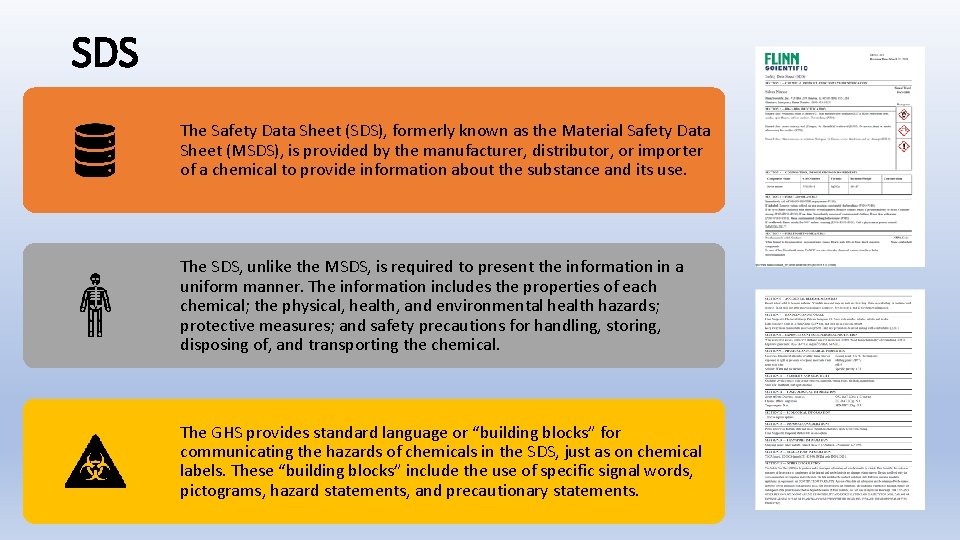
SDS The Safety Data Sheet (SDS), formerly known as the Material Safety Data Sheet (MSDS), is provided by the manufacturer, distributor, or importer of a chemical to provide information about the substance and its use. The SDS, unlike the MSDS, is required to present the information in a uniform manner. The information includes the properties of each chemical; the physical, health, and environmental health hazards; protective measures; and safety precautions for handling, storing, disposing of, and transporting the chemical. The GHS provides standard language or “building blocks” for communicating the hazards of chemicals in the SDS, just as on chemical labels. These “building blocks” include the use of specific signal words, pictograms, hazard statements, and precautionary statements.
What is GHS? Developed by the United nations, GHS: (Global Harmonized System) • Defines and classifies the hazards of chemical products • Provides health and safety information on labels and Safety Data Sheets (SDS’s) Goal of GHS: • That the same set of rules for classifying hazardous products; the same format and content for labels and SDS’s, will be adopted and used around the world
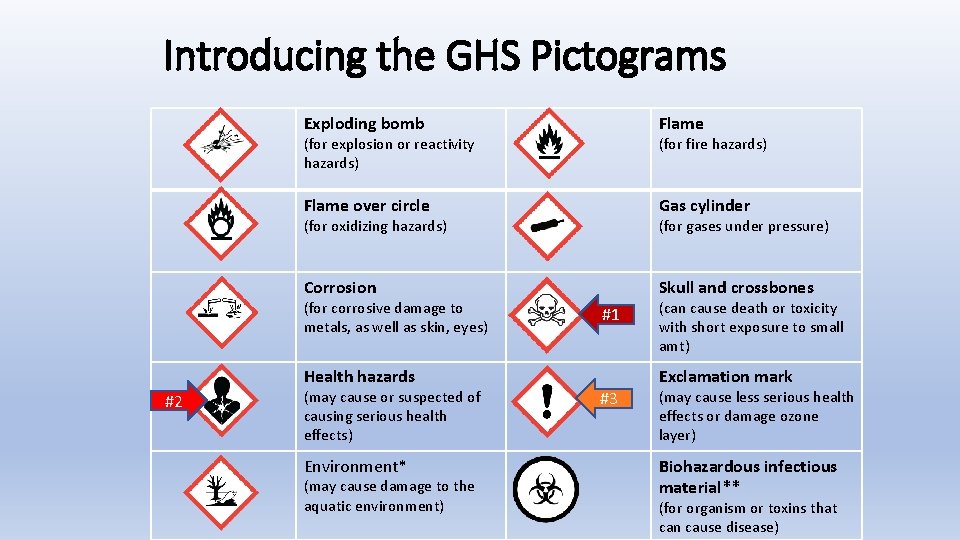
Introducing the GHS Pictograms Exploding bomb Flame over circle Gas cylinder Corrosion Skull and crossbones (for explosion or reactivity hazards) (for fire hazards) (for oxidizing hazards) (for corrosive damage to metals, as well as skin, eyes) (for gases under pressure) #1 Health hazards #2 (may cause or suspected of causing serious health effects) Environment* (may cause damage to the aquatic environment) (can cause death or toxicity with short exposure to small amt) Exclamation mark #3 (may cause less serious health effects or damage ozone layer) Biohazardous infectious material** (for organism or toxins that can cause disease)
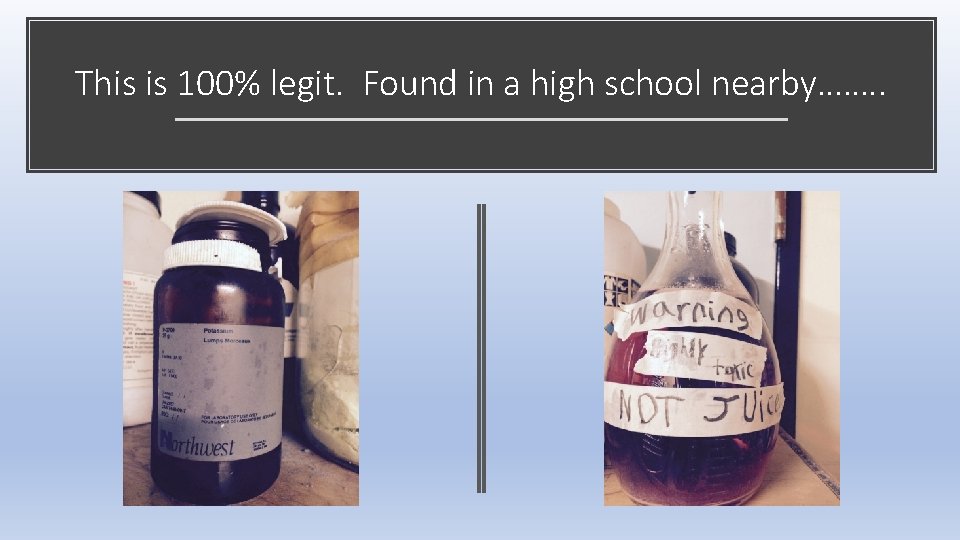
This is 100% legit. Found in a high school nearby……. .
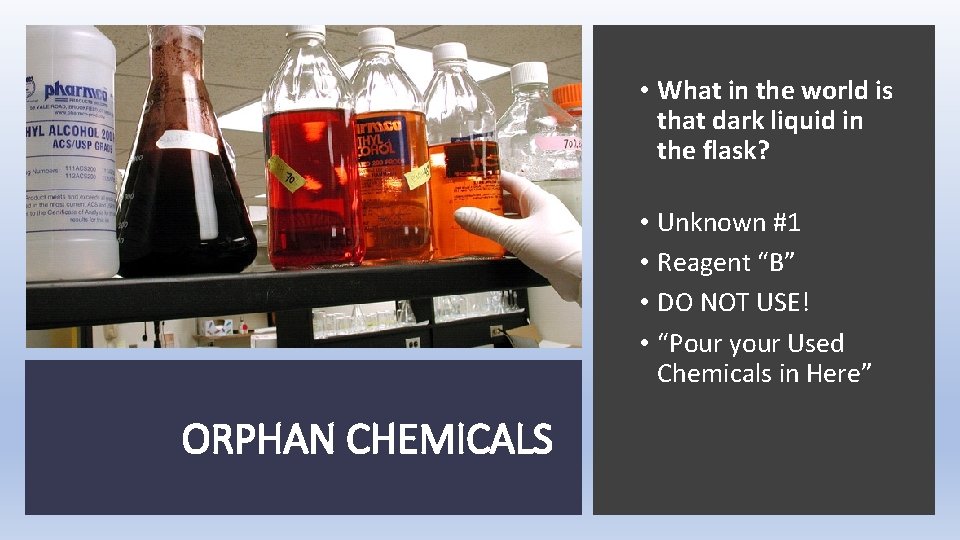
• What in the world is that dark liquid in the flask? • Unknown #1 • Reagent “B” • DO NOT USE! • “Pour your Used Chemicals in Here” ORPHAN CHEMICALS
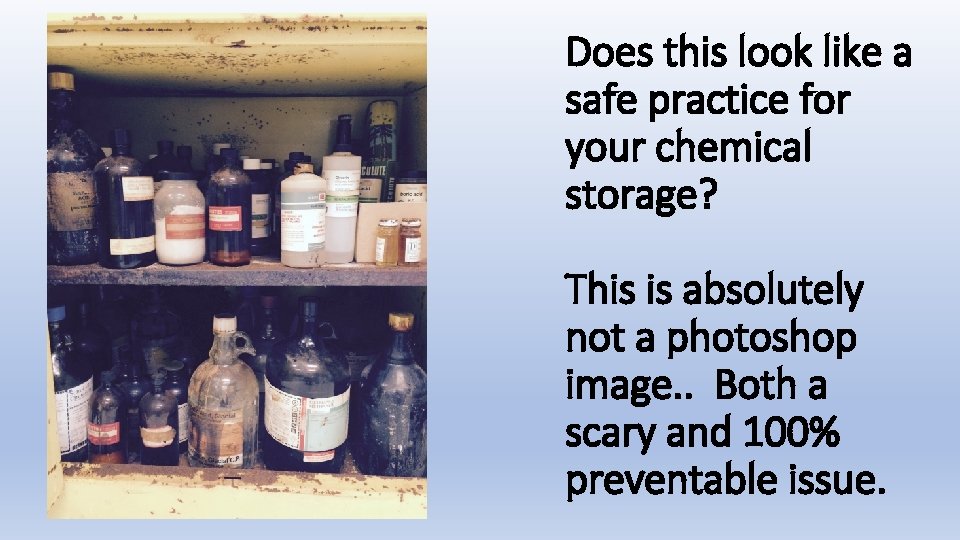
Does this look like a safe practice for your chemical storage? This is absolutely not a photoshop image. . Both a scary and 100% preventable issue.
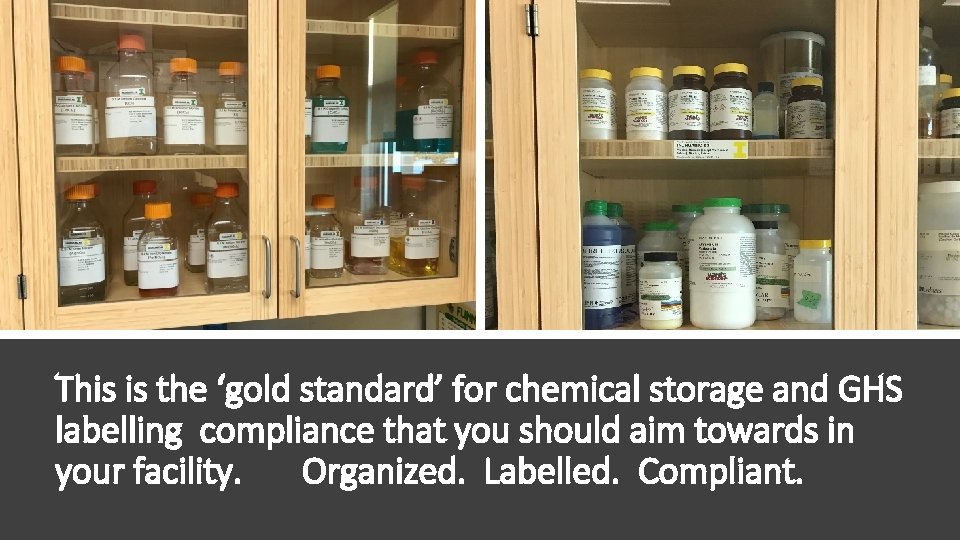
This is the ‘gold standard’ for chemical storage and GHS labelling compliance that you should aim towards in your facility. Organized. Labelled. Compliant.
How to deal with labelling older chemicals in the school prep area / storage cabinets • Image of old chemical with new ‘Workplace’ label overlay…. • You must have a current chemical inventory of the products in your lab. • You need to have a GHS label on EVERY Chemical in the lab including dropper bottles and student learning kits. There is no exemption for small bottles – even dropper bottles should have a proper label.
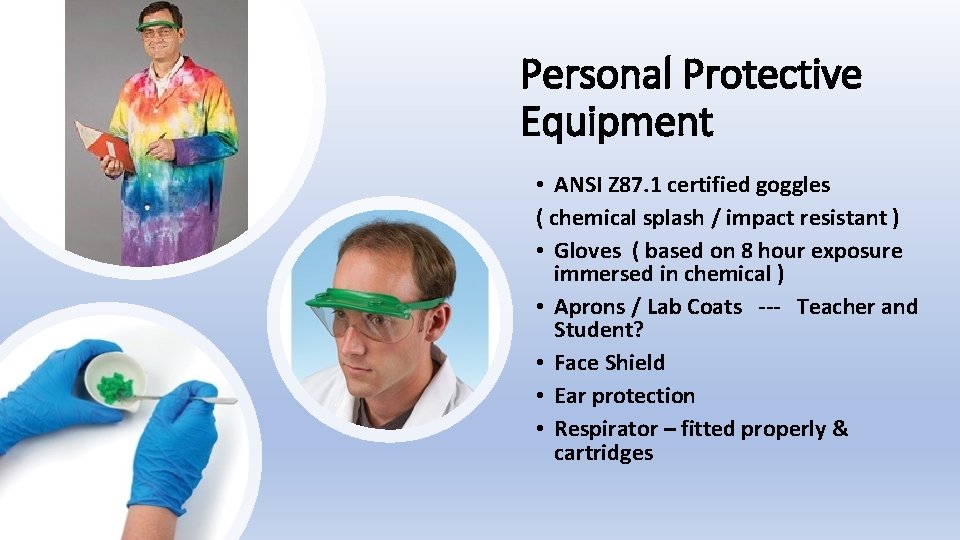
Personal Protective Equipment • ANSI Z 87. 1 certified goggles ( chemical splash / impact resistant ) • Gloves ( based on 8 hour exposure immersed in chemical ) • Aprons / Lab Coats --- Teacher and Student? • Face Shield • Ear protection • Respirator – fitted properly & cartridges
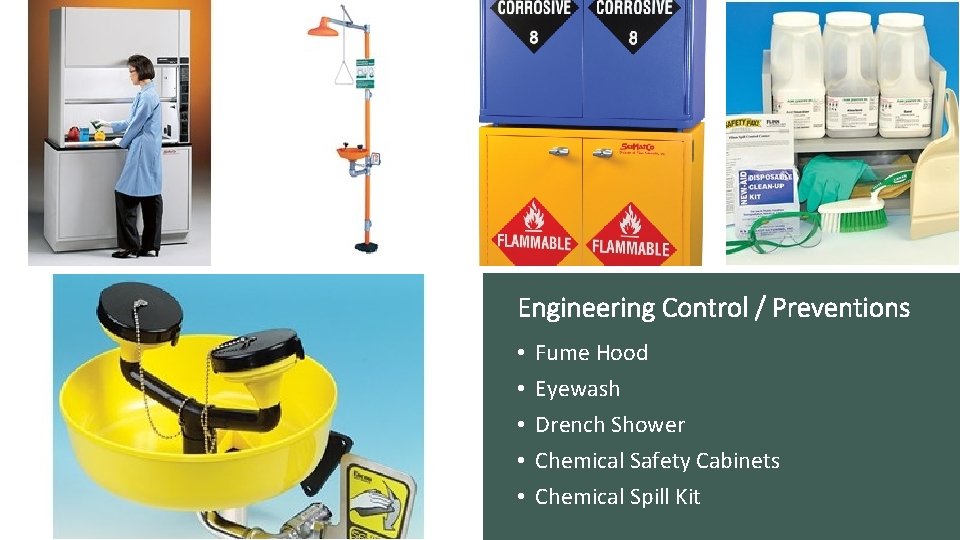
Engineering Control / Preventions • • • Fume Hood Eyewash Drench Shower Chemical Safety Cabinets Chemical Spill Kit
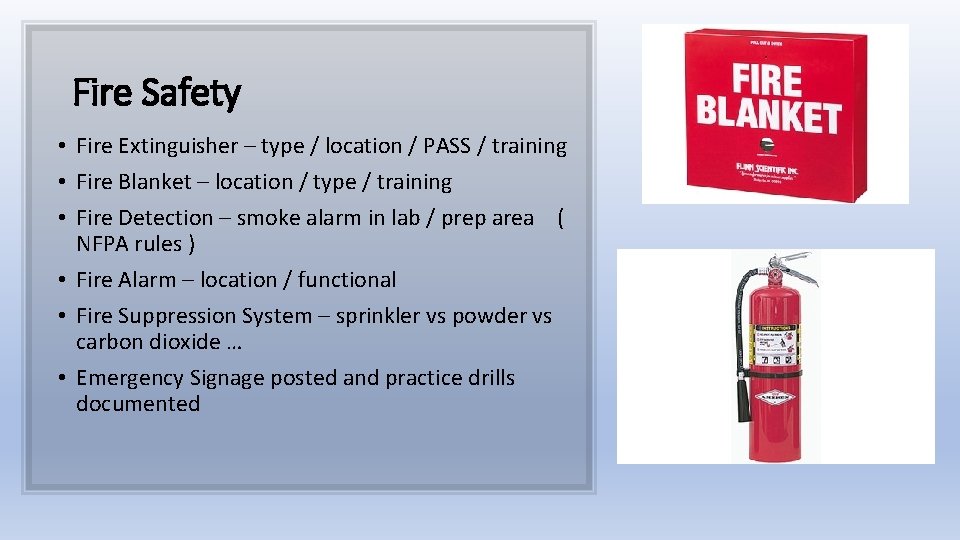
Fire Safety • Fire Extinguisher – type / location / PASS / training • Fire Blanket – location / type / training • Fire Detection – smoke alarm in lab / prep area ( NFPA rules ) • Fire Alarm – location / functional • Fire Suppression System – sprinkler vs powder vs carbon dioxide … • Emergency Signage posted and practice drills documented
Employee Training Program • Have the teachers been trained in the following areas? 1. Chemical labelling (GHS ) and SDS management 2. Chemical storage ( compatibility issues / space / location. . ) 3. Chemical handling & dispensing techniques ( solution dilution ) 4. Chemical disposal process and storage of hazardous wastes 5. Chemical spills ( acid / base / solvent ) 6. Fire / Flood / Broken Glass / Accidental Injury / 7. CHP Review and Updating annually – including administration 8. First Aid & Fire Extinguisher Use
Being consistent is critical to the on-going safety and success in the school science department. Best Practices in the Science Department 1. Current inventory of chemicals on-site and a manageable effective storage system 2. All chemicals labelled according to GHS 3. Organized lab areas – no clutter or leftover lab activities for weeks 4. Safety training and compliance for ALL employees
5. Always use (model) PPE when in the lab 5. Use of a Lab Safety Contract with students to reinforce behavior. 6. Follow procedures from the CHP / school district safety manual / DOE policy documents Best Practices Continued… 7. Ordering chemicals in smaller amounts in the lowest concentration possible to minimize storage and disposal
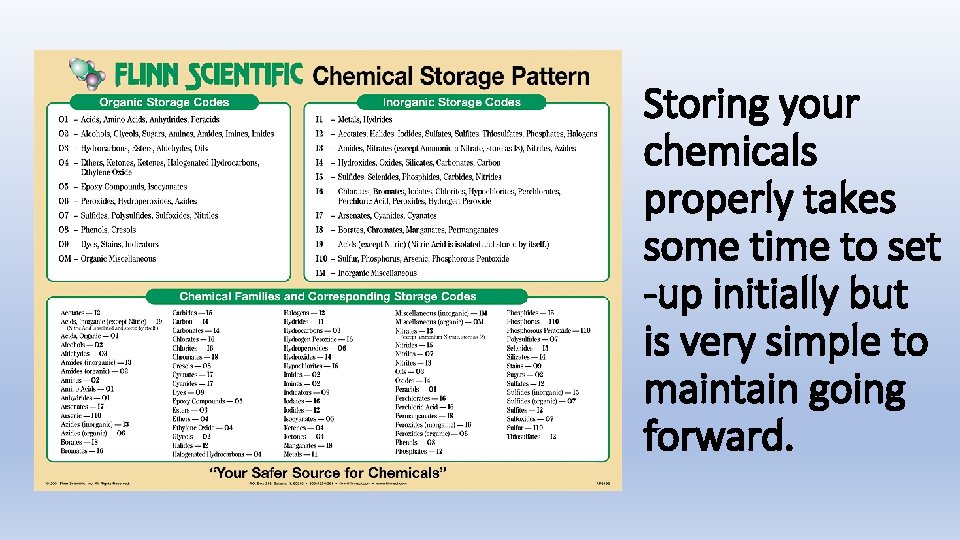
Storing your chemicals properly takes some time to set -up initially but is very simple to maintain going forward.
Common Concerns about OSHA Compliance • Do we have the ‘right’ chemical storage cabinets? • Do we have hazardous chemicals? ( risk exceeds value ) • Do we have an accurate inventory? • Do we have GHS labels on the chemicals? • Do we have a Chemical Hygiene Plan in place? How current? • Do we have a Chemical Hygiene Officer? Who is it? • Do we have the necessary PPE? ( Goggles / respirator / gloves etc. ) • Do we have a functional fume hood / eyewash / shower? • Do we have an ongoing safety training program for employees? • Do we have a Banned list of chemicals / activities that is communicated?
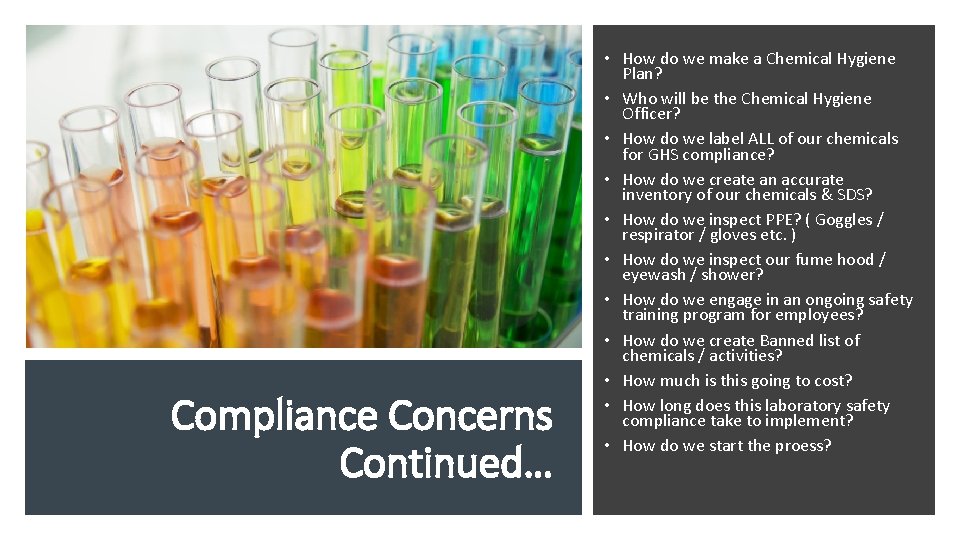
Compliance Concerns Continued… • How do we make a Chemical Hygiene Plan? • Who will be the Chemical Hygiene Officer? • How do we label ALL of our chemicals for GHS compliance? • How do we create an accurate inventory of our chemicals & SDS? • How do we inspect PPE? ( Goggles / respirator / gloves etc. ) • How do we inspect our fume hood / eyewash / shower? • How do we engage in an ongoing safety training program for employees? • How do we create Banned list of chemicals / activities? • How much is this going to cost? • How long does this laboratory safety compliance take to implement? • How do we start the proess?
OSHA Checklist for Compliance with the Laboratory Standard • https: //www. bnl. gov/physics/safety/documents/pdf/Lab. Standard. Che cklist. PDF • This is a great walk-through to identify your needs in the school. • Simple Yes/No format will allow for focus on areas of concern and forms a plan for continual improvement in the culture of safety in the school and across the school district.
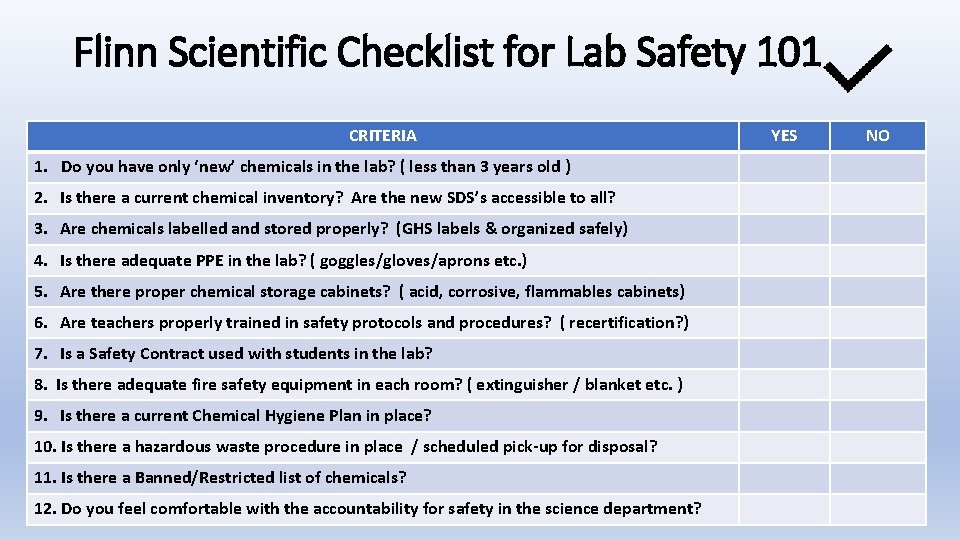
Flinn Scientific Checklist for Lab Safety 101 CRITERIA 1. Do you have only ‘new’ chemicals in the lab? ( less than 3 years old ) 2. Is there a current chemical inventory? Are the new SDS’s accessible to all? 3. Are chemicals labelled and stored properly? (GHS labels & organized safely) 4. Is there adequate PPE in the lab? ( goggles/gloves/aprons etc. ) 5. Are there proper chemical storage cabinets? ( acid, corrosive, flammables cabinets) 6. Are teachers properly trained in safety protocols and procedures? ( recertification? ) 7. Is a Safety Contract used with students in the lab? 8. Is there adequate fire safety equipment in each room? ( extinguisher / blanket etc. ) 9. Is there a current Chemical Hygiene Plan in place? 10. Is there a hazardous waste procedure in place / scheduled pick-up for disposal? 11. Is there a Banned/Restricted list of chemicals? 12. Do you feel comfortable with the accountability for safety in the science department? YES NO
Flinn Scientific has a CHP template that you can use. It is the most widely referenced CHP and will save you time in developing your own version as well as accelerate the culture of safety and awareness in your school.
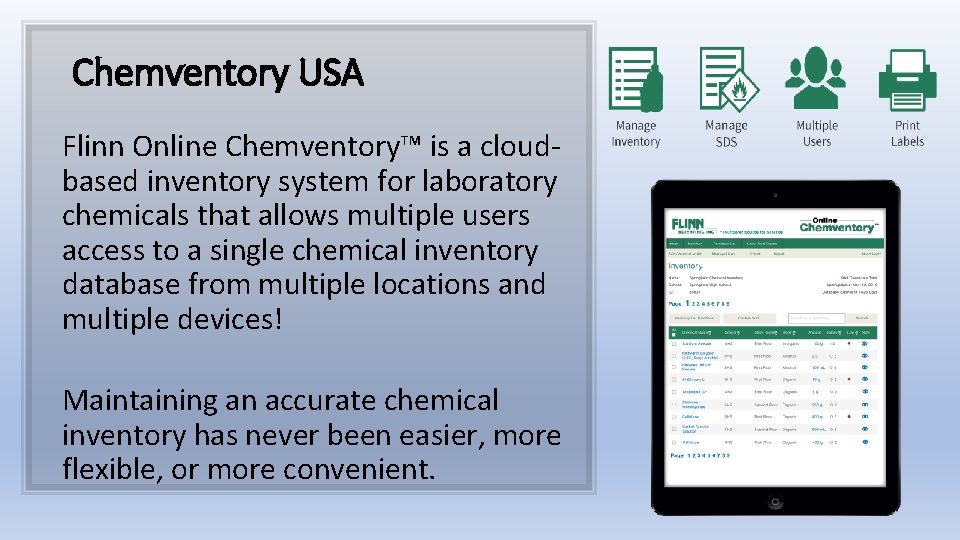
Chemventory USA Flinn Online Chemventory™ is a cloudbased inventory system for laboratory chemicals that allows multiple users access to a single chemical inventory database from multiple locations and multiple devices! Maintaining an accurate chemical inventory has never been easier, more flexible, or more convenient.
Flinn Certified Lab Safety Course (On-line) • You can participate in the Award-Winning Lab Safety Certification from Flinn ( On-Line and FREE ) • 8 hour modular course covering every topic in the science lab in a practical and direct way. • You must pass each unit before proceeding ( there are built-in evaluations to ensure knowledge transfer ) • Certificate of Completion provided and Recertification course available as well. High School and Middle School versions available. • https: //labsafety. flinnsci. com/app/
Resources to Help you: Contact Cameron Dummer for a complimentary Flinn Scientific Chemical Hygiene Plan (CHP) template to use to kick-start your culture of lab safety and awareness or a ‘Test-Drive’ of the Chemventory software that manages inventory, labels and SDS’s. The ‘Yellow Pages’ at the back of each Flinn catalog and Reference Manual are loaded with safety resources and are provided to each of your teachers and schools for FREE. We have also put these safety resources online for you to use as required. You can call us for technical support and a Flinn scientist / resident expert will help! cdummer@flinnsci. com 1 -630 -389 -5062 direct
References for your review • https: //www. osha. gov/Publications/laboratory/OSHAfactsheet-laboratory-safetyosha-lab-standard. pdf • https: //www. flinnsci. com/fire-safety-inspection/dc 10454/ • https: //www. flinnsci. com/api/library/Download/d 2 bdf 6 cbd 2194 bc 4 a 2808269 adffc 1 e 5 • https: //www. acs. org/content/acs/en/education/policies/safety. html • https: //www. bnl. gov/physics/safety/documents/pdf/Lab. Standard. Checklist. PDF • https: //labsafety. flinnsci. com/app/ • https: //www. flinnsci. com/api/library/Download/b 2038 e 119 fca 4 b 39 aae 7 a 0 d 1 f 092 a 9 e 0 • https: //www. flinnsci. com/resources/safety-reference/
- Slides: 38