
OSHA RECORDKEEPING Bureau of Workers Compensation PA Training
OSHA RECORDKEEPING Bureau of Workers’ Compensation PA Training for Health & Safety (PATHS) Injuries & Illnesses 29 CFR 1904 OSHA 300 Logs PPT-076 -04 1
Program Purpose • The intent of this presentation is not to teach employers how to complete any of the OSHA forms mentioned or to provide interpretations of what is and isn’t a recordable incident. • The overall purpose of this program is to serve as an overview of OSHA’s 29 CFR 1904 Recordkeeping Standard. • Questions pertaining to the recording/nonrecording of particular incidents should be referred to your OSHA Area Office. PPT-076 -04 2
OSHA Recordability & WC Don’t Mix Workers’ Compensation (WC) determinations do NOT impact OSHA recordability! • Some cases may be OSHA recordable and compensable. • Some cases may be compensable, but not OSHA recordable. • Some cases may be OSHA recordable, but not compensable. PPT-076 -04 3
Organization of the Rule Recordkeeping rule applies to employers with more than 10 employees Subpart C - Recording criteria and Forms Subpart D - Other requirements Subpart E - Reporting to the government PPT-076 -04 4
Five Step Process PPT-076 -04 5
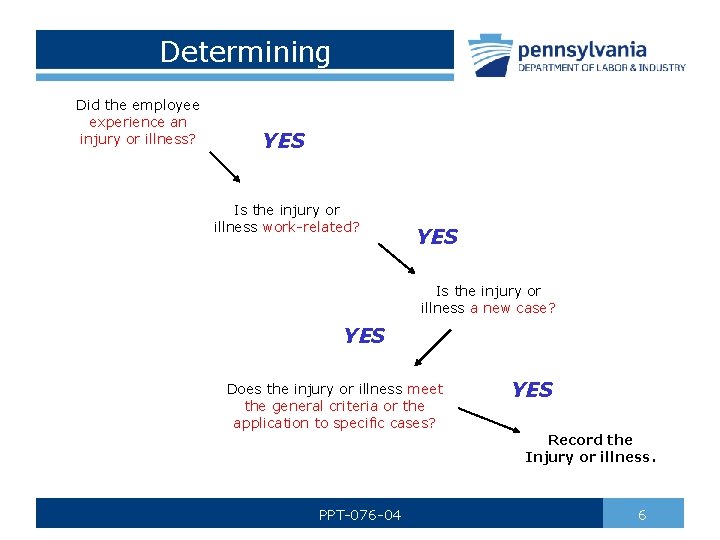
Determining Did the employee experience an injury or illness? YES Is the injury or illness work-related? YES Is the injury or illness a new case? YES Does the injury or illness meet the general criteria or the application to specific cases? YES Record the Injury or illness. PPT-076 -04 6
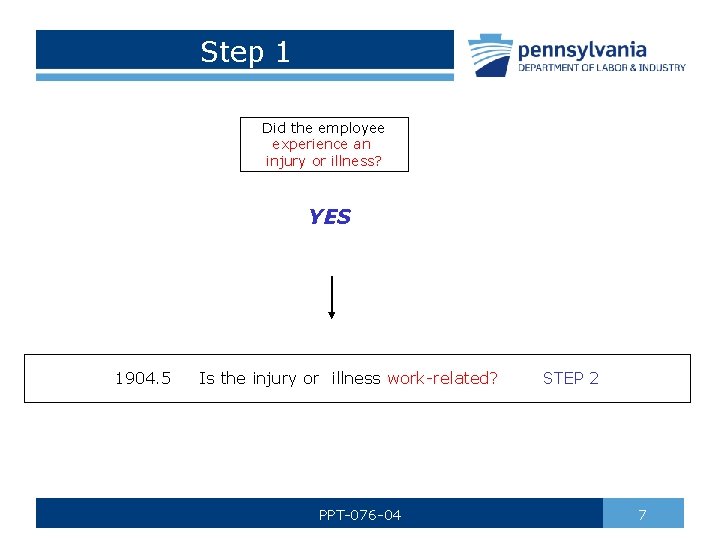
Step 1 Did the employee experience an injury or illness? YES 1904. 5 Is the injury or illness work-related? PPT-076 -04 STEP 2 7
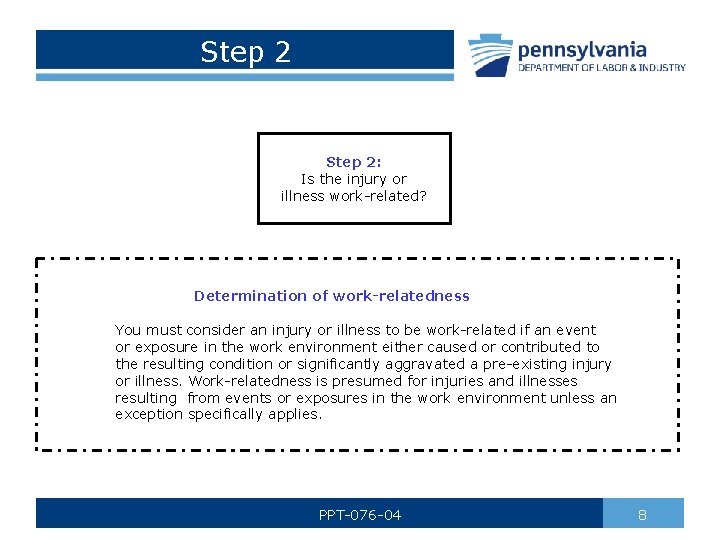
Step 2: Is the injury or illness work-related? Determination of work-relatedness You must consider an injury or illness to be work-related if an event or exposure in the work environment either caused or contributed to the resulting condition or significantly aggravated a pre-existing injury or illness. Work-relatedness is presumed for injuries and illnesses resulting from events or exposures in the work environment unless an exception specifically applies. PPT-076 -04 8
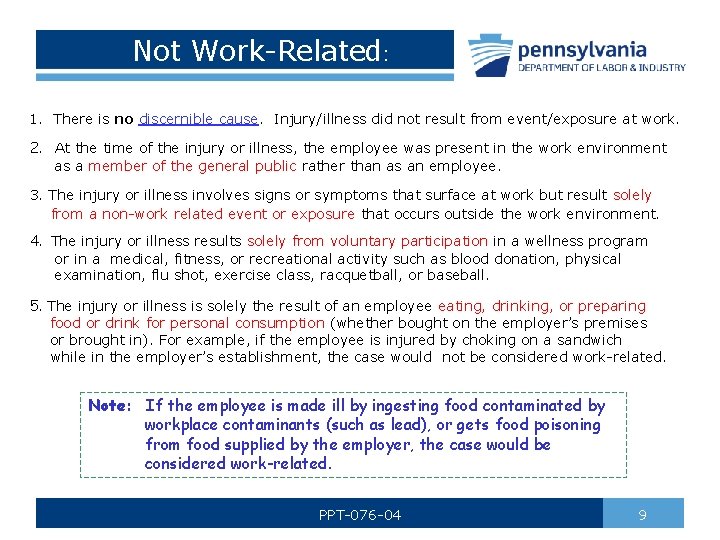
Not Work-Related: 1. There is no discernible cause. Injury/illness did not result from event/exposure at work. 2. At the time of the injury or illness, the employee was present in the work environment as a member of the general public rather than as an employee. 3. The injury or illness involves signs or symptoms that surface at work but result solely from a non-work related event or exposure that occurs outside the work environment. 4. The injury or illness results solely from voluntary participation in a wellness program or in a medical, fitness, or recreational activity such as blood donation, physical examination, flu shot, exercise class, racquetball, or baseball. 5. The injury or illness is solely the result of an employee eating, drinking, or preparing food or drink for personal consumption (whether bought on the employer’s premises or brought in). For example, if the employee is injured by choking on a sandwich while in the employer’s establishment, the case would not be considered work-related. Note: If the employee is made ill by ingesting food contaminated by workplace contaminants (such as lead), or gets food poisoning from food supplied by the employer, the case would be considered work-related. PPT-076 -04 9
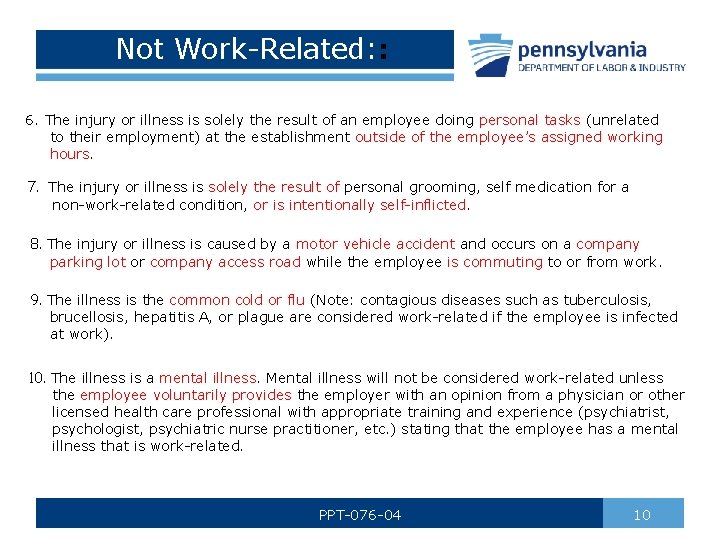
Not Work-Related: : 6. The injury or illness is solely the result of an employee doing personal tasks (unrelated to their employment) at the establishment outside of the employee’s assigned working hours. 7. The injury or illness is solely the result of personal grooming, self medication for a non-work-related condition, or is intentionally self-inflicted. 8. The injury or illness is caused by a motor vehicle accident and occurs on a company parking lot or company access road while the employee is commuting to or from work. 9. The illness is the common cold or flu (Note: contagious diseases such as tuberculosis, brucellosis, hepatitis A, or plague are considered work-related if the employee is infected at work). 10. The illness is a mental illness. Mental illness will not be considered work-related unless the employee voluntarily provides the employer with an opinion from a physician or other licensed health care professional with appropriate training and experience (psychiatrist, psychologist, psychiatric nurse practitioner, etc. ) stating that the employee has a mental illness that is work-related. PPT-076 -04 10
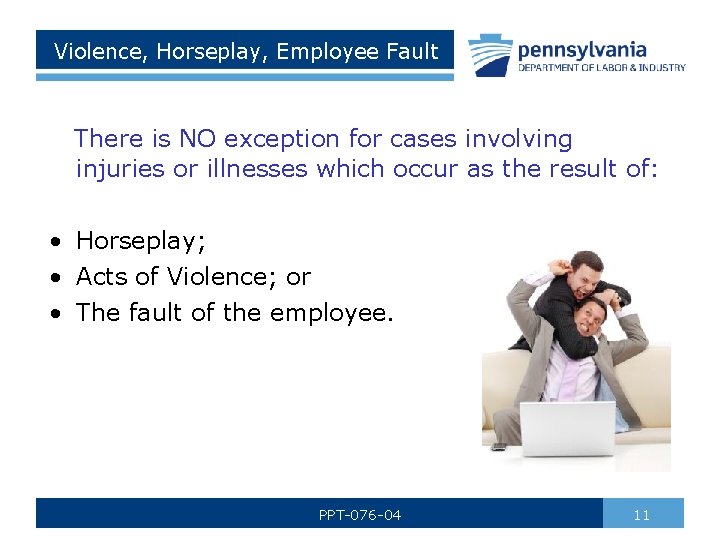
Violence, Horseplay, Employee Fault There is NO exception for cases involving injuries or illnesses which occur as the result of: • Horseplay; • Acts of Violence; or • The fault of the employee. PPT-076 -04 11
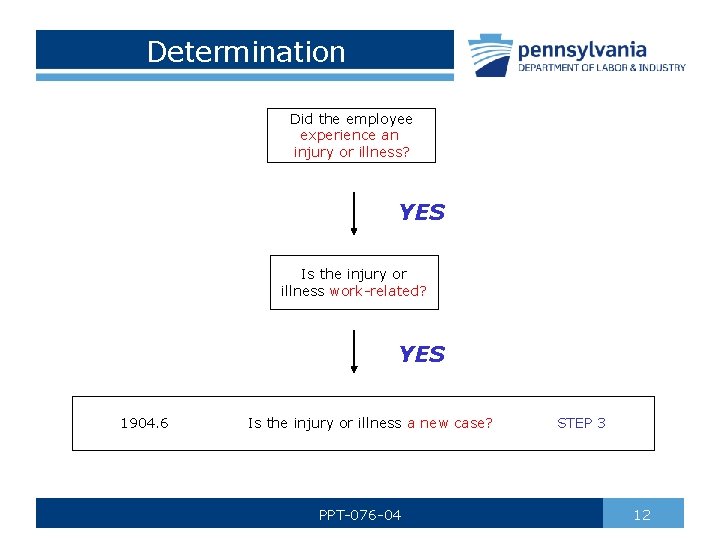
Determination Did the employee experience an injury or illness? YES Is the injury or illness work-related? YES 1904. 6 Is the injury or illness a new case? PPT-076 -04 STEP 3 12
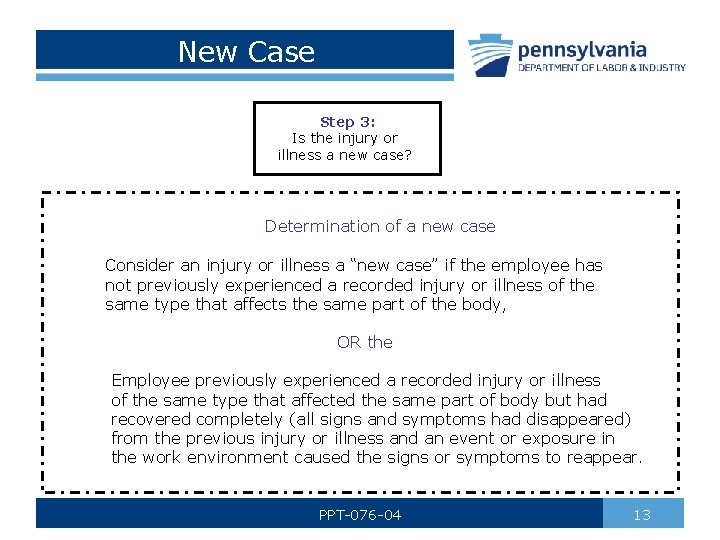
New Case Step 3: Is the injury or illness a new case? Determination of a new case Consider an injury or illness a “new case” if the employee has not previously experienced a recorded injury or illness of the same type that affects the same part of the body, OR the Employee previously experienced a recorded injury or illness of the same type that affected the same part of body but had recovered completely (all signs and symptoms had disappeared) from the previous injury or illness and an event or exposure in the work environment caused the signs or symptoms to reappear. PPT-076 -04 13
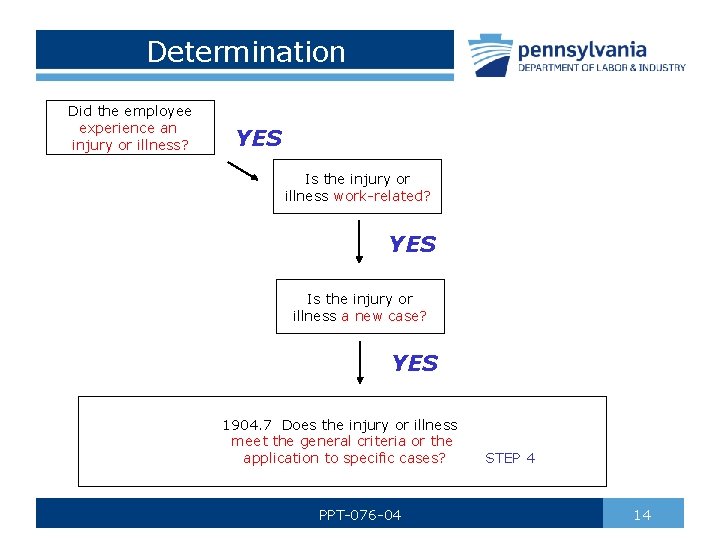
Determination Did the employee experience an injury or illness? YES Is the injury or illness work-related? YES Is the injury or illness a new case? YES 1904. 7 Does the injury or illness meet the general criteria or the application to specific cases? PPT-076 -04 STEP 4 14
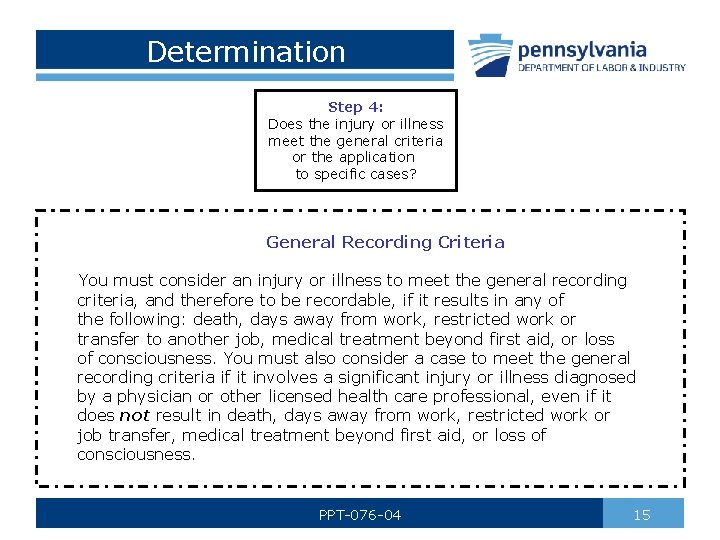
Determination Step 4: Does the injury or illness meet the general criteria or the application to specific cases? General Recording Criteria You must consider an injury or illness to meet the general recording criteria, and therefore to be recordable, if it results in any of the following: death, days away from work, restricted work or transfer to another job, medical treatment beyond first aid, or loss of consciousness. You must also consider a case to meet the general recording criteria if it involves a significant injury or illness diagnosed by a physician or other licensed health care professional, even if it does not result in death, days away from work, restricted work or job transfer, medical treatment beyond first aid, or loss of consciousness. PPT-076 -04 15
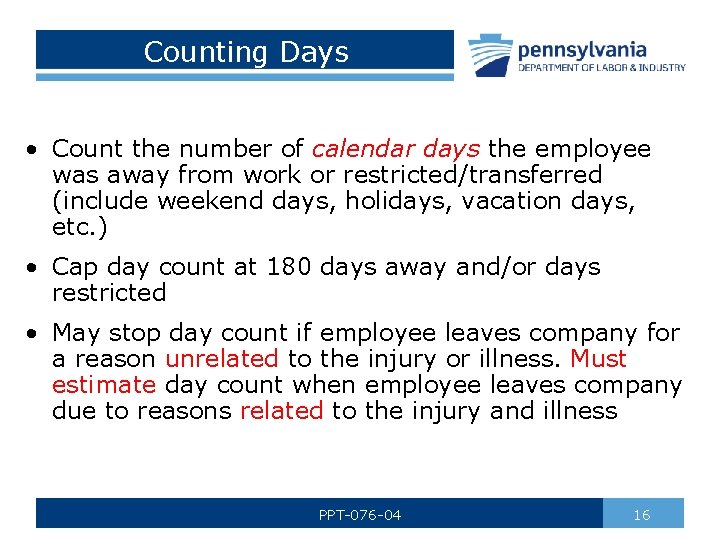
Counting Days • Count the number of calendar days the employee was away from work or restricted/transferred (include weekend days, holidays, vacation days, etc. ) • Cap day count at 180 days away and/or days restricted • May stop day count if employee leaves company for a reason unrelated to the injury or illness. Must estimate day count when employee leaves company due to reasons related to the injury and illness PPT-076 -04 16
Restricted Work Activity – “Fine Points” • Restriction/transfer limited to day of injury/illness onset not recordable-includes employee being sent home during shift. • Production of fewer goods or services not considered RWA. • Vague restrictions from physician or LHCP (e. g. , “light duty” or “take it easy for a week”) are to be recorded as RWA if no further information is obtained. PPT-076 -04 17
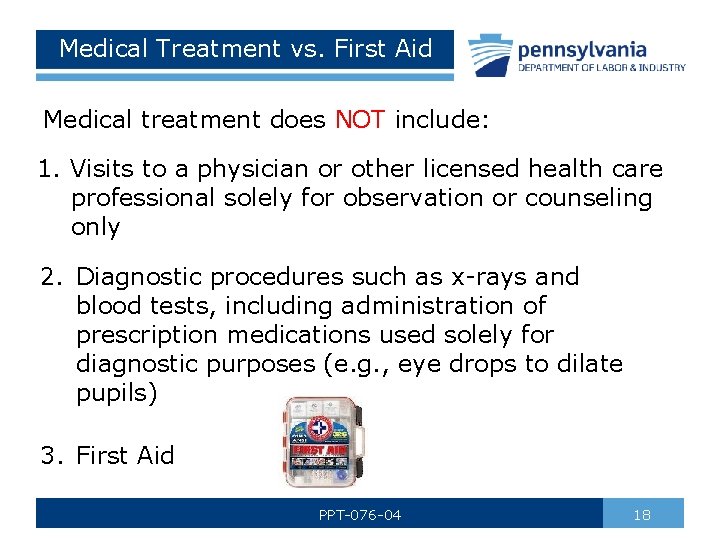
Medical Treatment vs. First Aid Medical treatment does NOT include: 1. Visits to a physician or other licensed health care professional solely for observation or counseling only 2. Diagnostic procedures such as x-rays and blood tests, including administration of prescription medications used solely for diagnostic purposes (e. g. , eye drops to dilate pupils) 3. First Aid PPT-076 -04 18
Medical Treatment vs. First Aid list is comprehensive: • Using temporary immobilization devices while transporting an accident victim • Drilling a nail • Using eye patches • Removing foreign bodies from the eye using only irrigation or a cotton swab PPT-076 -04 19
Medical Treatment vs. First Aid • • First Aid: Removing splinters or foreign material from areas other than the eye by irrigation, tweezers, cotton swabs or other simple means Using finger guards Using massages Drinking fluids for relief of heat stress Any other procedure is medical treatment PPT-076 -04 20
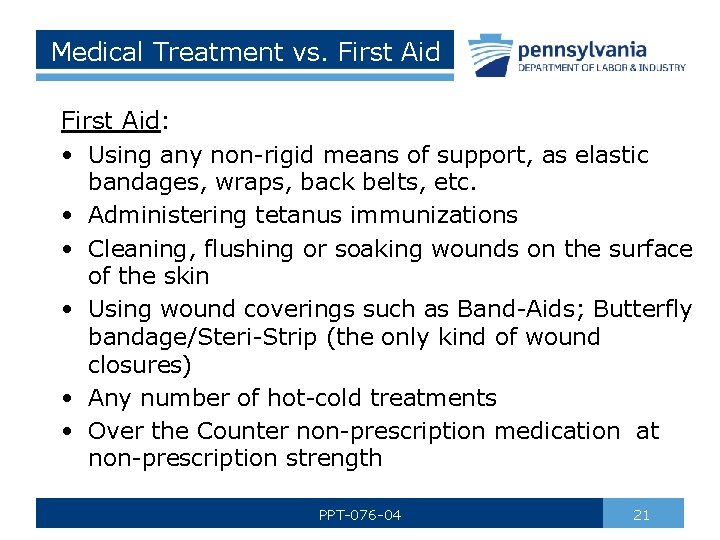
Medical Treatment vs. First Aid: • Using any non-rigid means of support, as elastic bandages, wraps, back belts, etc. • Administering tetanus immunizations • Cleaning, flushing or soaking wounds on the surface of the skin • Using wound coverings such as Band-Aids; Butterfly bandage/Steri-Strip (the only kind of wound closures) • Any number of hot-cold treatments • Over the Counter non-prescription medication at non-prescription strength PPT-076 -04 21
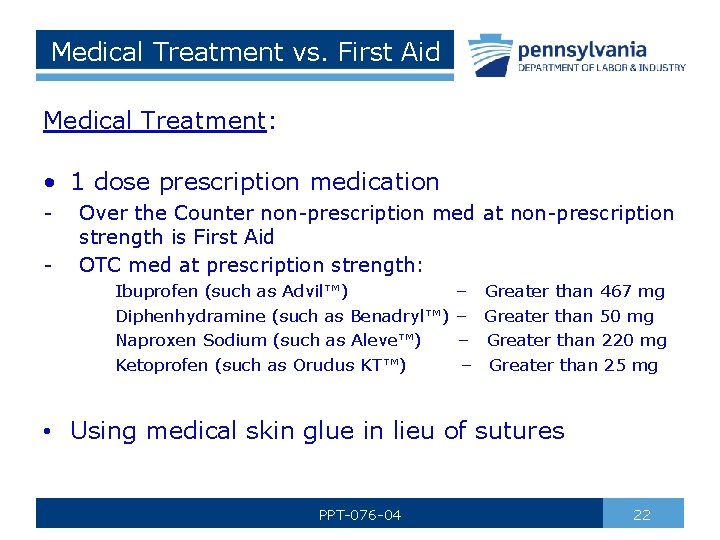
Medical Treatment vs. First Aid Medical Treatment: • 1 dose prescription medication - Over the Counter non-prescription med at non-prescription strength is First Aid OTC med at prescription strength: Ibuprofen (such as Advil™) Diphenhydramine (such as Benadryl™) Naproxen Sodium (such as Aleve™) Ketoprofen (such as Orudus KT™) – Greater than 467 mg – Greater than 50 mg – Greater than 220 mg – Greater than 25 mg • Using medical skin glue in lieu of sutures PPT-076 -04 22
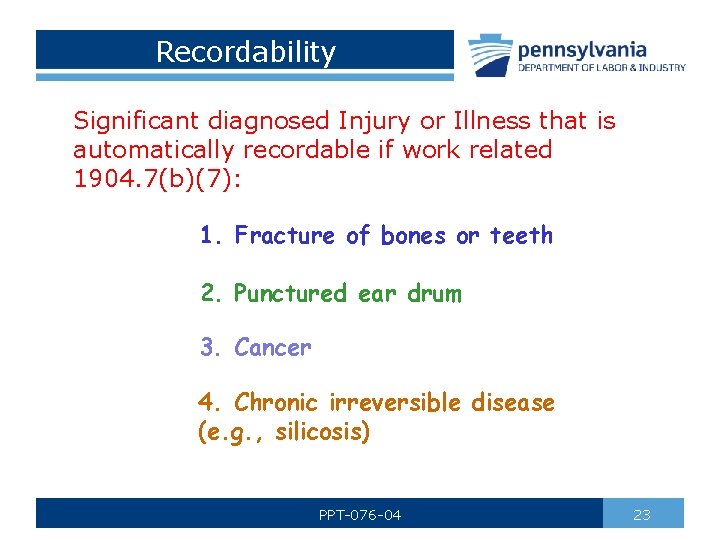
Recordability Significant diagnosed Injury or Illness that is automatically recordable if work related 1904. 7(b)(7): 1. Fracture of bones or teeth 2. Punctured ear drum 3. Cancer 4. Chronic irreversible disease (e. g. , silicosis) PPT-076 -04 23
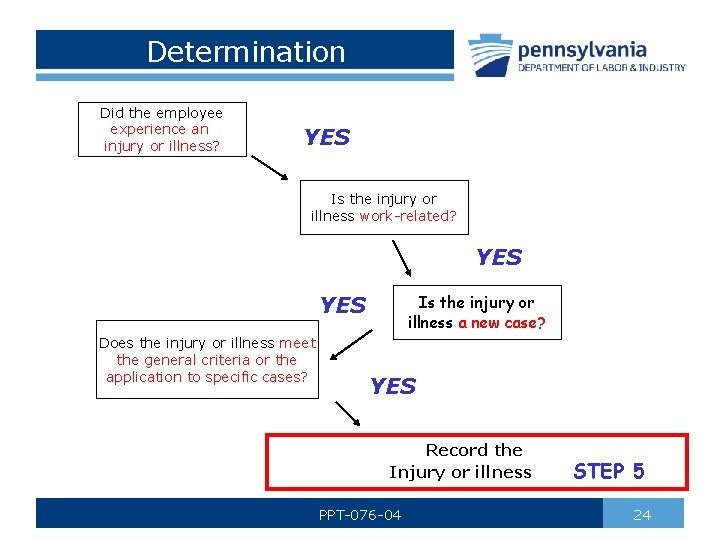
Determination Did the employee experience an injury or illness? YES Is the injury or illness work-related? YES Is the injury or illness a new case? YES Does the injury or illness meet the general criteria or the application to specific cases? YES Record the Injury or illness PPT-076 -04 STEP 5 24
Determining Case Severity Case Scenarios Employee has a work-related injury or illness, sees doctor, told she can only work on light duty for the next two weeks. Normally scheduled for five day workweeks. How many days of restricted work activity should be entered on the OSHA Log? 14 = All calendar days from the day following injury until day of return to regular work activity. PPT-076 -04 25
Determining Case Severity Case Scenarios • • • If a physician recommends medical treatment, but the employee does not follow the recommendation, Is the case recordable? Yes; Physician recommended/documented If an injured employee has repeated sessions of hot or cold therapy, does this case involve medical treatment? No; hot/cold therapy not medical treatment Wound closures: Steri-Strips and butterfly bandages are now considered to be first aid. Does this mean that staples, surgical glue, or other wound closures are also first aid? No; These devices are medical treatment PPT-076 -04 26
Determining Case Severity Case Scenarios • Employee receives prescription medication in her eye to facilitate examination. Is this considered medical treatment? No; Med used to enhance examination only • Employees exposed to slight release of non toxic chemical. Several feel “light headed”, receive simple administration of oxygen and return to work. Are these cases recordable? Yes; Oxygen administered • Employee’s ankle is injured at work; a slight hairline fracture is detected in a positive X-ray diagnosis. No medical treatment is provided. Is this case recordable? Yes; Fracture of bones PPT-076 -04 27
OSHA Recordability & Workers’ Compensation determinations do NOT impact OSHA recordability: Some cases may be OSHA recordable and compensable. Some cases may be compensable, but not OSHA recordable. Some cases may be OSHA recordable, but not compensable. BE CAREFUL YOU DON’T CONFUSE THEM! PPT-076 -04 28
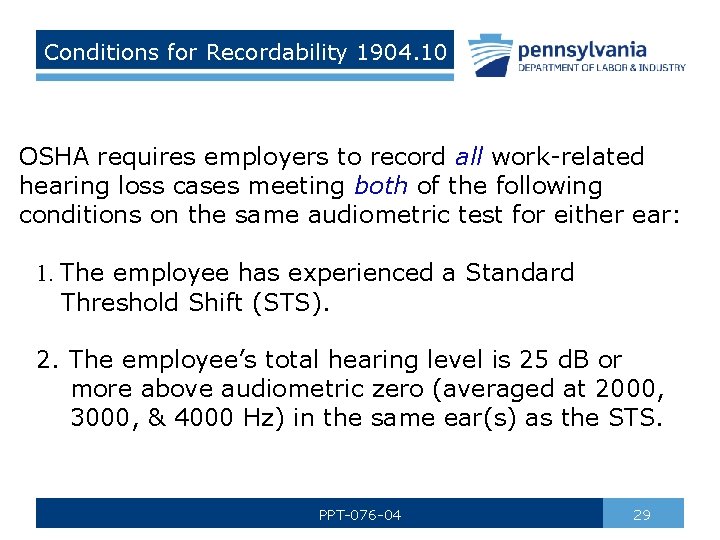
Conditions for Recordability 1904. 10 OSHA requires employers to record all work-related hearing loss cases meeting both of the following conditions on the same audiometric test for either ear: 1. The employee has experienced a Standard Threshold Shift (STS). 2. The employee’s total hearing level is 25 d. B or more above audiometric zero (averaged at 2000, 3000, & 4000 Hz) in the same ear(s) as the STS. PPT-076 -04 29
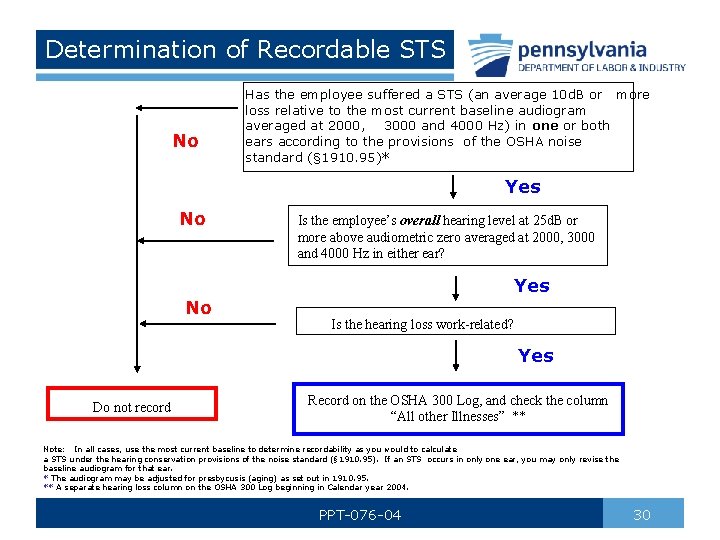
Determination of Recordable STS No Has the employee suffered a STS (an average 10 d. B or more loss relative to the most current baseline audiogram averaged at 2000, 3000 and 4000 Hz) in one or both ears according to the provisions of the OSHA noise standard (§ 1910. 95)* Yes No No Is the employee’s overall hearing level at 25 d. B or more above audiometric zero averaged at 2000, 3000 and 4000 Hz in either ear? Yes Is the hearing loss work-related? Yes Do not record Record on the OSHA 300 Log, and check the column “All other Illnesses” ** Note: In all cases, use the most current baseline to determine recordability as you would to calculate a STS under the hearing conservation provisions of the noise standard (§ 1910. 95). If an STS occurs in only one ear, you may only revise the baseline audiogram for that ear. * The audiogram may be adjusted for presbycusis (aging) as set out in 1910. 95. ** A separate hearing loss column on the OSHA 300 Log beginning in Calendar year 2004. PPT-076 -04 30
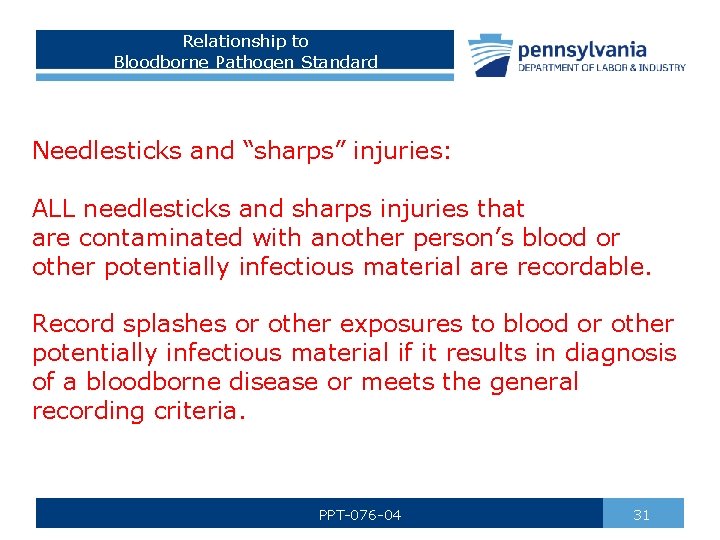
Relationship to Bloodborne Pathogen Standard Needlesticks and “sharps” injuries: ALL needlesticks and sharps injuries that are contaminated with another person’s blood or other potentially infectious material are recordable. Record splashes or other exposures to blood or other potentially infectious material if it results in diagnosis of a bloodborne disease or meets the general recording criteria. PPT-076 -04 31
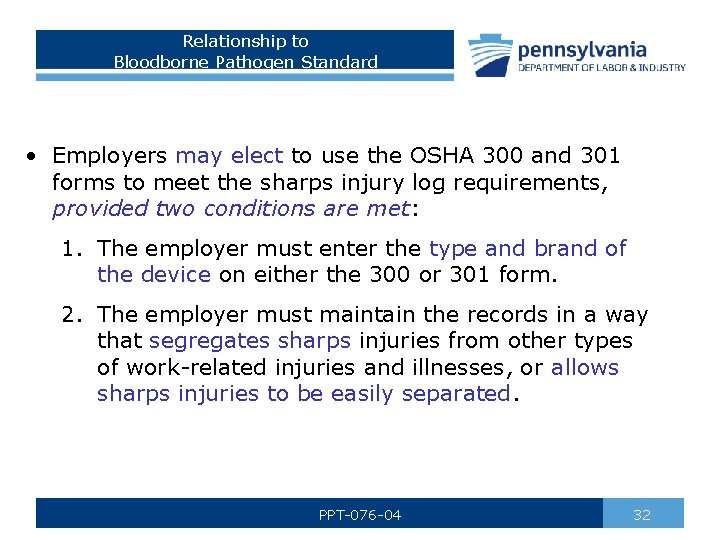
Relationship to Bloodborne Pathogen Standard • Employers may elect to use the OSHA 300 and 301 forms to meet the sharps injury log requirements, provided two conditions are met: 1. The employer must enter the type and brand of the device on either the 300 or 301 form. 2. The employer must maintain the records in a way that segregates sharps injuries from other types of work-related injuries and illnesses, or allows sharps injuries to be easily separated. PPT-076 -04 32
Other Recording Issues • TB – Positive skin test recordable when known work place exposure to active TB disease. • Musculoskeletal Disorders (MSD) recordable when General Recording Criteria is met. • Covered Employees (temporary/contract employees supervised on a day-to-day basis). • Certification by a senior establishment management official on OSHA 300 A Summary Form. PPT-076 -04 33
1904. 29 - Forms • OSHA Form 300, Log of Work-Related Injuries and Illnesses • OSHA Form 300 A, Summary of Work-Related Injuries and Illnesses • OSHA Form 301, Injury and Illness Incident Report An equivalent form can be used as long as it has the same information, is as readable and understandable, and uses the same instructions as the OSHA form it replaces PPT-076 -04 34
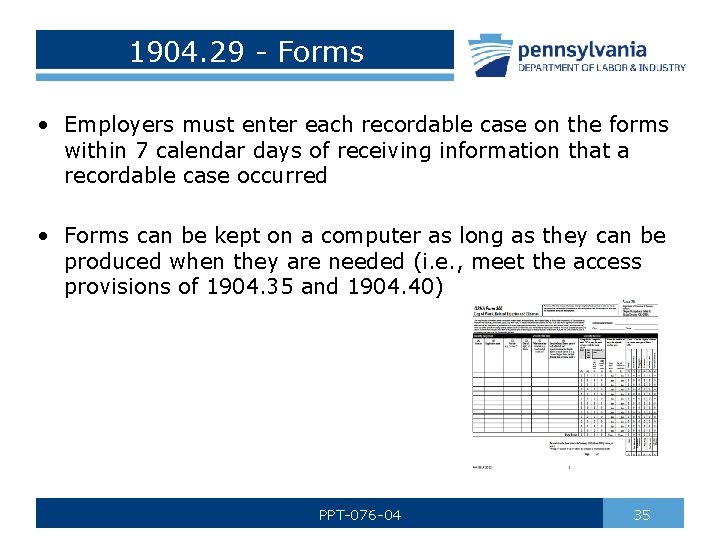
1904. 29 - Forms • Employers must enter each recordable case on the forms within 7 calendar days of receiving information that a recordable case occurred • Forms can be kept on a computer as long as they can be produced when they are needed (i. e. , meet the access provisions of 1904. 35 and 1904. 40) PPT-076 -04 35
Subpart D - Other Requirements • 1904. 30 Multiple business establishments • 1904. 31 Covered employees • 1904. 32 Annual summary • 1904. 33 Retention and updating • 1904. 34 Change in Business Ownership • 1904. 35 Employee involvement PPT-076 -04 36
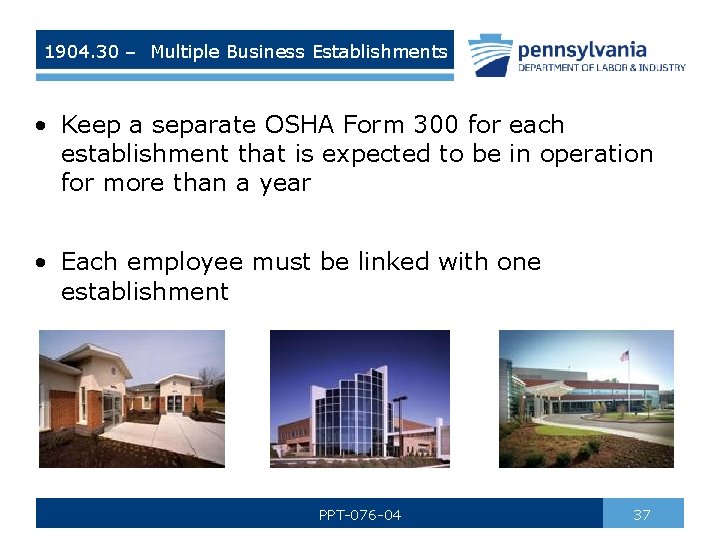
1904. 30 – Multiple Business Establishments • Keep a separate OSHA Form 300 for each establishment that is expected to be in operation for more than a year • Each employee must be linked with one establishment PPT-076 -04 37
1904. 30 – Multiple Business Establishments Employer may keep records at a central location if: Information about the injury or illness can be transmitted to the central location within 7 days and The records can be produced at the establishment within time frames in 1904. 35 and 1904. 40 PPT-076 -04 38
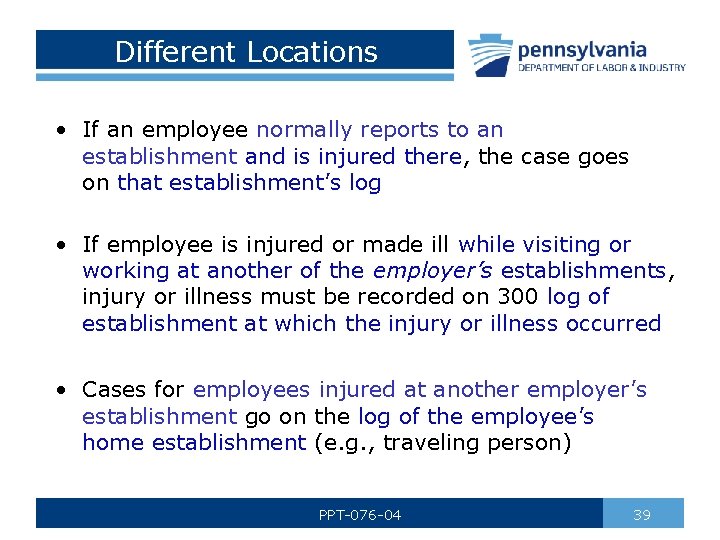
Different Locations • If an employee normally reports to an establishment and is injured there, the case goes on that establishment’s log • If employee is injured or made ill while visiting or working at another of the employer’s establishments, injury or illness must be recorded on 300 log of establishment at which the injury or illness occurred • Cases for employees injured at another employer’s establishment go on the log of the employee’s home establishment (e. g. , traveling person) PPT-076 -04 39
1904. 31 – Covered Employees • Employees on payroll • Employees not on payroll who are supervised on a day-to-day basis • Temporary help agencies should not record the cases experienced by temp workers who are supervised by the using firm PPT-076 -04 40
1904. 31 – Covered Employees • Self-employed individuals working on an employers’ site are not covered by the OSH ACT – no reporting requirements. • Contractor’s employees – if under day to day supervision of contractor then recorded by contractor. If day to day by employer then employer must record. • Employer and personnel supply service, temp help service, employee leasing service or contractor should coordinate efforts. • If day to day supervision then employer must report fatalities, in-patient hospitalization, etc. PPT-076 -04 41
1904. 32 – Annual Summary (300 A) Before February 1 of next calendar year you must: • Review OSHA 300 Log to verify entries are complete and accurate (also correct deficiencies identified) • Create annual summary of injuries/illnesses recorded on 300 • Post annual summary • Have company executive certify that he/she has examined 300 Log and believes it is correct and complete PPT-076 -04 42
Annual Summary (300 A) Company executive defined as one of the following: • Owner of company (only if company is sole proprietorship or partnership) • Officer of the corporation • Highest ranking company official working at the establishment • Immediate supervisor of the highest ranking company official working at the establishment PPT-076 -04 43
Posting of Annual Summary • Must post in conspicuous location or locations in each establishment where notices to employees are usually placed. • Annual summary posting must not be altered, defaced or covered by other material • Must post no later than February 1 of following calendar year to cover previous calendar year • Must keep posted until April 30 PPT-076 -04 44
1904. 33 Retention and Updating Must save the following for five (5) years following the end of the calendar year these records cover: • • OSHA 300 Log Privacy list (if one exists) Annual summary (300 A) OSHA 301 incident report forms PPT-076 -04 45
1904. 33 Retention and Updating • Must update your OSHA 300 Logs to include newly discovered recordable injuries/illnesses and to show any changes that have occurred in the classification of previously recorded injuries and illnesses. • If the description or outcome of a case changes, you must remove or line out the original entry and enter the new information. PPT-076 -04 46
1904. 34 Change in Business Ownership • If business changes ownership must record & report work-related injuries & illnesses only for that period of the year during which company actually owned. • Relative 1904 records must be transferred to new owner/company. • New company/owner must save all records of establishment kept by prior owner – do not need to update/correct. PPT-076 -04 47
1904. 35 Employee involvement • Must inform each employee of how he or she is to report an injury or illness • Must provide limited access to the injury & illness records for your employees and their representatives PPT-076 -04 48
1904. 35 Employee Rights • Modifications to 1904. 35 make it a violation for employers to discourage employee reporting of injuries or illnesses. • Employers must inform employees of their right to report workplace illnesses or injuries free from retaliation. • This obligation can be met by displaying the “OSHA Poster” version 2015 or newer. All workers have the right to: • Raise a safety or health concern with their employer or OSHA, or report a work related injury or illness without retaliation. PPT-076 -04 49
Supart E-Reporting Information to the Government • 1904. 39 Fatality and Catastrophe Reporting • 1904. 40 Access for Government Representatives PPT-076 -04 50
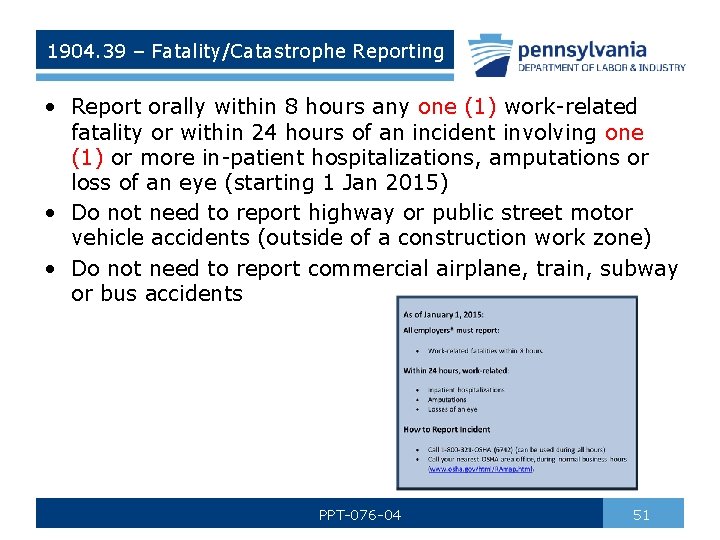
1904. 39 – Fatality/Catastrophe Reporting • Report orally within 8 hours any one (1) work-related fatality or within 24 hours of an incident involving one (1) or more in-patient hospitalizations, amputations or loss of an eye (starting 1 Jan 2015) • Do not need to report highway or public street motor vehicle accidents (outside of a construction work zone) • Do not need to report commercial airplane, train, subway or bus accidents PPT-076 -04 51
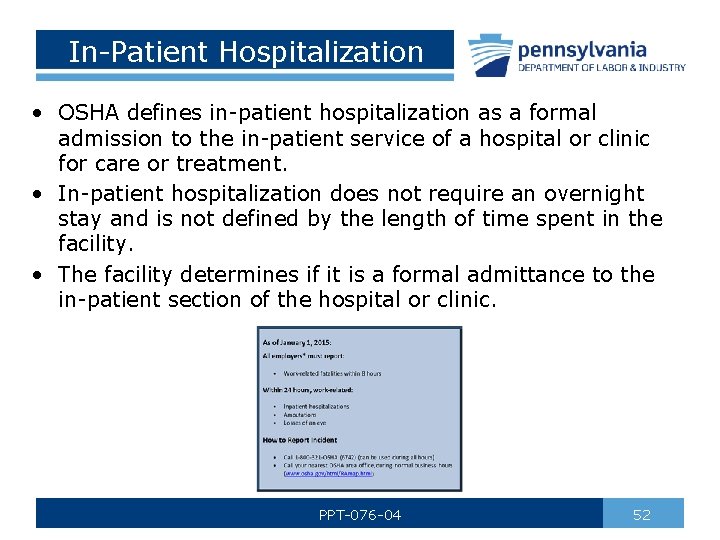
In-Patient Hospitalization • OSHA defines in-patient hospitalization as a formal admission to the in-patient service of a hospital or clinic for care or treatment. • In-patient hospitalization does not require an overnight stay and is not defined by the length of time spent in the facility. • The facility determines if it is a formal admittance to the in-patient section of the hospital or clinic. PPT-076 -04 52
Amputation • The traumatic loss of a limb or other external body part. • Include a part such as a limb or appendage that has been: ◦ Severed ◦ Cut Off ◦ Completely or partially amputated ◦ Fingertip amputations with or without bone loss ◦ Medical amputations resulting from irreparable damage ◦ Amputations of body parts that have been reattached • Do not include: avulsions (tissue torn away from the body), enucleations (removal of an eyeball), deglovings (skin torn away from the underlying tissue), scalpings, severed ears, broken or chipped teeth. PPT-076 -04 53
How to Report – Three Options • By telephone to the OSHA Area Office nearest the site of the work-related incident during normal business hours. • By telephone to the 24 -hour OSHA hotline (1 -800 -321 -OSHA or 1 -800 -321 -6742). • Electronically, using the event reporting application located on OSHA’s public website: http: //www. osha. gov/pls/serform. html. PPT-076 -04 54
What Information to Provide 1. 2. 3. 4. 5. Establishment Name Location of work-related incident Date & time of the incident Type of reportable event (e. g. fatality, etc. ) Total number & names of employees who suffered incidents 6. Any temporary workers involved 7. If so, name & address of temp agency 8. Union information (if applicable) PPT-076 -04 55
1904. 40 -Providing Records to Gov’t. Reps. • Must provide copies of the records within four (4) business hours • Use the business hours of the establishment where the records are located PPT-076 -04 56
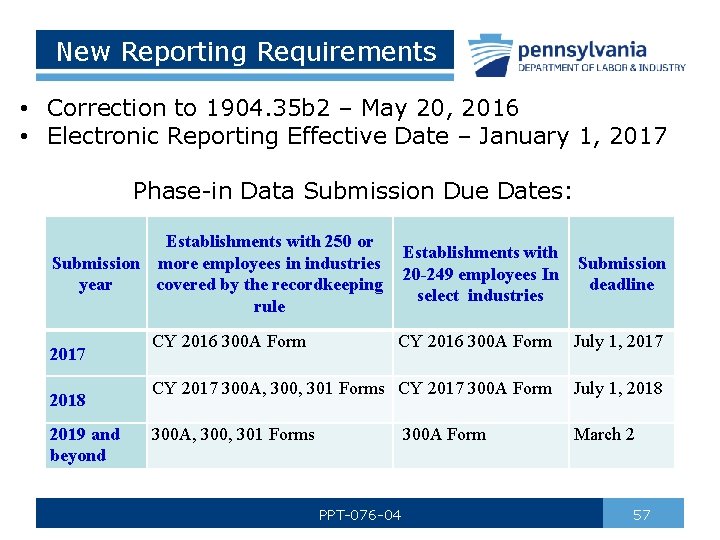
New Reporting Requirements • Correction to 1904. 35 b 2 – May 20, 2016 • Electronic Reporting Effective Date – January 1, 2017 Phase-in Data Submission Due Dates: Establishments with 250 or Submission more employees in industries year covered by the recordkeeping rule 2017 2018 2019 and beyond Establishments with 20 -249 employees In select industries Submission deadline CY 2016 300 A Form July 1, 2017 CY 2017 300 A, 300, 301 Forms CY 2017 300 A Form July 1, 2018 300 A, 300, 301 Forms March 2 CY 2016 300 A Form PPT-076 -04 57
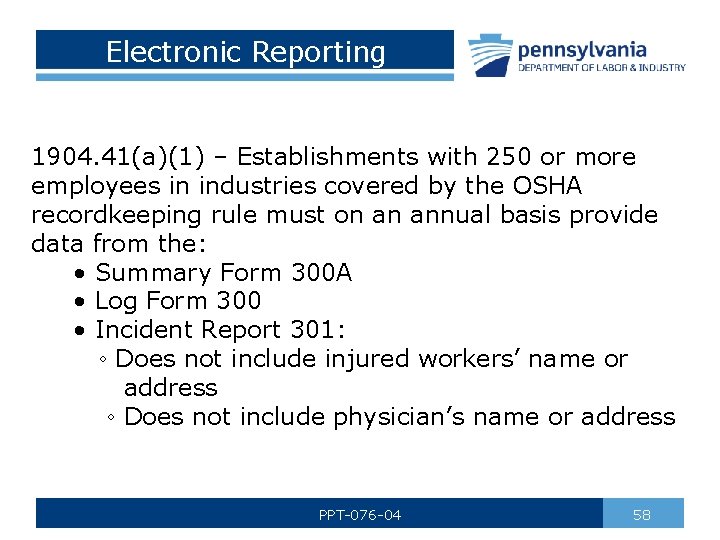
Electronic Reporting 1904. 41(a)(1) – Establishments with 250 or more employees in industries covered by the OSHA recordkeeping rule must on an annual basis provide data from the: • Summary Form 300 A • Log Form 300 • Incident Report 301: ◦ Does not include injured workers’ name or address ◦ Does not include physician’s name or address PPT-076 -04 58
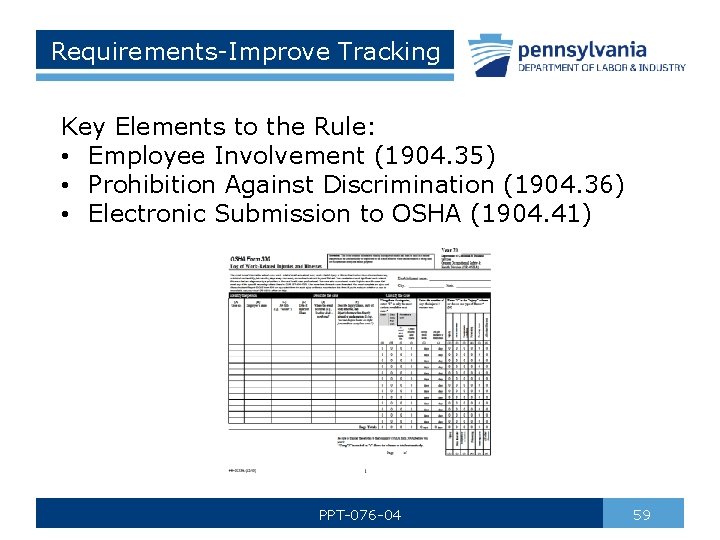
Requirements-Improve Tracking Key Elements to the Rule: • Employee Involvement (1904. 35) • Prohibition Against Discrimination (1904. 36) • Electronic Submission to OSHA (1904. 41) PPT-076 -04 59
For More Help OSHA’s Recordkeeping Pagehttp: //www. osha. gov/recordkeeping/index. html ● OSHA’s “Recordkeeping Advisor” http: //www. dol. gov/elaws/OSHARecordkeeping. htm ● OSHA Regional Recordkeeping Coordinators ● OSHA Duty Officer PPT-076 -04 60
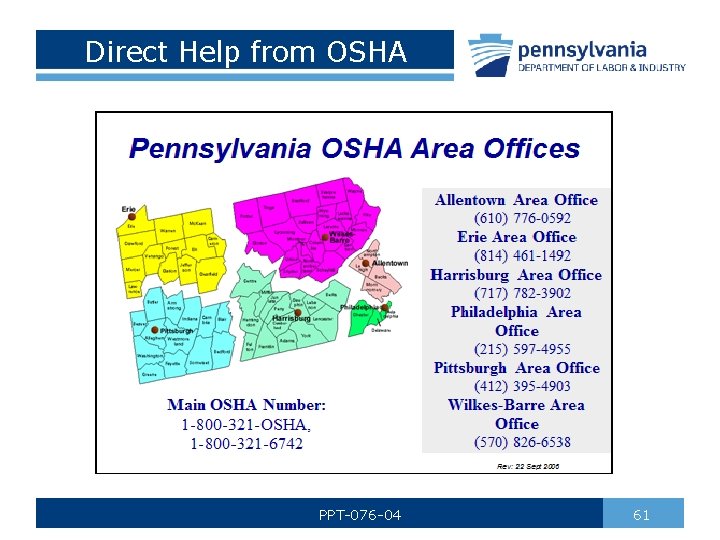
Direct Help from OSHA PPT-076 -04 61
Contact Information Health & Safety Training Specialists 1171 South Cameron Street, Room 324 Harrisburg, PA 17104 -2501 (717) 772 -1635 RA-LI-BWC-PATHS@pa. gov Like us on Facebook! https: //www. facebook. com/BWCPATHS PPT-076 -04 62

Questions PPT-076 -04 63
- Slides: 63