
OSHA RECORD KEEPING How to Maintain the Logs
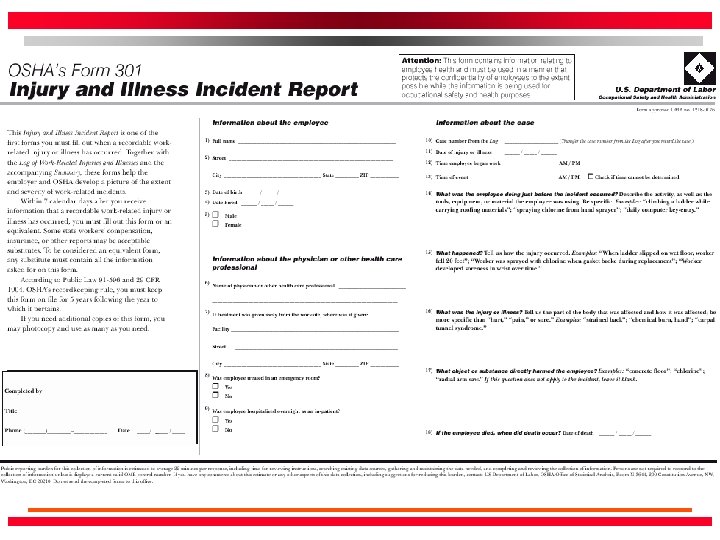
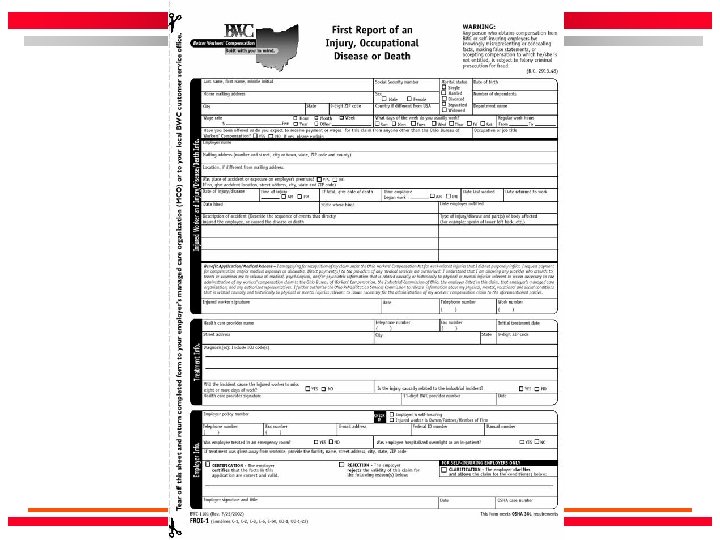
- Slides: 71
OSHA RECORD KEEPING How to Maintain the Logs and Other Forms
OSHA RECORDKEEPING CLASS OBJECTIVES Upon completing this class you should have the knowledge to do the following things.
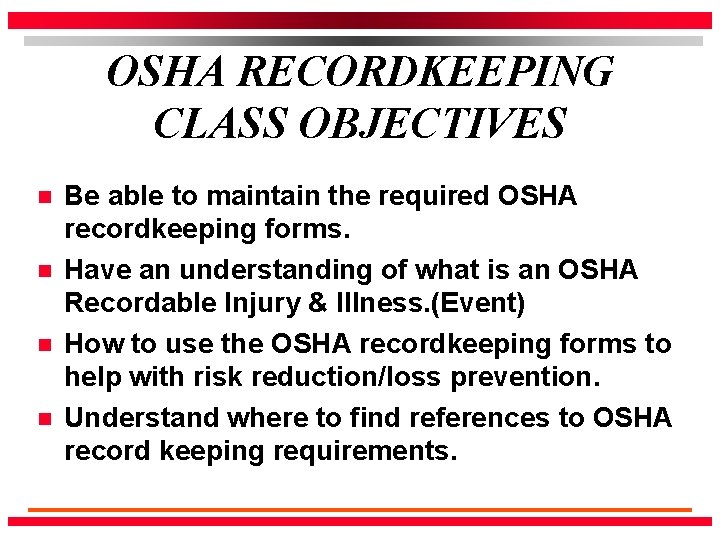
OSHA RECORDKEEPING CLASS OBJECTIVES n n Be able to maintain the required OSHA recordkeeping forms. Have an understanding of what is an OSHA Recordable Injury & Illness. (Event) How to use the OSHA recordkeeping forms to help with risk reduction/loss prevention. Understand where to find references to OSHA record keeping requirements.
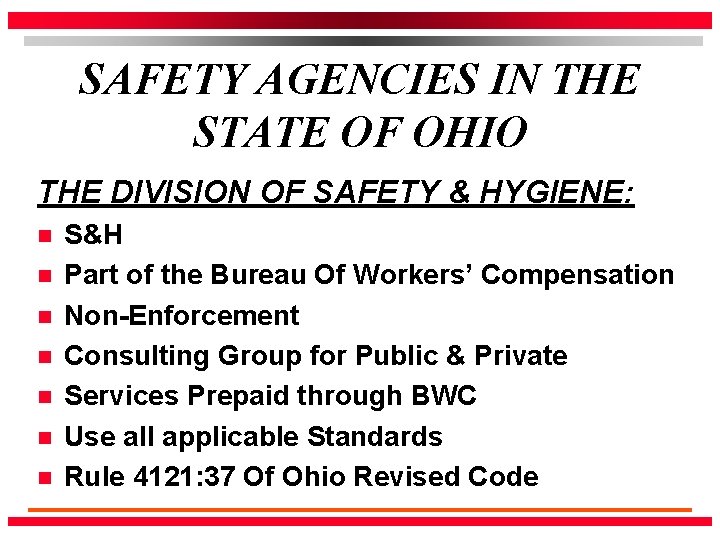
SAFETY AGENCIES IN THE STATE OF OHIO THE DIVISION OF SAFETY & HYGIENE: n n n n S&H Part of the Bureau Of Workers’ Compensation Non-Enforcement Consulting Group for Public & Private Services Prepaid through BWC Use all applicable Standards Rule 4121: 37 Of Ohio Revised Code
SAFETY AGENCIES IN THE STATE OF OHIO Occupational Safety & Health Administration: n OSHA n Part of the Department Of Labor n Enforcement for Private Employers n Enforce 29 CFR (Code Of Federal Regulations) n The OSHA Act Public Law 91 -596
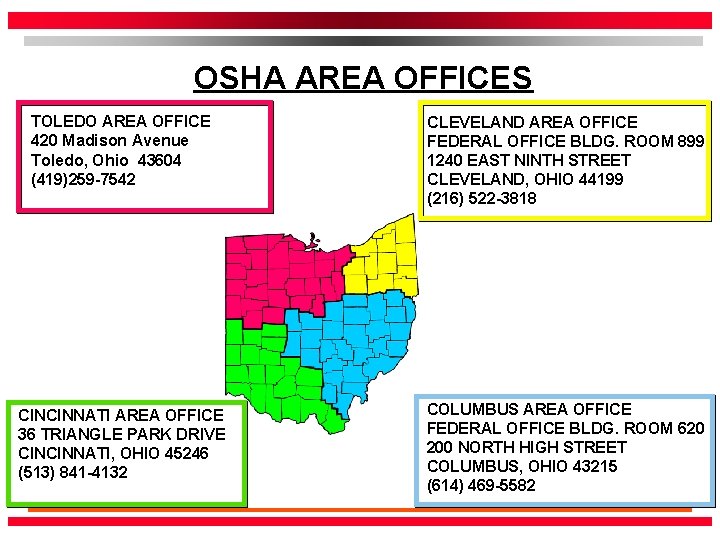
OSHA AREA OFFICES TOLEDO AREA OFFICE 420 Madison Avenue Toledo, Ohio 43604 (419)259 -7542 CLEVELAND AREA OFFICE FEDERAL OFFICE BLDG. ROOM 899 1240 EAST NINTH STREET CLEVELAND, OHIO 44199 (216) 522 -3818 CINCINNATI AREA OFFICE 36 TRIANGLE PARK DRIVE CINCINNATI, OHIO 45246 (513) 841 -4132 COLUMBUS AREA OFFICE FEDERAL OFFICE BLDG. ROOM 620 200 NORTH HIGH STREET COLUMBUS, OHIO 43215 (614) 469 -5582
SAFETY AGENCIES IN THE STATE OF OHIO Division Of Labor & Workers Safety: n Part of the BWC n PERRP - Ohio Public Employment Risk Reduction Program n Enforcement for Public Employers n Enforce 29 CFR (Code Of Federal Regulations) n Rule 4167: -4 -01
SAFETY AGENCIES IN THE STATE OF OHIO OSHA On-site Part of the BWC n Consultative Group n Consultative for the Private Sector n Enforce 29 CFR (Code Of Federal Regulations n
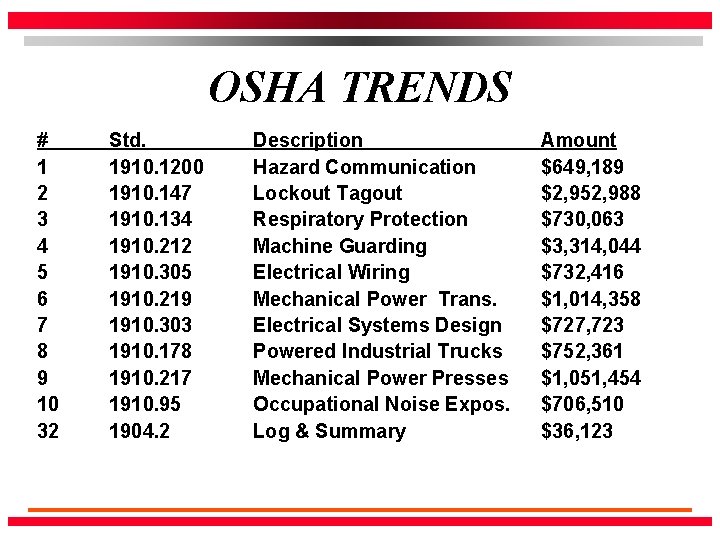
OSHA TRENDS # 1 2 3 4 5 6 7 8 9 10 32 Std. 1910. 1200 1910. 147 1910. 134 1910. 212 1910. 305 1910. 219 1910. 303 1910. 178 1910. 217 1910. 95 1904. 2 Description Hazard Communication Lockout Tagout Respiratory Protection Machine Guarding Electrical Wiring Mechanical Power Trans. Electrical Systems Design Powered Industrial Trucks Mechanical Power Presses Occupational Noise Expos. Log & Summary Amount $649, 189 $2, 952, 988 $730, 063 $3, 314, 044 $732, 416 $1, 014, 358 $727, 723 $752, 361 $1, 051, 454 $706, 510 $36, 123
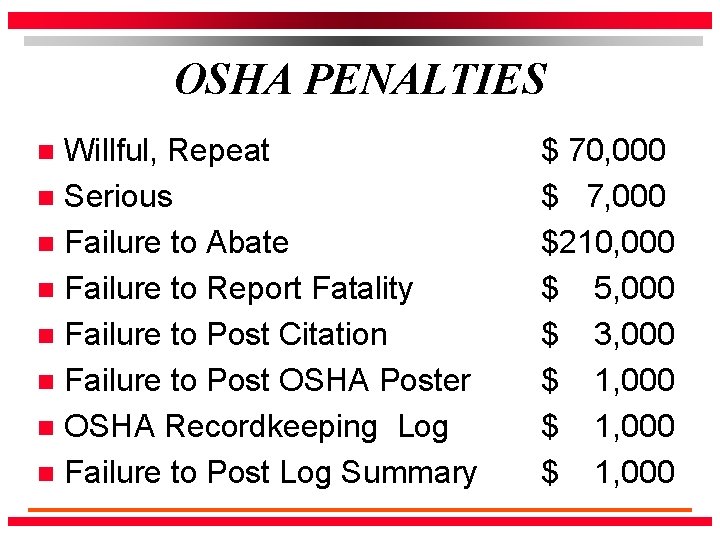
OSHA PENALTIES Willful, Repeat n Serious n Failure to Abate n Failure to Report Fatality n Failure to Post Citation n Failure to Post OSHA Poster n OSHA Recordkeeping Log n Failure to Post Log Summary n $ 70, 000 $ 7, 000 $210, 000 $ 5, 000 $ 3, 000 $ 1, 000
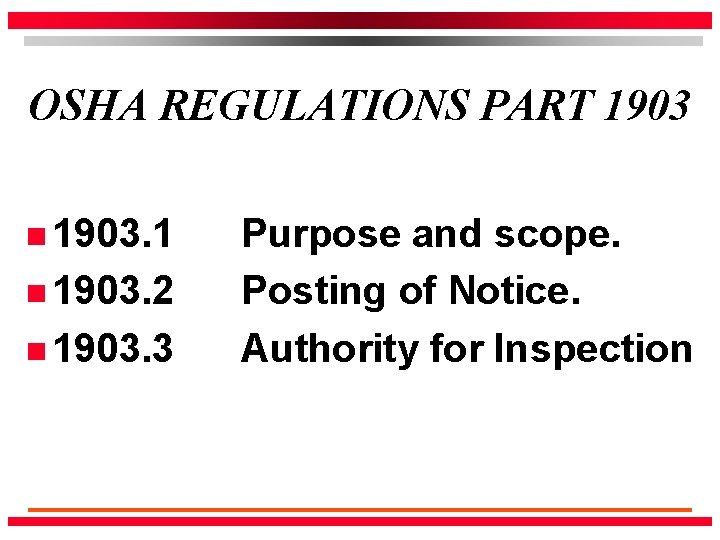
OSHA REGULATIONS PART 1903 n 1903. 1 n 1903. 2 n 1903. 3 Purpose and scope. Posting of Notice. Authority for Inspection
The OSHA ACT Public Law 91 -596 91 st Congress, S. 2193 December 29, 1970
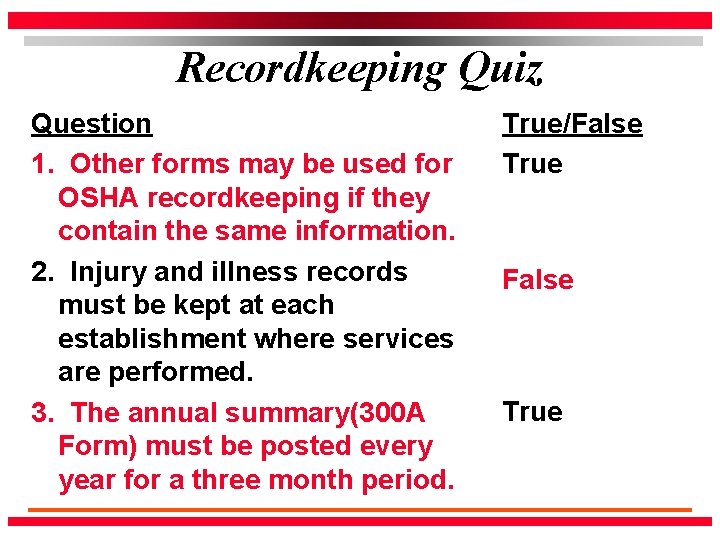
Recordkeeping Quiz Question 1. Other forms may be used for OSHA recordkeeping if they contain the same information. 2. Injury and illness records must be kept at each establishment where services are performed. 3. The annual summary(300 A Form) must be posted every year for a three month period. True/False True
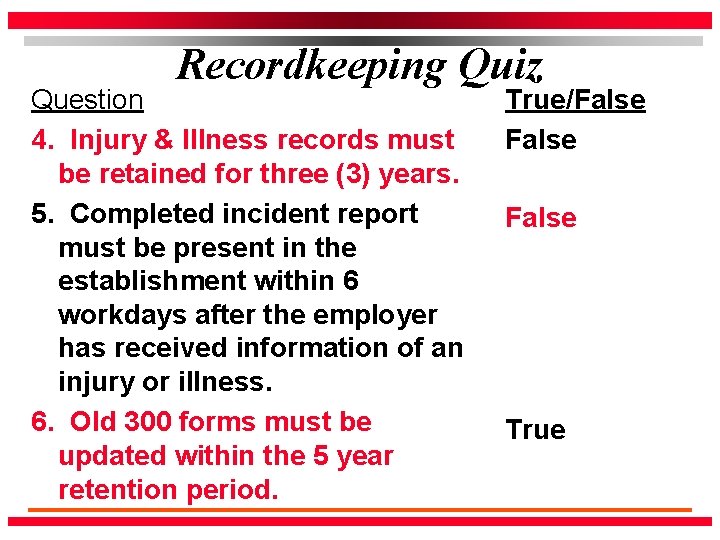
Recordkeeping Quiz Question 4. Injury & Illness records must be retained for three (3) years. 5. Completed incident report must be present in the establishment within 6 workdays after the employer has received information of an injury or illness. 6. Old 300 forms must be updated within the 5 year retention period. True/False True
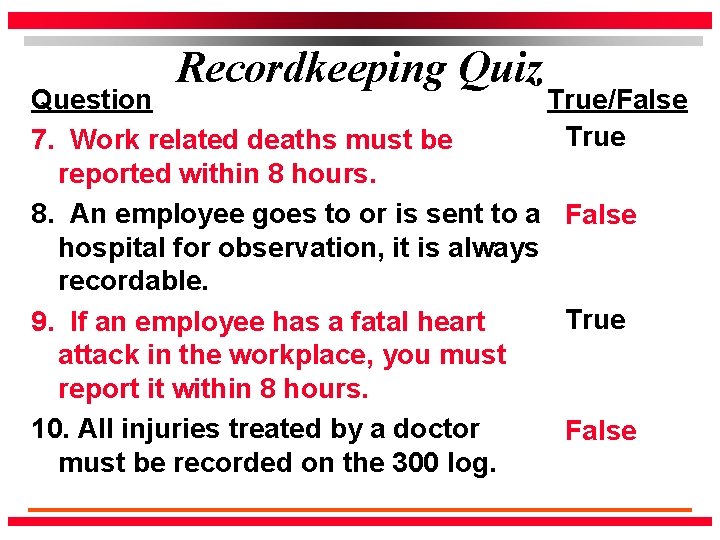
Recordkeeping Quiz True/False Question True 7. Work related deaths must be reported within 8 hours. 8. An employee goes to or is sent to a False hospital for observation, it is always recordable. True 9. If an employee has a fatal heart attack in the workplace, you must report it within 8 hours. 10. All injuries treated by a doctor False must be recorded on the 300 log.
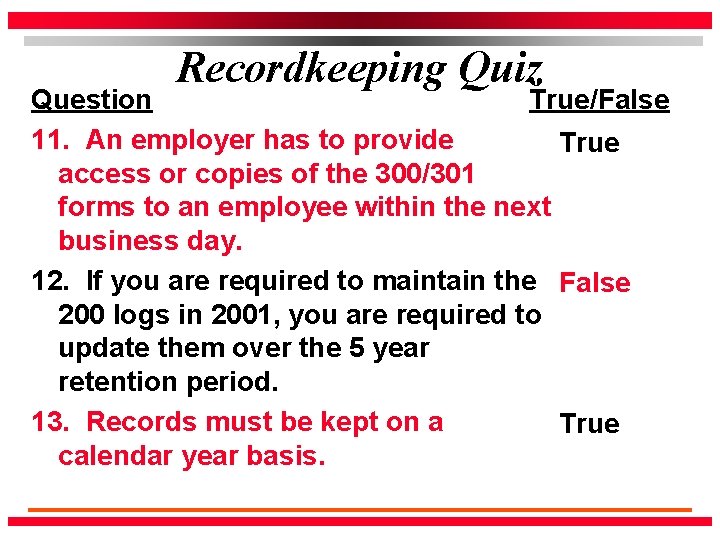
Recordkeeping Quiz True/False Question 11. An employer has to provide True access or copies of the 300/301 forms to an employee within the next business day. 12. If you are required to maintain the False 200 logs in 2001, you are required to update them over the 5 year retention period. 13. Records must be kept on a True calendar year basis.
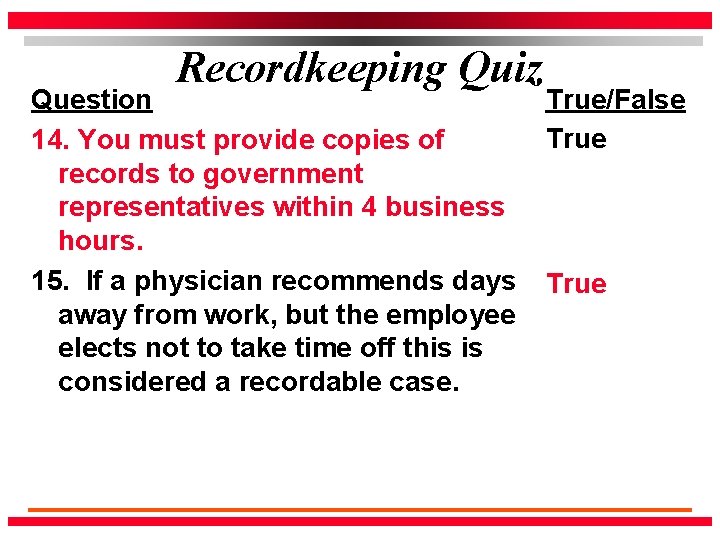
Recordkeeping Quiz Question 14. You must provide copies of records to government representatives within 4 business hours. 15. If a physician recommends days away from work, but the employee elects not to take time off this is considered a recordable case. True/False True
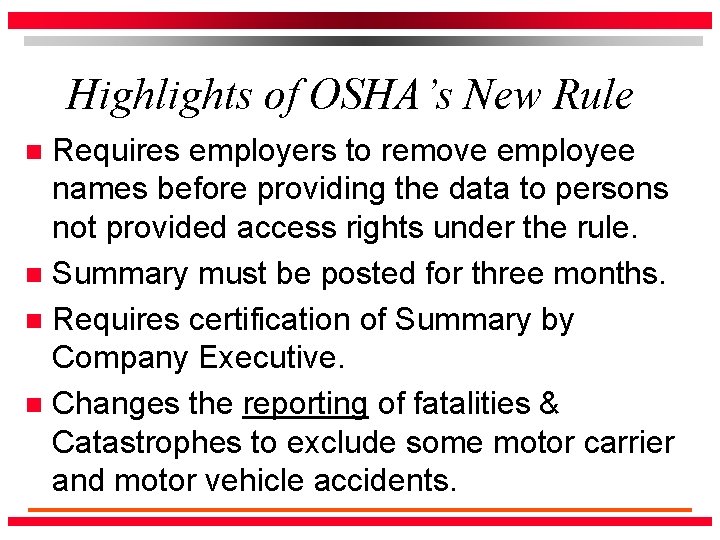
Highlights of OSHA’s New Rule Requires employers to remove employee names before providing the data to persons not provided access rights under the rule. n Summary must be posted for three months. n Requires certification of Summary by Company Executive. n Changes the reporting of fatalities & Catastrophes to exclude some motor carrier and motor vehicle accidents. n
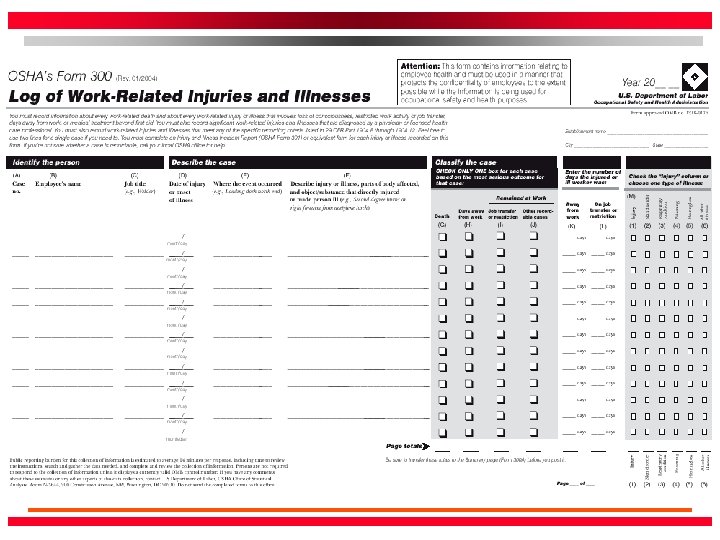
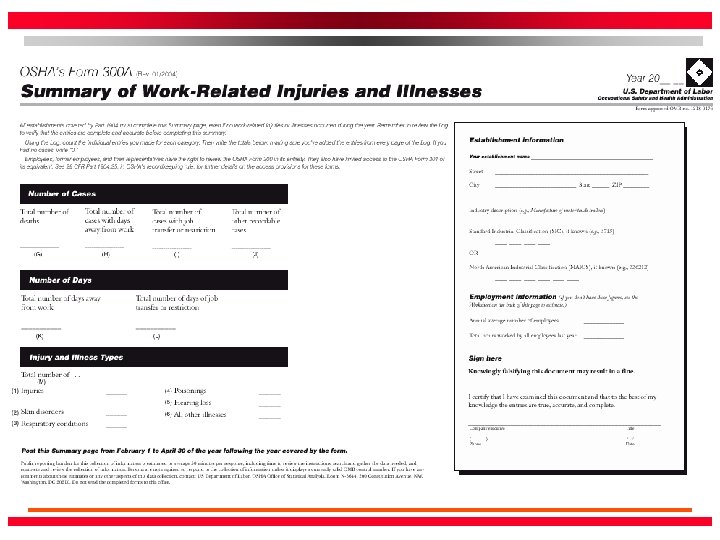
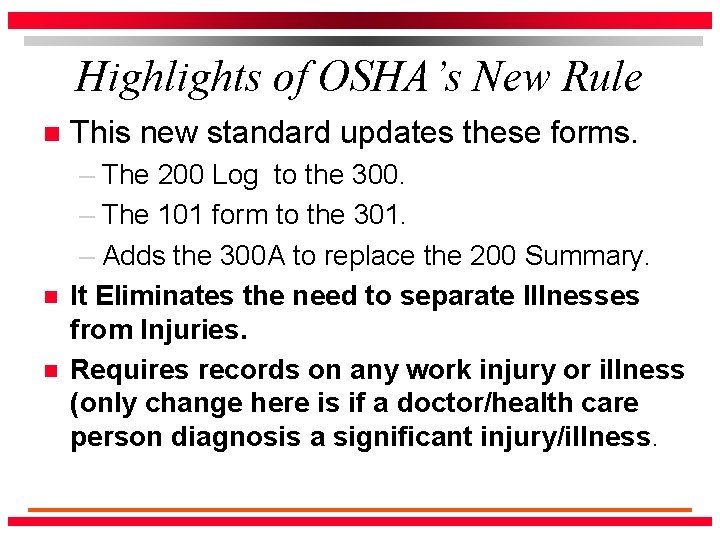
Highlights of OSHA’s New Rule n This new standard updates these forms. n – The 200 Log to the 300. – The 101 form to the 301. – Adds the 300 A to replace the 200 Summary. It Eliminates the need to separate Illnesses from Injuries. Requires records on any work injury or illness (only change here is if a doctor/health care person diagnosis a significant injury/illness. n
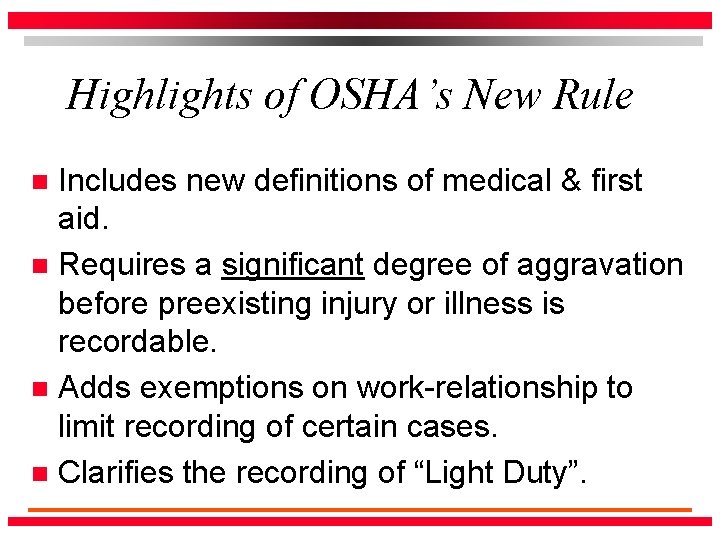
Highlights of OSHA’s New Rule Includes new definitions of medical & first aid. n Requires a significant degree of aggravation before preexisting injury or illness is recordable. n Adds exemptions on work-relationship to limit recording of certain cases. n Clarifies the recording of “Light Duty”. n
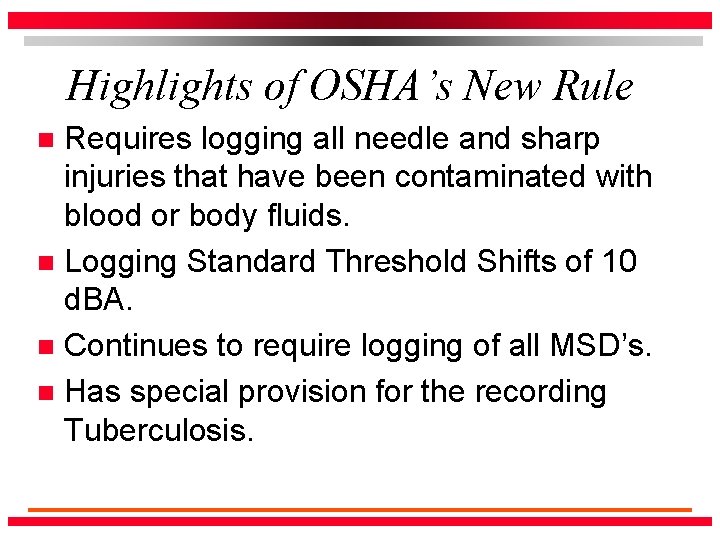
Highlights of OSHA’s New Rule Requires logging all needle and sharp injuries that have been contaminated with blood or body fluids. n Logging Standard Threshold Shifts of 10 d. BA. n Continues to require logging of all MSD’s. n Has special provision for the recording Tuberculosis. n
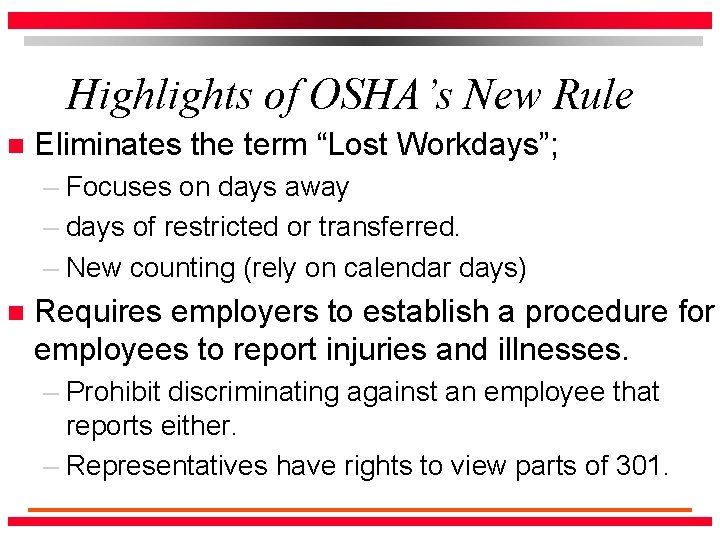
Highlights of OSHA’s New Rule n Eliminates the term “Lost Workdays”; – Focuses on days away – days of restricted or transferred. – New counting (rely on calendar days) n Requires employers to establish a procedure for employees to report injuries and illnesses. – Prohibit discriminating against an employee that reports either. – Representatives have rights to view parts of 301.
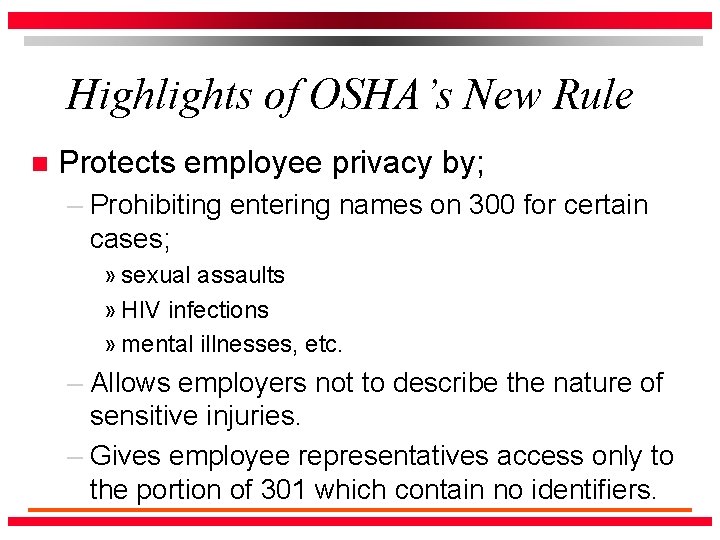
Highlights of OSHA’s New Rule n Protects employee privacy by; – Prohibiting entering names on 300 for certain cases; » sexual assaults » HIV infections » mental illnesses, etc. – Allows employers not to describe the nature of sensitive injuries. – Gives employee representatives access only to the portion of 301 which contain no identifiers.
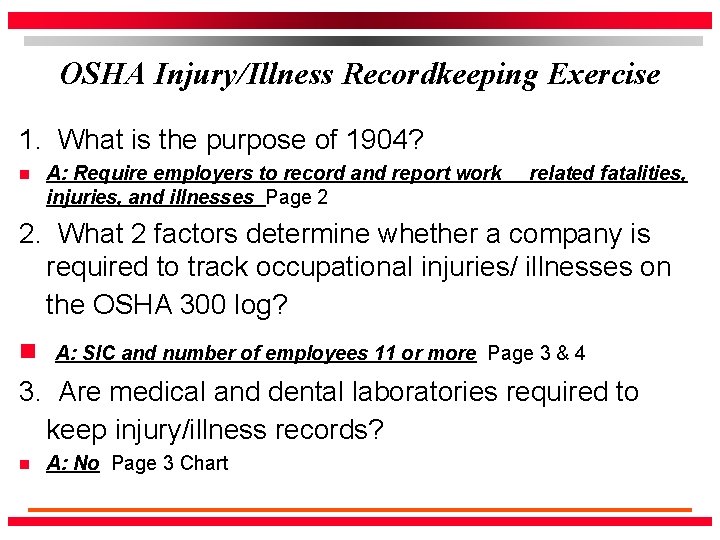
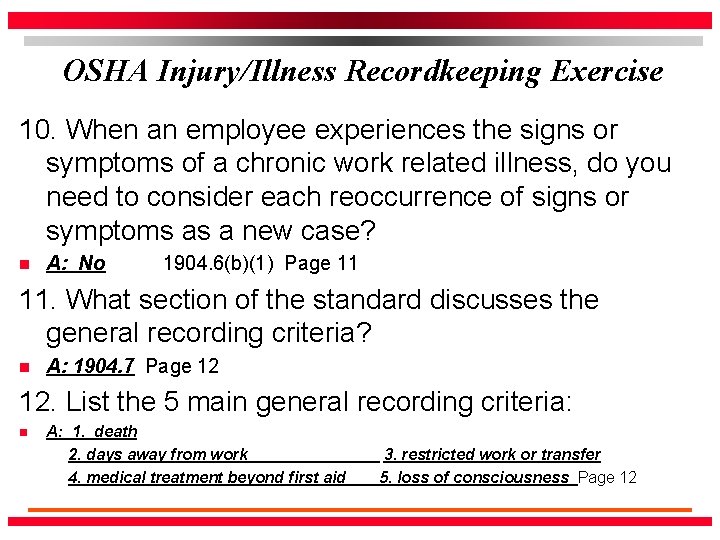
OSHA Injury/Illness Recordkeeping Exercise 1. What is the purpose of 1904? n A: Require employers to record and report work injuries, and illnesses Page 2 related fatalities, 2. What 2 factors determine whether a company is required to track occupational injuries/ illnesses on the OSHA 300 log? n A: SIC and number of employees 11 or more Page 3 & 4 3. Are medical and dental laboratories required to keep injury/illness records? n A: No Page 3 Chart
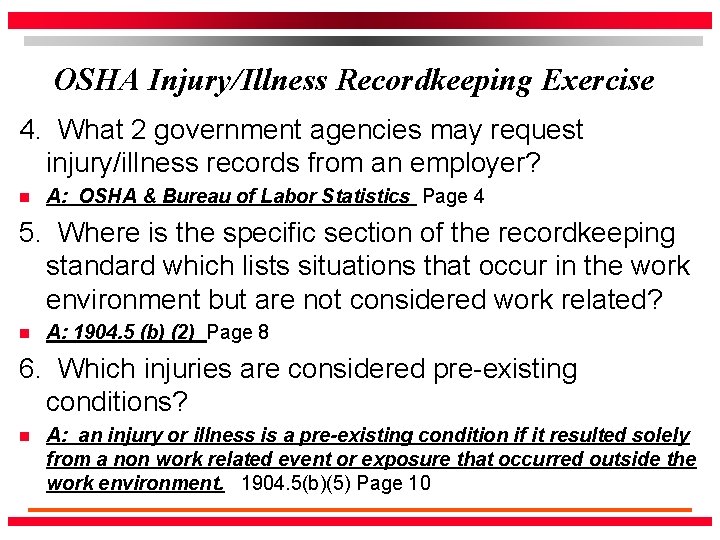
OSHA Injury/Illness Recordkeeping Exercise 4. What 2 government agencies may request injury/illness records from an employer? n A: OSHA & Bureau of Labor Statistics Page 4 5. Where is the specific section of the recordkeeping standard which lists situations that occur in the work environment but are not considered work related? n A: 1904. 5 (b) (2) Page 8 6. Which injuries are considered pre-existing conditions? n A: an injury or illness is a pre-existing condition if it resulted solely from a non work related event or exposure that occurred outside the work environment. 1904. 5(b)(5) Page 10
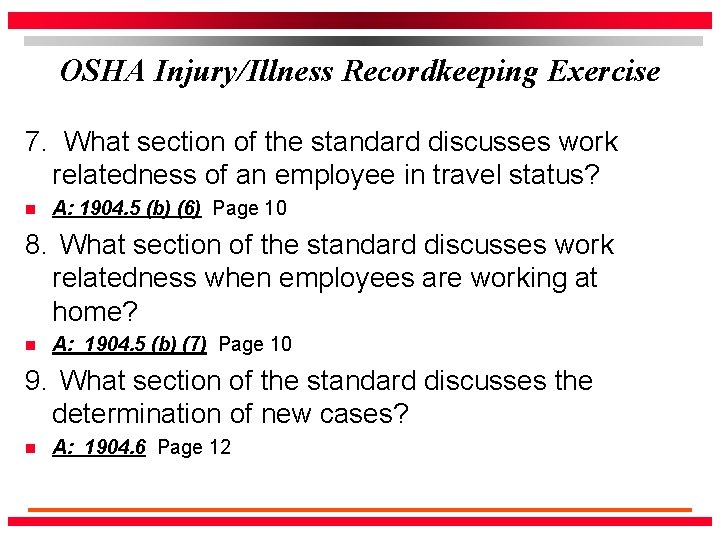
OSHA Injury/Illness Recordkeeping Exercise 7. What section of the standard discusses work relatedness of an employee in travel status? n A: 1904. 5 (b) (6) Page 10 8. What section of the standard discusses work relatedness when employees are working at home? n A: 1904. 5 (b) (7) Page 10 9. What section of the standard discusses the determination of new cases? n A: 1904. 6 Page 12
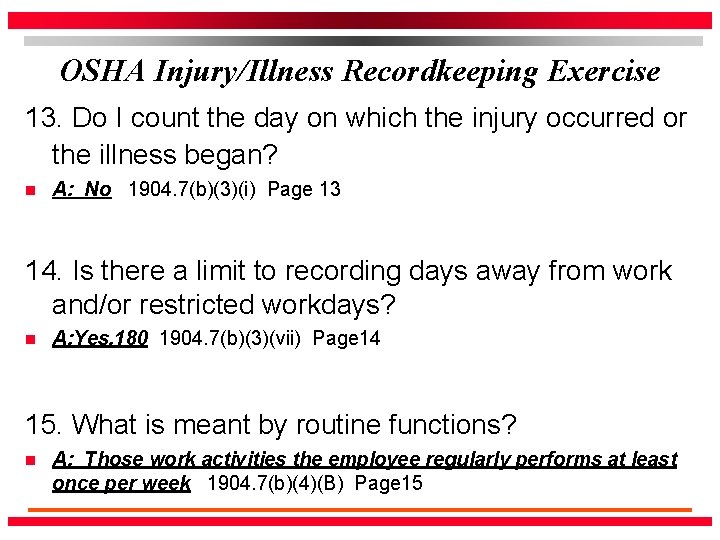
OSHA Injury/Illness Recordkeeping Exercise 10. When an employee experiences the signs or symptoms of a chronic work related illness, do you need to consider each reoccurrence of signs or symptoms as a new case? n A: No 1904. 6(b)(1) Page 11 11. What section of the standard discusses the general recording criteria? n A: 1904. 7 Page 12 12. List the 5 main general recording criteria: n A: 1. death 2. days away from work 4. medical treatment beyond first aid 3. restricted work or transfer 5. loss of consciousness Page 12
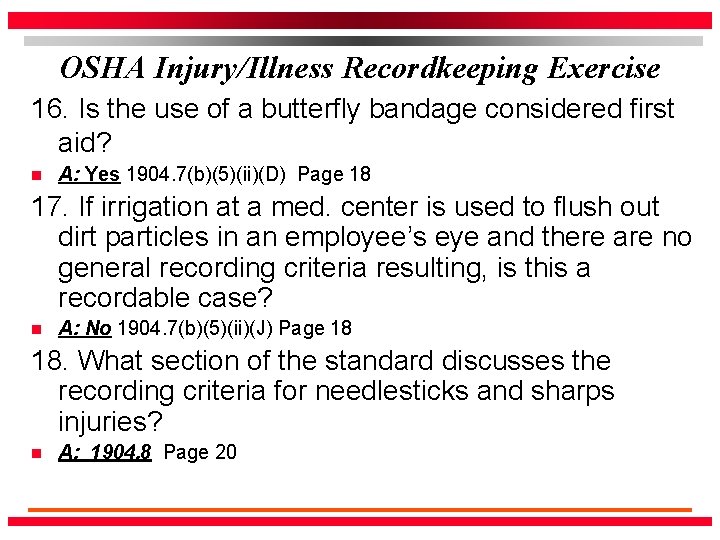
OSHA Injury/Illness Recordkeeping Exercise 13. Do I count the day on which the injury occurred or the illness began? n A: No 1904. 7(b)(3)(i) Page 13 14. Is there a limit to recording days away from work and/or restricted workdays? n A: Yes, 180 1904. 7(b)(3)(vii) Page 14 15. What is meant by routine functions? n A: Those work activities the employee regularly performs at least once per week 1904. 7(b)(4)(B) Page 15
OSHA Injury/Illness Recordkeeping Exercise 16. Is the use of a butterfly bandage considered first aid? n A: Yes 1904. 7(b)(5)(ii)(D) Page 18 17. If irrigation at a med. center is used to flush out dirt particles in an employee’s eye and there are no general recording criteria resulting, is this a recordable case? n A: No 1904. 7(b)(5)(ii)(J) Page 18 18. What section of the standard discusses the recording criteria for needlesticks and sharps injuries? n A: 1904. 8 Page 20
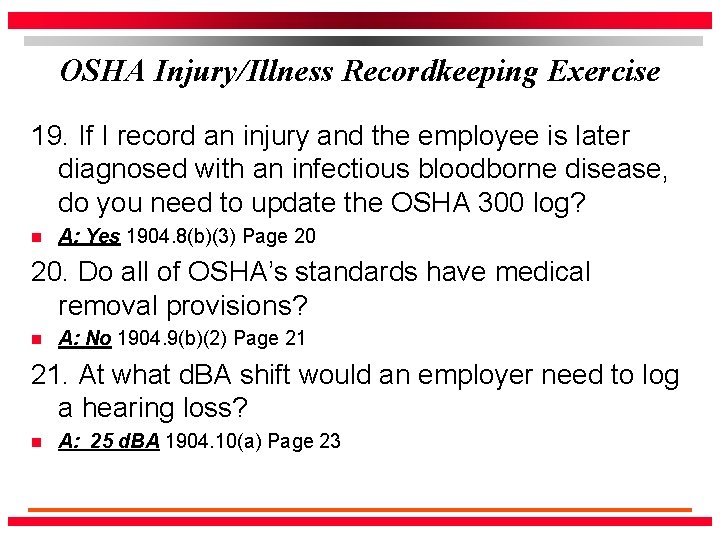
OSHA Injury/Illness Recordkeeping Exercise 19. If I record an injury and the employee is later diagnosed with an infectious bloodborne disease, do you need to update the OSHA 300 log? n A: Yes 1904. 8(b)(3) Page 20 20. Do all of OSHA’s standards have medical removal provisions? n A: No 1904. 9(b)(2) Page 21 21. At what d. BA shift would an employer need to log a hearing loss? n A: 25 d. BA 1904. 10(a) Page 23
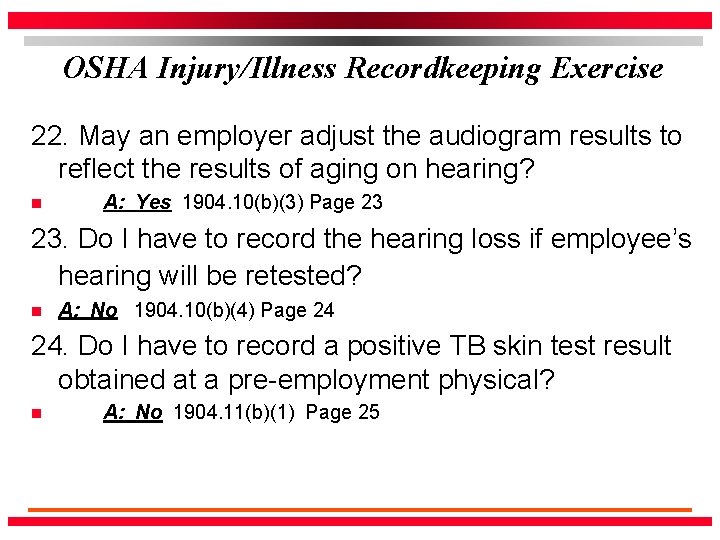
OSHA Injury/Illness Recordkeeping Exercise 22. May an employer adjust the audiogram results to reflect the results of aging on hearing? n A: Yes 1904. 10(b)(3) Page 23 23. Do I have to record the hearing loss if employee’s hearing will be retested? n A: No 1904. 10(b)(4) Page 24 24. Do I have to record a positive TB skin test result obtained at a pre-employment physical? n A: No 1904. 11(b)(1) Page 25
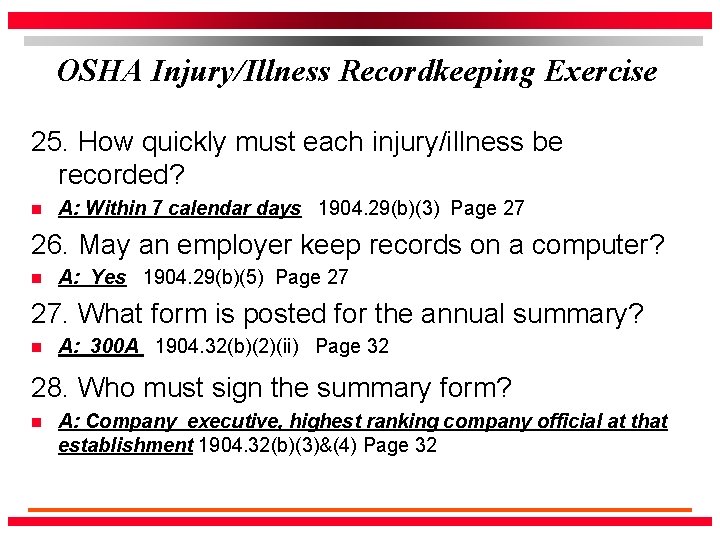
OSHA Injury/Illness Recordkeeping Exercise 25. How quickly must each injury/illness be recorded? n A: Within 7 calendar days 1904. 29(b)(3) Page 27 26. May an employer keep records on a computer? n A: Yes 1904. 29(b)(5) Page 27 27. What form is posted for the annual summary? n A: 300 A 1904. 32(b)(2)(ii) Page 32 28. Who must sign the summary form? n A: Company executive, highest ranking company official at that establishment 1904. 32(b)(3)&(4) Page 32
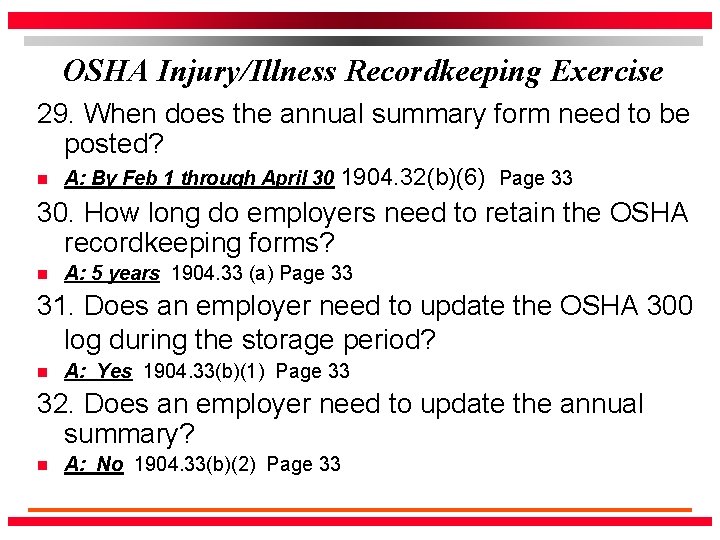
OSHA Injury/Illness Recordkeeping Exercise 29. When does the annual summary form need to be posted? n A: By Feb 1 through April 30 1904. 32(b)(6) Page 33 30. How long do employers need to retain the OSHA recordkeeping forms? n A: 5 years 1904. 33 (a) Page 33 31. Does an employer need to update the OSHA 300 log during the storage period? n A: Yes 1904. 33(b)(1) Page 33 32. Does an employer need to update the annual summary? n A: No 1904. 33(b)(2) Page 33
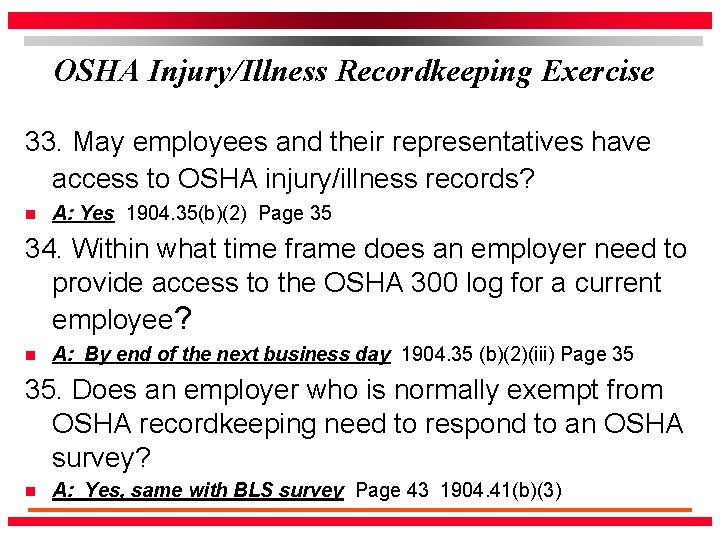
OSHA Injury/Illness Recordkeeping Exercise 33. May employees and their representatives have access to OSHA injury/illness records? n A: Yes 1904. 35(b)(2) Page 35 34. Within what time frame does an employer need to provide access to the OSHA 300 log for a current employee? n A: By end of the next business day 1904. 35 (b)(2)(iii) Page 35 35. Does an employer who is normally exempt from OSHA recordkeeping need to respond to an OSHA survey? n A: Yes, same with BLS survey Page 43 1904. 41(b)(3)
OSHA 29 CFR Part 1904 Recording and Reporting Occupational Injuries and Illnesses
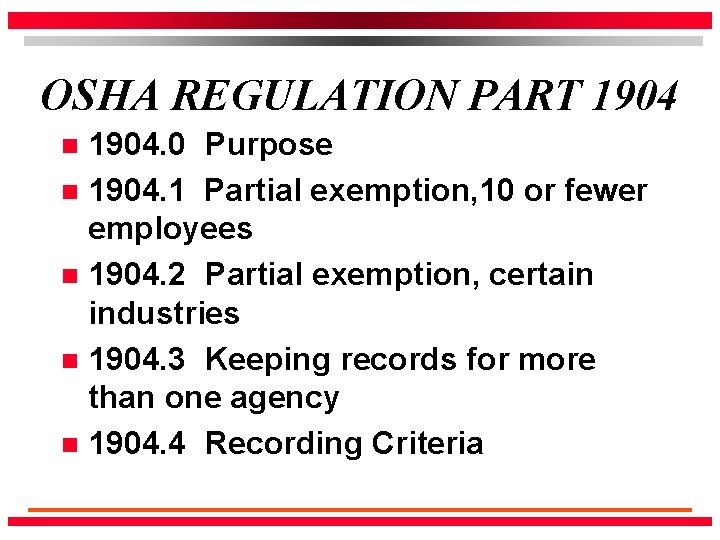
OSHA REGULATION PART 1904. 0 Purpose n 1904. 1 Partial exemption, 10 or fewer employees n 1904. 2 Partial exemption, certain industries n 1904. 3 Keeping records for more than one agency n 1904. 4 Recording Criteria n
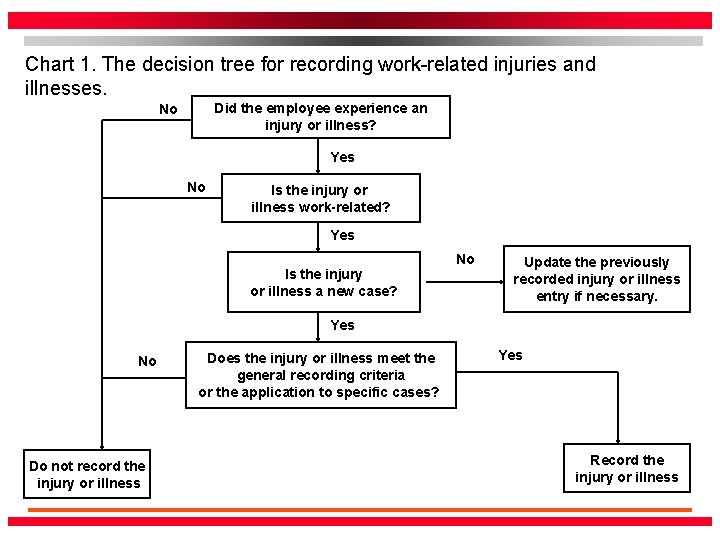
Chart 1. The decision tree for recording work-related injuries and illnesses. Did the employee experience an injury or illness? No Yes No Is the injury or illness work-related? Yes Is the injury or illness a new case? No Update the previously recorded injury or illness entry if necessary. Yes No Do not record the injury or illness Does the injury or illness meet the general recording criteria or the application to specific cases? Yes Record the injury or illness
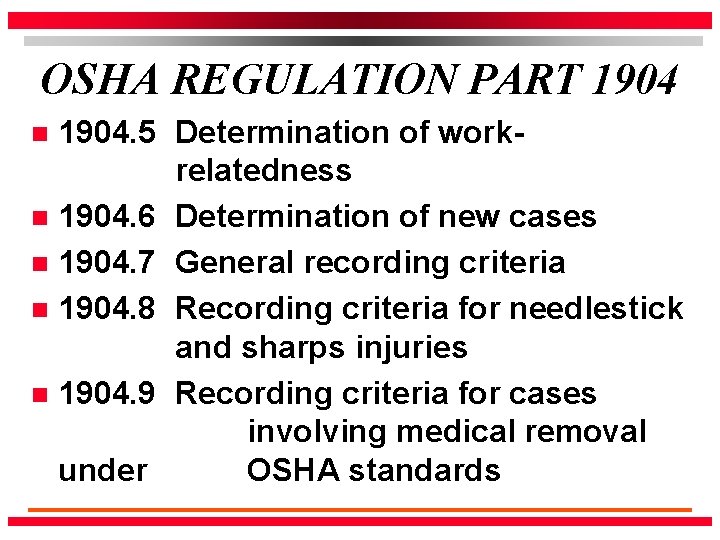
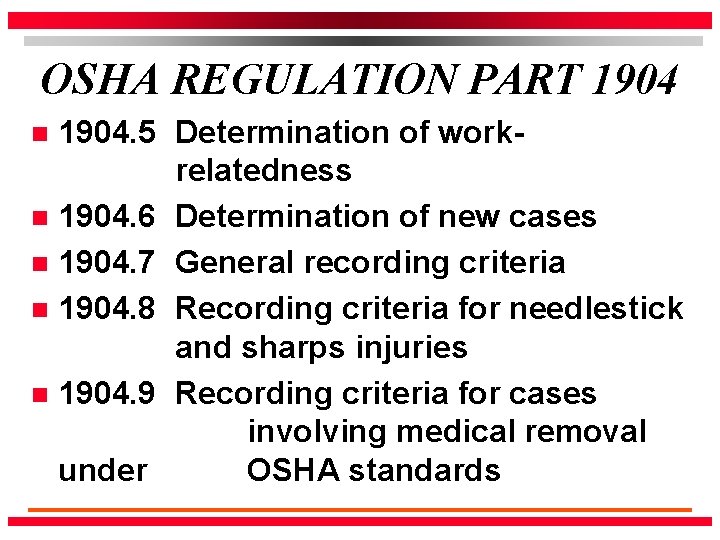
OSHA REGULATION PART 1904. 5 Determination of workrelatedness n 1904. 6 Determination of new cases n 1904. 7 General recording criteria n 1904. 8 Recording criteria for needlestick and sharps injuries n 1904. 9 Recording criteria for cases involving medical removal under OSHA standards n
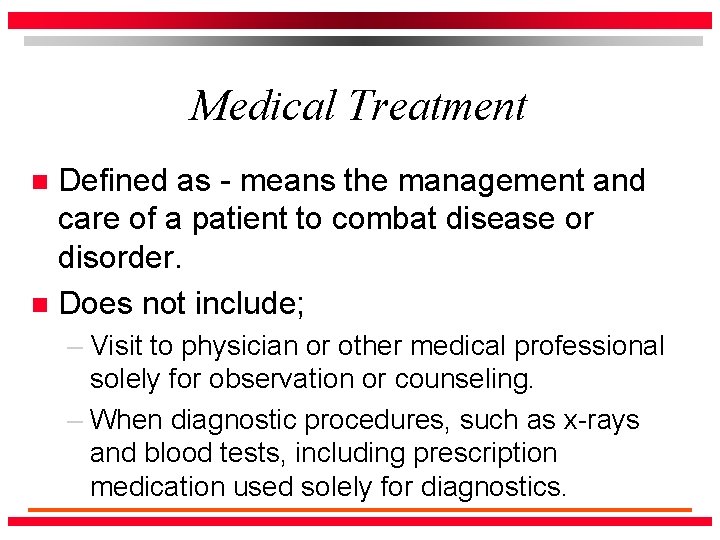
Medical Treatment Defined as - means the management and care of a patient to combat disease or disorder. n Does not include; n – Visit to physician or other medical professional solely for observation or counseling. – When diagnostic procedures, such as x-rays and blood tests, including prescription medication used solely for diagnostics.
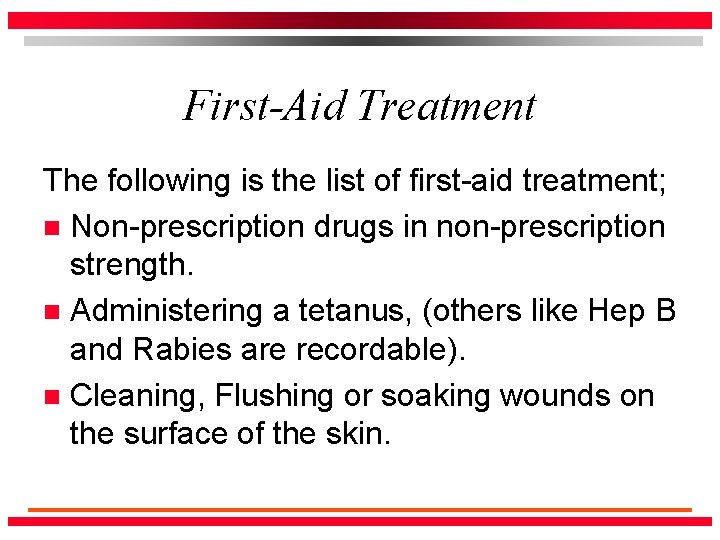
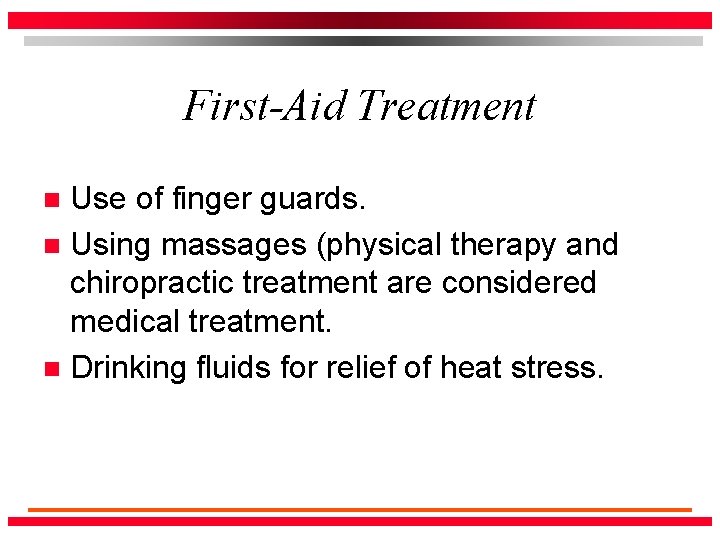
First-Aid Treatment The following is the list of first-aid treatment; n Non-prescription drugs in non-prescription strength. n Administering a tetanus, (others like Hep B and Rabies are recordable). n Cleaning, Flushing or soaking wounds on the surface of the skin.
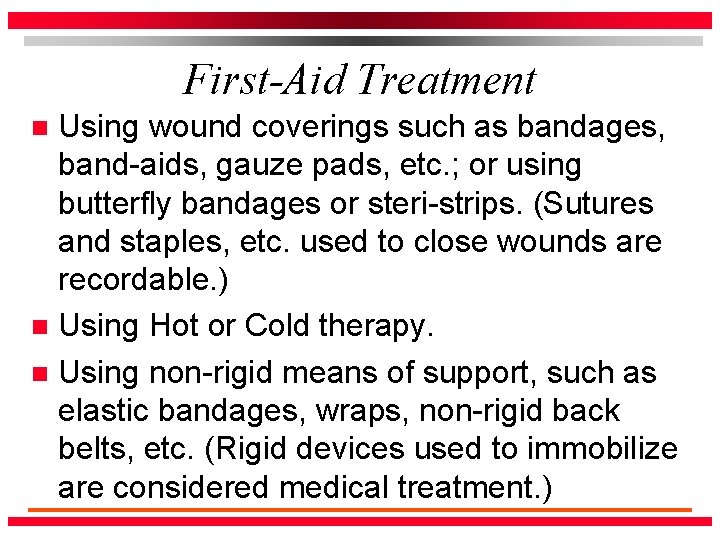
First-Aid Treatment Using wound coverings such as bandages, band-aids, gauze pads, etc. ; or using butterfly bandages or steri-strips. (Sutures and staples, etc. used to close wounds are recordable. ) n Using Hot or Cold therapy. n Using non-rigid means of support, such as elastic bandages, wraps, non-rigid back belts, etc. (Rigid devices used to immobilize are considered medical treatment. ) n
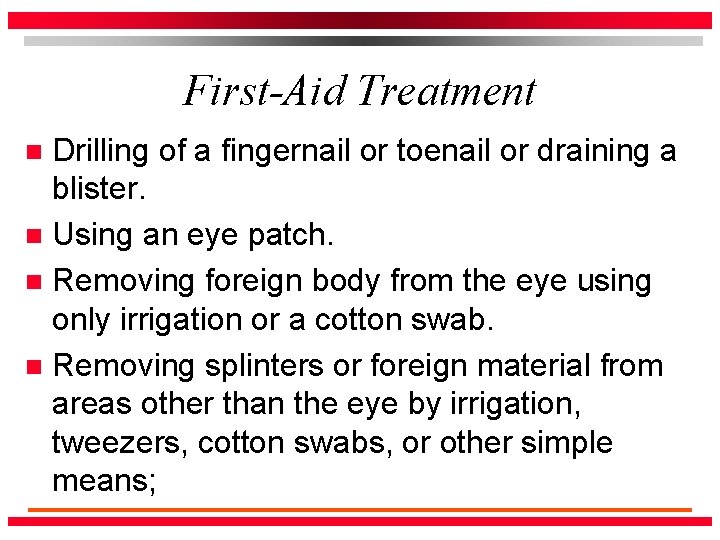
First-Aid Treatment Drilling of a fingernail or toenail or draining a blister. n Using an eye patch. n Removing foreign body from the eye using only irrigation or a cotton swab. n Removing splinters or foreign material from areas other than the eye by irrigation, tweezers, cotton swabs, or other simple means; n
First-Aid Treatment Use of finger guards. n Using massages (physical therapy and chiropractic treatment are considered medical treatment. n Drinking fluids for relief of heat stress. n
OSHA REGULATION PART 1904. 5 Determination of workrelatedness n 1904. 6 Determination of new cases n 1904. 7 General recording criteria n 1904. 8 Recording criteria for needlestick and sharps injuries n 1904. 9 Recording criteria for cases involving medical removal under OSHA standards n
OSHA REGULATION PART 1904 n 1904. 10 Recording criteria for cases involving occupational hearing loss
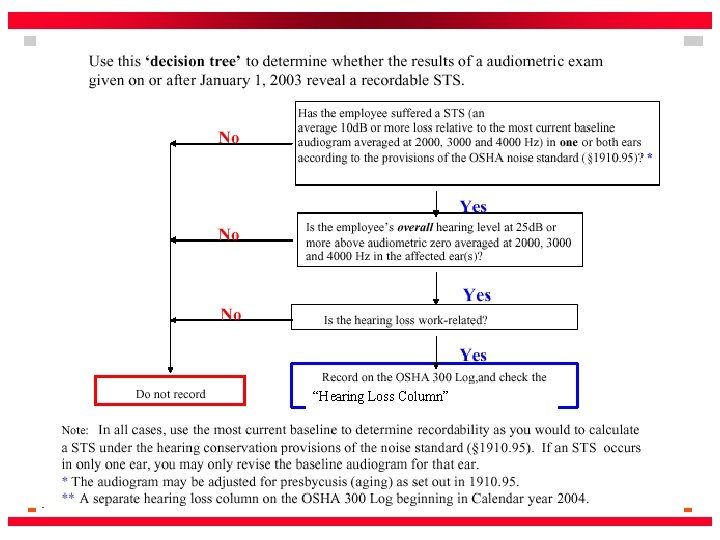
“Hearing Loss Column”
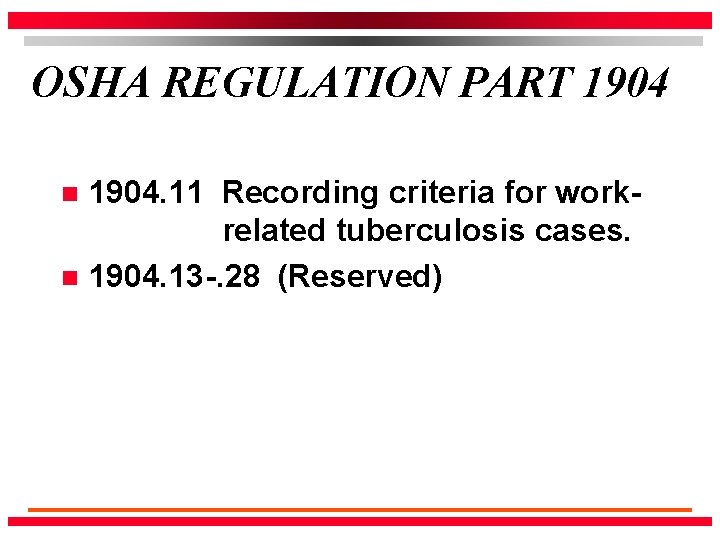
OSHA REGULATION PART 1904. 11 Recording criteria for workrelated tuberculosis cases. n 1904. 13 -. 28 (Reserved) n
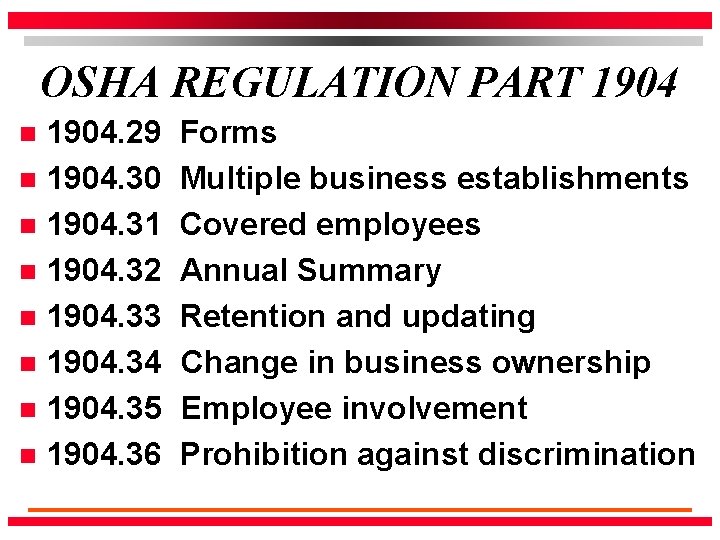
OSHA REGULATION PART 1904. 29 n 1904. 30 n 1904. 31 n 1904. 32 n 1904. 33 n 1904. 34 n 1904. 35 n 1904. 36 n Forms Multiple business establishments Covered employees Annual Summary Retention and updating Change in business ownership Employee involvement Prohibition against discrimination
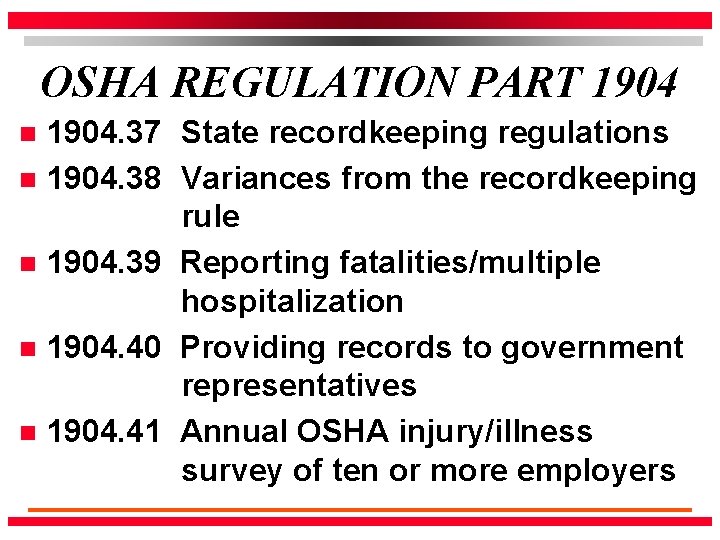
OSHA REGULATION PART 1904. 37 State recordkeeping regulations n 1904. 38 Variances from the recordkeeping rule n 1904. 39 Reporting fatalities/multiple hospitalization n 1904. 40 Providing records to government representatives n 1904. 41 Annual OSHA injury/illness survey of ten or more employers n
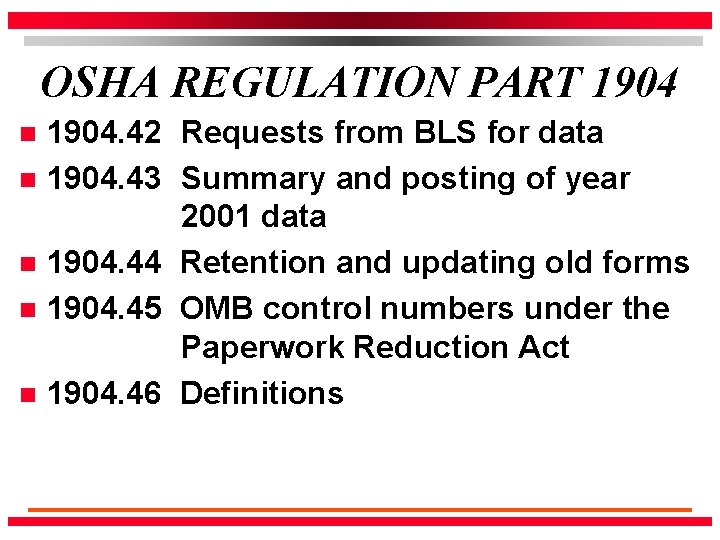
OSHA REGULATION PART 1904. 42 Requests from BLS for data n 1904. 43 Summary and posting of year 2001 data n 1904. 44 Retention and updating old forms n 1904. 45 OMB control numbers under the Paperwork Reduction Act n 1904. 46 Definitions n
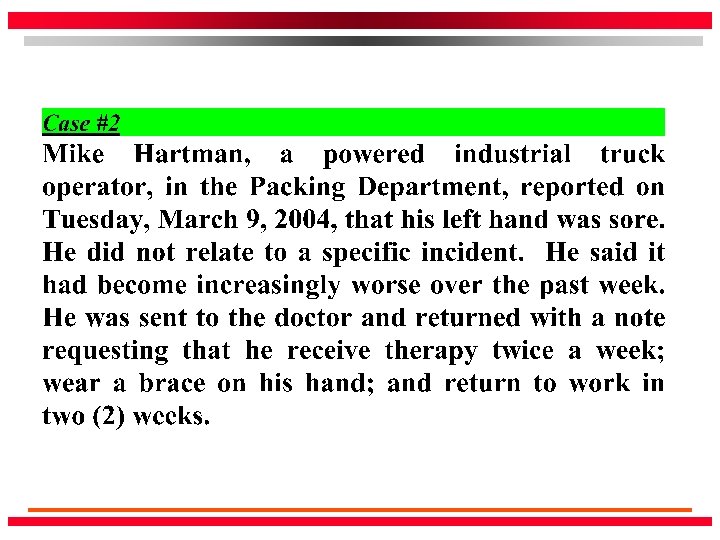
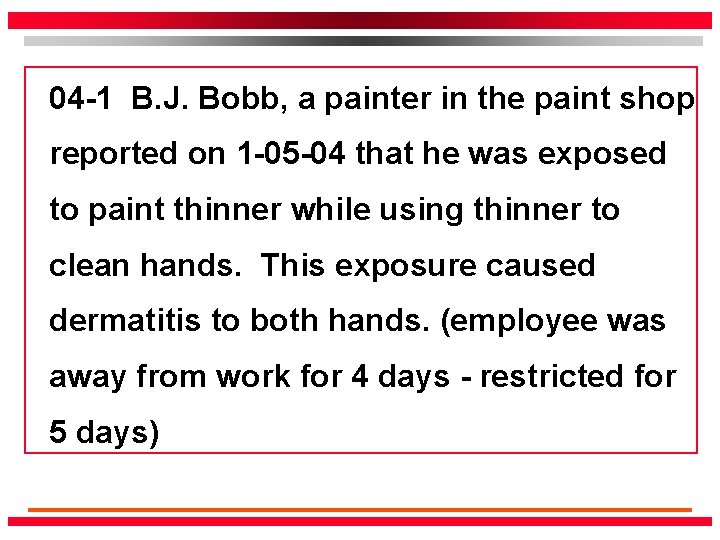
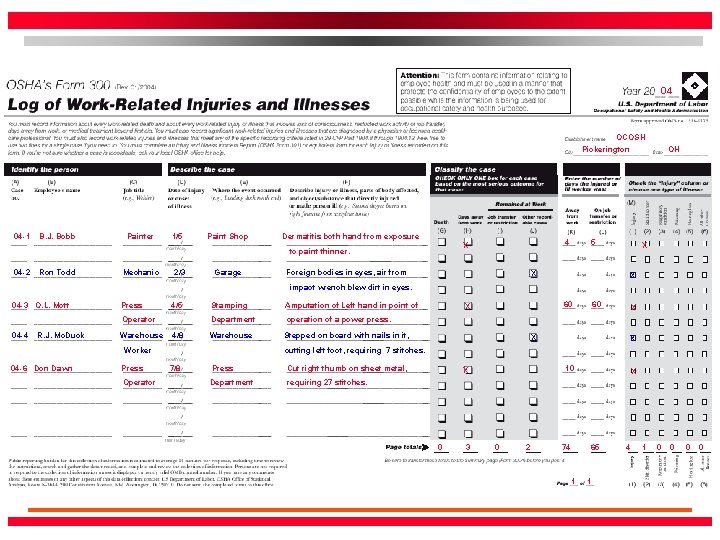
04 -1 B. J. Bobb, a painter in the paint shop reported on 1 -05 -04 that he was exposed to paint thinner while using thinner to clean hands. This exposure caused dermatitis to both hands. (employee was away from work for 4 days - restricted for 5 days)
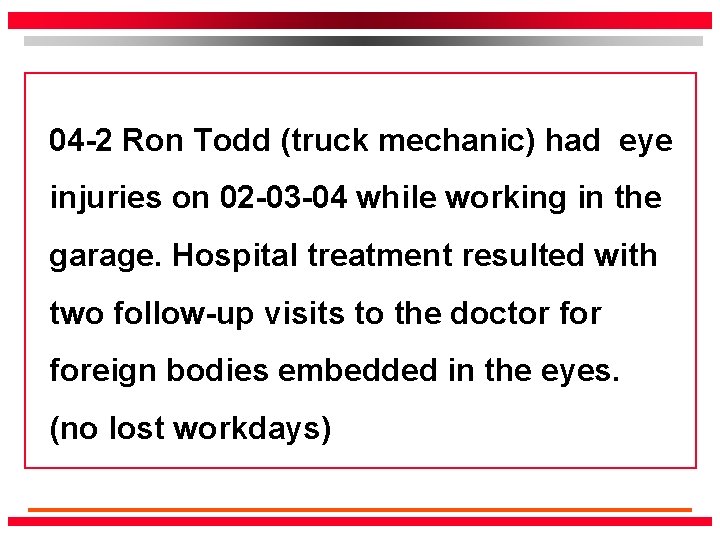
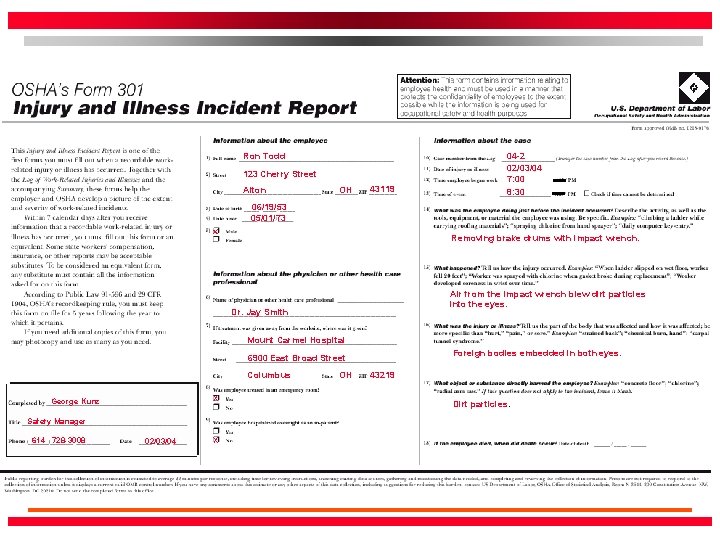
04 -2 Ron Todd (truck mechanic) had eye injuries on 02 -03 -04 while working in the garage. Hospital treatment resulted with two follow-up visits to the doctor foreign bodies embedded in the eyes. (no lost workdays)
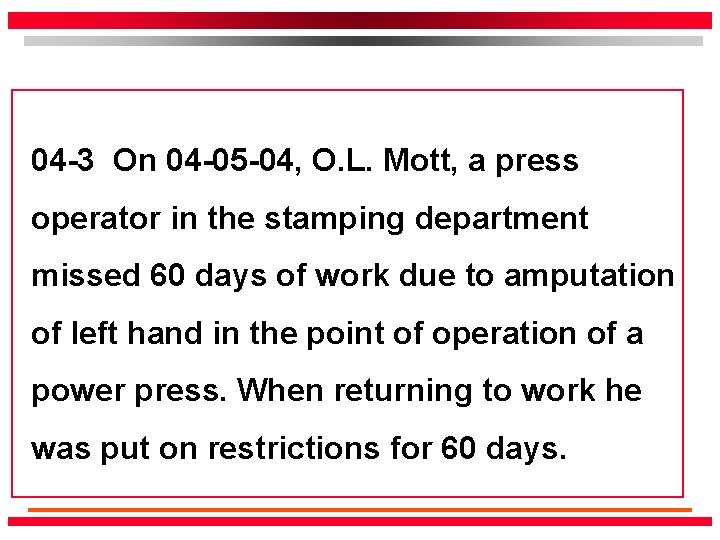
04 -3 On 04 -05 -04, O. L. Mott, a press operator in the stamping department missed 60 days of work due to amputation of left hand in the point of operation of a power press. When returning to work he was put on restrictions for 60 days.
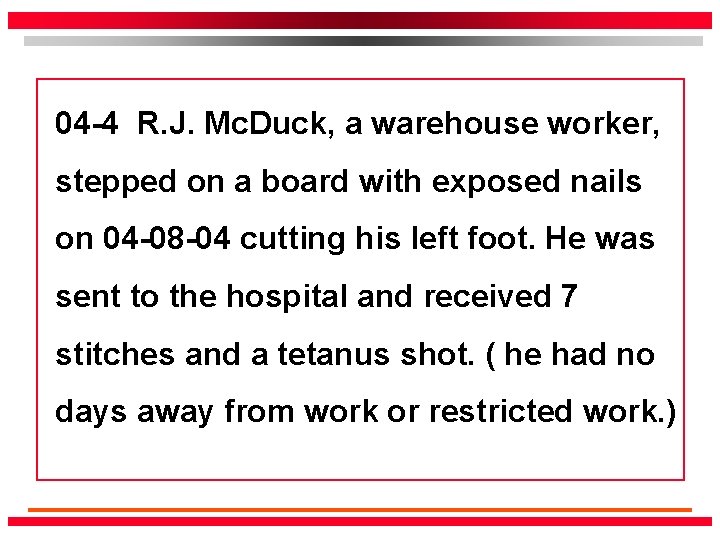
04 -4 R. J. Mc. Duck, a warehouse worker, stepped on a board with exposed nails on 04 -08 -04 cutting his left foot. He was sent to the hospital and received 7 stitches and a tetanus shot. ( he had no days away from work or restricted work. )
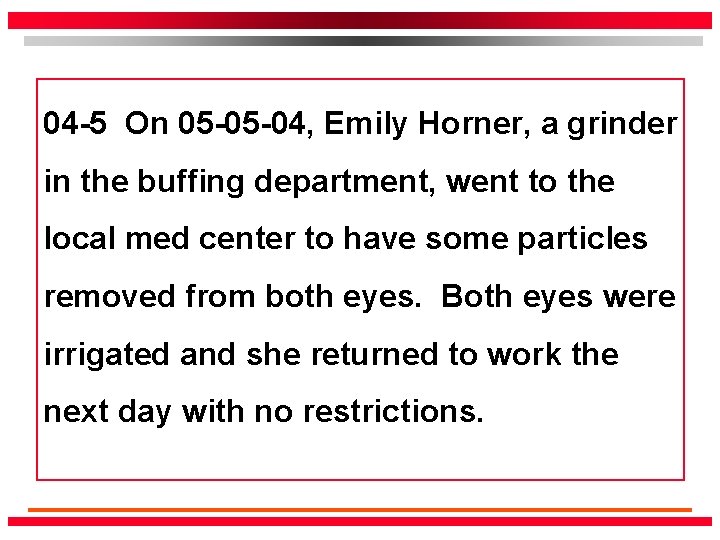
04 -5 On 05 -05 -04, Emily Horner, a grinder in the buffing department, went to the local med center to have some particles removed from both eyes. Both eyes were irrigated and she returned to work the next day with no restrictions.
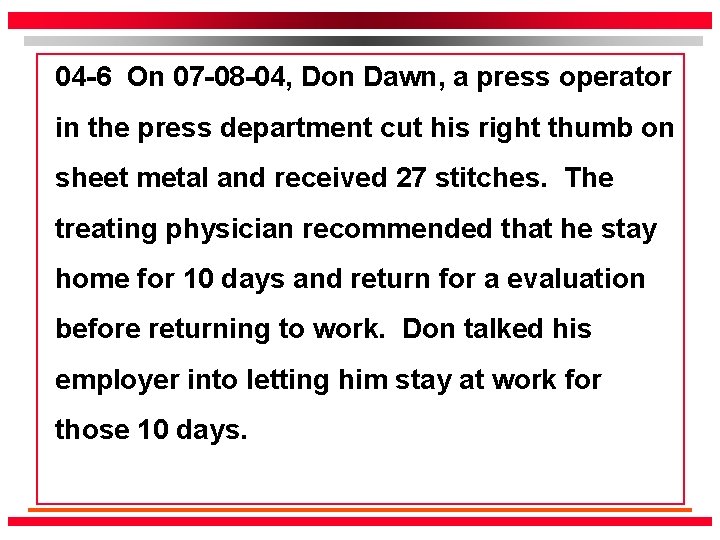
04 -6 On 07 -08 -04, Don Dawn, a press operator in the press department cut his right thumb on sheet metal and received 27 stitches. The treating physician recommended that he stay home for 10 days and return for a evaluation before returning to work. Don talked his employer into letting him stay at work for those 10 days.
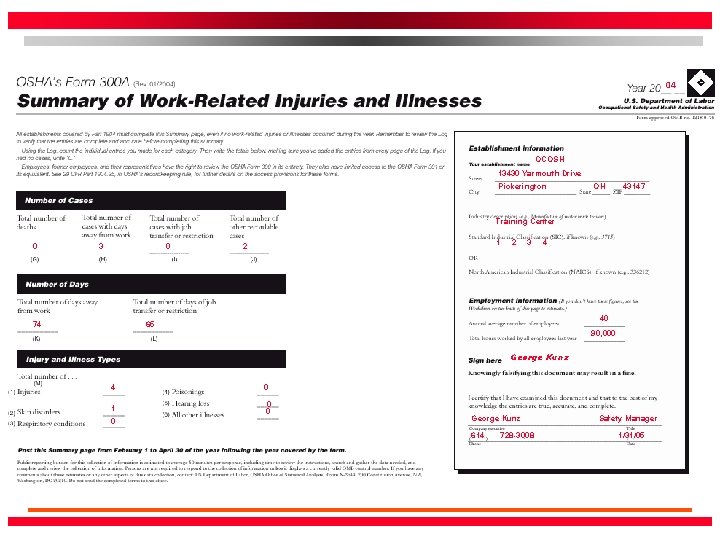
04 OCOSH Pickerington 04 -1 B. J. Bobb Painter 1/5 Paint Shop Dermatitis both hand from exposure 04 -2 Ron Todd Mechanic 2/3 Garage 4 X to paint thinner. Foreign bodies in eyes, air from OH 5 X X X impact wrench blew dirt in eyes. 04 -3 O. L. Mott Press 4/5 Operator 04 -4 R. J. Mc. Duck Warehouse 4/8 Stamping Amputation of Left hand in point of Department operation of a power press. Warehouse Worker 04 -6 Don Dawn Press Operator 60 X Stepped on board with nails in it, 60 X X X cutting left foot, requiring 7 stitches. 7/8 Press Cut right thumb on sheet metal, Department requiring 27 stitches. 10 X 0 3 0 2 74 X 65 1 1 4 1 0 0
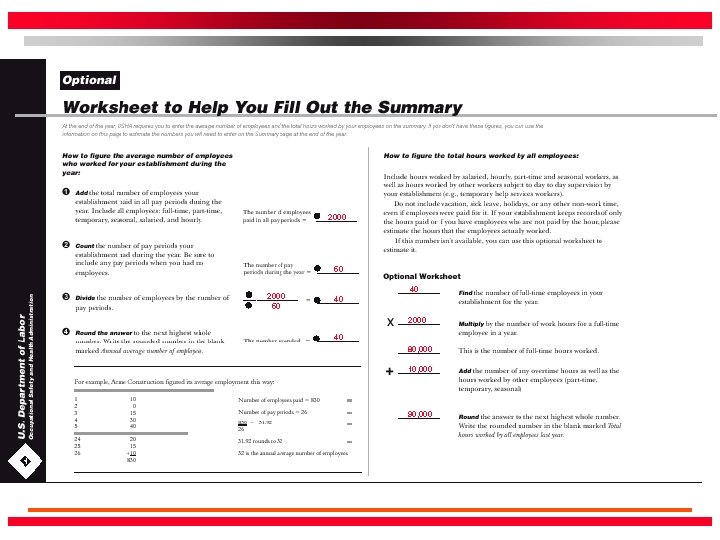
2000 50 40 40 2000 40 80, 000 10, 000 90, 000
04 OCOSH 13430 Yarmouth Drive Pickerington OH 43147 Training Center 0 3 0 74 1 2 2 3 4 40 65 90, 000 George Kunz 4 0 1 0 0 0 George Kunz 614 728 -3008 Safety Manager 1/31/05
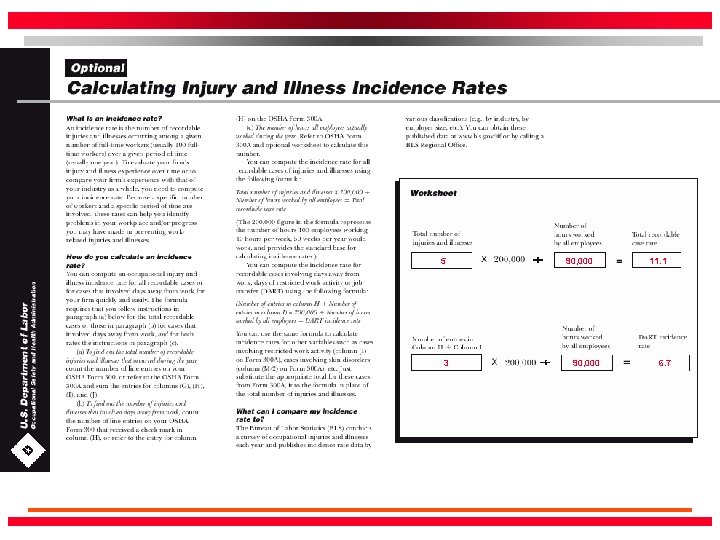
5 3 90, 000 11. 1 6. 7
Ron Todd 123 Cherry Street Alton OH 43119 04 -2 02/03/04 7: 00 8: 30 06/19/53 05/01/73 x Removing brake drums with impact wrench. Air from the impact wrench blew dirt particles into the eyes. Dr. Jay Smith Mount Carmel Hospital Foreign bodies embedded in both eyes. 6900 East Broad Street Columbus X George Kunz Safety Manager 614 728 -3008 02/03/04 X OH 43219 Dirt particles.