
OSHA Process Safety Management Program Chemical and Refinery
- Slides: 21
OSHA Process Safety Management Program Chemical and Refinery National Emphasis Programs
Emphasis Programs OSHA Emphasis Program (NEP) address hazardous industries or operations for targeted inspections. Ø Programmed inspections will take place in all Regions in facilities that are known to OSHA. Ø Un-programmed inspections will also be conducted in all OSHA Regions. Ø
CHEMICAL PSM NEP Purpose: Prevention or minimization of the consequences of catastrophic releases of toxic, reactive, flammable, or explosive chemicals
PSM STANDARD (1910. 119) Application Ø A process which involves a chemical at or above the specified threshold quantities listed in Appendix A (136) Ø A process which involves a flammable liquid or gas (defined in 1910. 1200(c)) on site in one location, in a quantity of 10, 000 pounds (4535. 9 kg) or more (with some exceptions).
PSM NATIONAL EMPHASIS PROGRAM PSM Refinery NEP Ø OSHA initiated the Refinery NEP in 2007 to address catastrophic releases of highly hazardous chemicals at refineries (SIC 2911) Ø Region VI conducted approximately 32 refinery NEP inspections over the next three years.
NEP Targeting Sources Ø OSHA will use four sources for targeting Ø U. S. EPA Chemical Accident Prevention Provisions, RMP 3 Ø Explosives manufacturing NAICS codes Ø OSHA’s IMIS database Ø OSHA Area Office knowledge of local facilities.
Site Selection 3 -5 inspections per Area Office per year. In Region VI we will also performing 6 refineries. OSHA will also use the Chem NEP inspection framework to conduct incident investigations (fires/explosions fatalities and catastrophes) Ø Based on their familiarity with local facilities, ROs and AOs shall add or delete facilities as necessary. Ø Ø Ø
Selection of Unit A PSM-covered process or processes shall be selected for evaluation for compliance with the standard. For large continuous processes, a portion of the covered process may be selected, for example, a unit operation within the covered process. Ø More than one unit may be selected if it is deemed necessary to get a representative sample of the facility’s covered processes based on the size and complexity of the facility. Ø Often the most hazardous process is selected; however, discretion can be used in choosing the Selected Unit. Ø
Ammonia One of the Categories will include Ø Category 1 –Facilities likely to have ammonia used for refrigeration
PSM STANDARD Ø Process Safety Information (PSI) Ø Process Hazard Analysis (PHA) Ø Operating Procedures Ø Pre-startup Safety Review Ø Mechanical integrity
PSM STANDARD Ø Contractor Evaluation/Performance Ø Management of change Ø Incident investigation Ø Emergency planning and response Ø Compliance Audits
Chemical NEP Inspection Plan OSHA to inspect host and contract employers Ø Contractors (including subcontractors) working on or adjacent to the Selected Unit Ø OSHA will use the applicable questions in the dynamic list to evaluate contractor compliance Ø Includes construction contractors working on or adjacent to the Selected Unit(s) Ø Inspection emphasis on implementation over documentation. Ø
Selection of Unit Ø Ø Ø Ø Ø OSHA shall select a PSM-covered process For large continuous process, OSHA may select a portion of the covered process (the Selected Unit(s)) Selection will be based on factors such as: Risk of releasing flammables and toxic substances Operating pressures/temperatures Quantity of chemicals present Incident reports and other history Age of the process unit Employee representative input
Chemical NEP Outreach Ø OSHA will develop chemical plant PSM information and training materials. Ø OSHA has performed outreach activities that will support the enforcement efforts. Ø Outreach products and activities include: letters and news releases, seminars on chemical plant process safety topics, coordination with OSHA’s cooperative program participants, including VPP, Strategic Partnerships, and Alliances.
Process Safety Management Accident Investigation Scenario
XXX Incorporated § Gas Plant-vessel overpressure gas release ignited by an undetermined source initiating large fire § Plant operators attempted to shut down the plant by activating the emergency shutdown system; but without success § Emergency shutdown device (one button) did not work § Plant operator and contractors evacuated the plant § Fire continues for several hours; but fire extinguishing is not proposed due to explosion hazard and risk involved
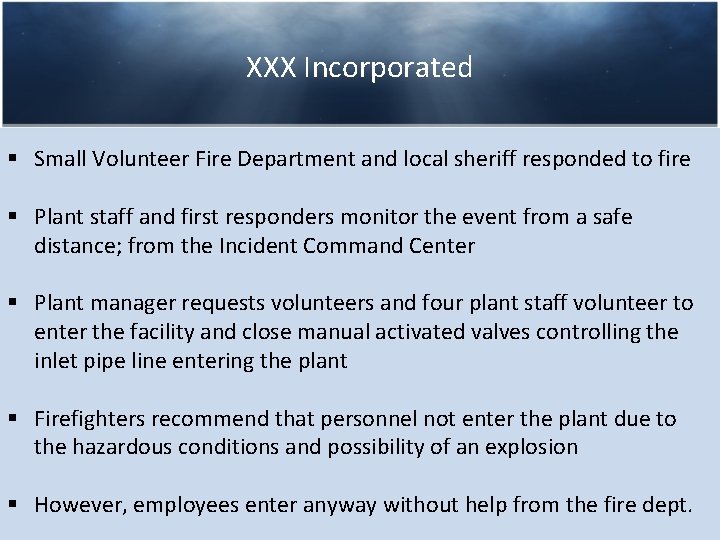
XXX Incorporated § Small Volunteer Fire Department and local sheriff responded to fire § Plant staff and first responders monitor the event from a safe distance; from the Incident Command Center § Plant manager requests volunteers and four plant staff volunteer to enter the facility and close manual activated valves controlling the inlet pipe line entering the plant § Firefighters recommend that personnel not enter the plant due to the hazardous conditions and possibility of an explosion § However, employees enter anyway without help from the fire dept.
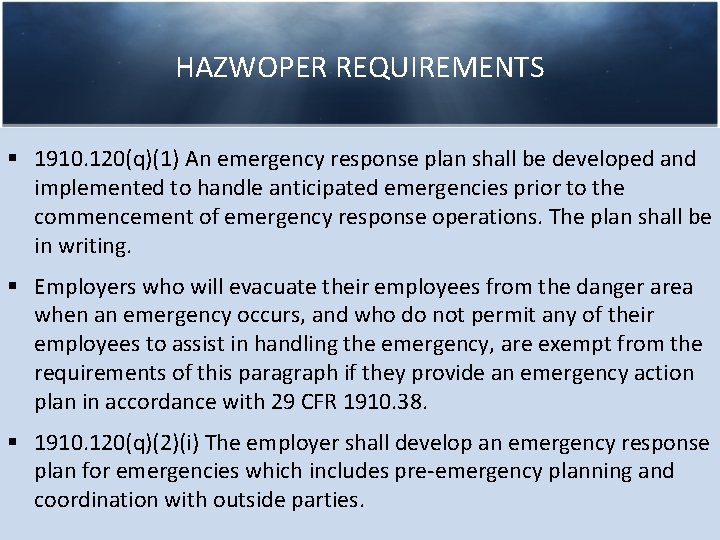
HAZWOPER REQUIREMENTS § 1910. 120(q)(1) An emergency response plan shall be developed and implemented to handle anticipated emergencies prior to the commencement of emergency response operations. The plan shall be in writing. § Employers who will evacuate their employees from the danger area when an emergency occurs, and who do not permit any of their employees to assist in handling the emergency, are exempt from the requirements of this paragraph if they provide an emergency action plan in accordance with 29 CFR 1910. 38. § 1910. 120(q)(2)(i) The employer shall develop an emergency response plan for emergencies which includes pre-emergency planning and coordination with outside parties.
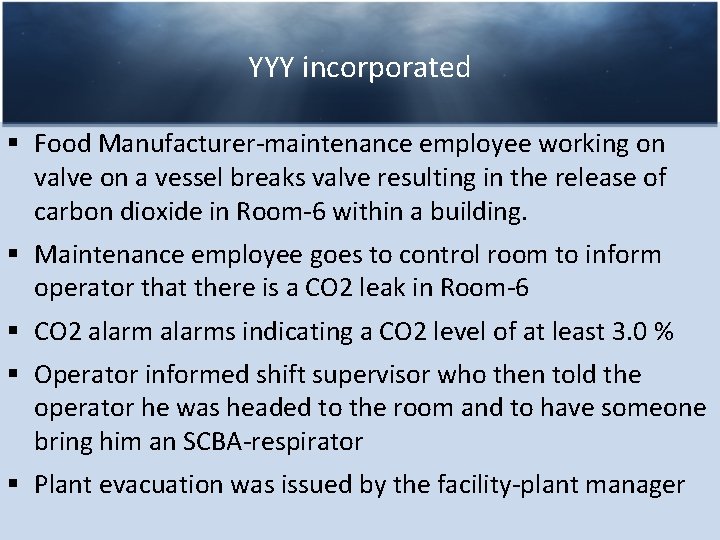
YYY incorporated § Food Manufacturer-maintenance employee working on valve on a vessel breaks valve resulting in the release of carbon dioxide in Room-6 within a building. § Maintenance employee goes to control room to inform operator that there is a CO 2 leak in Room-6 § CO 2 alarms indicating a CO 2 level of at least 3. 0 % § Operator informed shift supervisor who then told the operator he was headed to the room and to have someone bring him an SCBA-respirator § Plant evacuation was issued by the facility-plant manager
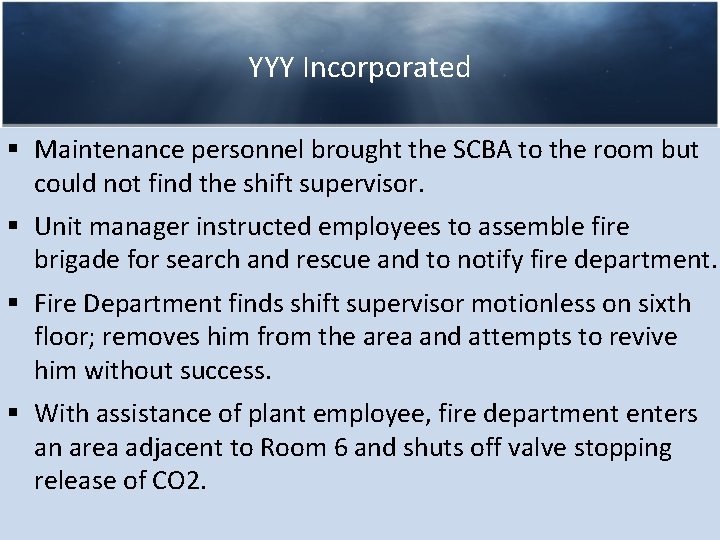
YYY Incorporated § Maintenance personnel brought the SCBA to the room but could not find the shift supervisor. § Unit manager instructed employees to assemble fire brigade for search and rescue and to notify fire department. § Fire Department finds shift supervisor motionless on sixth floor; removes him from the area and attempts to revive him without success. § With assistance of plant employee, fire department enters an area adjacent to Room 6 and shuts off valve stopping release of CO 2.
HAZWOPER REQUIREMENTS § 1910. 120(q)(3)(iv) Employees engaged in emergency response and exposed to hazardous substances presenting an inhalation hazard or potential inhalation hazard shall wear positive pressure self-contained breathing apparatus while engaged in emergency response, until such time that the individual in charge of the ICS determines through the use of air monitoring that a decreased level of respiratory protection will not result in hazardous exposures to employees. § 1910. 120(q)(3)(v) The individual in charge of the ICS shall limit the number of emergency response personnel at the emergency site, in those areas of potential or actual exposure to incident or site hazards, to those who are actively performing emergency operations. However, operations in hazardous areas shall be performed using the buddy system in groups of two or more.