
OSHA Maritime Activities and Regulatory Update Marine Chemist
- Slides: 45
OSHA: Maritime Activities and Regulatory Update Marine Chemist Association Annual Seminar Chicago, Illinois August 13 - 15, 2012
OSHA MISH-MASH • • • Recent Regulatory Activities Update on Subpart F Guidance Activities Issues Raised by Marine Chemists MACOSH Enforcement Data for FY 2011 and 2012
Regulatory Activity Globally Harmonized System of Classification and Labelling of Chemicals (GHS) • Published March 26, 2012 • Revises criteria for: – Classification of chemical hazards – Labeling provisions – requirements for signal words, pictograms, hazard statements, precautionary statements – Specified format for SDS – Definitions to terms – Requirements for training employees on labels and SDSs • Several changes to substance specific health standards, PSM, and flammable and combustible liquids to ensure compliance with GHS
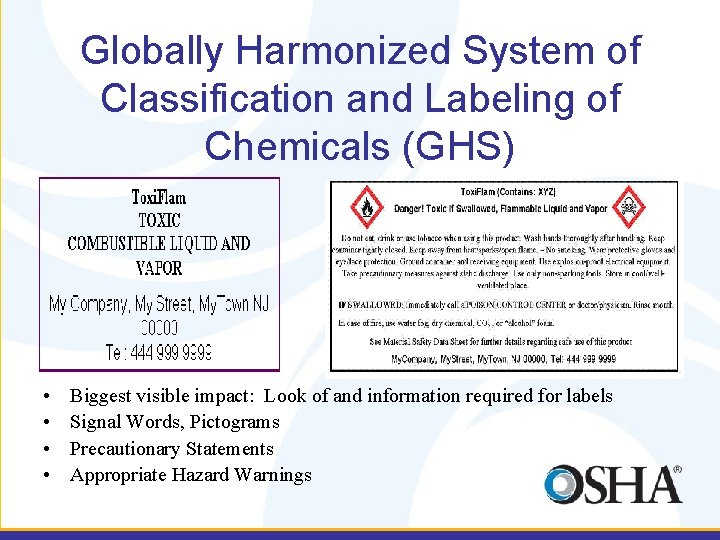
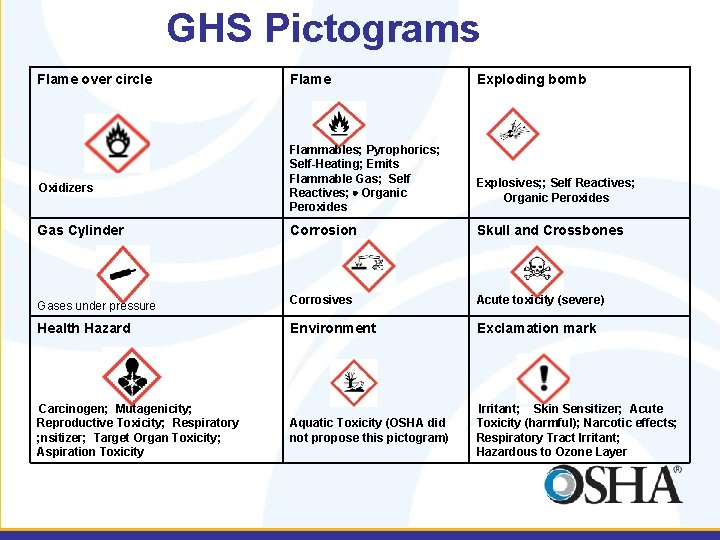
Globally Harmonized System of Classification and Labeling of Chemicals (GHS) • • Biggest visible impact: Look of and information required for labels Signal Words, Pictograms Precautionary Statements Appropriate Hazard Warnings
GHS Pictograms Flame over circle Oxidizers Flame Flammables; Pyrophorics; Self-Heating; Emits Flammable Gas; Self Reactives; Organic Peroxides Exploding bomb Explosives; ; Self Reactives; Organic Peroxides Gas Cylinder Corrosion Skull and Crossbones Gases under pressure Corrosives Acute toxicity (severe) Health Hazard Environment Exclamation mark Carcinogen; Mutagenicity; Reproductive Toxicity; Respiratory ; nsitizer; Target Organ Toxicity; Aspiration Toxicity Irritant; Skin Sensitizer; Acute Aquatic Toxicity (OSHA did not propose this pictogram) Toxicity (harmful); Narcotic effects; Respiratory Tract Irritant; Hazardous to Ozone Layer
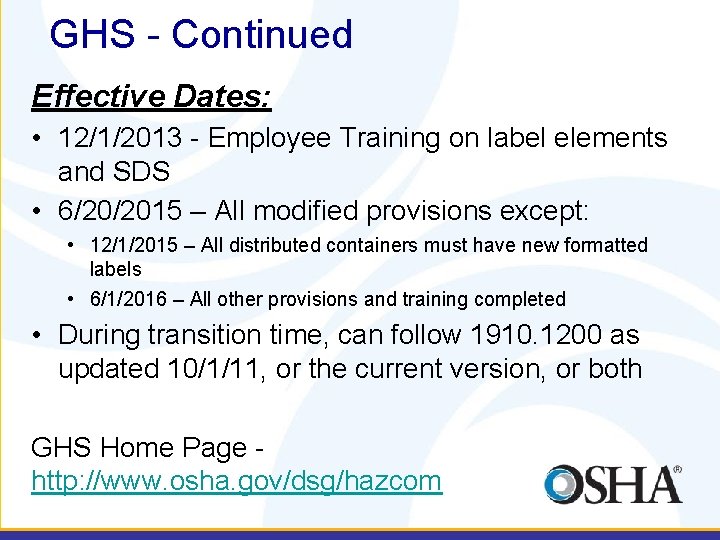
GHS - Continued Effective Dates: • 12/1/2013 - Employee Training on label elements and SDS • 6/20/2015 – All modified provisions except: • 12/1/2015 – All distributed containers must have new formatted labels • 6/1/2016 – All other provisions and training completed • During transition time, can follow 1910. 1200 as updated 10/1/11, or the current version, or both GHS Home Page - http: //www. osha. gov/dsg/hazcom
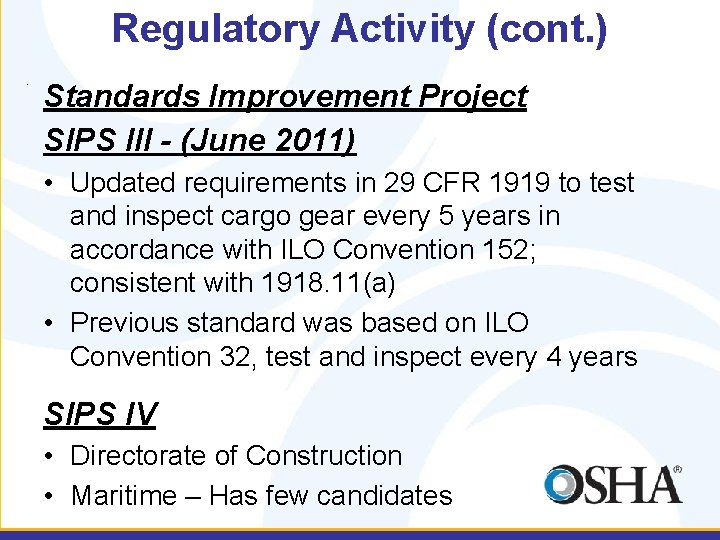
Regulatory Activity (cont. ). Standards Improvement Project SIPS III - (June 2011) • Updated requirements in 29 CFR 1919 to test and inspect cargo gear every 5 years in accordance with ILO Convention 152; consistent with 1918. 11(a) • Previous standard was based on ILO Convention 32, test and inspect every 4 years SIPS IV • Directorate of Construction • Maritime – Has few candidates
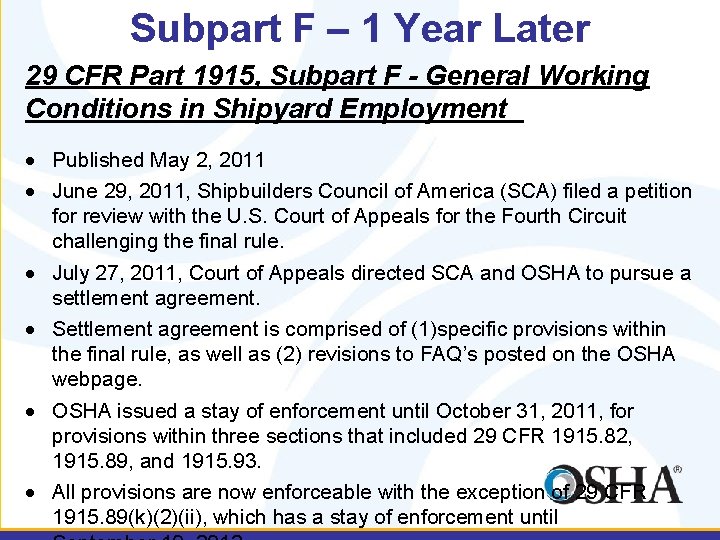
Subpart F – 1 Year Later 29 CFR Part 1915, Subpart F - General Working Conditions in Shipyard Employment Published May 2, 2011 June 29, 2011, Shipbuilders Council of America (SCA) filed a petition for review with the U. S. Court of Appeals for the Fourth Circuit challenging the final rule. July 27, 2011, Court of Appeals directed SCA and OSHA to pursue a settlement agreement. Settlement agreement is comprised of (1)specific provisions within the final rule, as well as (2) revisions to FAQ’s posted on the OSHA webpage. OSHA issued a stay of enforcement until October 31, 2011, for provisions within three sections that included 29 CFR 1915. 82, 1915. 89, and 1915. 93. All provisions are now enforceable with the exception of 29 CFR 1915. 89(k)(2)(ii), which has a stay of enforcement until
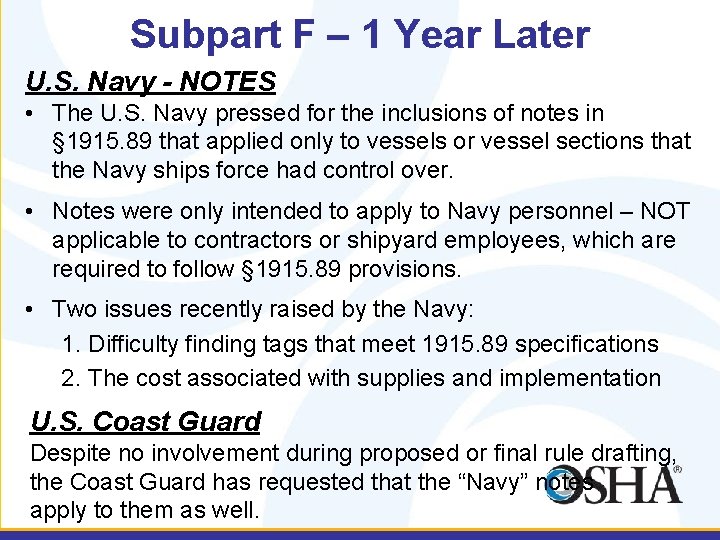
Subpart F – 1 Year Later U. S. Navy - NOTES • The U. S. Navy pressed for the inclusions of notes in § 1915. 89 that applied only to vessels or vessel sections that the Navy ships force had control over. • Notes were only intended to apply to Navy personnel – NOT applicable to contractors or shipyard employees, which are required to follow § 1915. 89 provisions. • Two issues recently raised by the Navy: 1. Difficulty finding tags that meet 1915. 89 specifications 2. The cost associated with supplies and implementation U. S. Coast Guard Despite no involvement during proposed or final rule drafting, the Coast Guard has requested that the “Navy” notes apply to them as well.
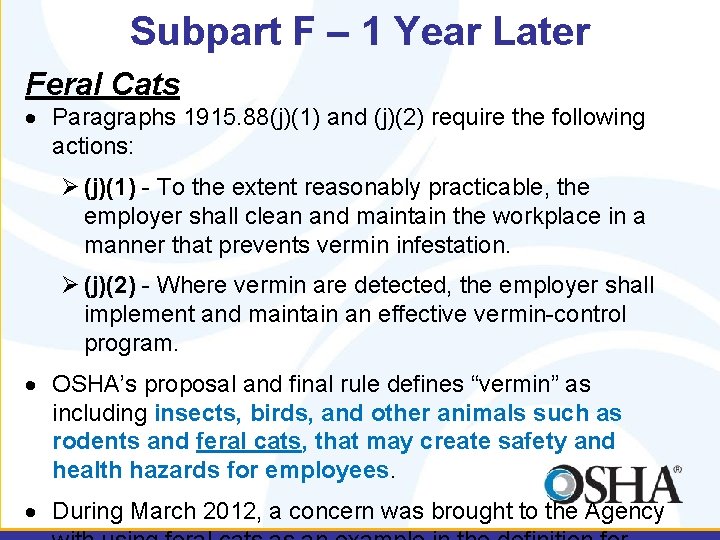
Subpart F – 1 Year Later Feral Cats Paragraphs 1915. 88(j)(1) and (j)(2) require the following actions: Ø (j)(1) - To the extent reasonably practicable, the employer shall clean and maintain the workplace in a manner that prevents vermin infestation. Ø (j)(2) - Where vermin are detected, the employer shall implement and maintain an effective vermin-control program. OSHA’s proposal and final rule defines “vermin” as including insects, birds, and other animals such as rodents and feral cats, that may create safety and health hazards for employees. During March 2012, a concern was brought to the Agency
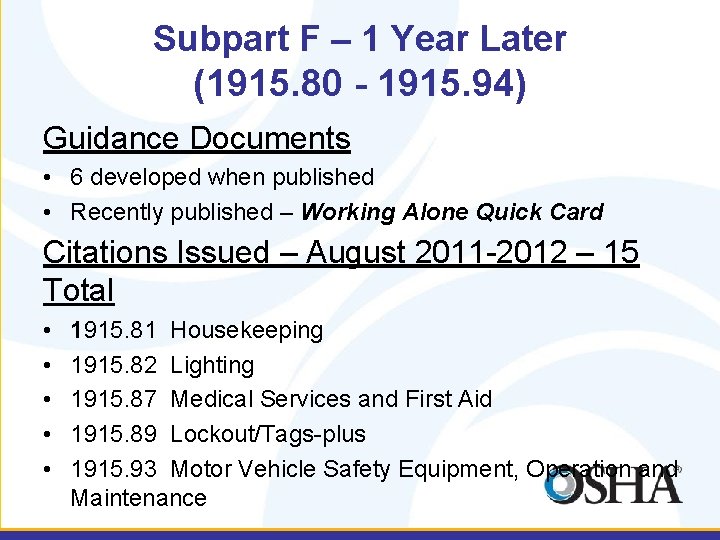
Subpart F – 1 Year Later (1915. 80 - 1915. 94) Guidance Documents • 6 developed when published • Recently published – Working Alone Quick Card Citations Issued – August 2011 -2012 – 15 Total • • • 1915. 81 Housekeeping 1915. 82 Lighting 1915. 87 Medical Services and First Aid 1915. 89 Lockout/Tags-plus 1915. 93 Motor Vehicle Safety Equipment, Operation and Maintenance
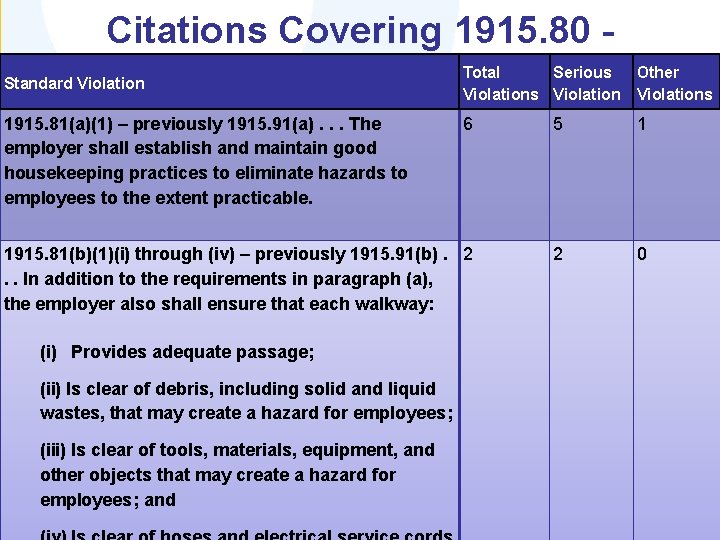
Citations Covering 1915. 80 - Serious 1915. 94 Total Standard Violations Violation 1915. 81(a)(1) – previously 1915. 91(a). . . The employer shall establish and maintain good housekeeping practices to eliminate hazards to employees to the extent practicable. Other Violations 6 5 1 1915. 81(b)(1)(i) through (iv) – previously 1915. 91(b). 2. . In addition to the requirements in paragraph (a), the employer also shall ensure that each walkway: 2 0 (i) Provides adequate passage; (ii) Is clear of debris, including solid and liquid wastes, that may create a hazard for employees; (iii) Is clear of tools, materials, equipment, and other objects that may create a hazard for employees; and
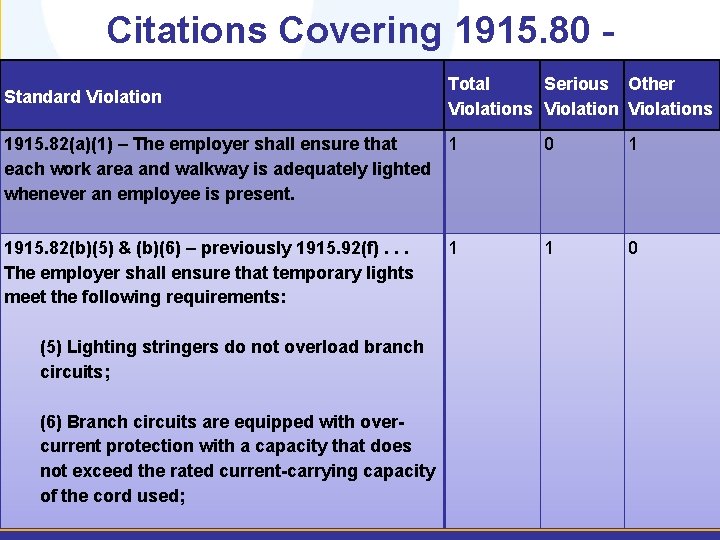
Citations Covering 1915. 80 - 1915. 94 Total Serious Other Standard Violations 1915. 82(a)(1) – The employer shall ensure that 1 each work area and walkway is adequately lighted whenever an employee is present. 0 1 1915. 82(b)(5) & (b)(6) – previously 1915. 92(f). . . The employer shall ensure that temporary lights meet the following requirements: (5) Lighting stringers do not overload branch circuits; 1 0 (6) Branch circuits are equipped with overcurrent protection with a capacity that does not exceed the rated current-carrying capacity of the cord used; 1
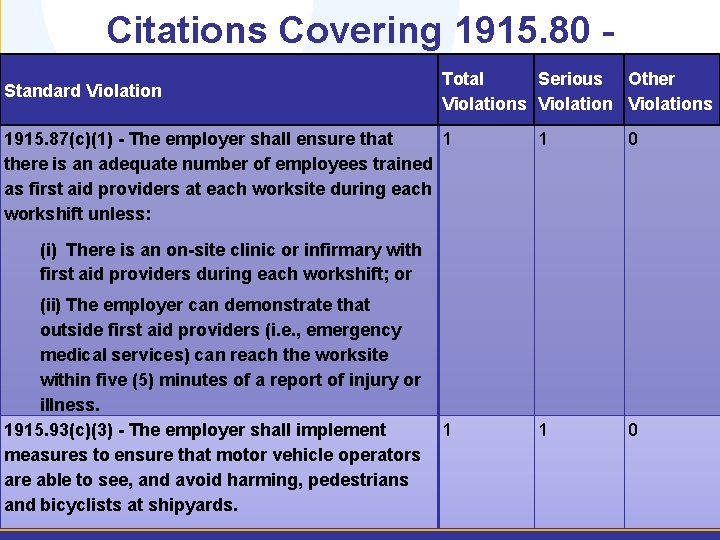
Citations Covering 1915. 80 - 1915. 94 Total Serious Other Standard Violations 1915. 87(c)(1) - The employer shall ensure that 1 there is an adequate number of employees trained as first aid providers at each worksite during each workshift unless: 1 0 (i) There is an on-site clinic or infirmary with first aid providers during each workshift; or (ii) The employer can demonstrate that outside first aid providers (i. e. , emergency medical services) can reach the worksite within five (5) minutes of a report of injury or illness. 1915. 93(c)(3) - The employer shall implement 1 measures to ensure that motor vehicle operators are able to see, and avoid harming, pedestrians and bicyclists at shipyards.
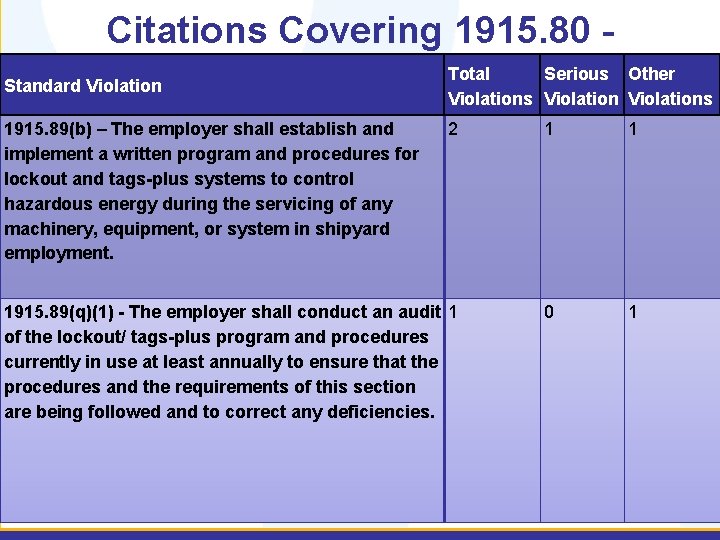
Citations Covering 1915. 80 - Total Serious Other 1915. 94 Standard Violations 1915. 89(b) – The employer shall establish and implement a written program and procedures for lockout and tags-plus systems to control hazardous energy during the servicing of any machinery, equipment, or system in shipyard employment. 2 1 1 1915. 89(q)(1) - The employer shall conduct an audit 1 of the lockout/ tags-plus program and procedures currently in use at least annually to ensure that the procedures and the requirements of this section are being followed and to correct any deficiencies. 0 1
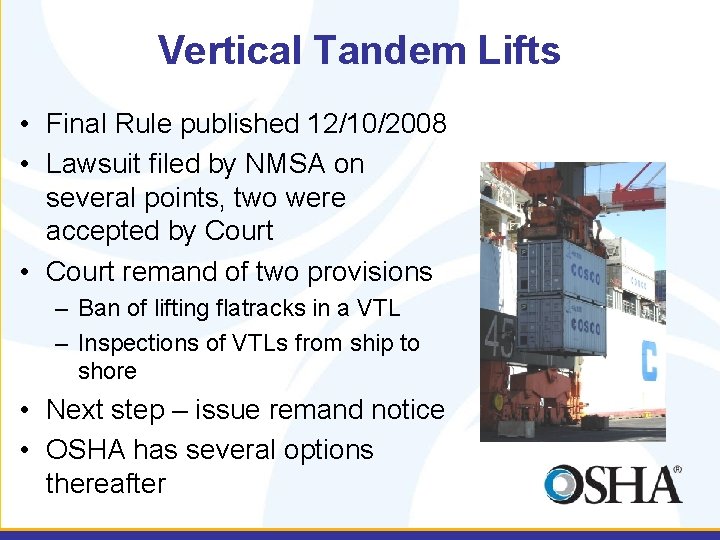
Vertical Tandem Lifts • Final Rule published 12/10/2008 • Lawsuit filed by NMSA on several points, two were accepted by Court • Court remand of two provisions – Ban of lifting flatracks in a VTL – Inspections of VTLs from ship to shore • Next step – issue remand notice • OSHA has several options thereafter
Directorate of Enforcement - Guidance Activity Longshoring and Marine Terminals “Tool Shed” Directive and Cargo Gear Directive in Agency Clearance • Incorporates SIP III, VTL, PPE Payment, and updates interpretations Shipyard Employment “Tool Bag” Directive in Agency Clearance • Includes 29 CFR Part 1915, Subpart F - General Working Conditions in Shipyard Employment, published on May 2, 2011 • Provides information regarding Settlement Agreement between the SCA and OSHA.
Issues Raised by Marine Chemists • OSHA Outreach Program • OSHA Jurisdiction • Employers providing first aid to MC while on site
Outreach Training Program and OSHA Jurisdiction Outreach Training Limited to OSHA Jurisdiction • The OSH Act covers private sector employers and their employees in the 50 states and certain territories and jurisdictions under federal authority. • OSHA Outreach Training Program classes limited to training conducted within OSHA's jurisdiction. • Classes delivered outside of OSHA's jurisdiction are not recognized and trainers will not receive student course completion cards for those students. • An exception exists, with prior OSHA approval, for training that is provided on a contract basis for a specific organization and only its employees. • The trainer must submit a written request for exception at least 60 days in advance of the scheduled training
Outreach Training Program and OSHA Jurisdiction (cont. ) Exception for Training Conducted Outside OSHA Jurisdiction 1. Primary authorized trainer 2. Trainer email address 3. Copy of trainer card 4. Outreach class type (indicate industry and number of hours) 5. Contracting organization name and address 6. Start and end times and dates 7. A topic outline which indicates each topic, the length of time each topic will be taught, and the date and time the topic will be taught. 8. Guest trainer name(s) 9. Address where training will be conducted 10. Typed list of employees to be trained on the contracting
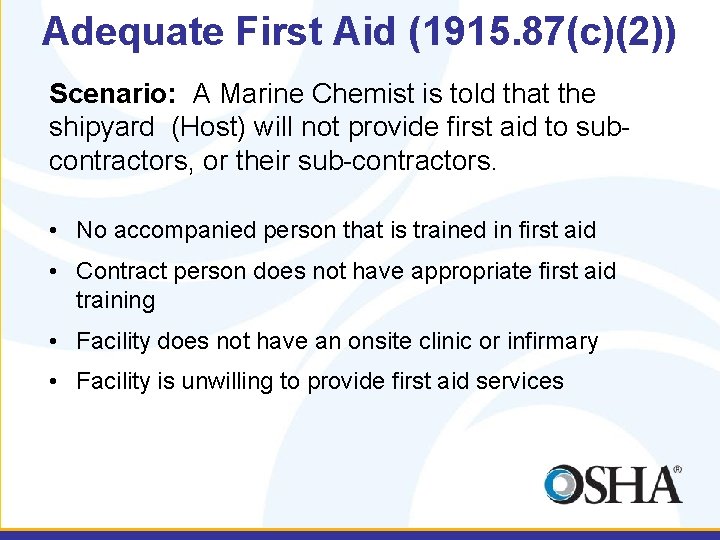
Adequate First Aid (1915. 87(c)(2)) Scenario: A Marine Chemist is told that the shipyard (Host) will not provide first aid to subcontractors, or their sub-contractors. • No accompanied person that is trained in first aid • Contract person does not have appropriate first aid training • Facility does not have an onsite clinic or infirmary • Facility is unwilling to provide first aid services
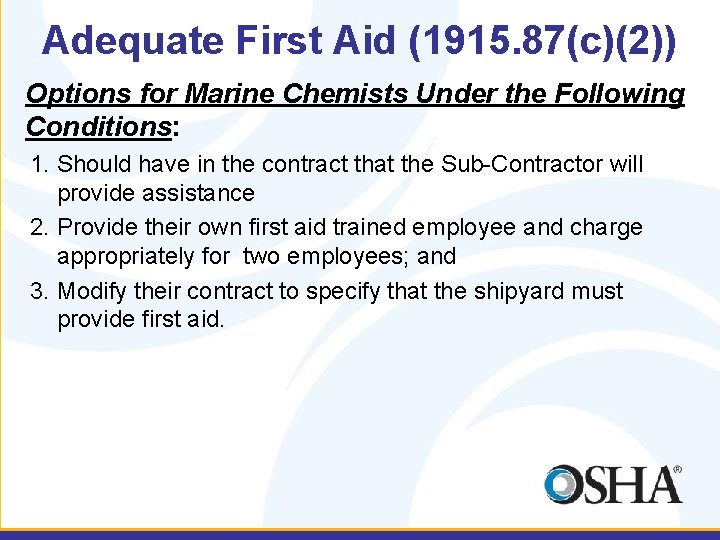
Adequate First Aid (1915. 87(c)(2)) Options for Marine Chemists Under the Following Conditions: 1. Should have in the contract that the Sub-Contractor will provide assistance 2. Provide their own first aid trained employee and charge appropriately for two employees; and 3. Modify their contract to specify that the shipyard must provide first aid.
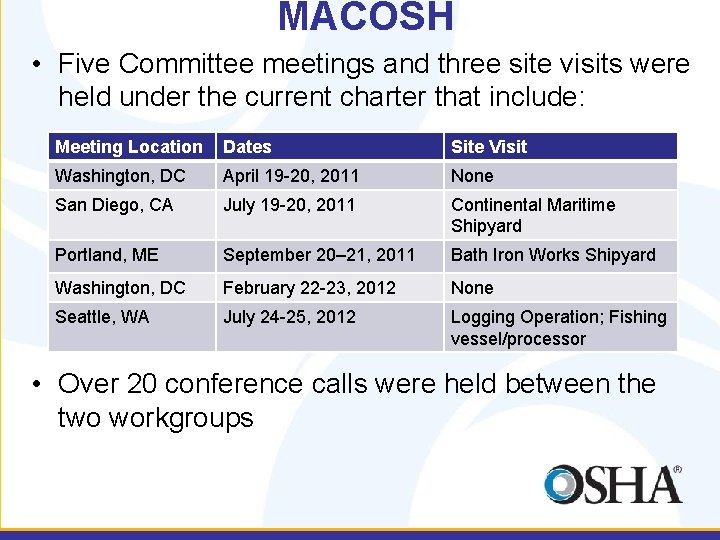
MACOSH • Five Committee meetings and three site visits were held under the current charter that include: Meeting Location Dates Site Visit Washington, DC April 19 -20, 2011 None San Diego, CA July 19 -20, 2011 Continental Maritime Shipyard Portland, ME September 20– 21, 2011 Bath Iron Works Shipyard Washington, DC February 22 -23, 2012 None Seattle, WA July 24 -25, 2012 Logging Operation; Fishing vessel/processor • Over 20 conference calls were held between the two workgroups
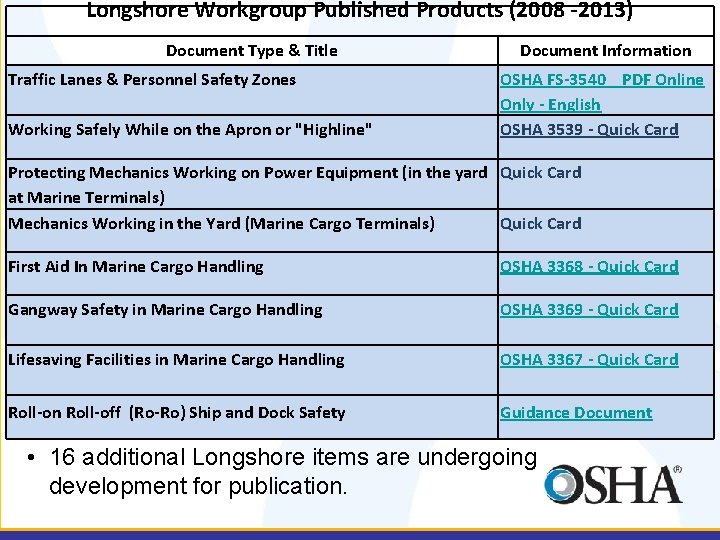
Longshore Workgroup Published Products (2008 -2013) Document Type & Title Traffic Lanes & Personnel Safety Zones Working Safely While on the Apron or "Highline" Document Information OSHA FS-3540 PDF Online Only - English OSHA 3539 - Quick Card Protecting Mechanics Working on Power Equipment (in the yard Quick Card at Marine Terminals) Mechanics Working in the Yard (Marine Cargo Terminals) Quick Card First Aid In Marine Cargo Handling OSHA 3368 - Quick Card Gangway Safety in Marine Cargo Handling OSHA 3369 - Quick Card Lifesaving Facilities in Marine Cargo Handling OSHA 3367 - Quick Card Roll-on Roll-off (Ro-Ro) Ship and Dock Safety Guidance Document • 16 additional Longshore items are undergoing development for publication.
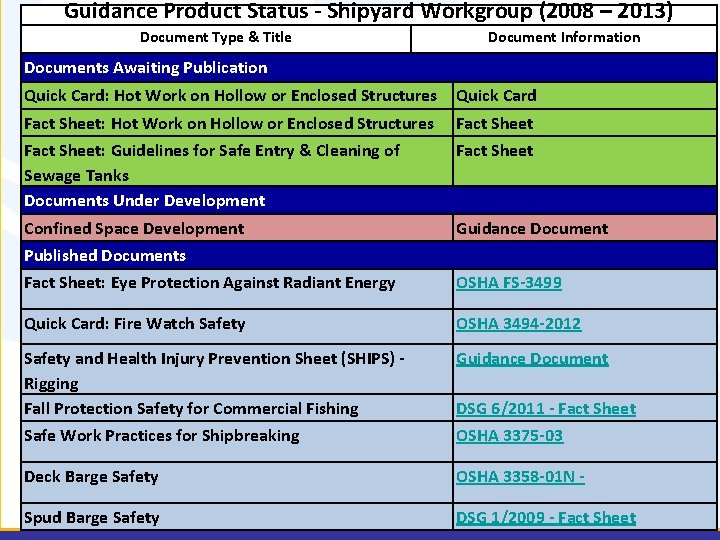
Guidance Product Status - Shipyard Workgroup (2008 – 2013) Document Type & Title Document Information Documents Awaiting Publication Quick Card: Hot Work on Hollow or Enclosed Structures Quick Card Fact Sheet: Hot Work on Hollow or Enclosed Structures Fact Sheet: Guidelines for Safe Entry & Cleaning of Sewage Tanks Documents Under Development Fact Sheet Confined Space Development Guidance Document Published Documents Fact Sheet: Eye Protection Against Radiant Energy OSHA FS-3499 Quick Card: Fire Watch Safety OSHA 3494 -2012 Safety and Health Injury Prevention Sheet (SHIPS) Rigging Fall Protection Safety for Commercial Fishing Guidance Document Safe Work Practices for Shipbreaking OSHA 3375 -03 Deck Barge Safety OSHA 3358 -01 N - Spud Barge Safety DSG 1/2009 - Fact Sheet DSG 6/2011 - Fact Sheet
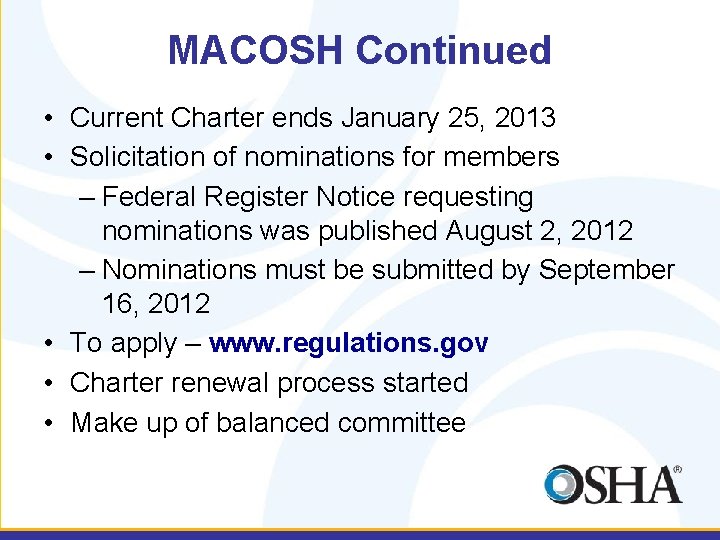
MACOSH Continued • Current Charter ends January 25, 2013 • Solicitation of nominations for members – Federal Register Notice requesting nominations was published August 2, 2012 – Nominations must be submitted by September 16, 2012 • To apply – www. regulations. gov • Charter renewal process started • Make up of balanced committee
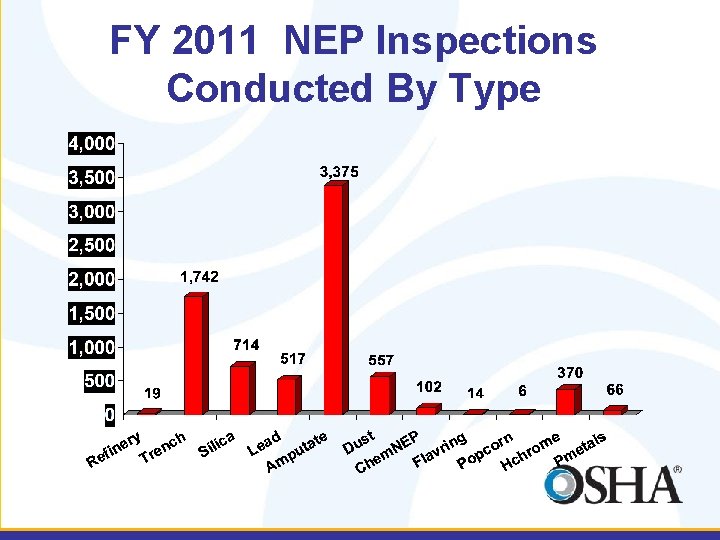
FY 2011 Federal OSHA NEP Enforcement Data • Note: In some cases, due to the migration of data from IMIS to OIS, FY 2011 and FY 2012 values may be projected.
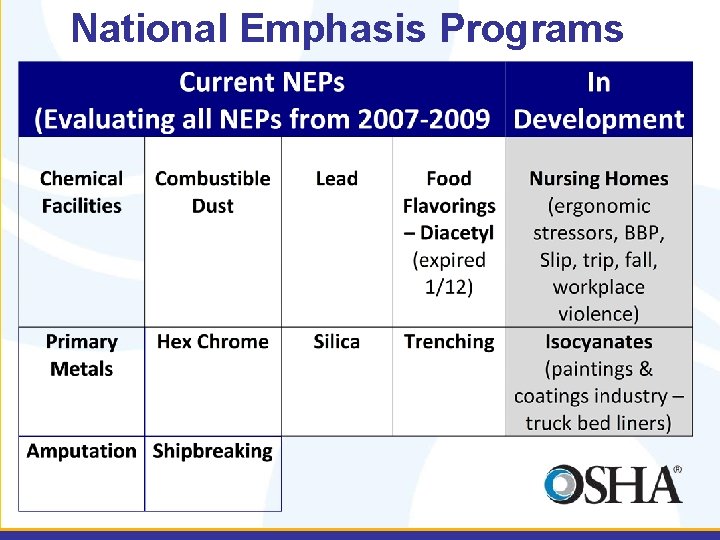
National Emphasis Programs
FY 2011 NEP Inspections Conducted By Type
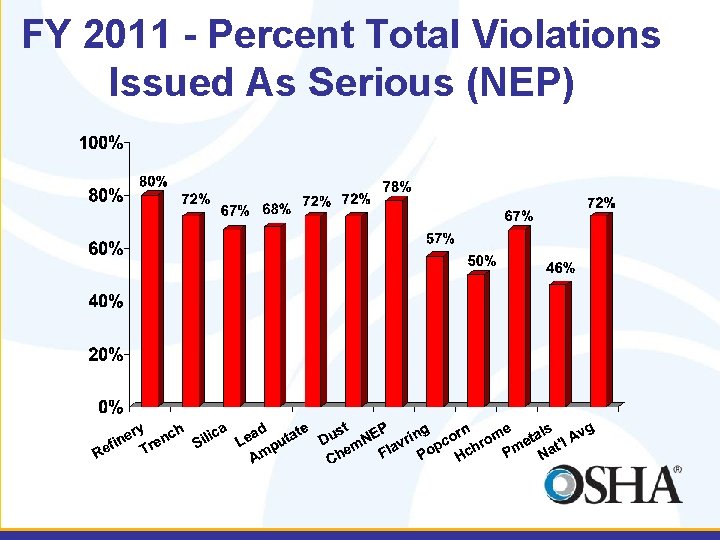
FY 2011 - Percent Total Violations Issued As Serious (NEP)
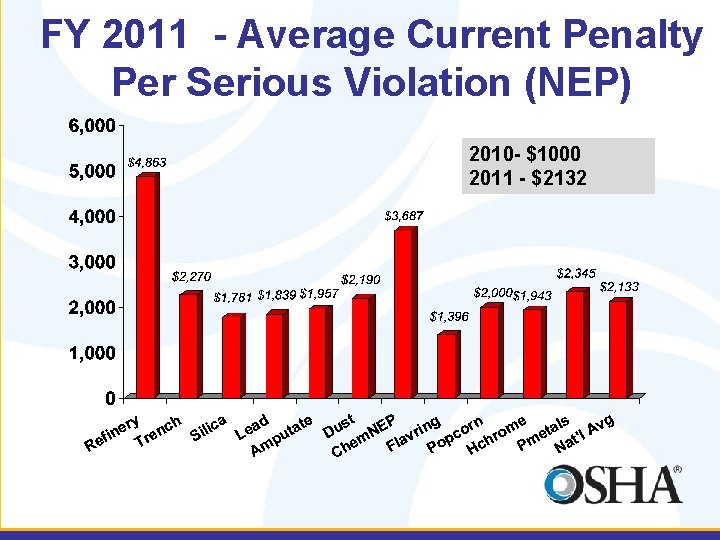
FY 2011 - Average Current Penalty Per Serious Violation (NEP) 2010 - $1000 2011 - $2132
OSHA’s Penalty Policy • October 1, 2010: Deployment of administrative enhancements • FY 2011: Monitored the new policy • April 1, 2012: Increased the employer size reduction factor for employers with 1 – 25 employees from 40% to 60%
FY 2008 – FY 2012 (Oct-Dec) Federal OSHA Maritime Enforcement Data • Prepared February 22, 2012 • Due to migration from IMIS to OIS, data may be incomplete at this time.
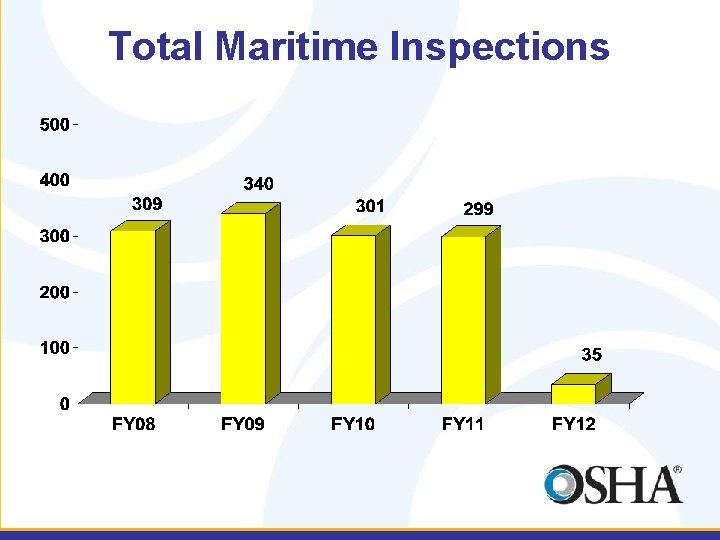
Total Maritime Inspections
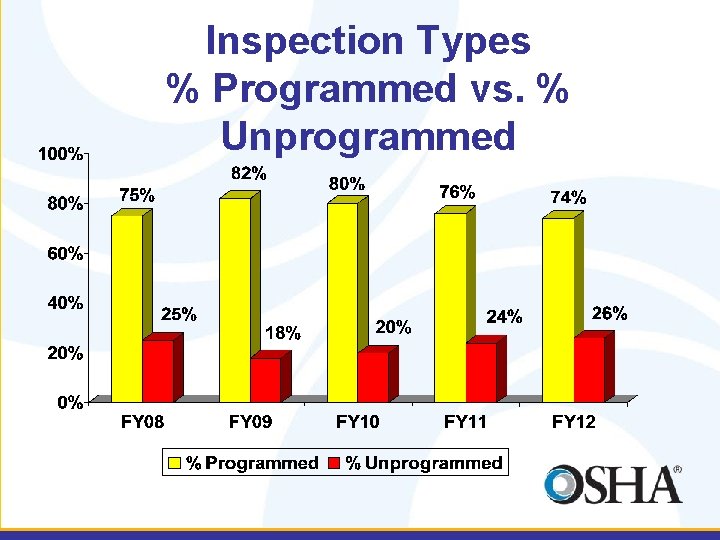
Inspection Types % Programmed vs. % Unprogrammed
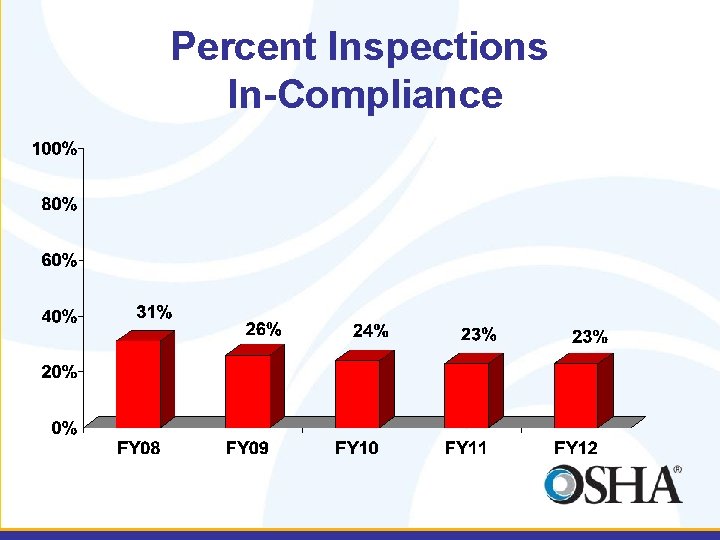
Percent Inspections In-Compliance
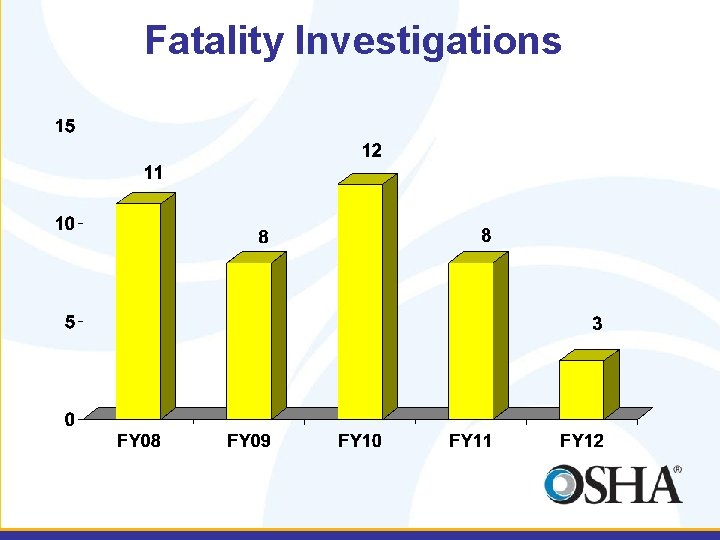
Fatality Investigations
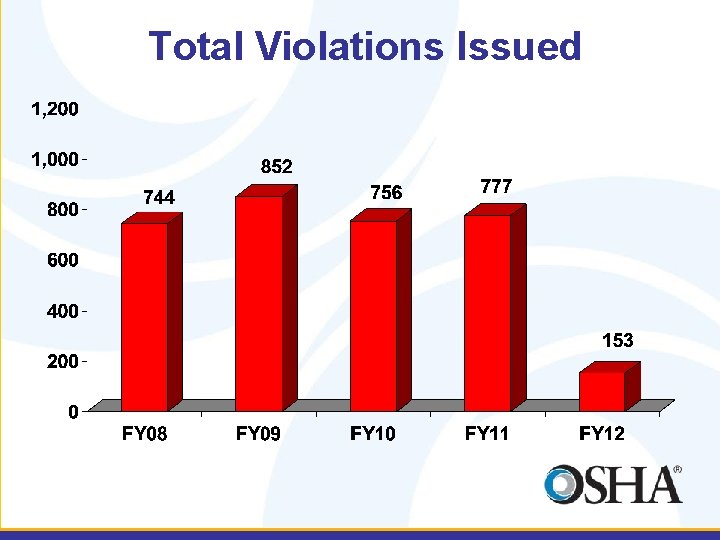
Total Violations Issued
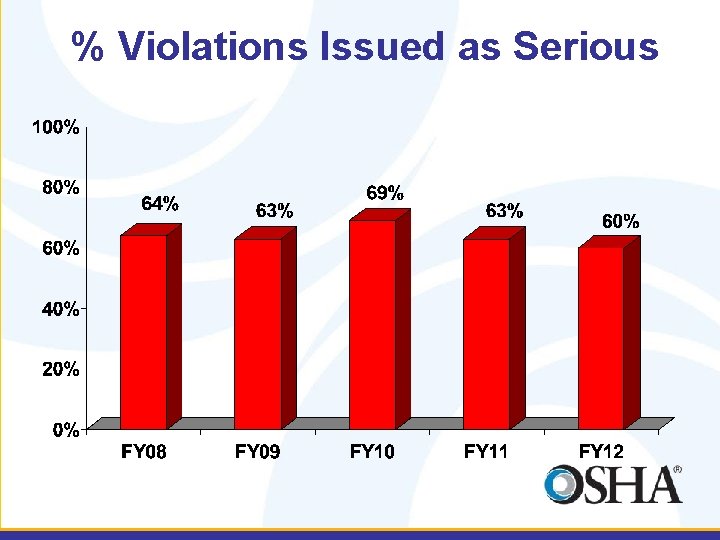
% Violations Issued as Serious
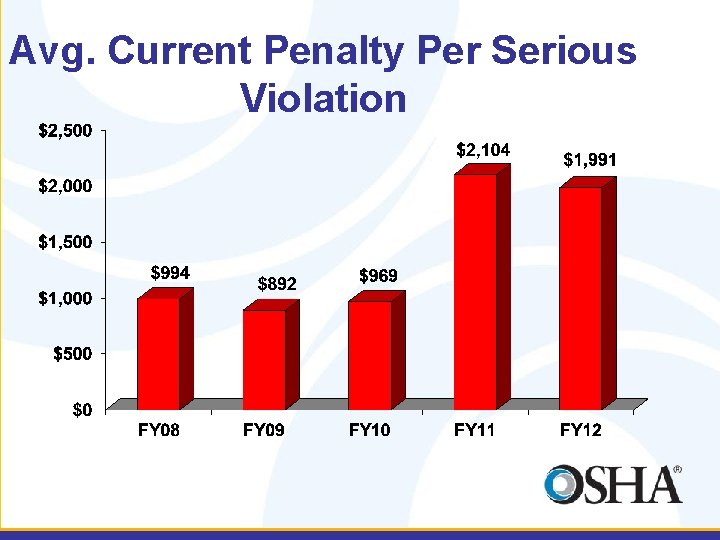
Avg. Current Penalty Per Serious Violation
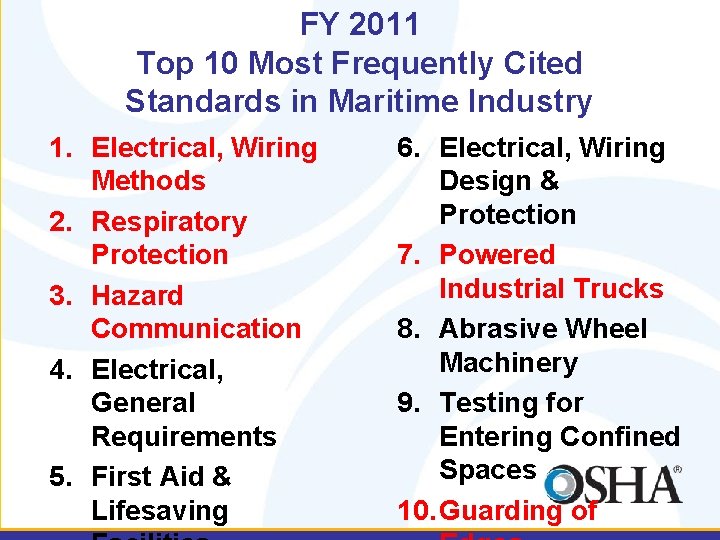
FY 2011 Top 10 Most Frequently Cited Standards in Maritime Industry 1. Electrical, Wiring Methods 2. Respiratory Protection 3. Hazard Communication 4. Electrical, General Requirements 5. First Aid & Lifesaving 6. Electrical, Wiring Design & Protection 7. Powered Industrial Trucks 8. Abrasive Wheel Machinery 9. Testing for Entering Confined Spaces 10. Guarding of
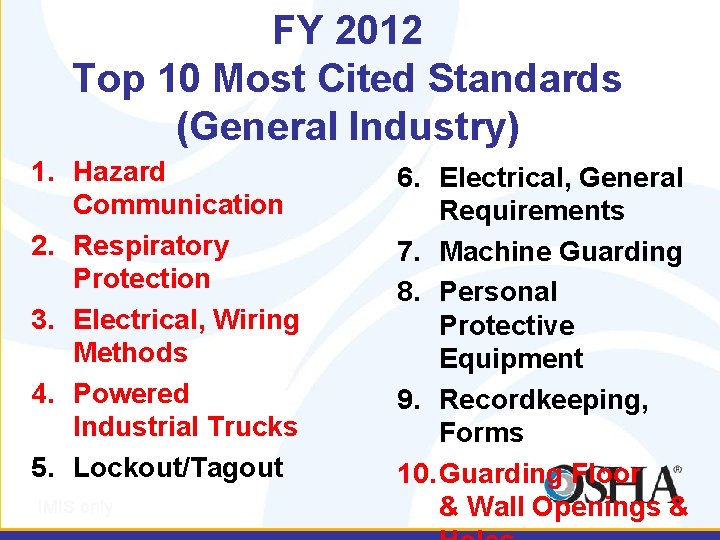
FY 2012 Top 10 Most Cited Standards (General Industry) 1. Hazard Communication 2. Respiratory Protection 3. Electrical, Wiring Methods 4. Powered Industrial Trucks 5. Lockout/Tagout IMIS only 6. Electrical, General Requirements 7. Machine Guarding 8. Personal Protective Equipment 9. Recordkeeping, Forms 10. Guarding Floor & Wall Openings &
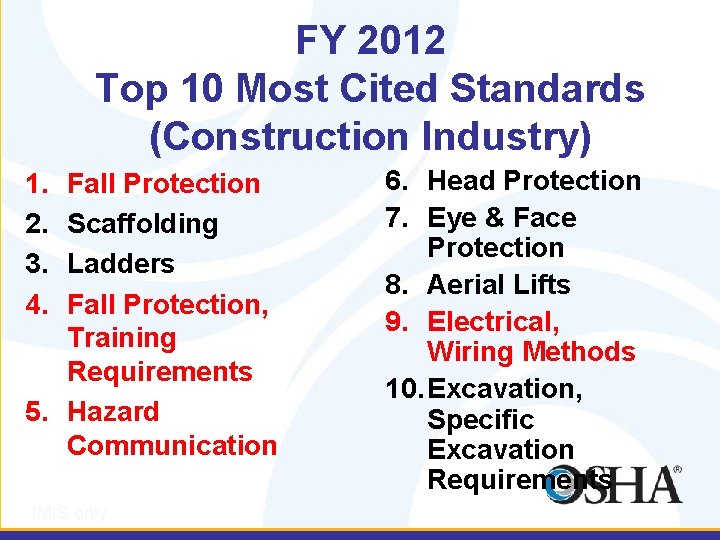
FY 2012 Top 10 Most Cited Standards (Construction Industry) 1. 2. 3. 4. Fall Protection Scaffolding Ladders Fall Protection, Training Requirements 5. Hazard Communication IMIS only 6. Head Protection 7. Eye & Face Protection 8. Aerial Lifts 9. Electrical, Wiring Methods 10. Excavation, Specific Excavation Requirements
Amy Wangdahl, CSP Director, Office of Maritime & Agriculture Directorate of Standards and Guidance Occupational Safety and Health Administration 202 -693 -2066 Wangdahl. amy@dol. gov