
OSHA LABORATORY SAFETY BIOMEDICAL AND BIOHAZARDOUS WASTE TRAINING
OSHA, LABORATORY SAFETY, BIOMEDICAL AND BIOHAZARDOUS WASTE TRAINING PART B Hazard Communication/Chemical and Biohazard Safety Bloodborne Pathogens/Exposure Control Plan Biomedical/Biohazardous Waste

§ Inspect all glassware before use § Tape or shield glass vacuum vessels § Do not substitute lab Dewar flasks with household thermos § Transport all glass container in secondary rubber container § Fire-polish all cut glass tubing and rods § Follow lab procedure for inserting glass tubes or rods into stoppers
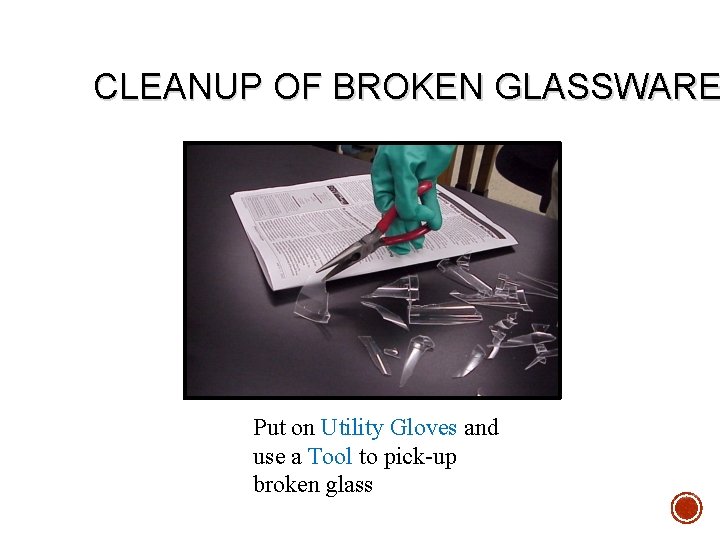
CLEANUP OF BROKEN GLASSWARE Put on Utility Gloves and use a Tool to pick-up broken glass
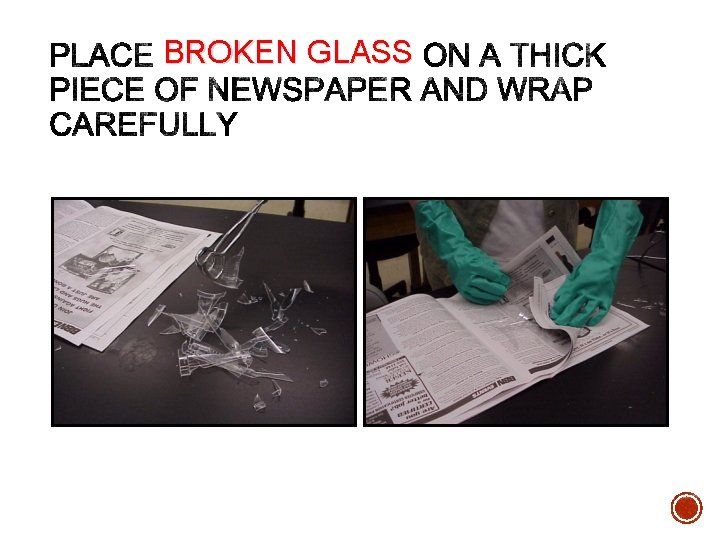
BROKEN GLASS
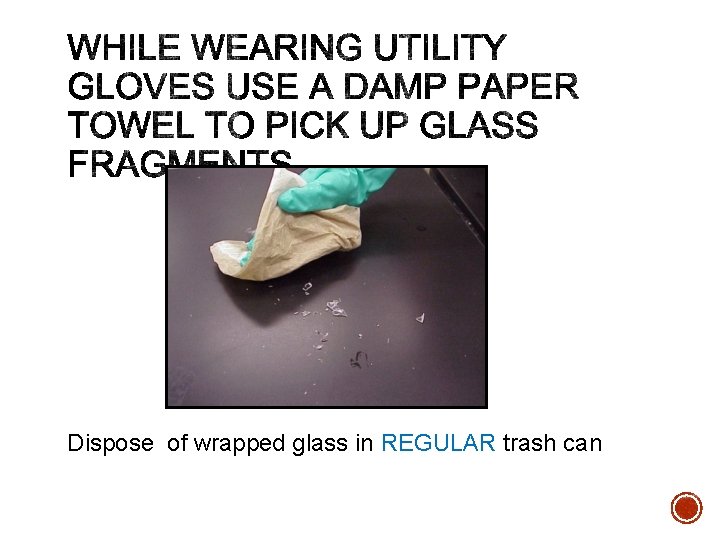
Dispose of wrapped glass in REGULAR trash can
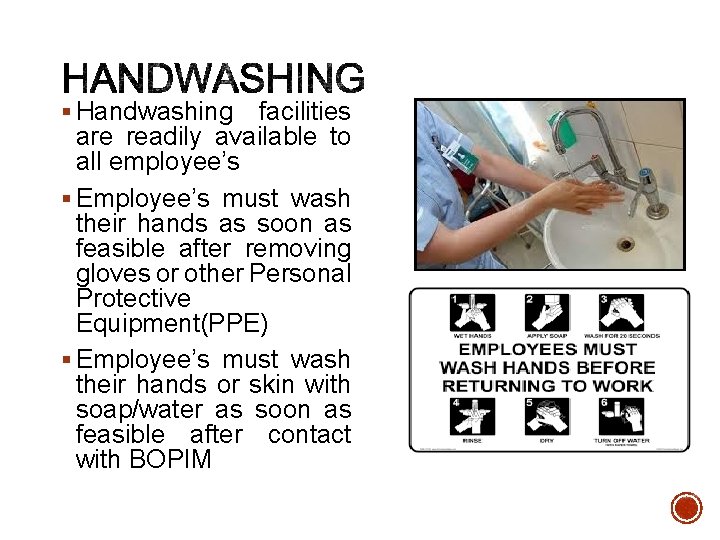
§ Handwashing facilities are readily available to all employee’s § Employee’s must wash their hands as soon as feasible after removing gloves or other Personal Protective Equipment(PPE) § Employee’s must wash their hands or skin with soap/water as soon as feasible after contact with BOPIM
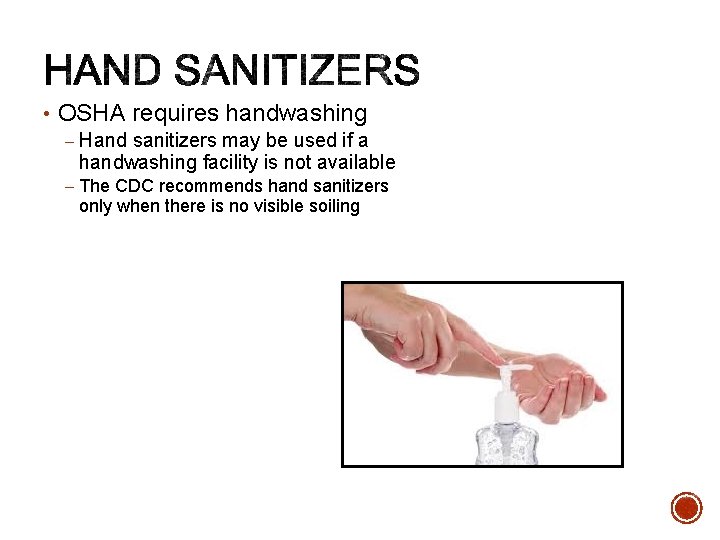
• OSHA requires handwashing – Hand sanitizers may be used if a handwashing facility is not available – The CDC recommends hand sanitizers only when there is no visible soiling
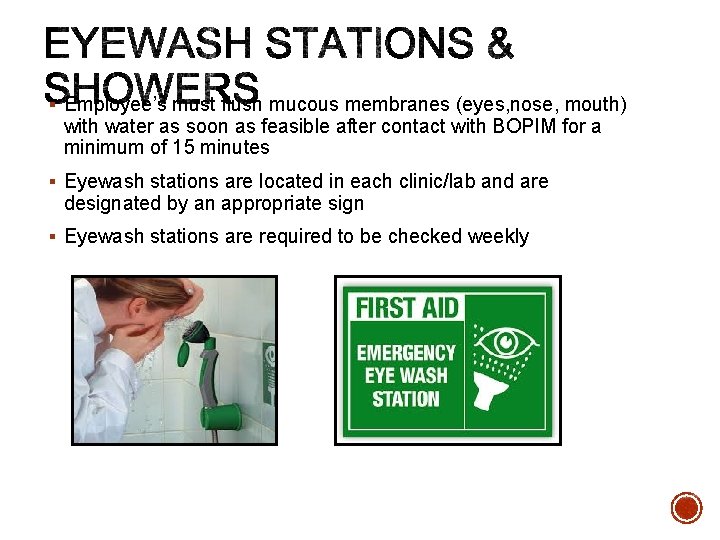
§ Employee’s must flush mucous membranes (eyes, nose, mouth) with water as soon as feasible after contact with BOPIM for a minimum of 15 minutes § Eyewash stations are located in each clinic/lab and are designated by an appropriate sign § Eyewash stations are required to be checked weekly
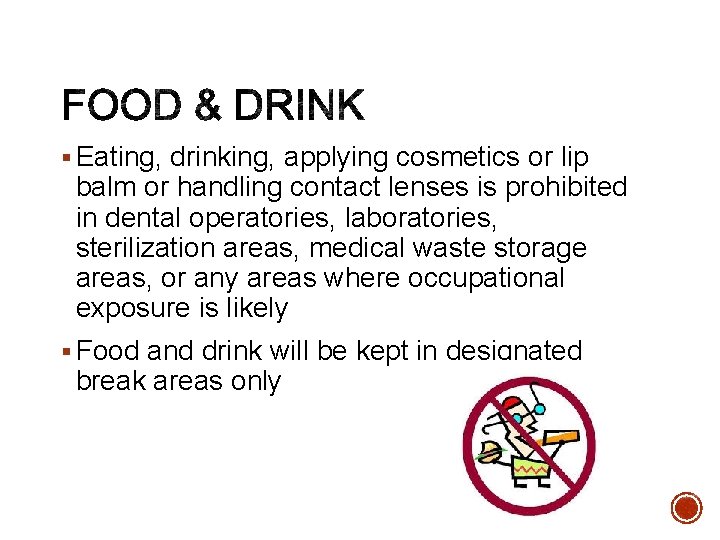
§ Eating, drinking, applying cosmetics or lip balm or handling contact lenses is prohibited in dental operatories, laboratories, sterilization areas, medical waste storage areas, or any areas where occupational exposure is likely § Food and drink will be kept in designated break areas only
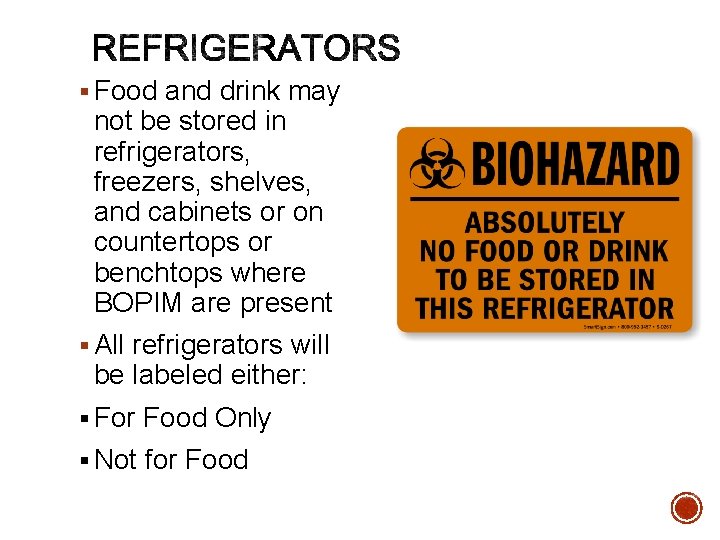
§ Food and drink may not be stored in refrigerators, freezers, shelves, and cabinets or on countertops or benchtops where BOPIM are present § All refrigerators will be labeled either: § For Food Only § Not for Food
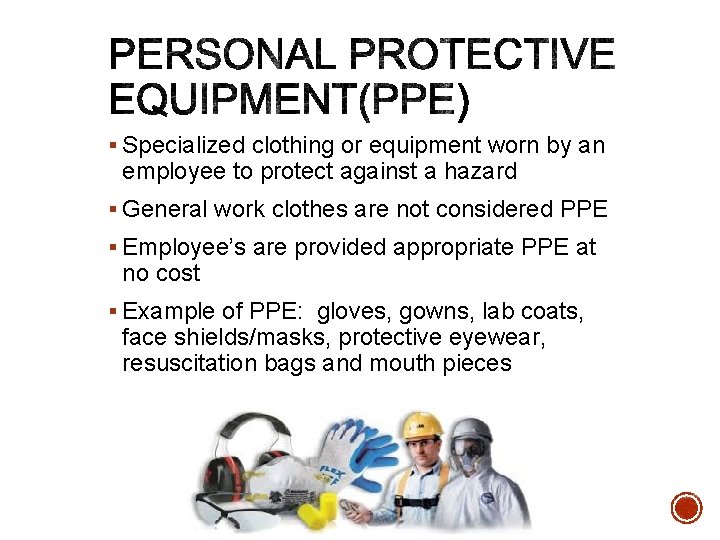
§ Specialized clothing or equipment worn by an employee to protect against a hazard § General work clothes are not considered PPE § Employee’s are provided appropriate PPE at no cost § Example of PPE: gloves, gowns, lab coats, face shields/masks, protective eyewear, resuscitation bags and mouth pieces

§ The specific PPE will depend on the task and degree of exposure anticipated § Employee’s must use appropriate PPE whenever there is potential for occupational exposure § This is an OSHA requirement- there are NO exceptions
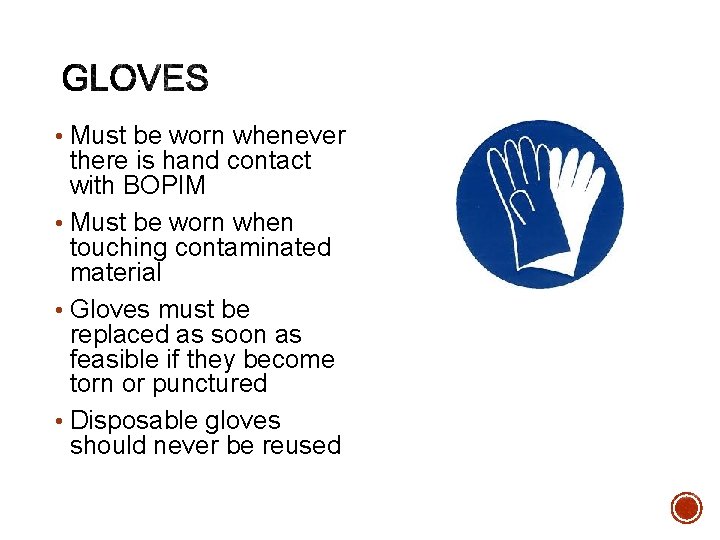
• Must be worn whenever there is hand contact with BOPIM • Must be worn when touching contaminated material • Gloves must be replaced as soon as feasible if they become torn or punctured • Disposable gloves should never be reused
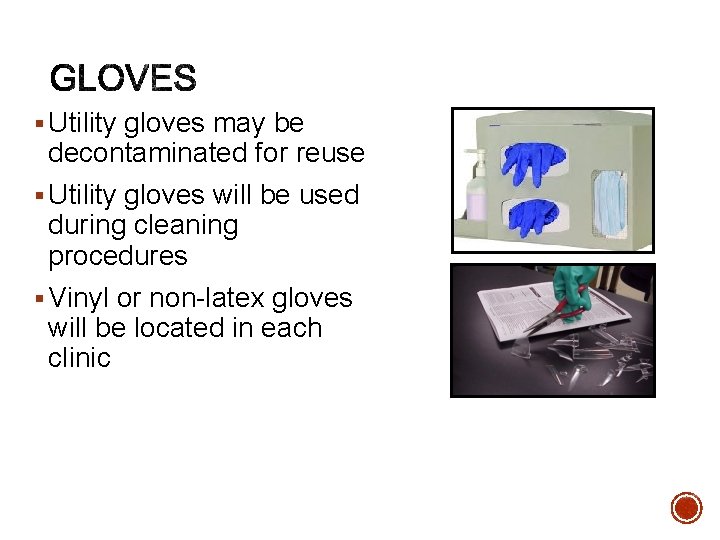
§ Utility gloves may be decontaminated for reuse § Utility gloves will be used during cleaning procedures § Vinyl or non-latex gloves will be located in each clinic
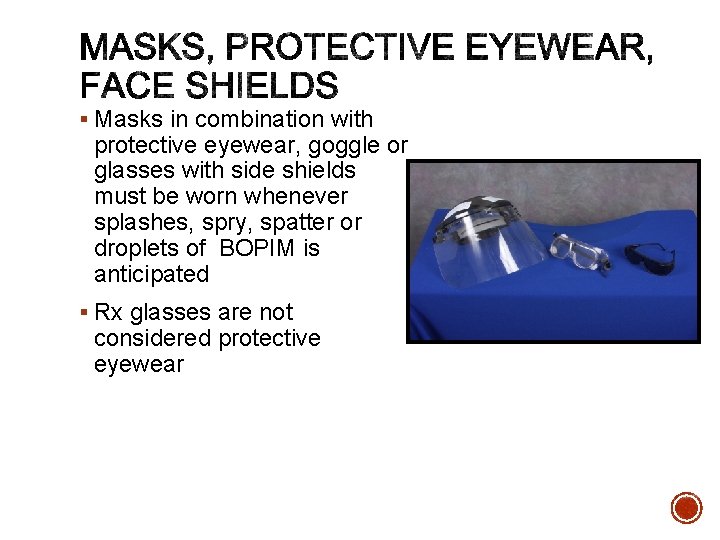
§ Masks in combination with protective eyewear, goggle or glasses with side shields must be worn whenever splashes, spry, spatter or droplets of BOPIM is anticipated § Rx glasses are not considered protective eyewear
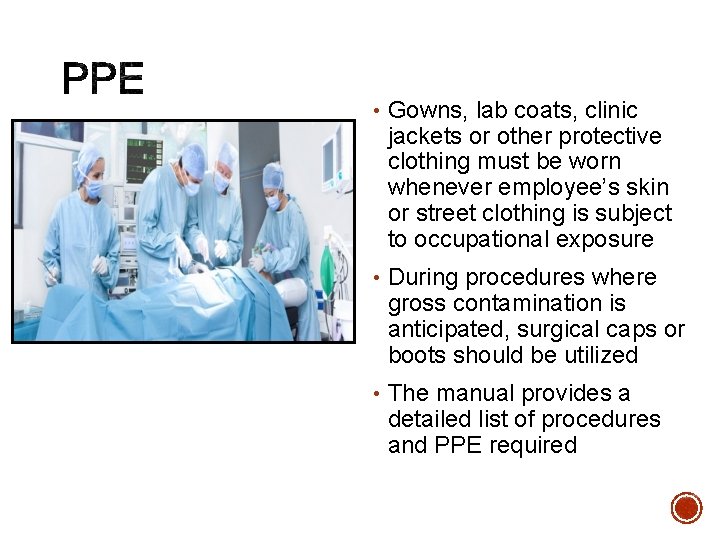
• Gowns, lab coats, clinic jackets or other protective clothing must be worn whenever employee’s skin or street clothing is subject to occupational exposure • During procedures where gross contamination is anticipated, surgical caps or boots should be utilized • The manual provides a detailed list of procedures and PPE required
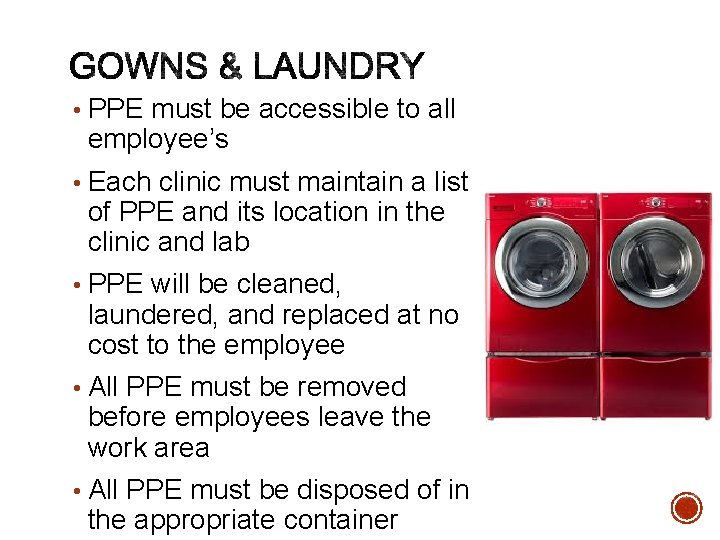
• PPE must be accessible to all employee’s • Each clinic must maintain a list of PPE and its location in the clinic and lab • PPE will be cleaned, laundered, and replaced at no cost to the employee • All PPE must be removed before employees leave the work area • All PPE must be disposed of in the appropriate container
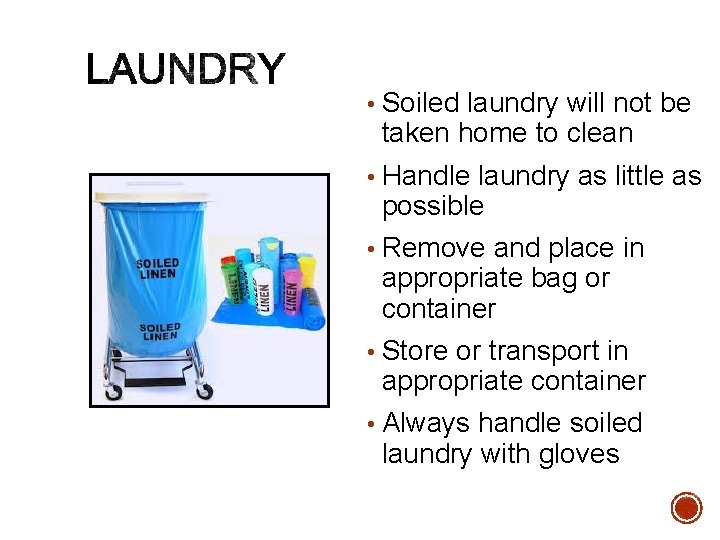
• Soiled laundry will not be taken home to clean • Handle laundry as little as possible • Remove and place in appropriate bag or container • Store or transport in appropriate container • Always handle soiled laundry with gloves

• Rag wheels will be washed and autoclaved after each case § A small amount of pumice will be dispensed and use only for that case and will be placed on disposable trays § Each dental case will be disinfected before it is returned to the clinic § Mechanical pipetting is not allowed § Biologic safety cabinets should be used whenever procedures are conducted that have a high potential for generating droplets

§ All lab employee’s will remove gloves and wash their hands and remove all PPE before leaving the laboratory § Laboratory work surfaces will be decontaminated with appropriate chemical germicides after a spill or BOPIM and when work activities are completed § Scientific equipment that has become contaminated will be cleaned before sent for repairs
§ The Hepatitis B vaccination will be provided to all employee’s identified as having occupational exposure § A employee has the right to refusal, but must sign a form declining vaccination. This form is located in the Exposure Control Plan. The first dose of vaccine will be administered within 10 working days of the employee’s job assignment at no cost to the employee. § A routine booster is not required at this time, however, in the event one is required it will be offered to the employee at no cost
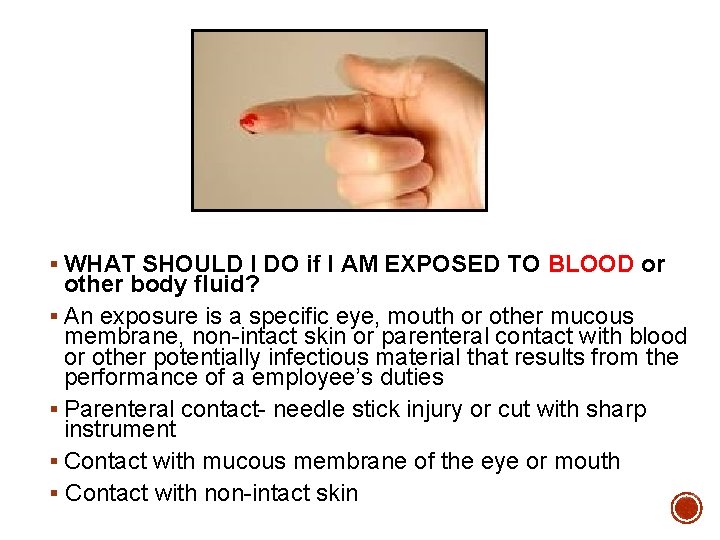
§ WHAT SHOULD I DO if I AM EXPOSED TO BLOOD or other body fluid? § An exposure is a specific eye, mouth or other mucous membrane, non-intact skin or parenteral contact with blood or other potentially infectious material that results from the performance of a employee’s duties § Parenteral contact- needle stick injury or cut with sharp instrument § Contact with mucous membrane of the eye or mouth § Contact with non-intact skin
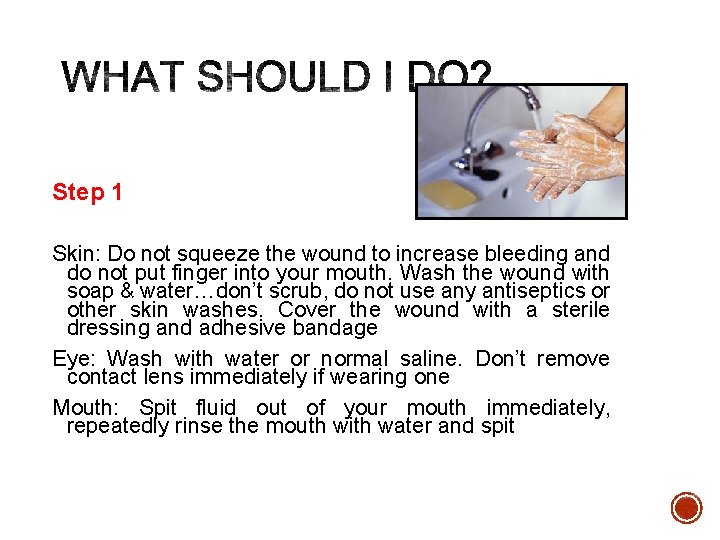
Step 1 Skin: Do not squeeze the wound to increase bleeding and do not put finger into your mouth. Wash the wound with soap & water…don’t scrub, do not use any antiseptics or other skin washes. Cover the wound with a sterile dressing and adhesive bandage Eye: Wash with water or normal saline. Don’t remove contact lens immediately if wearing one Mouth: Spit fluid out of your mouth immediately, repeatedly rinse the mouth with water and spit
Step 2 § Inform the supervisor or clinical staff immediately that you have had an exposure. While you are attending to your injury, the supervisor will interview the patient and review medical history to determine risk potential § The exposed person should report to the nearest emergency care facility as soon as possible and no longer that 24 hours after the exposure for baseline blood testing (if you have elected to do so). You have the right to choose to decline treatment. § Post-exposure prophylaxis for HIV, HBV, & HCV when medically indicated, will be provided, to include counseling § The evaluation and post-exposure follow-up will be made available at no cost to the employee
Step 3 § The supervising employee will contact security to fill out an incident report and will notify the HR employee benefits specialist if the employee chooses to continue with further follow-up treatment. § Proper post-exposure paper work must be assembled an placed into the employees personnel file § Forms are located in the exposure control plan and with human resources
• Every attempt will be made to have the source patient’s blood tested as soon as feasible to determine HBV, HCV and HIV infectivity. Testing is not required if the source is known to be infected. The source patient has the right to decline testing. • Results will be made available to the employee if the source consents to disclosure. • The employee’s blood will be collected for a baseline. • The employee will be offered any medically indicated prophylaxis recommended. Refer to Exposure Control Plan.
WHAT SHOULD I DO? • Step 1 - Wash the site and cover the wound with a bandage for percutaneous injury or wash out the eye with water if eye exposed or spit and then continue to rinse and spit if mouth exposed • Step 2 – Inform your supervisor who will identify source of potentially infectious material and assess the risk and document to route of exposure. • Step 3 - Exposed person should report to nearest emergency facility as soon as possible and at least within 24 hours. • Step 3 - Supervisor will inform Security and fill out an incident form and contact the HR Benefits Specialist • Step 4 – Post-exposure prophylaxis and follow-up as indicated by medical professional • Step 5 - Proper post-exposure paperwork assembled and placed in personnel file
EFSC OSHA/BLOODBORNE PATHOGENS CONTACTS For questions concerning the Exposure Control Plan & Biomedical Waste Plan Contact: Safety Department Radiation Safety Officer (RSO) Science Laboratory Supervisors
§END §OSHA, Laboratory Safety, Bio-Medical and Bio-Hazardous Waste Training Part B
- Slides: 32