
OSHA Form 33 May 20 2009 Liese Barnes
OSHA Form 33 May 20, 2009 Liese Barnes HIOSH OSHA Hawai`i Workshop 05/20/2009 1
Objectives • • Become familiar with OSHA form 33 Understand why it’s a good tool Learn the basics of using the form Become familiar with common pitfalls OSHA Hawai`i Workshop 05/20/2009 2
What is the OSHA Form 33? • Evaluation tool for effectiveness of safety and health management systems (SHMS) • Scores 58 inter-related attributes OSHA Hawai`i Workshop 05/20/2009 3
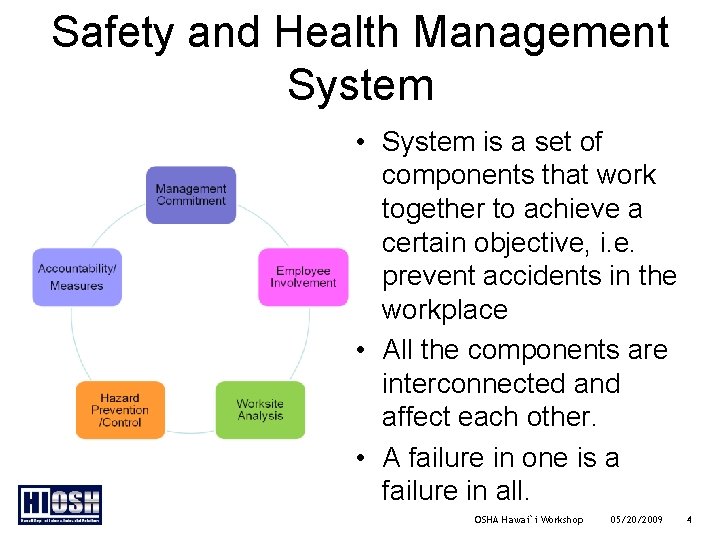
Safety and Health Management System • System is a set of components that work together to achieve a certain objective, i. e. prevent accidents in the workplace • All the components are interconnected and affect each other. • A failure in one is a failure in all. OSHA Hawai`i Workshop 05/20/2009 4
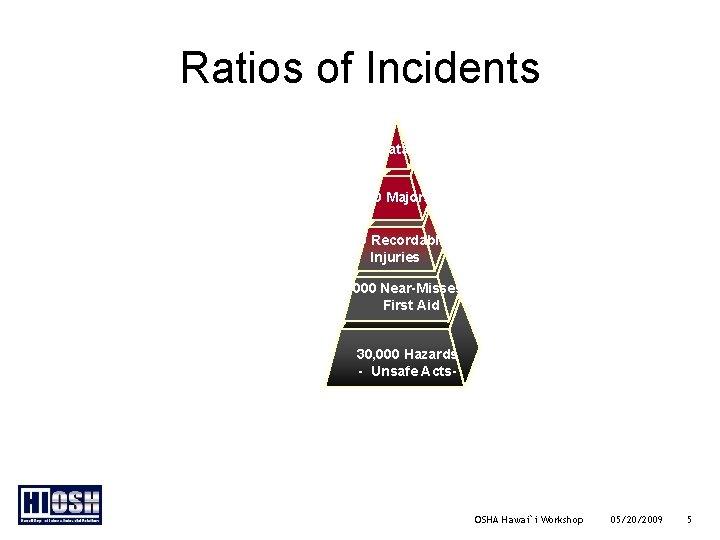
Ratios of Incidents 1 Fatal 30 Majors 300 Recordable Injuries 3, 000 Near-Misses or First Aid 30, 000 Hazards - Unsafe Acts- OSHA Hawai`i Workshop 05/20/2009 5
Why is the Form 33 a Good Tool? • It is validated – Effective predictor of SHMS success • It is consistent – From one person to another, at different times • OSHA uses it to evaluate – SHARP – VPP (coming soon) OSHA Hawai`i Workshop 05/20/2009 6
Why is the Form 33 a Good Tool? • 1985 version I • 1990 -93 version II, (1989 OSHA program mgmt guidelines) • 1991 first validation study • 1995 -96 version III • 1998 validation study • 1999 predictability study • 2001 newest version OSHA Hawai`i Workshop 05/20/2009 7
OSHA Form 33 Uses: • SHARP applicants – Safety and Health Recognition Program • VPP applicants (coming soon) – Voluntary Protection Program • Consultation services OSHA Hawai`i Workshop 05/20/2009 8
Form 33 SHMS Components • Operational Component (19 attributes) • Managerial Component (20 attributes) • Cultural Component (19 attributes) OSHA Hawai`i Workshop 05/20/2009 9
Form 33 SHMS Components Operational: Well defined and communicated system to identify, correct and control hazards Managerial: Effective planning, administration, training, management leadership and supervision to support prevention of hazards Cultural: Developed “safety culture”: Management and employees working together actively & effectively OSHA Hawai`i Workshop 05/20/2009 10
Operational Component • Hazard Anticipation and Detection (#1 -10) • Hazard Prevention and Control (#11 -19) OSHA Hawai`i Workshop 05/20/2009 11
Managerial Component • Planning and Evaluation (#20 -25) • Administration and Supervision (#26 -33) • Safety and Health Training (#34 -39) OSHA Hawai`i Workshop 05/20/2009 12
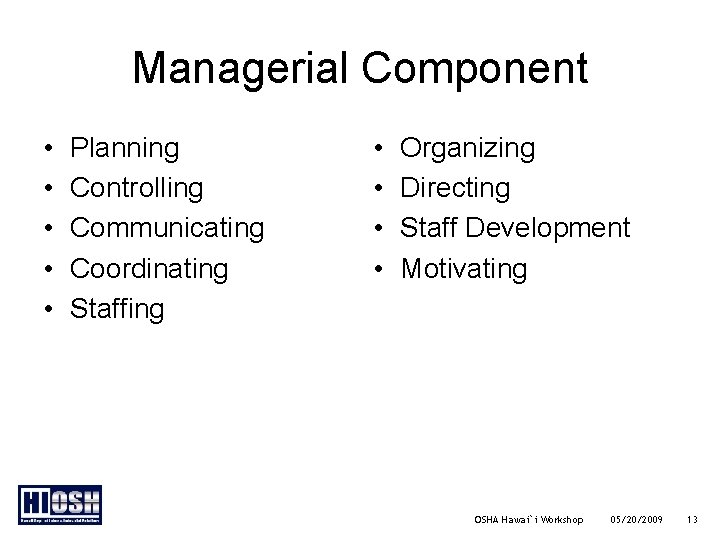
Managerial Component • • • Planning Controlling Communicating Coordinating Staffing • • Organizing Directing Staff Development Motivating OSHA Hawai`i Workshop 05/20/2009 13
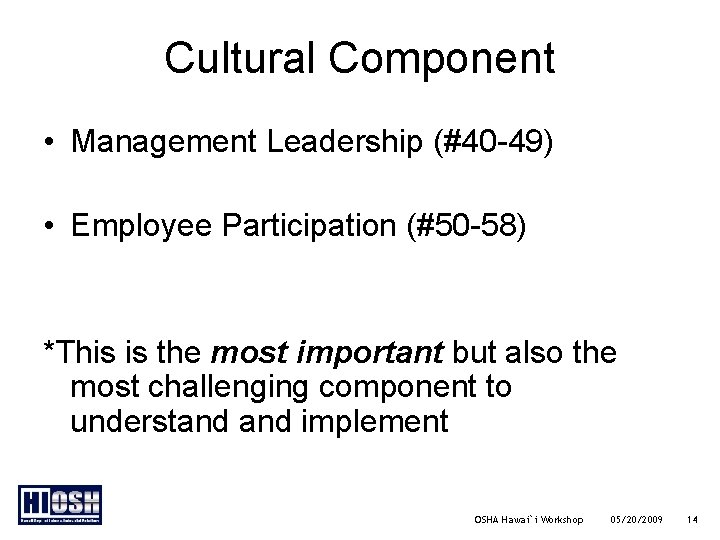
Cultural Component • Management Leadership (#40 -49) • Employee Participation (#50 -58) *This is the most important but also the most challenging component to understand implement OSHA Hawai`i Workshop 05/20/2009 14
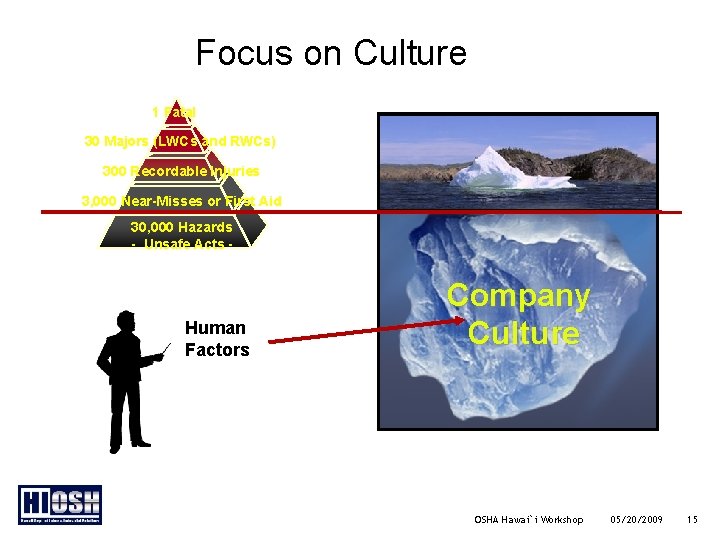
Focus on Culture 1 Fatal 30 Majors (LWCs and RWCs) 300 Recordable Injuries 3, 000 Near-Misses or First Aid 30, 000 Hazards - Unsafe Acts - Human Factors Company Culture OSHA Hawai`i Workshop 05/20/2009 15
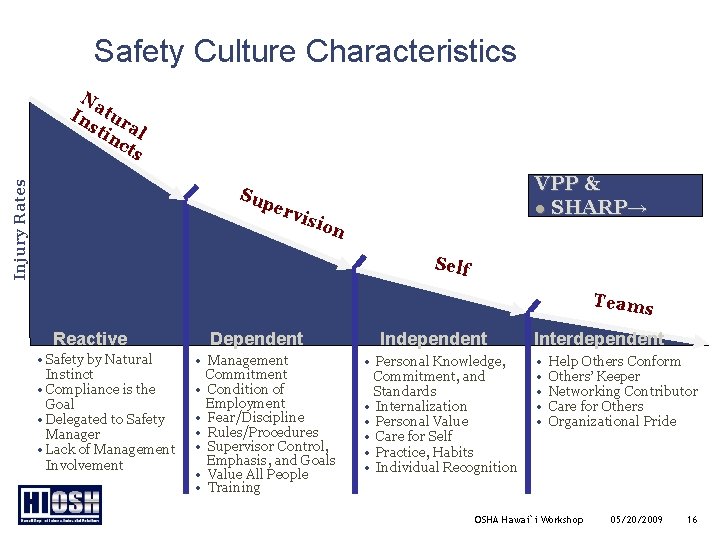
Safety Culture Characteristics Injury Rates Na In tur sti al nc ts Sup erv VPP & l SHARP→ isio n Self Teams Reactive • Safety by Natural Instinct • Compliance is the Goal • Delegated to Safety Manager • Lack of Management Involvement Dependent • Management Commitment • Condition of Employment • Fear/Discipline • Rules/Procedures • Supervisor Control, Emphasis, and Goals • Value All People • Training Independent • Personal Knowledge, Commitment, and Standards • Internalization • Personal Value • Care for Self • Practice, Habits • Individual Recognition Interdependent • • • Help Others Conform Others’ Keeper Networking Contributor Care for Others Organizational Pride OSHA Hawai`i Workshop 05/20/2009 16
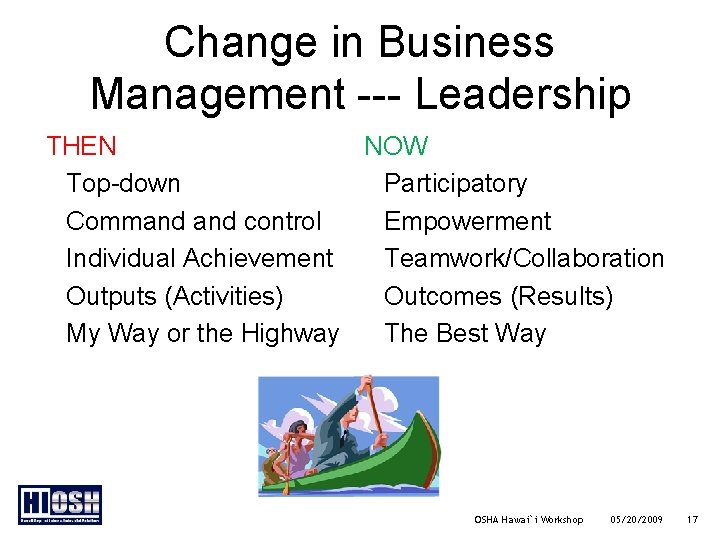
Change in Business Management --- Leadership THEN • Top-down • Command control • Individual Achievement • Outputs (Activities) • My Way or the Highway NOW • Participatory • Empowerment • Teamwork/Collaboration • Outcomes (Results) • The Best Way OSHA Hawai`i Workshop 05/20/2009 17
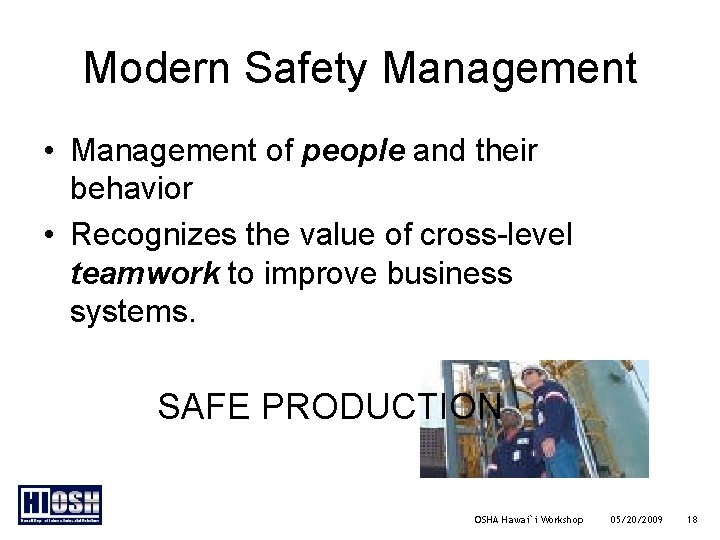
Modern Safety Management • Management of people and their behavior • Recognizes the value of cross-level teamwork to improve business systems. SAFE PRODUCTION OSHA Hawai`i Workshop 05/20/2009 18
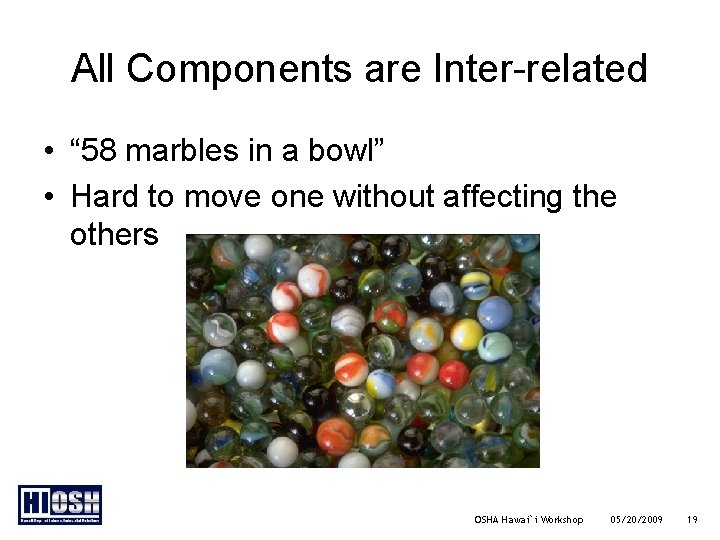
All Components are Inter-related • “ 58 marbles in a bowl” • Hard to move one without affecting the others OSHA Hawai`i Workshop 05/20/2009 19
Using the Form 33 Rate attributes: 0 = No 1 = No, needs major improvement 2 = Yes, needs minor improvement 3 = Yes NA = Not applicable NE = Not evaluated OSHA Hawai`i Workshop 05/20/2009 20
Using the Form 33 Gather information – Document review – Management, supervisor, employee interviews – Observation of work processes, practices, conditions OSHA Hawai`i Workshop 05/20/2009 21
Understand the Attributes • Refer to assessment tips form 33 *These are only tips, not an all inclusive explanation. OSHA Hawai`i Workshop 05/20/2009 22
Top Down vs. Bottom Up • Ask management about their system • Find a hazard • Then verify: • Expand the questioning to documents and management interviews – Document review – Observation – Employee interviews OSHA Hawai`i Workshop 05/20/2009 23
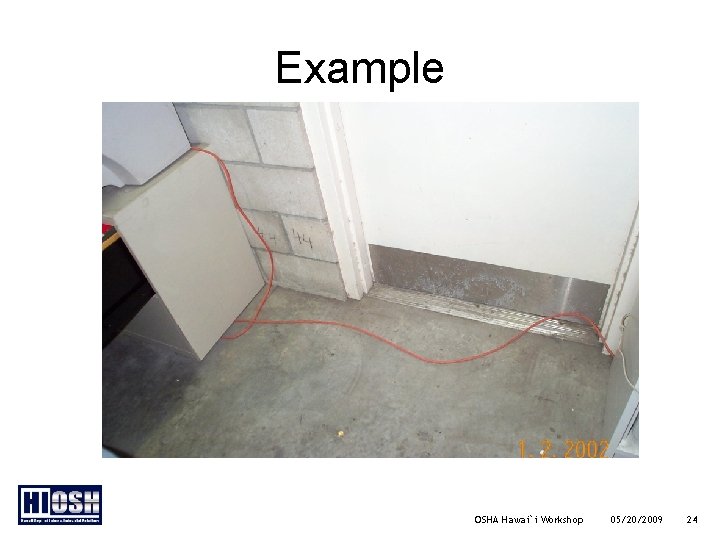
Example OSHA Hawai`i Workshop 05/20/2009 24
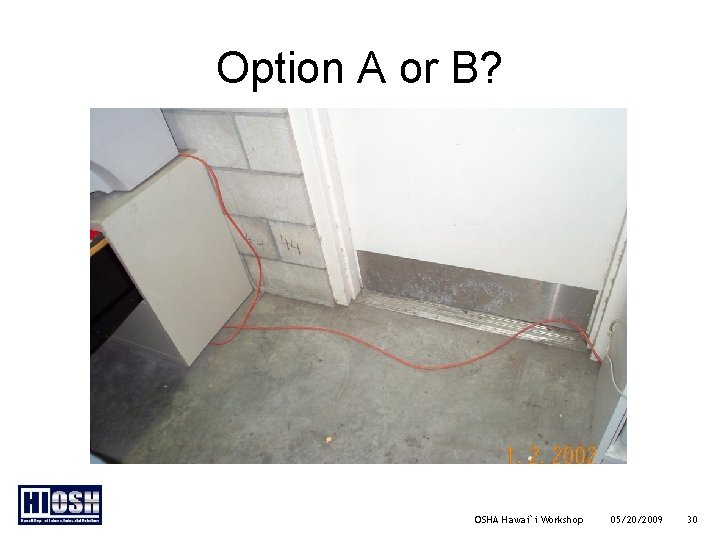
So what do you do? • • Option A Use the form 33 Start asking questions Find out WHY the hazard was allowed to exist Use the information to improve your SHMS Option B • Pull out the extension cord and say “It’s fixed!” OSHA Hawai`i Workshop 05/20/2009 25
Why was this allowed to exist? Failure to identify? If yes, what else should be asked? Failure to correct? If yes, what else should be asked? OSHA Hawai`i Workshop 05/20/2009 26
Attribute #4: “An Effective Hazard Reporting System Exists” 1. Employees can recognize hazards, understand the harm 2. System to report hazards – Employees know how to use it, and – Employees care enough to use it. 3. Hazards are corrected promptly 4. Employees reporting hazards receive prompt feedback regarding correction 5. Employees can report to other if not corrected OSHA Hawai`i Workshop 05/20/2009 27
#4: Some related attributes 1. 2. 3. 4. #34 Safety and health training #46 managers assure that appropriate safety and health training is provided Planning and administration #35 Safety and health training #26 -27 assignment and communication of safety and health tasks #54 employee participation in hazard detection activities #43 managers personally follow safety and health rules 5, 6, 7. Administration and supervision OSHA Hawai`i Workshop 05/20/2009 28
Using the Form 33 • Need to understand the attributes • Attributes are inter-related • Evaluation yields strengths/weaknesses in SHMS →→Action plan for improvement OSHA Hawai`i Workshop 05/20/2009 29
Option A or B? OSHA Hawai`i Workshop 05/20/2009 30
Find and Fix, Find… OSHA Hawai`i Workshop 05/20/2009 31
Attribute #4: Falling short • It’s common sense: the employee tells his supervisor What rating might you give this system? OSHA Hawai`i Workshop 05/20/2009 32
Form 33: Common Pitfall Thinking that you have “finished” the safety process OSHA Hawai`i Workshop 05/20/2009 33
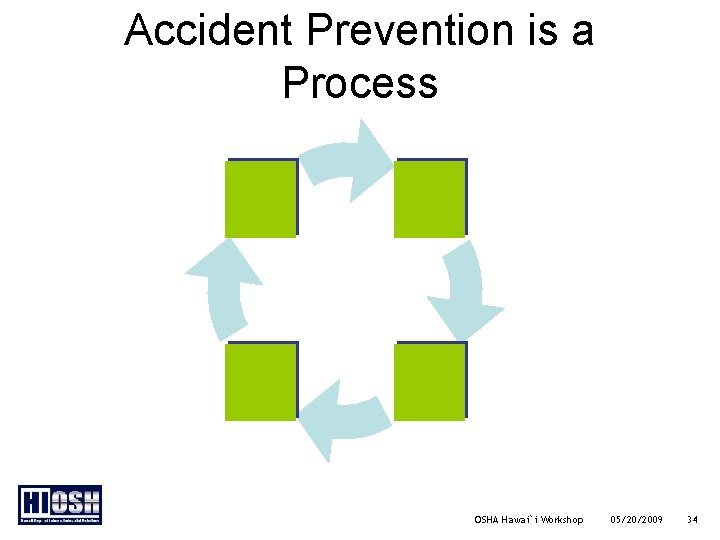
Accident Prevention is a Process OSHA Hawai`i Workshop 05/20/2009 34
Form 33 • Mode of continuous improvement OSHA Hawai`i Workshop 05/20/2009 35
Safety Management Process • Must be effectively integrated into the organization’s culture and operations; and • Must also be adaptable to change as the organization evolves. An effective safety management system is one that meets the needs of the organization. OSHA Hawai`i Workshop 05/20/2009 36
SHARP • • • Safety and Health Achievement Recognition Program OSHA Hawai`i Workshop 05/20/2009 37
SHARP Pitfalls 1. SHARP is easy to obtain Truth: Only about 1300 out of 7 million workplaces have obtained SHARP status We want you to be in the club, but it’s an exclusive club OSHA Hawai`i Workshop 05/20/2009 38
SHARP Pitfalls 2. SHARP = Compliance Truth: Compliance is the minimum required by law. You don’t get an award this. OSHA Hawai`i Workshop 05/20/2009 39
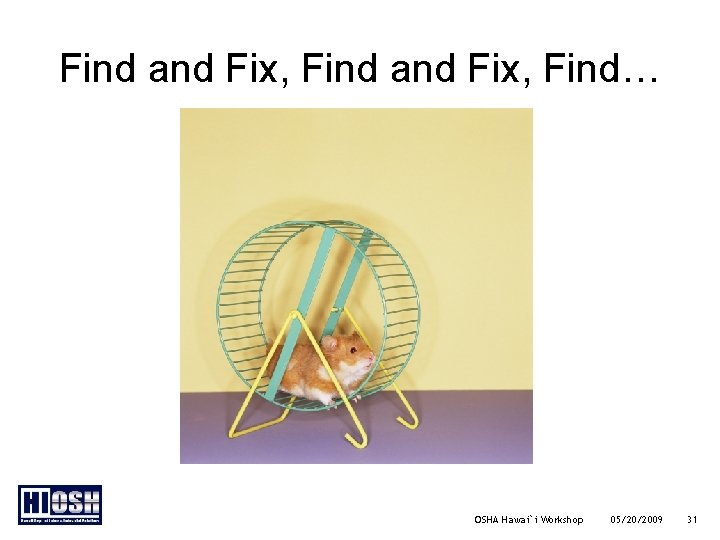
Compliance vs. SHARP • The minimum required by law • Above and beyond compliance • HIOSH standards • Best Practices • “Find and Fix” hazards • Safety and Health Management System aimed at hazard prevention & continuous improvement OSHA Hawai`i Workshop 05/20/2009 40
SHARP Pitfalls 3. Someone said I could/should get SHARP Question: Did they use the form 33? Was it used properly? OSHA Hawai`i Workshop 05/20/2009 41
Questions? OSHA Hawai`i Workshop 05/20/2009 42
- Slides: 42