
OSHA COMPLIANT BLOODBORNE PATHOGEN INFECTION CONTROL TRAINING Statement
OSHA COMPLIANT BLOODBORNE PATHOGEN & INFECTION CONTROL TRAINING
■ Statement of Disclosure #1 Premiere Continuing Education provides educational activities that are free from bias. The information provided in this course is to be used for educational purposes only. It is not intended as a substitute for professional healthcare. Neither the planners of this course nor the author have conflicts of interest to disclose. (A conflict of interest exists when the planners and/or authors have financial relationship with providers of goods or services which could influence their objectivity in presenting educational content. ) This course is not co-provided. #1 Premiere Continuing Education has not received commercial support for this course. ■ There is no “off-label” use of medications in this course. All doses and dose ranges are for adults, unless otherwise indicated. Trade names, when used, are intended as an example of a class of medication, not an endorsement of a specific medication or manufacturer by #1 Premiere Continuing Education.
Introduction Intended Audience This course is intended for people who need OSHA compliant Bloodborne Pathogens and infection control training, according to OSHA BBP Standard (29 CFR 1910. 1030) as part of their job requirement because they may face occupational exposure to Bloodborne Pathogens and infectious disease.
Why Care About This Course Introduction ■ Work tasks may involve the use of needles, razors, and other instruments that may pierce the skin ■ These tasks may lead to exposure to bloodborne pathogens ■ Protect yourself and – – family friends patients and your business
Introduction Learning Objectives ■ Understand how pathogens transmit or move in the environment ■ Identify various pathogens & their symptoms ■ Describe ways to limit pathogenic exposure using hand hygiene & personal protective equipment ■ Institute workplace & engineering controls ■ Explain how to handle an exposure incident
Agenda Introduction ■ Overview – – – Background Definitions Transmission & Risk Factors ■ Exposure Control – – – Exposure Control Plan Exposure Determination Exposure Incident Post-Exposure Risk of Infection ■ Compliance – – – Precautions Hand Hygiene Personal Protective Equipment Cleaning & Disinfecting Regulated Waste ■ Pathogens – – Types of Pathogens Bloodborne Pathogens & Communicable Diseases

OVERVIEW
Overview Agenda Background Definitions Transmission & Risk Factors

Background Occupational Safety & Health Administration (OSHA) The Occupational Safety and Health Act of 1970 (OSH Act) was passed to prevent workers from being killed or seriously harmed at work. This law created the Occupational Safety and Health Administration (OSHA), which sets and enforces protective workplace safety and health standards. OSHA also provides information, training, and assistance to employers and workers. Under the OSH Act, employers have the responsibility to provide a safe workplace. What is OSHA?

Background Centers for Disease Control & Prevention (CDC) CDC works 24/7 to protect America from health, safety and security threats, both foreign and in the U. S. Whether diseases start at home or abroad, are chronic or acute, curable or preventable, human error or deliberate attack, CDC fights disease and supports communities and citizens to do the same. What is the CDC?

Background Bloodborne Pathogens (BBP) Pathogenic (disease-causing) microorganisms that are present in human blood and can cause disease in humans. Including, but not limited to: • Hepatitis B Virus (HBV) • Hepatitis C Virus (HCV) • Human Immunodeficiency Virus (HIV) What are bloodborne pathogens?
Background Healthcare Worker Infections • In 1987, there were 8, 700 cases of Hepatitis B infection among health care workers. Who are high-risk populations for contracting BBP?
Background ■ OSHA was tasked with reducing spread of infection among healthcare workers ■ The Bloodborne Pathogens Standard was published in 1991 The Standard imposes requirements on employers of workers who may be exposed to blood or other potentially infectious materials (OPIM) such as certain tissues and body fluids.
Background Bloodborne Pathogens Standard • In 1995, just four years after publication of OSHA's standard, only 800 new cases related to occupational exposure were reported by the Centers for Disease Control and Prevention (CDC). Did the Standard improve conditions?
Background ■ Despite the successes, the number of needlestick injuries continued to grow along with healthcare workers’ risk ■ The conclusion was that health care workers face a significant threat not only from HCV & HIV but all bloodborne pathogens The Needlestick Safety and Prevention Act, signed into law in 2000, directed OSHA to update the Bloodborne Pathogen Standard (29 CFR 1910. 1030)

BBP Standard (29 CFR 1910. 1030) a) Scope & Application b) Definitions c) Exposure Control 1) 2) f) 1) Exposure Control Plan Exposure Determination 2) 3) d) Methods of Compliance 1) 2) 3) 4) Universal Precautions Engineering and Work Practice Controls Personal Protective Equipment Housekeeping 4) 5) 6) 2) 3) 4) 5) Experimentation & Manipulation Labs & Facilities Criteria Labs Criteria Facilities Criteria Training Requirements General Hepatitis B Vaccination Post-Exposure Evaluation & Follow-Up Information Provided to the Healthcare Professional’s Written Opinion Medical Recordkeeping g) Communications of Hazards to Employees e) HIV & HBV Research Labs & Production Facilities 1) Hepatitis B Vaccination & Post-Exposure Evaluation & Follow-Up 1) 2) Labels & Signs Information & Training h) Recordkeeping 1) 2) 3) 4) 5) i) Medical Records Training Records Availability Transfer of Records Sharps Injury Log Dates Link to Standard on Dept of Labor Website
Definitions ■ Blood: human blood, human blood components, and products made from human blood ■ Bloodborne Pathogens: pathogenic (disease-causing) microorganisms that are present in human blood and can cause disease in humans. Including, but not limited to: – Human Immunodeficiency Virus (HIV) – Hepatitis B Virus (HBV) – Hepatitis C Virus (HCV) ■ Contaminated: the presence or the reasonably anticipated presence of blood or other potentially infectious materials on a surface or in or on an item ■ Contaminated Laundry: means laundry which has been soiled with blood or other potentially infectious materials or may contain sharps
Definitions ■ Contaminated Sharps: any contaminated object that can penetrate the skin including, but not limited to: – Needles, Razors, Broken glass, Scalpels, Broken capillary tubes ■ Decontamination: the use of physical or chemical means to remove, inactivate, or destroy bloodborne pathogens on a surface or item to the point where they are no longer capable of transmitting infectious particles and the surface or item is rendered safe for handling, use, or disposal ■ Engineering Controls: controls (e. g. , sharps disposal containers, sharps with engineered sharps injury protection) that isolate or remove the bloodborne pathogens hazard from the workplace
Definitions ■ Exposure Incident: a specific eye, mouth, other mucous membrane, non-intact skin, or parenteral contact with blood or other potentially infectious materials that results from the performance of an employee's duties ■ Handwashing Facilities: means a facility providing an adequate supply of running potable water, soap and single use towels or hot air-drying machines ■ Licensed Healthcare Professional: a person whose legally permitted scope of practice allows him or her to independently perform certain activities including Hepatitis B Vaccination and Post-exposure Evaluation and Follow-up

Definitions ■ Needleless systems: means a device that does not use needles for: – the collection of bodily fluids or withdrawal of body fluids after initial venous or arterial access is established; – the administration of medication or fluids; or – any other procedure involving the potential for occupational exposure to bloodborne pathogens due to percutaneous injuries from contaminated sharps ■ Occupational Exposure: reasonably anticipated skin, eye, mucous membrane, or parenteral contact with blood or other potentially infectious materials that may result from the performance of an employee's duties

Definitions ■ Other Potentially Infectious Materials (OPIM): – Human body fluids including any body fluid that is visibly contaminated with blood such as saliva or vomit, and all body fluids in situations where it is difficult or impossible to differentiate between body fluids or such as emergency response; – Any unfixed tissue or organ (other than intact skin) from a human (living or dead); and – Any of the following, if known or reasonably likely to contain or be infected with HIV, HBV, or HCV: ■ Cell, tissue, or organ cultures from humans or experimental animals; ■ Blood, organs, or other tissues from experimental animals; or ■ Culture medium or other solutions
Definitions ■ Parenteral Contact: piercing mucous membranes or the skin barrier through such events as needlesticks, razor cuts ■ Personal Protective Equipment: is specialized clothing or equipment worn or used by an employee for protection against a hazard – General work clothes (e. g. , uniforms, pants, shirts or blouses) not intended to function as protection against a hazard are not considered to be personal protective equipment
Definitions ■ Regulated Waste: waste that is any of the following– Liquid or semi-liquid blood or OPIM; – Contaminated items that: ■ Contain liquid or semi-liquid blood, or are caked with dried blood or OPIM; and ■ Are capable of releasing these materials when handled or compressed. – Contaminated sharps – Pathological and microbiological wastes containing blood or OPIM
Definitions ■ Sharps with engineered sharps injury protections: a non-needle sharp or a needle device used for withdrawing body fluids, accessing a vein or artery, or administering medications or other fluids, with a built-in safety feature or mechanism that effectively reduces the risk of an exposure incident ■ Source Individual: an whose blood or OPIM may be a source of occupational exposure, including, but are not limited to – clients, co-workers
Definitions ■ Sterilization: the use of a physical or chemical procedure to destroy all microbial life including highly resistant bacterial endospores ■ Universal Precautions: an approach to infection control – all human blood and certain human body fluids are treated as if known to be infectious for HIV, HBV, HCV, and other bloodborne pathogens ■ Work Practice Controls: controls that reduce the likelihood of exposure by defining the manner in which a task is performed
Modes of Transmission: the way germs are moved ■ Germs don’t move themselves – depend on people, the environment, and/or objects to move ■ Ways that germs spread – Directly ■ Contact (person-to-person) ■ Droplet spread – Indirectly ■ Vehicle – – fomite (contaminated object) biological (blood) ■ Airborne
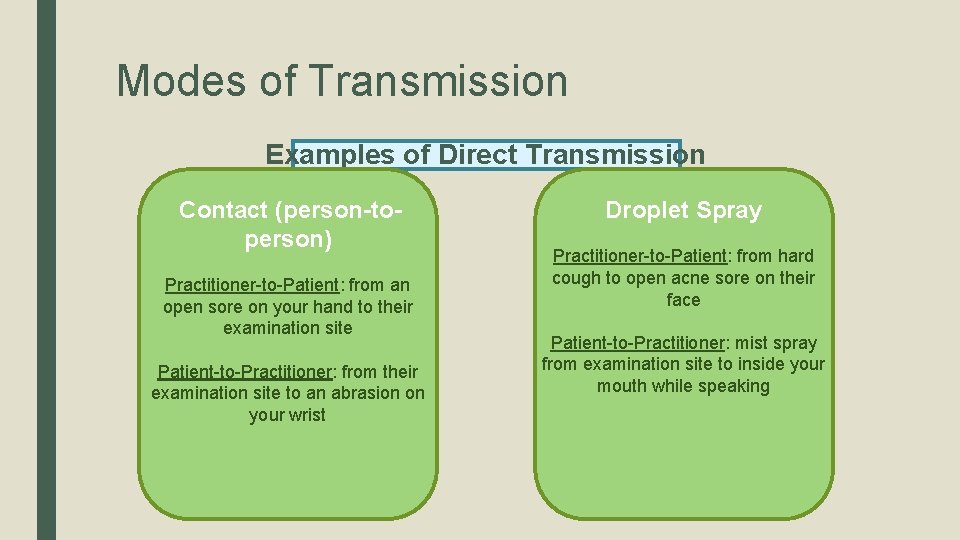
Modes of Transmission Examples of Direct Transmission Contact (person-toperson) Practitioner-to-Patient: from an open sore on your hand to their examination site Patient-to-Practitioner: from their examination site to an abrasion on your wrist Droplet Spray Practitioner-to-Patient: from hard cough to open acne sore on their face Patient-to-Practitioner: mist spray from examination site to inside your mouth while speaking
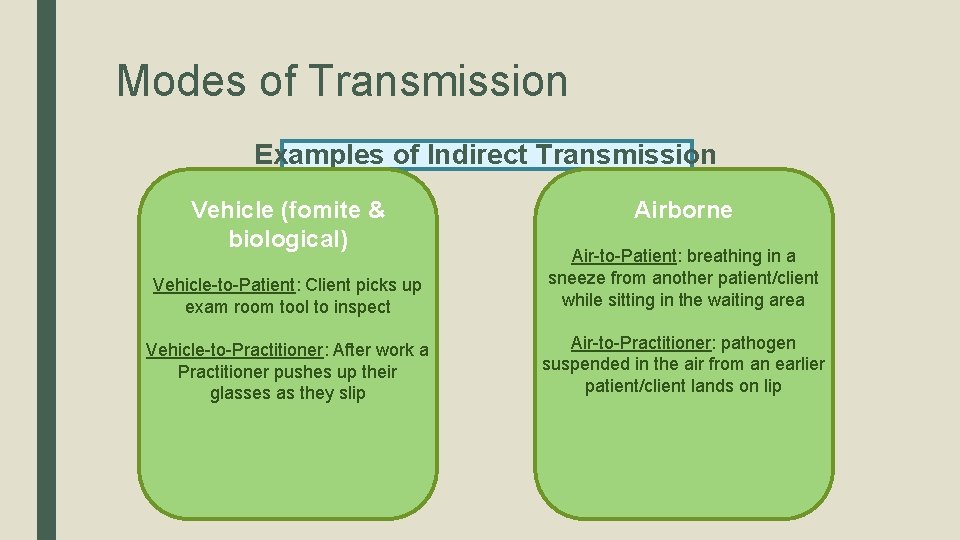
Modes of Transmission Examples of Indirect Transmission Vehicle (fomite & biological) Airborne Vehicle-to-Patient: Client picks up exam room tool to inspect Air-to-Patient: breathing in a sneeze from another patient/client while sitting in the waiting area Vehicle-to-Practitioner: After work a Practitioner pushes up their glasses as they slip Air-to-Practitioner: pathogen suspended in the air from an earlier patient/client lands on lip
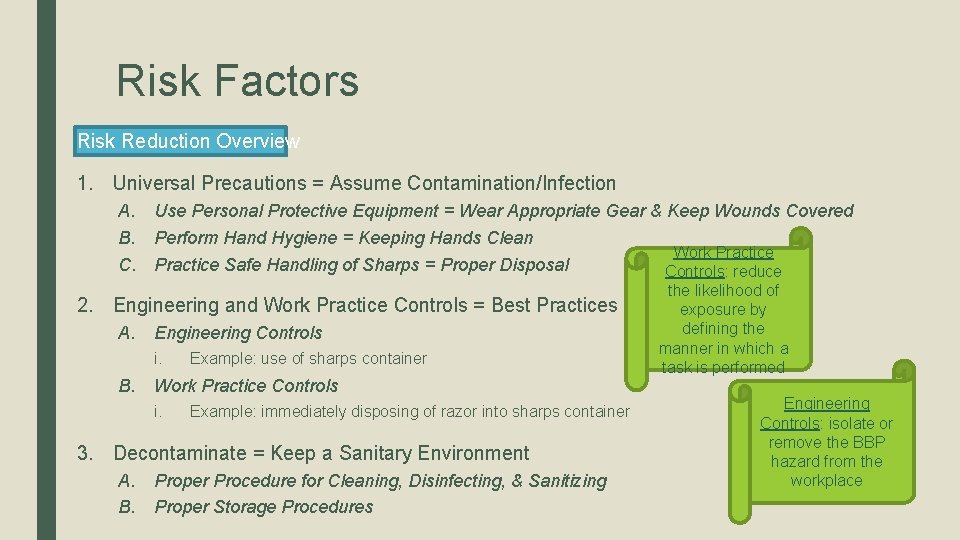
Risk Factors Risk Reduction Overview 1. Universal Precautions = Assume Contamination/Infection A. Use Personal Protective Equipment = Wear Appropriate Gear & Keep Wounds Covered B. Perform Hand Hygiene = Keeping Hands Clean Work Practice C. Practice Safe Handling of Sharps = Proper Disposal Controls: reduce 2. Engineering and Work Practice Controls = Best Practices A. Engineering Controls i. B. Example: use of sharps container Work Practice Controls i. Example: immediately disposing of razor into sharps container 3. Decontaminate = Keep a Sanitary Environment A. B. Proper Procedure for Cleaning, Disinfecting, & Sanitizing Proper Storage Procedures the likelihood of exposure by defining the manner in which a task is performed Engineering Controls: isolate or remove the BBP hazard from the workplace
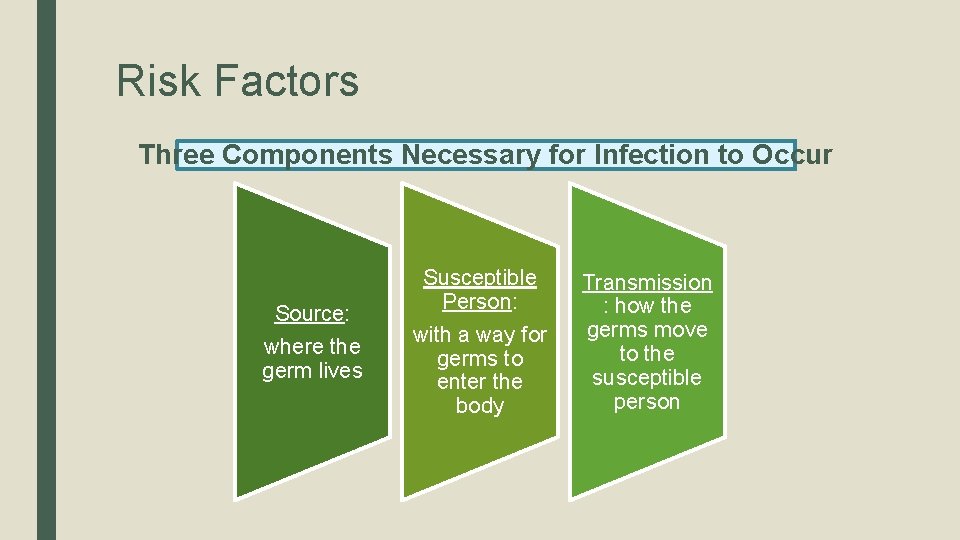
Risk Factors Three Components Necessary for Infection to Occur Source: where the germ lives Susceptible Person: with a way for germs to enter the body Transmission : how the germs move to the susceptible person
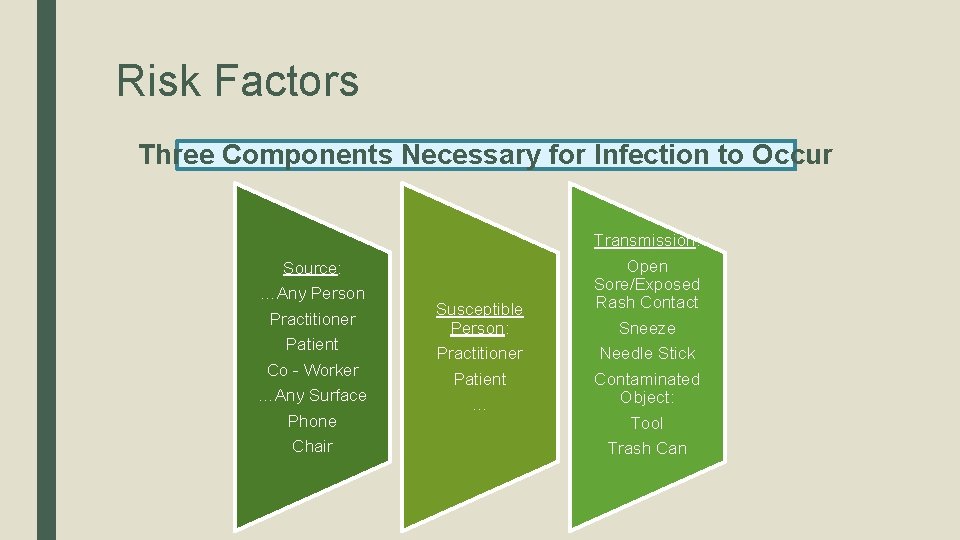
Risk Factors Three Components Necessary for Infection to Occur Source: …Any Person Practitioner Patient Co - Worker …Any Surface Phone Chair Susceptible Person: Practitioner Patient … Transmission: Open Sore/Exposed Rash Contact Sneeze Needle Stick Contaminated Object: Tool Trash Can
- Slides: 31