
OSHA AN EXPLANATION OF A NEGATIVE EXPOSURE ASSESSMENT
![A “Negative Initial Exposure Assessment”[29 CFR 1926. 1101(b)] means that there will be no](https://slidetodoc.com/presentation_image/5057f7350aca9b494ecf12d2eea72d1a/image-2.jpg "A “Negative Initial Exposure Assessment”[29 CFR 1926. 1101(b)] means that there will be no")
- Slides: 10
OSHA AN EXPLANATION OF A NEGATIVE EXPOSURE ASSESSMENT
A “Negative Initial Exposure Assessment”[29 CFR 1926. 1101(b)] means that there will be no employee exposure to asbestos above the PEL (0. 1 f/cc) when conducting a work on a certain ACM, using certain described control methods and work practices conducted by employees trained in compliance with the standard, including air monitoring data on the described procedure. It is a well thought-out plan on how to do work in a safe way. The assessment is required by law. If you do not have it, you must assume positive for exposure, document that exposure and comply with the OSHA standards to protect employees in that exposure situation. An OSHA citation for “No NEA” is a “Serious” violation, as exposure must be assumed.
The requirement for the “Initial Exposure Assessment” in OSHA at 29 CFR 1926(f)(2) could be interpreted to merely require an assessment of upcoming work by a Competent Person, and however it comes out, negative (<0. 1 f/cc) or positive (>0. 1 f/cc), it would determine what elements of the standard must be complied with. However, to interpret the standard in this way is to miss the overall concept of the Competent Person, the pro-active role of the regulation, and “employee exposure”. The employer has strict requirements for : Competent Person Regulated Area Wet methods HEPA-vac cleanup Prompt containing of waste Certain prohibitions Training Identification/notification of ACM etc.
None of these requirements are triggered by “exposure”, but are required regardless of exposure. You should understand from this, and from the definition and responsibility of the required Competent Person, that the primary intent of the regulation is to keep employees from being exposed, not to address employee exposure after the fact. If we protect employees with respirators, we must comply with the Respiratory Protection standard at 1910. 134. In the first paragraph we read that employee protection is accomplished first by doing work in a way that does not produce exposure, not by wearing respirators. With all that in mind, you should interpret the responsibility of the Competent Person to produce a “Negative Initial Exposure Assessment”, not merely an assessment of exposure from work practices that may be positive or negative.
In the asbestos control industry, we work to control exposure from a particulate (harmful dust, as OSHA would say). We can usually figure out how to keep from generating the dust (pro-active, not re-active controls). The reasons that 29 CFR 1926. 1101 must be pro-active (NEA, not just EA) to protect employees, is that (1) there are no symptoms to asbestos exposure, and (2) the exposure “accumulates” in the body (the exposure or the disease that results cannot be “cured” – it must be prevented). In other words, asbestos disease is “dose-response related” – the higher the accumulated dose, the higher the potential disease. “Employee exposure”, as defined in the regulation, is measured as if the employee were not using a respirator. So, keeping employee exposure below the PEL requires work practice controls, not merely respirator use.
OSHA A GUIDE TO DOCUMENTING A NEGATIVE EXPOSURE ASSESSMENT
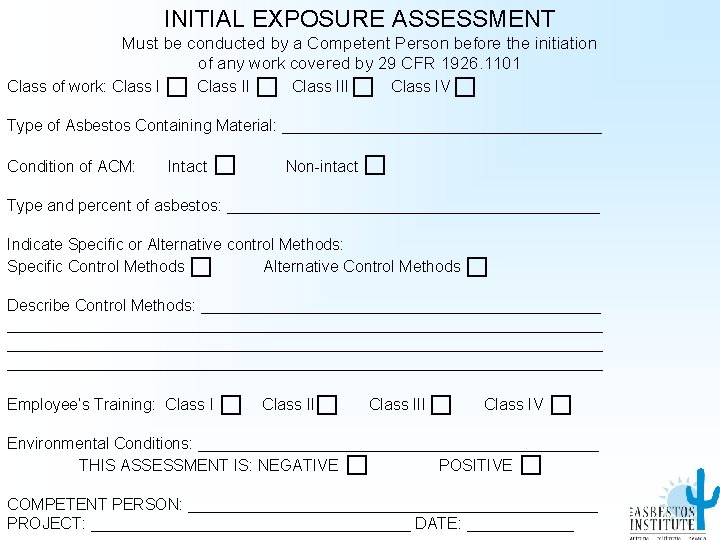
INITIAL EXPOSURE ASSESSMENT Must be conducted by a Competent Person before the initiation of any work covered by 29 CFR 1926. 1101 Class of work: Class III Class IV Type of Asbestos Containing Material: __________________ Condition of ACM: Intact Non-intact Type and percent of asbestos: _____________________ Indicate Specific or Alternative control Methods: Specific Control Methods Alternative Control Methods Describe Control Methods: ___________________________________________________________________ Employee’s Training: Class III Class IV Environmental Conditions: _______________________ THIS ASSESSMENT IS: NEGATIVE POSITIVE COMPETENT PERSON: _______________________ PROJECT: __________________ DATE: ______
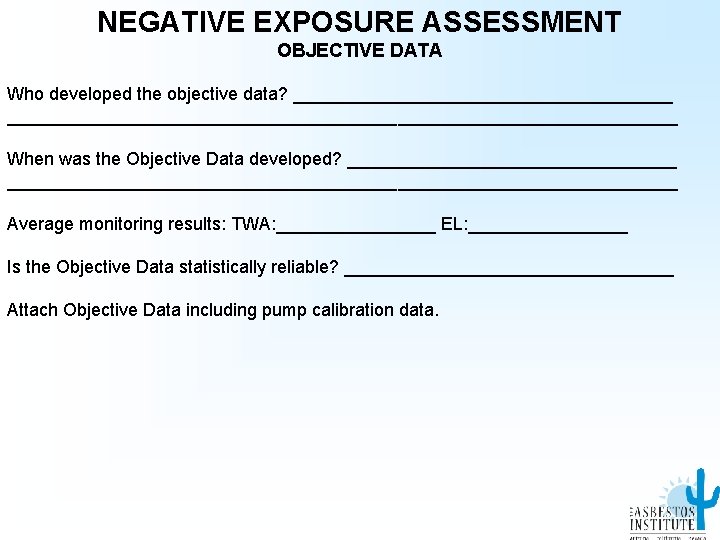
NEGATIVE EXPOSURE ASSESSMENT OBJECTIVE DATA Who developed the objective data? _____________________________________________________ When was the Objective Data developed? __________________________________________________ Average monitoring results: TWA: ________ EL: ________ Is the Objective Data statistically reliable? _________________ Attach Objective Data including pump calibration data.
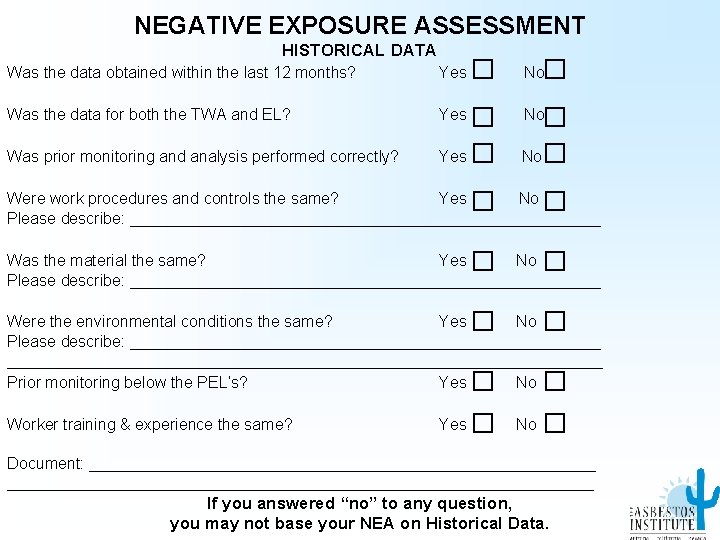
NEGATIVE EXPOSURE ASSESSMENT HISTORICAL DATA Was the data obtained within the last 12 months? Yes No Was the data for both the TWA and EL? Yes No Was prior monitoring and analysis performed correctly? Yes No Were work procedures and controls the same? Yes No Please describe: ___________________________ Was the material the same? Yes No Please describe: ___________________________ Were the environmental conditions the same? Yes No Please describe: ____________________________________________________________ Prior monitoring below the PEL’s? Yes No Worker training & experience the same? Yes No Document: ______________________________________________________________ If you answered “no” to any question, you may not base your NEA on Historical Data.
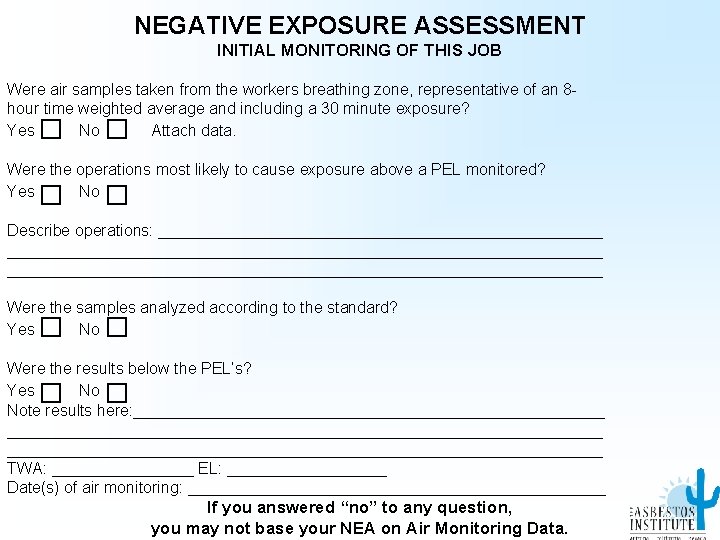
NEGATIVE EXPOSURE ASSESSMENT INITIAL MONITORING OF THIS JOB Were air samples taken from the workers breathing zone, representative of an 8 hour time weighted average and including a 30 minute exposure? Yes No Attach data. Were the operations most likely to cause exposure above a PEL monitored? Yes No Describe operations: ___________________________________________________________ Were the samples analyzed according to the standard? Yes No Were the results below the PEL’s? Yes No Note results here: ____________________________________________________________ TWA: ________ EL: _________ Date(s) of air monitoring: ________________________ If you answered “no” to any question, you may not base your NEA on Air Monitoring Data.