
OSHA All Up in your Business Recordkeeping Severe
OSHA All Up in your Business Recordkeeping Severe Injury Reporting Injury Tracking Application (ITA)
This Session Completing OSHA Recordkeeping form Recordable and non recordable Summary posting Reporting a fatality or severe injury to OSHA Electronic Submission of Records (ITA)
Definitions Recording Referring to an entry on the OSHA log Reporting Referring to making verbal report to OSHA on a specific incident
1 st - Completing the OSHA Recordkeeping Forms A review of the recordkeeping requirements and forms at a high level: The forms in OSHA’s recordkeeping package Recordability criteria for injuries and illnesses Recording injuries/illnesses on the forms 1 2
injury and illness recordkeeping forms? W E Many but not all employers. Exceptions are based on: DO �Small employer exemption – 10 or fewer employees at all times during the year �Low hazard industry exemption – see list of Partially Exempt Industries (PDF) “It’s easy and beneficial. ” 2 3
What forms must be completed? 3 OSHA Form 300 – Log of Work Related Injuries and Illnesses OSHA Form 301 – Injury and Illness Incident Report OSHA Form 300 A – Summary of Work Related Injuries and Illnesses 4
What cases need to be recorded on the forms? Injuries and illnesses and Work related and Meet certain severity criteria 4 We tend to over report our injuries when we are not certain of recordability. 5
What is considered an injury or illness? �An abnormal condition or disorder �Not an exposure, unless it results in signs or symptoms IE: if an employee is exposed to a chemical and does not exhibit symptoms due to the exposure, the case would not be recorded on the log, even if it involved preventative medical treatment. 5 6
What cases are work related? Cases caused by events or exposures in the work environment Cases contributed to by events or exposures in the work environment Cases significantly aggravated by events or exposures in the work environment (For a list of activities that are not work related, see section 1904. 5(b)(2) [PDF]. ) 6 7
What are the severity criteria for recording a work related injury or illness? Death Loss of consciousness Days away from work Restricted work activity or job transfer Medical treatment beyond first aid 7 This one is the devil. . . 8

First aid handout
1904. 5(b)(2) Are there situations where an injury occurs in the work environment and is not considered workrelated? - Handout Yes, an injury or illness occurring in the work environment that falls under one of the following exceptions is not work related, and therefore is not recordable. At the time of the injury or illness, the employee was present in the work environment as a member of the general public rather than as an employee. The injury or illness involves signs or symptoms that surface at work but result solely from a non work related event or exposure that occurs outside the work environment. The injury or illness results solely from voluntary participation in a wellness program or in a medical, fitness, or recreational activity such as blood donation, physical examination, flu shot, exercise class,
is not considered work related The injury or illness is solely the result of an employee eating, drinking, or preparing food or drink for personal consumption (whether bought on the employer's premises or brought in). The injury or illness is solely the result of an employee doing personal tasks (unrelated to their employment) at the establishment outside of the employee's assigned working hours. The injury or illness is solely the result of personal grooming, self medication for a non work related condition, or is intentionally self inflicted.
continued The injury is caused by a motor vehicle accident and occurs on a company parking lot or company access road while employee is commuting to or from work. The illness is the common cold or flu (Note: contagious diseases such as tuberculosis, hepatitis A, or plague are considered work-related if the employee is infected at work). The illness is a mental illness. Mental illness will not be considered work-related unless the employee voluntarily provides the employer with an opinion from a physician with appropriate training stating that the employee has a mental illness that is work-related.
Logging injuries and illnesses and forms review
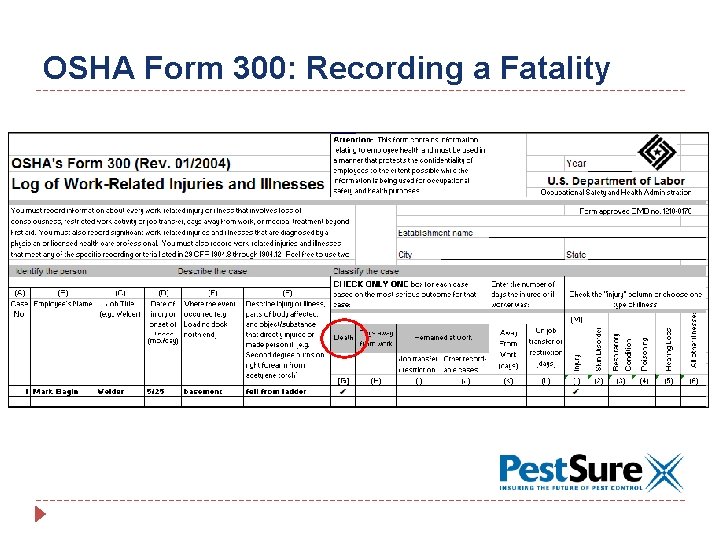
OSHA Form 300: Recording a Fatality 8 9
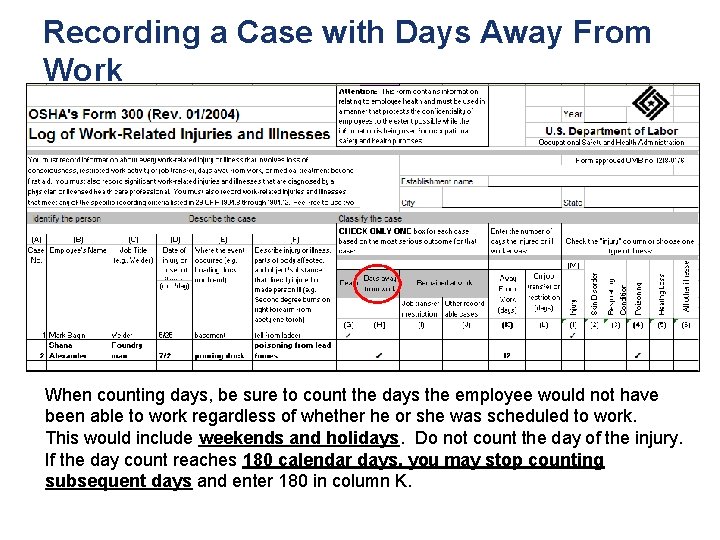
Recording a Case with Days Away From Work 9 When counting days, be sure to count the days the employee would not have been able to work regardless of whether he or she was scheduled to work. This would include weekends and holidays. Do not count the day of the injury. If the day count reaches 180 calendar days, you may stop counting subsequent days and enter 180 in column K. 10
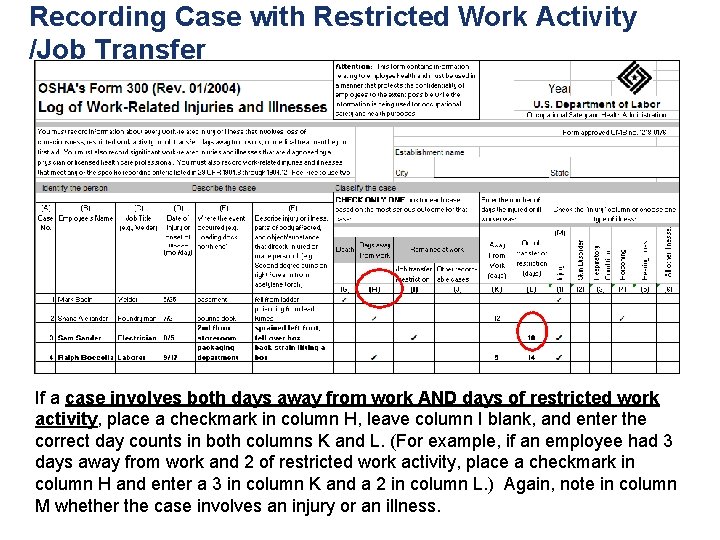
Recording Case with Restricted Work Activity /Job Transfer If a case involves both days away from work AND days of restricted work activity, place a checkmark in column H, leave column I blank, and enter the correct day counts in both columns K and L. (For example, if an employee had 3 days away from work and 2 of restricted work activity, place a checkmark in column H and enter a 3 in column K and a 2 in column L. ) Again, note in column M whether the case involves an injury or an illness. 10 11
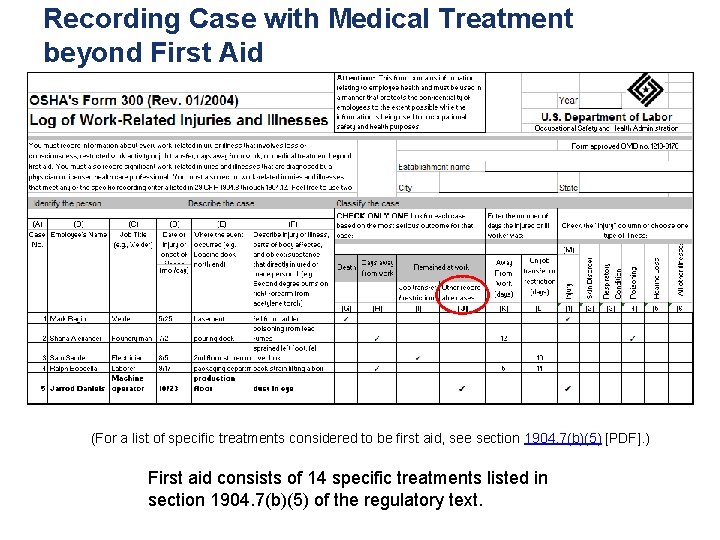
Recording Case with Medical Treatment beyond First Aid (For a list of specific treatments considered to be first aid, see section 1904. 7(b)(5) [PDF]. ) 11 First aid consists of 14 specific treatments listed in section 1904. 7(b)(5) of the regulatory text. 12
Other Recording Criteria 12 Significant diagnosed injury or illness Needlestick and sharps injuries – section 1904. 8 (PDF) Medical removal – section 1904. 9 (PDF) Hearing loss – section 1904. 10 (PDF) Tuberculosis – section 1904. 11 (PDF) 13
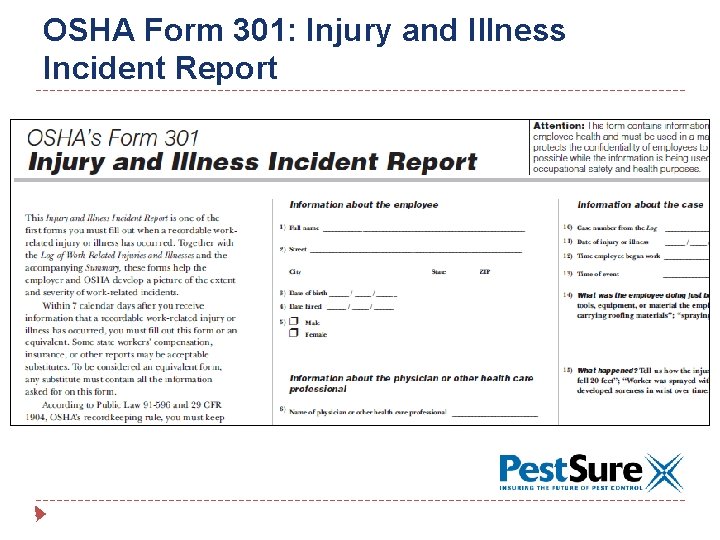
OSHA Form 301: Injury and Illness Incident Report 13 14
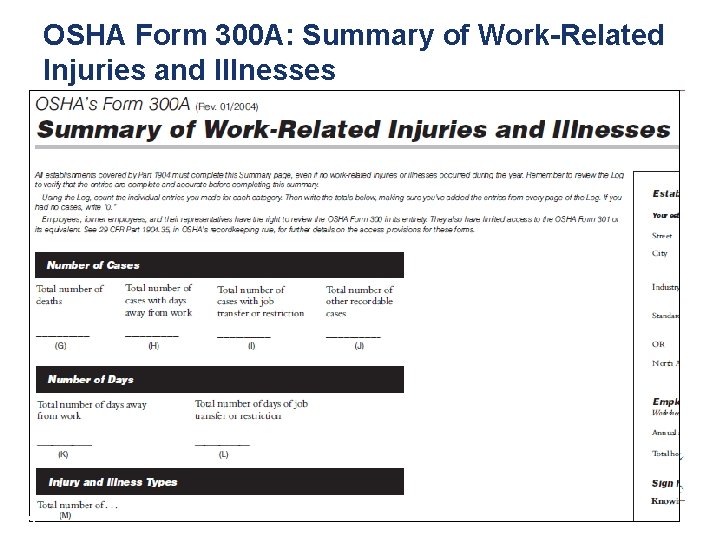
OSHA Form 300 A: Summary of Work-Related Injuries and Illnesses 14 15
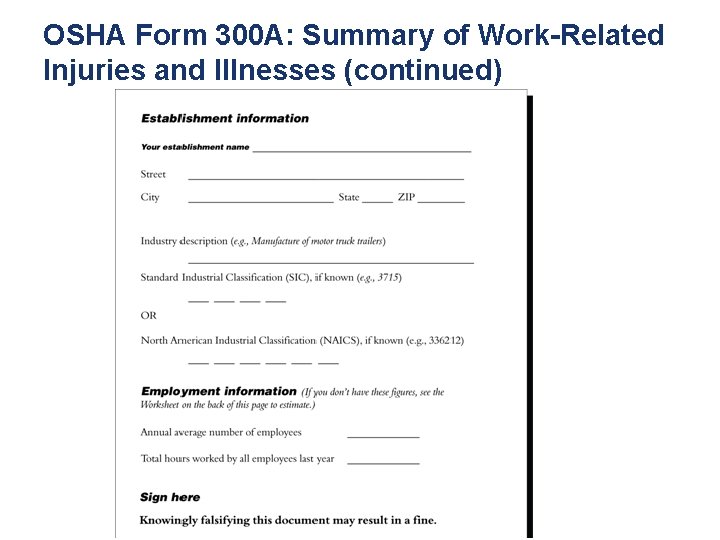
OSHA Form 300 A: Summary of Work-Related Injuries and Illnesses (continued) 15 16
Keep the Forms on File �File and update for 5 years �Do not send copies to OSHA unless asked to do so �Allow access to the records 16 17
Resources • Recordkeeping web page (https: //www. osha. gov/recordkeeping) • Q&A Search web page (https: //www. osha. gov/recordkeeping/faq_search/index. html) • Local OSHA Offices https: //www. osha. gov/html/RAmap. html) • E-correspondence/Contact us (https: //www. osha. gov/html/Feed_Back. html) 17 18

Severe Injury Reporting Employers must report any worker fatality within 8 hours and any amputation, loss of an eye, or hospitalization of a worker within 24 hours.
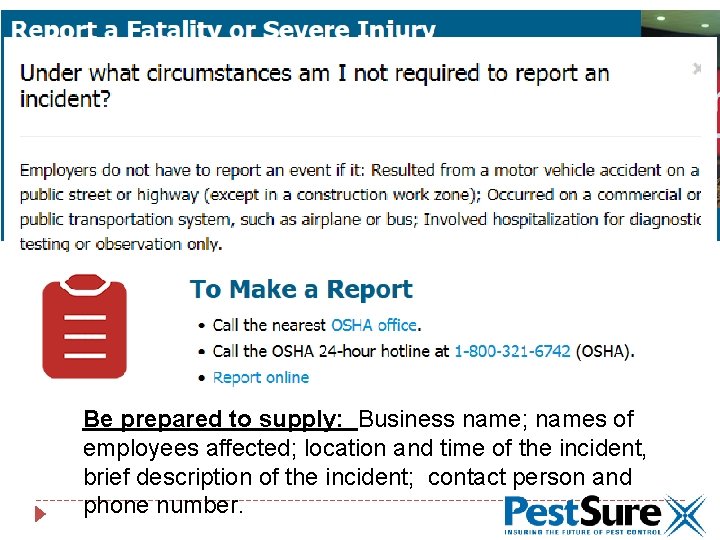
Be prepared to supply: Business name; names of employees affected; location and time of the incident, brief description of the incident; contact person and phone number.

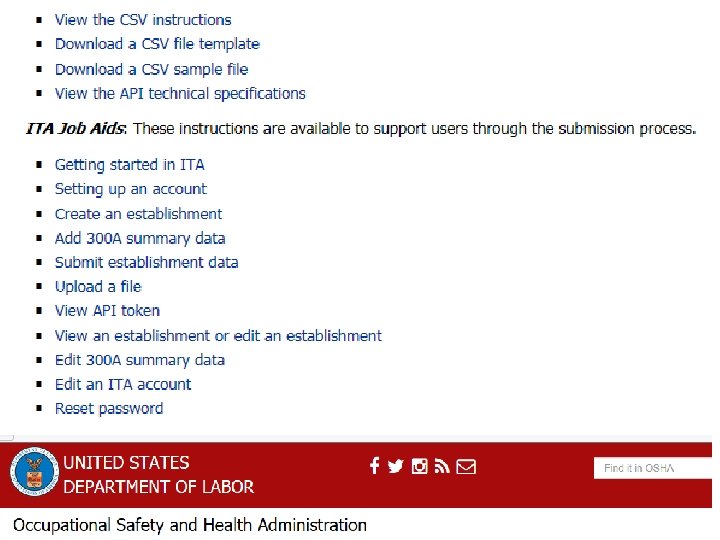
Electronic Submission of Records Injury Tracking Application
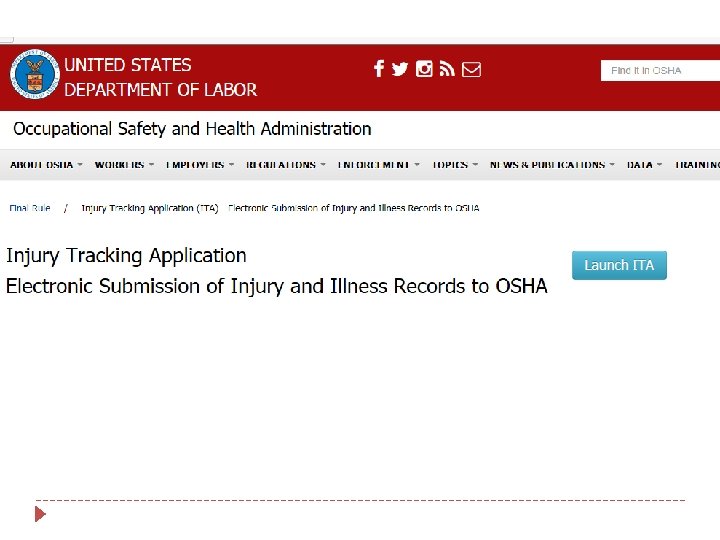
Electronic Submission of Records • The Injury Tracking Application (ITA) is accessible from the ITA launch page, where you can provide the Agency your 2017 OSHA Form 300 A information. The date by which certain employers are required to submit to OSHA the information from their completed 2017 Form 300 A is July 1, 2018. • Beginning in 2019 and every year thereafter, covered establishments must submit the information by March 2.
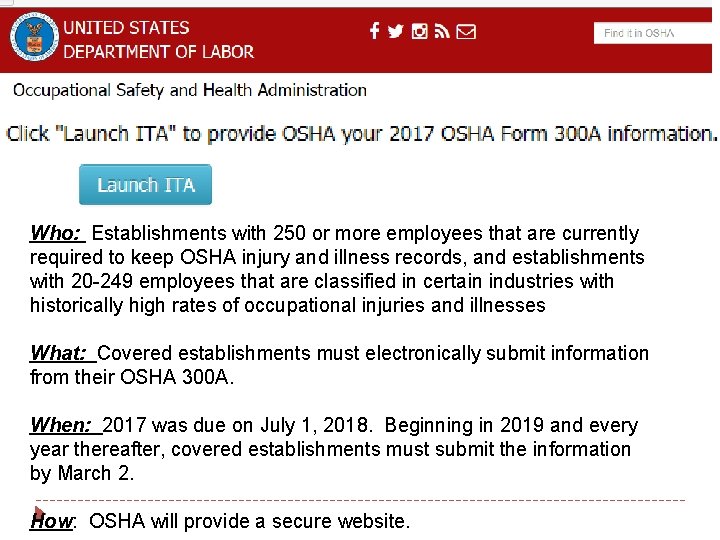
Who: Establishments with 250 or more employees that are currently required to keep OSHA injury and illness records, and establishments with 20 249 employees that are classified in certain industries with historically high rates of occupational injuries and illnesses What: Covered establishments must electronically submit information from their OSHA 300 A. When: 2017 was due on July 1, 2018. Beginning in 2019 and every year thereafter, covered establishments must submit the information by March 2. How: OSHA will provide a secure website.
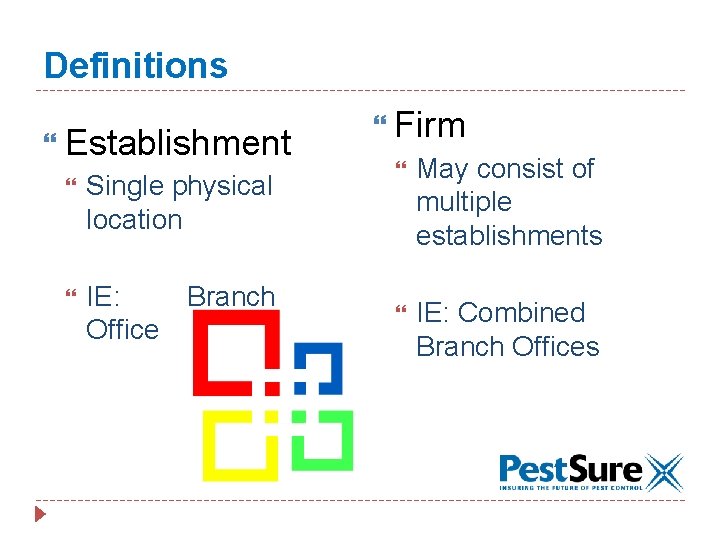
Definitions Establishment Single physical location IE: Branch Office Firm May consist of multiple establishments IE: Combined Branch Offices
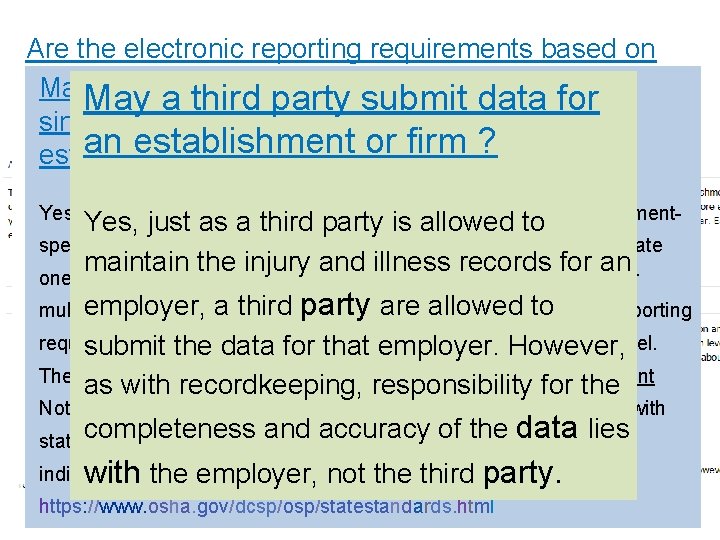
Frequently Asked Questions Are the electronic reporting requirements based on the size of the establishment or the size of the firm? May a firm with multiple establishments make a May a third party submit data for single submission of the data from the multiple an establishment or firm ? The electronic reporting requirements are based on the size of the establishments? establishment, not the firm. The OSHA injury and illness records are Yes, a firm with more than one establishment may submit establishment maintained at the establishment level. An establishment is defined as a Yes, just as a third party is allowed to single physical location where business is conducted or where services or specific data for multiple establishments. To do this, the firm will create maintain the injury and illness records for an industrial operations are performed. A firm may be comprised of one or one registration and follow the directions provided to submit data for more establishments. To determine if you need to provide OSHA with the employer, a third are allowed to multiple establishments. It is important to note that the electronic reporting party required data for an establishment, you need to determine the requirements are for data at the establishment level, not the firm level. submit the data for that employer. However, establishment’s peak employment during the last calendar year. Each The submitted data must be specific for each individual establishment as with recordkeeping, responsibility for the individual employed in the establishment at any time during the calendar Note that establishments under state plan jurisdiction must comply with completeness and accuracy of the lies year counts as one employee, including full time, part time, seasonal, and state plan regulations. For more information about the regulations in data temporary workers. individual state plans, see here: with the employer, not the third party. https: //www. osha. gov/dcsp/osp/statestandards. html
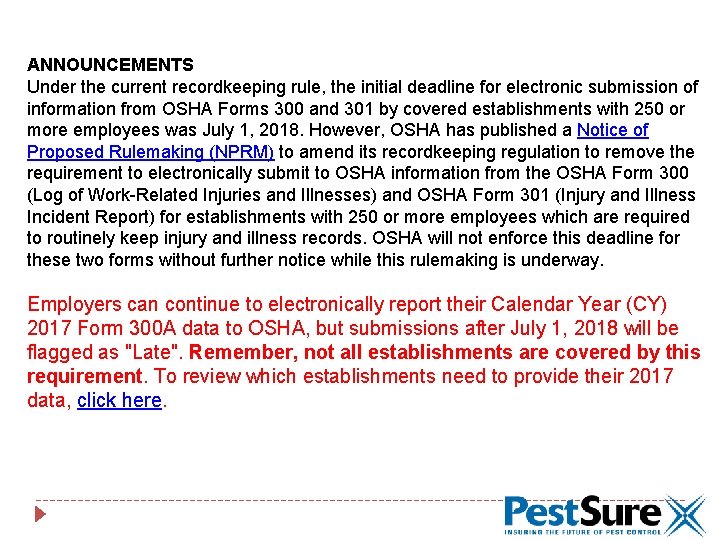
ANNOUNCEMENTS Under the current recordkeeping rule, the initial deadline for electronic submission of information from OSHA Forms 300 and 301 by covered establishments with 250 or more employees was July 1, 2018. However, OSHA has published a Notice of Proposed Rulemaking (NPRM) to amend its recordkeeping regulation to remove the requirement to electronically submit to OSHA information from the OSHA Form 300 (Log of Work Related Injuries and Illnesses) and OSHA Form 301 (Injury and Illness Incident Report) for establishments with 250 or more employees which are required to routinely keep injury and illness records. OSHA will not enforce this deadline for these two forms without further notice while this rulemaking is underway. Employers can continue to electronically report their Calendar Year (CY) 2017 Form 300 A data to OSHA, but submissions after July 1, 2018 will be flagged as "Late". Remember, not all establishments are covered by this requirement. To review which establishments need to provide their 2017 data, click here.

Linda Midyett Safety and Loss Prevention – Pest. Sure mobile: 941 735 3884 Linda_Midyett@ajg. com Discussion? 1. 2. 3. Recordkeeping Severe Injury Reporting Injury Tracking Application (ITA)
- Slides: 40