
Oscillations Kinematics sinusoidal waves Dynamics Newtons law and
- Slides: 9
Oscillations • Kinematics - sinusoidal waves • Dynamics -Newton’s law and Hooke’s law. • Energetics – Conservation of Energy • Mass on a spring • Pendulum
Oscillations • • • repetitive displacements with a time period provide the basis for measuring time serve as the starting point for describing wave motion. Example- Mass on a spring
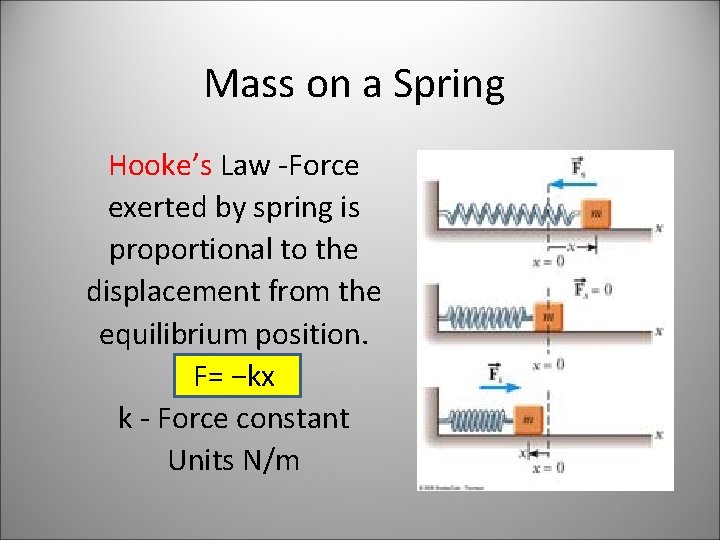
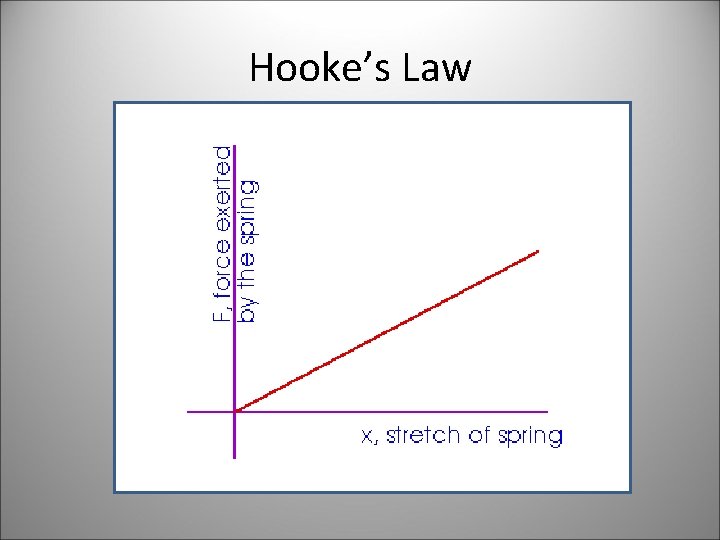
Mass on a Spring Hooke’s Law -Force exerted by spring is proportional to the displacement from the equilibrium position. F= −kx k - Force constant Units N/m
Hooke’s Law
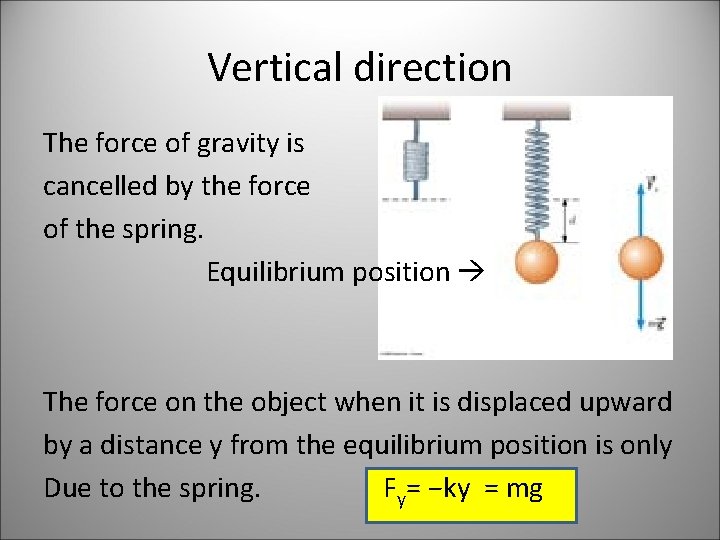
Vertical direction The force of gravity is cancelled by the force of the spring. Equilibrium position The force on the object when it is displaced upward by a distance y from the equilibrium position is only Due to the spring. Fy= −ky = mg
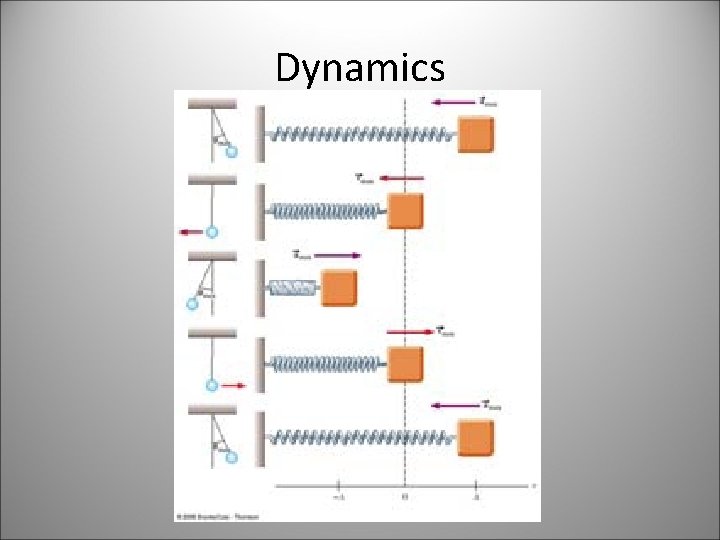
Dynamics
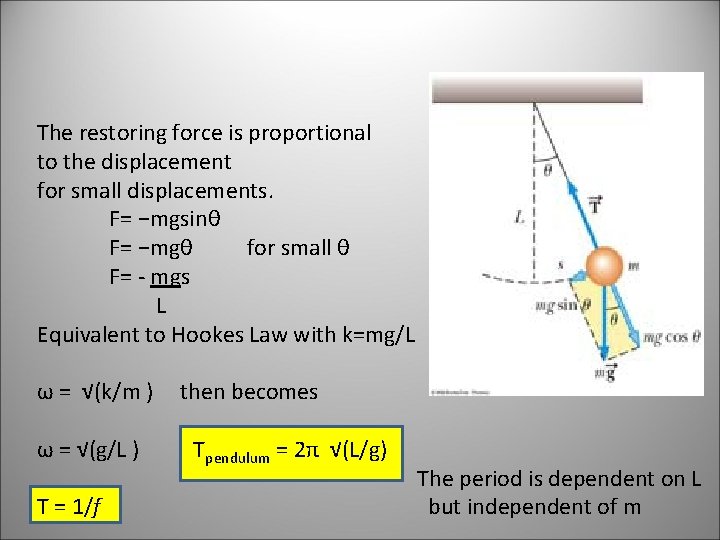
The restoring force is proportional to the displacement for small displacements. F= −mgsinθ F= −mgθ for small θ F= - mgs L Equivalent to Hookes Law with k=mg/L ω = √(k/m ) ω = √(g/L ) T = 1/f then becomes Tpendulum = 2π √(L/g) The period is dependent on L but independent of m
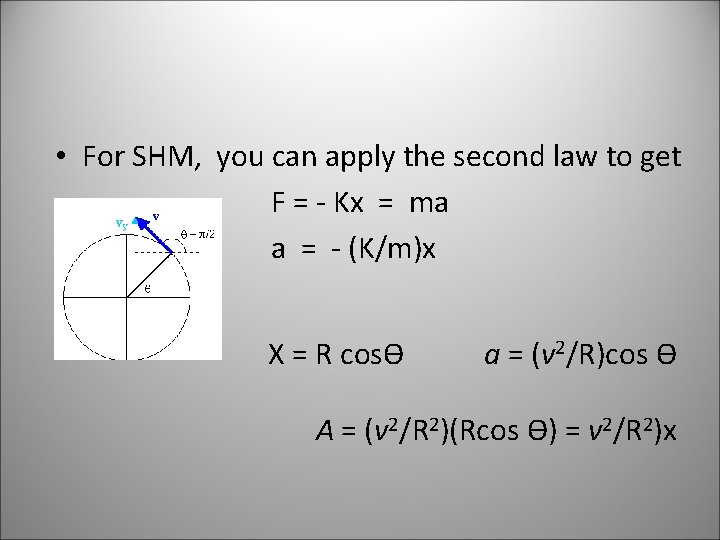
• For SHM, you can apply the second law to get F = - Kx = ma a = - (K/m)x X = R cosѲ a = (v 2/R)cos Ѳ A = (v 2/R 2)(Rcos Ѳ) = v 2/R 2)x
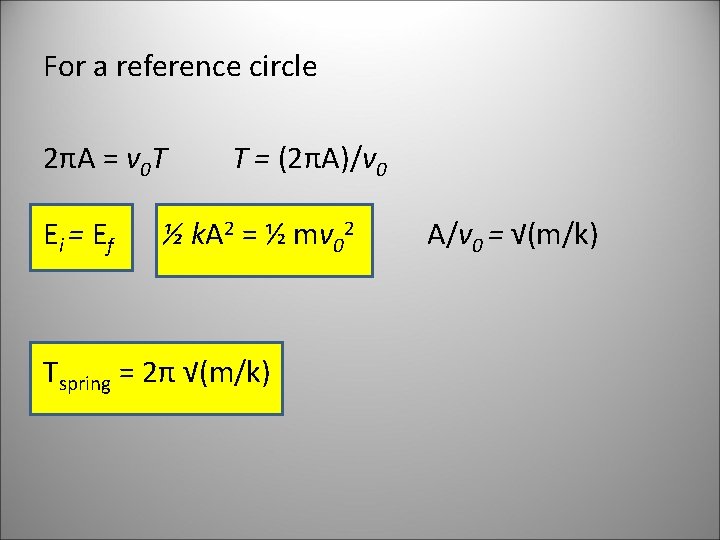
For a reference circle 2πA = v 0 T Ei = Ef T = (2πA)/v 0 ½ k. A 2 = ½ mv 02 Tspring = 2π √(m/k) A/v 0 = √(m/k)