
Oscillations About Equilibrium 7 1 Periodic Motion Periodic
Oscillations About Equilibrium
7. 1 Periodic Motion
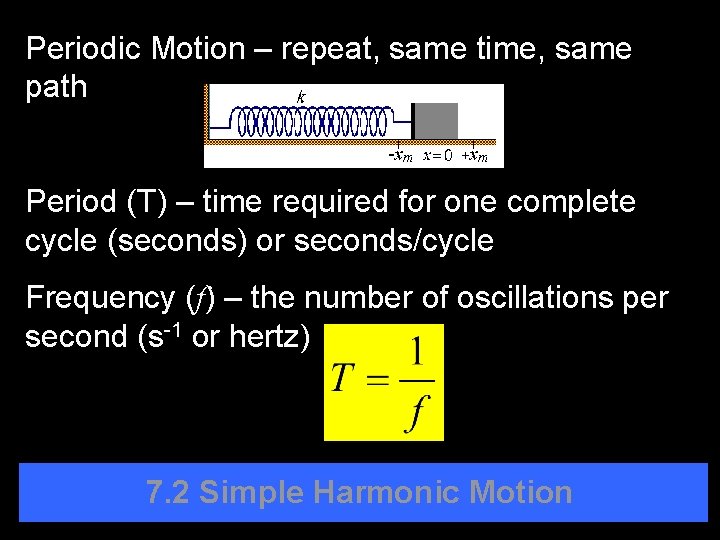
Periodic Motion – repeat, same time, same path Period (T) – time required for one complete cycle (seconds) or seconds/cycle Frequency (f) – the number of oscillations per second (s-1 or hertz) 7. 2 Simple Harmonic Motion
7. 2 Simple Harmonic Motion
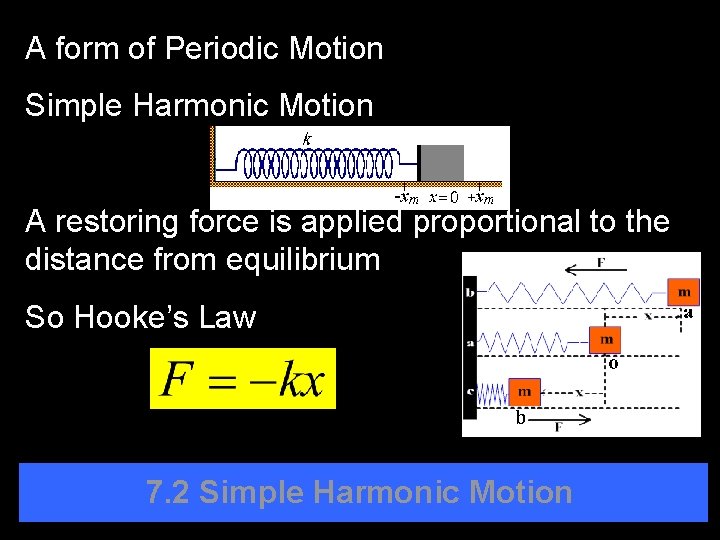
A form of Periodic Motion Simple Harmonic Motion A restoring force is applied proportional to the distance from equilibrium So Hooke’s Law 7. 2 Simple Harmonic Motion
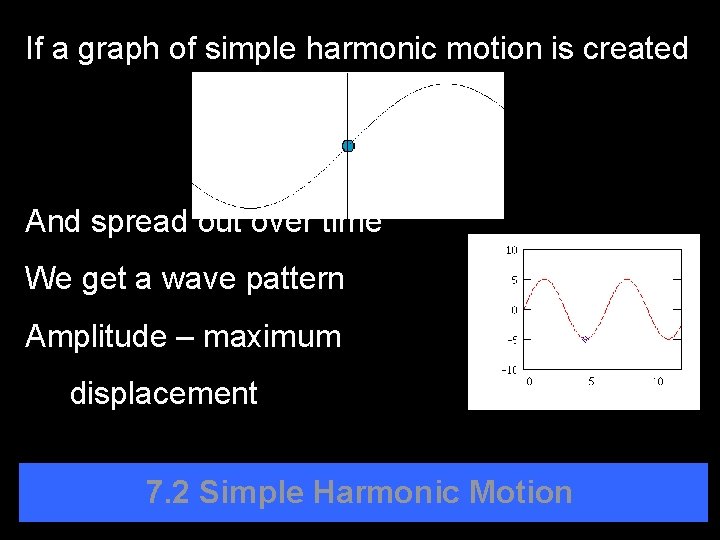
If a graph of simple harmonic motion is created And spread out over time We get a wave pattern Amplitude – maximum displacement 7. 2 Simple Harmonic Motion
7. 3 The Period of a Mass on a Spring
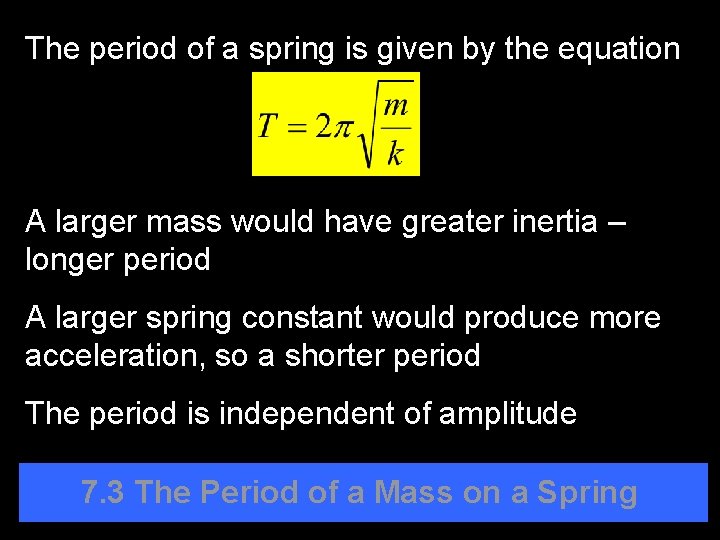
The period of a spring is given by the equation A larger mass would have greater inertia – longer period A larger spring constant would produce more acceleration, so a shorter period The period is independent of amplitude 7. 3 The Period of a Mass on a Spring
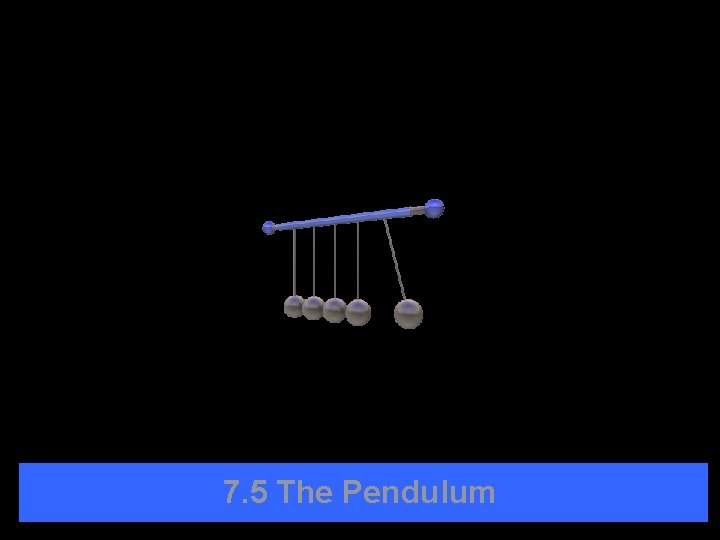
7. 5 The Pendulum
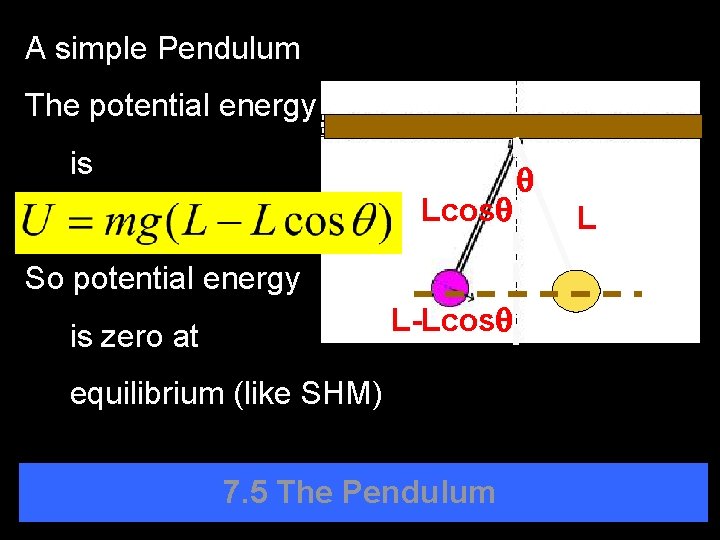
A simple Pendulum The potential energy is Lcosq So potential energy L-Lcosq is zero at equilibrium (like SHM) 7. 5 The Pendulum q L
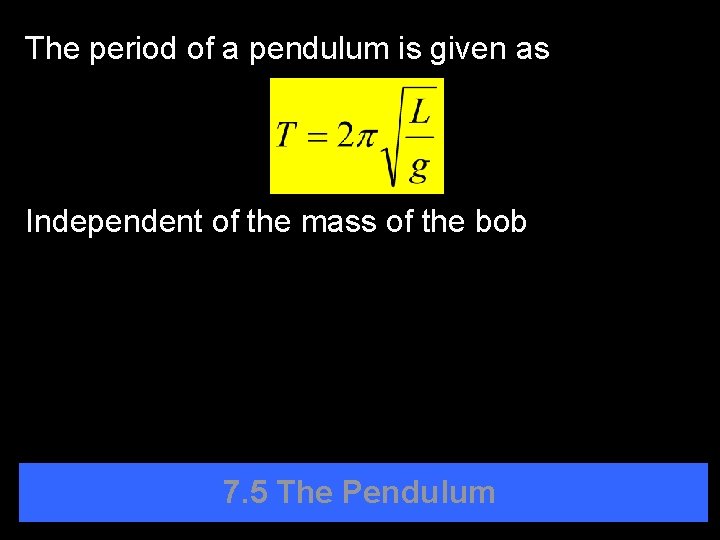
The period of a pendulum is given as Independent of the mass of the bob 7. 5 The Pendulum
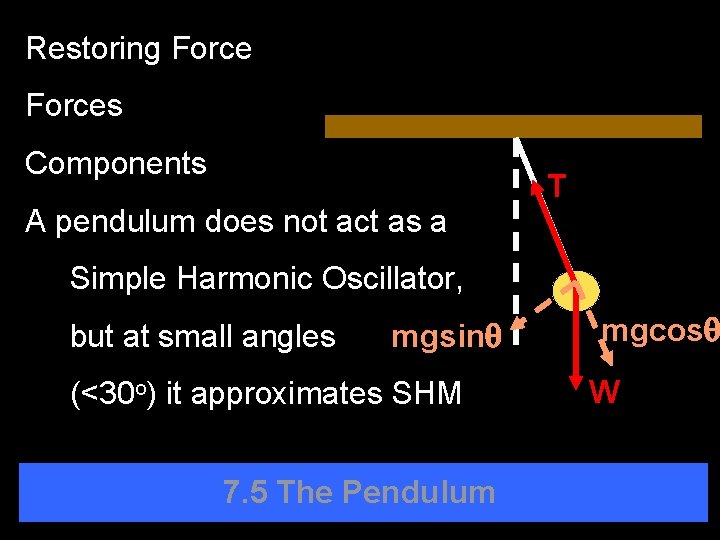
Restoring Forces Components A pendulum does not act as a T Simple Harmonic Oscillator, but at small angles mgsinq (<30 o) it approximates SHM 7. 5 The Pendulum mgcosq W
7. 7 Driven Oscillations and Resonance
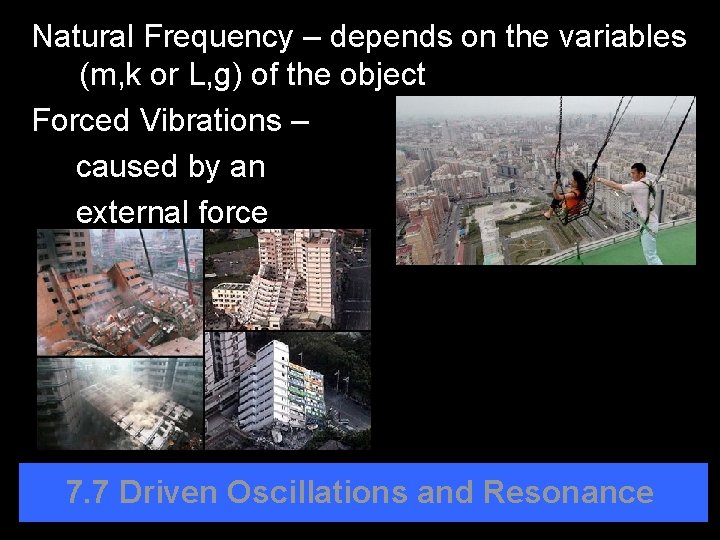
Natural Frequency – depends on the variables (m, k or L, g) of the object Forced Vibrations – caused by an external force 7. 7 Driven Oscillations and Resonance
Resonant Frequency – the natural vibrating frequency of a system Resonance – when the external frequency is near the natural frequency and damping is small Tacoma Narrow Bridge 7. 7 Driven Oscillations and Resonance
7. 8 Types of Waves
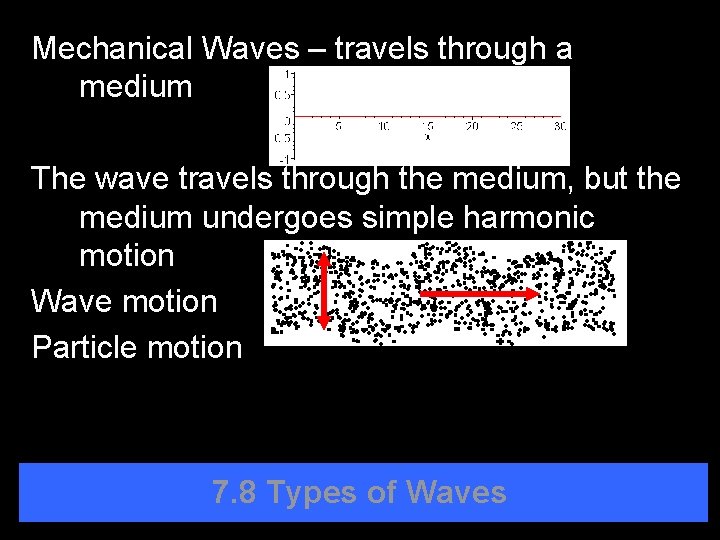
Mechanical Waves – travels through a medium The wave travels through the medium, but the medium undergoes simple harmonic motion Wave motion Particle motion 7. 8 Types of Waves
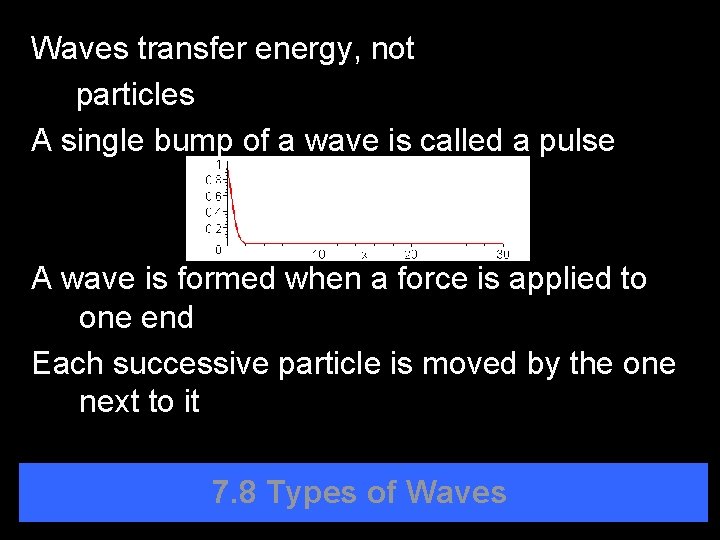
Waves transfer energy, not particles A single bump of a wave is called a pulse A wave is formed when a force is applied to one end Each successive particle is moved by the one next to it 7. 8 Types of Waves
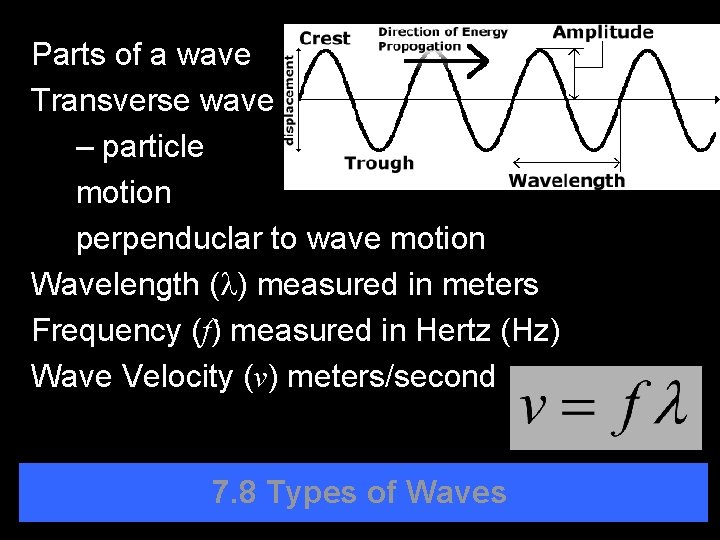
Parts of a wave Transverse wave – particle motion perpenduclar to wave motion Wavelength (l) measured in meters Frequency (f) measured in Hertz (Hz) Wave Velocity (v) meters/second 7. 8 Types of Waves
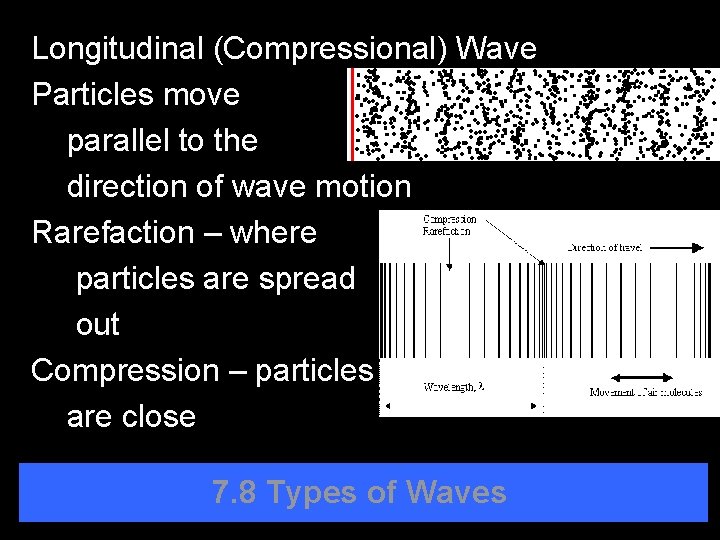
Longitudinal (Compressional) Wave Particles move parallel to the direction of wave motion Rarefaction – where particles are spread out Compression – particles are close 7. 8 Types of Waves
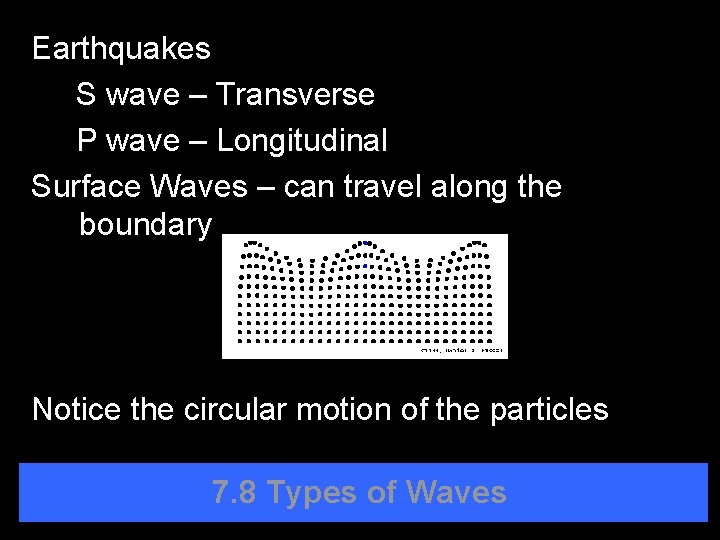
Earthquakes S wave – Transverse P wave – Longitudinal Surface Waves – can travel along the boundary Notice the circular motion of the particles 7. 8 Types of Waves
7. 9 Reflection and Transmission of Waves
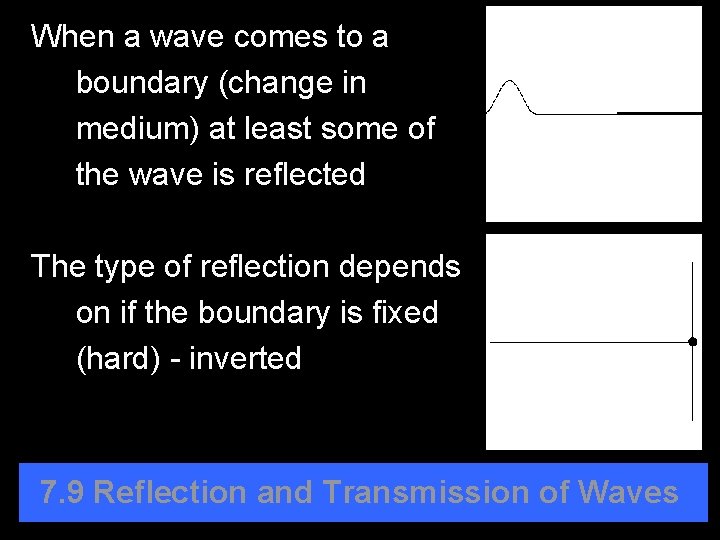
When a wave comes to a boundary (change in medium) at least some of the wave is reflected The type of reflection depends on if the boundary is fixed (hard) - inverted 7. 9 Reflection and Transmission of Waves
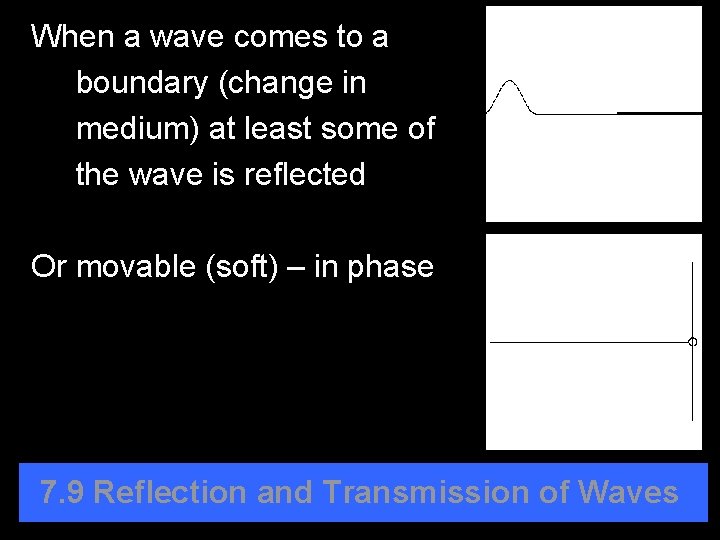
When a wave comes to a boundary (change in medium) at least some of the wave is reflected Or movable (soft) – in phase 7. 9 Reflection and Transmission of Waves
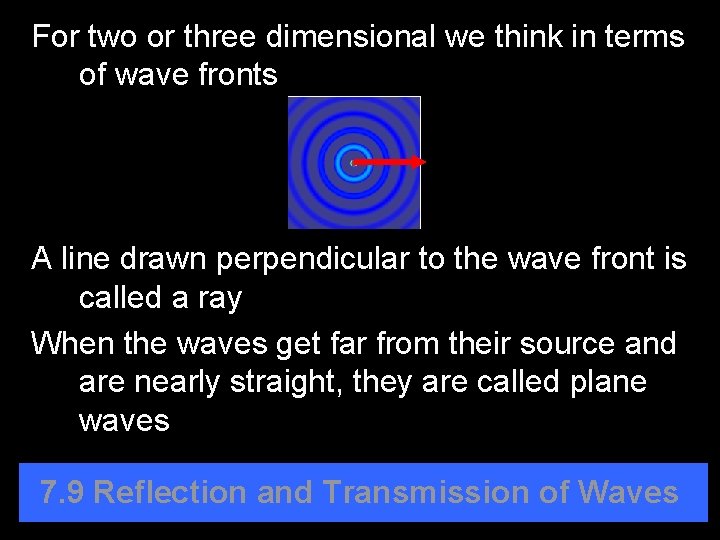
For two or three dimensional we think in terms of wave fronts A line drawn perpendicular to the wave front is called a ray When the waves get far from their source and are nearly straight, they are called plane waves 7. 9 Reflection and Transmission of Waves
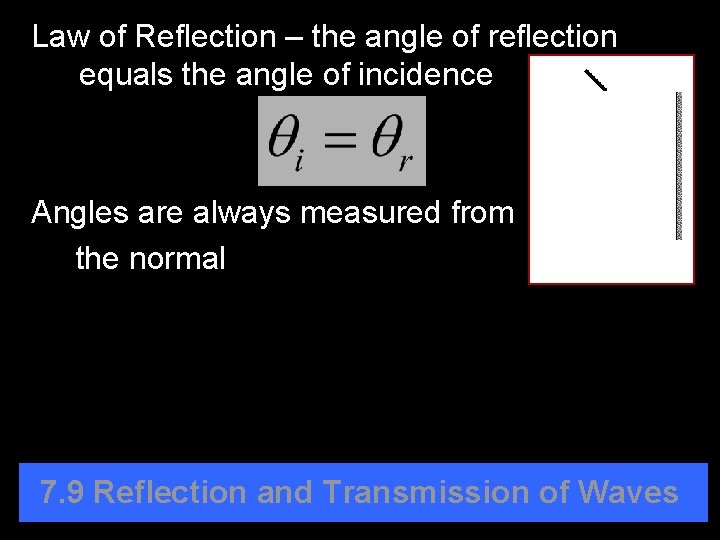
Law of Reflection – the angle of reflection equals the angle of incidence Angles are always measured from the normal 7. 9 Reflection and Transmission of Waves
7. 10 Characteristics of Sound
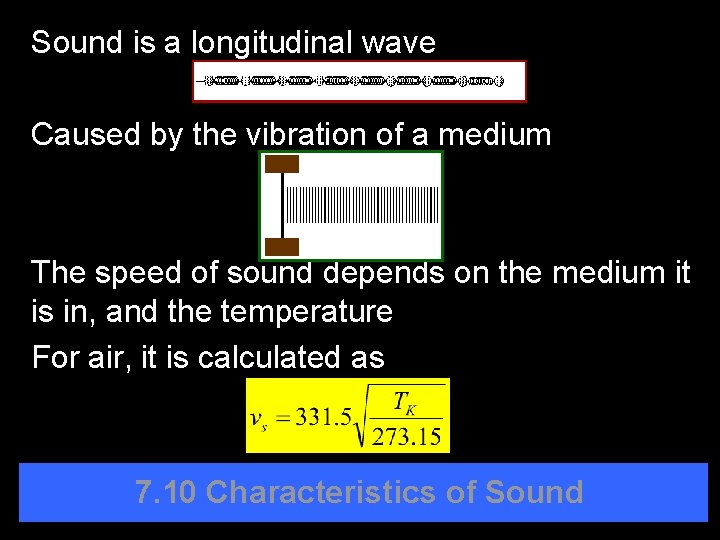
Sound is a longitudinal wave Caused by the vibration of a medium The speed of sound depends on the medium it is in, and the temperature For air, it is calculated as 7. 10 Characteristics of Sound
Loudness – sensation of intensity Pitch – sensation of frequency Range of human hearing – 20 Hz to 20, 000 Hz ultrasonic – higher than human hearing dogs hear to 50, 000 Hz, bats to 100, 000 Hz infrasonic – lower than human hearing 7. 10 Characteristics of Sound
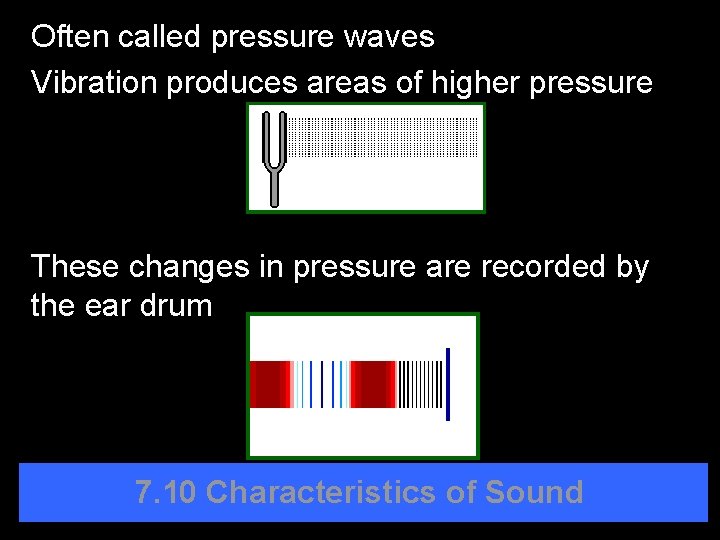
Often called pressure waves Vibration produces areas of higher pressure These changes in pressure are recorded by the ear drum 7. 10 Characteristics of Sound
7. 11 Intensity of Sound
Loudness – sensation Relative to surrounding and intensity Intensity – power per unit area Humans can detect intensities as low as 10 -12 W/m 2 The threshold of pain is 1 W/m 2 7. 11 Intensity of Sound
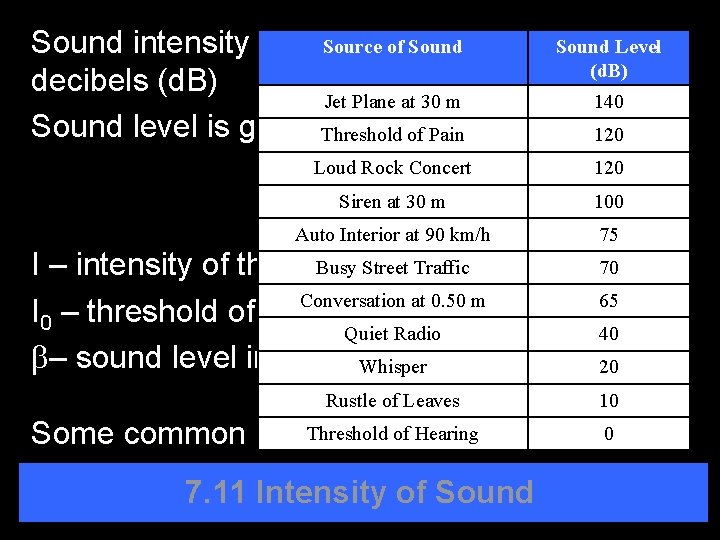
Sound intensity is usually in Source ofmeasured Sound Level (d. B) decibels (d. B) Jet Plane at 30 m 140 Sound level is given Threshold as of Pain 120 Loud Rock Concert 120 Siren at 30 m 100 Auto Interior at 90 km/h 75 Busy Street Traffic I – intensity of the sound Conversation at-12 0. 50 m I 0 – threshold of hearing (10 W/m 2) Quiet Radio b– sound level in d. B Whisper Rustle of Leaves Threshold of Hearing Some common relative intensities 7. 11 Intensity of Sound 70 65 40 20 10 0
7. 12 The Ear
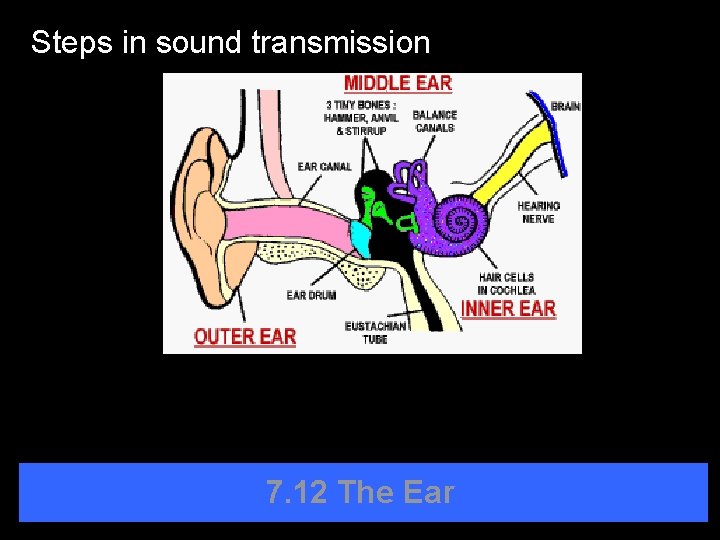
Steps in sound transmission 7. 12 The Ear
7. 13 Sources of Sound: Strings and Air Columns
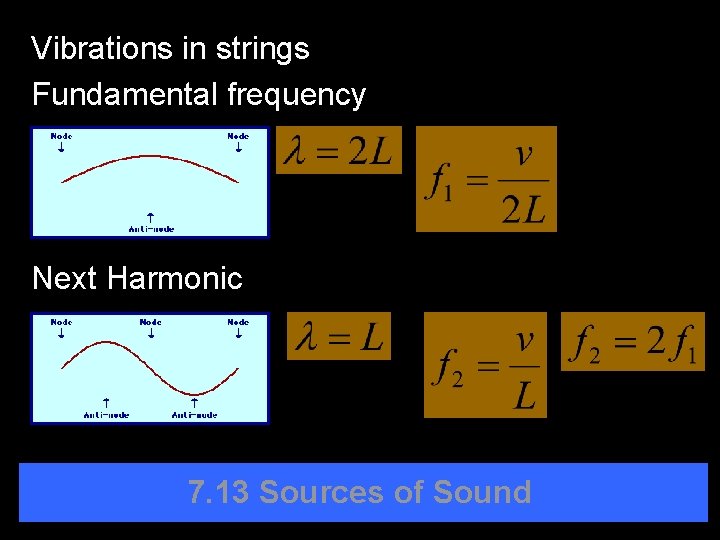
Vibrations in strings Fundamental frequency Next Harmonic 7. 13 Sources of Sound
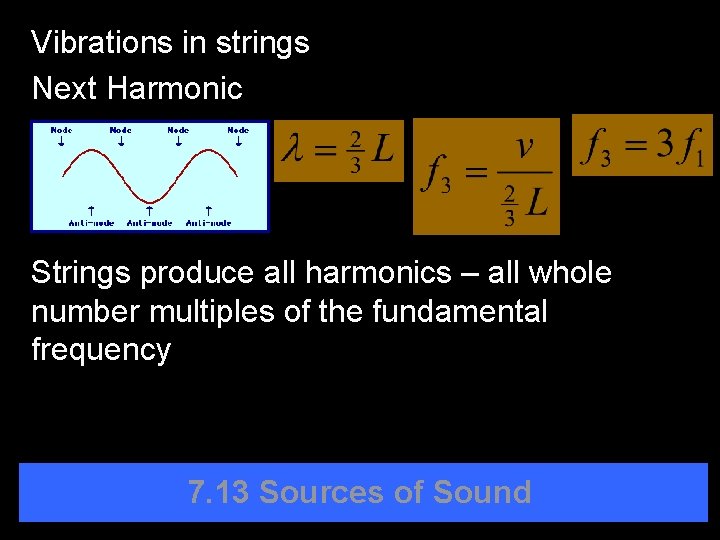
Vibrations in strings Next Harmonic Strings produce all harmonics – all whole number multiples of the fundamental frequency 7. 13 Sources of Sound
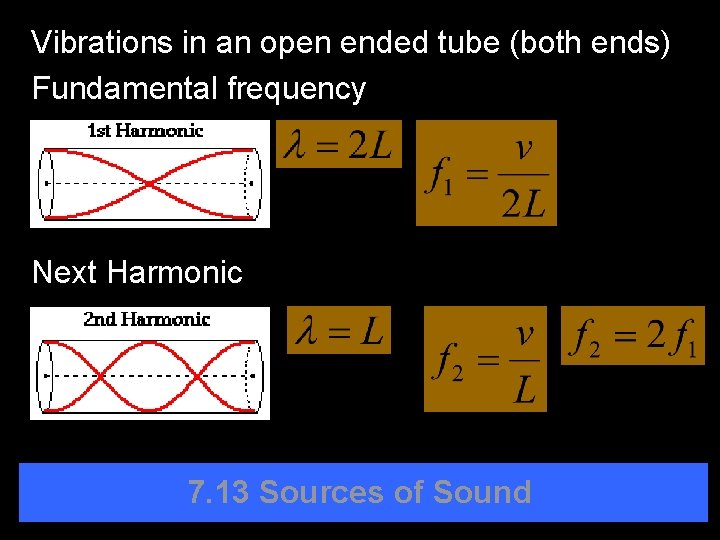
Vibrations in an open ended tube (both ends) Fundamental frequency Next Harmonic 7. 13 Sources of Sound
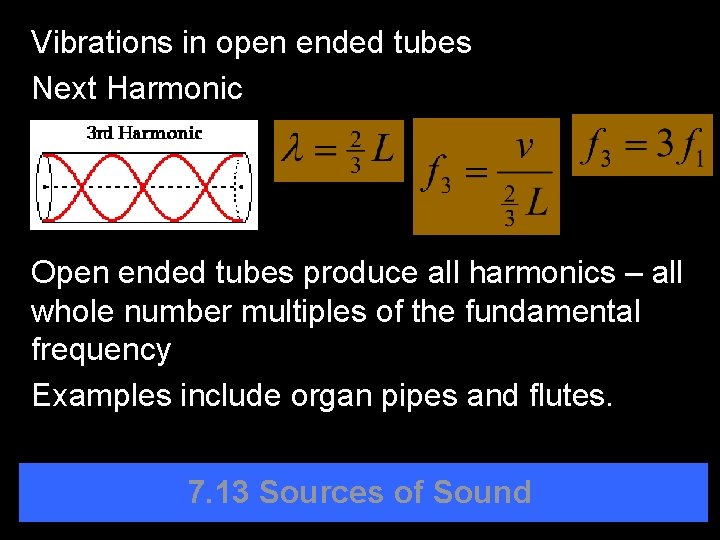
Vibrations in open ended tubes Next Harmonic Open ended tubes produce all harmonics – all whole number multiples of the fundamental frequency Examples include organ pipes and flutes. 7. 13 Sources of Sound
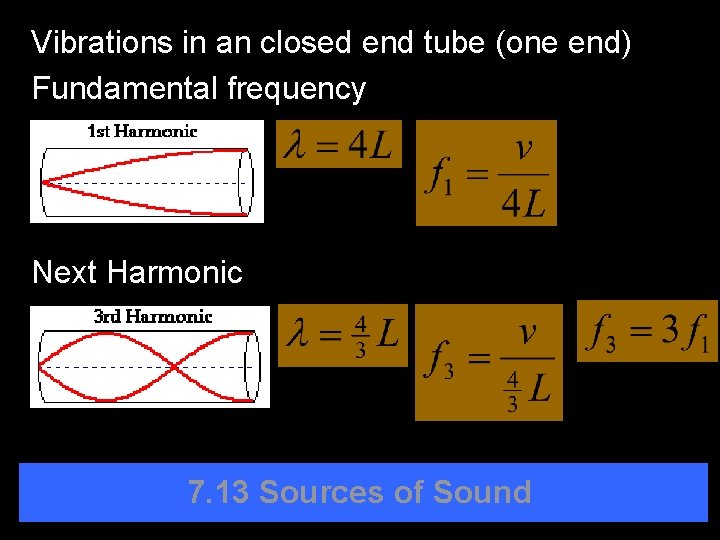
Vibrations in an closed end tube (one end) Fundamental frequency Next Harmonic 7. 13 Sources of Sound
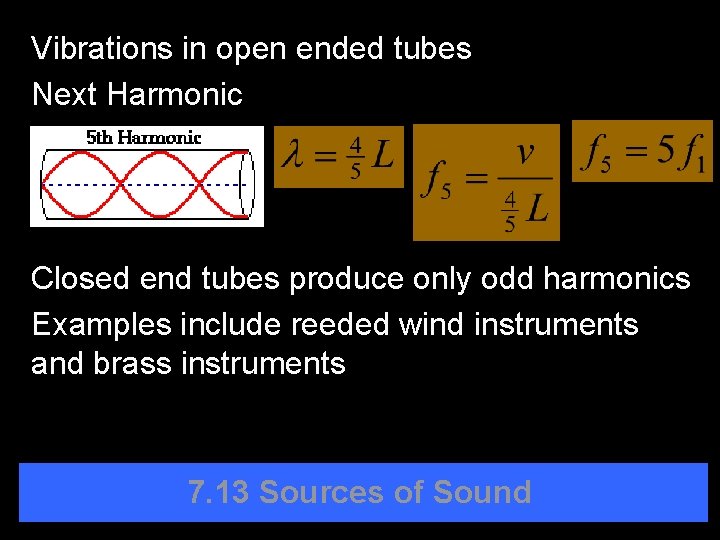
Vibrations in open ended tubes Next Harmonic Closed end tubes produce only odd harmonics Examples include reeded wind instruments and brass instruments 7. 13 Sources of Sound
7. 14 Interference of Sound Waves: Beats
If waves are produced by two identical sources A pattern of constructive and destructive interference forms Applet 7. 14 Interference of Sound Waves: Beats
7. 15 The Doppler Effect
Doppler Effect – the change in pitch due to the relative motion between a source of sound and the receiver Doppler Effect Applies to all wave phenomena Light Doppler Objects moving toward you have a higher apparent frequency Objects moving away have a lower apparent frequency 7. 15 The Doppler Effect
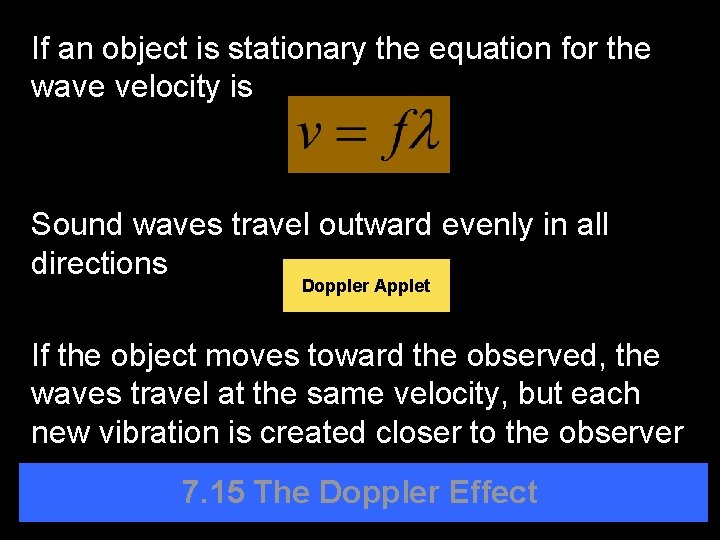
If an object is stationary the equation for the wave velocity is Sound waves travel outward evenly in all directions Doppler Applet If the object moves toward the observed, the waves travel at the same velocity, but each new vibration is created closer to the observer 7. 15 The Doppler Effect
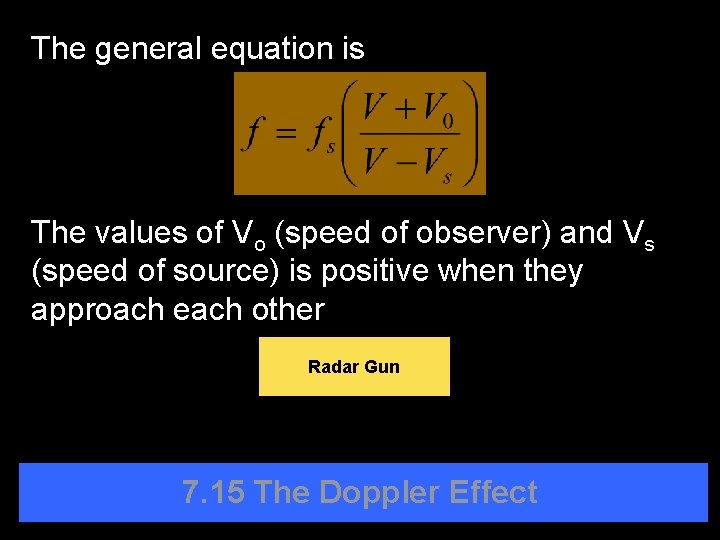
The general equation is The values of Vo (speed of observer) and Vs (speed of source) is positive when they approach each other Radar Gun 7. 15 The Doppler Effect
7. 16 Interference
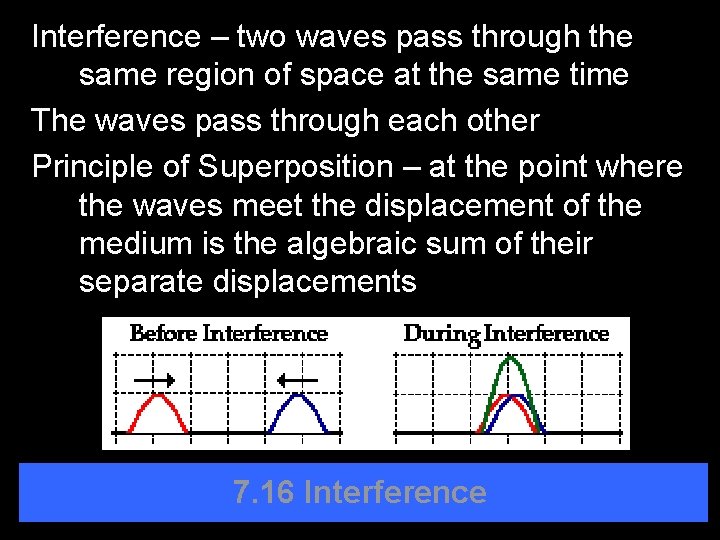
Interference – two waves pass through the same region of space at the same time The waves pass through each other Principle of Superposition – at the point where the waves meet the displacement of the medium is the algebraic sum of their separate displacements 7. 16 Interference
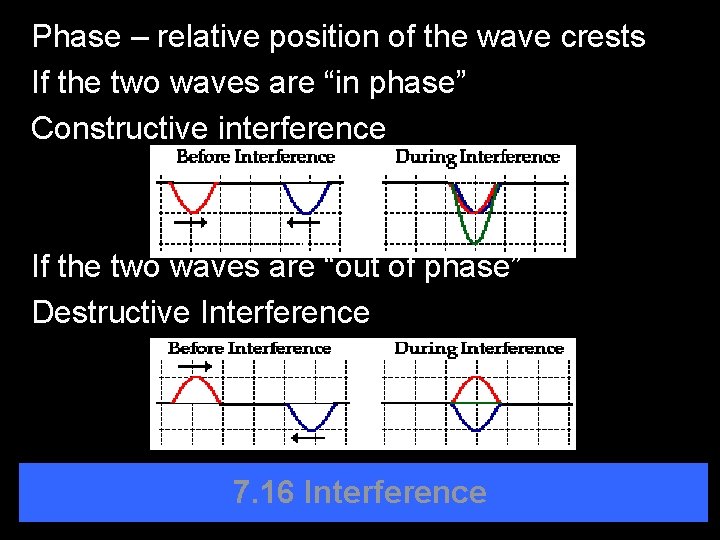
Phase – relative position of the wave crests If the two waves are “in phase” Constructive interference If the two waves are “out of phase” Destructive Interference 7. 16 Interference
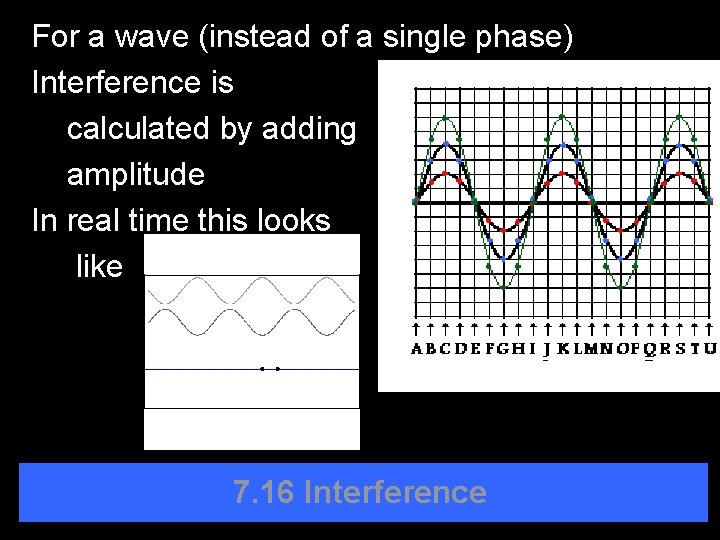
For a wave (instead of a single phase) Interference is calculated by adding amplitude In real time this looks like 7. 16 Interference
- Slides: 52