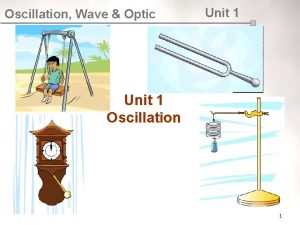
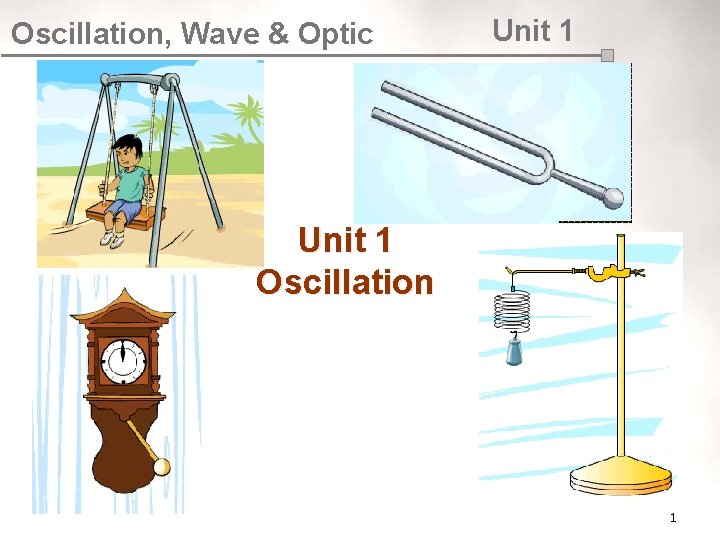
Oscillation Wave Optic Unit 1 Oscillation 1 Oscillation
![Oscillation, Wave & Optic ¡ ¡ ¡ Unit 1 [PPT]Chapter 9: Simple Harmonic Motion](https://slidetodoc.com/presentation_image_h/a3940da64ece8dbb042950c78df859f6/image-89.jpg "Oscillation, Wave & Optic ¡ ¡ ¡ Unit 1 [PPT]Chapter 9: Simple Harmonic Motion")
- Slides: 89
Oscillation, Wave & Optic Unit 1 Oscillation 1
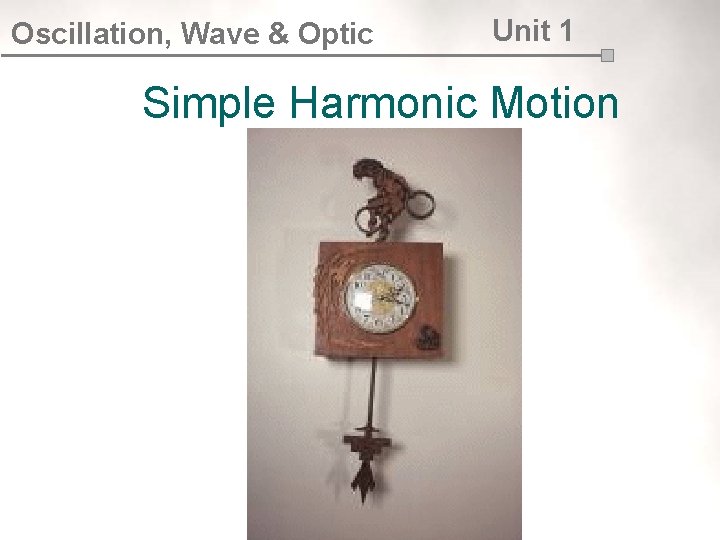
Oscillation, Wave & Optic Unit 1 Simple Harmonic Motion
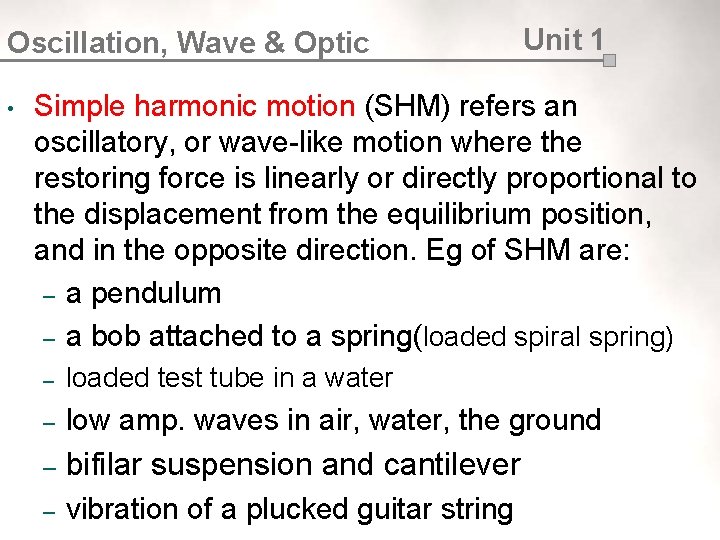
Oscillation, Wave & Optic • Unit 1 Simple harmonic motion (SHM) refers an oscillatory, or wave-like motion where the restoring force is linearly or directly proportional to the displacement from the equilibrium position, and in the opposite direction. Eg of SHM are: – a pendulum – a bob attached to a spring(loaded spiral spring) – loaded test tube in a water – low amp. waves in air, water, the ground – bifilar suspension and cantilever – vibration of a plucked guitar string
Oscillation, Wave & Optic Unit 1 CONDITIONS FOR SHM ¡ A mass that oscillates ¡ The mass must obey Hooke’s law ¡ A fixed point at which the mass is in equilibrium ¡ A restoring force which returns the mass to its equilibrium position if its displaced. 4
Oscillation, Wave & Optic Unit 1 Introduction to Oscillation http: //www. acoustics. salford. ac. uk/feschools/waves/shm. php http: //www. schoolphysics. co. uk/age 16 -19/ 5
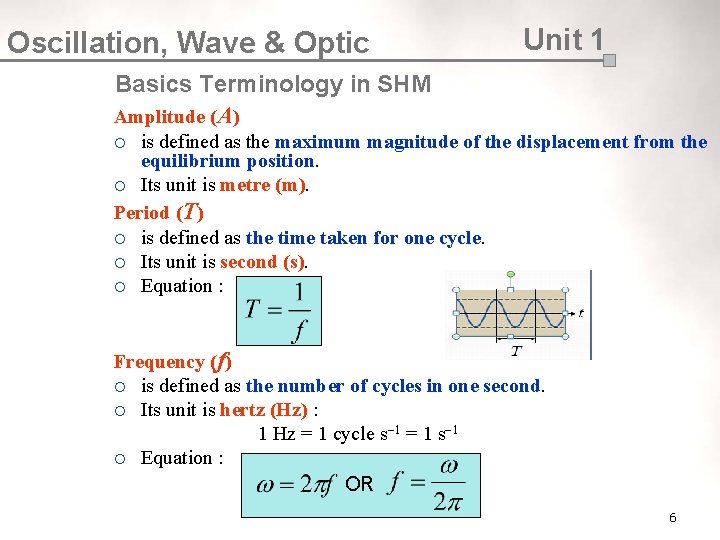
Oscillation, Wave & Optic Unit 1 Basics Terminology in SHM Amplitude (A) is defined as the maximum magnitude of the displacement from the equilibrium position. ¡ Its unit is metre (m). Period (T) ¡ is defined as the time taken for one cycle. ¡ Its unit is second (s). ¡ Equation : ¡ Frequency (f) ¡ is defined as the number of cycles in one second. ¡ Its unit is hertz (Hz) : 1 Hz = 1 cycle s 1 = 1 s 1 ¡ Equation : OR 6
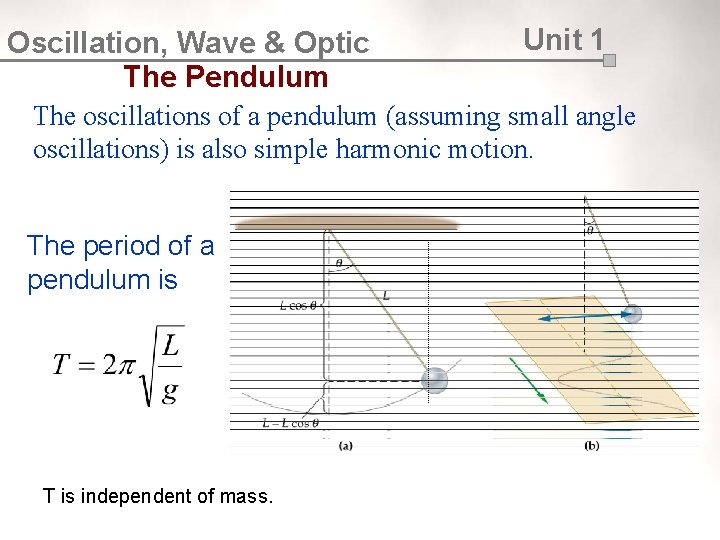
Oscillation, Wave & Optic The Pendulum Unit 1 The oscillations of a pendulum (assuming small angle oscillations) is also simple harmonic motion. The period of a pendulum is T is independent of mass.
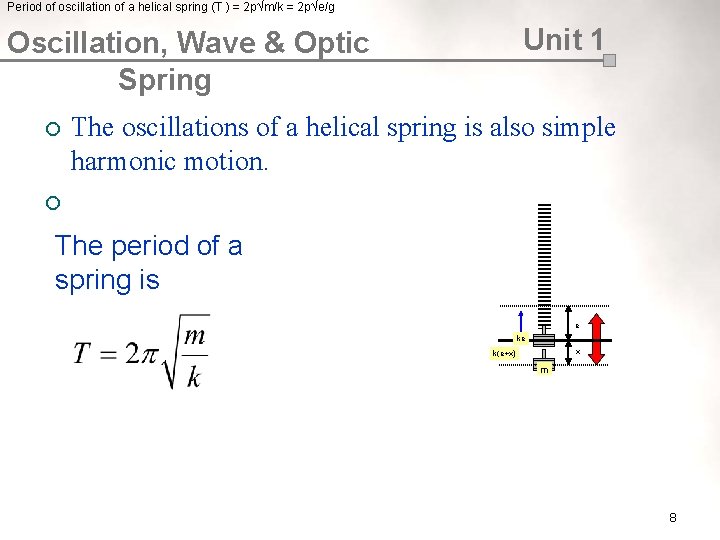
Period of oscillation of a helical spring (T ) = 2 p√m/k = 2 p√e/g Unit 1 Oscillation, Wave & Optic Spring ¡ ¡ The oscillations of a helical spring is also simple harmonic motion. The period of a spring is e ke x k(e+x) m 8
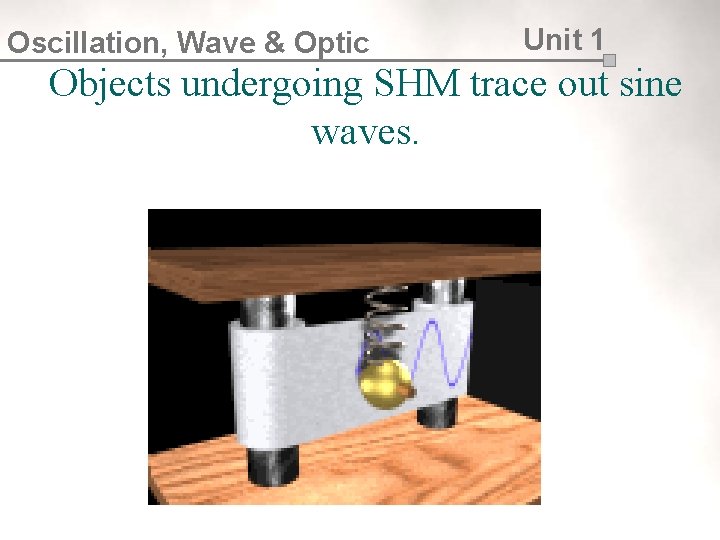
Oscillation, Wave & Optic Unit 1 Objects undergoing SHM trace out sine waves.
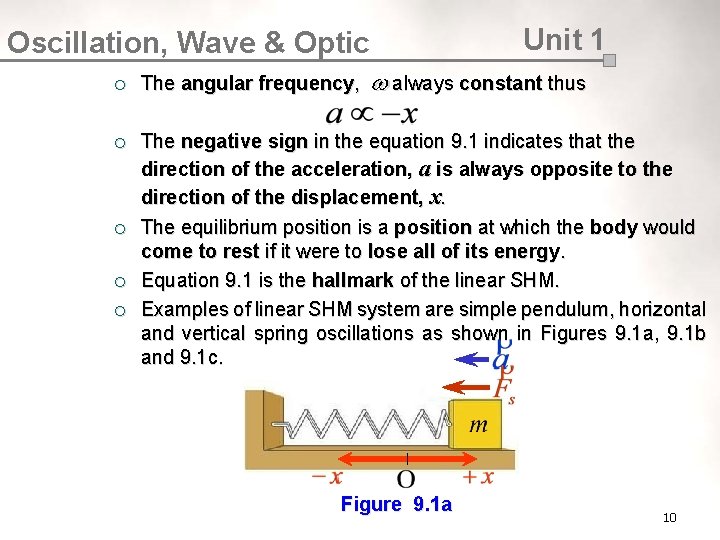
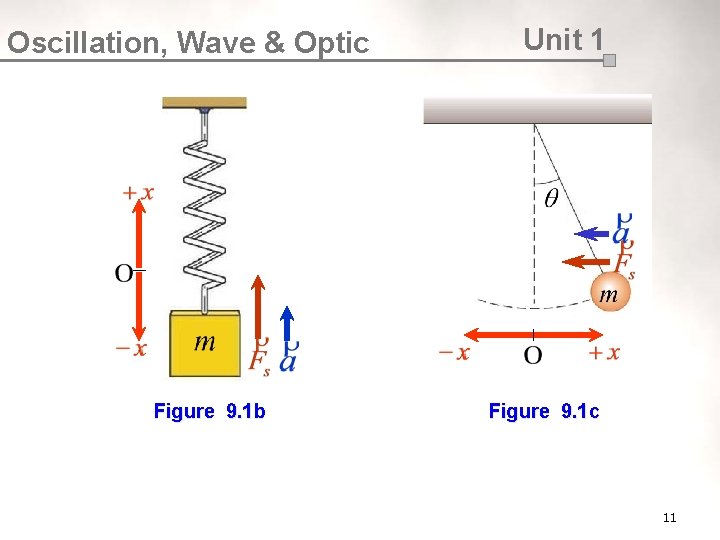
Oscillation, Wave & Optic ¡ ¡ ¡ Unit 1 The angular frequency, always constant thus The negative sign in the equation 9. 1 indicates that the direction of the acceleration, a is always opposite to the direction of the displacement, x. The equilibrium position is a position at which the body would come to rest if it were to lose all of its energy. Equation 9. 1 is the hallmark of the linear SHM. Examples of linear SHM system are simple pendulum, horizontal and vertical spring oscillations as shown in Figures 9. 1 a, 9. 1 b and 9. 1 c. Figure 9. 1 a 10
Oscillation, Wave & Optic Figure 9. 1 b Unit 1 Figure 9. 1 c 11
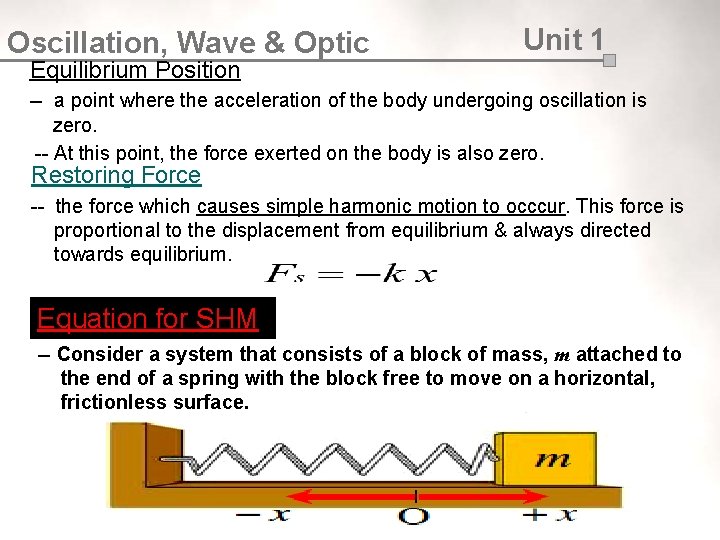
Oscillation, Wave & Optic Equilibrium Position Unit 1 -- a point where the acceleration of the body undergoing oscillation is zero. -- At this point, the force exerted on the body is also zero. Restoring Force -- the force which causes simple harmonic motion to occcur. This force is proportional to the displacement from equilibrium & always directed towards equilibrium. Equation for SHM -- Consider a system that consists of a block of mass, m attached to the end of a spring with the block free to move on a horizontal, frictionless surface.
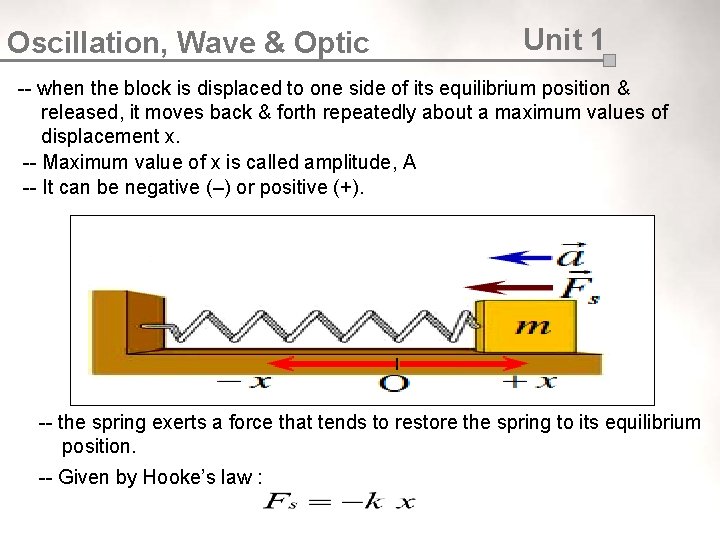
Oscillation, Wave & Optic Unit 1 -- when the block is displaced to one side of its equilibrium position & released, it moves back & forth repeatedly about a maximum values of displacement x. -- Maximum value of x is called amplitude, A -- It can be negative (–) or positive (+). -- the spring exerts a force that tends to restore the spring to its equilibrium position. -- Given by Hooke’s law :
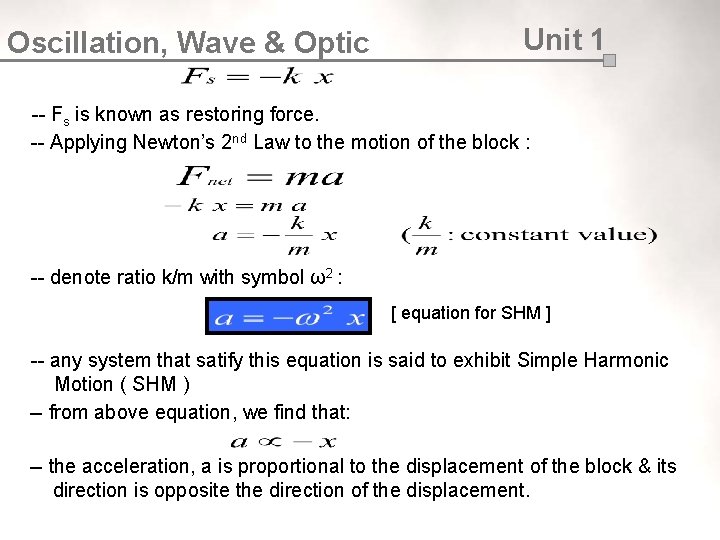
Oscillation, Wave & Optic Unit 1 -- Fs is known as restoring force. -- Applying Newton’s 2 nd Law to the motion of the block : -- denote ratio k/m with symbol ω2 : [ equation for SHM ] -- any system that satify this equation is said to exhibit Simple Harmonic Motion ( SHM ) -- from above equation, we find that: -- the acceleration, a is proportional to the displacement of the block & its direction is opposite the direction of the displacement.
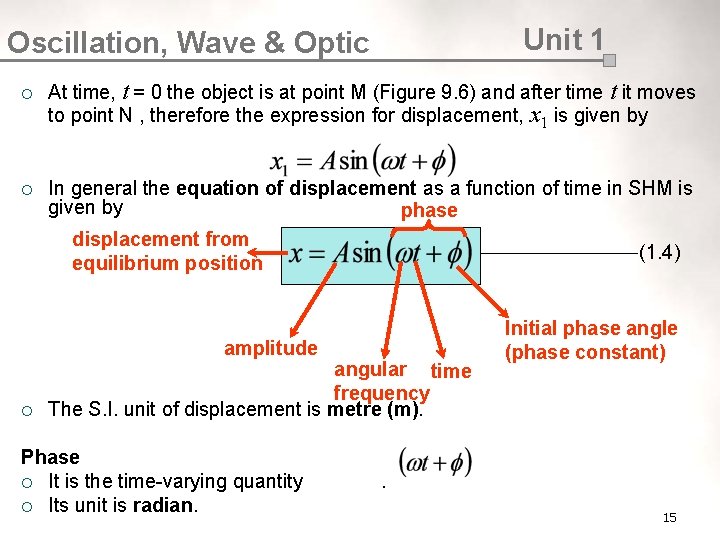
Oscillation, Wave & Optic ¡ ¡ At time, t = 0 the object is at point M (Figure 9. 6) and after time t it moves to point N , therefore the expression for displacement, x 1 is given by In general the equation of displacement as a function of time in SHM is given by phase displacement from equilibrium position amplitude ¡ Unit 1 angular time frequency The S. I. unit of displacement is metre (m). Phase ¡ It is the time-varying quantity . ¡ Its unit is radian. (1. 4) Initial phase angle (phase constant) 15
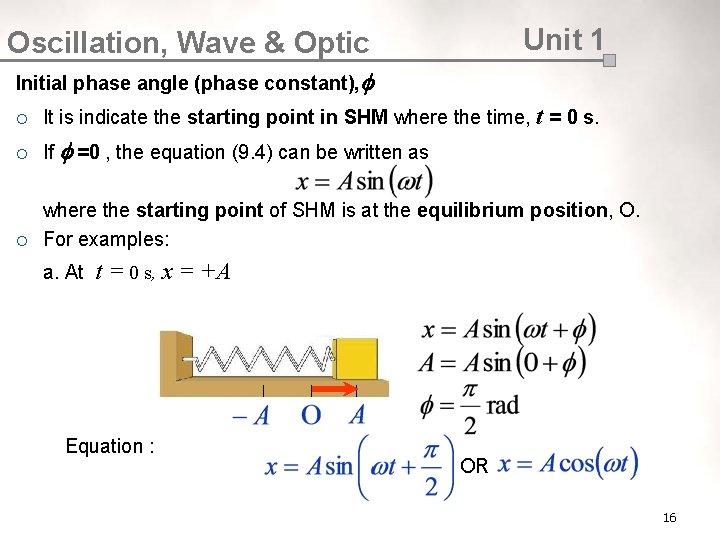
Unit 1 Oscillation, Wave & Optic Initial phase angle (phase constant), ¡ It is indicate the starting point in SHM where the time, t = 0 s. ¡ If =0 , the equation (9. 4) can be written as ¡ where the starting point of SHM is at the equilibrium position, O. For examples: a. At t = 0 s, x = +A Equation : OR 16
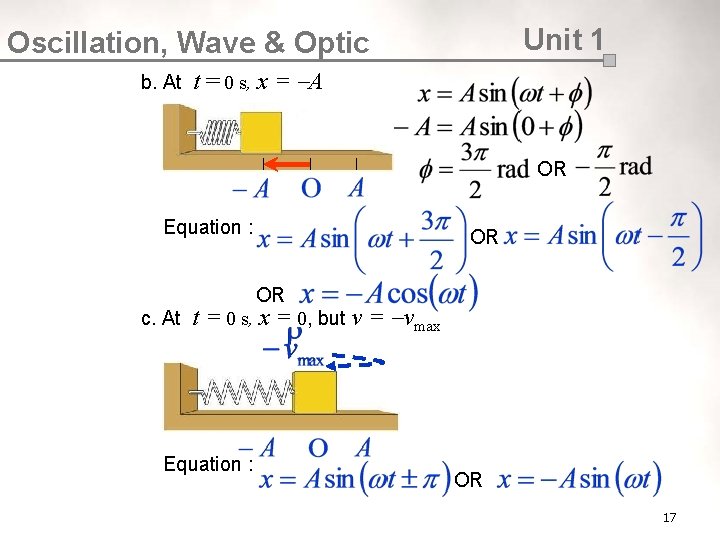
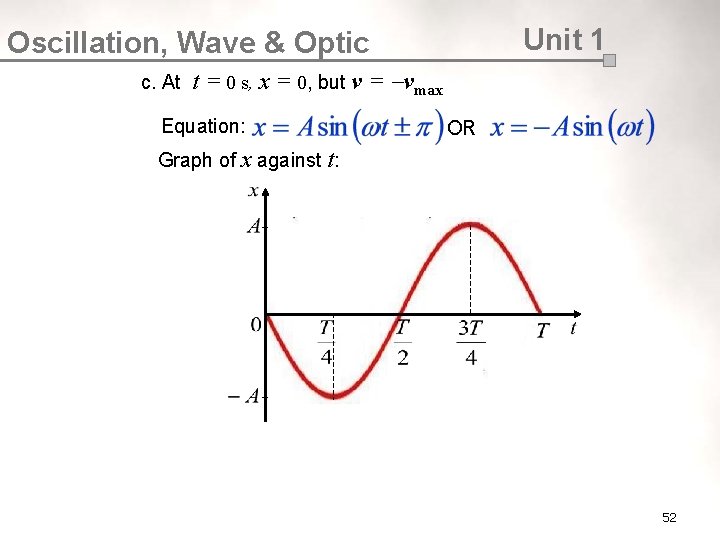
Unit 1 Oscillation, Wave & Optic b. At t = 0 s, x = A OR Equation : c. At t OR OR = 0 s, x = 0, but v = vmax Equation : OR 17
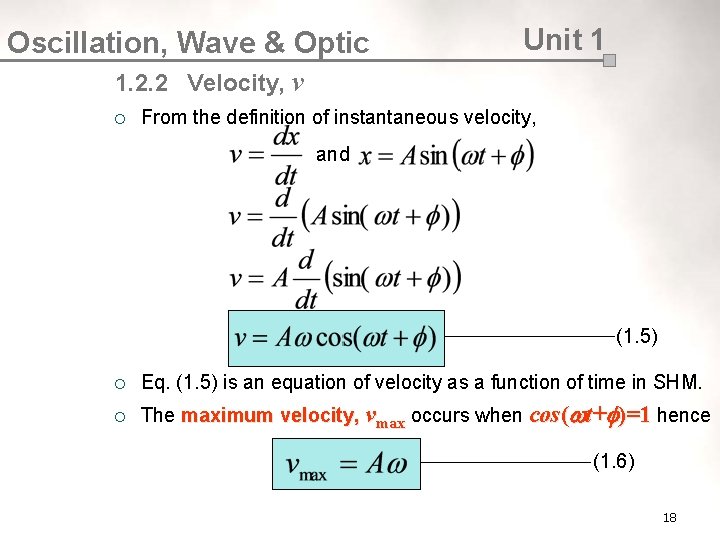
Oscillation, Wave & Optic Unit 1 1. 2. 2 Velocity, v ¡ From the definition of instantaneous velocity, and (1. 5) ¡ Eq. (1. 5) is an equation of velocity as a function of time in SHM. ¡ The maximum velocity, vmax occurs when cos( t+ )=1 hence (1. 6) 18
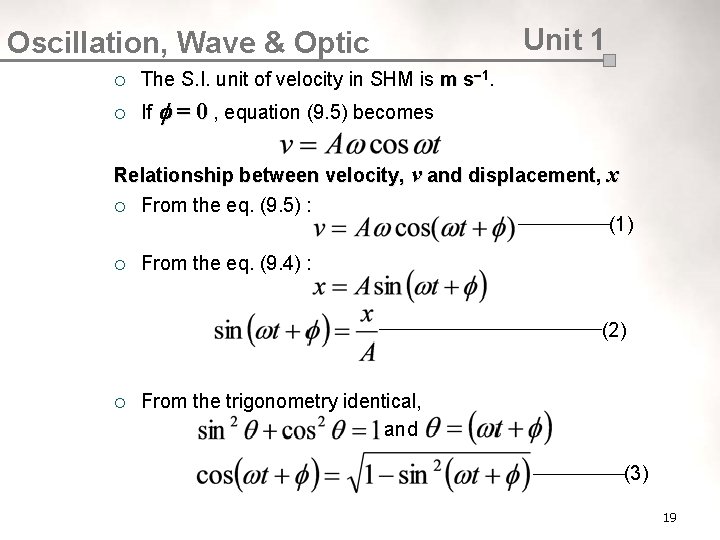
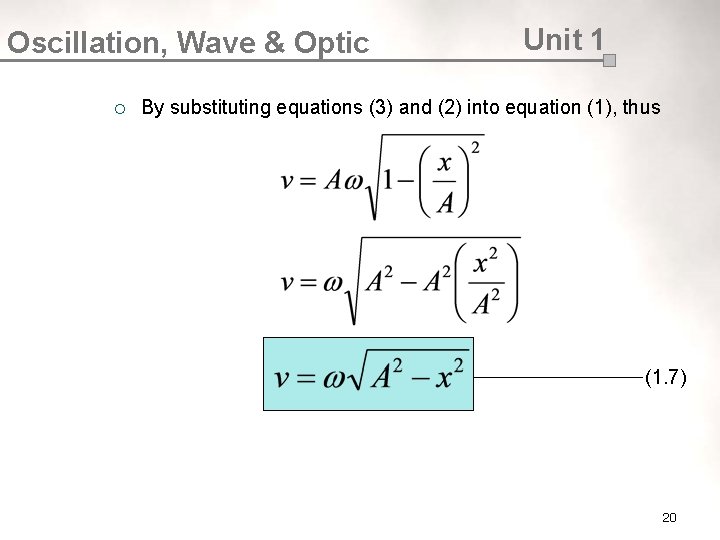
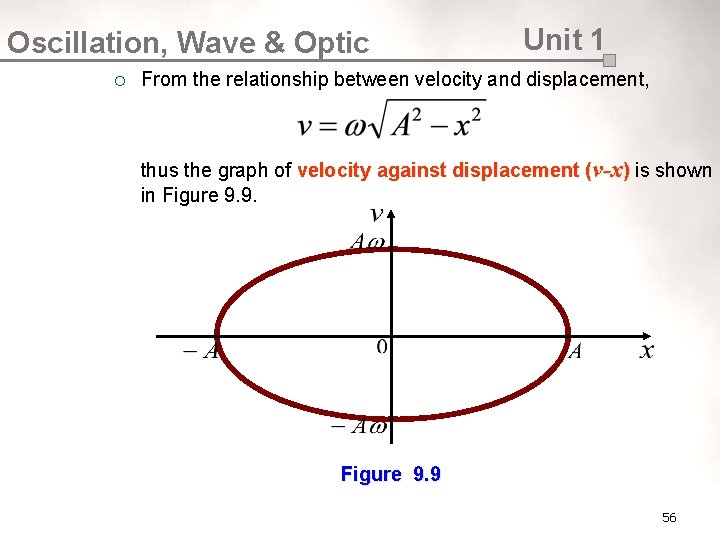
Oscillation, Wave & Optic ¡ The S. I. unit of velocity in SHM is m s 1. ¡ If = 0 , equation (9. 5) becomes Unit 1 Relationship between velocity, v and displacement, x ¡ From the eq. (9. 5) : (1) ¡ From the eq. (9. 4) : (2) ¡ From the trigonometry identical, and (3) 19
Oscillation, Wave & Optic ¡ Unit 1 By substituting equations (3) and (2) into equation (1), thus (1. 7) 20
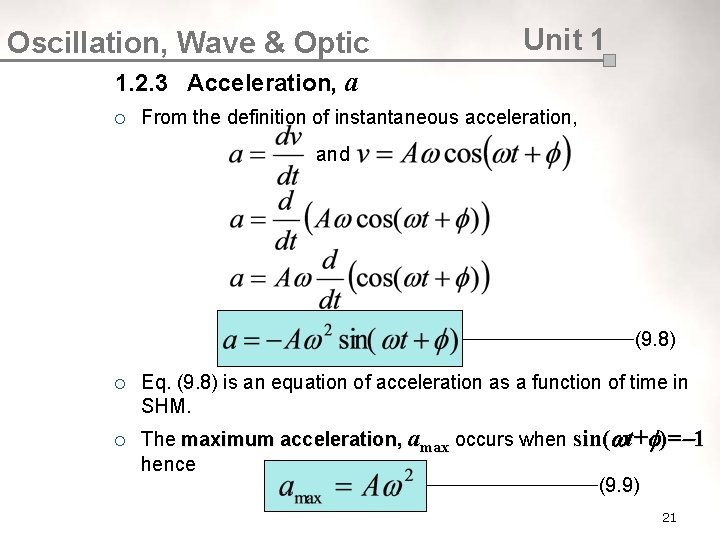
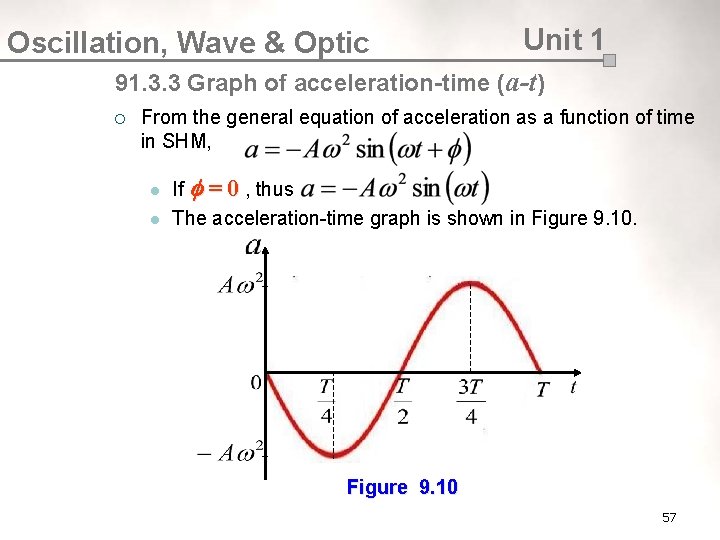
Oscillation, Wave & Optic Unit 1 1. 2. 3 Acceleration, a ¡ From the definition of instantaneous acceleration, and (9. 8) ¡ ¡ Eq. (9. 8) is an equation of acceleration as a function of time in SHM. The maximum acceleration, amax occurs when sin( t+ )= 1 hence (9. 9) 21
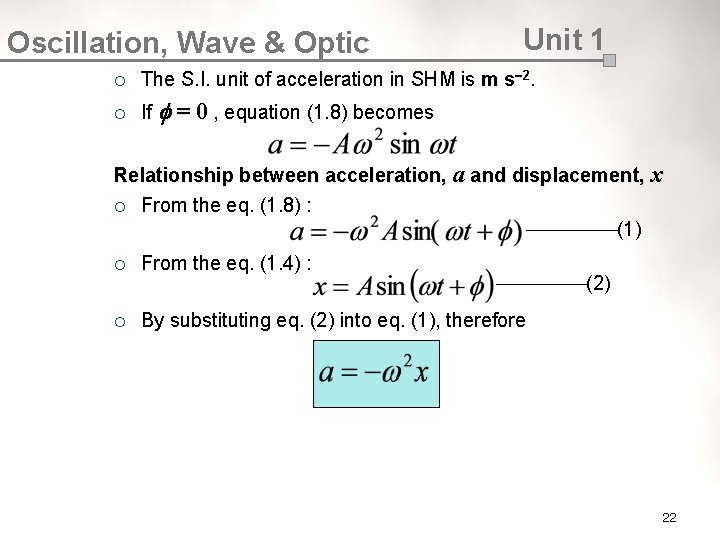
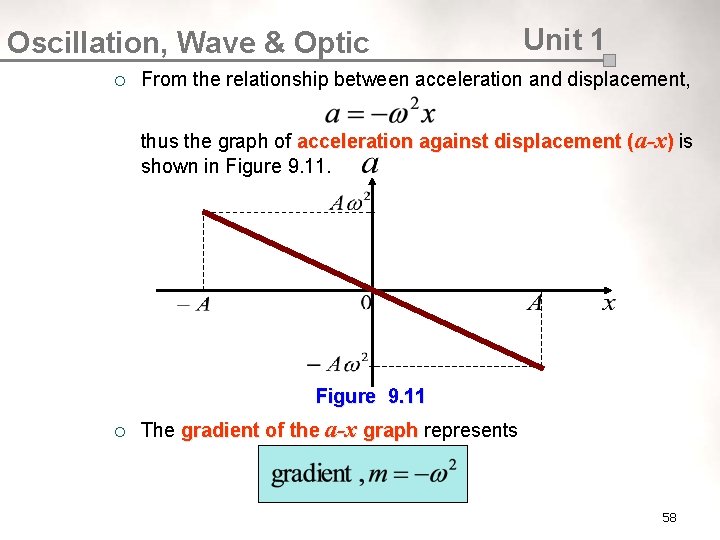
Oscillation, Wave & Optic Unit 1 ¡ The S. I. unit of acceleration in SHM is m s 2. ¡ If = 0 , equation (1. 8) becomes Relationship between acceleration, a and displacement, x ¡ From the eq. (1. 8) : (1) ¡ From the eq. (1. 4) : ¡ By substituting eq. (2) into eq. (1), therefore (2) 22
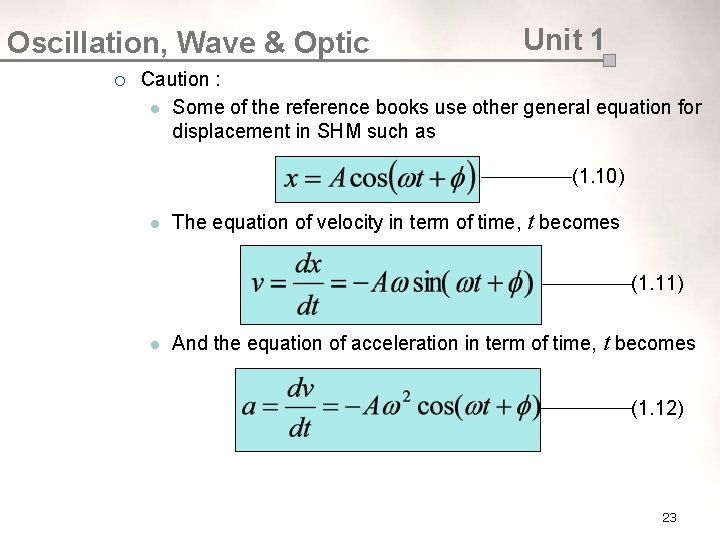
Oscillation, Wave & Optic ¡ Unit 1 Caution : l Some of the reference books use other general equation for displacement in SHM such as (1. 10) l The equation of velocity in term of time, t becomes (1. 11) l And the equation of acceleration in term of time, t becomes (1. 12) 23
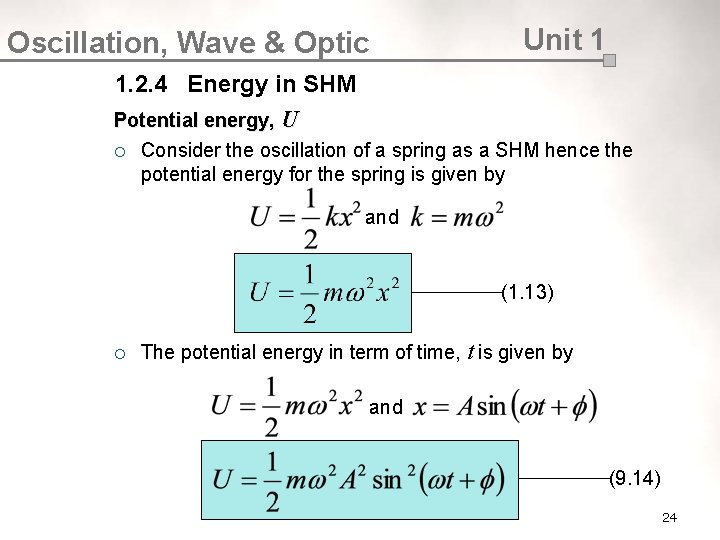
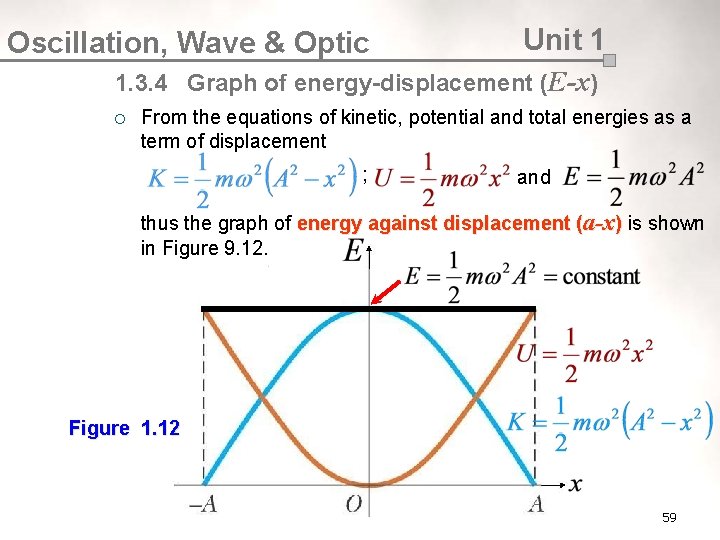
Oscillation, Wave & Optic Unit 1 1. 2. 4 Energy in SHM Potential energy, U ¡ Consider the oscillation of a spring as a SHM hence the potential energy for the spring is given by and (1. 13) ¡ The potential energy in term of time, t is given by and (9. 14) 24
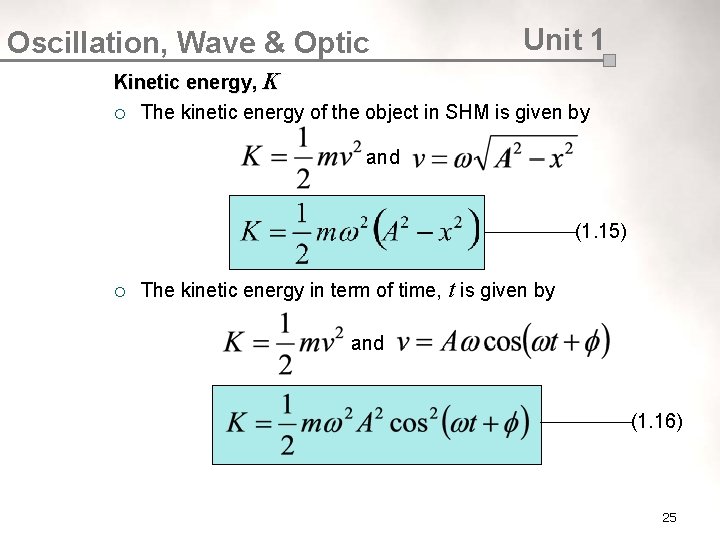
Oscillation, Wave & Optic Unit 1 Kinetic energy, K ¡ The kinetic energy of the object in SHM is given by and (1. 15) ¡ The kinetic energy in term of time, t is given by and (1. 16) 25
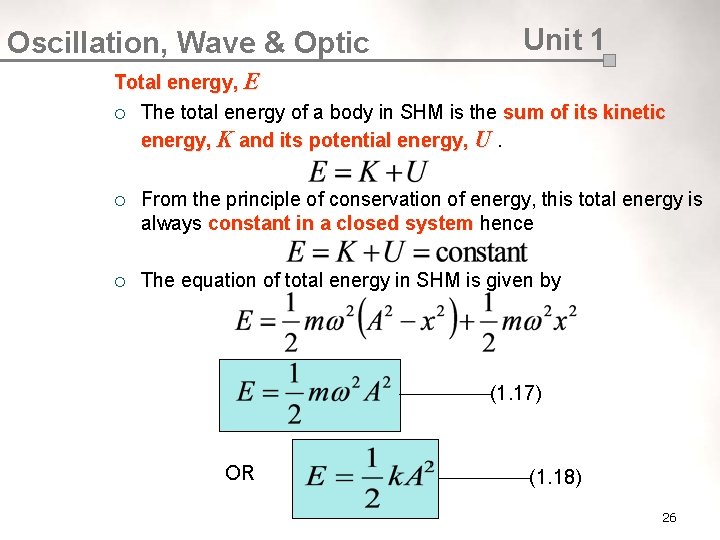
Oscillation, Wave & Optic Unit 1 Total energy, E ¡ The total energy of a body in SHM is the sum of its kinetic energy, K and its potential energy, U. ¡ From the principle of conservation of energy, this total energy is always constant in a closed system hence system ¡ The equation of total energy in SHM is given by (1. 17) OR (1. 18) 26
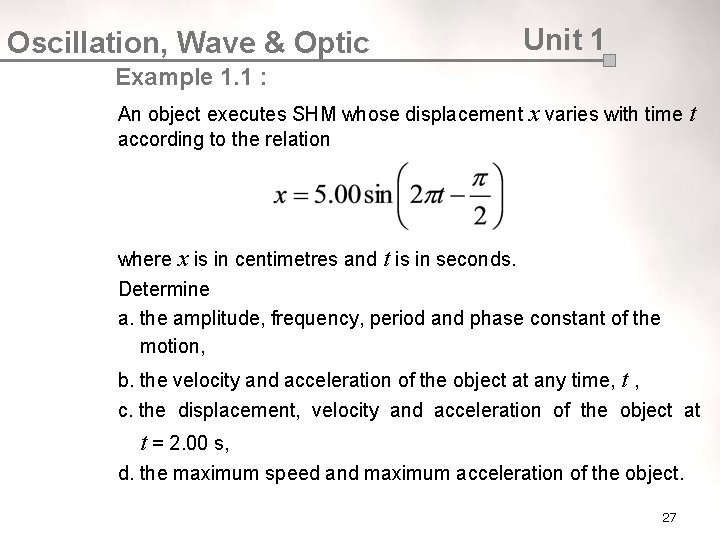
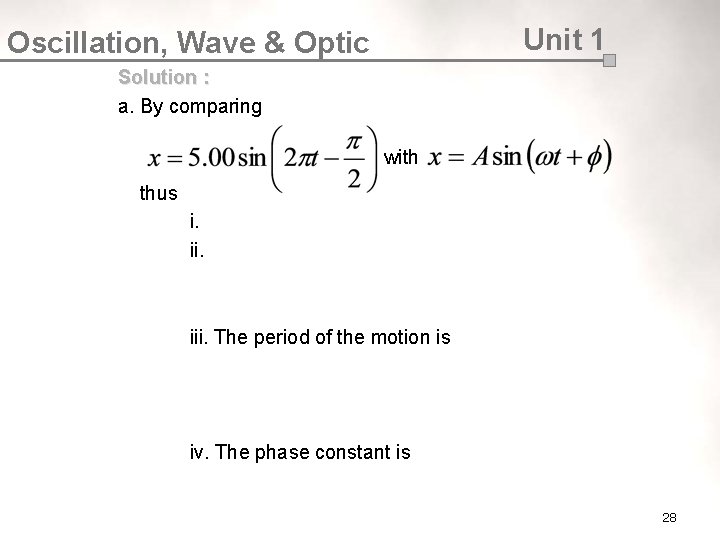
Oscillation, Wave & Optic Unit 1 Example 1. 1 : An object executes SHM whose displacement x varies with time t according to the relation where x is in centimetres and t is in seconds. Determine a. the amplitude, frequency, period and phase constant of the motion, b. the velocity and acceleration of the object at any time, t , c. the displacement, velocity and acceleration of the object at t = 2. 00 s, d. the maximum speed and maximum acceleration of the object. 27
Unit 1 Oscillation, Wave & Optic Solution : a. By comparing with thus i. iii. The period of the motion is iv. The phase constant is 28
Oscillation, Wave & Optic Unit 1 Solution : b. i. Differentiating x respect to time, thus 29
Oscillation, Wave & Optic Unit 1 Solution : b. ii. Differentiating v respect to time, thus 30
Oscillation, Wave & Optic Unit 1 Solution : c. For t = 2. 00 s i. The displacement of the object is ii. The velocity of the object is OR 31
Oscillation, Wave & Optic Unit 1 Solution : c. For t = 2. 00 s iii. The acceleration of the object is OR 32
Oscillation, Wave & Optic Unit 1 Solution : d. i. The maximum speed of the object is given by ii. The maximum acceleration of the object is 33
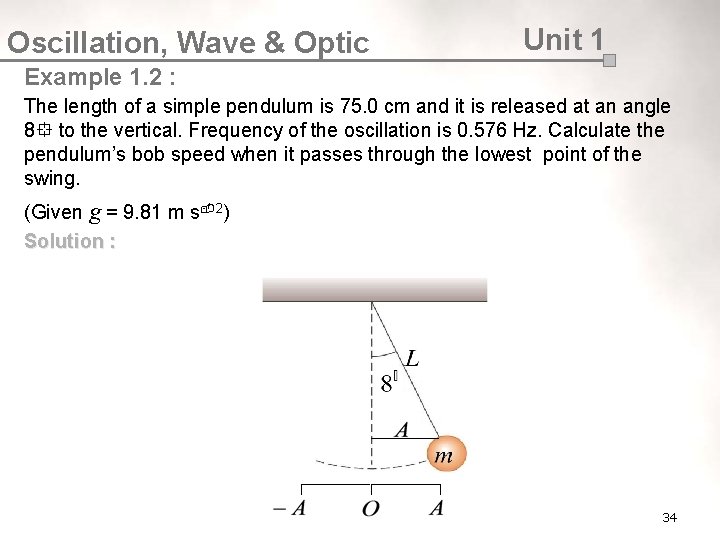
Oscillation, Wave & Optic Unit 1 Example 1. 2 : The length of a simple pendulum is 75. 0 cm and it is released at an angle 8 to the vertical. Frequency of the oscillation is 0. 576 Hz. Calculate the pendulum’s bob speed when it passes through the lowest point of the swing. (Given g = 9. 81 m s 2) Solution : 34
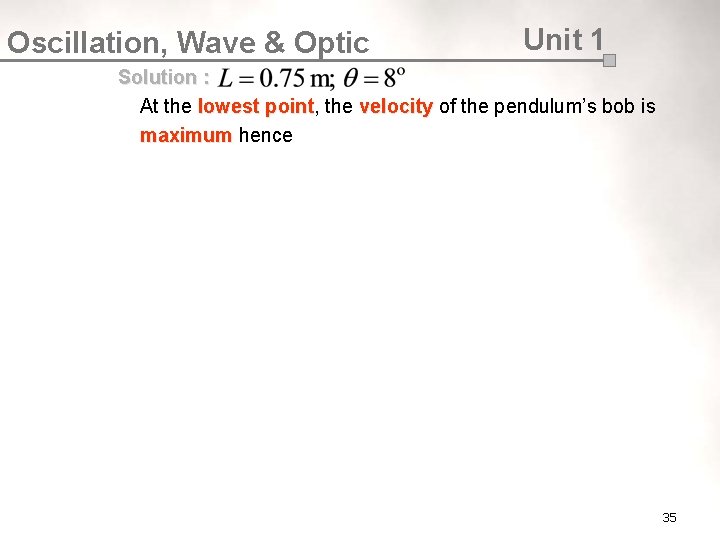
Oscillation, Wave & Optic Unit 1 Solution : At the lowest point, the velocity of the pendulum’s bob is point velocity maximum hence maximum 35
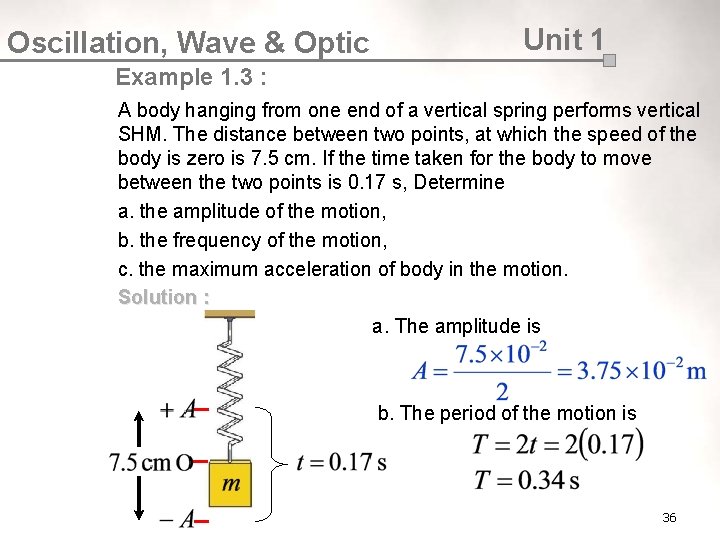
Oscillation, Wave & Optic Unit 1 Example 1. 3 : A body hanging from one end of a vertical spring performs vertical SHM. The distance between two points, at which the speed of the body is zero is 7. 5 cm. If the time taken for the body to move between the two points is 0. 17 s, Determine a. the amplitude of the motion, b. the frequency of the motion, c. the maximum acceleration of body in the motion. Solution : a. The amplitude is b. The period of the motion is 36
Oscillation, Wave & Optic Unit 1 Solution : b. Therefore the frequency of the motion is c. From the equation of the maximum acceleration in SHM, hence 37
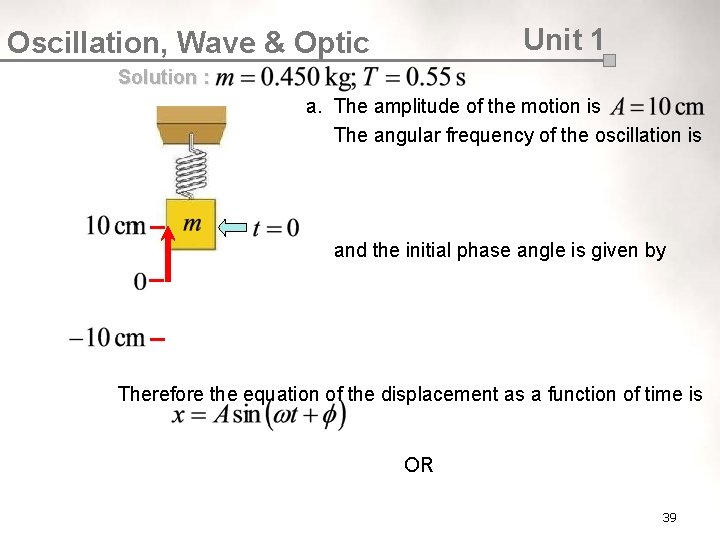
Oscillation, Wave & Optic Unit 1 Example 1. 4 : An object of mass 450 g oscillates from a vertically hanging light spring once every 0. 55 s. The oscillation of the mass-spring is started by being compressed 10 cm from the equilibrium position and released. a. Write down the equation giving the object’s displacement as a function of time. b. How long will the object take to get to the equilibrium position for the first time? c. Calculate i. the maximum speed of the object, ii. the maximum acceleration of the object. 38
Unit 1 Oscillation, Wave & Optic Solution : a. The amplitude of the motion is The angular frequency of the oscillation is and the initial phase angle is given by Therefore the equation of the displacement as a function of time is OR 39
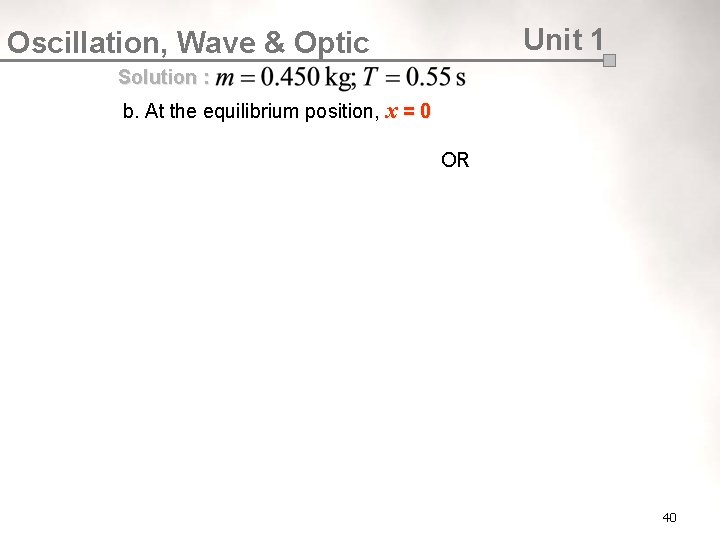
Unit 1 Oscillation, Wave & Optic Solution : b. At the equilibrium position, x = 0 0 OR 40
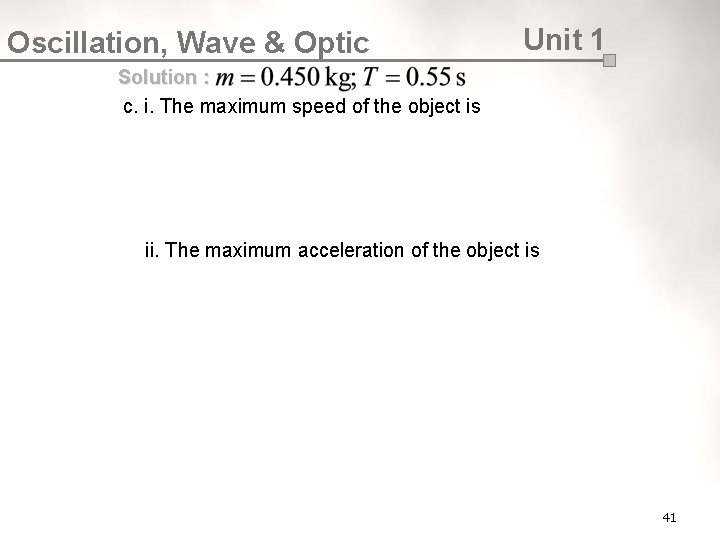
Oscillation, Wave & Optic Unit 1 Solution : c. i. The maximum speed of the object is ii. The maximum acceleration of the object is 41
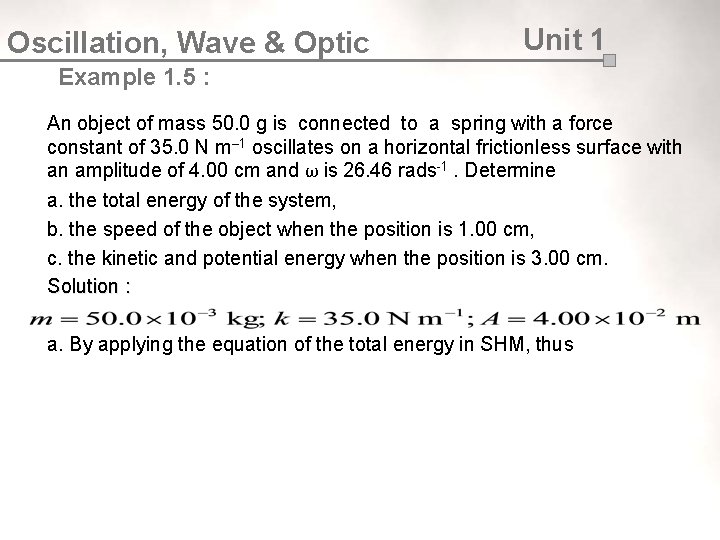
Oscillation, Wave & Optic Unit 1 Example 1. 5 : An object of mass 50. 0 g is connected to a spring with a force constant of 35. 0 N m– 1 oscillates on a horizontal frictionless surface with an amplitude of 4. 00 cm and ω is 26. 46 rads-1. Determine a. the total energy of the system, b. the speed of the object when the position is 1. 00 cm, c. the kinetic and potential energy when the position is 3. 00 cm. Solution : a. By applying the equation of the total energy in SHM, thus
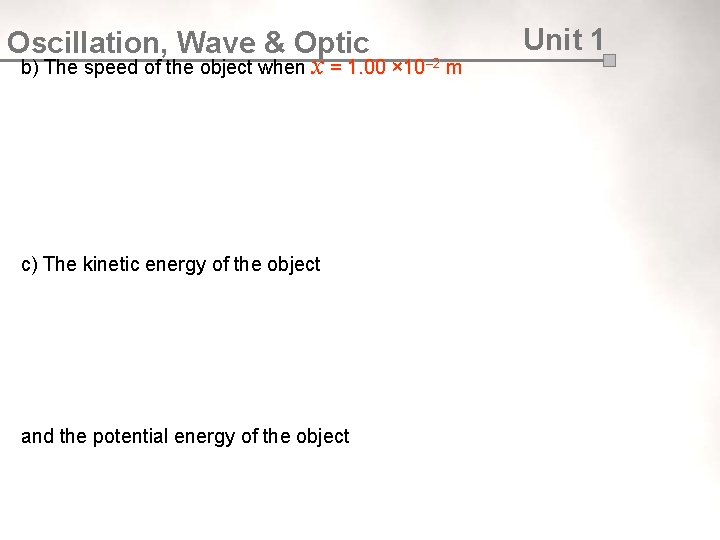
Oscillation, Wave & Optic b) The speed of the object when x = 1. 00 × 10– 2 m c) The kinetic energy of the object and the potential energy of the object Unit 1
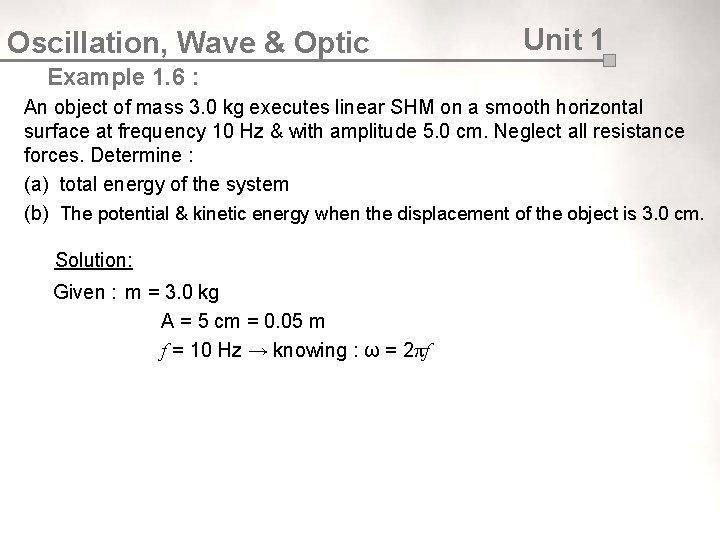
Oscillation, Wave & Optic Unit 1 Example 1. 6 : An object of mass 3. 0 kg executes linear SHM on a smooth horizontal surface at frequency 10 Hz & with amplitude 5. 0 cm. Neglect all resistance forces. Determine : (a) total energy of the system (b) The potential & kinetic energy when the displacement of the object is 3. 0 cm. Solution: Given : m = 3. 0 kg A = 5 cm = 0. 05 m f = 10 Hz → knowing : ω = 2πf
Oscillation, Wave & Optic b) To calculate Kinetic energy : Unit 1
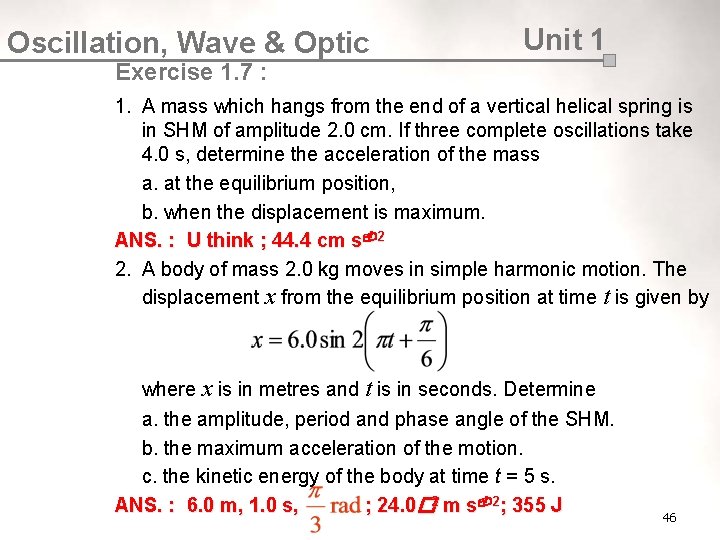
Oscillation, Wave & Optic Unit 1 Exercise 1. 7 : 1. A mass which hangs from the end of a vertical helical spring is in SHM of amplitude 2. 0 cm. If three complete oscillations take 4. 0 s, determine the acceleration of the mass a. at the equilibrium position, b. when the displacement is maximum. ANS. : U think ; 44. 4 cm s 2 2. A body of mass 2. 0 kg moves in simple harmonic motion. The displacement x from the equilibrium position at time t is given by where x is in metres and t is in seconds. Determine a. the amplitude, period and phase angle of the SHM. b. the maximum acceleration of the motion. c. the kinetic energy of the body at time t = 5 s. ANS. : 6. 0 m, 1. 0 s, ; 24. 0� 2 m s 2; 355 J 46
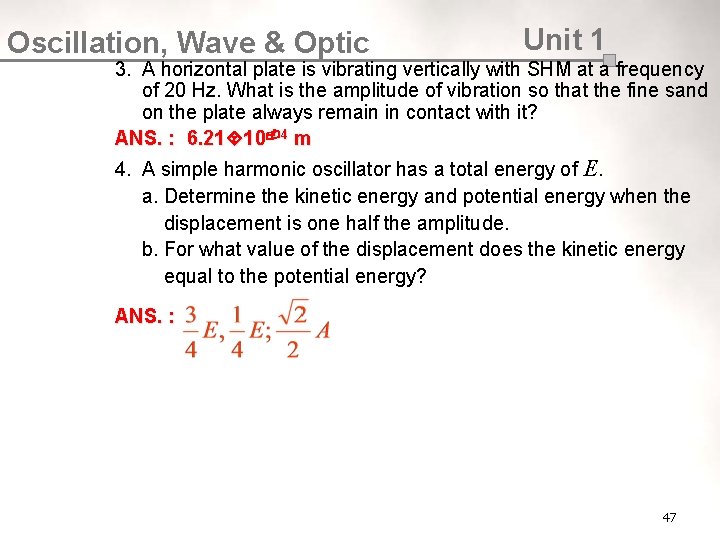
Oscillation, Wave & Optic Unit 1 3. A horizontal plate is vibrating vertically with SHM at a frequency of 20 Hz. What is the amplitude of vibration so that the fine sand on the plate always remain in contact with it? ANS. : 6. 21 10 4 m 4. A simple harmonic oscillator has a total energy of E. a. Determine the kinetic energy and potential energy when the displacement is one half the amplitude. b. For what value of the displacement does the kinetic energy equal to the potential energy? ANS. : 47
Oscillation, Wave & Optic Learning Outcome: Unit 1 1. 3 Graphs of SHM (1 hour) At the end of this chapter, students should be able to: ¡ Sketch, interpret and distinguish the following graphs: l displacement - time l velocity - time l acceleration - time l energy - displacement 48
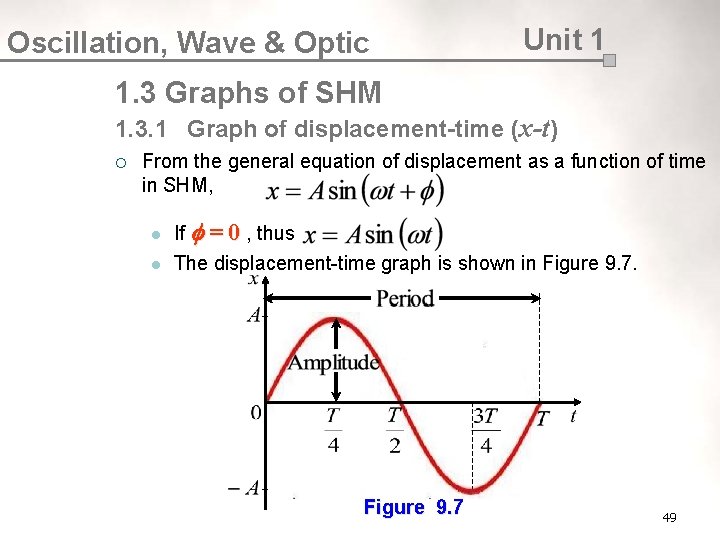
Oscillation, Wave & Optic Unit 1 1. 3 Graphs of SHM 1. 3. 1 Graph of displacement-time (x-t) ¡ From the general equation of displacement as a function of time in SHM, l l If = 0 , thus The displacement-time graph is shown in Figure 9. 7 49
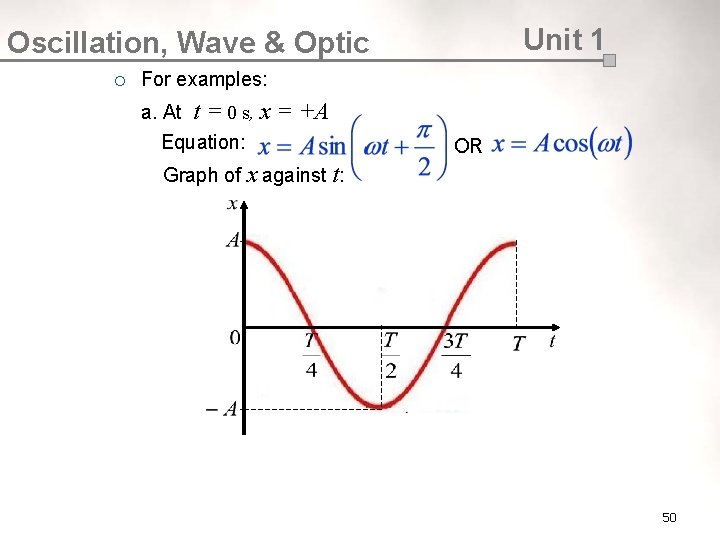
Unit 1 Oscillation, Wave & Optic ¡ For examples: a. At t = 0 s, x Equation: = +A OR Graph of x against t: 50
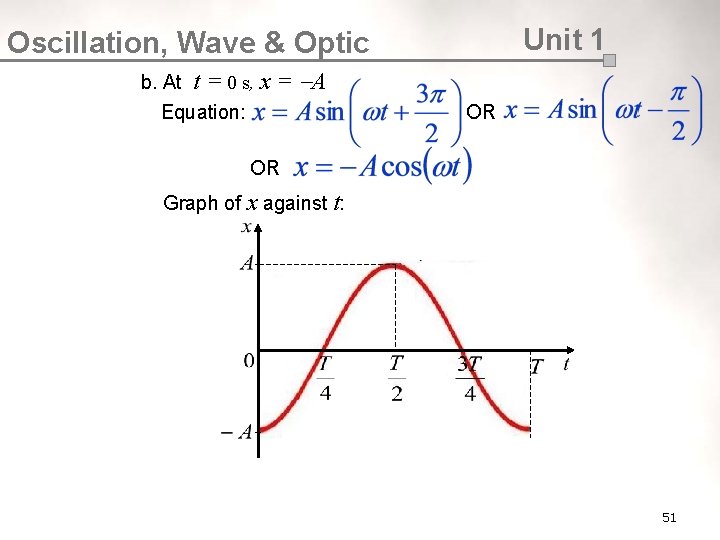
Unit 1 Oscillation, Wave & Optic b. At t = 0 s, x = Equation: OR A OR Graph of x against t: 51
Unit 1 Oscillation, Wave & Optic c. At t = 0 s, x = 0, but v = vmax Equation: OR Graph of x against t: 52
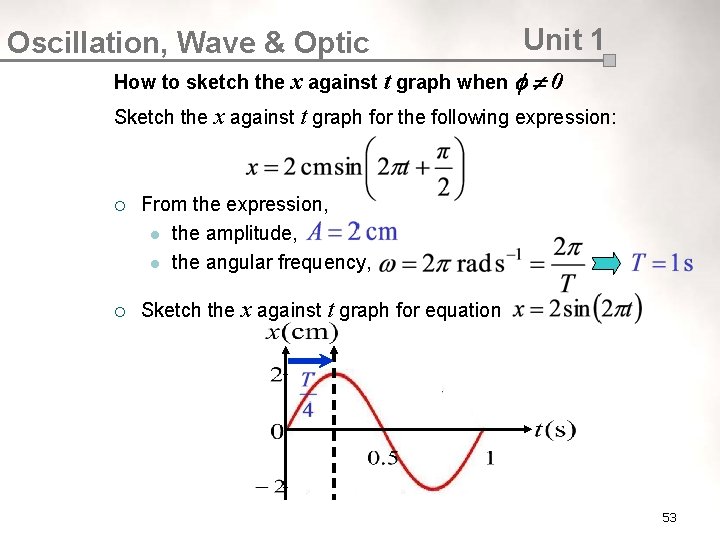
Oscillation, Wave & Optic Unit 1 How to sketch the x against t graph when 0 Sketch the x against t graph for the following expression: ¡ ¡ From the expression, l the amplitude, l the angular frequency, Sketch the x against t graph for equation 53
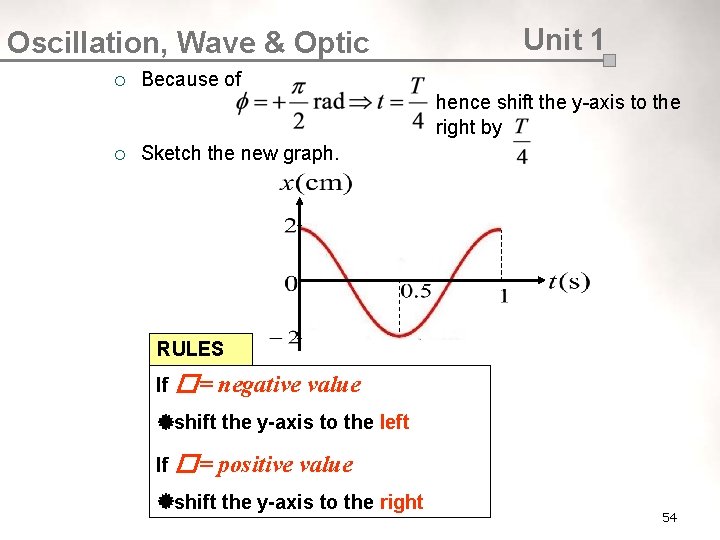
Oscillation, Wave & Optic ¡ Unit 1 Because of hence shift the y-axis to the right by ¡ Sketch the new graph. RULES If � = negative value shift the y-axis to the left If � = positive value shift the y-axis to the right 54
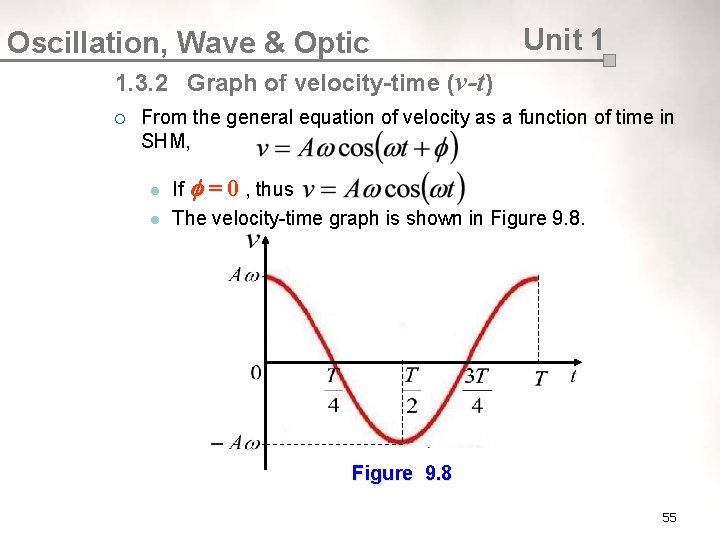
Oscillation, Wave & Optic Unit 1 1. 3. 2 Graph of velocity-time (v-t) ¡ From the general equation of velocity as a function of time in SHM, l l If = 0 , thus The velocity-time graph is shown in Figure 9. 8 55
Oscillation, Wave & Optic ¡ Unit 1 From the relationship between velocity and displacement, thus the graph of velocity against displacement (v-x) is shown in Figure 9. 9 56
Oscillation, Wave & Optic Unit 1 91. 3. 3 Graph of acceleration-time (a-t) ¡ From the general equation of acceleration as a function of time in SHM, l l If = 0 , thus The acceleration-time graph is shown in Figure 9. 10 57
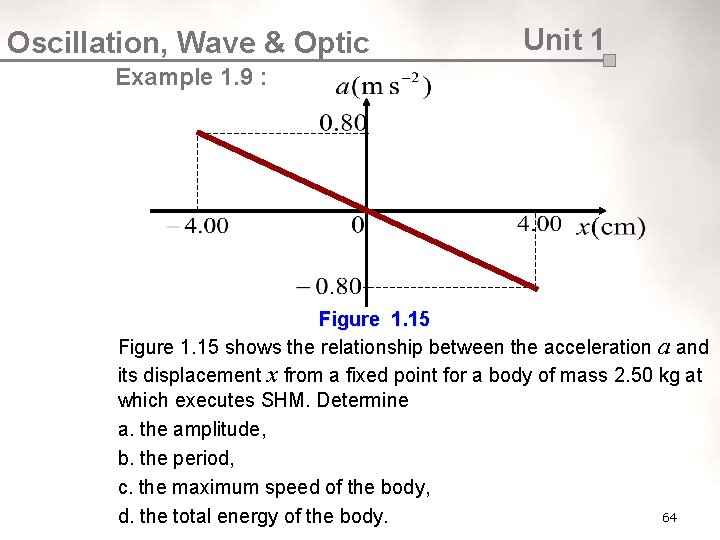
Oscillation, Wave & Optic ¡ Unit 1 From the relationship between acceleration and displacement, thus the graph of acceleration against displacement (a-x) is shown in Figure 9. 11 ¡ The gradient of the a-x graph represents graph 58
Oscillation, Wave & Optic Unit 1 1. 3. 4 Graph of energy-displacement (E-x) ¡ From the equations of kinetic, potential and total energies as a term of displacement ; and thus the graph of energy against displacement (a-x) is shown in Figure 9. 12. Figure 1. 12 59
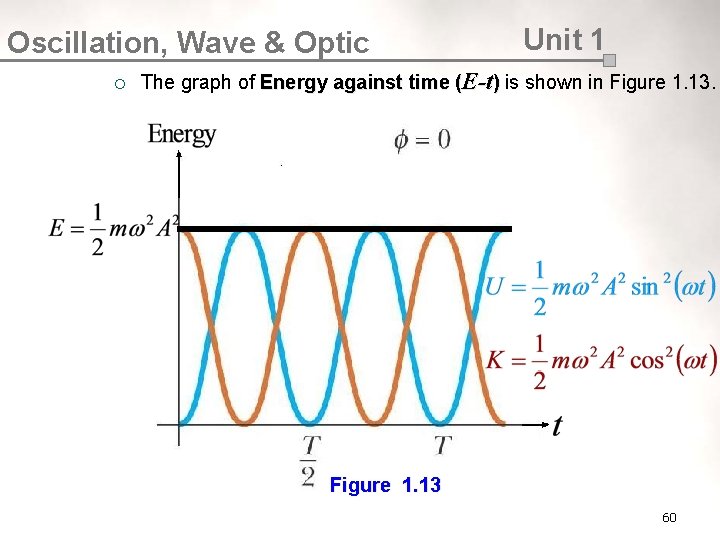
Oscillation, Wave & Optic ¡ Unit 1 The graph of Energy against time (E-t) is shown in Figure 1. 13 60
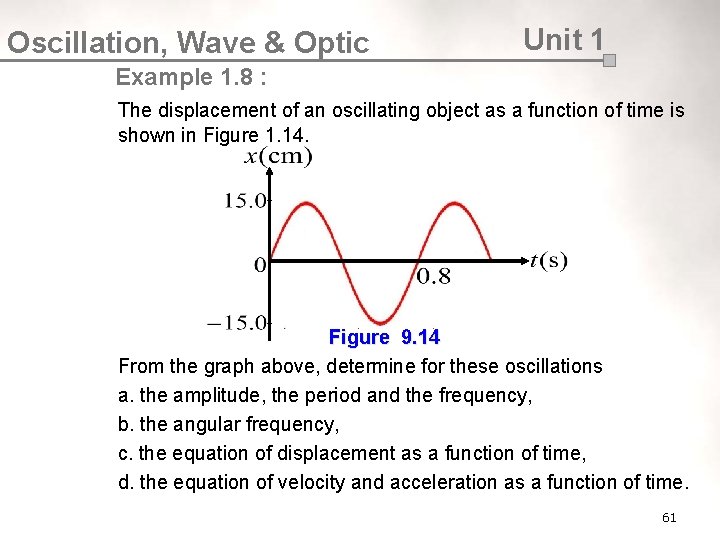
Oscillation, Wave & Optic Unit 1 Example 1. 8 : The displacement of an oscillating object as a function of time is shown in Figure 1. 14. Figure 9. 14 From the graph above, determine for these oscillations a. the amplitude, the period and the frequency, b. the angular frequency, c. the equation of displacement as a function of time, d. the equation of velocity and acceleration as a function of time. 61
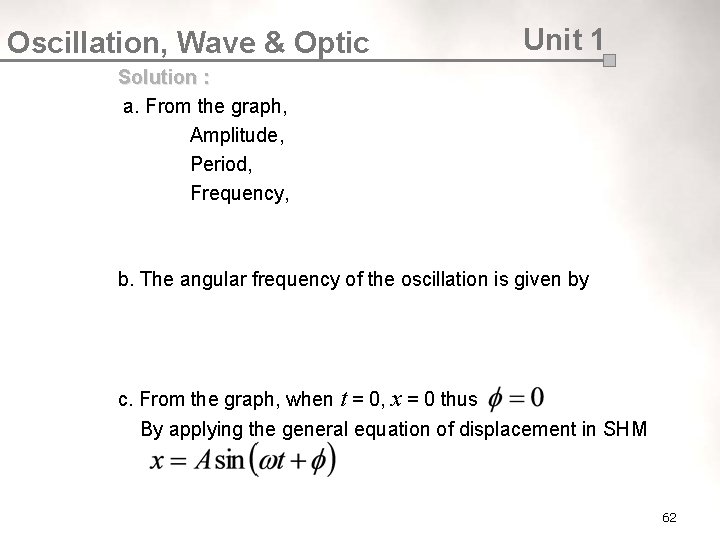
Oscillation, Wave & Optic Unit 1 Solution : a. From the graph, Amplitude, Period, Frequency, b. The angular frequency of the oscillation is given by c. From the graph, when t = 0, x = 0 thus By applying the general equation of displacement in SHM 62
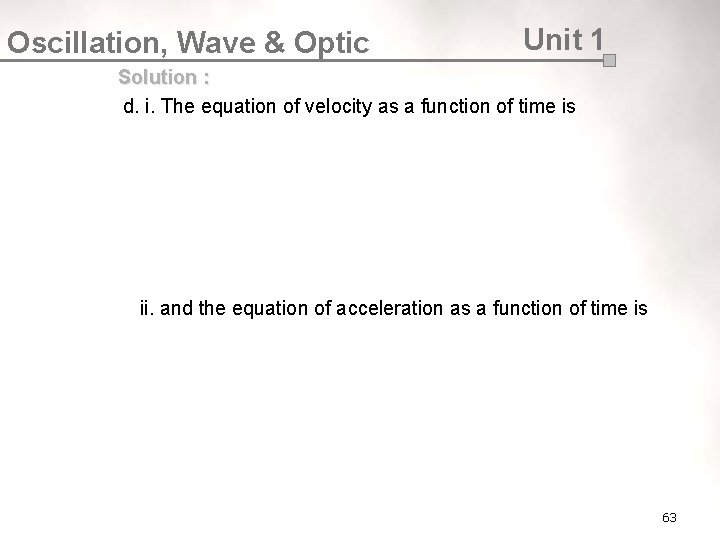
Oscillation, Wave & Optic Unit 1 Solution : d. i. The equation of velocity as a function of time is ii. and the equation of acceleration as a function of time is 63
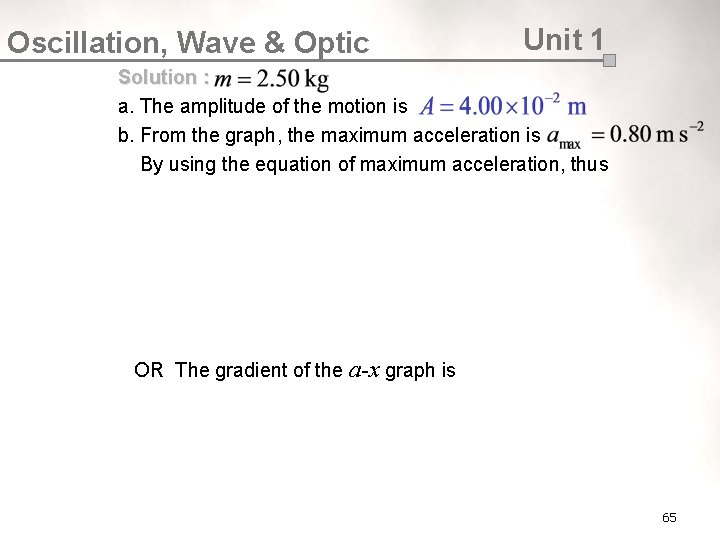
Oscillation, Wave & Optic Unit 1 Example 1. 9 : Figure 1. 15 shows the relationship between the acceleration a and its displacement x from a fixed point for a body of mass 2. 50 kg at which executes SHM. Determine a. the amplitude, b. the period, c. the maximum speed of the body, 64 d. the total energy of the body.
Oscillation, Wave & Optic Unit 1 Solution : a. The amplitude of the motion is b. From the graph, the maximum acceleration is By using the equation of maximum acceleration, thus OR The gradient of the a-x graph is 65
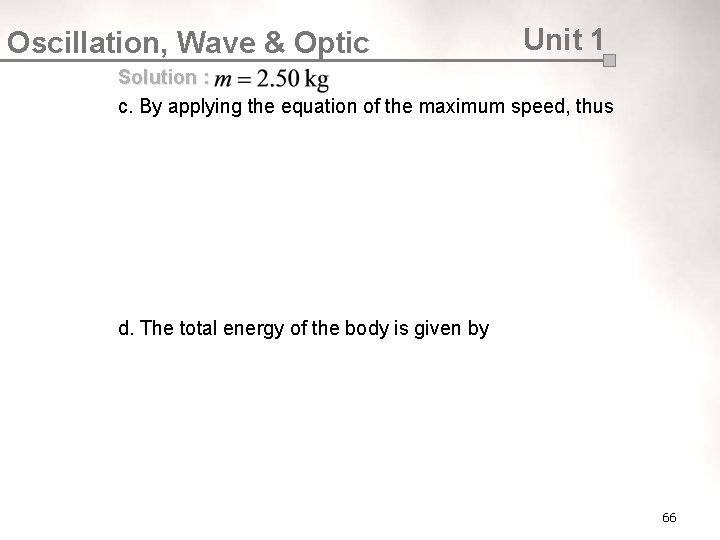
Oscillation, Wave & Optic Unit 1 Solution : c. By applying the equation of the maximum speed, thus d. The total energy of the body is given by 66
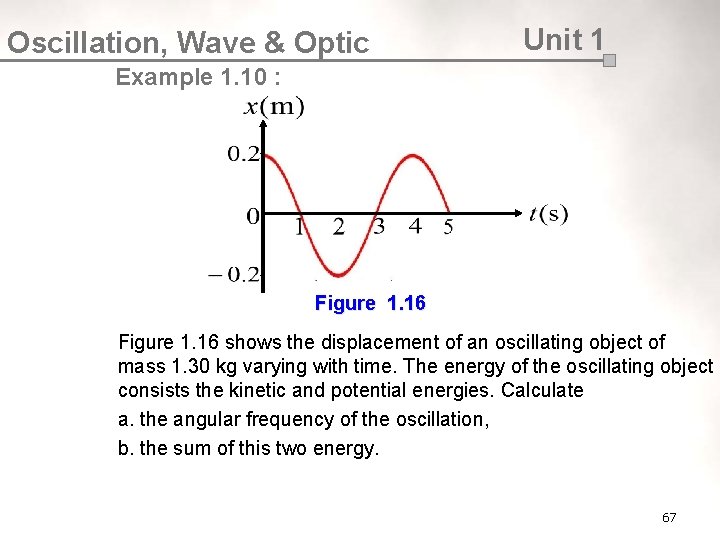
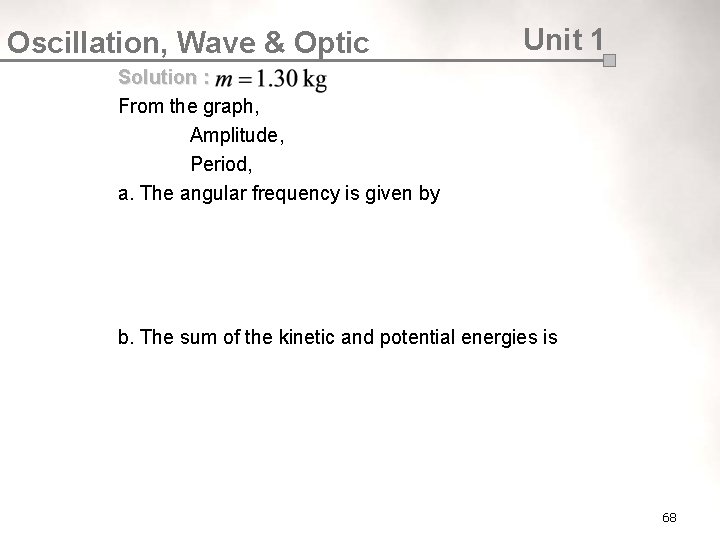
Oscillation, Wave & Optic Unit 1 Example 1. 10 : Figure 1. 16 shows the displacement of an oscillating object of mass 1. 30 kg varying with time. The energy of the oscillating object consists the kinetic and potential energies. Calculate a. the angular frequency of the oscillation, b. the sum of this two energy. 67
Oscillation, Wave & Optic Unit 1 Solution : From the graph, Amplitude, Period, a. The angular frequency is given by b. The sum of the kinetic and potential energies is 68
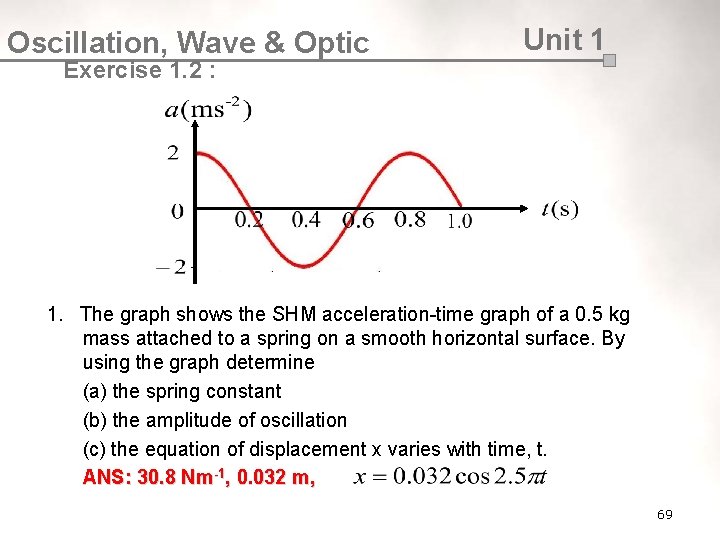
Oscillation, Wave & Optic Unit 1 Exercise 1. 2 : 1. The graph shows the SHM acceleration-time graph of a 0. 5 kg mass attached to a spring on a smooth horizontal surface. By using the graph determine (a) the spring constant (b) the amplitude of oscillation (c) the equation of displacement x varies with time, t. ANS: 30. 8 Nm-1, 0. 032 m, 69
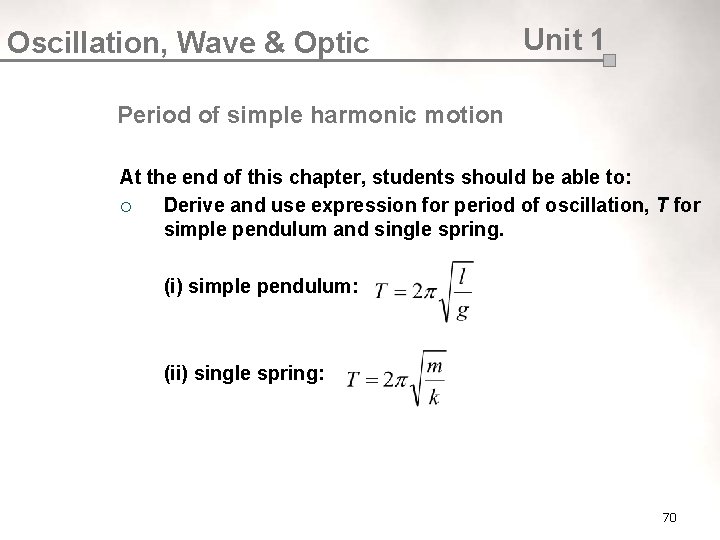
Oscillation, Wave & Optic Unit 1 Period of simple harmonic motion At the end of this chapter, students should be able to: ¡ Derive and use expression for period of oscillation, T for simple pendulum and single spring. (i) simple pendulum: (ii) single spring: 70
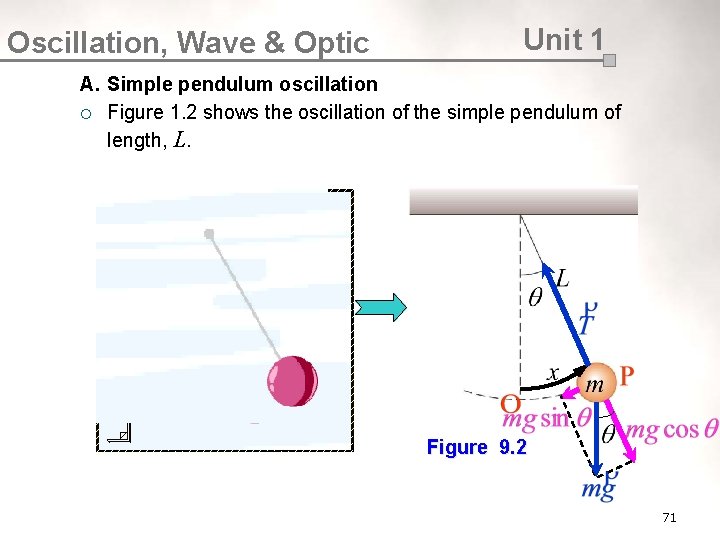
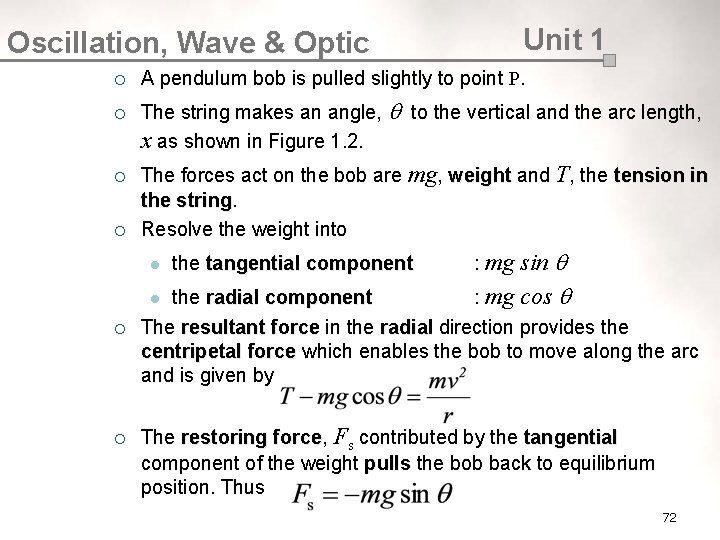
Oscillation, Wave & Optic Unit 1 A. Simple pendulum oscillation ¡ Figure 1. 2 shows the oscillation of the simple pendulum of length, L. Figure 9. 2 71
Oscillation, Wave & Optic ¡ ¡ A pendulum bob is pulled slightly to point P. The string makes an angle, to the vertical and the arc length, x as shown in Figure 1. 2. The forces act on the bob are mg, weight and T, the tension in weight the string Resolve the weight into l ¡ the tangential component : mg cos : mg sin the radial component The resultant force in the radial direction provides the force radial centripetal force which enables the bob to move along the arc force and is given by l ¡ Unit 1 The restoring force, force Fs contributed by the tangential component of the weight pulls the bob back to equilibrium pulls position. Thus 72
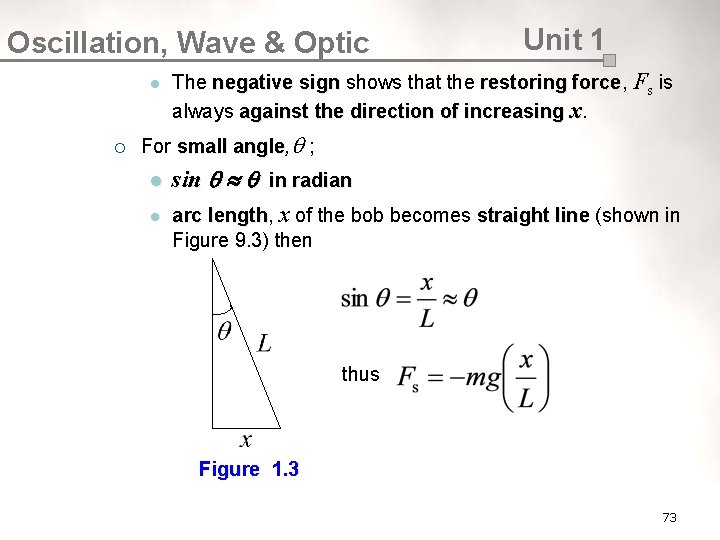
Oscillation, Wave & Optic l ¡ Unit 1 The negative sign shows that the restoring force, sign force Fs is always against the direction of increasing x. For small angle, angle ; l l sin in radian arc length, length x of the bob becomes straight line (shown in Figure 9. 3) then thus Figure 1. 3 73
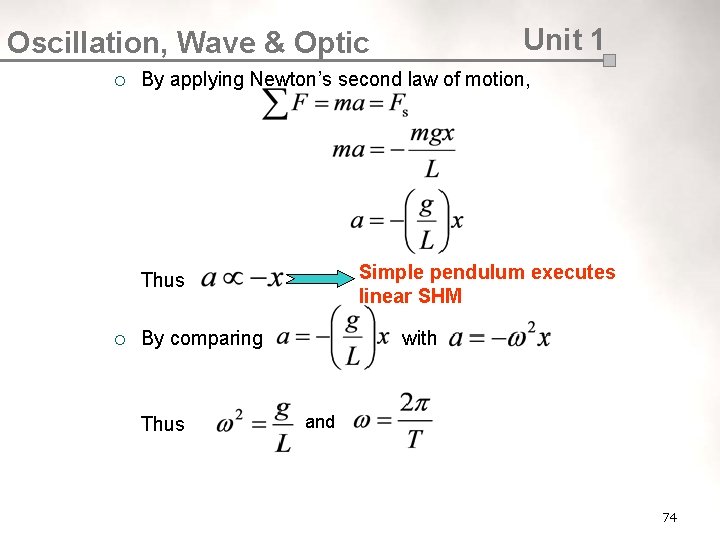
Unit 1 Oscillation, Wave & Optic ¡ By applying Newton’s second law of motion, Simple pendulum executes linear SHM Thus ¡ By comparing Thus with and 74
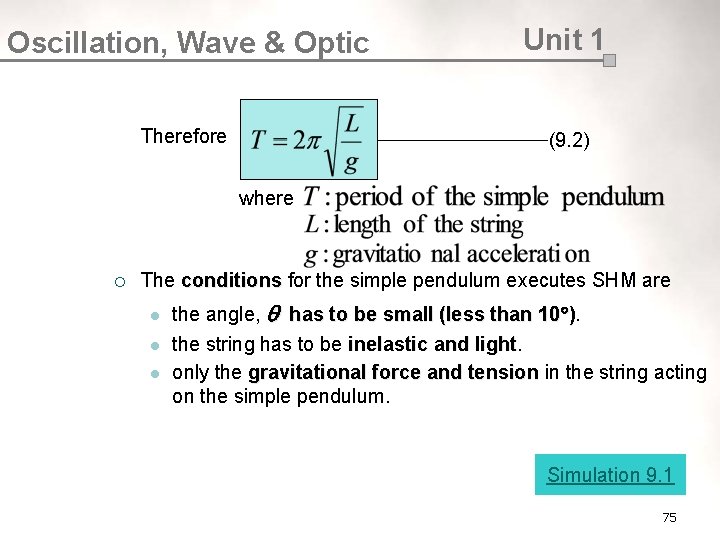
Oscillation, Wave & Optic Unit 1 Therefore (9. 2) where ¡ The conditions for the simple pendulum executes SHM are conditions l l l the angle, has to be small (less than 10 ). the string has to be inelastic and light only the gravitational force and tension in the string acting tension on the simple pendulum. Simulation 9. 1 75
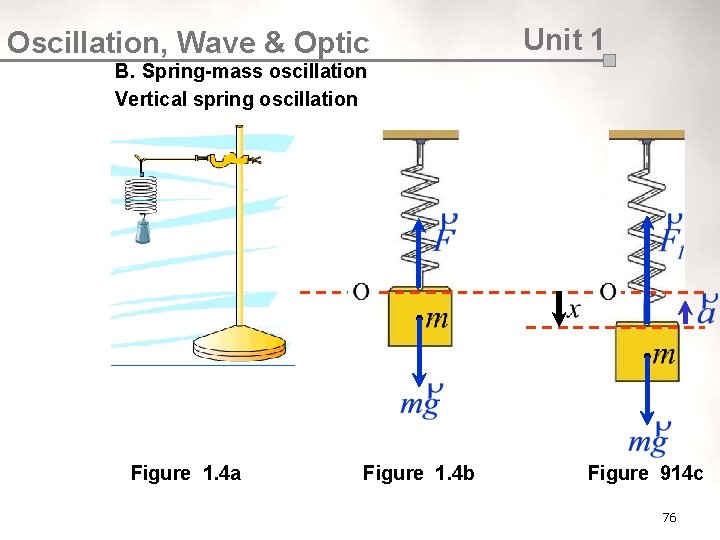
Oscillation, Wave & Optic Unit 1 B. Spring-mass oscillation Vertical spring oscillation Figure 1. 4 a Figure 1. 4 b Figure 914 c 76
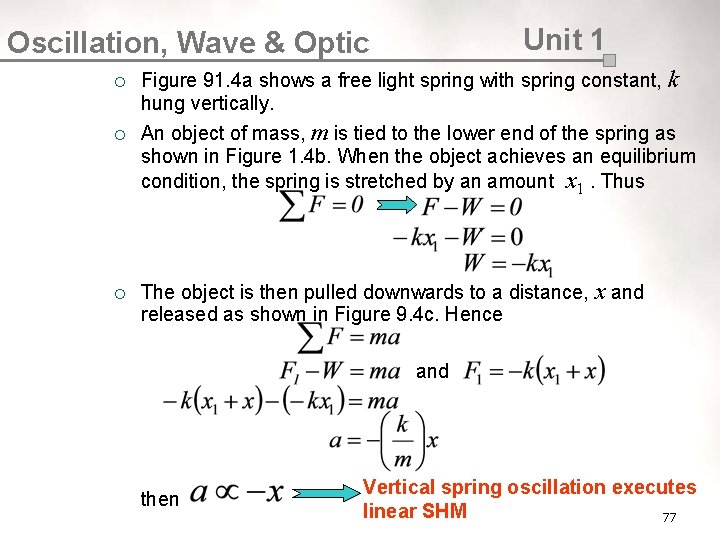
Unit 1 Oscillation, Wave & Optic ¡ ¡ Figure 91. 4 a shows a free light spring with spring constant, k hung vertically. An object of mass, m is tied to the lower end of the spring as shown in Figure 1. 4 b. When the object achieves an equilibrium condition, the spring is stretched by an amount x 1. Thus ¡ The object is then pulled downwards to a distance, x and released as shown in Figure 9. 4 c. Hence and then Vertical spring oscillation executes linear SHM 77
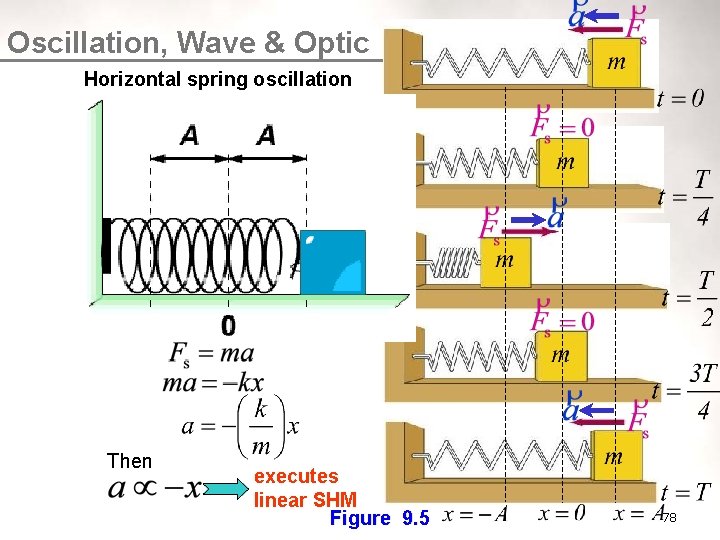
Oscillation, Wave & Optic Unit 1 Horizontal spring oscillation ¡ Figure 9. 5 shows a spring is initially stretched with a displacement, x = A and then released. ¡ According to Hooke’s law, ¡ The mass accelerates toward equilibrium position, x = 0 by the restoring force, Fs hence Then executes linear SHM Figure 9. 5 78
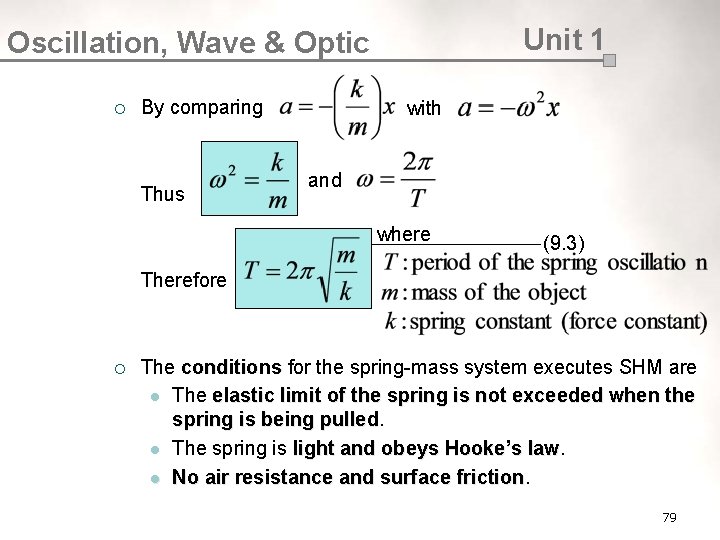
Unit 1 Oscillation, Wave & Optic ¡ By comparing Thus with and where (9. 3) Therefore ¡ The conditions for the spring-mass system executes SHM are conditions l The elastic limit of the spring is not exceeded when the spring is being pulled l The spring is light and obeys Hooke’s law l No air resistance and surface friction 79
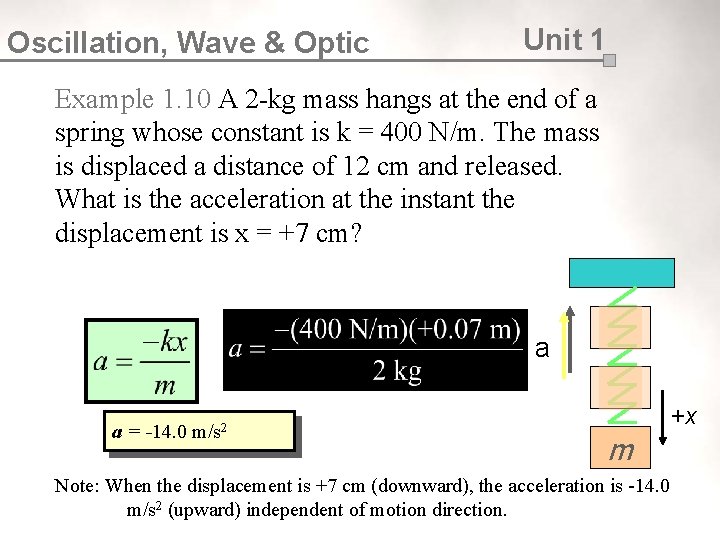
Oscillation, Wave & Optic Unit 1 Example 1. 10 A 2 -kg mass hangs at the end of a spring whose constant is k = 400 N/m. The mass is displaced a distance of 12 cm and released. What is the acceleration at the instant the displacement is x = +7 cm? a a = -14. 0 m/s 2 m Note: When the displacement is +7 cm (downward), the acceleration is -14. 0 m/s 2 (upward) independent of motion direction. +x
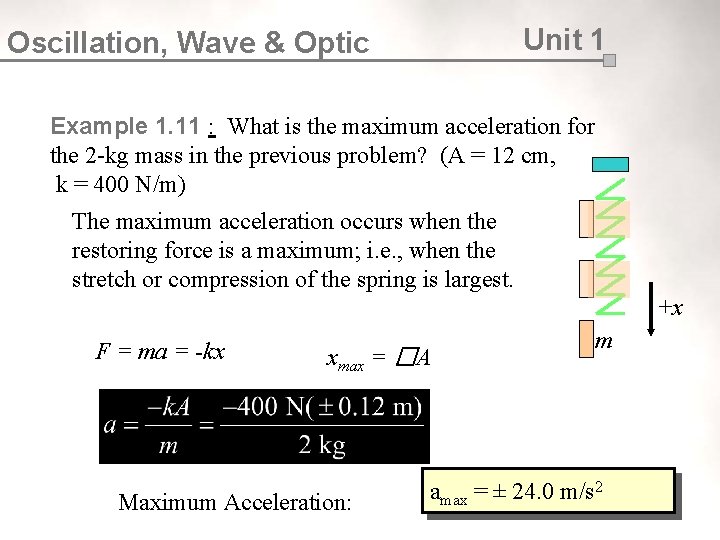
Unit 1 Oscillation, Wave & Optic Example 1. 11 : What is the maximum acceleration for the 2 -kg mass in the previous problem? (A = 12 cm, k = 400 N/m) The maximum acceleration occurs when the restoring force is a maximum; i. e. , when the stretch or compression of the spring is largest. +x F = ma = -kx xmax = �A Maximum Acceleration: m amax = ± 24. 0 m/s 2
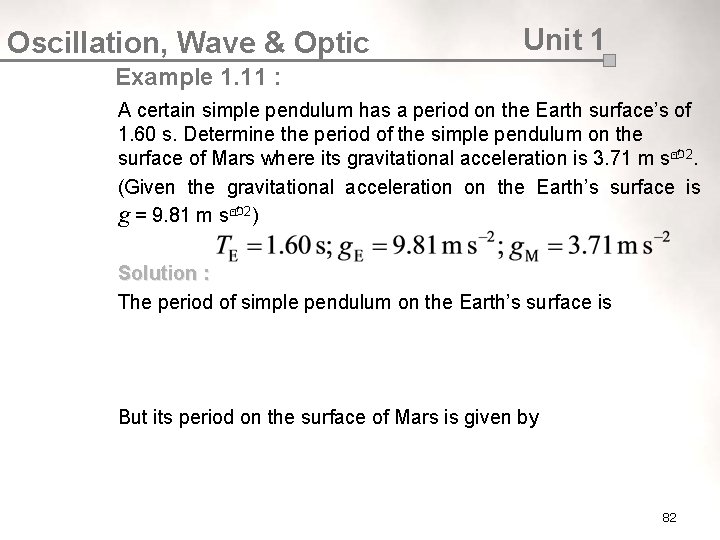
Oscillation, Wave & Optic Unit 1 Example 1. 11 : A certain simple pendulum has a period on the Earth surface’s of 1. 60 s. Determine the period of the simple pendulum on the surface of Mars where its gravitational acceleration is 3. 71 m s 2. (Given the gravitational acceleration on the Earth’s surface is g = 9. 81 m s 2) Solution : The period of simple pendulum on the Earth’s surface is But its period on the surface of Mars is given by 82
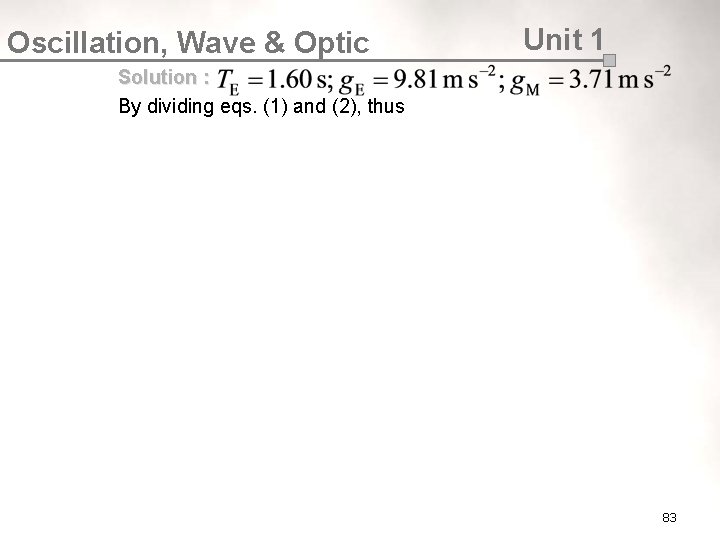
Oscillation, Wave & Optic Unit 1 Solution : By dividing eqs. (1) and (2), thus 83
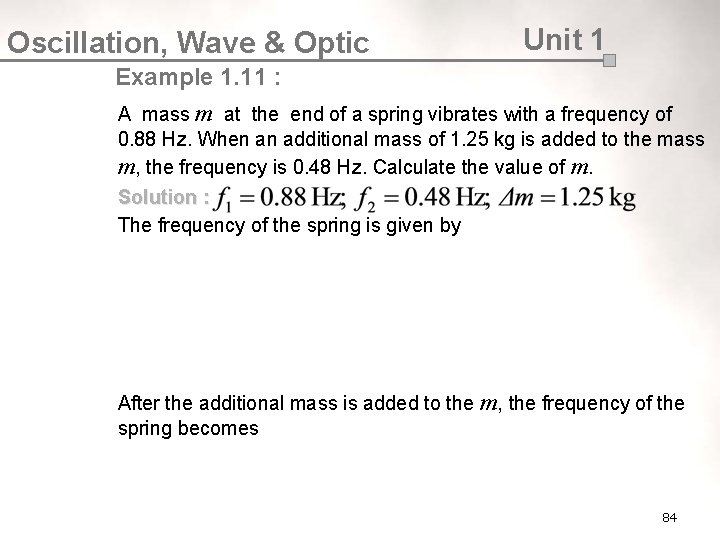
Oscillation, Wave & Optic Unit 1 Example 1. 11 : A mass m at the end of a spring vibrates with a frequency of 0. 88 Hz. When an additional mass of 1. 25 kg is added to the mass m, the frequency is 0. 48 Hz. Calculate the value of m. Solution : The frequency of the spring is given by After the additional mass is added to the m, the frequency of the spring becomes 84
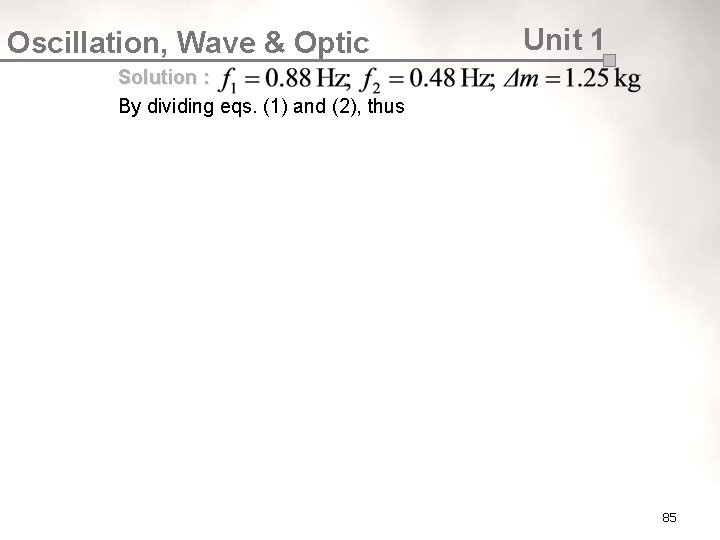
Oscillation, Wave & Optic Unit 1 Solution : By dividing eqs. (1) and (2), thus 85
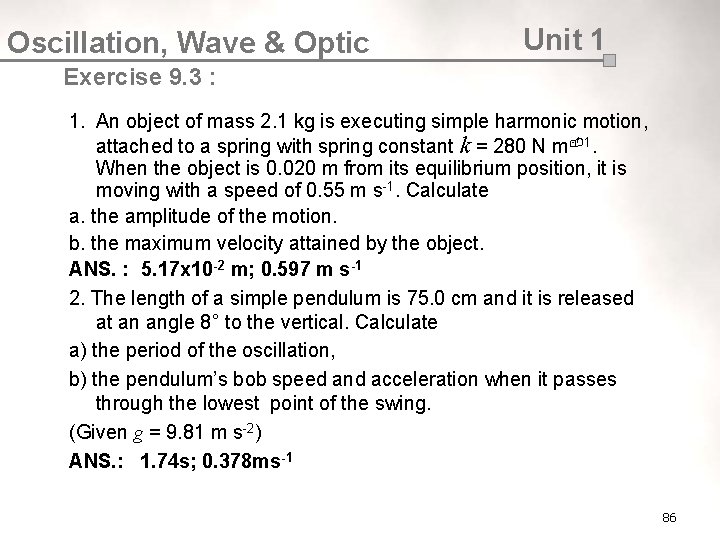
Oscillation, Wave & Optic Unit 1 Exercise 9. 3 : 1. An object of mass 2. 1 kg is executing simple harmonic motion, attached to a spring with spring constant k = 280 N m 1. When the object is 0. 020 m from its equilibrium position, it is moving with a speed of 0. 55 m s-1. Calculate a. the amplitude of the motion. b. the maximum velocity attained by the object. ANS. : 5. 17 x 10 -2 m; 0. 597 m s-1 2. The length of a simple pendulum is 75. 0 cm and it is released at an angle 8° to the vertical. Calculate a) the period of the oscillation, b) the pendulum’s bob speed and acceleration when it passes through the lowest point of the swing. (Given g = 9. 81 m s-2) ANS. : 1. 74 s; 0. 378 ms-1 86
Oscillation, Wave & Optic 3. Unit 1 The acceleration of free fall on the Moon is 1/6 the acceleration of free fall on the earth. If the period of a simple pendulum on the earth is 1. 0 second, what would its period be on the Moon. ANS: 2. 45 s 87
Oscillation, Wave & Optic Unit 1 THE END… Next Chapter… CHAPTER 10 : Mechanical waves 88
Oscillation, Wave & Optic ¡ ¡ ¡ Unit 1 [PPT]Chapter 9: Simple Harmonic Motion www. matrik. net/fizik/wp-content/uploads/2012/. . . /Chapter 9 student. ppt. Cached the force which causes simple harmonic motion to occcur. This force is proportional to the displacement from equilibrium & always directed towards equilibrium. 89