
ORYX 1 ORYX not an acronym but upper
ORYX 1
ORYX not an acronym, but upper case q Designed for use with cell phones q o To protect confidentiality of voice/data o For “data channel”, not “control channel” o Control channel encrypted with CMEA q Standard developed by q Cipher design process not open o Telecommunications Industry Association (TIA) o Flaws in cipher discovered in 1997 o In violation of Kerckhoffs Principle ORYX 2
Stream Cipher ORYX is a stream cipher q Recall that a stream cipher can be viewed as a generalization of one-time pad q A stream cipher initialized with (short) key q Cipher then generates a long keystream q Keystream is used like a one-time pad q o XOR with message to encrypt/decrypt ORYX 3
ORYX Stream cipher q Uses 3 shift registers, denoted X, A, B q o Each holds 32 bits Key is initial fill of registers q Therefore, ORYX has 96 bit key q ORYX also uses a lookup table L q o Where L acts as IV (or MI) q Note that L is not secret ORYX 4

ORYX generates keystream 1 byte/step q Most stream ciphers generate 1 bit/step q o RC 4 stream cipher also generates bytes q ORYX is very weak o RC 4 is weak due to the way it is used in WEP q What is wrong with ORYX? o Generates 1 byte of keystream o Too much of the internal state is exposed o Might be stronger if only generated 1 bit/step ORYX 5
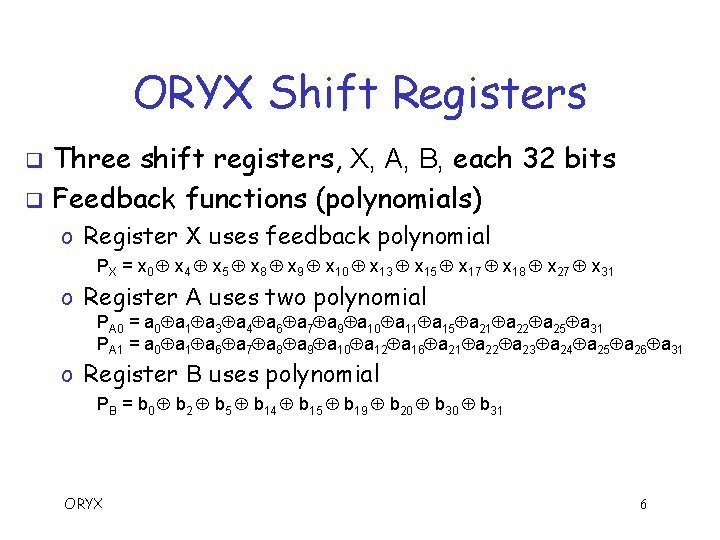
ORYX Shift Registers Three shift registers, X, A, B, each 32 bits q Feedback functions (polynomials) q o Register X uses feedback polynomial PX = x 0 x 4 x 5 x 8 x 9 x 10 x 13 x 15 x 17 x 18 x 27 x 31 o Register A uses two polynomial PA 0 = a 0 a 1 a 3 a 4 a 6 a 7 a 9 a 10 a 11 a 15 a 21 a 22 a 25 a 31 PA 1 = a 0 a 1 a 6 a 7 a 8 a 9 a 10 a 12 a 16 a 21 a 22 a 23 a 24 a 25 a 26 a 31 o Register B uses polynomial PB = b 0 b 2 b 5 b 14 b 15 b 19 b 20 b 31 ORYX 6
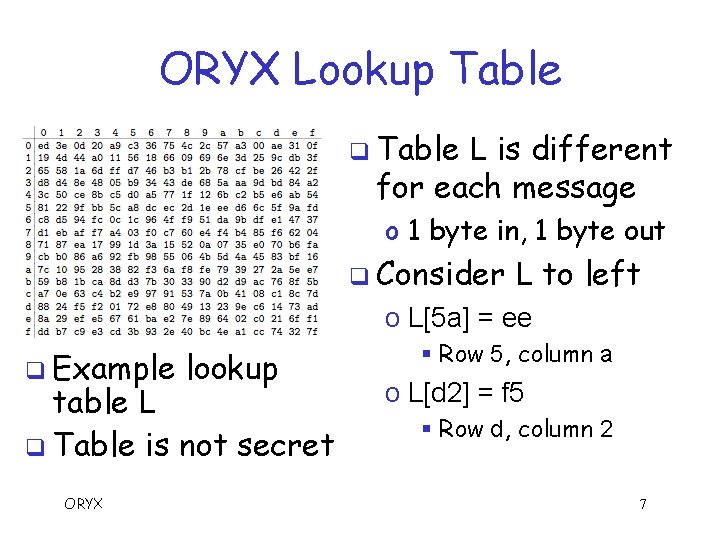
ORYX Lookup Table q Table L is different for each message o 1 byte in, 1 byte out q Consider L to left o L[5 a] = ee q Example lookup table L q Table is not secret ORYX § Row 5, column a o L[d 2] = f 5 § Row d, column 2 7

ORYX Wiring Diagram PA 0 0 31 S PA 1 0 PB C Shift Register A Shift Register B 0 PX 31 31 L L + Shift Register X S determines whether to use PA 0 or PA 1 q C determines whether B steps 1 or 2 times q L is a fixed (per msg), known lookup table q ORYX 8 Kt
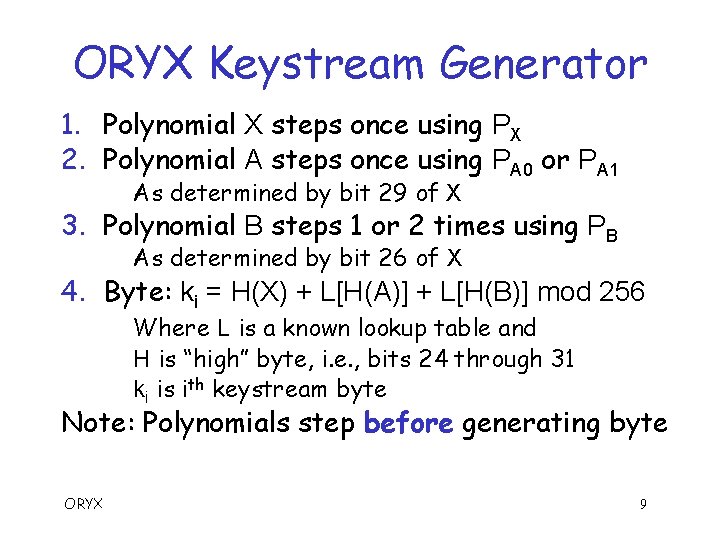
ORYX Keystream Generator 1. Polynomial X steps once using PX 2. Polynomial A steps once using PA 0 or PA 1 As determined by bit 29 of X 3. Polynomial B steps 1 or 2 times using PB As determined by bit 26 of X 4. Byte: ki = H(X) + L[H(A)] + L[H(B)] mod 256 Where L is a known lookup table and H is “high” byte, i. e. , bits 24 through 31 ki is ith keystream byte Note: Polynomials step before generating byte ORYX 9
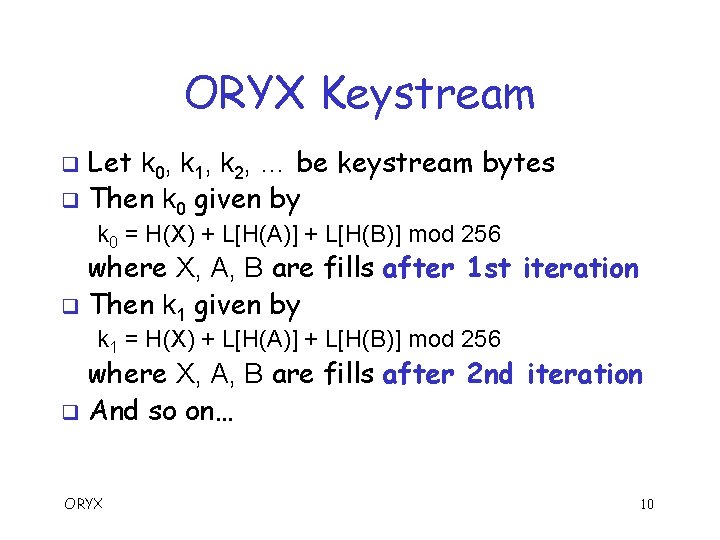
ORYX Keystream Let k 0, k 1, k 2, … be keystream bytes q Then k 0 given by q k 0 = H(X) + L[H(A)] + L[H(B)] mod 256 where X, A, B are fills after 1 st iteration q Then k 1 given by k 1 = H(X) + L[H(A)] + L[H(B)] mod 256 where X, A, B are fills after 2 nd iteration q And so on… ORYX 10
ORYX Attack is not difficult q Idea of the attack q o o o q Suppose we know plaintext bytes p 0, p 1, …, pn Then we know keystream bytes, k 0, k 1, …, kn At each iteration, small change in internal state Byte of output gives lots of info on state Given enough plaintext, reconstruct initial fills Only need small amount of known plaintext ORYX 11
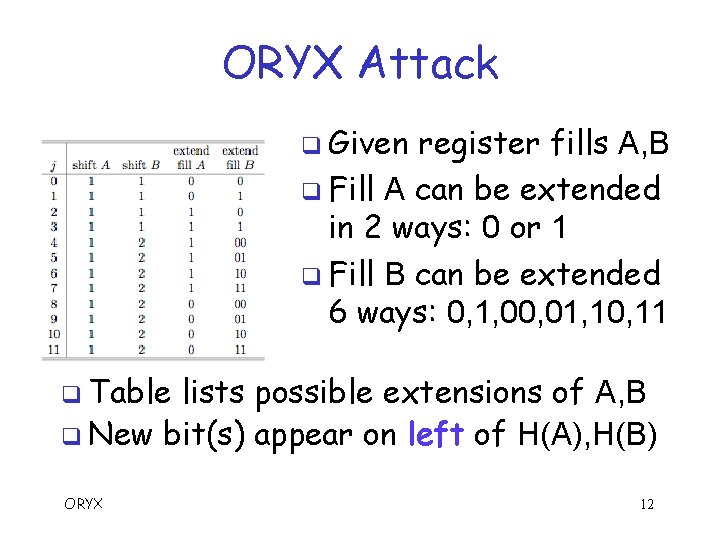
ORYX Attack q Given register fills A, B q Fill A can be extended in 2 ways: 0 or 1 q Fill B can be extended 6 ways: 0, 1, 00, 01, 10, 11 q Table lists possible extensions of A, B q New bit(s) appear on left of H(A), H(B) ORYX 12
![ORYX Attack q Given keystream bytes ki where ki = H(X) + L[H(A)] +](http://slidetodoc.com/presentation_image_h/33347faeaec9489bdd4a095ab1b89d5a/image-13.jpg "ORYX Attack q Given keystream bytes ki where ki = H(X) + L[H(A)] +")
ORYX Attack q Given keystream bytes ki where ki = H(X) + L[H(A)] + L[H(B)] mod 256 And X, A, B are fills after (i+1)st iteration q For each of 216 possible (H(A), H(B)) q o o Let H(X) = k 0 L[H(A)] L[H(B)] mod 256 For each of 12 extensions of (A, B) Let Y = k 1 L[H(A)] L[H(B)] mod 256 Is Y a possible extension of H(X) ? § If yes, save result for testing with bytes k 2, k 3, … o If no valid extension, discard (H(A), H(B)) ORYX 13
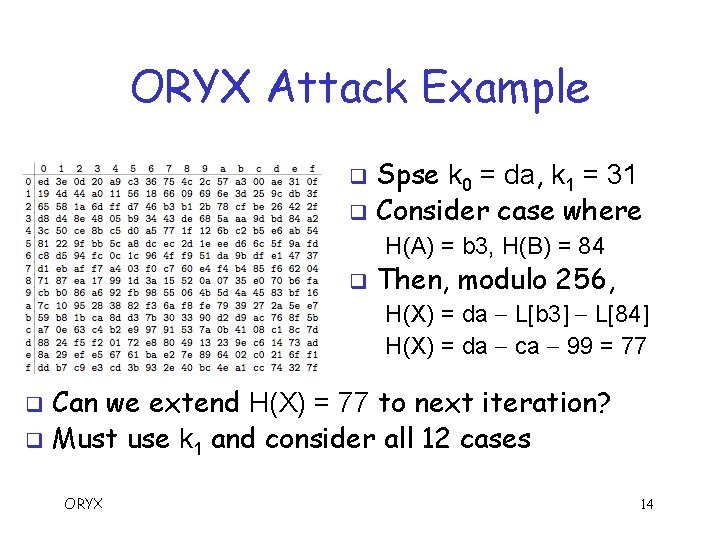
ORYX Attack Example Spse k 0 = da, k 1 = 31 q Consider case where q H(A) = b 3, H(B) = 84 q Then, modulo 256, H(X) = da L[b 3] L[84] H(X) = da ca 99 = 77 Can we extend H(X) = 77 to next iteration? q Must use k 1 and consider all 12 cases q ORYX 14
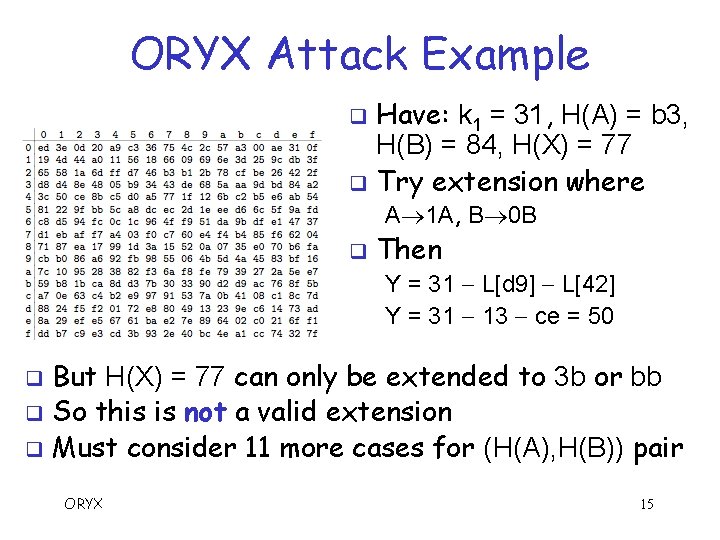
ORYX Attack Example Have: k 1 = 31, H(A) = b 3, H(B) = 84, H(X) = 77 q Try extension where q A 1 A, B 0 B q Then Y = 31 L[d 9] L[42] Y = 31 13 ce = 50 But H(X) = 77 can only be extended to 3 b or bb q So this is not a valid extension q Must consider 11 more cases for (H(A), H(B)) pair q ORYX 15
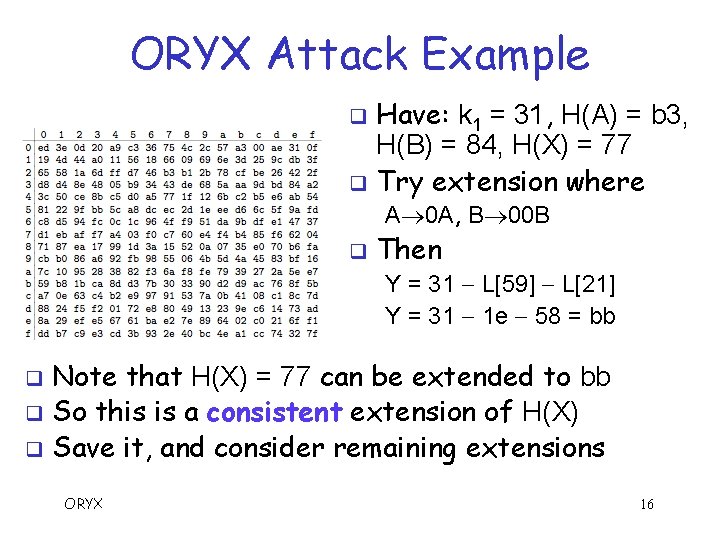
ORYX Attack Example Have: k 1 = 31, H(A) = b 3, H(B) = 84, H(X) = 77 q Try extension where q A 0 A, B 00 B q Then Y = 31 L[59] L[21] Y = 31 1 e 58 = bb Note that H(X) = 77 can be extended to bb q So this is a consistent extension of H(X) q Save it, and consider remaining extensions q ORYX 16
ORYX Attack q Attack algorithm o We have described a breadth first search o Depth-first search would work too q But is the attack practical? o Can we really determine correct initial fill? o How efficient is attack? o How much known plaintext is required? q We can easily answer these questions… ORYX 17
ORYX Attack q Guess all pairs of initial (H(A), H(B)) o There are 216 = 65536 of these o For each, use k 0 to solve for H(X) Have 216 putative triples (H(A), H(B), H(X)) q For each of these 65536 q o For each of 12 extensions of (H(A), H(B)), compute Y = k 1 L[H(A)] L[H(B)] mod 256 o Note that Y is putative extension of X o So, 7 bits of Y must agree with 7 bits from H(X) q Expect (12 65536) / 128 = 6144 survivors ORYX 18
ORYX Attack Expect 6144 survivors using k 1 q For each of these 6144, use k 2 and repeat the process… q o Compute 12 extensions of (H(A), H(B)) o New Y must agree with 7 bits of putative X (previous Y) o Expect (12 6144) / 128 = 576 survivors q Expected number of survivors decreases by factor greater that 10 at each step o Eventually, only 1 survivor is expected ORYX 19
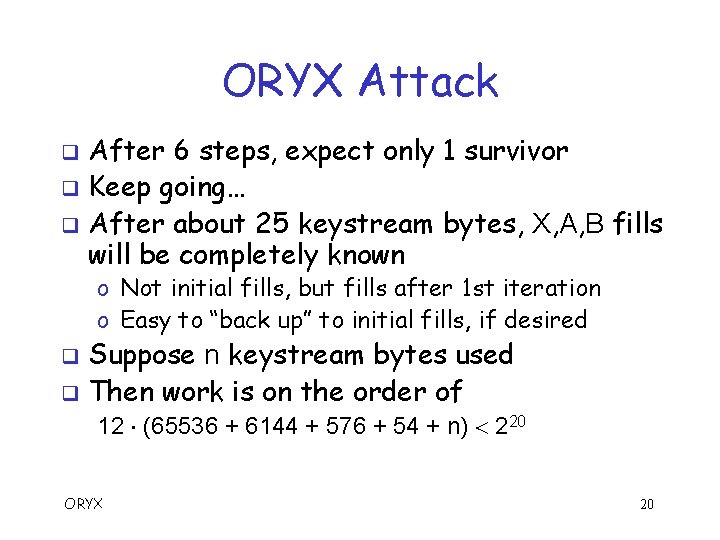
ORYX Attack After 6 steps, expect only 1 survivor q Keep going… q After about 25 keystream bytes, X, A, B fills will be completely known q o Not initial fills, but fills after 1 st iteration o Easy to “back up” to initial fills, if desired Suppose n keystream bytes used q Then work is on the order of q 12 (65536 + 6144 + 576 + 54 + n) 220 ORYX 20
ORYX q ORYX is very insecure o Work of about 220 to recover 96 -bit key! q What is the problem? o One iteration does not change internal state very much o Byte of keystream gives lots of info on state q Can it be improved? o Many alternatives… ORYX 21
![More Secure ORYX ? q ORYX does the following byte = H(X) + L[H(A)]](http://slidetodoc.com/presentation_image_h/33347faeaec9489bdd4a095ab1b89d5a/image-22.jpg "More Secure ORYX ? q ORYX does the following byte = H(X) + L[H(A)]")
More Secure ORYX ? q ORYX does the following byte = H(X) + L[H(A)] + L[H(B)] mod 256 q where H is high-order byte Could instead do bit = s(X) s(L[H(A)]) s(L[H(B)]) q q q where s selects the high-order bit of a byte Then previous attack does not work, since o Expect (12 216) / 1 = 219. 6 after k 1 o Expect (12 219. 6) / 1 = 223. 2 after k 2, etc. But this “secure” ORYX is very slow! And may be other attacks to worry about… ORYX 22
- Slides: 22