
Orthosis Evaluation Tammy J Le Sage MOT OTRL

- Slides: 55
Orthosis Evaluation Tammy J. Le. Sage MOT, OTR/L, CHT Elisabeth Mc. Gee DPT, MOT, OTR/L, PT, CHT, MTC
Orthotic Evaluation Interview, chart review and reports Injury/ surgery Hand dominance l Observation Hand posture/ use l Palpation l l Assessments for: Pain Skin and allergies Wounds Bone Joint/ Ligament Muscle/ Tendon Nerve/ Sensation Vascular ROM Function Reimbursement
Orthotic Classifications Tammy J. Le. Sage MOT, OTR, CHT Elisabeth Mc. Gee DPT, MOT, OTR/L, PT, CHT, MTC
Terminology l l Orthosis: is a noun and should be used in place of the word splint Orthoses: is a pleural noun and should be used to replace the term for multiple splints “Fabricating an orthosis” should be used in place of the verb splinting Orthotic: is an adjective and is used to describe a noun associated with the science of orthotics, such as orthotic device, orthotic treatment plan, orthotic intervention, orthotic fabrication, or orthotic coding
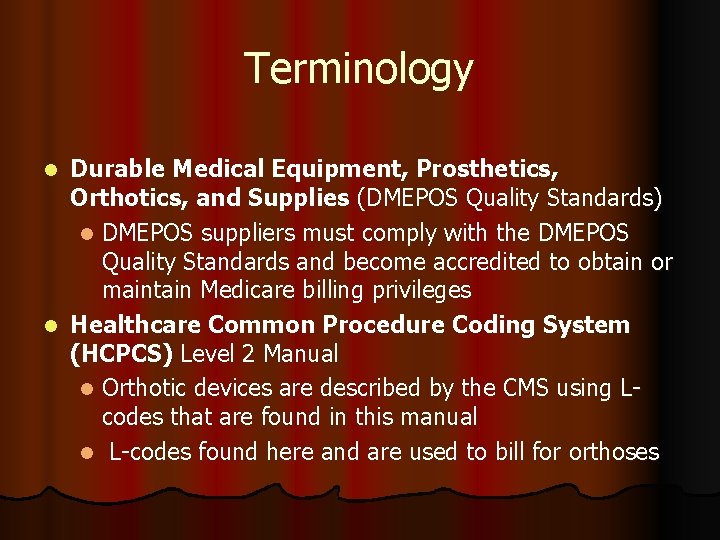
Terminology Durable Medical Equipment, Prosthetics, Orthotics, and Supplies (DMEPOS Quality Standards) l DMEPOS suppliers must comply with the DMEPOS Quality Standards and become accredited to obtain or maintain Medicare billing privileges l Healthcare Common Procedure Coding System (HCPCS) Level 2 Manual l Orthotic devices are described by the CMS using Lcodes that are found in this manual l L-codes found here and are used to bill for orthoses l
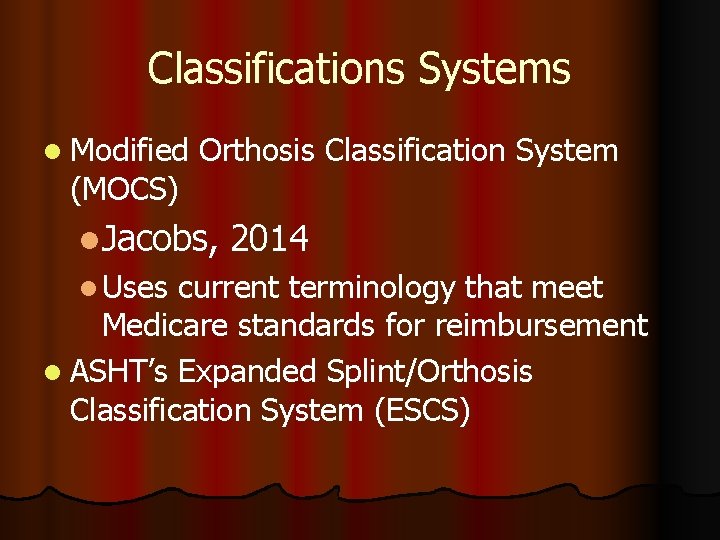
Classifications Systems l Modified (MOCS) Orthosis Classification System l. Jacobs, l Uses 2014 current terminology that meet Medicare standards for reimbursement l ASHT’s Expanded Splint/Orthosis Classification System (ESCS)
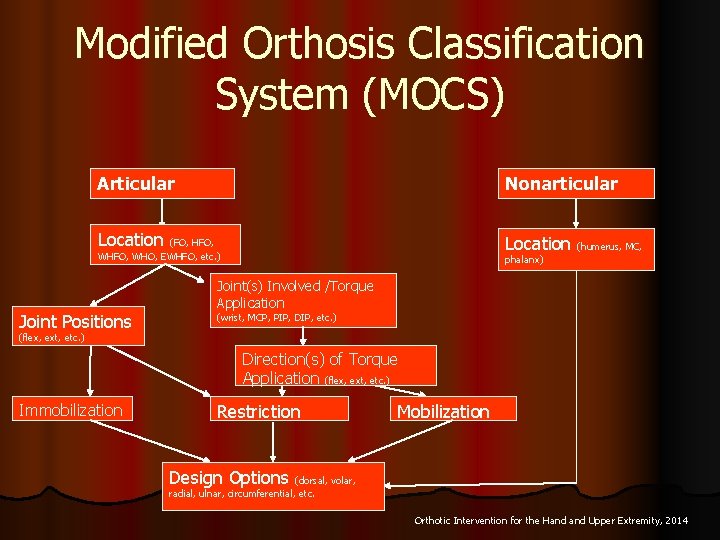
Modified Orthosis Classification System (MOCS) Articular Nonarticular Location (FO, HFO, WHO, EWHFO, etc. ) Joint Positions (humerus, MC, phalanx) Joint(s) Involved /Torque Application (wrist, MCP, PIP, DIP, etc. ) (flex, ext, etc. ) Direction(s) of Torque Application (flex, ext, etc. ) Immobilization Restriction Mobilization Design Options (dorsal, volar, radial, ulnar, circumferential, etc. Orthotic Intervention for the Hand Upper Extremity, 2014
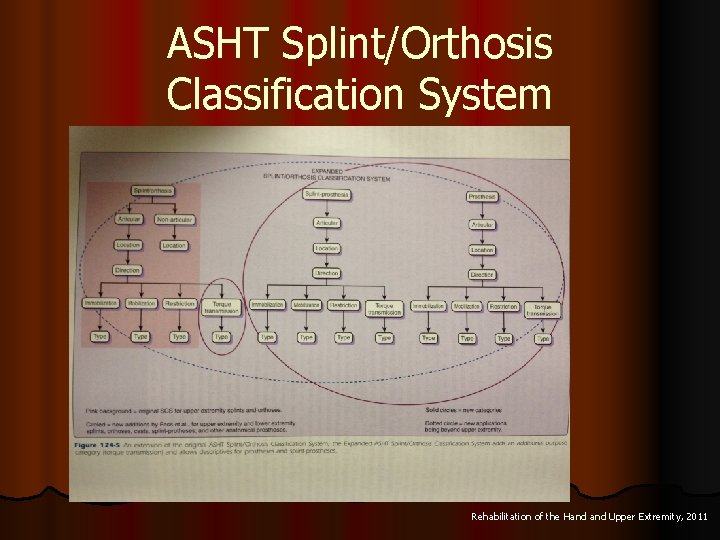
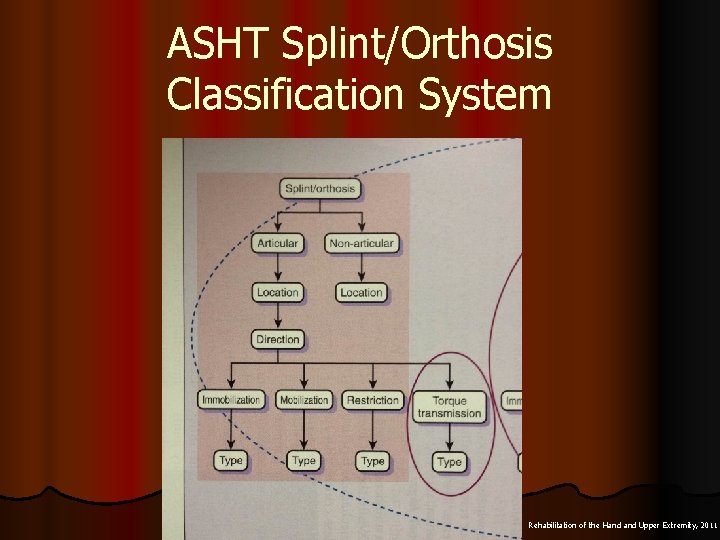
ASHT Splint/Orthosis Classification System Rehabilitation of the Hand Upper Extremity, 2011
ASHT Splint/Orthosis Classification System Rehabilitation of the Hand Upper Extremity, 2011
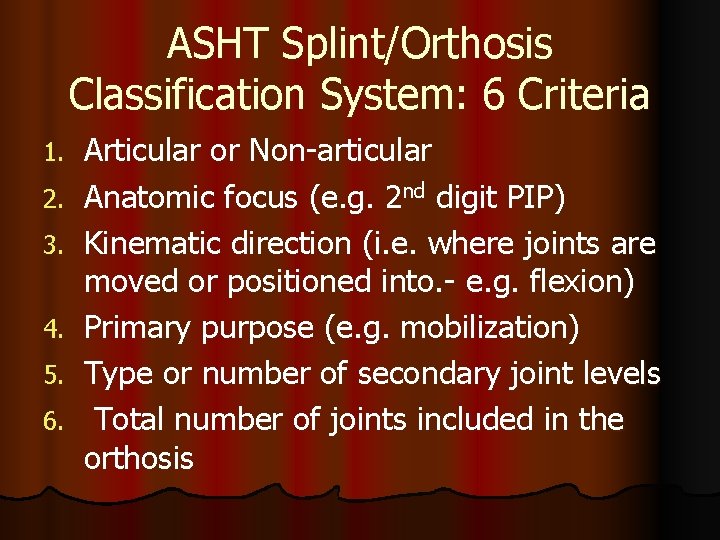
ASHT Splint/Orthosis Classification System: 6 Criteria 1. 2. 3. 4. 5. 6. Articular or Non-articular Anatomic focus (e. g. 2 nd digit PIP) Kinematic direction (i. e. where joints are moved or positioned into. - e. g. flexion) Primary purpose (e. g. mobilization) Type or number of secondary joint levels Total number of joints included in the orthosis
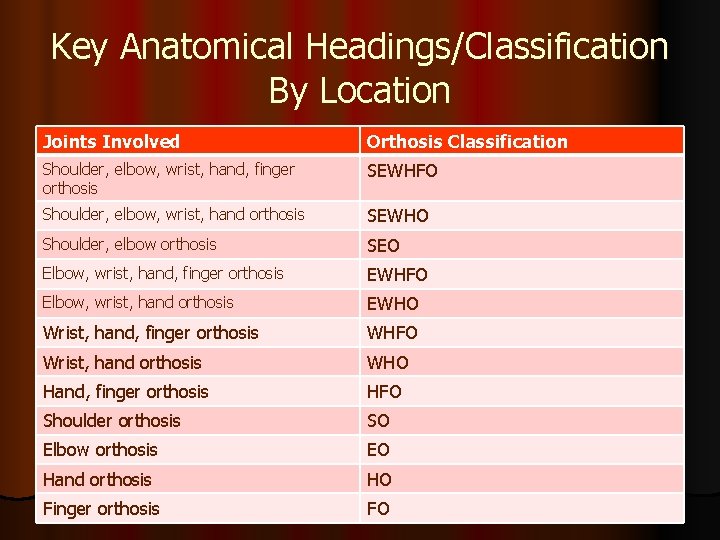
Key Anatomical Headings/Classification By Location Joints Involved Orthosis Classification Shoulder, elbow, wrist, hand, finger orthosis SEWHFO Shoulder, elbow, wrist, hand orthosis SEWHO Shoulder, elbow orthosis SEO Elbow, wrist, hand, finger orthosis EWHFO Elbow, wrist, hand orthosis EWHO Wrist, hand, finger orthosis WHFO Wrist, hand orthosis WHO Hand, finger orthosis HFO Shoulder orthosis SO Elbow orthosis EO Hand orthosis HO Finger orthosis FO
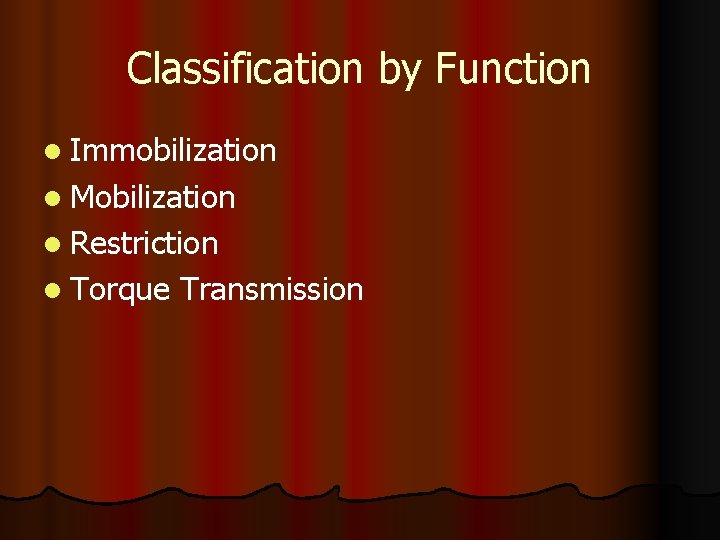
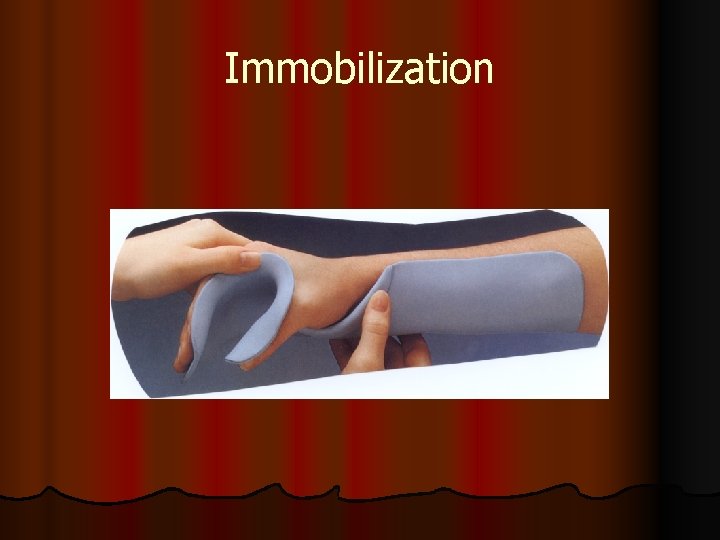
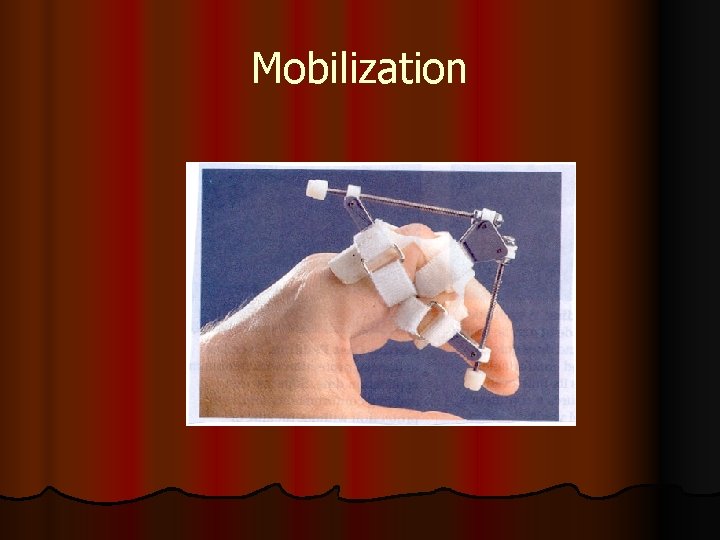
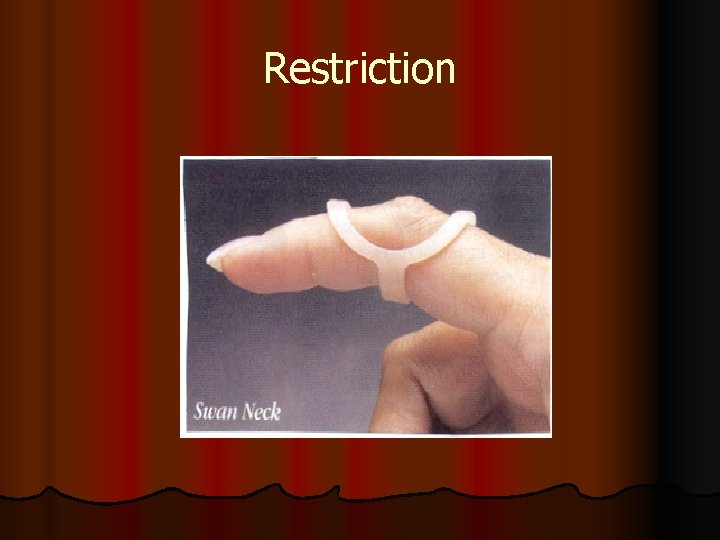
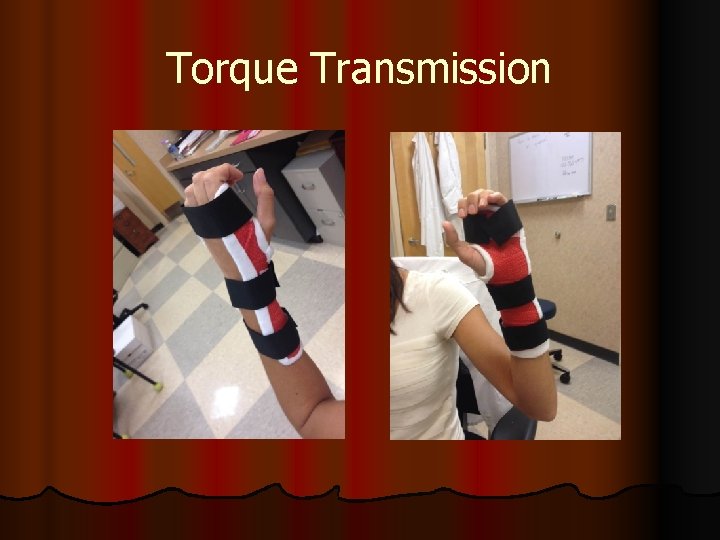
Classification by Function l Immobilization l Mobilization l Restriction l Torque Transmission
Immobilization
Mobilization
Restriction
Torque Transmission
Non-MOCS/SCS Nomenclature l Static Orthosis l Serial Static Orthosis l Dynamic Orthosis l Static Progressive Orthosis
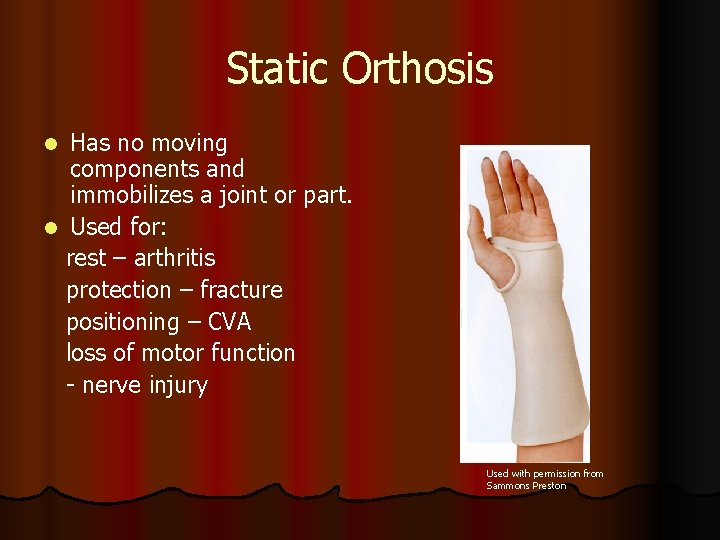
Static Orthosis Has no moving components and immobilizes a joint or part. l Used for: rest – arthritis protection – fracture positioning – CVA loss of motor function - nerve injury l Used with permission from Sammons Preston
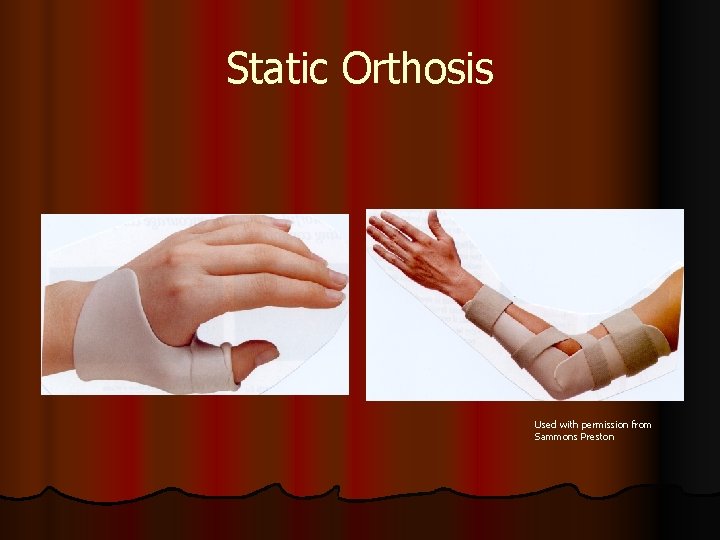
Static Orthosis Used with permission from Sammons Preston
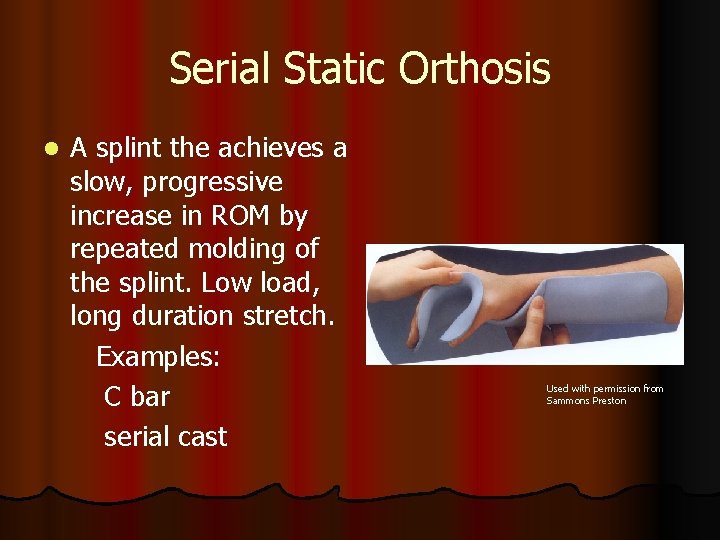
Serial Static Orthosis l A splint the achieves a slow, progressive increase in ROM by repeated molding of the splint. Low load, long duration stretch. Examples: C bar serial cast Used with permission from Sammons Preston
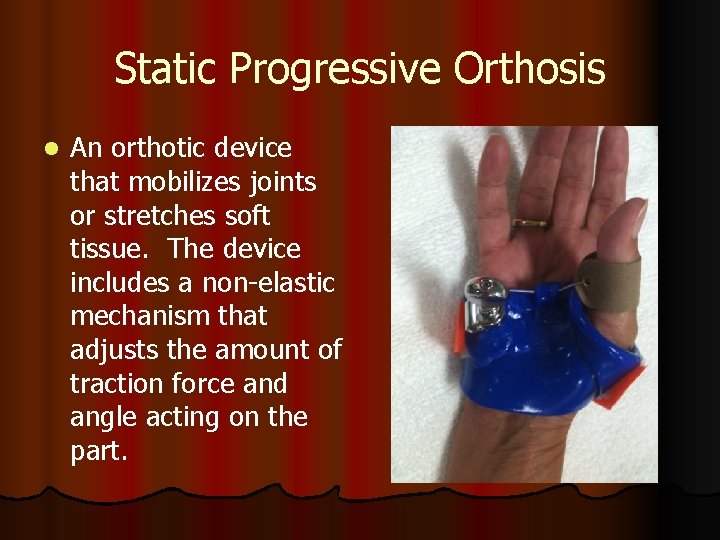
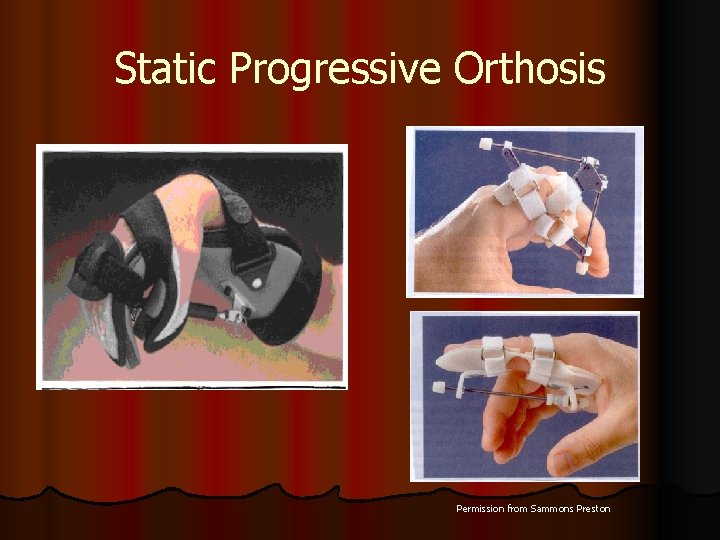
Static Progressive Orthosis l An orthotic device that mobilizes joints or stretches soft tissue. The device includes a non-elastic mechanism that adjusts the amount of traction force and angle acting on the part.
Static Progressive Orthosis Permission from Sammons Preston
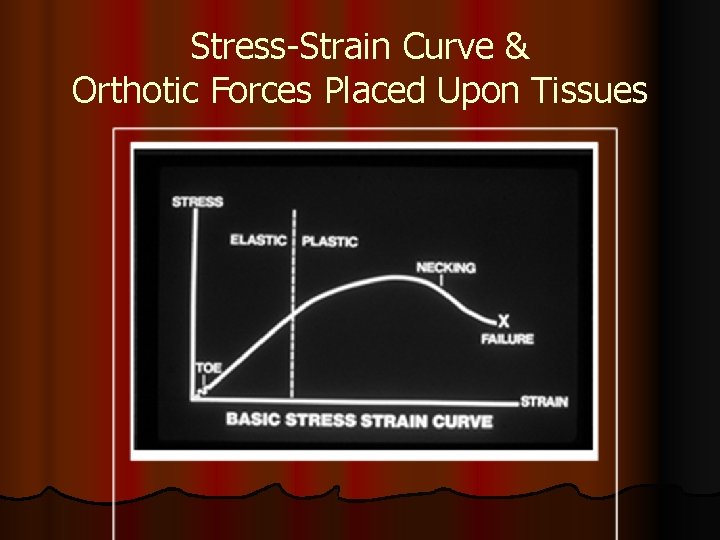
Stress-Strain Curve & Orthotic Forces Placed Upon Tissues
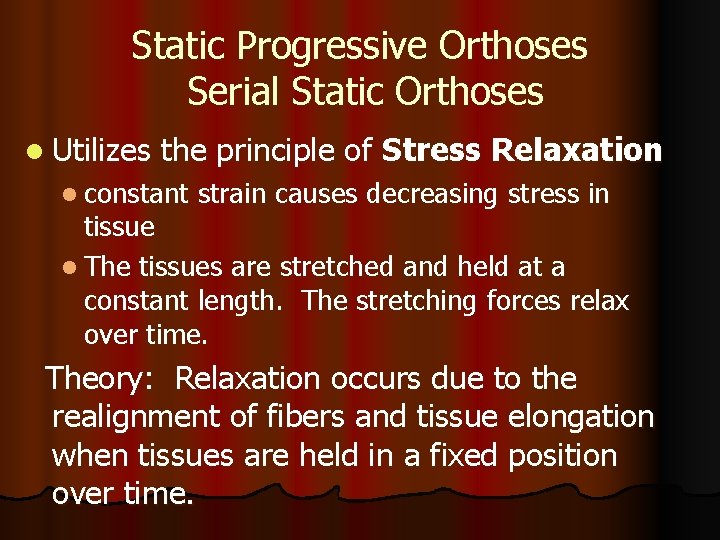
Static Progressive Orthoses Serial Static Orthoses l Utilizes the principle of Stress Relaxation l constant strain causes decreasing stress in tissue l The tissues are stretched and held at a constant length. The stretching forces relax over time. Theory: Relaxation occurs due to the realignment of fibers and tissue elongation when tissues are held in a fixed position over time.
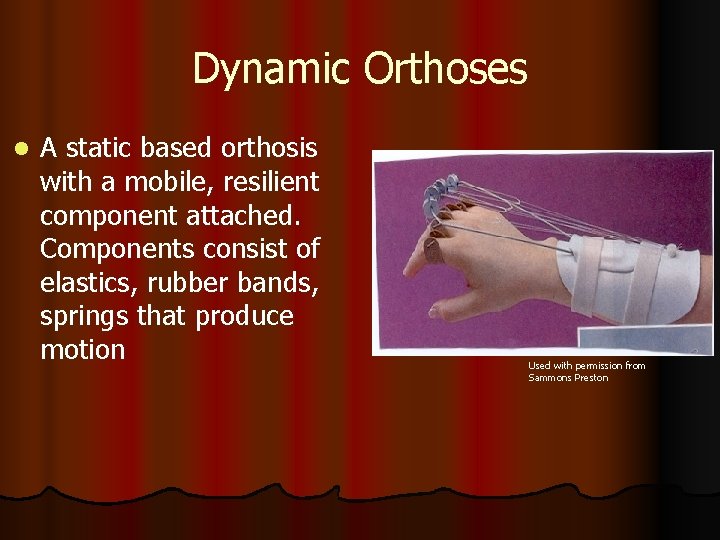
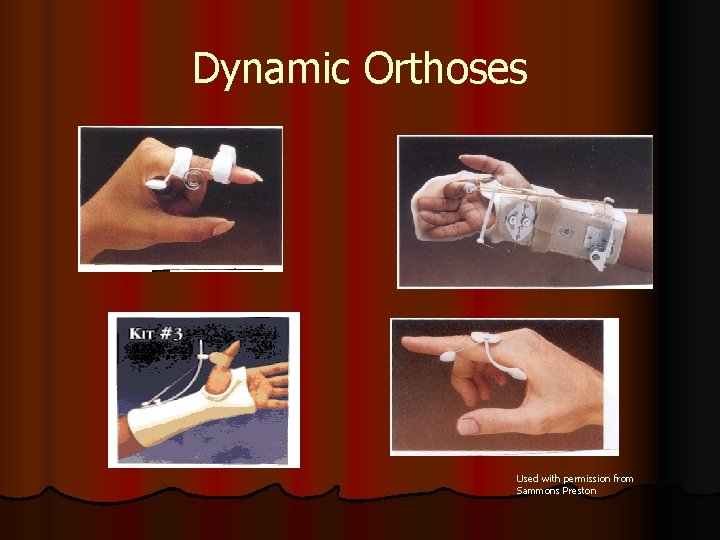
Dynamic Orthoses l A static based orthosis with a mobile, resilient component attached. Components consist of elastics, rubber bands, springs that produce motion Used with permission from Sammons Preston
Dynamic Orthoses Used with permission from Sammons Preston
Dynamic Orthoses l Principle of Creep lconstant stress causes increasing strain in tissue l. A constant load is applied for several hours during the day over a period of weeks or months. l. Low load, long duration stretch theory.
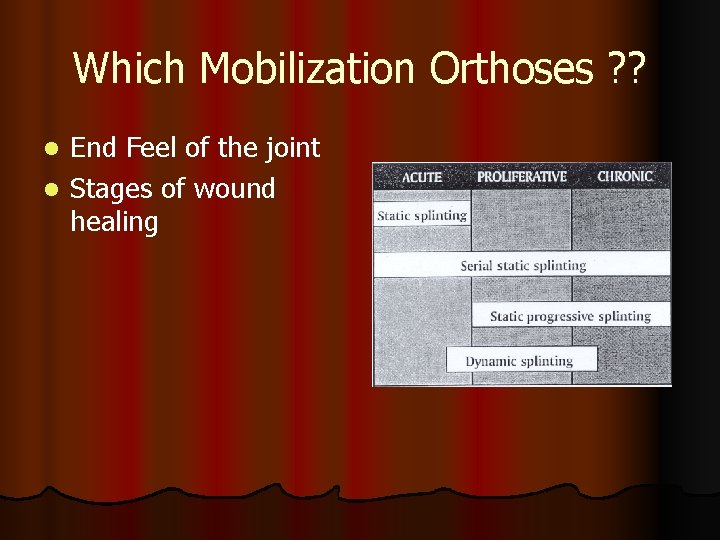
Which Mobilization Orthoses ? ? End Feel of the joint l Stages of wound healing l
How much force with Mobilization ? l Dr Brand’s theory: “Keeping the tissues at a physical state that demonstrates the need for change will stimulate the cells to multiply and make changes in response to the need. The more time in the orthosis, the more quickly the tissues will respond. ”
Classification by Design l Single surface design l Circumferential design l Forearm based, hand based, finger based
Single Surface Design Volar/ palmar l Dorsal l Radial half – radial gutter l Ulnar half – ulnar gutter l l Benefits: Support joints of flaccid muscles – CVA l Effective base for outriggers l Post operative orthotics – no pressure to areas, will damage repair. l
Single Surface Design l Dorsal Design l Advantages: Sensory surface exposed l Less distal migration l Best for extension outrigger l l Disadvantages: l Less muscular padding, more bony prominences
Single Surface Design l Volar Design l Advantages Natural padding (skin/ muscle) l Best for flexion outrigger l l Disadvantages l Tends to migrate distally with dynamic tension
Circumferential Design Covers all surfaces l Thinner material l Contour adds ridgity and strength Perforated material l Beneficial for: Immobilization painful joint l Protect soft tissue l Orthotic for activity – more comfort and control l Good design for serial static orthotics l Helps prevent migration l
Circumferential Design l Advantages Most stable l Least migration l l Disadvantages More complex design l More difficult for patient to apply l
Forearm Based Design l Advantages l Allows flexibility with adjusting dynamic or static progressive tension l Disadvantages l Bulkier and heavier to carry
Hand Based Design l Advantages Light weight, easier to carry l Less interference with UE function l l Disadvantages Difficult to fabricate l Inadequate length for dynamic tension device l
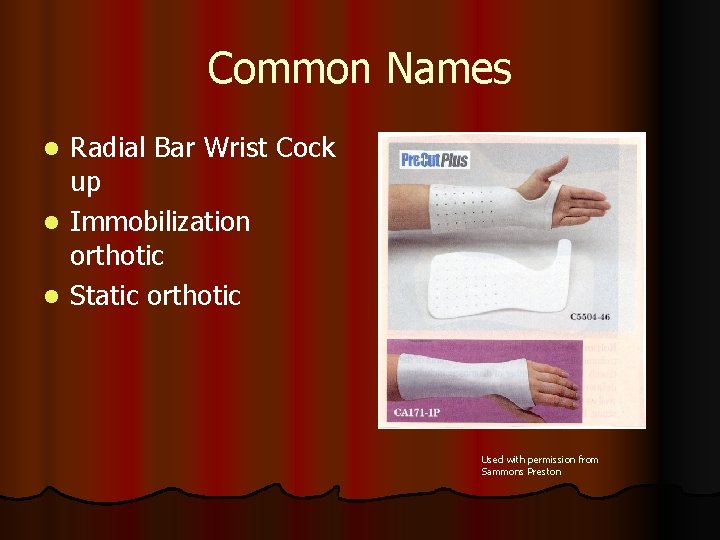
Common Names Radial Bar Wrist Cock up l Immobilization orthotic l Static orthotic l Used with permission from Sammons Preston
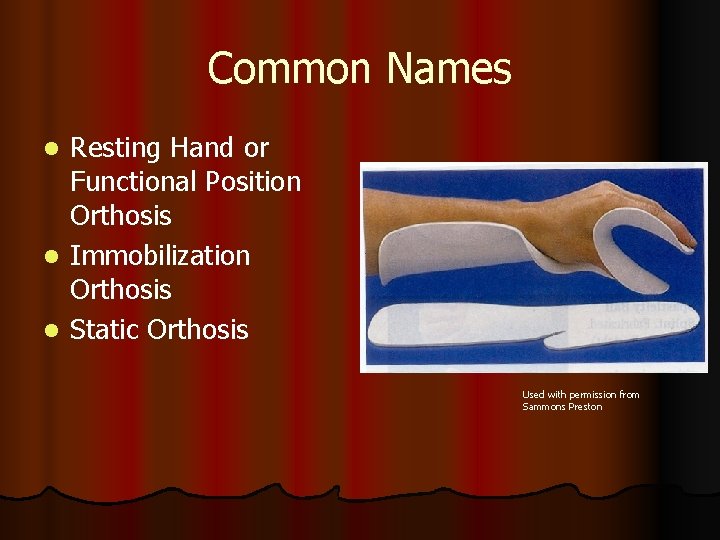
Common Names Resting Hand or Functional Position Orthosis l Immobilization Orthosis l Static Orthosis l Used with permission from Sammons Preston
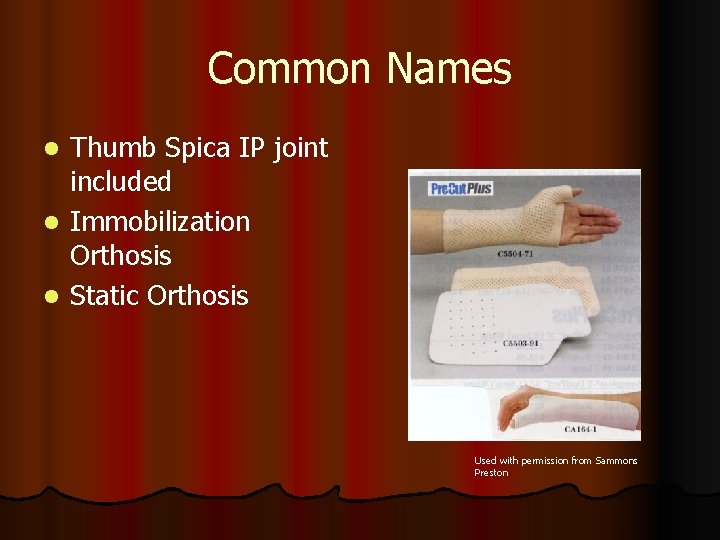
Common Names Thumb Spica IP joint included l Immobilization Orthosis l Static Orthosis l Used with permission from Sammons Preston
Biomechanical Principles Tammy Le. Sage MOT, OTR/L, CHT Elisabeth DPT, MOT, PT, OTR/L, CHT, MTC
Biomechanical Principles - Orthoses: Clinical Application Wider longer orthoses are more comfortable than short narrow orthoses. The length the forearm trough should be approximately 2/3 the length of the forearm. l Smoothed, flared or rolled edges on the proximal and distal aspect of an orthosis causes less pressure than do straight edges l You should attempt to maintain ½ the circumference of the thumb and forearm for a correct fit. l
Biomechanical Principles…. cont. Continuous uniform pressure over bony prominences is preferable to unequal pressure on a prominence. l Because some orthotic components must be narrow and the resultant force is great, a contiguous fit is paramount. l Wider straps and finger slings lower pressure applied to the underlying tissues. l Contour mechanically increases material strength l
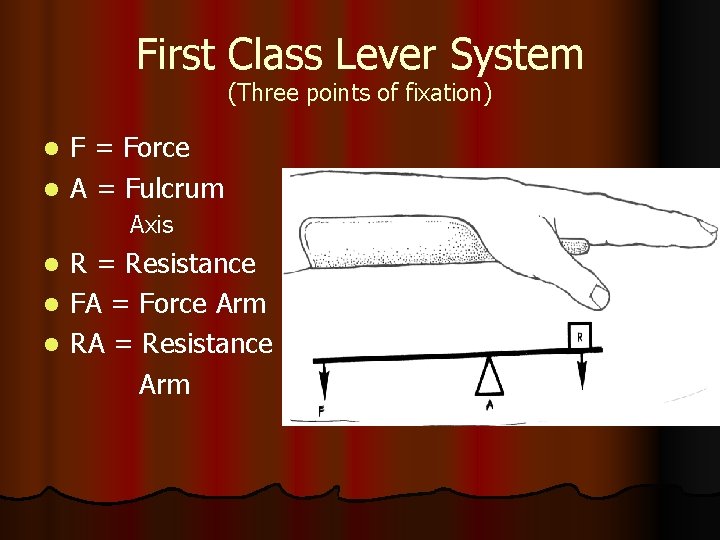
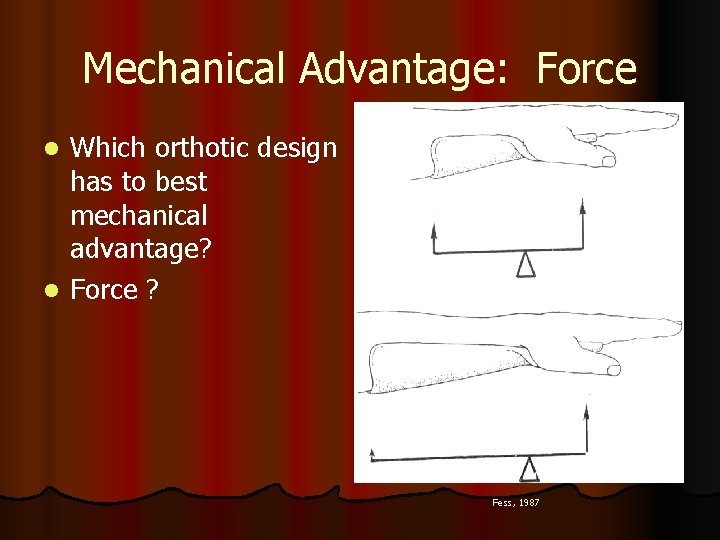
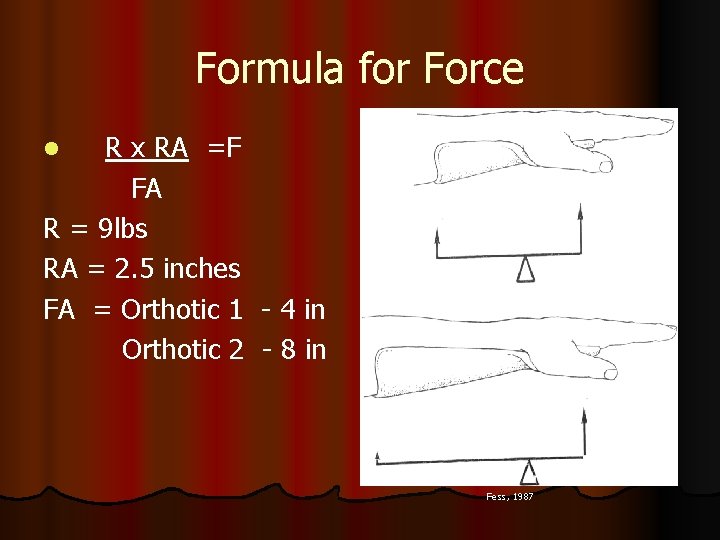
First Class Lever System (Three points of fixation) F = Force l A = Fulcrum l Axis R = Resistance l FA = Force Arm l RA = Resistance Arm l
Mechanical Advantage: Force Which orthotic design has to best mechanical advantage? l Force ? l Fess, 1987
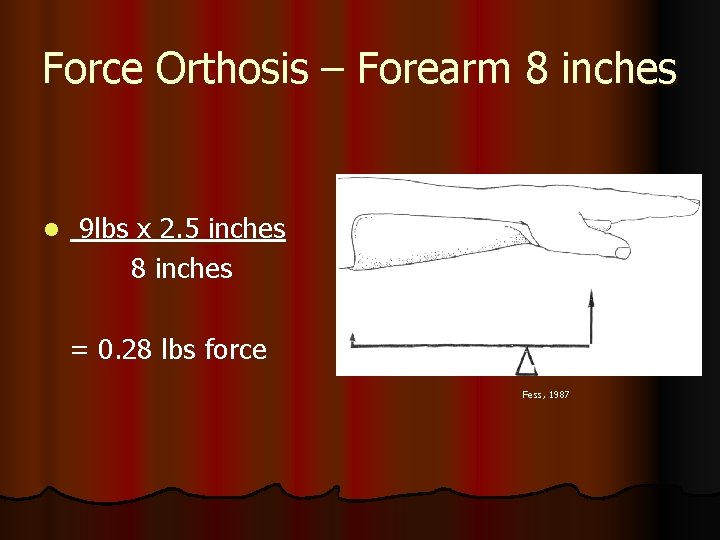
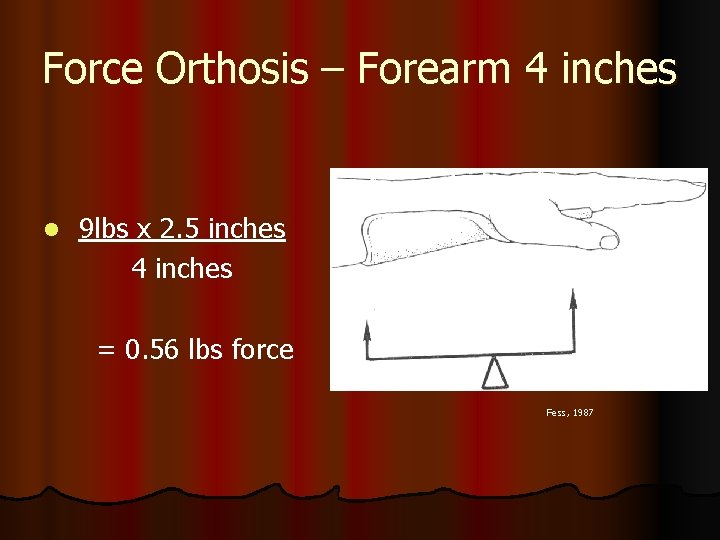
Formula for Force R x RA =F FA R = 9 lbs RA = 2. 5 inches FA = Orthotic 1 - 4 in Orthotic 2 - 8 in l Fess, 1987
Force Orthosis – Forearm 8 inches l 9 lbs x 2. 5 inches 8 inches = 0. 28 lbs force Fess, 1987
Force Orthosis – Forearm 4 inches l 9 lbs x 2. 5 inches 4 inches = 0. 56 lbs force Fess, 1987
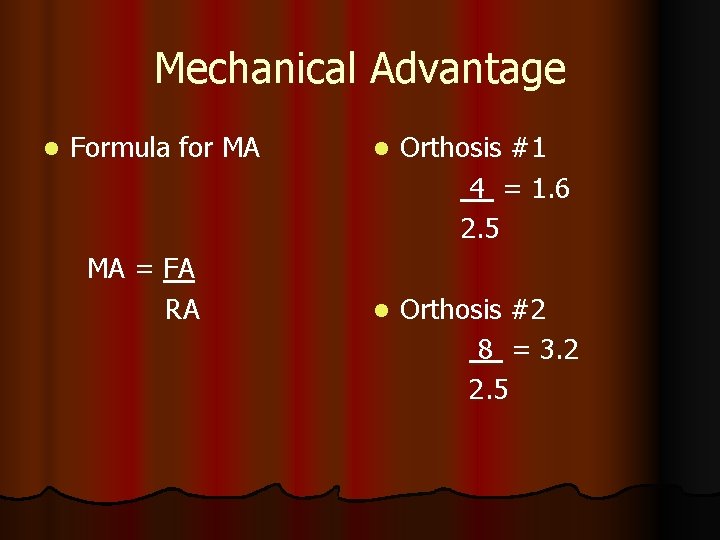
Mechanical Advantage l Formula for MA MA = FA RA l Orthosis #1 4 = 1. 6 2. 5 l Orthosis #2 8 = 3. 2 2. 5
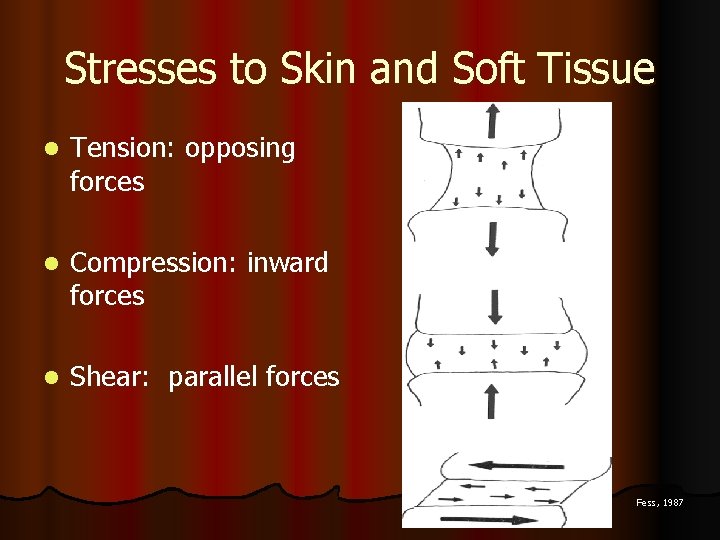
Stresses to Skin and Soft Tissue l Tension: opposing forces l Compression: inward forces l Shear: parallel forces Fess, 1987
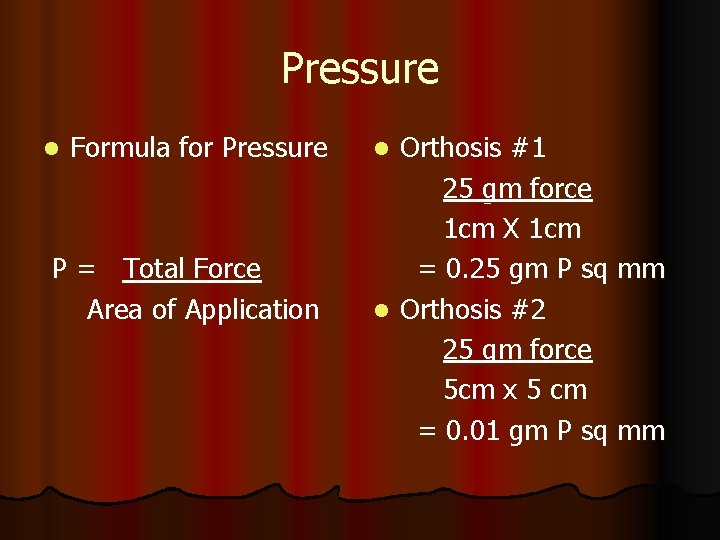
Pressure l Formula for Pressure P = Total Force Area of Application Orthosis #1 25 gm force 1 cm X 1 cm = 0. 25 gm P sq mm l Orthosis #2 25 gm force 5 cm x 5 cm = 0. 01 gm P sq mm l
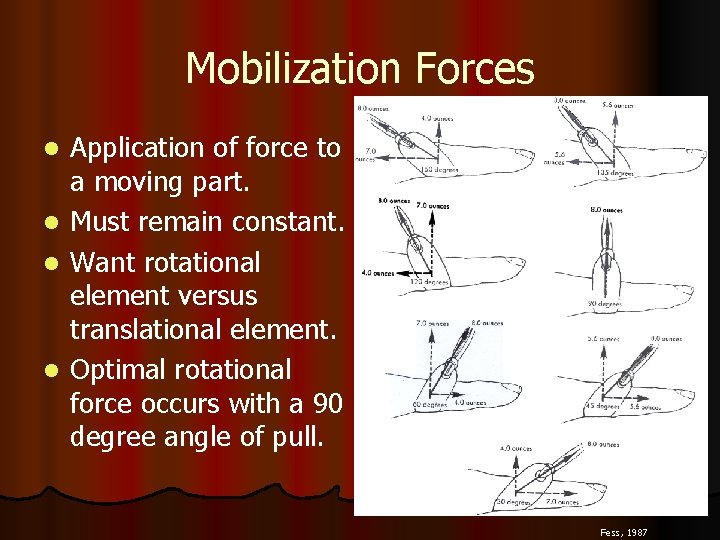
Mobilization Forces l l Application of force to a moving part. Must remain constant. Want rotational element versus translational element. Optimal rotational force occurs with a 90 degree angle of pull. Fess, 1987
Documentation l Important information to include in documentation when providing an orthotic device. Your thoughts? l Legal implications
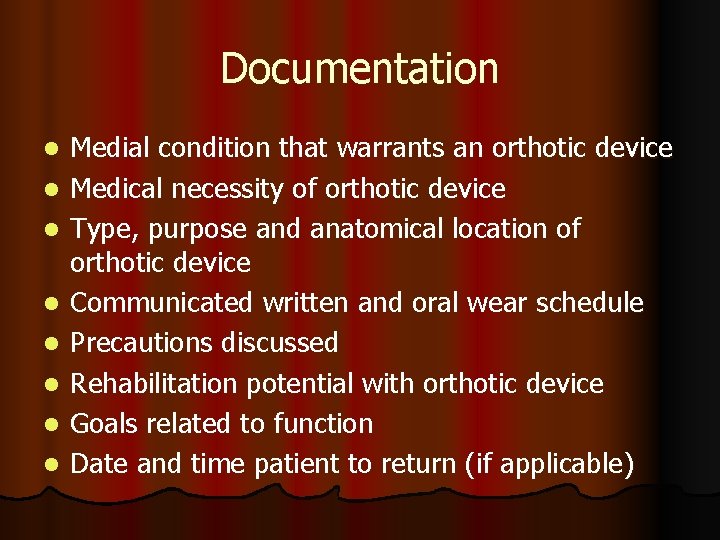
Documentation l l l l Medial condition that warrants an orthotic device Medical necessity of orthotic device Type, purpose and anatomical location of orthotic device Communicated written and oral wear schedule Precautions discussed Rehabilitation potential with orthotic device Goals related to function Date and time patient to return (if applicable)
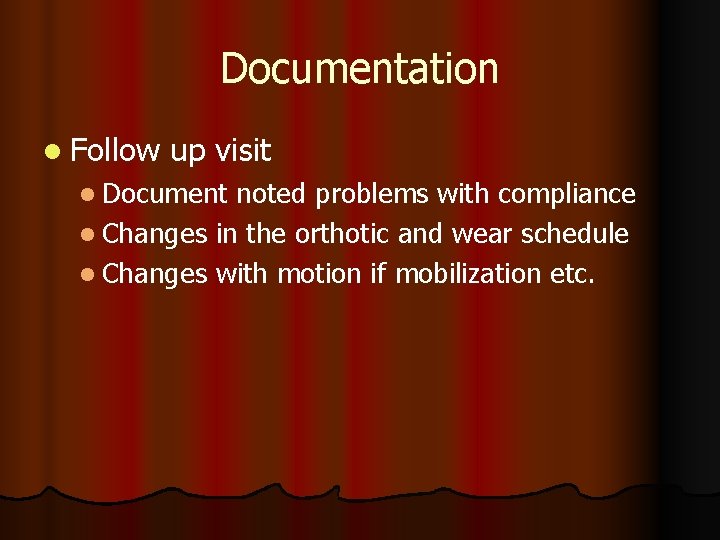
Documentation l Follow up visit l Document noted problems with compliance l Changes in the orthotic and wear schedule l Changes with motion if mobilization etc.