
Orthopedic limitations and Hand Injuries Ch 41 and

- Slides: 43
Orthopedic limitations and Hand Injuries Ch 41 and 42 in Trombly OT 624
Orthopedic Conditions • Caused by injuries, diseases and deformities of joints and related structures • Caused by trauma, cumulative trauma, or congenital anomaly • Rising incidence related to many competitive and recreational sports as well as increase in the elderly population and a concurrent home injuries and falls • Prevention= jt protection, positioning • Remediation= ROM, strength, nerve
Evaluation in OT • Assessment of roles • Controlled ROM w/in precautions • Non-resistive activities for 1 st 4 -6 wks. • Orthopedic protocol for specific condition/ specific physician • ID tasks that client is having difficulty with • Measure ROM early, strength later • Note skin color, sensation, pain level, edema
Intervention for fractures • Medical Treatment • Mobilization vs. Resting • Splint, Cast, Brace, • ORIF vs. External Fixator • Early mobility when possible • PROM, AAROM, AROM • Splinting • Scar tissue and wound management • Connective tissue work • Passive stretch, dynamic splinting, myofascial release
Shoulder Fx • Isometric exercises while immobilized moving toward isotonic ex • Pain control • Wall climbing • Codmans exercises • Scapular mobilization • Jt. Replacements- AAROM daily, skateboard, Pulley
Elbow Fx • Complication: Volkmann’s ischemia • Pale, bluish skin • Absence of radial pulse • Decreased hand sensation • Splinting 90 -100 degrees of flexion • Full ROM not always achieved
Forearm fractures • Radius or ulna short cast • AROM as soon as possible per MD protocol • Manage edema, pain, nerve damage
Hip fractures • Common in Older adults • ORIF (femur fx) vs. THR • Wt. Bearing status • NWB, TTWB, PWB, 50% WB, FWB • Precautions: • No extremes in flexion, adduction, IR/ER • Sleep w/abduction wedge • Use LH equip for reaching, dressing, bathing
Low Back Pain • Acute pain- proportional to physical findings • Chronic pain- lasts for months/ years • Results in personality changes • Disproportionate to physical problem • Goal to get people back to function, manage pain, reduce illness behavior, reduce disuse
Intervention for LBP • • • Positioning Adaptive equipment Reconditioning Strengthening Environmental modification Body mechanics
Body mechanics • Neutral pelvis, prop foot • Bend at the knees to lift, do half-kneel, squat or golfer’s lift • Avoid twisting, excessive bending or reaching • Sit to work if possible • Balance load
Hand Impairments Ch 42 in Trombly
Hand Therapy • Originated during WWII • Is done by OT/PT, nurses, orthopedics, Workman’s comp and voc specialists, PA • CHT-Certified Hand Therapist- Must have 5 years working with hands. Sit for national exam by ASHT • Though tx could focus on specific anatomic structures, the function is what’s important
Psychosocial factors • • • Adaptive responses Emotional factors Support systems Motivation Type of injury (e. g. traumatic vs. repetitive)
Hand Therapy Concepts • • • Tissue healing Antideformity positioning Attend to Pain PROM can be injurious Judicious use of heat Isolated exercise vs. purposeful activity vs. therapeutic occupation
Tissue Healing • Sequence: Inflammation, fibroplasia, maturation and remodeling • Vasoconstriction to vasodilation • WBC’s promote phagocytes removing dead tissue or foreign body
Interventions during tissue healing phases • Inflammation phase: rest is advised, edema management, pain control and positioning • Fibroplasia phase- starts at 4 days to 6 weeks. Formation of scar tissue. Begin AROM, Splint • Maturation phase-may last for years. Gentle resistive activity, avoid inflammation, dynamic or static splinting, scar tissue management
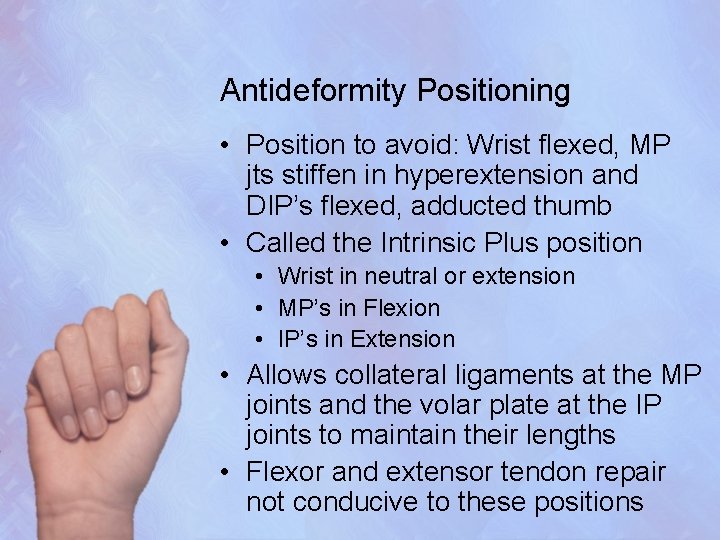
Antideformity Positioning • Position to avoid: Wrist flexed, MP jts stiffen in hyperextension and DIP’s flexed, adducted thumb • Called the Intrinsic Plus position • Wrist in neutral or extension • MP’s in Flexion • IP’s in Extension • Allows collateral ligaments at the MP joints and the volar plate at the IP joints to maintain their lengths • Flexor and extensor tendon repair not conducive to these positions
Attend to Pain • Myth of No-Pain, No Gain • Pain induced by therapy can cause CRPS or Complex regional pain syndrome • Watch for pt’s body language, face, • Use visual and verbal analog scales • Change treatment to a “hand’s off approach”
PROM • Can be injurious to delicate tissues in the hand • Can incite inflammation and trigger CRPS • Gentle and Pain-Free • Low load-long duration splinting may be more effective than PROM • Can cause inflammation if PROM is done after heat application
Judicious use of heat • Do not use on inflamed or edematous extremities • May degrade collagen and contribute to microscopic tears • Heat can have a rebound effect, with stiffening following its use • Use aerobic exercise to warm up tissue • Elevate the extremity in conjunction with heat • Monitor frequently for signs of inflammation
Exercise vs. Occupation • Isolate for discrete components that are involved • Integrate pt directed goals into hand therapy • Encourage use of UE in ADL’s • Purposeful activity- not only exercise, produces coordinated movement patterns in multiple planes, leads to better movement quality • Occupational as means instills OT’s heritage is a less function-oriented context…incorporate their occupations into therapy…. mechanics, crafts, homemaking, etc….
Evaluation in Hand Therapy • History • Injury, work and leisure interests, roles, Physician recommendations and precautions • Pain • • • Acute vs. chronic Intensity Type of pain Myofascial/ Trigger points vs. joint Analogs, draw on a body
Evaluation (continued) • Physical Exam • Observe, Cervical screening, posture, guarding, atrophy, edema • Wounds • Universal precautions • Stage, type, (red, yellow, black) • Red-revascularizing • Yellow-exuidate- needs cleansing and debreidment • Black-necrotic- needs debriedment
Evaluation (continued) • Types of Debriedment • Chemical (e. g. peroxide) • Manual (suture scissors, scrubbing) • Surgical (scrubbing under anesthesia (burns) • Scar Assessment • Hypertrophic • Tenodermodesis • Contracture- wound or scar crossing a joint • Mature- flat and softer and has neutral color, does not blanch to touch
Evaluation • Vascular Assessment • Cyanosis, erythemia, pallor, gangrene, grayish, blanching within 2 seconds of release of pressure • Edema • Circumferential measurement • Volumeter • Range of Motion • PROM, ROM • TAM or TROM
Evaluation (continued) • Grip and Pinch • 10 -15% difference in strength between dominant and nondominant hands • No relationship w/increase and increase function • Bell shaped curve • MMT • Sensibility • Dexterity and Hand function • • • Jebsen MMRT Box and Block Purdue Pegboard Nine Hole
Clinical Decision Making • • ADL and functional Implications Goals Quality of movement Structures • Joint vs. musculotendinous • Lag vs. contracture (extensor lag in spite of PROM available) • Intrinsic vs. extrinsic tightness (PROM of DIP vs. PIP) • Tightness of extrinsic extensors or extrinsic flexors
Interventions • Edema • Elevation • Compression • Manual edema mobilization (different than retrograde massage) • Lymphedema pumps
Intervention (continued) • Scar management • Compression • Silicone gel • Manual edema mobilization vs. friction massage • Tendon Gliding exercises (figure 42. 3) • Blocking exercises • Place and Hold • End feel and Splinting
Interventions • Splinting • Blocking • Buddy strapping • Dynamic vs. static
Common conditions • Stiff hand • Result of fracture • Decrease PROM/AROM if painful or swollen • Static splinting during acute inflammatory phase, dynamic when joint has a soft end feel • Tendonitis • • • More than half of occupational illnesses Tx= RICE Splinting @ night Gradual mobilization balanced w/rest Prevent reinjury though education
Types of Tendonitis • Lateral Epicondylitis • Proximal conditioning and scapular stabilizing • Built up handles • Splinting • Counterforce strap-reduces load on the tendon • Medial epicondylitis- Golfers elbow • Involves the FCR • Proximal conditioning, avoid end ranges, built up handles, and splinting as well as counterforce strap
Types of Tendonitis • De. Quervains Disease • APL and EPB at first dorsal compartment • Avoid wrist deviation (esp w/pinching) • Forearm thumb spica • Others (less common) • • Intersection syndrome EPL tendonitis ECU, FCR, FCU tendonitis Flexor Tendonsynovitis or trigger finger
Nerve Injuries • Median nerve compression- CTS • Steroid injection • Night splinting in neutral • Exercises for tendon gliding • Aerobic exercises • Proximal conditioning • Ergonomic modification • Postural training
Nerve Injuries (continued) • Cubital Tunnel Syndrome • Between the medial epicondyle and the olecranon • Ulnar nerve entrapment • Proximal and medial forearm pain • Radial Nerve Compression • Purely motor, inability to ext MP jts. • Can be entrapped at the supinator muscle • Nerve laceration • Surgical intervention w/protective splinting • Sensory re-ed • Reduction/prevention of a neuroma
Types of nerve injuries • Low median- OP and APB of thumb • Hi Median- FDP to IF and MF and DGS to all digits and pronation • Low ulnar- intrinsic loss= claw hand • Hi Ulnar- FDP of RF and SF and FDU • Low radial-MP ext is affected • Hi Radial-supinator, wrist and finger ext out
Fractures • Distal Radius fx- most common • Scaphoid- FOOSH, may accompany EPL and EPB stretching and ligamentous injury. Avascular necrosis is a risk. • Non Articular Hand Fx • Distal phalanx, Middle, Proximal, Metacarpal Fx (Fixation with wires, screws)
Ligament and Tendon Injuries • PIP joint sprain • Skier Thumb-collateral ligament of the thumb w/acute radial deviation • Flexor Tendon Injury • Zones of the hand • Passive Flexion-active extension protocol • Chow advocates early motion • Extensor Tendon Injury • Less common • 7 zones in the dorsum of the hand • In zones 3 and 4 can lead to boutonniere deformity • Tenolysis- surgical procedure to release tendon adhesion. Therapy begins a few hours after surgery
Complex Regional Pain Syndrome • CRPS- used to be called RSD • Type 1 - follows noxious event, pain, edema, abnormal skin color, pseudomotor activity • Type 2 -develops after a nerve injury • Pain is disproportionate to the injury • Four cardinal symptoms • Pain, swelling, stiffness, discoloration • Secondary symptoms • • • Osseous demineralization Sudomotor and temperature changes Trophic changes Vasomotor instability Palmar fascitis Pilomotor activity
Management of CRPS • Management of pain through medications, sympathetic blocks, modalities • Vaso motor challenge through stress loading (scrubbing) • change positions, temperature biofeedback, contrast, vibration, desensitization, water aerobics • Patient Directed therapy
Arthritis • Osteoarthritis or DJD • • Heberden’s nodes (@ DIP) Bouchard’s nodes at the PIP Thumb CMC arthroplasty is common TX includes splinting, pain mgmt, jt. Prot. • Rheumatoid (a systemic disease) • • Tx reduce inflammation Jt. Protection Splinting, Energy Conservation