
Orthonormal Basis Cartesian Coordinate System Unit vectors i
Orthonormal Basis • Cartesian Coordinate System – Unit vectors: i, j, k – Normalized to each other – Unique representation for each position!! – Convenient! • Works in general: – N dimension space • ANY N normalized orthogonal vectors will do!! – Infinite number of Cartesian coordinate systems in 3 D space!! • But we already know this
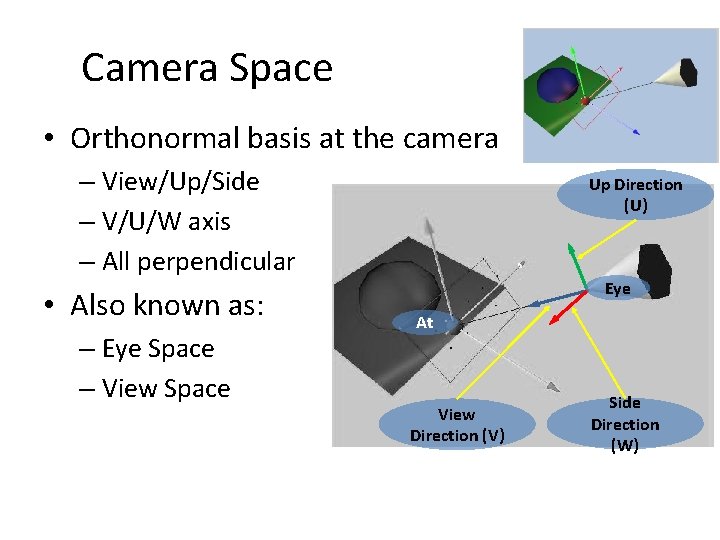
Camera Space • Orthonormal basis at the camera – View/Up/Side – V/U/W axis – All perpendicular • Also known as: – Eye Space – View Space Up Direction (U) Eye At View Direction (V) Side Direction (W)
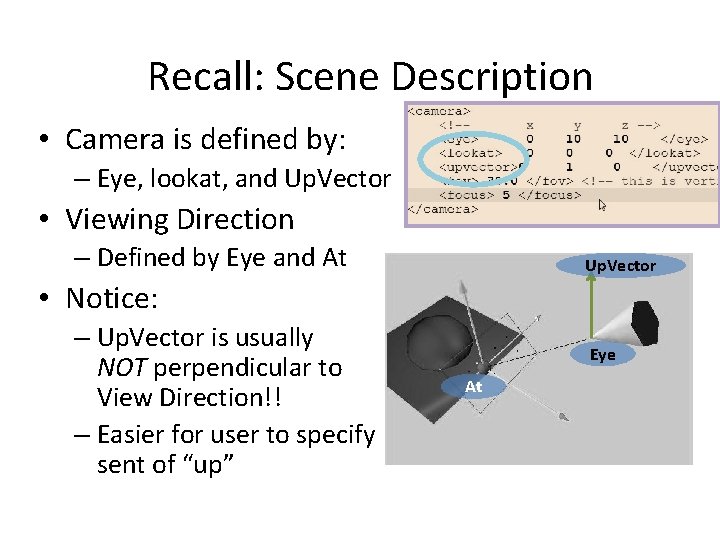
Recall: Scene Description • Camera is defined by: – Eye, lookat, and Up. Vector • Viewing Direction – Defined by Eye and At Up. Vector • Notice: – Up. Vector is usually NOT perpendicular to View Direction!! – Easier for user to specify sent of “up” Eye At
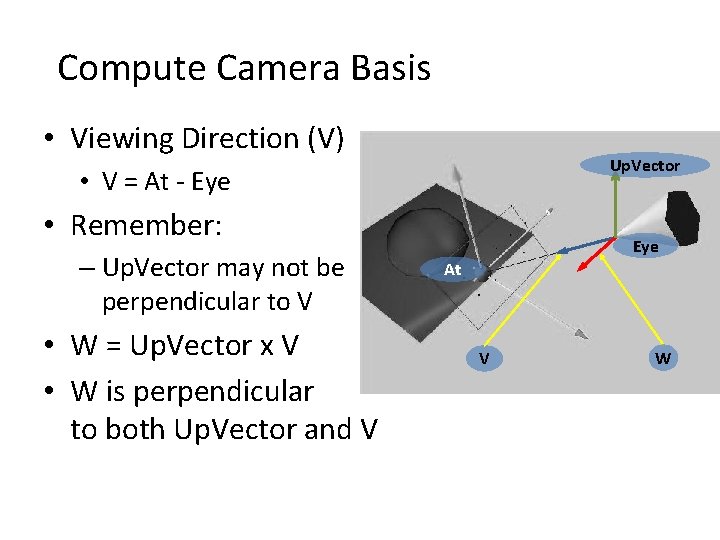
Compute Camera Basis • Viewing Direction (V) Up. Vector • V = At - Eye • Remember: – Up. Vector may not be perpendicular to V • W = Up. Vector x V • W is perpendicular to both Up. Vector and V Eye At V W
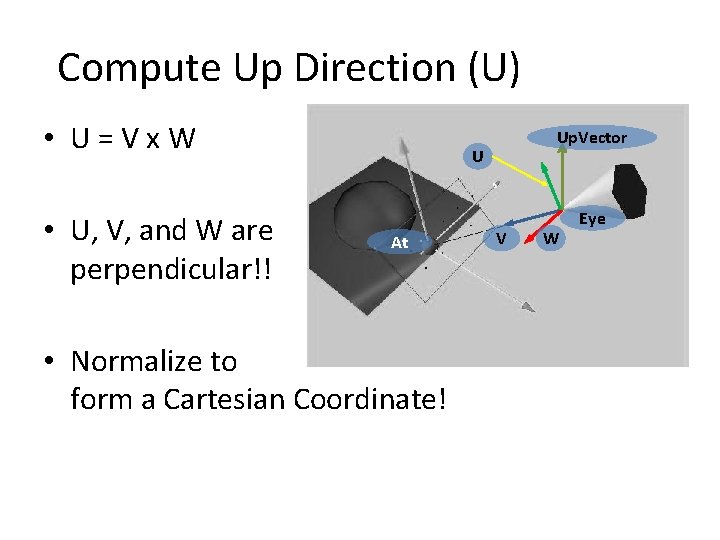
Compute Up Direction (U) • U=Vx. W • U, V, and W are perpendicular!! Up. Vector U At • Normalize to form a Cartesian Coordinate! V W Eye
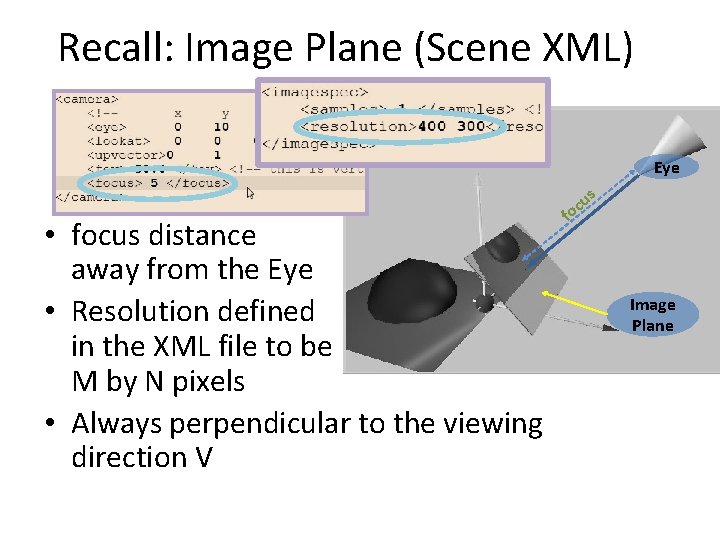
Recall: Image Plane (Scene XML) Eye s • focus distance away from the Eye • Resolution defined in the XML file to be M by N pixels • Always perpendicular to the viewing direction V cu o f Image Plane
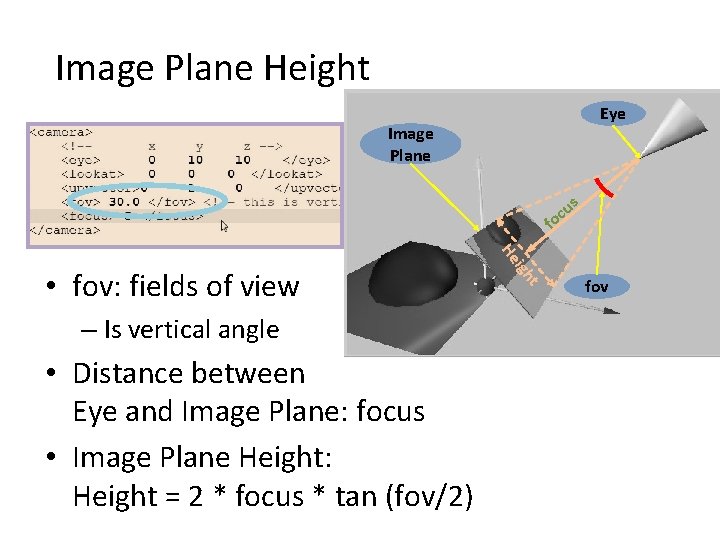
Image Plane Height Eye Image Plane s u oc f • Distance between Eye and Image Plane: focus • Image Plane Height: Height = 2 * focus * tan (fov/2) t – Is vertical angle igh He • fov: fields of view fov
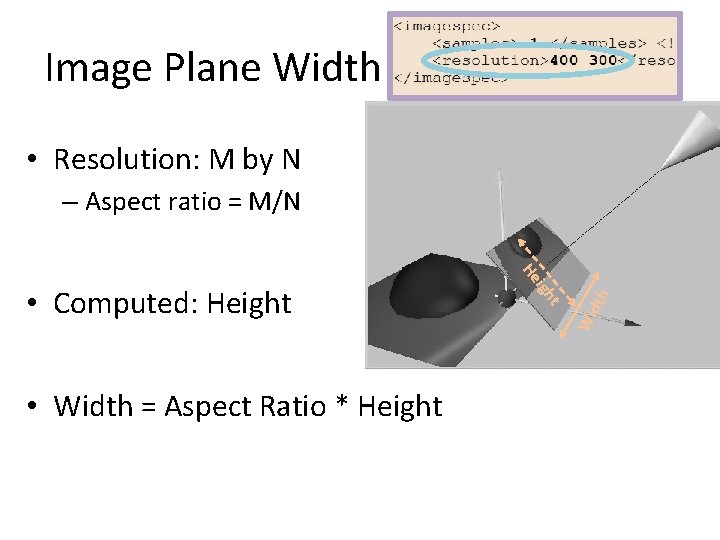
Image Plane Width • Resolution: M by N Wi ht • Width = Aspect Ratio * Height ig He • Computed: Height dth – Aspect ratio = M/N
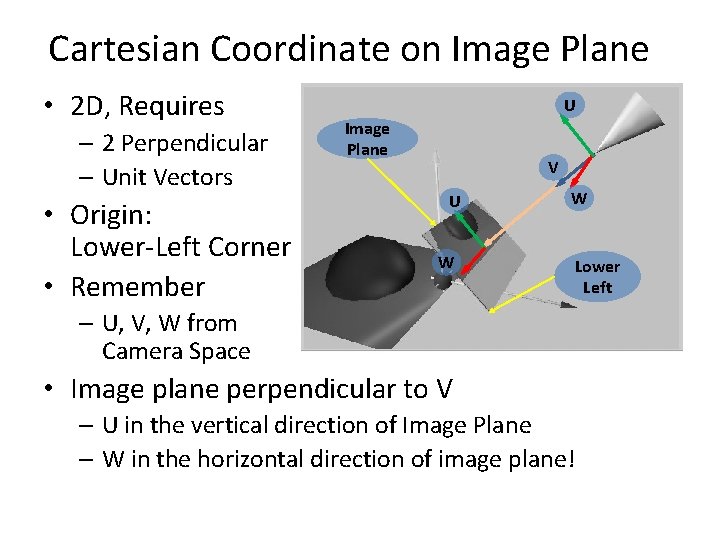
Cartesian Coordinate on Image Plane • 2 D, Requires – 2 Perpendicular – Unit Vectors • Origin: Lower-Left Corner • Remember U Image Plane V U W W Lower Left – U, V, W from Camera Space • Image plane perpendicular to V – U in the vertical direction of Image Plane – W in the horizontal direction of image plane!
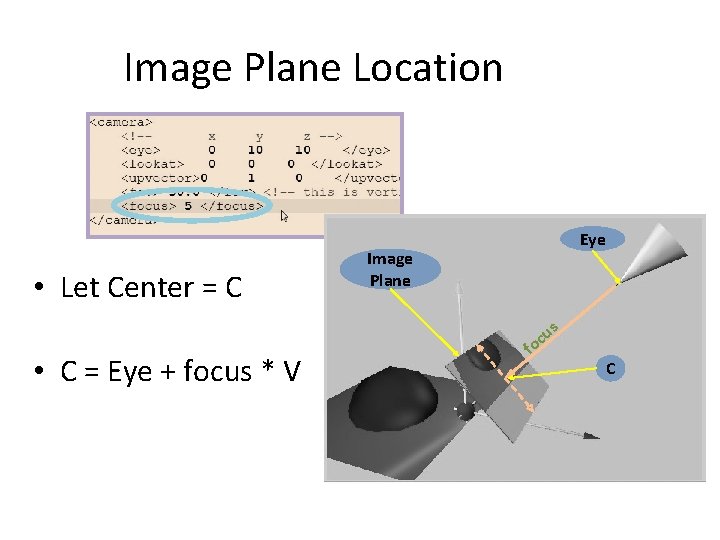
Image Plane Location • Let Center = C • C = Eye + focus * V Eye Image Plane s f u oc C
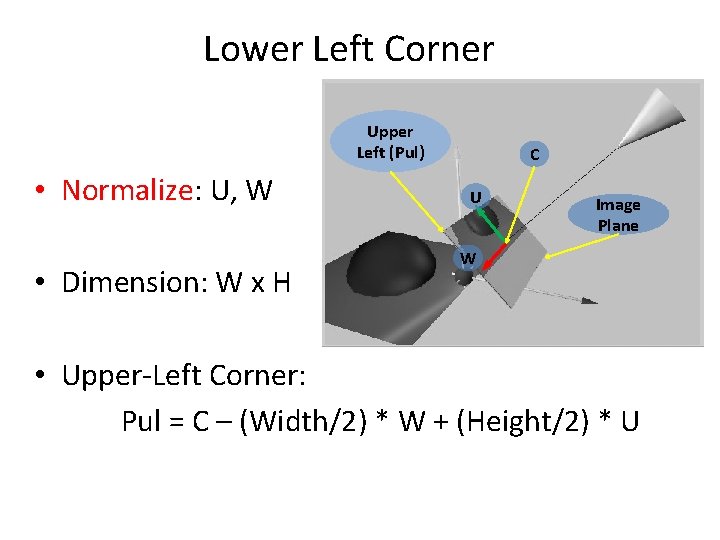
Lower Left Corner Upper Left (Pul) • Normalize: U, W • Dimension: W x H C U Image Plane W • Upper-Left Corner: Pul = C – (Width/2) * W + (Height/2) * U
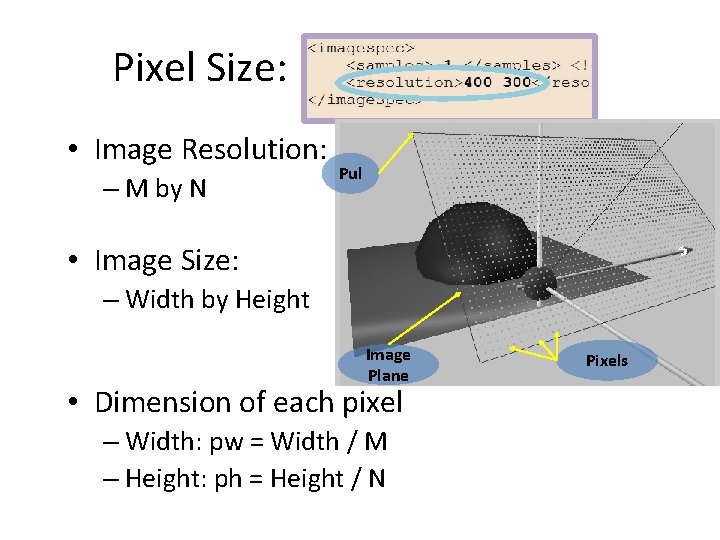
Pixel Size: • Image Resolution: – M by N Pul • Image Size: – Width by Height Image Plane • Dimension of each pixel – Width: pw = Width / M – Height: ph = Height / N Pixels
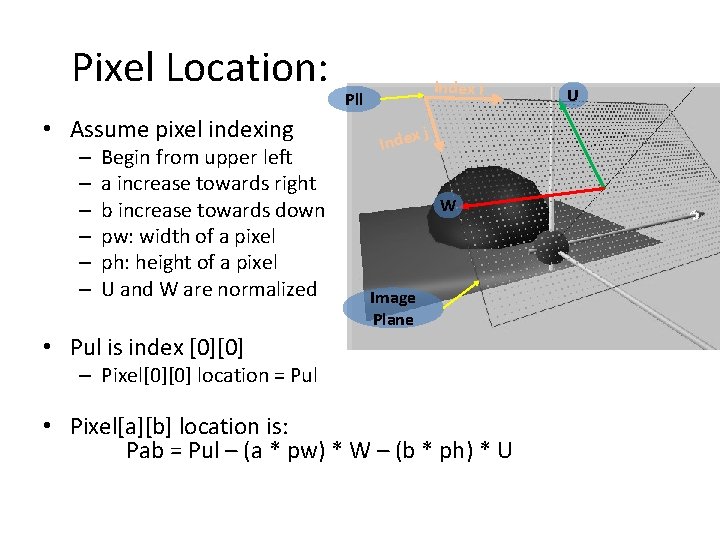
Pixel Location: • Assume pixel indexing – – – Begin from upper left a increase towards right b increase towards down pw: width of a pixel ph: height of a pixel U and W are normalized Index i Pll Index j W Image Plane • Pul is index [0][0] – Pixel[0][0] location = Pul • Pixel[a][b] location is: Pab = Pul – (a * pw) * W – (b * ph) * U U
Orthonormal Basis • What is an orthonormal basis in 3 D? • T/F: Given a 3 D room, there are four best unique orthonormal basis can we define, one at each of the corners.
Eye/Camera/View Space • How does a computer graphics user specify the eye space • In general when our users define the camera, can we expect the up vector to be perpendicular to the viewing direction? • By convention, X/Y/Z-axes are mapped to • Side vector is the cross product of: (order matters!!): • Up vector is the cross product of: (order matters!!):
- Slides: 15