
Orthogonal Frequency Division Multiplexing 1 Overview z Introduction
- Slides: 16
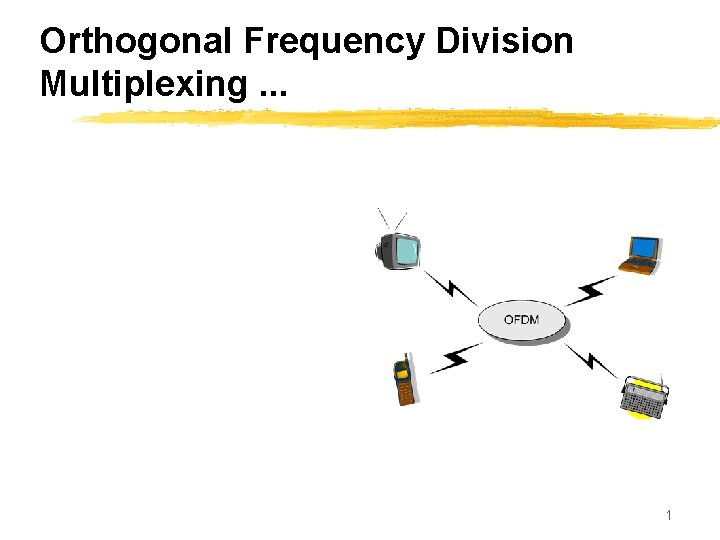
Orthogonal Frequency Division Multiplexing. . . 1
Overview. . . z Introduction about OFDM. z What is OFDM. z OFDM Mechanism. z Variation of OFDM. z Different Types of Multiplexing. z Applications of OFDM. z Advantages and Drawbacks z Conclusion. 2
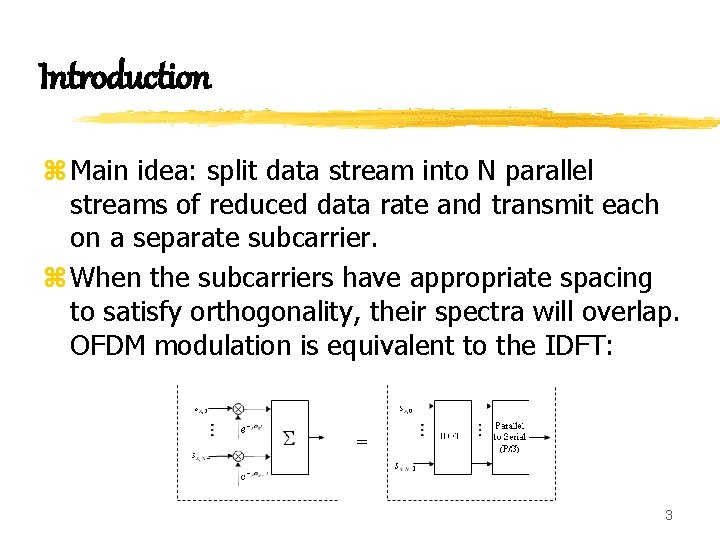
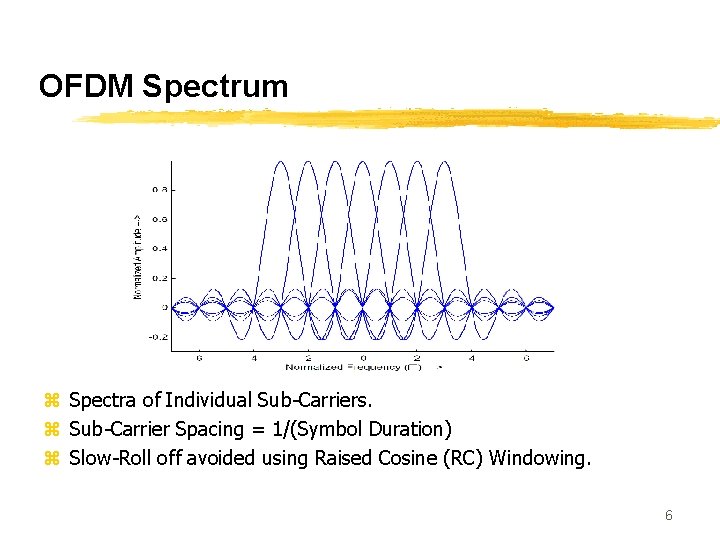
Introduction z Main idea: split data stream into N parallel streams of reduced data rate and transmit each on a separate subcarrier. z When the subcarriers have appropriate spacing to satisfy orthogonality, their spectra will overlap. OFDM modulation is equivalent to the IDFT: 3
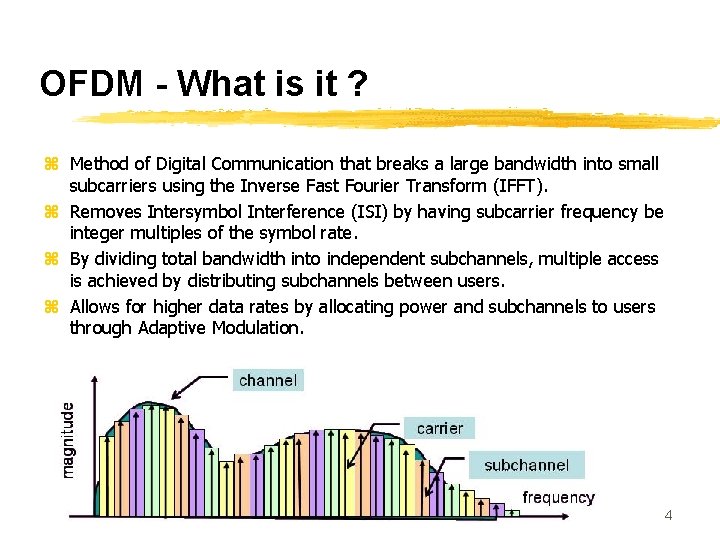
OFDM - What is it ? z Method of Digital Communication that breaks a large bandwidth into small subcarriers using the Inverse Fast Fourier Transform (IFFT). z Removes Intersymbol Interference (ISI) by having subcarrier frequency be integer multiples of the symbol rate. z By dividing total bandwidth into independent subchannels, multiple access is achieved by distributing subchannels between users. z Allows for higher data rates by allocating power and subchannels to users through Adaptive Modulation. 4
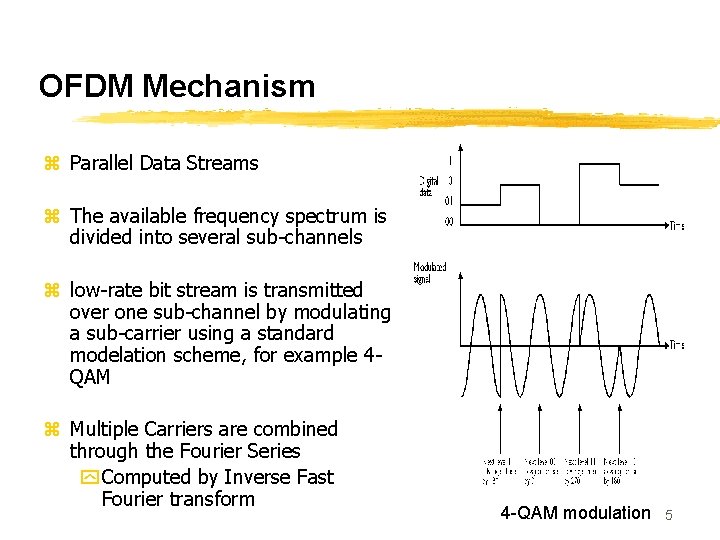
OFDM Mechanism z Parallel Data Streams z The available frequency spectrum is divided into several sub-channels z low-rate bit stream is transmitted over one sub-channel by modulating a sub-carrier using a standard modelation scheme, for example 4 QAM z Multiple Carriers are combined through the Fourier Series y Computed by Inverse Fast Fourier transform 4 -QAM modulation 5
OFDM Spectrum z Spectra of Individual Sub-Carriers. z Sub-Carrier Spacing = 1/(Symbol Duration) z Slow-Roll off avoided using Raised Cosine (RC) Windowing. 6
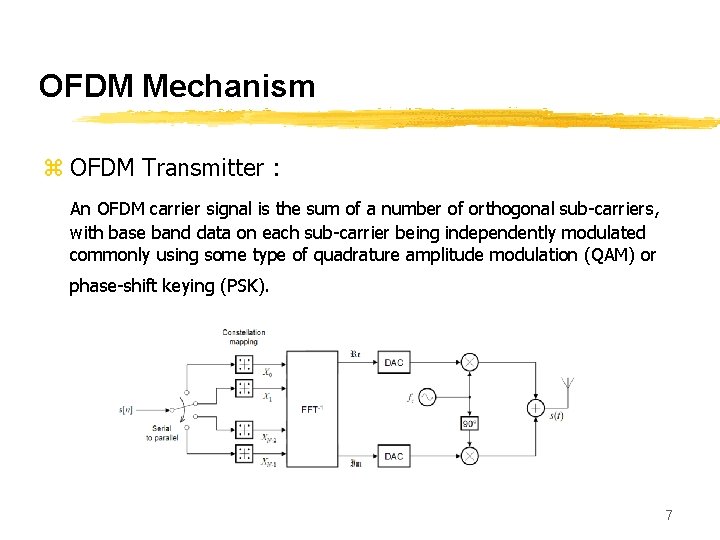
OFDM Mechanism z OFDM Transmitter : An OFDM carrier signal is the sum of a number of orthogonal sub-carriers, with base band data on each sub-carrier being independently modulated commonly using some type of quadrature amplitude modulation (QAM) or phase-shift keying (PSK). 7
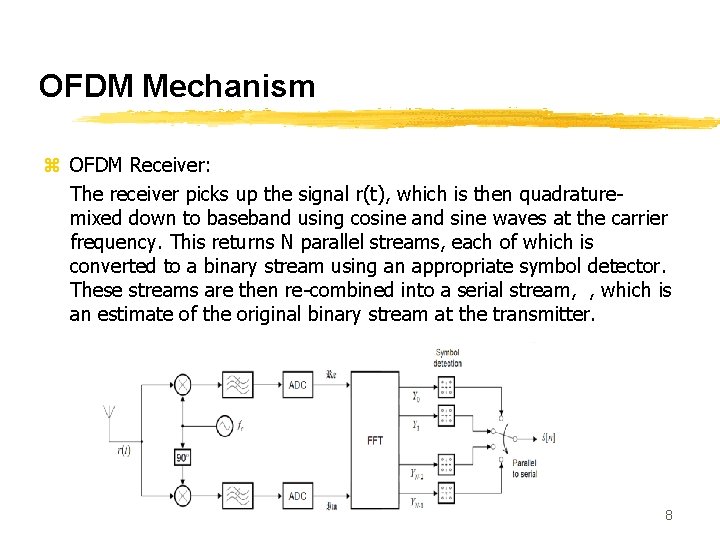
OFDM Mechanism z OFDM Receiver: The receiver picks up the signal r(t), which is then quadraturemixed down to baseband using cosine and sine waves at the carrier frequency. This returns N parallel streams, each of which is converted to a binary stream using an appropriate symbol detector. These streams are then re-combined into a serial stream, , which is an estimate of the original binary stream at the transmitter. 8
Variation of OFDM z MIMO-OFDM z VOFDM (Vector OFDM) z WOFDM - Wideband OFDM z Flash OFDM - Flarion (Lucent/Bell Labs spinoff) 9
Different types of Multiplexing z FDM frequency division multiplexing (FDM) is a technology that transmits multiple signals simultaneously over a single transmission path. z TDM (synchronous) Time-division multiplexing (TDM) is a method of putting multiple data streams in a single signal by separating the signal into many segments, each having a very short duration. z Wavelength-Division Multiplexing (WDM) technology which multiplexes multiple optical carrier signals on a single optical fibre by using different wavelengths (colours) of laser light to carry different signals. 10
OFDM Applications… z Digital Video Broadcasting z Digital Audio Broadcasting z ADSL z Wireless LANs z OFDMA -Multiple Access. 11
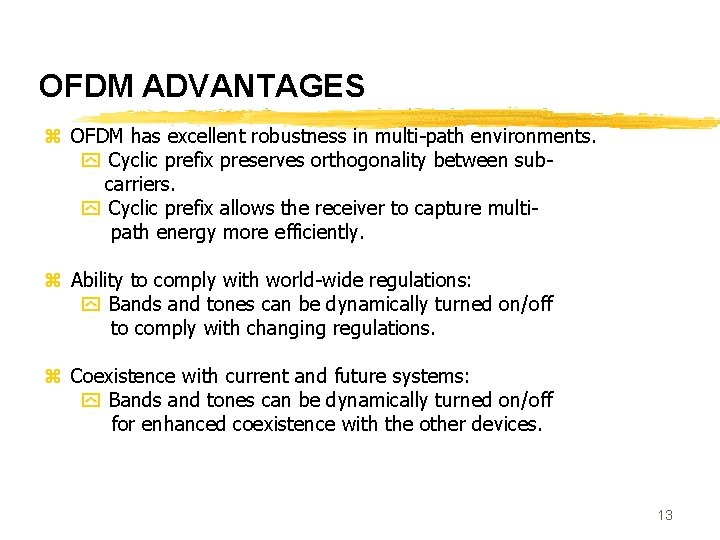
OFDM ADVANTAGES z OFDM is spectrally efficient y IFFT/FFT operation ensures that sub-carriers do not interfere with each other. z OFDM has an inherent robustness against narrowband interference. y Narrowband interference will affect at most a couple of subchannels. y Information from the affected subchannels can be erased and recovered via the forward error correction (FEC) codes. z Equalization is very simple compared to Single-Carrier systems 12
OFDM ADVANTAGES z OFDM has excellent robustness in multi-path environments. y Cyclic prefix preserves orthogonality between subcarriers. y Cyclic prefix allows the receiver to capture multipath energy more efficiently. z Ability to comply with world-wide regulations: y Bands and tones can be dynamically turned on/off to comply with changing regulations. z Coexistence with current and future systems: y Bands and tones can be dynamically turned on/off for enhanced coexistence with the other devices. 13
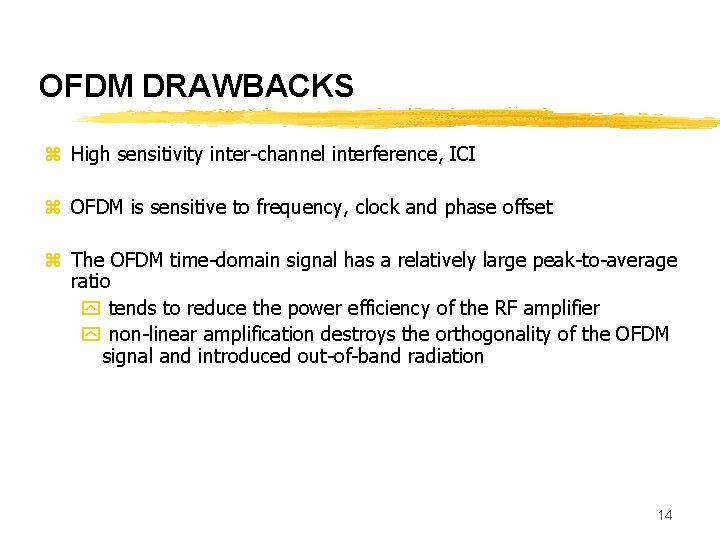
OFDM DRAWBACKS z High sensitivity inter-channel interference, ICI z OFDM is sensitive to frequency, clock and phase offset z The OFDM time-domain signal has a relatively large peak-to-average ratio y tends to reduce the power efficiency of the RF amplifier y non-linear amplification destroys the orthogonality of the OFDM signal and introduced out-of-band radiation 14
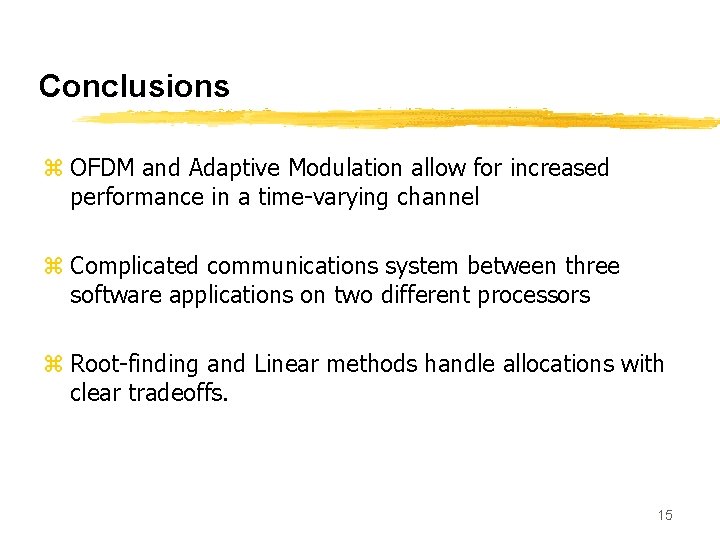
Conclusions z OFDM and Adaptive Modulation allow for increased performance in a time-varying channel z Complicated communications system between three software applications on two different processors z Root-finding and Linear methods handle allocations with clear tradeoffs. 15
Thank you for listening Any Questions? 16