
Orson Welles and Jeannette Nolan 1948 Macbeth Act
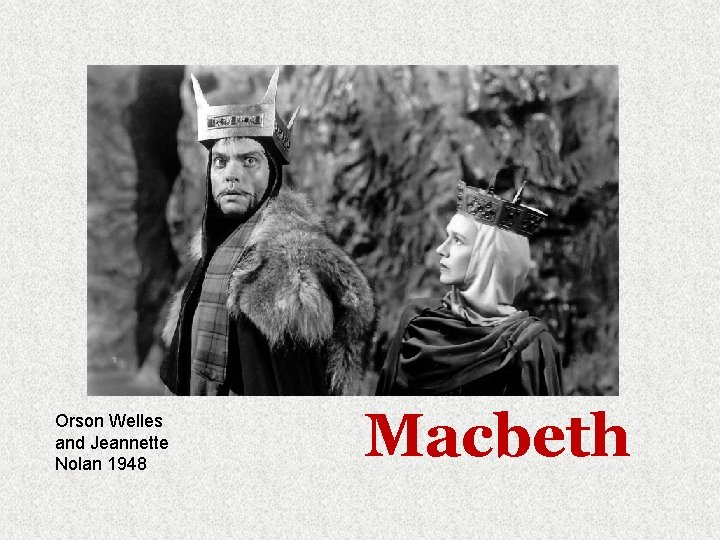
Orson Welles and Jeannette Nolan 1948 Macbeth
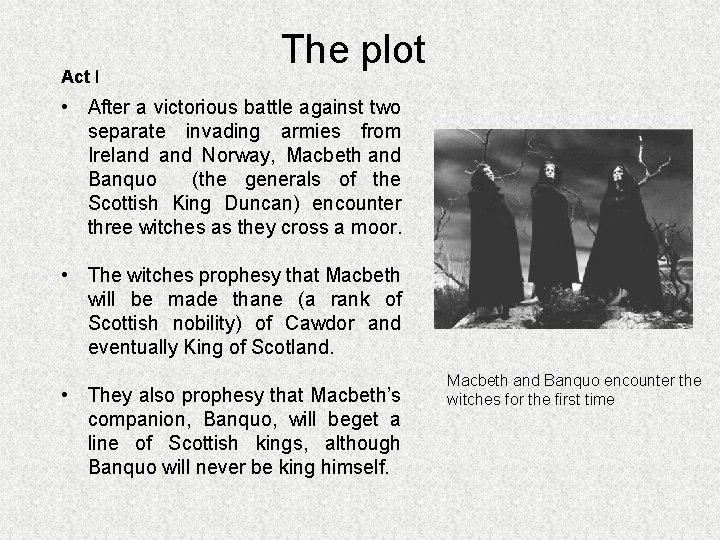
Act I The plot • After a victorious battle against two separate invading armies from Ireland Norway, Macbeth and Banquo (the generals of the Scottish King Duncan) encounter three witches as they cross a moor. • The witches prophesy that Macbeth will be made thane (a rank of Scottish nobility) of Cawdor and eventually King of Scotland. • They also prophesy that Macbeth’s companion, Banquo, will beget a line of Scottish kings, although Banquo will never be king himself. Macbeth and Banquo encounter the witches for the first time
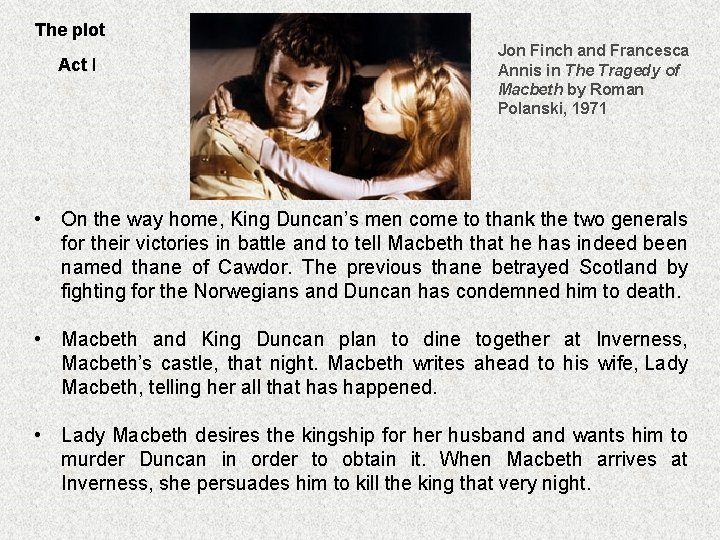
The plot Act I Jon Finch and Francesca Annis in The Tragedy of Macbeth by Roman Polanski, 1971 • On the way home, King Duncan’s men come to thank the two generals for their victories in battle and to tell Macbeth that he has indeed been named thane of Cawdor. The previous thane betrayed Scotland by fighting for the Norwegians and Duncan has condemned him to death. • Macbeth and King Duncan plan to dine together at Inverness, Macbeth’s castle, that night. Macbeth writes ahead to his wife, Lady Macbeth, telling her all that has happened. • Lady Macbeth desires the kingship for her husband wants him to murder Duncan in order to obtain it. When Macbeth arrives at Inverness, she persuades him to kill the king that very night.

The plot Act II • While Duncan is asleep, Macbeth stabs him, despite his doubts and a number of supernatural portents, including a vision of a bloody dagger. When Duncan’s death is discovered the next morning, Macbeth kills the chamberlains, after having planned with his wife to blame the murder on them, and easily assumes the kingship. • Duncan’s sons, Malcolm and Donalbain, flee to England Ireland, respectively, fearing that whoever killed Duncan desires their demise as well. Gabriele Lavia in Macbeth, 2009

The plot Act III Macbeth seeing the Ghost of Banquo (Johann Heinrich Füssli) • Fearful of the witches’ prophecy that Banquo’s heirs will seize throne, Macbeth hires a group of murderers to kill Banquo and his son Fleance on their way to a royal feast, but they fail to kill Fleance, who escapes into the night. At the feast that night, Banquo’s ghost visits Macbeth.
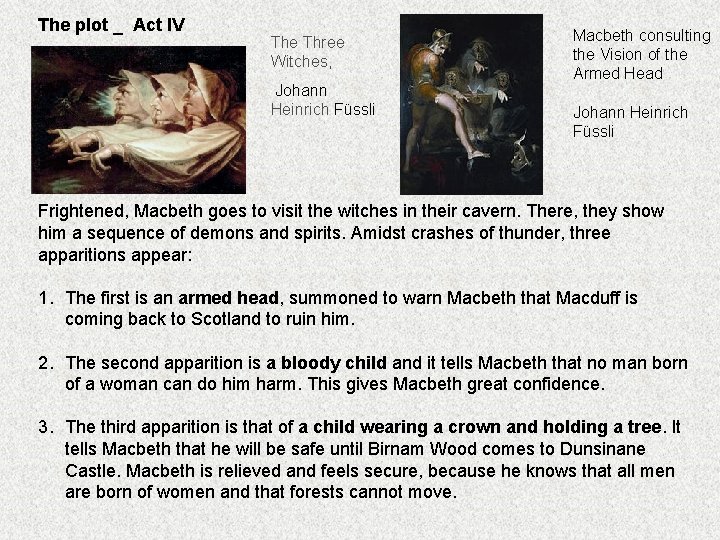
The plot _ Act IV The Three Witches, Johann Heinrich Füssli Macbeth consulting the Vision of the Armed Head Johann Heinrich Füssli Frightened, Macbeth goes to visit the witches in their cavern. There, they show him a sequence of demons and spirits. Amidst crashes of thunder, three apparitions appear: 1. The first is an armed head, summoned to warn Macbeth that Macduff is coming back to Scotland to ruin him. 2. The second apparition is a bloody child and it tells Macbeth that no man born of a woman can do him harm. This gives Macbeth great confidence. 3. The third apparition is that of a child wearing a crown and holding a tree. It tells Macbeth that he will be safe until Birnam Wood comes to Dunsinane Castle. Macbeth is relieved and feels secure, because he knows that all men are born of women and that forests cannot move.

The plot Act IV • When he learns that Macduff has fled to England to join Malcolm, Macbeth orders that Macduff’s castle be seized and, most cruelly, that Lady Macduff and her children be murdered. • When news of his family’s execution reaches Macduff in England, he is stricken with grief and vows revenge. Prince Malcolm, Duncan’s son, has succeeded in raising an army in England, and Macduff joins him as he rides to Scotland to challenge Macbeth’s forces. • The invasion has the support of the Scottish nobles, who are frightened by Macbeth’s tyrannical and murderous behaviour. Gabriele Lavia in Macbeth, 2009
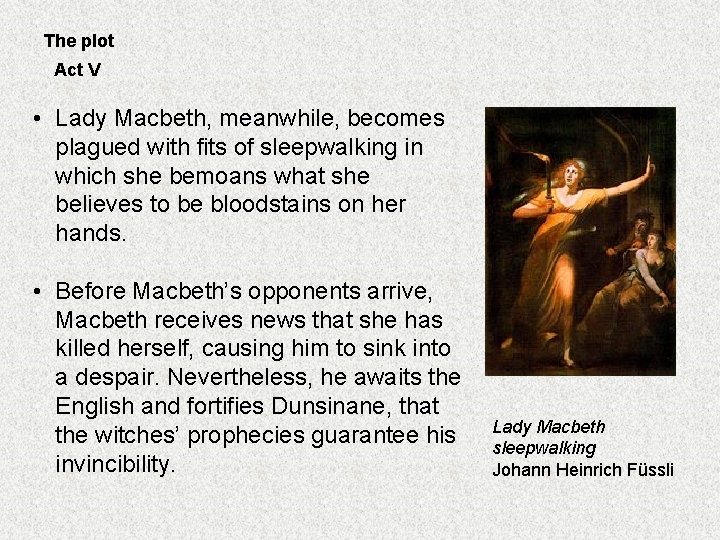
The plot Act V • Lady Macbeth, meanwhile, becomes plagued with fits of sleepwalking in which she bemoans what she believes to be bloodstains on her hands. • Before Macbeth’s opponents arrive, Macbeth receives news that she has killed herself, causing him to sink into a despair. Nevertheless, he awaits the English and fortifies Dunsinane, that the witches’ prophecies guarantee his invincibility. Lady Macbeth sleepwalking Johann Heinrich Füssli

The plot Act V Dunsinane • However, Macbeth learns that the English army is advancing on Dunsinane shielded with boughs cut from Birnam Wood is indeed coming to Dunsinane, fulfilling half of the witches’ prophecy. • In the battle Macbeth encounters Macduff, who declares that he was not “of woman born” but was instead “untimely ripped” from his mother’s womb. • Macbeth continues to fight until Macduff kills and beheads him. Malcolm, now the King of Scotland, declares his benevolent intentions for the country and invites all to see him crowned at Scone.
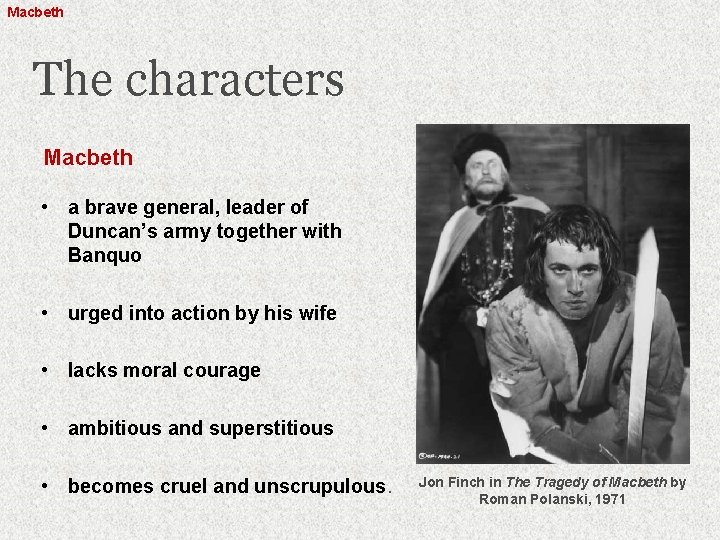
Macbeth The characters Macbeth • a brave general, leader of Duncan’s army together with Banquo • urged into action by his wife • lacks moral courage • ambitious and superstitious • becomes cruel and unscrupulous. Jon Finch in The Tragedy of Macbeth by Roman Polanski, 1971
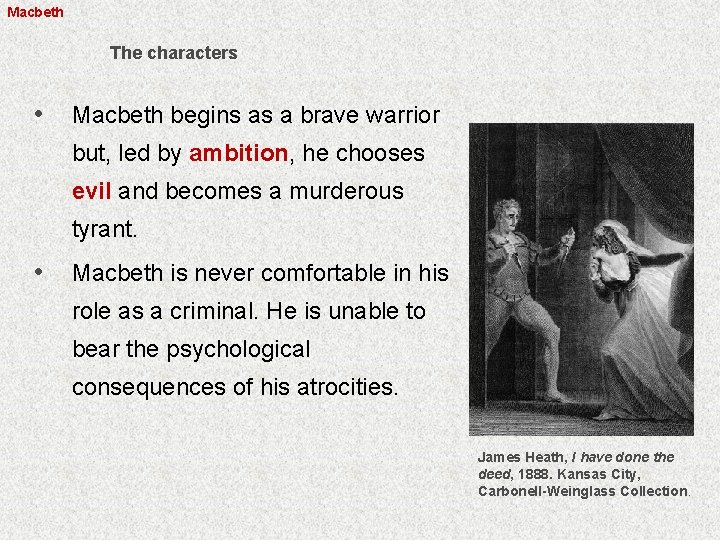
Macbeth The characters • Macbeth begins as a brave warrior but, led by ambition, he chooses evil and becomes a murderous tyrant. • Macbeth is never comfortable in his role as a criminal. He is unable to bear the psychological consequences of his atrocities. James Heath, I have done the deed, 1888. Kansas City, Carbonell-Weinglass Collection.
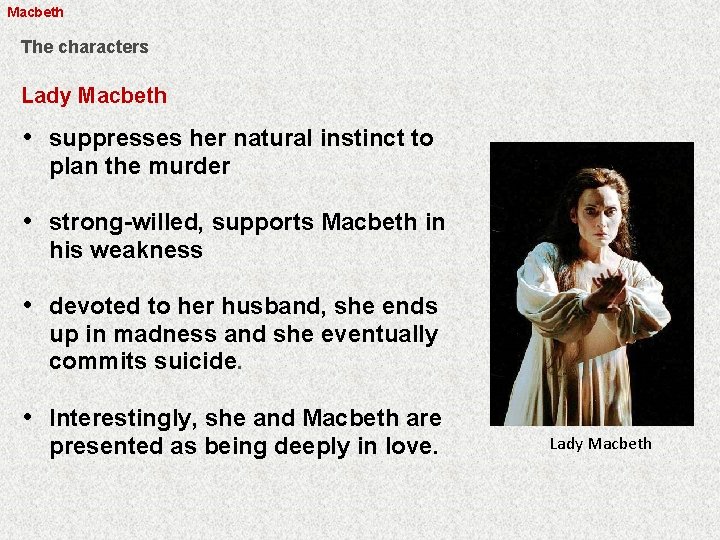
Macbeth The characters Lady Macbeth • suppresses her natural instinct to plan the murder • strong-willed, supports Macbeth in his weakness • devoted to her husband, she ends up in madness and she eventually commits suicide. • Interestingly, she and Macbeth are presented as being deeply in love. Lady Macbeth
Macbeth The characters King Duncan • peaceful and refined • shows poor judgement of human nature Banquo • a contrast to Macbeth in his modesty • does not follow temptation like Macbeth
Macbeth The characters Macduff • becomes important after Banquo’s murder • noble, loyal, patriotic Malcom • Duncan’s son
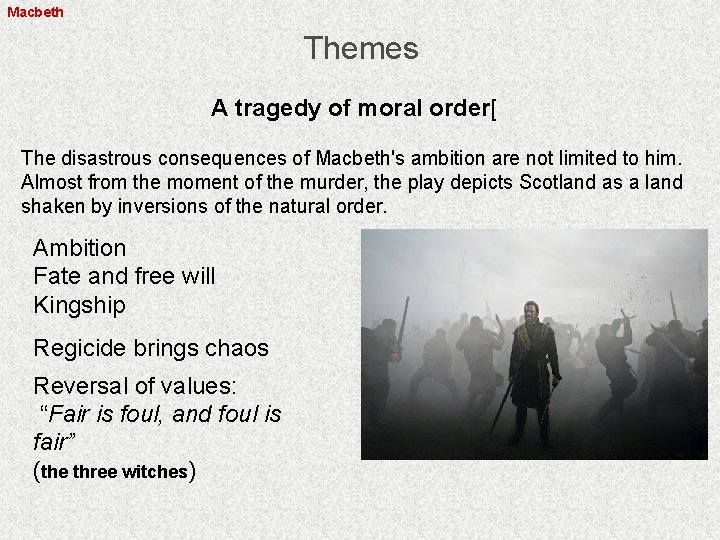
Macbeth Themes A tragedy of moral order[ The disastrous consequences of Macbeth's ambition are not limited to him. Almost from the moment of the murder, the play depicts Scotland as a land shaken by inversions of the natural order. Ambition Fate and free will Kingship Regicide brings chaos Reversal of values: “Fair is foul, and foul is fair” (the three witches)
Macbeth Style • Use of blank verse. Blank verse is basically unrhymed iambic pentameter: “Macbeth does murther Sleep, - the innocent Sleep; Sleep, that knits up the ravell’d sleave of care” (Act II, Scene 2)
Macbeth Style • A striking use of imagery: • similes “The sleeping and the dead are but as pictures” (Act II, Scene 2) • metaphors “Life’s but a walking shadow” (Act V, Scene 5) • symbols “the innocent Sleep” “A little water clears us of this deed” (Act II, Scene 2)
Macbeth The supernatural • The three witches and their prophecies lead Macbeth to success. • The chaos of nature on the night of Duncan’s murder. • Banquo’s ghost.
Macbeth The supernatural • • The apparitions with their prophecies (Act IV, Scene 1): o the helmeted head represents Macbeth himself o the bloody child represents Macduff o the crowned child bearing a tree represents Malcom The air-drawn dagger guiding Macbeth against his victims.
- Slides: 19