
Orphanet V 4 Whats new in the disease
- Slides: 16
Orphanet V 4 What’s new in the disease database? Dr Ana RATH Orphanet partners' meeting Lisbon 26 November 2007
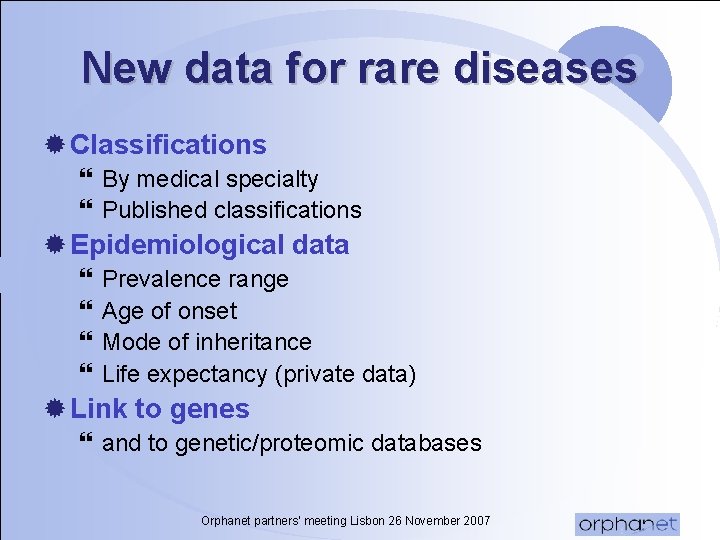
New data for rare diseases ® Classifications } By medical specialty } Published classifications ® Epidemiological data } } Prevalence range Age of onset Mode of inheritance Life expectancy (private data) ® Link to genes } and to genetic/proteomic databases Orphanet partners' meeting Lisbon 26 November 2007
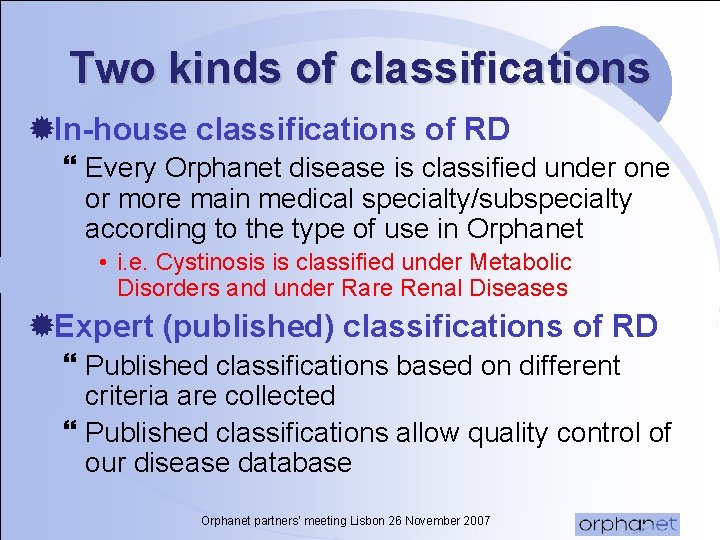
Two kinds of classifications ®In-house classifications of RD } Every Orphanet disease is classified under one or more main medical specialty/subspecialty according to the type of use in Orphanet • i. e. Cystinosis is classified under Metabolic Disorders and under Rare Renal Diseases ®Expert (published) classifications of RD } Published classifications based on different criteria are collected } Published classifications allow quality control of our disease database Orphanet partners' meeting Lisbon 26 November 2007
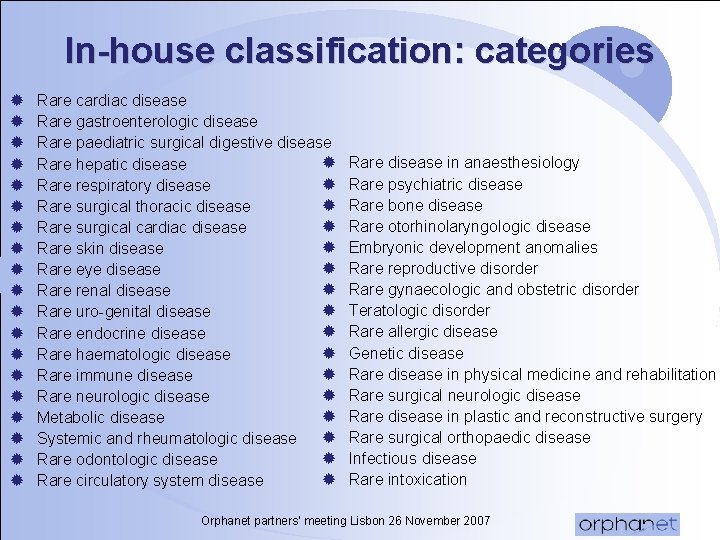
In-house classification: categories ® ® ® ® ® Rare cardiac disease Rare gastroenterologic disease Rare paediatric surgical digestive disease ® Rare hepatic disease ® Rare respiratory disease ® Rare surgical thoracic disease ® Rare surgical cardiac disease ® Rare skin disease ® Rare eye disease ® Rare renal disease ® Rare uro-genital disease ® Rare endocrine disease ® Rare haematologic disease ® Rare immune disease ® Rare neurologic disease ® Metabolic disease ® Systemic and rheumatologic disease ® Rare odontologic disease ® Rare circulatory system disease Rare disease in anaesthesiology Rare psychiatric disease Rare bone disease Rare otorhinolaryngologic disease Embryonic development anomalies Rare reproductive disorder Rare gynaecologic and obstetric disorder Teratologic disorder Rare allergic disease Genetic disease Rare disease in physical medicine and rehabilitation Rare surgical neurologic disease Rare disease in plastic and reconstructive surgery Rare surgical orthopaedic disease Infectious disease Rare intoxication Orphanet partners' meeting Lisbon 26 November 2007
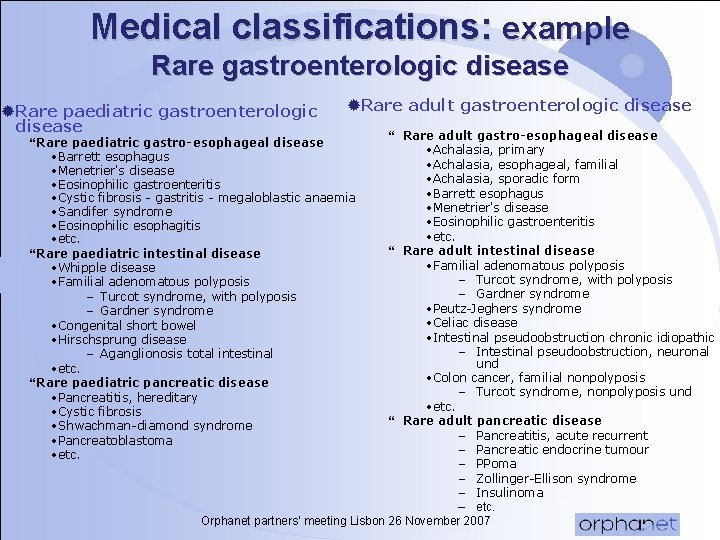
Medical classifications: example Rare gastroenterologic disease ®Rare paediatric gastroenterologic disease ®Rare adult gastroenterologic disease } Rare adult gastro-esophageal disease • Achalasia, primary • Achalasia, esophageal, familial • Achalasia, sporadic form • Barrett esophagus • Menetrier's disease • Eosinophilic gastroenteritis • etc. } Rare adult intestinal disease • Familial adenomatous polyposis – Turcot syndrome, with polyposis – Gardner syndrome • Peutz-Jeghers syndrome • Celiac disease • Intestinal pseudoobstruction chronic idiopathic – Intestinal pseudoobstruction, neuronal und • Colon cancer, familial nonpolyposis – Turcot syndrome, nonpolyposis und • etc. } Rare adult pancreatic disease – Pancreatitis, acute recurrent – Pancreatic endocrine tumour – PPoma – Zollinger-Ellison syndrome – Insulinoma – etc. Orphanet partners' meeting Lisbon 26 November 2007 }Rare paediatric gastro-esophageal disease • Barrett esophagus • Menetrier's disease • Eosinophilic gastroenteritis • Cystic fibrosis - gastritis - megaloblastic anaemia • Sandifer syndrome • Eosinophilic esophagitis • etc. }Rare paediatric intestinal disease • Whipple disease • Familial adenomatous polyposis – Turcot syndrome, with polyposis – Gardner syndrome • Congenital short bowel • Hirschsprung disease – Aganglionosis total intestinal • etc. }Rare paediatric pancreatic disease • Pancreatitis, hereditary • Cystic fibrosis • Shwachman-diamond syndrome • Pancreatoblastoma • etc.
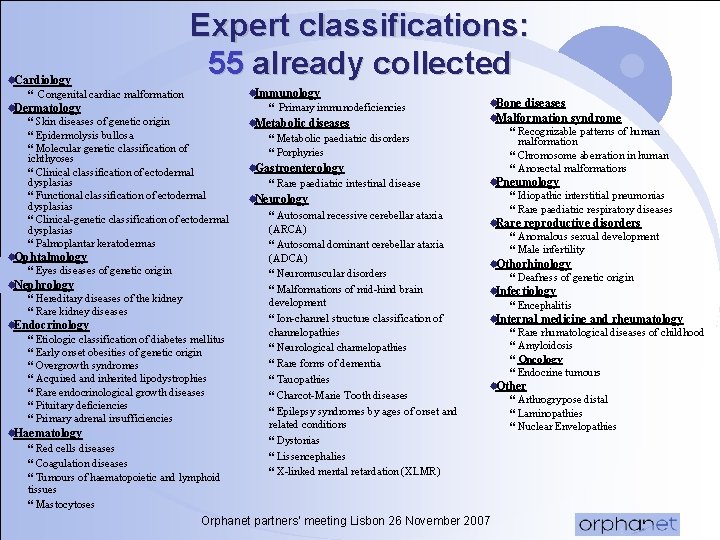
®Cardiology Expert classifications: 55 already collected ®Immunology } Congenital cardiac malformation ®Dermatology } Skin diseases of genetic origin } Epidermolysis bullosa } Molecular genetic classification of ichthyoses } Clinical classification of ectodermal dysplasias } Functional classification of ectodermal dysplasias } Clinical-genetic classification of ectodermal dysplasias } Palmoplantar keratodermas ®Ophtalmology } Eyes diseases of genetic origin ®Nephrology } Hereditary diseases of the kidney } Rare kidney diseases ®Endocrinology } Etiologic classification of diabetes mellitus } Early onset obesities of genetic origin } Overgrowth syndromes } Acquired and inherited lipodystrophies } Rare endocrinological growth diseases } Pituitary deficiencies } Primary adrenal insufficiencies ®Haematology } Red cells diseases } Coagulation diseases } Tumours of haematopoietic and lymphoid tissues } Mastocytoses } Primary immunodeficiencies ®Metabolic diseases } Metabolic paediatric disorders } Porphyries ®Gastroenterology } Rare paediatric intestinal disease ®Neurology } Autosomal recessive cerebellar ataxia (ARCA) } Autosomal dominant cerebellar ataxia (ADCA) } Neuromuscular disorders } Malformations of mid-hind brain development } Ion-channel structure classification of channelopathies } Neurological channelopathies } Rare forms of dementia } Tauopathies } Charcot-Marie Tooth diseases } Epilepsy syndromes by ages of onset and related conditions } Dystonias } Lissencephalies } X-linked mental retardation (XLMR) ®Bone diseases ®Malformation syndrome } Recognizable patterns of human malformation } Chromosome aberration in human } Anorectal malformations ®Pneumology } Idiopathic interstitial pneumonias } Rare paediatric respiratory diseases ®Rare reproductive disorders } Anomalous sexual development } Male infertility ®Othorhinology } Deafness of genetic origin ®Infectiology } Encephalitis ®Internal medicine and rheumatology } Rare rhumatological diseases of childhood } Amyloidosis } Oncology } Endocrine tumours ®Other } Arthrogrypose distal } Laminopathies } Nuclear Envelopathies Orphanet partners' meeting Lisbon 26 November 2007
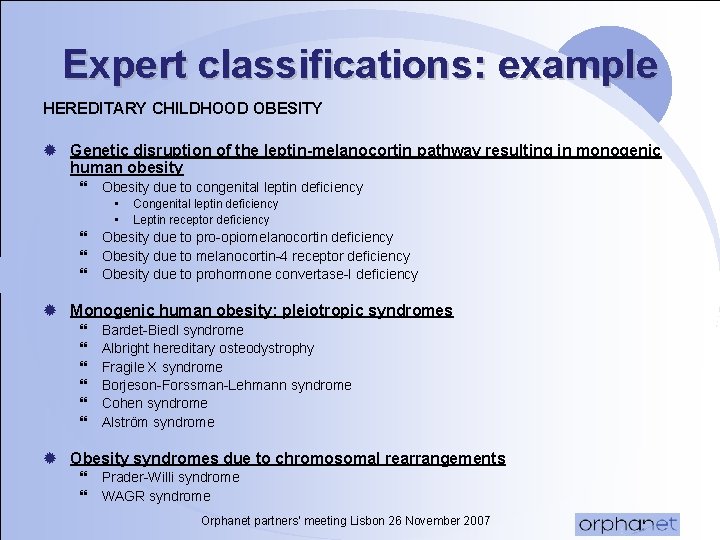
Expert classifications: example HEREDITARY CHILDHOOD OBESITY ® Genetic disruption of the leptin-melanocortin pathway resulting in monogenic human obesity } Obesity due to congenital leptin deficiency • • } } } Congenital leptin deficiency Leptin receptor deficiency Obesity due to pro-opiomelanocortin deficiency Obesity due to melanocortin-4 receptor deficiency Obesity due to prohormone convertase-I deficiency ® Monogenic human obesity: pleiotropic syndromes } } } Bardet-Biedl syndrome Albright hereditary osteodystrophy Fragile X syndrome Borjeson-Forssman-Lehmann syndrome Cohen syndrome Alström syndrome ® Obesity syndromes due to chromosomal rearrangements } } Prader-Willi syndrome WAGR syndrome Orphanet partners' meeting Lisbon 26 November 2007
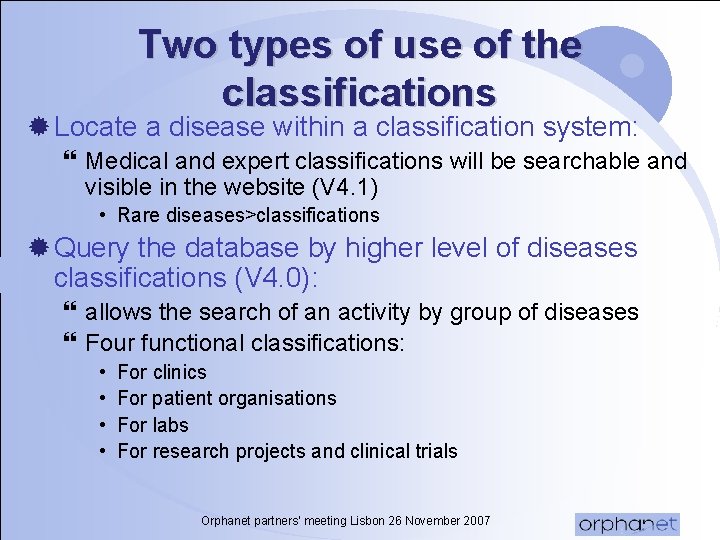
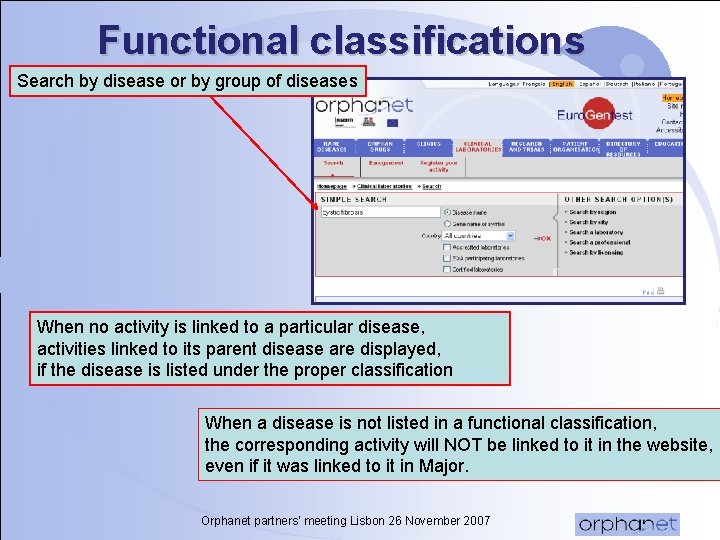
Two types of use of the classifications ® Locate a disease within a classification system: } Medical and expert classifications will be searchable and visible in the website (V 4. 1) • Rare diseases>classifications ® Query the database by higher level of diseases classifications (V 4. 0): } allows the search of an activity by group of diseases } Four functional classifications: • • For clinics For patient organisations For labs For research projects and clinical trials Orphanet partners' meeting Lisbon 26 November 2007
Functional classifications Search by disease or by group of diseases When no activity is linked to a particular disease, activities linked to its parent disease are displayed, if the disease is listed under the proper classification When a disease is not listed in a functional classification, the corresponding activity will NOT be linked to it in the website, even if it was linked to it in Major. Orphanet partners' meeting Lisbon 26 November 2007
Consequences of classifications for the database ® All the levels of a classification are diseases (and need translation): } “class” (categories) } “true” diseases (i. e. do have a text) } “und” (included diseases) ® Proposals for inclusion of a disease (at any level) in a functional classification will be treated in regular diseases meetings ® Linking an activity to a parent disease links it to all its “children” ® We will provide you with functional classifications in the form of a booklet (pdf, private Consor) Orphanet partners' meeting Lisbon 26 November 2007
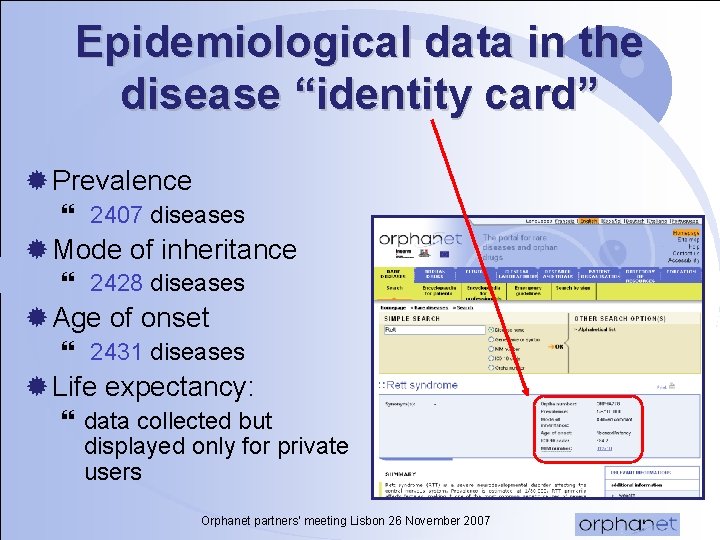
Epidemiological data in the disease “identity card” ® Prevalence } 2407 diseases ® Mode of inheritance } 2428 diseases ® Age of onset } 2431 diseases ® Life expectancy: } data collected but displayed only for private users Orphanet partners' meeting Lisbon 26 November 2007
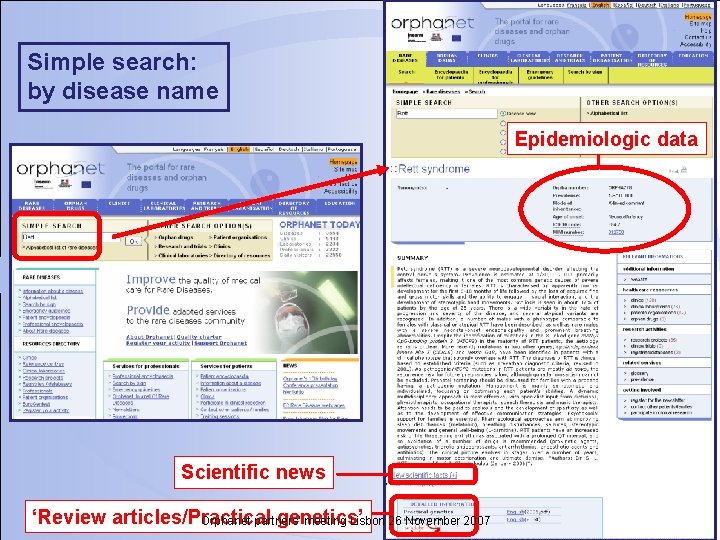
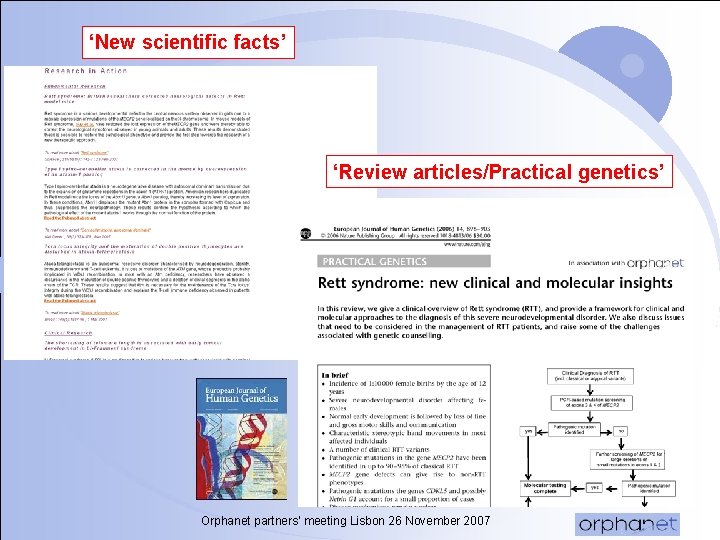
Simple search: by disease name Epidemiologic data Scientific news ‘Review articles/Practical genetics’ Orphanet partners' meeting Lisbon 26 November 2007
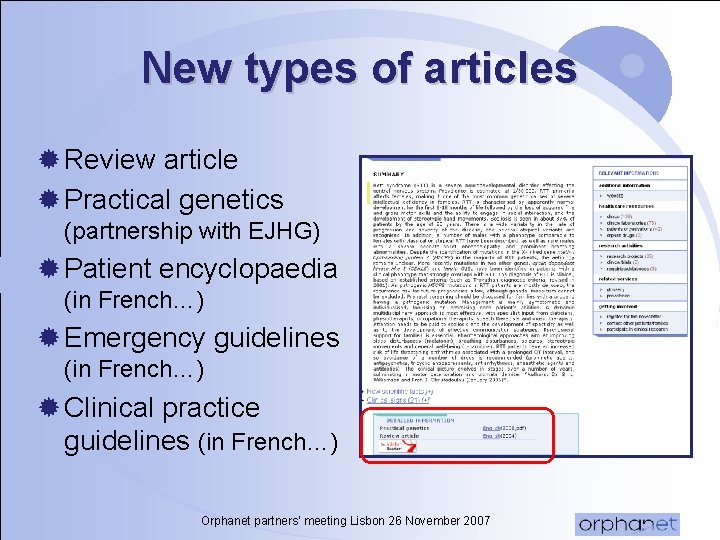
New types of articles ® Review article ® Practical genetics (partnership with EJHG) ® Patient encyclopaedia (in French…) ® Emergency guidelines (in French…) ® Clinical practice guidelines (in French…) Orphanet partners' meeting Lisbon 26 November 2007
‘New scientific facts’ ‘Review articles/Practical genetics’ Orphanet partners' meeting Lisbon 26 November 2007
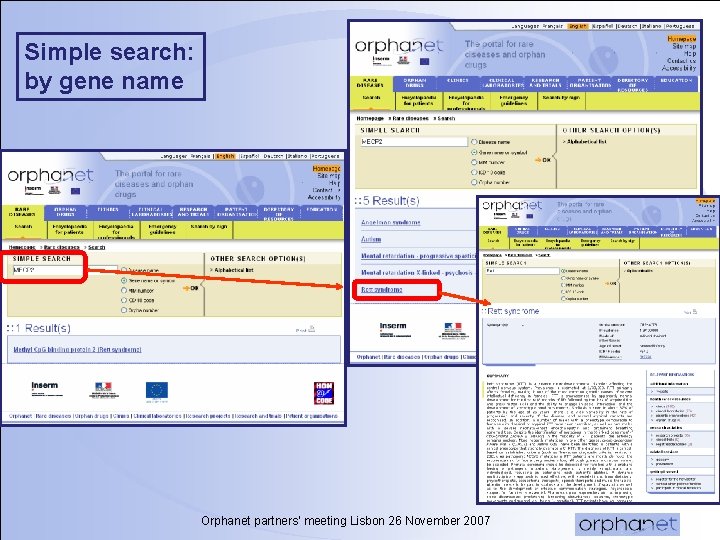
Links diseases - genes ® Linking diseases to genes will allow to (v 4. 1) } Search a disease by a gene (label, symbol, synonyms) } Search a gene by disease name } Reach genes/proteins databases ® 1372 diseases already linked to 1713 genes ® Swissprot: 1298 diseases linked to 1594 genes ® Genatlas: 1243 diseases linked to 1274 genes ® Genetest: 938 diseases linked to 1118 genes ® The 1713 genes allow links to HGCN Orphanet partners' meeting Lisbon 26 November 2007
Simple search: by gene name Orphanet partners' meeting Lisbon 26 November 2007