
ORISSA ESTATE ABOLITION ACT 1951 AN OVERVIEW Introduction
ORISSA ESTATE ABOLITION ACT 1951 AN OVERVIEW
Introduction v In pursuance of Directive Principles of State Policy, in order to secure economic Justice for all the historic Act, that is, Odisha Estate Abolition Act, 1951 took birth. v Since land was important source of wealth, and was concentrated in the lands of few, farms were exploited in their hands productivity of those lands were very low, the primary Job during Post. Independence was Agrarian Reforms. v Prior to enactment of this Act a committee (Naba Krushna Choudhury committee) on Agrarian Reforms was formed vide Go. O resolution No 7353/R Dt. 15. 11. 1946 and the said committed submitted it’s report on Dt. 07. 1949. the Estate Abolition Bill was introduced in State Legislature on 17. 01. 1950 and passed on 28. 09. 1951. the Odisha Estate Abolition Act, 1951 came in to force on 19. 02. 1952. v As Intermediacies were aware of the fact that their fights are going to be abolished after independence, some illegal transfor were made. So the legislation. Definition given effect certain provision w. e. f. 1 st January, 1946.
Definitions : ‘S. 2(g)-Estate’ v Includes a part of an Estate and means any land held by or vested in an intermediary and included under one entry in any revenue roll or any of the general registers of revenue-paying lands and revenue free lands, prepared and maintained under the law relating to land revenue for the time being in force or under any rule, order, custom or usage having the force of law, and includes revenue free lands not entered in any register or revenue roll and all classes of tenures or under-tenures & any jagir, inam or maufi or other similar grant.
‘S. 2(h)-Intermediary’ v v With reference to any estate means proprietor, subproprietor, landlord, land-holder, malguzar, thikadar, gaontia, tenure-holder, under-tenure holder & includes an inamdar, a jagirdar, zamindar etc including of the Ruler of an Indian State merged with the State of Orissa and all other holders or owners in interest in land between the raiyat and the State. Section 5(1) of the OT Act defines ‘tenure-holder’ a person who has acquired from a proprietor or another tenure-holder, a right to hold land for the purpose of collecting rents or bring it under cultivation by establishing tenancy on it. Section 5(5) provides that a tenant holding more than 33 acres shall be presumed to be a tenure-holder until contrary is shown.
‘S. 2(hh)-Intermediary interest’ v Means an estate or any rights or interest therein held or owned by or vested in an intermediary and any reference to ‘estates’ in this Act shall be construed as including a reference to ‘intermediary interest’ also
‘S. 2(i) Homestead’ v Means a dwelling house used by the intermediary for the purpose of his own residence or for the purpose of letting out on rent together with any courtyard, compound, orchard & out buildings attached thereto & includes any tank, library & place of worship appertaining to such dwelling house but doesn’t include building primarily used for office or kutchery after 01. 1946 for the administration of the estate.
‘S. 2(j) Khas possession’ v. Used w. r. t the possession of an intermediary of any land used for agricultural or horticultural purposes v. Means the possession of such intermediary by cultivating such land or carrying horticultural operations thereon himself with his own stock or by his own servants or by hired labour or with hired stock
‘S. 2(n)- Raiyat’ v Means any person holding the land for the purposes of cultivation and who has acquired the right of occupancy according to the tenancy law or rules for the time being in force in that area, or in the absence of such law or rules, the custom prevalent in that area; v As per sub-section 2 of S. 4 of OT Act, raiyat is one category of tenant. v S. 23 of OT Act provides that a person holding land continuously for 12 years shall be deemed to be a settled raiyat in that village. S. 24 provides that a settled raiyat has a right to occupancy
S. 2(o)- TRUST v“Trust” means a trust as defined in S. 3 of the Indian Trusts act, 1882 and shall include an express or constructive Trust existing for a public purpose of a charitable or religious nature & a Hindu, Muslim, Cristian, Buddhist or any other religious or charitable endowment.
S. 2(oo)- Trust Estate v“Trust Estate’” means an estate the whole of the net income whereof under any trust or other legal obligation has been dedicated exclusively to charitable or religious purposes of a public nature without any reservation of pecuniary benefit to any individual. v. Provided that all estates belonging to the Temple of Lord Jagannath at Puri within the meaning of the Shri Jagannath Temple Act, 1955 and all estates declared to be trust estates by a competent authority under this Act prior to the date of coming into force of the OEA (Amendment) Act, 1970 shall be deemed to be trust estates.
Sec. 3 - Notification, vesting an estate in the State v Government may from time to time by notification declare that the estate specified in the notification has passed to and become vested in the State free from all encumbrances. v Such publication shall be conclusive evidence of the notice of the declaration to everybody whose interest is affected by it. v Sec. 3 -A stipulates the provision for vesting of intermediary interest.
S. 3 -A. Vesting of Intermediary interest v(1) Without prejudice to the power under the last preceding section, the State Govt may by notification declares that the intermediary interests of all intermediaries or a class of intermediaries in the whole or a part of the estate have passed to and become vested in the State free from all encumbrances. v(2) The notification referred to in sub-section (1) shall be published in the Gazette & on such publication shall be conclusive evidence of the notice of the declaration to every whose interest is affected thereby.
‘S. 5 - Consequences of vesting of an estate in the State. v S. 5(a)- Subject to subsequent provisions of this Chapter the entire estate including all communal lands & parambokes, other non-raiyati lands, waste land, trees, orchads, pasture lands, forest, mines & minerals, rivers &streams, quarries, tanks and other irrigation works, water channels, fisheries, ferries, hats and bazars & buildings or structures together with land on which they stand shall vest absolutely in the State Govt free from all encumbrances and such intermediary shall cease to have any interest in such estate other than the interests expressly saved by or under the provisions of this Act.
Contd… v (i) Where the Collector is satisfied in respect of the settlement or lease of any land or mines or minerals comprised in such estate or the transfer of any kind of interests in any holding used primarily as office or kutchery for the collection of rent of such estate or as rest houses for estate servants on duty or as golas for storing rent in kind or part thereof, made or created at any time after 1 st day of January, 1946, that such settlement, lease or transfer was made with the object of defeating any provision of this Act or obtaining higher
Contd…. compensation, thereunder, he shall power to make enquiries in respect of such settlement, lease or transfer and may after giving reasonable notice to the parties concerned to appear & be heard, set aside any such settlement, lease or transfer , dispossess the person claiming under it & take possession of such property in the manner provided in clause (h) on such terms as may appear to him fair & equitable. v Provided that in case where the Collector decides not to set aside any such settlement, lease or transfer he shall refer the cases to the BOR for confirmation of the settlement, lease or transfer & the orders passed by the BOR in this behalf shall be final.
Interest expressly saved by under the provision of the Act. v After vesting of estates certain interest of Ex-Intermediaries are saved expressly. Those are explain U/s 6, 7, 8 including section 7 -A and 8 -A. homestead Land v S. 6 - Homesteads of intermediaries & buildings together with land on which such buildings stand in the possession of intermediaries & used as golas, factories or mills before the 1 st day of January, 1946 shall notwithstanding contained in this Act, be deemed to be settled by the Government with such intermediary & with all the shareholders owning the estate, who shall be entitled to retain possession of such homesteads of such buildings or structures together with the lands on which they stand, as tenants under the State Government subject to the payment of such fair & equitable ground rent as may be determined by the Collectors in the prescribed manner.
S. 7. Land in Khas Possession of Intermediary v. Certain other lands in Khas Possession of intermediaries to be retained by them on payment of rent as raiyat having occupancy raiyat on and from the date of vesting. v(j)-Khas Possession - Used w. r. t the possession of an intermediary of any land used for agricultural or horticultural purposes v. Means the possession of such intermediary by cultivating such land or carrying horticultural operations thereon himself with his own stock or by his own servants or by hired labour or with hired stock
S. 7 -A- Settlement of land & building v If the State Govt are of the opinion that any land, whether used for the purposes of hat, bazar, orchad, mine, quarry or otherwise, tank or building (being part of the trust estate) vested in the State Govt is needed for carrying out the purposes of the trust efficiently, then, notwithstanding anything contained in any other law for the time being in force, or in other provision of this Act, the State Govt. may settle such land, tank or building with the person who immediately before such vesting was an intermediary in respect of such land or tank or building, subject to the payment of such fair & equitable rent as may be determined by the Collector in the prescribed manner & subject to such other terms & conditions as may be prescribed.
Contd… • Provided that no such land, tank or building shall be settled under this Section(i) After the expiry of a period of (thirteen) years, from the date of commencement of the OEA(Amendment) Act, 1978. (ii) If such land, tank or building is held by a tenant; or (iii) If such land, tank or building has already been settled by Govt with any other person. (2) The intermediary with whom any property is settled under ss(1) shall hold the property as raiyat if the property is settled for agricultural purposes & as tenant in other cases.
Sec. 8 –Continuity of tenure of tenants (1) Any person who immediately before the date of vesting of an estate in the State Govt was in possession of any holding as a tenant under an intermediary shall, on and from the date of vesting be deemed to be a tenant of the State government and such person shall hold the land in the same rights and subject to the same restrictions and liabilities as he was entitled or subject to immediately before the date of vesting.
Contd…. . (2) Any person who immediately before the date of coming into force of the Orissa Estate Abolition (Amendment) Act, 13 of 1986 hold land under Government for rendering service as a village servant by whatever name called shall from the date of coming into force of the said Act be discharged from the conditions of such service and the land shall be settled with him with occupancy right in such rent as may be determined by the Collector in the prescribed manner.
Contd…. . (3) Any person who immediately before the date of vesting held land under an intermediary on favourable terms for personal service rendered by him to such intermediary shall, from the date of vesting be discharged from the conditions of such service and the land may be settled with him in such manner and under such terms and conditions as may be prescribed. Provided that nothing in sub-section (3) shall apply to trust estate which is vested in the State on or after the date of coming into force of the Orissa Estate Abolition (Amendment) Act, 1970.
Sec. 8 -A – Filling of claims U/s. 6, 7 & 8 & dispute relating thereto. (3) On the failure filling the claims within the period specified under this Section the provisions of Cl. (h) of section 5 shall, notwithstanding anything to the contrary in sections 6, 7 & 8, apply as if the right to possession of the land or buildings or structures, as the case may be, had vested in the State Government by the operation of this Act and thereupon the right to make any such claim as aforesaid shall stand extinguished. Provided when such failure is due to pendency of proceedings in court of law disputing validity of notification U/s 3 or 3 A State Government may extend the period for filling of the claim.
Trust Estate • S. 8 -A(5)- Without prejudice to the provisions contained in ss (4) where a claim in respect of any estates is made by the intermediary on the ground that it is a trust estate, the Collector, shall, whether or not any objection is filed under the said sub-section, make a reference to the Tribunal constituted u/s. 8 -D for determining whether the estate is a trust estate or not and shall act according to the orders passed by the said Tribunal: Provided that in case of any estate referred to in the proviso to clause (oo) of S. 2, no such reference shall be necessary.
Contd… • S. 8 -D – State Government may constitute one or more Tribunal, by notification, having such local jurisdiction as may be specified therein. • S. 8 -E(1) – Tribunal under prescribed procedure shall publish the references received U/s. 8 -A(5) inviting objection thereto from persons interested. • (2) After receipt of the objection, if any, the Tribunal shall, after giving the persons concerned an opportunity of being heard & making such enquiry as it deems necessary, determine whether the estate is a trust or not & send a copy of the order to the Collector who has made the reference.
Sec. 9 – Appeal against Collector’s order U/s. 3, 3 B, 5, 6, 7, 8 & 8 A If such order is passed by the Collector appeal shall preferred to BOR within 60 days. Provided that if such order is passed by officer other than Collector of the district, an appeal if preferred within 60 days of such order shall lie to the Collector. [Collector includes ADM]
Section 38 -B - Revision (1) The BOR may on its own motion or on a report from the Collector, call for and examine the record of any proceeding in which any authority subordinate to BOR has made any decision or passed an order under this Act for the purpose of satisfying itself as to the regularity of such proceeding or the correctness, legality or propriety of such decision or order & if in any case it appears to the BOR that any such decision or order ought to be modified, annulled, reversed or remitted, it may pass order accordingly.
Sec. 39 - Bar to jurisdiction of Civil Court in certain matters No suit shall be brought in any Civil Court in respect of any entry in or omission from a Compensation Assessment Roll or in respect of any order passed under Ch. II to VI or in connection with any matter which is or has already been the subject of any application made or proceeding taken under the said Chapters.
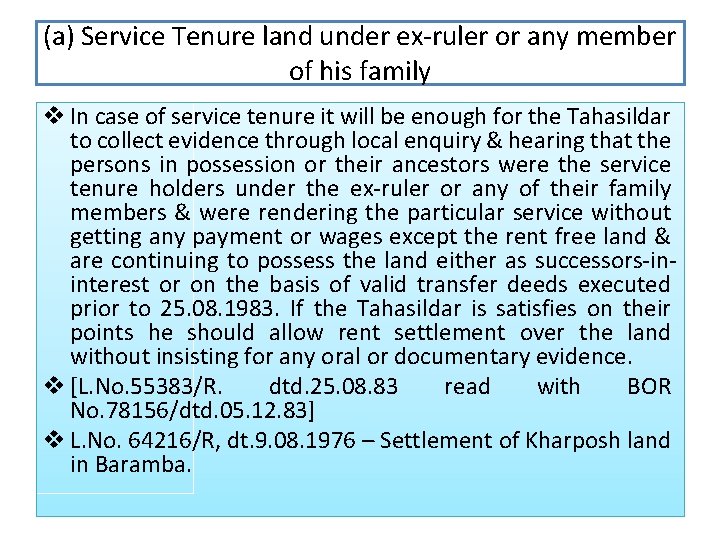
(a) Service Tenure land under ex-ruler or any member of his family v In case of service tenure it will be enough for the Tahasildar to collect evidence through local enquiry & hearing that the persons in possession or their ancestors were the service tenure holders under the ex-ruler or any of their family members & were rendering the particular service without getting any payment or wages except the rent free land & are continuing to possess the land either as successors-ininterest or on the basis of valid transfer deeds executed prior to 25. 08. 1983. If the Tahasildar is satisfies on their points he should allow rent settlement over the land without insisting for any oral or documentary evidence. v [L. No. 55383/R. dtd. 25. 08. 83 read with BOR No. 78156/dtd. 05. 12. 83] v L. No. 64216/R, dt. 9. 08. 1976 – Settlement of Kharposh land in Baramba.
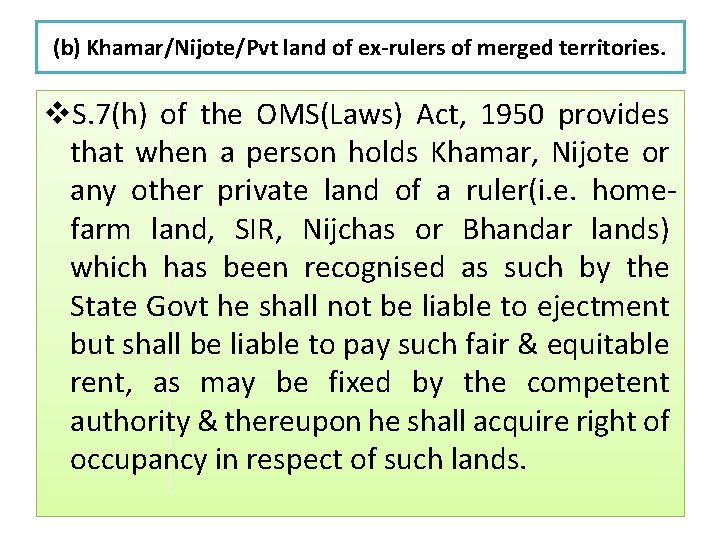
(b) Khamar/Nijote/Pvt land of ex-rulers of merged territories. v. S. 7(h) of the OMS(Laws) Act, 1950 provides that when a person holds Khamar, Nijote or any other private land of a ruler(i. e. homefarm land, SIR, Nijchas or Bhandar lands) which has been recognised as such by the State Govt he shall not be liable to ejectment but shall be liable to pay such fair & equitable rent, as may be fixed by the competent authority & thereupon he shall acquire right of occupancy in respect of such lands.
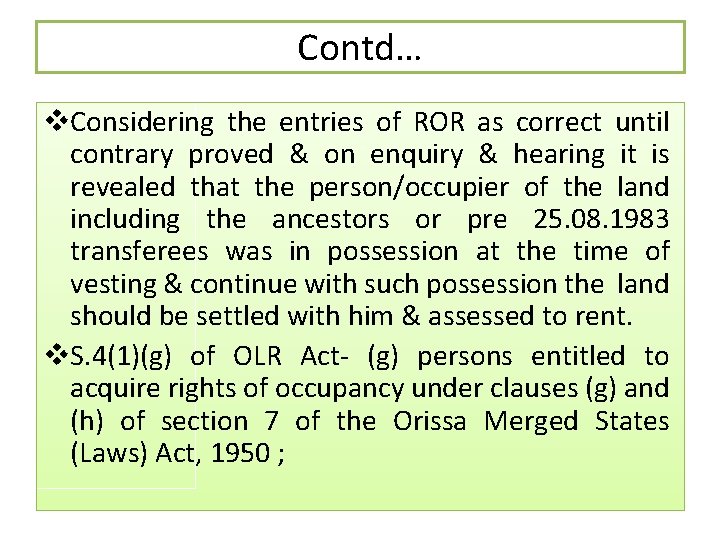
Contd… v. Considering the entries of ROR as correct until contrary proved & on enquiry & hearing it is revealed that the person/occupier of the land including the ancestors or pre 25. 08. 1983 transferees was in possession at the time of vesting & continue with such possession the land should be settled with him & assessed to rent. v. S. 4(1)(g) of OLR Act- (g) persons entitled to acquire rights of occupancy under clauses (g) and (h) of section 7 of the Orissa Merged States (Laws) Act, 1950 ;
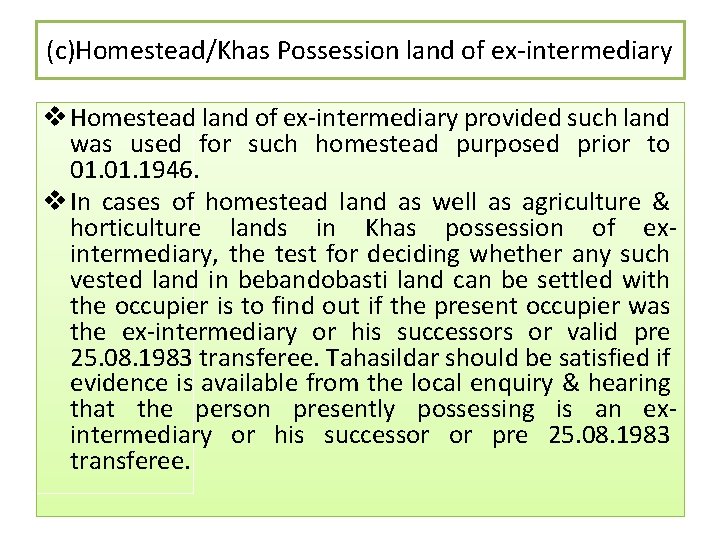
(c)Homestead/Khas Possession land of ex-intermediary v Homestead land of ex-intermediary provided such land was used for such homestead purposed prior to 01. 1946. v In cases of homestead land as well as agriculture & horticulture lands in Khas possession of exintermediary, the test for deciding whether any such vested land in bebandobasti land can be settled with the occupier is to find out if the present occupier was the ex-intermediary or his successors or valid pre 25. 08. 1983 transferee. Tahasildar should be satisfied if evidence is available from the local enquiry & hearing that the person presently possessing is an exintermediary or his successor or pre 25. 08. 1983 transferee.
(d) Land held as village servant/personal service rendered to ex-intermediary v In these cases the test for conferring raiyat status & for assessment of fair & equitable rent is whether the person in occupation of the land or his ancestors (1) was actually the village servant holding land under the Govt for rendering service as village servants on or immediately prior to 17. 05. 1986, i. e. date on which OEA (Amd) Act, 1986 came into force, or (2) whether a pre 25. 08. 1983 transferee (3) whether the person in occupation of the land or his ancestor was holding the land under the ex-intermediary (except trust estate) on favourable terms for rendering personal service to the ex-intermediary (4) whether he is a pre 25. 08. 1983 transferee.
Important Supreme Court Rulings. v v v v 1. State of Bihar v Kameswar Singh; AIR 1952 SC 252. 2. K C Gajapati Narayan Deo v State of Orissa AIR 1953 SC 375. 3. Sri Sita Maharani & Ors v. Chhedi Mohanta & Ors, AIR 1955 SC, 328. 4. Sailendra Narayan Bhanja Deo v State of Orissa 1956 SCC 449. 5. Ananda Behera & anr v. State of Orissa & anr. AIR 1956 SC 17. 6. Kumar Bimal Ch Sinha v. State of Orissa & Ors AIR 1962 SC 1912. 7. Shivashonkar Prasad Sah v Baikuntha Nath Singh, AIR 1969 SC 971. 8. 4. Basanti Kumari Sahu v. State of Orissa & Ors, 1991(I) OLR (SC) 347. 9. S. P. Chengalvaraya Naidu Vrs Jagannath [(1994) 1 SCC 1 10. State of Orissa & Ors v. Brundaban Sharma & anr. 1995 Supp. (3) SCC 249 11. State of Orissa v. Nityananda Satpathy & Ors, (2003) 7 SCC, 146. 12. Bondar Singh & ors v. Nihal Singh & ors, (2003) 4 SCC 161. 13. State of Orissa v Harapriya Bisoi (2009)12 SCC 378. 14. Sri Jagannath Temple v Sidhamatha, CA No. 7729 of 2009 decided on 16 th December 2015

THANKS
- Slides: 35