
ORIGINS OF THE VIETNAM WAR LEADING UP TO
- Slides: 30
ORIGINS OF THE VIETNAM WAR LEADING UP TO AMERICAN INVOLVEMENT
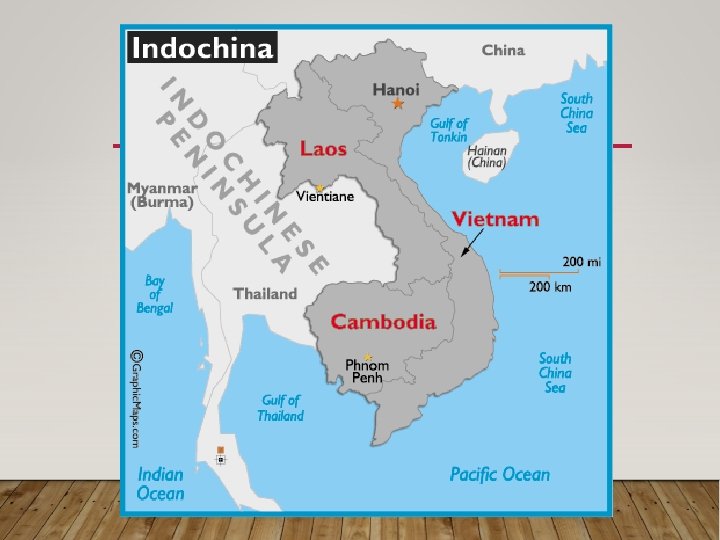
VIETNAM BACKGROUND • France began its conquest of Indochina in 1859. In spite of military resistance, by 1888 the area of the current-day nations of Cambodia and Vietnam was made into the colony of French Indochina • The Vietnamese group who fought the French during this period was called the Viet Minh, Minh who was controlled by the Communist Party of Vietnam
VIETNAM IN WWII • During WWII the Japanese took over Indochina but in August 1945, the Japanese had been defeated and surrendered unconditionally. • Viet Minh entered and grasped power across Vietnam in the "August Revolution" • On September 2 nd 1945, Ho Chi Minh, Minh the leader of the Viet Minh, declared the independence of Vietnam before a crowd of 500, 000 in Hanoi.
ALLIES AID FRANCE • However, the major allied victors of World War II, the United Kingdom, the United States and the Soviet Union, all agreed that the area still belonged to the French. • As the French did not have the ships, weapons or soldiers to immediately retake Vietnam, the major powers came to an agreement that British troops would occupy the south while Nationalist Chinese forces would move in from the north.
FRENCH INDOCHINA WAR • Ho Chi Minh initially attempted to negotiate with the French who were slowly re-establishing their control across the country. • In January 1946, the Viet Minh won elections across central and northern Vietnam. • The French landed in Hanoi by March 1946 and in November of that year they ousted the Viet Minh from the city. • Soon thereafter the Viet Minh began a guerrilla war against the French Union forces, beginning the French Indochina War
AMERICA GETS INVOLVED • In January 1950, the communist nations, led by the People's Republic of China, recognized the Viet Minh's Democratic Republic of Vietnam as the government of Vietnam. • Non-Communist nations recognized the French-backed State of Vietnam in Saigon led by former Emperor Bao Dai the following month. • Chinese military advisors began assisting the Viet Minh in July 1950. Chinese weapons, expertise, and laborers transformed the Viet Minh from a guerrilla force into a regular army. • By 1954, the U. S. had supplied 900 advisors and 300, 000 small arms and spent $1 billion in support of
DIEN BIEN PHU • The Battle of Dien Bien Phu marked the end of French involvement in Indochina. The Viet Minh and their commander Vo Nguyen Giap handed the French a stunning military defeat. • On May 7 th 1954, the French Army surrendered. • At the Geneva Conference the French negotiated a ceasefire agreement with the Viet Minh. Independence was
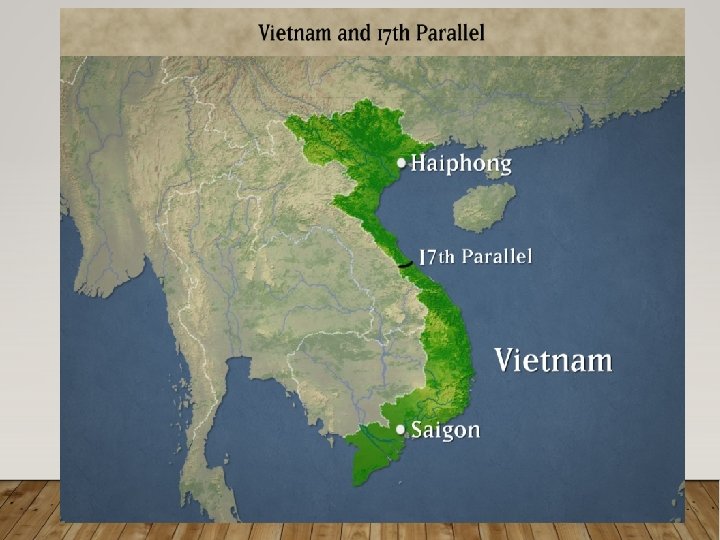
GENEVA ACCORDS • Vietnam was temporarily separated at the 17 th parallel, and under the terms of the Geneva Convention, civilians were to be given the opportunity to freely move between the two provisional states. • Elections throughout the country were to be held, according to the Geneva accords by June of 1958.
VIETNAM SPLIT • In the north, the Viet Minh established a communist state and engaged in a drastic land reform program in which an estimated 8, 000 perceived “government enemies” were executed. • In the south a non-communist state was established under Ngô Đình Diệm, the prime minister. • The last French soldiers left Vietnam in April 1956. The Chinese completed their withdrawal from North Vietnam at around the same time.
NO ELECTIONS IN VIETNAM • In June 1955, Prime Minister Ngo Dinh Diem of South Vietnam announced that elections would not be held. "How can we expect 'free elections' to be held in the Communist North? " Diem asked. President Dwight D. Eisenhower wrote that, in 1954, "80 per cent of the population would have voted for the Communist Ho Chi Minh" • The Domino Theory was in effect and John F. Kennedy, then a U. S. senator, said in a speech to the American Friends of Vietnam: "Burma, Thailand, India, Japan, the Philippines and obviously Laos and Cambodia are among those whose security would be threatened if the Red Tide of Communism overflowed
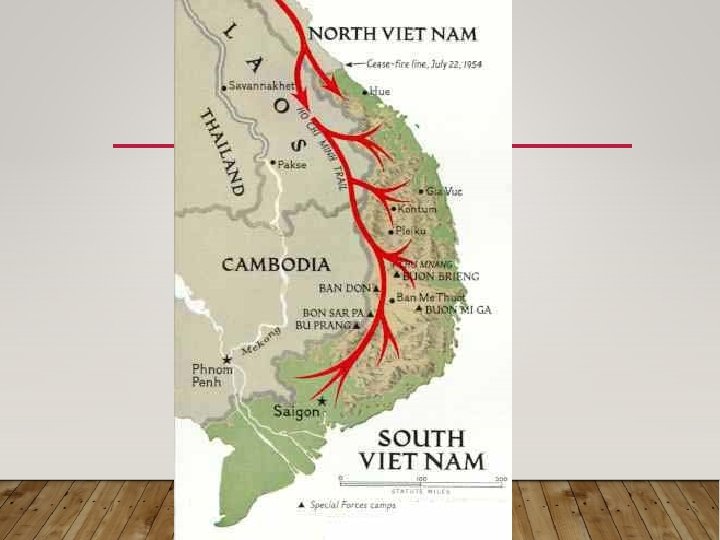
NORTH TRIES TO UNIFY VIETNAM • In January 1959, the North's government issued a secret resolution authorizing an "armed struggle". This authorized the southern communists to begin largescale operations against the South Vietnamese military. • North Vietnam supplied troops and supplies, and the infiltration of men and weapons from the north began along the Ho Chi Minh Trail • According to a November 1960 report, a "significant part" of the population in the south supported the communists. The communists thus had a degree of popular support for their campaign to bring down Diem and reunify the country.
• By 1963, there were 16, 000 American military personnel in South Vietnam, up from Eisenhower's 900 advisors.
KENNEDY’S REACTION • Kennedy's policy toward South Vietnam rested on the assumption that Diem and his forces must ultimately defeat the guerrillas on their own. • He was against the deployment of American troops and observed that "to introduce U. S. forces in large numbers there today, while it might have an initially favorable military impact, would almost certainly lead to adverse political and, in the long run, adverse military consequences. "
JOHNSON TAKES OVER • Lyndon B. Johnson (LBJ), took over the presidency after the death of Kennedy, On November 24, 1963. • Johnson said, "the battle against communism. . . must be joined. . . with strength and determination. ” • Johnson had reversed Kennedy's disengagement policy from Vietnam in withdrawing 1, 000 troops by the end of 1963
GULF OF TONKIN INCIDENT • On August 2 nd 1964, the USS Maddox, on an intelligence mission along North Vietnam's coast, was allegedly fired upon and in retaliation damaged several torpedo boats that had been stalking the Maddox in the Gulf of Tonkin. • A second attack was reported two days later on the USS Turner Joy and Maddox in the same area. • The circumstances of the attack were murky. The US ships possibly could have fired first provoking the North Vietnamese, or it could have all been staged just so
• While President Johnson’s final resolution was being drafted, Senator Wayne Morse attempted to lead a campaign to raise awareness about possible faulty records of the incident involving the USS Maddox. But he was unsuccessful. • Congress approved the Gulf of Tonkin Resolution, and gave the president power to conduct military operations in Southeast Asia without declaring war. • The Resolution gave President Johnson approval "to take all necessary steps, including the use of armed force, to assist any member…requesting assistance in defense of its freedom. " • Sometimes called a “Blank Check”
FIRST AMERICAN INVOLVEMENT • The National Security Council recommended a threestage escalation of the bombing of North Vietnam. On March 2 nd 1965, Operation Rolling Thunder commenced. • The bombing campaign, which ultimately lasted three years, was intended to force North Vietnam to cease its support for the South Vietnamese insurgents by threatening to destroy North Vietnam's air defenses and industrial infrastructure. • Between March 1965 and November 1968, "Rolling Thunder" flooded the north with a million tons of missiles, rockets and bombs.
THE GROUND WAR STARTS • Escalation of the war officially started on the morning of January 31 st 1965. • Orders were to mobilize the US Army and Marines from Okinawa to South Vietnam. • F-105 s, pilots, and support were also deployed from Okinawa and landed in Vietnam that afternoon to join up with other smaller units who had already arrived weeks earlier. • Preparations were under way for the first step of Operation Flaming Dart. The mission of Operation Flaming Dart was to cross the 17 th Parallel into North Vietnam and attack the North Vietnamese Army.
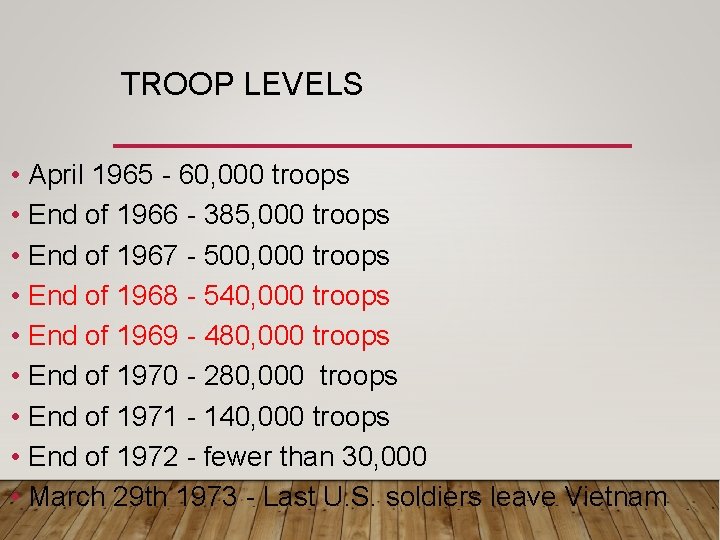
TROOP LEVELS • April 1965 - 60, 000 troops • End of 1966 - 385, 000 troops • End of 1967 - 500, 000 troops • End of 1968 - 540, 000 troops • End of 1969 - 480, 000 troops • End of 1970 - 280, 000 troops • End of 1971 - 140, 000 troops • End of 1972 - fewer than 30, 000 • March 29 th 1973 - Last U. S. soldiers leave Vietnam
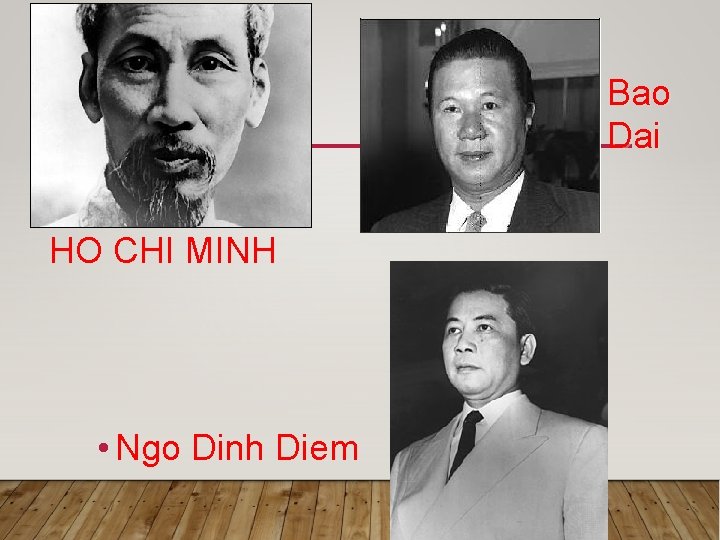
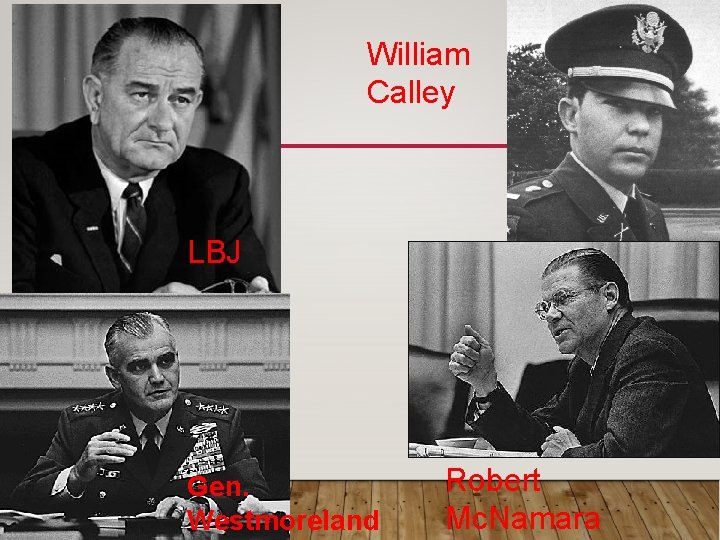
PEOPLE OF VIETNAM WAR • Ho Chi Minh - Leader of North Vietnam • Vietminh - North Vietnamese Army fighting the war • Viet Cong - The insurgents in South Vietnam that were aided by the Vietminh. US was fighting mostly against the Vietcong • Bao Dai - The Emperor of South Vietnam • Ngo Dinh Diem - The Prime Minister of South Vietnam • William Calley – Led the My Lai Massacre • LBJ – President of US responsible for the escalation of the Vietnam war. • Robert Mc. Namara – Secretary of Defense for Kennedy and Johnson • General Westmoreland – Supreme Commander of all US troops in Vietnam
Bao Dai HO CHI MINH • Ngo Dinh Diem
William Calley LBJ Gen. Westmoreland Robert Mc. Namara
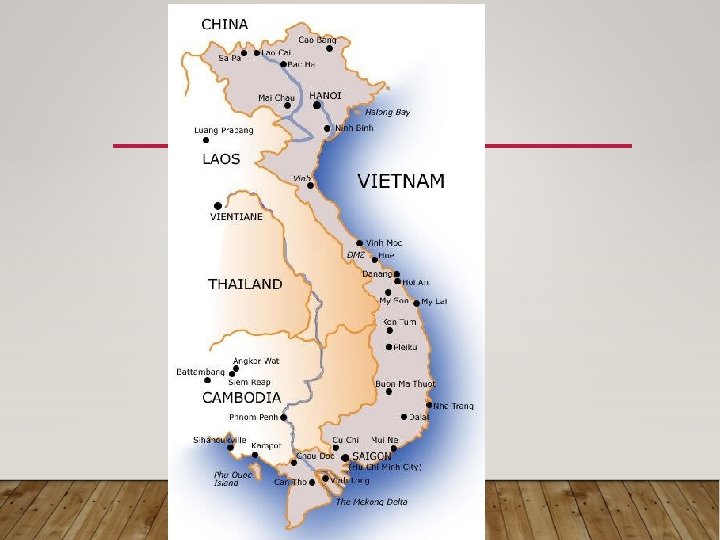
PLACES IN VIETNAM • Hanoi – Capital of North Vietnam • Saigon – Capital of South Vietnam
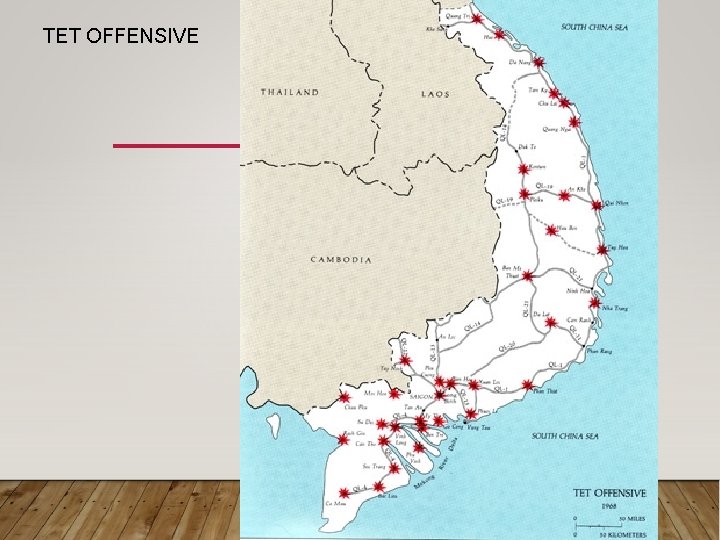
VIETNAM EVENTS • Tet Offensive - was a military campaign during the Vietnam War that began on January 31, 1968. Forces of the Viet Cong and the North Vietnamese army, fought against the forces of South Vietnam and the United States. Offensive was to strike military and civilian control centers throughout South Vietnam and to spark a general uprising among the population thus ending the war in a single blow. • My Lai - was the mass murder conducted by a unit of the U. S. Army on March 16, 1968 of 504 unarmed citizens in South Vietnam, all of whom were civilians and a majority of whom were women, children and elderly people.
TET OFFENSIVE
TERMS TO KNOW • Vietnamization - The plan was to encourage the South Vietnamese to take more responsibility for fighting the war. It was hoped that this policy would eventually enable the United States to withdraw gradually all their soldiers from Vietnam. • Re-education camps - the North Vietnamese government imprisoned several hundred thousand former military officers and government workers from the former regime of South Vietnam as revenge after the fall of Saigon • POW’s and MIA’s – Prisoners of War and Soldiers who went Missing in Action