
Origins of Intelligence Testing Who made the first
- Slides: 17
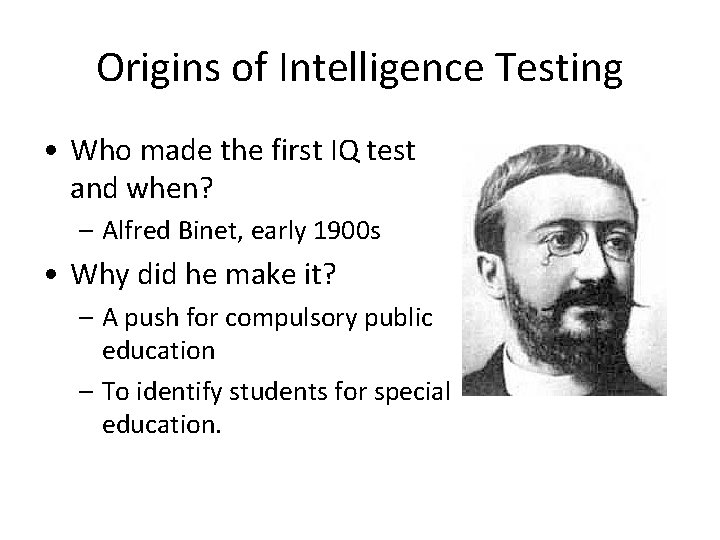
Origins of Intelligence Testing • Who made the first IQ test and when? – Alfred Binet, early 1900 s • Why did he make it? – A push for compulsory public education – To identify students for special education.
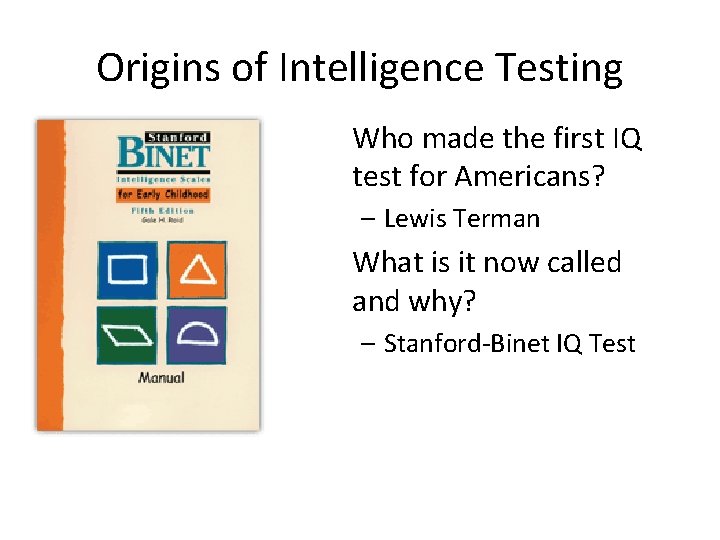
Origins of Intelligence Testing • Who made the first IQ test for Americans? – Lewis Terman • What is it now called and why? – Stanford-Binet IQ Test
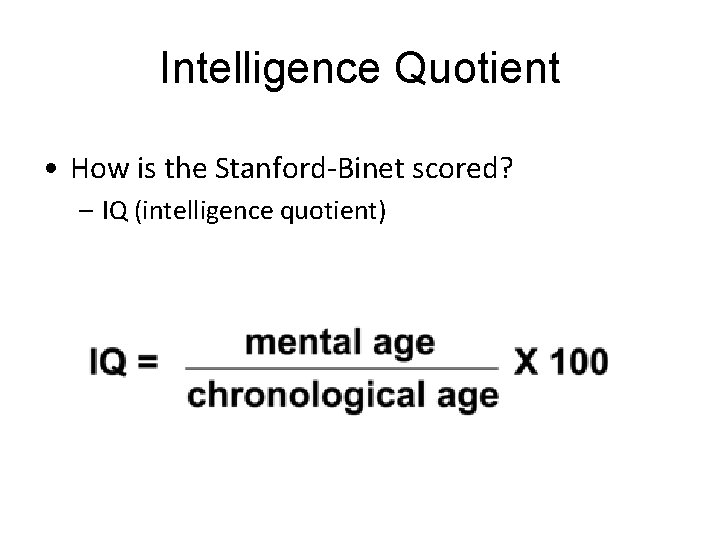
Intelligence Quotient • How is the Stanford-Binet scored? – IQ (intelligence quotient)
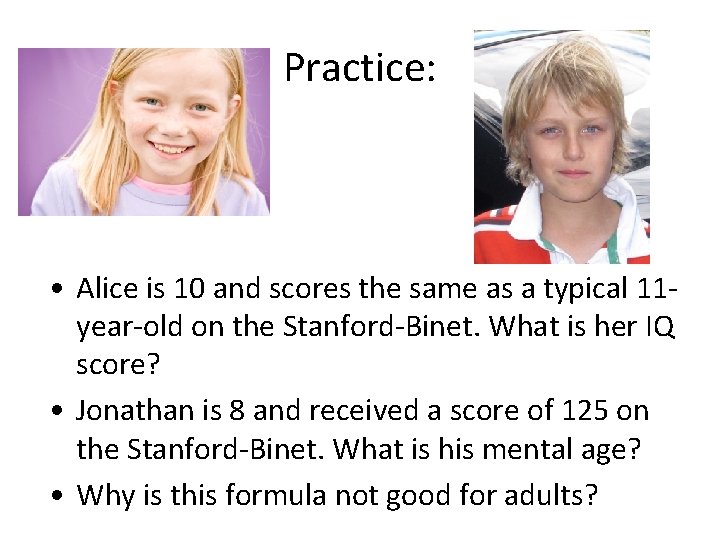
Practice: • Alice is 10 and scores the same as a typical 11 year-old on the Stanford-Binet. What is her IQ score? • Jonathan is 8 and received a score of 125 on the Stanford-Binet. What is his mental age? • Why is this formula not good for adults?
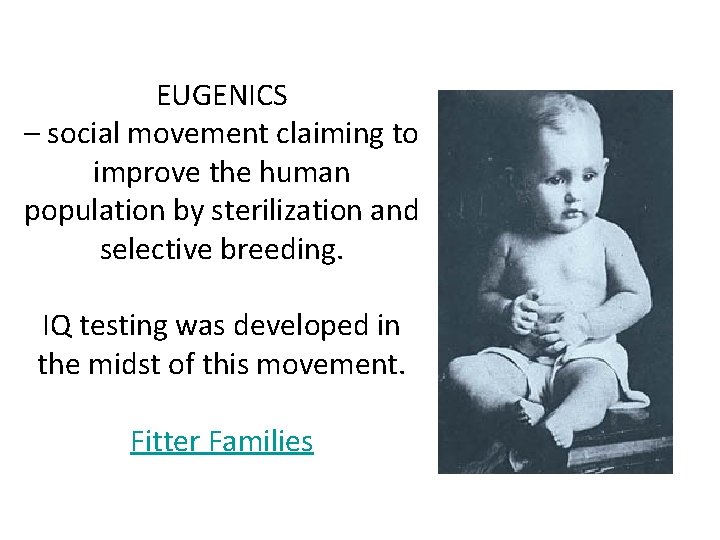
EUGENICS – social movement claiming to improve the human population by sterilization and selective breeding. IQ testing was developed in the midst of this movement. Fitter Families
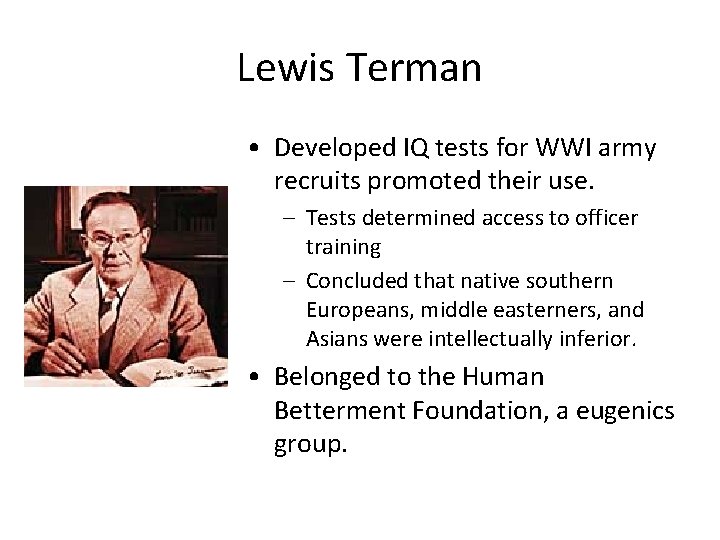
Lewis Terman • Developed IQ tests for WWI army recruits promoted their use. – Tests determined access to officer training – Concluded that native southern Europeans, middle easterners, and Asians were intellectually inferior. • Belonged to the Human Betterment Foundation, a eugenics group.
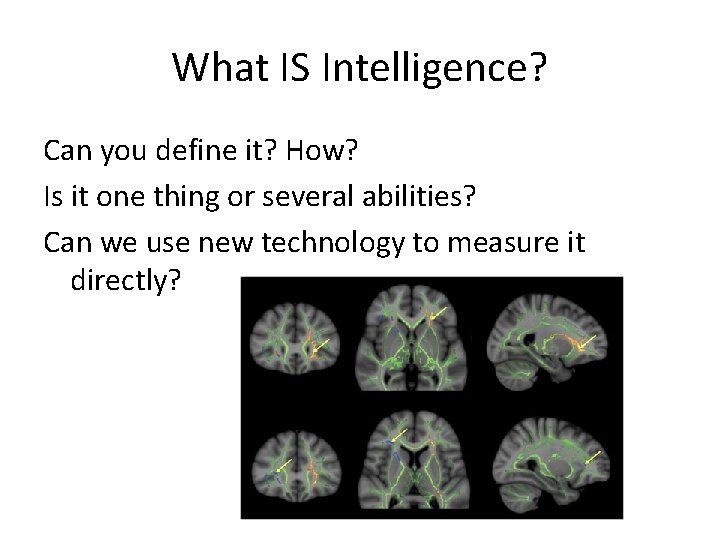
What IS Intelligence? Can you define it? How? Is it one thing or several abilities? Can we use new technology to measure it directly?
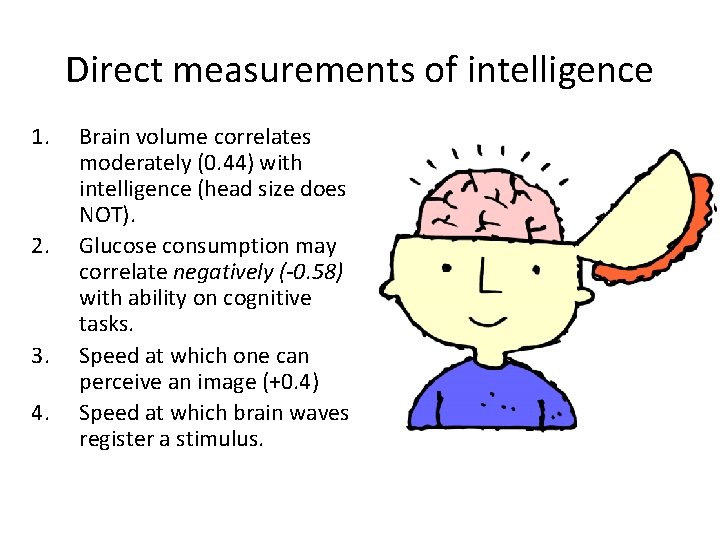
Direct measurements of intelligence 1. 2. 3. 4. Brain volume correlates moderately (0. 44) with intelligence (head size does NOT). Glucose consumption may correlate negatively (-0. 58) with ability on cognitive tasks. Speed at which one can perceive an image (+0. 4) Speed at which brain waves register a stimulus.
Personality Traits List some: friendly, funny, spiffylicious
Factor Analysis Using statistics to find clusters of related items. For intelligence, maybe…… Able to learn calculus, able to use big words, able to explain how to set a pick in BB, ability to memorize long strings of numbers, able to solve logic puzzles, good at scrabble, get good grades, get a high SAT score, able to learn to read music, able to come up with creative ideas, able to find patterns, able to read people’s body language, able to read a map.
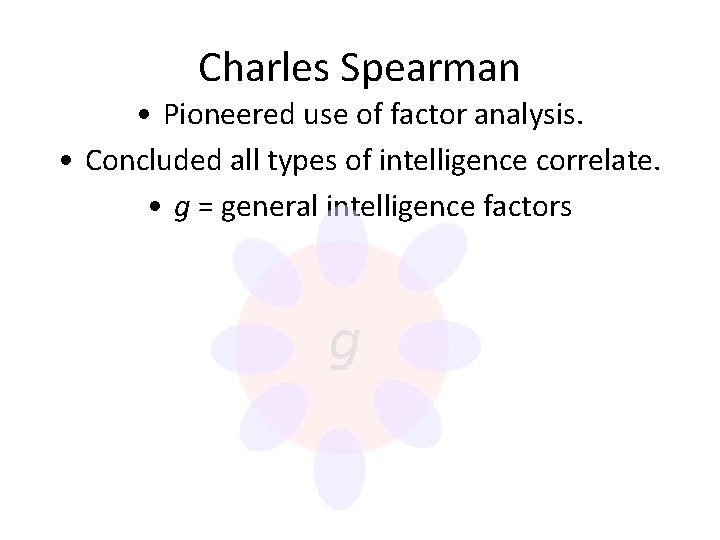
Charles Spearman • Pioneered use of factor analysis. • Concluded all types of intelligence correlate. • g = general intelligence factors
Savant Syndrome • More
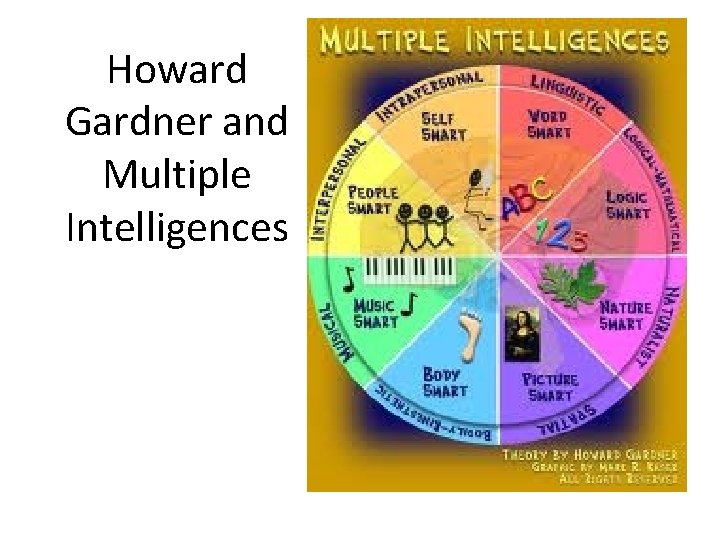
Howard Gardner and Multiple Intelligences
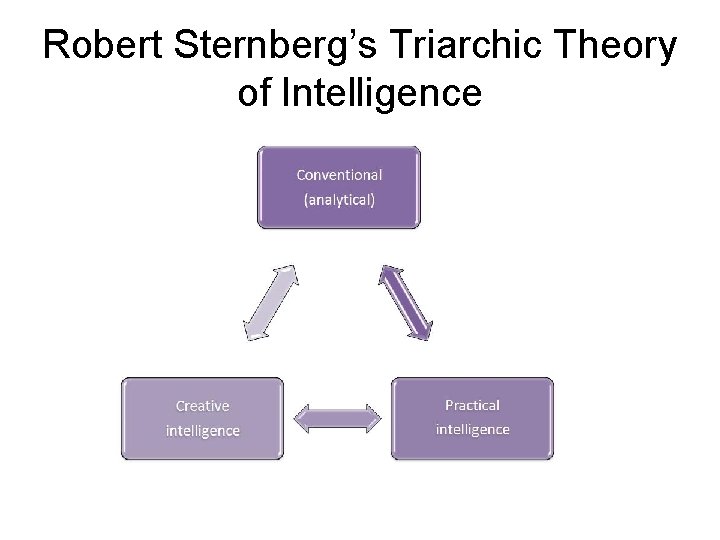
Robert Sternberg’s Triarchic Theory of Intelligence
Emotional Intelligence • Daniel Goleman • competencies and skills that drive leadership performance, such as: – Self-awareness – Self-management – Social awareness – Relationship management • Walter Mischel’s marshmallow test
Mnemonic Haiku A spear-man has one point but a young Gardner has many sharp tools.
Factor Analysis loyal, devoted, rebellious, affectionate, distant, cold, aloof, aspiring, ambitious, motivated, unmotivated, candid, guarded, secretive, caring, callous, cheerful, gloomy, grumpy, considerate, thoughtful, inconsiderate, helpful, combative, courageous, fearful, courteous, rude, impolite, decisive, uncommitted, uncaring, hostile, determined, indecisive, unsure, perseveres, endures, relents, enthusiastic, apathetic, indifferent, expansive, constricting, flexible, inflexible, rigid, unbending, stubborn, forgiving, unforgiving, resentful, spiteful, focused, unfocused, scattered, authoritarian, controlling, friendly, unfriendly, distant, aloof, hostile, frugal, thrifty, wasteful, generous, stingy, miserly, selfish, malicious, hateful, grateful, unappreciative, hard-working, lazy, honest, dishonest, deceiving, humble, arrogant, conceited, interested, indifferent, complacent, jealous, envious, covetous, cruel, mean, mature, immature, modest, vain, open-minded, tolerant, small-minded, intolerant, optimistic, persistent, practical, impractical, punctual, realistic, naïve, ¯